Showing posts with label Desmond Tutu. Show all posts

Sunday, December 26, 2021

Requiescat in pace Archbishop Desmond Tutu. Thank you for your solidarity and example of nonviolent resistance

"If you are neutral in situations of injustice, you have chosen the side of the oppressor. If an elephant has its foot on the tail of a mouse and you say that you are neutral, the mouse will not appreciate your neutrality." -  Archbishop Desmond Tutu

 Desmond Tutu backed inquiry into Oswaldo Payá and Harold Cepero deaths 
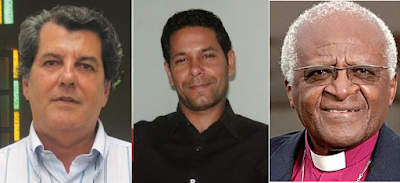
Mourning the death of Archbishop Desmond Tutu at age 90. Remembering with gratitude his solidarity with the Cuban people in 2013, when he joined with others in demanding an inquiry into the July 22, 2012, deaths of Oswaldo Payá Sardiñas and Harold Cepero.

But there is much more to be thankful for.

During the struggle against Apartheid people power had a huge impact, greater than the violence of the African National Congress, in effecting regime change. Archbishop Desmond Tutu played an important role in this nonviolent struggle to end an unjust regime.

"Among the most sustained campaigns, involving national organizations as well as providing a target for local demonstrators, was the campaign to boycott Shell that paralleled campaigns in Europe directed at the same multinational company. Beginning with a sit-in by the Free South Africa Movement at the Shell offices in Washington, DC,159 the campaign gained support not only from the United Mine Workers, but also other unions, including the AFL-CIO trade union federation. And it tied the action to support of the National Union of Mineworkers in South Africa. Desmond Tutu joined the press conference launching the boycott, and churches joined actively in the coalition. The Interfaith Centre for Corporate Responsibility (ICCR) added Shell to its list of 12 key corporate ‘partners in apartheid’ targeted for divestment actions."

The Christian Liberation Movement has drawn from this history and is calling for a clear, coordinated, multilateral targeting of companies doing business with the Castro regime, targeting them with boycotts, protests, sit-ins, and peaceful invasions of said companies until they divest from the dictatorship in Havana. The effort Archbishop Desmond Tutu joined demonstrated that it worked in South Africa and it can work again today in Cuba. 

Nontombi "Naomi" Tutu
 

He is survived by four children who have continued their father's nonviolent legacy. At the University of Rochester Nontombi "Naomi" Tutu, the third child of Desmond Tutu, who grew up in the midst of the racist apartheid regime in South Africa, in 2011 she gave the lecture “Our Shared Humanity: Creating Understanding Through the Principles of Martin Luther King Jr.,” and offered some insights on nonviolence:

  • "The lessons of Gandhi and King are that for true liberty and liberation, we have to be those who hold up the humanity of all.”
  • “We can’t dehumanize others without dehumanizing ourselves."
  • “We were going to be a family who did pray for those who oppressed us.”
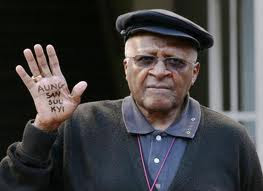
 

Archbishop Desmond Tutu demonstrates his solidarity with Aung San Suu Kyi

Tuesday, July 26, 2016

Candidate Clinton's silence on Castro regime's beating of Cuban women answered with more violence a day later

"In keeping silent about evil, in burying it so deep within us that no sign of it appears on the surface, we are implanting it, and it will rise up a thousand fold in the future." -  Aleksandr Solzhenitsyn, The Gulag Archipelago 1918-1956  

Cuban women targeted by the Castro regime's repressive forces this past Sunday
On July 23, 2016 a plane flew over the Florida International University Arena asking Hillary Clinton to help stop the beatings of Cuban women by the Castro regime and its agents. Over two thousand fliers were distributed on that day that called on Hillary Clinton to help put an end to the physical assaults on the wives, mothers, sisters, and daughters of Cuban political prisoners by calling on General Raul Castro to stop the systematic beatings against these women.

Unfortunately one day later, with the non-response of Secretary Clinton to this request, in Cuba once again the wives, mothers, sisters, and daughters of Cuban political prisoners were beaten, kicked and had stones thrown at them when they tried to peacefully assemble in Havana, Cuba on July 24, 2016.

Candidate Clinton's silence on the Castro regime's continued systematic beating of Cuban women was answered loudly with more violence. This silence brings to mind the words of Archbishop Desmond Tutu,  "If you are neutral in situations of injustice, you have chosen the side of the oppressor." Hopefully Hillary Clinton will speak out on behalf of Cuban women before the next attack.

The video below was from July 18th and reflects what happened yesterday.


Friday, December 23, 2011

Vaclav Havel's constant solidarity on behalf of China's Liu Xiaobo

"It's up to all of us to try, and those that say that individuals are not capable of changing anything are only looking for excuses." - Vaclav Havel, Interview with Amnesty International in 2011
2 years ago today the trial against Liu Xiaobo began

On the day that the world bid farewell to Vaclav Havel an e-mail arrived from the Human Rights Foundation that said: "Nobel Laureate Liu Xiaobo: In a Chinese Prison but Not Forgotten." It was two years ago today, December 23, 2009 that the trial against the human rights defender on charges of "inciting subversion of state power" began and ended on Christmas day when the Beijing Municipal No. 1 Intermediate People’s Court issued a guilty verdict and 11-year prison sentence. There was widespread international condemnation of the trial and verdict. The UN High Commissioner for Human Rights Navi Pillay issued a statement of concern that the decision "represents a serious setback for the protection and promotion of human rights in China," and described the sentence as "extremely harsh."

Liu Xiaobo was convicted of "inciting subversion of state power" but it is important to highlight what this Orwellian phrase seeks to obfuscate that the Chinese dissident was imprisoned for his role in drafting and circulating an open letter requesting reforms. A group of 303 Chinese writers, intellectuals, lawyers, journalists, retired Party officials, workers, peasants, and businessmen issued this open letter - "Charter 08" - on December 9, 2008 calling for legal reforms, democracy and protection of human rights in China. This is the reason Liu Xiaobo was placed on trial and condemned to 11 years in prison.


Czech Expresident Havel Delivers Protest Regarding Liu Xiaobo Imprisonment to Chinese Embassy

Many remain silent about the human rights situation in China because of its economic might and claim that nothing can be done, but Vaclav Havel never held that view. In fact, he protested Western silence. Just days following the trial verdict on January 7, 2010, Vaclav Havel walked over to the Chinese Embassy in Prague and rang the doorbell on three occasions before posting his protest letter through the outdoor embassy mail slot. The former Czech president turned to reporters present and explained what he was doing:
“We are here now because we are asking the Chinese president and Chinese government not to repeat what happened to us 33 years ago ,where fighters for freedom were pursued and persecuted.”
On January 19, 2010 Havel met with the Executive Director of Human Rights in China, Sharon Hom, and engaged her in a dialogue/interview about Liu Xiaobo, Charter 08 and the struggle for democratic reform in China. When asked about the similarities between China today and Czechloslovakia in 1977 explained that:
The similarities, I would say, are in the basic structure of human rights reflected in a democratic system, which of course the regime doesn’t want. The regime wishes for the dictatorship of one party. I think this is where Charter 08 and Charter 77 are similar: they have similar targets and similar messages to deliver to the [respective] regimes.

On February 3, 2010 both Czech and Slovak members of parliament nominated Liu Xiaobo for the Nobel Peace Prize. The nomination was also endorsed by Vaclav Havel and many of the former spokespersons of Charter 77. The 2009 Nobel Prize in Literature laureate, Herta Müller, in a letter to the Nobel Foundation on behalf of Liu Xiaobo wrote:

I have urgent request to make to you today. As you know, Vaclav Havel nominated the Chinese writer Liu Xiaobo for the Nobel Peace Prize 2010.[...]I, too, believe that Liu Xiaobo deserves the Nobel Peace Prize because in the face of countless threats from the Chinese regime and great risk to his life, he has fought unerringly for the freedom of the individual.
Despite warnings and threats against Norway and the Nobel Committee by the Chinese government Liu Xiaobo was awarded the Nobel Peace Prize in 2010. Desmond Tutu and Vaclav Havel on December 5, 2010 called on the Chinese government to release Liu Xiaobo in order that he be able to accept the Nobel Peace Prize or risk losing its international credibility. The Chinese regime not only refused to release Liu Xiaobo but his wife, Liu Xia, was held under house arrest and was unable to represent her husband in Oslo to receive the award. Instead Liv Ullman read the statement Liu Xiaobo gave at his trial on December 23, 2009 titled I Have No Enemies: My Final Statement. Before being sentenced to 11 years in prison on December 25, 2009 addressing the court in the previous mentioned statement he concluded:

I hope that I will be the last victim of China's endless literary inquisitions and that from now on no one will be incriminated because of speech.

Freedom of expression is the foundation of human rights, the source of humanity, and the mother of truth. To strangle freedom of speech is to trample on human rights, stifle humanity, and suppress truth.

In order to exercise the right to freedom of speech conferred by the Constitution, one should fulfill the social responsibility of a Chinese citizen. There is nothing criminal in anything I have done. [But] if charges are brought against me because of this, I have no complaints.

On December 8, 2011 Vaclav Havel signed on as one of the members of a new International Committee to Support Liu Xiaobo. Liu Xiaobo's Nobel Peace Prize placed a spotlight on China's human rights violations. Hopefully his courageous example and Vaclav Havel's solidarity will shame those who remain silent before this ongoing injustice.

Sunday, November 14, 2010

Prisoners of conscience in Burma and Cuba freed just hours apart

But many still remain unjustly imprisoned and need solidarity


Aung San Suu Kyi & Arnaldo Ramos Lauzurique both freed on Saturday

Saturday was a good day for freedom. Two prisoners of conscience on opposite sides of the world but facing similar regimes obtained there freedom. In Burma, Aung San Suu Kyi, age 65, and in Cuba, Arnaldo Ramos Lauzurique, age 68, both prisoners of conscience saw freedom after too many years in unjust captivity.


Arnaldo Ramos Lauzurique speaks out following his release (Spanish)

Both emerged from their imprisonment declaring their commitment to work for a democratic transition and a society where human rights are respected. While at the same time addressing their respective regime's with the necessity to open up and respect human rights to avoid chaos in Cuba and end the ongoing chaos in Burma. Both had refused accepting any conditions that would restrict their ability to act in defense of human rights and liberty and remain committed to the cause despite their age:

“I’m still youthful because of the demands of the cause. After we gain democracy, I will stay as an old lady.”Aung San Suu Kyi, November 14, 2010

"I'll be involved in the same activities I did before they sent me to prison, which were not criminal but opposition" Arnaldo Ramos Lauzurique,
November 14, 2010

Arnaldo Ramos Lauzurique with wife & Lady in White Lidia Lima

Arnaldo was reunited with his wife Lidia Lima who is also a Lady in White, but Aung San Suu Kyi was unable to be reunited with her husband. When her spouse, Michael Aris, was diagnosed with terminal cancer the military junta refused to allow him to enter Burma and would not guarantee Aung San Suu Kyi the right to return to her homeland.

Aung San Suu Kyi greets supporters and press on Saturday

At the time of his death in 1999 Suu Kyi had not been able to see her husband in over three years. She is able to maintain her commitment to nonviolence and the need for national reconciliation, in part, because of her understanding of courage: “Courage means to work for what you believe with perseverance and to be strong and to have good will. It's not courageous to use one's physical strength and to shout loudly.”


Aung San Suu Kyi speaks out on political freedom, democracy and political prisoners

Both the Burmese and Cuban democratic oppositions understand that the freedom of all political prisoners is an important first step on the path to the restoration of fundamental human rights. The bottom line is that without political freedom there is no democracy. No matter how many votes the regime's in Burma or Cuba hold as long as political freedoms are not respected and dissent is outlawed then the entire "electoral" process amounts to a sham.


Laura Pollan speaks on reforming Cuban legal code and freeing political prisoners

Hundreds upon hundreds of political prisoners remain imprisoned not only the over 2,200 in Burma and hundreds in Cuba but in other repressive regimes such as China, Vietnam, Zimbabwe all around the world. Its up to you to take action and do something. Write a letter demanding a political prisoner be freed, call your representative, make a video, sign a petition and help get the word out.
South African Archbishop Desmond Tutu demonstrates his solidarity with Aung San Suu Kyi

Tuesday, September 28, 2010

Shared Concern Initiative’s appeal on the forthcoming election in Burma

Burma's Democratic Charade

by Shared Concern Initiative

PRAGUE – On November 7, when Burma’s first general election for almost two decades is to be held, a well-rehearsed script will play out. The country’s ruling generals will twist what is meant to be a democratic process, whereby the people get to express their will, into a mockery of free expression in which people vote in fear and without hope.

The international community must judge Burma’s generals by their actions, not their words and promises. The facts on the ground in Burma speak the truth more loudly than all the proclamations from the generals about a free ballot and a democratic transition.

More than 2,100 political prisoners remain in jail in Burma. Many have been tortured, kept in horrific conditions, and denied medical care. Attacks against the country’s ethnic minorities continue, with the deliberate targeting of civilians, including children, by the Burmese military and police. The country’s media remains censored, freedom of expression denied, and the most popular political party in the country, the National League for Democracy, which won elections in 1990, has been forced to disband because it decided not to register for the November elections.

In such conditions, free and fair elections will be impossible. This so-called democratic transition, a process designed solely by dictators and with input only from the regime’s loyalists, will result in continued dictatorship.

Before Burma’s fate is sealed in a new-model dictatorship, the United Nations must immediately and vigorously embark on a fresh process designed to deliver national reconciliation and democracy to that troubled country. The international community, East and West, must unite behind a UN-led initiative to start genuine dialogue.

But, for this dialogue to have any real legitimacy, it must include the Nobel Peace Prize laureate Daw Aung San Suu Kyi, who has endured decades of house arrest, and her party, the NLD. Other democratic opposition groups, and genuine ethnic-minority representatives, also need to be given a voice in the process.

Pressure must be brought to bear to bring Burma’s generals to a negotiating table where real negotiations take place. All the tools at the disposal of the international community should be used to bring this about.

But responsibility for assisting Burma does not lie solely at the door of the UN. The pressure on Burma’s generals must also be bilateral and multilateral – and should be reinforced by carefully calibrated economic measures, including targeted financial and banking sanctions.

Action must also be taken to end the impunity with which the Burmese generals have ruled. The dictatorship stands accused of committing war crimes and crimes against humanity, mostly against the country’s minorities, who chafe at decades of oppression, ostracism, and military misrule. The UN General Assembly should follow the UN Special Rapporteur‘s recommendation to establish a Commission of Inquiry into war crimes and crimes against humanity in Burma.

Moreover, the UN Security Council should impose an arms embargo against Burma, as it has in other countries similarly afflicted by conflict and serious human rights abuses. Those countries supplying arms to Burma expose themselves to charges of complicity in the war crimes and crimes against humanity committed by the dictatorship.

Dictatorship and human rights abuses will continue in Burma after November 7. We do not need to wait until after the election to know this. So there is no excuse for continued inaction. Now is the time for the world to unite behind the people of Burma, and to help bring them peace and dignity at last.

Václav Havel is a former President of the Czech Republic,

His Holiness the Dalai Lama is the spiritual leader of Tibetan Buddhism,

HRH El Hassan Bin Talal is Chairman of the Arab Thought Forum,

André Glucksmann is a French philosopher and essayist,

Vartan Gregorian is President of the Carnegie Corporation,

Michael Novak is a Roman Catholic philosopher and diplomat,

Karel Schwarzenberg is Foreign Minister of the Czech Republic,

Desmond Tutu is a Nobel Peace Prize laureate,

Grigory Yavlinsky is Chairman of the Russian United Democratic Party, Yabloko.

Sunday, August 23, 2009

Che Guevara's Lamentable Legacy


Che Guevara's Lamentable Legacy


By John Suarez

“We must say here what is a known truth, which we have always expressed before the world: firing squad executions, yes, we have executed; we are executing and we will continue to execute as long as is necessary. Our struggle is a struggle to the death."
Ernesto "Che" Guevara
UN General Assembly, 1964


"Hatred as an element of the struggle; a relentless hatred of the enemy, impelling us over and beyond the natural limitations that man is heir to and transforming him into an effective, violent, selective and cold killing machine. Our soldiers must be thus; a people without hatred cannot vanquish a brutal enemy."
Ernesto "Che" GuevaraHavana, April 16, 1967.

Film makers have been erecting a romantic image of Che Guevara from the days of his youth, as in Walter Salles's film ''The Motorcycle Diaries,"or his final days in Bolivia in Steven Soderbergh's " Che Guevara." It is important to highlight Guevara's actual message, actions, and legacy. Both films are a revisionist white wash that ignore both the atrocities committed, his hate filled writings, and their aftermath not only in Cuba but in the Americas.

The image of Che Guevara hanging in the College dorms of student radicals in 2009 may be cliché, but his message is not. In his Message to the Tricontinental Guevara argued that hatred was something to be harnessed and used: "Not only as an element to struggle against injustice,” but to be used to perpetrate new injustices. Guevara describes the utilization of hatred or as he put it “relentless hatred” to “impel us over and beyond the natural limitations of man.” This use of hatred to encourage the dehumanization of an adversary is but another manifestation of the doctrine found throughout the centuries to justify mass murder and torture.

If hate was the solution to all problems then the heroes of the 20th century would have been: Lenin, Hitler, Mussolini, Stalin, Pol Pot, and Guevara. Instead they are viewed in most quarters as mass murderers and criminals except for those who are blinded by their "relentless hatred" of their fellow human and/or their political ideology. History has demonstrated two fundamental approaches to change the face of the world. One way views hatred of the other as an element of the struggle in which the ends justify whatever means and has been the way for the individuals listed above.

Che Guevara was an admirer of Mao Zedong and his formulation of guerilla warfare is adapted from the Chinese leader. Che published influential manuals Guerrilla Warfare (1961) and Guerrilla Warfare: A Method (1963), which were based on his own experiences and partly chairman Mao Zedong's writings. Guevara stated that revolution in Latin America must come through insurgent forces developed in rural areas with peasant support. His international legacy of glorifying violence through an erroneous analysis of guerilla warfare, based on his experiences with the Batista army, which was too incompetent and corrupt to fight, and applying Zedong’s writings on the subject led to bloodbaths in Argentina, Chile, El Salvador, Nicaragua, Chiapas, Congo, Angola and decades of military dictatorship and political violence. Nevertheless it could have been worse. Che was killed in 1967 in the jungles of Bolivia. Another disciple of Mao Zedong who adapted his theories was Pol Pot, who unlike Che achieved power in 1975 after a guerilla struggle in Cambodia. He carried out a radical revolution modeled after Mao and ended by killing 25% of the entire population of his country: Cambodia.

Children in Cuba beginning at age 5 are taught to chant " We will be like Che!" every Friday at school. They are taught to be like the man who saw people as material to be molded and shaped in his Guevara’s own words: " To build communism, you must build new men as well as the new economic base. Hence it is very important to choose correctly the instrument for mobilizing the masses. Basically, this instrument must be moral in character, without neglecting, however, a correct utilization of the material stimulus-especially of a social character." One method of material stimulus was the firing squad. Che Guevara personally carried out hundreds of executions and issued even more death warrants. According to journalist Luis Ortega, who knew him, Che sent 1,897 men to the firing squad.

The consequences of building violent, selective, and cold killing machines is that these means lead to tragic ends that continue the cycle of violence and bloodshed. One example took place in the early morning hours of July 13, 1994 just six miles from Havana’s sea wall, the Malecón, out in the ocean a tug-boat with more than 71 Cubans trying to head for sanctuary were attacked. These victims were met by other tugboats captained by Che's "new men" who used high pressure hoses to knock these refugees overboard into the sea, and later rammed and sank the boat drowning 41 passengers. 21 of the dead were women and children. Ten years after the massacre acts of remembrance were carried out around the world. Jorge García, who lost 14 family members on the tugboat, poke out rejecting Che Guevara’s approach while embracing another: "There are those who think that we should be full of rancor and a thirst for vengeance, but I don't want revenge. I feel sorry for the people who assassinated my family but I do want a trial so that this situation can serve as a lesson and that these people or others like them in other parts of the world, don't do this kind of thing again. Not in Cuba. Not anywhere.” Seek justice but not revenge. Address an injustice with justice not new injustices.

This is a radical alternative to Che Guevara and Mao Ze Dong, tragically an alternative that would have saved tens of millions of more lives in the past century. Its philosophical underpinning is found in the statement: " Love your enemies, do good to those who hate you, bless those who curse you, pray for those who mistreat you.” This path has and continues to be followed by persons of such diverse backgrounds as Mahatma Gandhi, Martin Luther King Jr., Lech Walesa, Vaclav Havel, Corazon Aquino, Desmond Tutu, Aung San Suu Kyi, and Dr. Oscar Elias Biscet. These men and women have demonstrated that hatred is something to be overcome, not an "element of struggle," but rather a stumbling block to freedom. Martin Luther King Jr. spoke of the challenge in November of 1960 in reference to sit-ins organized to protest segregation:

The sit-in demonstrations seek to secure moral ends through moral means. And ever so often in history when men seek to achieve the splendid goals of freedom, human dignity, and justice they resort to methods of violence, such as guerrilla warfare, such as assassination, and other methods of bloody revolution. […] We see here a crusade without violence, and there is no attempt on the part of those who engaged in sit-ins to annihilate the opponent but to convert him. […] I submit that this method […] is justifiable because it uses moral, humanitarian, and constructive means in order to achieve the constructive end.

Guevara had been executed on October 9, 1967 and just months before his own assassination Martin Luther King Jr. called on his staff to combat the “romantic illusion” of guerilla warfare in the style of Che Guevara among young radicals concluding: “We must not be intimidated by those who are laughing at nonviolence now.

Che Guevara argued in his writings and speeches that hatred is good because it, "transforms us into effective, violent, selective, and cold killing machines" Yet Mahatma Gandhi directly challenged this kind of thinking when decades before Che arrived on the political scene others advocated the same methods as Guevara in India arguing with great prescience: It is a cowardly thought, that of killing others. Whom do you suppose to free by assassination? The millions of India do not desire it. Those who are intoxicated by the wretched modern civilization think these things. Those who will rise to power by murder will certainly not make the nation happy.

Forty years after the assassination of Martin Luther King Jr. an African American took the oath of office and became President of the United States in a country that has profoundly changed. What of the rest of Latin America? Guevara’s call to action in a hemisphere with too many military juntas led to new military juntas in countries that had not known them before in their history: Brazil, Ecuador, Panama, and Uruguay all had their longest military juntas following the Castro regime exporting guerillas to violently overthrow governments in 1959 along with promoting Guevarist ideology. On January 3-15, 1966 the Tricontinental Conference hosted by the Cuban government and the explicit announcement of their goals in Guevara’s Message to the Tricontinental. Other countries such as Chile, who had last known a military junta between 1924 and 1931, in reaction to communist threats in 1973 embraced Augusto Pinochet who remained in power for seventeen years.

With the exception of Nicaragua Che Guevara’s prescription for revolution in Latin America led to a generation of right wing military dictatorships and harsh repression. In Nicaragua it led to a Marxist left wing military dictatorship and civil war. Ironically, Pinochet was brought down by followers of Gandhi and King who through non-violent action pressured Pinochet into a plebiscite which he lost and through persistence and patience sought and continue to seek justice for his victims. If Fidel Castro and Che Guevara had not created the Tricontinental in 1966 and explicitly called for the use of terrorism and armed guerrillas then there might not have been an Operation Condor, in which the military establishments responded to Che Guevara's call to create "cold killing machines" by creating their own and setting them loose on left wing partisans. A month before Pinochet's September 11, 1973 coup against the democratically elected Salvador Allende four radical left wing organizations from Argentina, Bolivia, Chile, and Uruguay met and established the Revolutionary Coordinating Junta.

This struggle for real freedom is both spiritual and material. The spiritual enemies are hatred, distrust, fear and despair. For example in the case of Cuba there are abundant reasons to hate the evils and injustices committed by Guevara and his co-conspirators. They have imprisoned tens of thousands of prisoners of conscience, attempted to indoctrinate an entire generation, made Cubans second class citizens in their own country, they have divided families, made political ideology a litmus test for patriotism, and executed thousands. Cuban dissident leaders inspired by Gandhi and King have rejected this culture of violence and hatred despite great suffering on their own part. Dr. Oscar Elias Biscet, an opposition leader currently serving a 25-year prison sentence for his human rights activism believes that: "To love one's neighbor is also to love one's enemy. Although in reality that qualifier-'enemy' does not exist in my vocabulary. I recognize that I only have adversaries and I have acquired the capacity to love them because in this way we do away with violence, wrath, vengeance, hatred and substitute them with justice and forgiveness."

Oswaldo Paya Sardiñas addressing the European Parliament upon being awarded the Sakharov Prize for Freedom of Thought in Strasbourg, France on the 17 of December 2002 declared: “ The first victory we can claim is that our hearts are free of hatred. Hence we say to those who persecute us and who try to dominate us: ‘You are my brother. I do not hate you, but you are not going to dominate me by fear. I do not wish to impose my truth, nor do I wish you to impose yours on me. We are going to seek the truth together’.” With this victory courageous Cuban democrats are in the process of bringing this lamentable legacy to an end with a rebirth of freedom and national reconciliation.
