Showing posts with label prisoners of conscience. Show all posts

Saturday, June 24, 2023

#FreeLuisManuelandMakyel: Amnesty International calls for release of Cuban prisoners of conscience unjustly sentenced to five and nine years in prison one year ago today

#FreeLuisManuel #FreeMaykel  

From L to R: Anamely Ramos, Luis Manuel Otero Alcántara & Maykel Castillo Pérez

Luis Manuel Otero Alcántara and Maykel “Osorbo” Castillo Pérez were unjustly sentenced to five and nine years in prison, respectively following a political show trial on June 24, 2022 in Cuba. Last year before their prison sentences were announced, the human rights organization, Freedom House, produced a video about these two prisoners of conscience and artists. There are over one thousand other prisoners of conscience today in Cuba's prisons.


Below is the statement released yesterday by Amnesty International:


Cuba: Authorities must release prisoners of conscience wrongly convicted a year ago

Photo: Anamely Ramos

June 23, 2023
 

The Cuban authorities must release artists Luis Manuel Otero Alcántara and Maykel “Osorbo” Castillo Pérez immediately and unconditionally, Amnesty International said today, one year since they were unjustly sentenced to five and nine years in prison, respectively, in a legal process that did not respect the guarantees of fair trial.

“The continued arbitrary detention of Luis Manuel and Maykel is part of a pattern of repression based on imprisoning at all cost those who disagree with the authorities. These detentions are intended to have a chilling effect on activism and to silence freedom of expression in Cuba,” said Erika Guevara-Rosas, Americas director at Amnesty International.

“These convictions are a sign of the cruelty that President Díaz-Canel’s government is willing to inflict on anyone who criticizes the Cuban authorities. The authorities must stop using the criminal justice system to repress the population and take the necessary measures to guarantee the independence of the judiciary and the Attorney General’s Office.”

Maykel Castillo Pérez, known as “Osorbo”, is a musician and human rights activist. He is co-writer of the song “Patria y vida”, which criticizes the Cuban government and has been adopted as a protest anthem. He was detained at his home on 18 May 2021 by security officials and has been in prison ever since.

Luis Manuel Otero Alcántara is a member of the artistic collective Movimiento San Isidro, which has opposed a law that censors artists. He was arrested on 11 July 2021 in Havana after announcing in a video that he would join the protests that same day, along with thousands of others who demonstrated peacefully and spontaneously in dozens of cities to demand a change in living conditions in Cuba.

During the protests, thousands of people criticized the shortage of food and medicine, the inadequate electricity system and the restrictive measures taken in response to the Covid-19 pandemic. Authorities responded with a wave of widespread repression across the country. During the protests and in the following weeks, hundreds of people were arbitrarily and violently detained; many of them were charged and prosecuted for various crimes. According to the organization Justice 11J, as of 7 June 2023, 773 people detained during the 2021 protests were still deprived of their liberty.

In 2021, Amnesty International documented the details and context of the detention of Luis Manuel Otero Alcántara and Maykel “Osorbo” Castillo Pérez and named both artists prisoners of conscience, as they have been deprived of their liberty solely for peacefully exercising their human rights.

Both artists were charged with the crimes of “contempt” and “public disorder”, crimes that the Cuban government commonly uses to criminalize activists and political opponents. The definitions of these crimes in the Criminal Code are ambiguous and they are used arbitrarily to justify imprisoning people for acts that should not be considered crimes, such as criticizing or insulting an authority. The new Cuban Penal Code, which came into force in December 2022, not only kept these provisions in force, but increased the minimum penalties applicable for these crimes. 

In addition, Luis Manuel was accused of “insulting national symbols” and Maykel of “defaming institutions, organizations, heroes and martyrs”. Both are crimes that unduly restrict the right to freedom of expression guaranteed in international human rights law.

Amnesty International has also criticized the Cuban courts’ lack of genuine independence, particularly in politically motivated cases where they display undeniable deference to the Attorney General’s Office and where convictions of political dissidents are virtually guaranteed.

Judicial authorities systematically conduct these trials in closed sessions, without public access. A family member of the accused may attend, but no human rights defenders, journalists or diplomatic representatives are admitted. Amnesty International has repeatedly requested access to various trials of activists or political dissidents, without receiving a response from the authorities.

Among the actions of Luis Manuel and Maykel that the court considered criminal are the posting of texts and images of political protest on social media, such as a meme referring to the authorities, photographs on the beach with the Cuban flag, participating in demonstrations and singing a protest song in the street.

In this and other cases documented by Amnesty International, the courts take into consideration inconsequential aspects of the life of the accused that should have no relevance in criminal matters. For example, the court has used as evidence their jobs or trades, relationships with other people and their participation in guild associations linked to the government. In the case of these two prisoners of conscience, the court noted that Luis Manuel Otero “met with antisocial elements with low moral standards” and that Maykel Castillo “met with antisocial elements”.

Amnesty International considers that the criminal proceedings and the sentences in which they culminated were a farce, devoid of any respect for the minimum guarantees of a fair trial. The sentences must be quashed and those affected immediately and unconditionally released. The government must also ensure that neither they, nor their families or associates, suffer repression for asking for justice in these cases.

https://www.amnesty.org/en/latest/news/2023/06/cuba-must-release-prisoners-of-conscience/

 They both appeared in the 2021 music video "Patria y Vida" that embraced life, and rejected the Castro regime's death cult. Maykel Castillo was also a co-writer, and rapper in the song itself. 


Saturday, December 24, 2022

Call to action for a Christmas without political prisoners in Cuba, Venezuela and Nicaragua

Continue to remember those in prison as if you were together with them in prison, and those who are mistreated as if you yourselves were suffering."- Hebrews 13:3


Enjoying the holidays with family and friends? Getting ready for the New Year's celebrations? Please take a moment from the festivities and think of those locked up and mistreated for exercising their fundamental human rights.  

Partial lists provided by internal human rights groups indicate that there are at least 1,034 political prisoners in Cuba, 235 political prisoners in Nicaragua, and 274 political prisoners in Venezuela spending the holiday season behind bars. At a minimum 1,543 fellow humans are arbitrarily detained and being subjected to cruel and unusual punishment for matters of conscience.

This has been going on in the Americas for over sixty years, and for too long it has been normalized.

Let us show our solidarity with those who are unjustly imprisoned on account of their political convictions. The late Vaclav Havel, interviewed by Amnesty International in 2011, understood the need for persons of goodwill to take action. "It's up to all of us to try, and those that say that individuals are not capable of changing anything are only looking for excuses."

Some psychologists argue that as the number of victims increase into the hundreds, and thousands that compassion collapses out of the human fear of being overwhelmed.

These are three cases, one for Venezuela, one for Cuba and one for Nicaragua.  

Venezuela


"
Javier Tarazona, Director of local NGO FundaREDES, was arbitrarily detained on July 2, 2021 after attempting to report harassment from security officers at the Attorney General’s Office in the city of Coro (Western Venezuela), and charged with inciting hatred, treason and “terrorism”. His pre-trial hearing took place on December 16, 2021, after more than five months of delays. Javier Tarazona is a prisoner of conscience, having been arbitrarily detained for his human rights work. Tarazona’s health has seriously deteriorated due to lack of medical treatment."  Source: Amnesty International. He remains imprisoned, and his family and colleagues continue to campaign for his release.

Cuba

"Maykel Castillo Pérez, more commonly known by his artistic name: 'Maykel Osorbo,' is a Cuban musician and member of the San Isidro Movement. He is also one of the co-authors of the son “Patria y Vida”, that has become a protest anthem for its critical view of the Cuban government. The musician has been subjected to constant harassment by authorities and has been arbitrarily detained on many occasions. On 18 May 2021, state security agents detained the musician at his home, and for the 10 days following his arrest, refused to provide information on his whereabouts to family and loved ones. On 19 August 2021, Amnesty International named Castillo Pérez a prisoner of conscience, along with other Cubans detained in the context of the protests of 11 July 2021

On 24 March 2022, the organization issued a press release calling authorities to allow it and other human rights observers access to the country to monitor the trials. On 26 May 2022, Amnesty International and Human Rights Watch issued a joint statement calling for the immediate and unconditional release of Castillo Pérez, ahead of the start of his trial. Cuba remains the only country in the Americas that does not permit Amnesty International to visit to carry out human rights monitoring work." Source: Amnesty International He was condemned to nine years in prison six months ago on June 24, 2022, and remains in poor health.

Nicaragua


"Three weeks after his arrest by the regime of President Daniel Ortega made international headlines, one of Nicaragua’s most renowned intellectuals, Oscar René Vargas, has been indicted by the government with “conspiracy to undermine national integrity” and other trumped-up charges. Vargas is the latest high-profile prisoner of conscience in Nicaragua. He is being held at the notorious El Chipote prison outside of Managua, where he joins some 200 other political prisoners."

"The 77-year-old Vargas had been living in exile in Costa Rica since 2018, where he was forced to flee after the regime issued an arrest warrant because he had criticized the government's repression of mass protests that year. After learning that his sister had become seriously infirm, Vargas returned to Nicaragua on November 22. Within minutes of arriving at his sister’s house in the Bolonia neighborhood of Managua, several dozen police and state security agents raided the house, bursting in with machine guns and dragging him away. For the next 48 hours, the regime forcibly concealed Vargas until petitions by the family and the Center for Human Rights in Nicaragua (CENIDH), and international pressure forced the government to acknowledge his arrest."

Vargas, considered the dean of Nicaraguan sociology, is one of the most prominent and well-respected academic voices in the opposition. He is the author of 56 books and over 1,000 articles on Nicaragua, Latin America, and world affairs. Vargas began his political life in the 1960s, participating in the struggle against the Somoza dictatorship. In 1967 he hid Daniel Ortega from Somoza’s state security, thus saving his life. He participated throughout the 1970s in the struggle against the dictatorship, and from 1979-1990 he served as an advisor to the nine-member National Directorate, the highest decision-making body of the ruling Sandinista National Liberation Front (FSLN)." Source: NACLA 

Please join us in speaking up for these and other political prisoners. Please remember the words of the great Czech dissident Václav Havel who explained back in 1990 that "[t]he salvation of this human world lies nowhere else than in the human heart, in the human power to reflect, in human meekness and human responsibility."

It begins with you. Will you do your part?

1. Please  ask your pastor, rabbi, or priest to pray for the freedom of political prisoners during their religious services during this holiday season.

2. Please write letters to religious leaders in your community to request that the governments of Cuba, Venezuela and Nicaragua free their political prisoners.

3. Please use the following hashtags to spread this message.

#LiberenLosYa
#FreeThemNow
#FreedomForPoliticalPrisoners
#LibertadParaLosPresosPoliticos
#CubaNicaraguaVenezuela
#NavidadSinPresosPolíticosEnCubaVenezuelaYNicaragua. #ChristmasWithoutPoliticalPrisonersInCubaVenezuelaAndNicaragua  

4. Please sign the petition to expel the Castro regime from the UN Human Rights Council.
 

Thursday, December 3, 2020

Protest for the Freedom of Expression in Cuba today at 3:00pm at the Embassy of Cuba in Washington DC

For Freedom

The Castro regime pledged on November 27th to dialogue with Cuban artists following a massive protest in front of the Ministry of Culture, but backtracked on their commitment, and increased repression, and launched a campaign to slander members of the San Isidro Movement.

Protesters at Ministry of Culture demanding freedom of expression on November 27

Today at 3:30pm in front of the Cuban Embassy in Washington DC. friends of freedom will hold a nonviolent "Protest for the Freedom of Expression in Cuba." Poetry will be read during the demonstration.


 We will also be highlighting the plight of Cuban political prisoners, especially these urgent cases.


Tuesday, October 6, 2020

Odyssey of Cuban matriarch Maydolis Leyva Portelles and her family: Jailed because they refused to mourn Fidel Castro's death

A cautionary tale started in 2016 that continues through today

Maydolis Leyva Portelles and her family targeted by secret police in Cuba

Communist hardliners do not forgive or forget. The death of Fidel Castro on November 25, 2016 plunged hard line Marxist Leninists into mourning for the Cuban tyrant, and was the case with Stalin and Mao, not mourning the passing of the dictator was a punishable offense.

 Maydolis Leyva Portelles and her three children were punished for not sufficiently lamenting the passing of the individual most responsible for turning Cuba into a communist dictatorship for the past 61 years.

Twin sisters Anairis and Adairis Miranda Leyva, their mom and their brother Fidel Manuel Batista Leyva jailed for leaving their home during the period of mourning for Fidel Castro were recognized as prisoners of conscience by Amnesty International in March 2017.

They had been jailed since November 27, 2016 for not having mourned the death of Fidel Castro. The three siblings were hospitalized following a hunger strike that began on March 7, 2017 and were conditionally released on April 3, 2017.   

However the harassment did not end, but has continued to the present day. 

Adairis Miranda Leyva has two children: Tahimí Rodríguez Miranda (age 14 ) and Alain Michel Rodríguez Miranda (age 12), that over the past three years have not been able to go to school out of fear for their physical security. Due to the beatings, Acts of Repudiation, offenses and threats carried out against them by angry mobs of communist teachers, parents and students.

On February 24, 2020, after they held a public protest on Holguín Boulevard, repression increased: they suffered severe beatings, arbitrary arrests, murder attempts, attempted police rape (against Ana Iris and Ada Iris), serious moral and political offenses. To make matters worse, the communist dictatorship seeks to jail them again on spurious charges.

On September 26, 2020, at 7:41 PM, mobs organized by the dictatorship, members of the violent rapid response groups led by secret police, began an Act of Repudiation against them. In this attack, they threw bricks at them, smashed their door and the window. The mob invaded their home, burned down their kitchen, and destroyed what little they owned. 

During the attack, in which more than a hundred people participated, the secret police led by Lt. Colonel Alejandro, head of the confrontation brigade in Holguín), as well as police officers were present to encourage the mob action sanctioned by the Castro regime.

They were only able to save themselves because they climbed onto a neighbor's roof; and at dawn escaped by going out through someone else's house. This happened to them, their dog and María Casado Ureña, a 72-year-old woman, was also physically assaulted and threatened by the mob for visiting them.

Now they are homeless and observing birthdays seeking refuge with good Samaritans who are in turn targeted by the dictatorship for granting them shelter.

Nearly four  years after they failed to mourn Fidel Castro's death this family is seeking asylum, and fear for their lives. This is how communism in practice deals with dissidents, and those who do not actively support the dictatorship in Havana.

Wednesday, March 18, 2020

Cuba's Black Spring Seventeen Years Later: A look back

We remember.

With Former Prisoner of Conscience Regis Iglesias at the UNHRC in 2013
There are days that one will never forget. Days that one remembers where they were when the phone call arrived and the news broke, but on March 18, 2003 began a month that I'll never forget. The calls began arriving at the Cuban Democratic Directorate from all over Cuba that human rights defenders and independent journalists were being rounded up and their homes searched by Cuban State Security agents. Over a span of 48 hours 75 activists who would become known as "the group of the 75" were rounded up and jailed.

Eleven days later would find me along with Jannet Rivero at the United Nations Human Rights Commission in Geneva, Switzerland and for both of us it was our first time there. Over the previous five years Janisset Rivero had represented the Cuban Democratic Directorate at the Commission. She prepared us and guided us around all the bureaucratic pitfalls. Our objective was to denounce the crackdown while relaying as much information as possible to human rights experts that wanted to know what was taking place. The detentions had taken place between March 18 and 19 but it was not until April 1, 2003 that relatives were notified of the summary trials that were held April 3 – 7, 2003 and the draconian prison sentences issued by the regime.

Reports circulated that prosecutors were requesting death penalties for some of the group of the 75. The death penalty had in fact been requested for both Jesús Mustafá Felipe and Jose Daniel Ferrer Garcia.

At the same time another event transpired that demonstrated the willingness of the Castro regime to kill. On April 2, 2003 a ferry with 40 people on board going from Havana to Regla was hijacked by 11 Cubans who wanted to take it to the United States of America., but ran out of fuel 45 kilometers from the Cuban coastline.

The hijackers threatened to harm the passengers if there demands to flee Cuba were not met. However, the situation ended without violence and the regime in an official note announced that “all of those who had been on board were rescued and saved without so much as a shot or a scratch.”

The hijackers underwent summary trials between April 5 – 8, 2003 and three of them Lorenzo Enrique Copello Castillo, Bárbaro Leodán Sevilla García, and Jorge Luis Martínez Isaac, were sentenced to death and executed on April 11,2003.

The threat of death penalties being applied against the nonviolent activists and the summary nature with which the dictatorship would carry out the unjust sentence created a level of anxiety and pressure on all of us both in Geneva and in Miami working to relay the information as quickly and accurately as possible while seeking out press coverage and solidarity from others in order to pressure the dictatorship into not carrying out its threats. Over the course of our time there we spoke on five occasions before the Human Rights Commission about the situation in Cuba providing updates as events transpired.

On April 3, 2003 in the midst of the summary trials both of us addressed the United Nations Human Rights Commission on the agenda item "Question of the violation of human rights and fundamental freedoms in any part of the world"and summaries remain part of the official record:
JOHN SUAREZ, of Christian Democrat International, said that in recent days the Cuban Government had carried out one of its largest crackdowns ever against democratic opposition in Cuba. Homes were ransacked, books and computers confiscated and about 48 activists were arrested. During 2002 the number of assaults and arrests against independent journalists and human rights activists in Cuba had increased considerably. Taking advantage of the fact that the international community was primarily focused on the outbreak of war in Iraq, Cuban authorities had arrested dozens of non-violent activists in the past two weeks.
There were hundreds of political prisoners in Cuba. These defenders of human rights were systematically denied medical and religious attention and were held in provinces far from their places of residence.
JANNET RIVERO, of Liberal International, said the President of Liberation International had recently made an urgent appeal for the immediate release of dozens of human rights activists arrested in Cuba. During 2002, nearly 30 activists had been arrested and many were still in prison, not yet having been tried. Also during 2002, dozens of independent journalists had been arrested or fined for exercising their rights to inform and be informed freely. And more than 180 elementary, high school and college professors had been fired from their jobs or prevented from teaching for not responding unconditionally to the ideas and political campaigns of the Government. University students, meanwhile, had been expelled for signing a citizen initiative seeking the restoration of fundamental rights.
 On April 9, 2003 in the general debate on civil and political rights both of us again took the floor and in addition to the plight of the group of the 75 addressed the fate of other nonviolent activists:
JANNET RIVERO, of Liberal International, said attention must be paid to the policy of the Cuban Government of detaining political prisoners.  Some had been unjustly held for years, and recently there had been a wave of new repression against those advocating for human rights and democracy.  The repressive policy of Cuba had not stopped since 1959 and was aimed at keeping people from enjoying their civil and political rights.
Francisco Chaviano Gonzalez had been a prisoner of conscience for 15 years.  Liberal International pointed out that a Government that denied civil and political rights to its citizens was not a legitimate Government.  Liberal International called for the Cuban Government's repression of the Cuban people to cease.

JOHN SUAREZ, of Christian Democratic International, said that more than 100 human rights activists had suffered searches, arrests and expedited trials in Cuba.  Many had already been condemned to sentences of up to 26 years in prison for defending civil and political rights in the country.  On 7 April 2003, Dr. Oscar Elias Biscet was tried without due process and today was facing up to 25 years in prison for defending human rights in Cuba.  In Cuban prisons, political prisoners were denied medical assistance as a form of punishment for upholding their ideas.  Highly dangerous criminals were used by State Security to attack imprisoned activities, as was the case of Nestor Rodriguez Lobaina, a young activist whose jaw was broken in three parts, and who was severely beaten on three more occasions before being taken to the hospital.
 We continued to provide information and speak out at the United Nations Human Rights Commission and would continue do the same at the United Nations Human Rights Council that replaced it. More importantly, at the beginning we spoke for those who could not speak but as the years passed their families were able to speak out in Geneva addressing the countries of the world demanding their loved ones release, and eventually some of the former prisoners of conscience  themselves forcibly exiled would address the United Nations Human Rights Council such as Nestor Rodriguez Lobaina in 2012.

Below Blanca Gonzalez, a Lady in White, addressed the United Nations Human Rights Commission in 2005 on the plight of her son Normando Hernandez.


Unfortunately, in 2013 at the United Nations Human Rights Council and in recent years, the interventions are no longer about only prisoners of conscience, and the torture and mistreatment of nonviolent activists, but their deaths under suspicious circumstances such as in the cases of Orlando Zapata Tamayo, Juan Wilfredo Soto Garcia, Laura  Pollán and now Oswaldo Payá Sardiñas.

What changed after 2003 that led the regime in Cuba to release from prison all the human rights defenders imprisoned during the Black Cuban spring?  The question also arises what has changed over the past four years that has led to the rise in the number of deaths of high profile human rights defenders in Cuba?

The formation of the human rights movement, the Ladies in White in March of 2003 led by capable women such as Laura  Pollán and Berta Soler who week in and week out challenged the repressive forces on the island with nonviolent civic resistance. Women marching with flowers, gladioli, through the streets of Havana demanding their loved ones freedom and the freedom of all political prisoners.  International human rights organizations played a crucial role in investigating and confirming that these activists were indeed prisoners of conscience.

International Committee for Democracy in Cuba
At the same time an international campaign led by members of parliament and former heads of state that petitioned and lobbied the Cuban government to release its prisoners of conscience made a great impact. The International Committee for Democracy in Cuba , an initiative proposed by Václav Havel, was formed in September of 2003 in response to the crackdown. All these factors combined with the death of Orlando Zapata Tamayo on February 23, 2010 and rising violence against the Ladies in White by the regime and its failure to crush their nonviolent protests forced the regime to the negotiating table, but it had one more trick up its sleeve. Instead of directly meeting with the Ladies in White, thus being forced to recognize the nonviolent opposition movement, it sought the Catholic Church - not as a mediator between two opposing sides, as I'd first hoped - but the side the regime would negotiate with. This placed the Cuban Church in the unenviable task of taking the results of that conversation and call to the prisoners and their families and explain the regime's terms.

The release of the prisoners led to the international community lowering its guard and the dismantling of the committees whose sole objective the freedom of the group of the 75 had been achieved. This combined with a number of other factors led the Cuban regime to believe that it could literally get away with murder if it was done in a discrete matter. Despite the international attention and outrage over the death of Orlando Zapata Tamayo other deaths failed to spark the same level of outcry and their frequency began to increase. Reaching into higher echelons of the opposition leadership, and until now reaching its culmination in the deaths of  Laura  Pollán and Oswaldo Payá Sardiñas.

However it appears that the regime underestimated the Payá family's courage and persistence when making their calculations and there is now an international campaign underway to learn the truth and pursue justice, not revenge.

Both Oswaldo and Laura were not satisfied with a fraudulent change that would maintain the regime intact while granting it international legitimacy which would mean more money and credits that it needs to continue.

There are great challenges before the opposition but one of the lessons of the Cuban Black Spring and the decade that followed is that with courage, persistence and international solidarity even a brutal totalitarian dictatorship can be pressured into releasing all of its prisoners of conscience.

Unfortunately, failing to maintain the vigilance and the pressure only means that they were replaced by new ones and that the regime will retaliate and eliminate those it considers a threat when international vigilance is on the wane.

The good news is that seventeen years later Regis Iglesias, one of the prisoners of conscience of the Black Cuban Spring doesn't need me to speak for him at the United Nations Human Rights Council. The bad news is that he needs to be there addressing the extrajudicial killings of his friends Oswaldo Payá Sardiñas and Harold Cepero Escalante.

Monday, February 11, 2019

Cuban prisoner of conscience marks 803 days in prison.

"I regret that the EU does not require Cuba to stop being a totalitarian regime." - Eduardo Cardet, over twitter on September 19, 2016

Prisoner of conscience Eduardo Cardet has spent 803 days unjustly imprisoned

Dr. Eduardo Cardet has spent 803 days unjustly imprisoned and separated from his family. Eduardo is a medical doctor, a husband, a father of two small children, and the national coordinator of the Christian Liberation Movement (MCL). MCL is a nonviolent movement that has sought civic means to achieve democratic change in Cuba.

Fidel Castro died on November 25, 2016 while Cardet was outside of Cuba. He was interviewed by international media and gave a frank assessment of Fidel Castro's political legacy and said that there was nothing positive.

Two days after Fidel Castro's death was announced Eduardo Cardet described events as follows: “There are few people in the streets, and lots of police presence. Lots of controls and restrictions. Castro was a man hated and rejected by the Cuban people.”

He returned to Cuba and was beaten up and arrested in front of his wife and children on November 30, 2016. Since that day he has been arbitrarily and unjustly detained by the Castro dictatorship.


Refusing to mourn Fidel Castro's death is punishable by prison in Cuba, and offering a nonviolent political alternative to the existing system is grounds for a prolonged prison sentence.

In March of 2017 he was sentenced to three years in prison, and Amnesty International recognized him as a prisoner of conscience.

The Spanish Senate, members of Congress, international human rights gatherings, civil society and the Christian Liberation Movement have called for his immediate release.

Today, his plight is not forgotten and in the United Kingdom calls for his freedom continue.

Friday, January 4, 2019

Top 12 Notes from the Cuban Exile Quarter tweets of 2018

"History is nothing but assisted and recorded memory." - George Santayana 


These are the top tweets for each month of 2018 arranged in chronological order. George Santayana understood the importance of remembering the past in order to avoid repeating the same mistakes and injustices. This was the year of the Cuba UPR and victims of the regime speaking truth to power as it sought to carry out its fraudulent change. It was the year that the steady work of completely undermining democracy in Nicaragua finally brought forth the murderous assault of the regime as it clamped down its totalitarian cage on the people of Nicaragua. The year ended with a campaign to release political prisoners in Cuba, Venezuela and Nicaragua.

January 2018


 February 2018
March 2018

April 2018

May 2018

June 2018


July 2018
August 2018

September 2018

October 2018


November 2018
December 2018


Saturday, March 17, 2018

Update on Cuban prisoner of conscience Eduardo Cardet: health worsening, not being provided religious assistance

One year and three months unjustly imprisoned, Eduardo Cardet, finds his health worsening and not being provided religious assistance following a brutal attack on December 19, 2017.

Cuban prisoner of conscience Eduardo Cardet Concepción
 Yesterday the Christian Liberation Movement, a democratic opposition movement based in Cuba, posted in an update on the condition of their imprisoned national coordinator Dr. Eduardo Cardet. He is an Amnesty International prisoner of conscience who has been subjected to brutal beatings and attacks by regime officials and prison inmates (most likely on orders of prison officials). Dr. Cardet, who is also a medical doctor, husband, and father of two faces a worsening health situation, according to his wife, Dr. Yaimaris Vecino who visited him on March 16, 2018, with a poor prognosis and due to bureaucratic hurdles from both the Catholic Church and the Castro regime is not receiving religious attendance. 

"Eduardo was severely beaten in prison while being held with his hands tied."
UPDATED INFORMATION to March 16, 2018

Update 03/16 The state of health of #EduardoCardet worsens. His wife, Dr. Yaimaris Vecino (who visited him today) reports that his asthma is worsening as well as another illness that does not have a good prognosis.

 
On the other hand, Eduardo only receives evasions from the authorities when he tries to find out the status of his prison situation. [He is being housed with the same prisoners who brutally beat him and repeatedly stabbed him with a sharp object on December 19, 2017.]

Update 03/14 Eduardo Cardet with intense asthma attacks.

Update 03/07 Eduardo Cardet with health problems due to worsening of his asthma


On March 8, 2018 Cubanet reported that the Inter-American Commission on Human Rights had issued precautionary measures for Eduardo Cardet and on February 12, 2018 requested information from the State on what had happened with a span of five days of not receiving any response to date."
Due to the events, the IACHR has requested that the Cuban Government "adopt the necessary measures to guarantee the life and personal integrity of Mr. Eduardo Cardet Concepción" and that he "have adequate medical access, according to his needs," according to the memorandum that has been sent to the Cuban authorities.

The text also requests that the Cuban government "arrange the measures to be implemented with the beneficiary (Cardet) and his representatives", as well as "report on the actions taken in order to investigate the alleged facts that led to the adoption of this resolution and thus avoid its repetition."

The Commission "requests the Government of Cuba to report, within a period of 15 days, counted as of the date of this resolution, on the adoption of the required precautionary measures and update said information periodically."
On another front the Christian Liberation Movement reported on March 6, 2018 of the bureaucratic hurdles encountered by Eduardo Cardet to receive religious assistance.
Religious assistance in prison to Eduardo Cardet, leader of the Christian Liberation Movement, pending bureaucratic procedures  

Religious assistance to Eduardo Cardet in prison, pending bureaucratic procedures of the Church and later, whatever the regime decides.

The family of Eduardo Cardet is still waiting to receive the form of Penitentiary Pastoral to take it to the jail where Eduardo Cardet is unjustly held, that he must fill out and deliver it to the "re-educator." 

Once this procedure is completed, the authorization for a priest to visit Eduardo would depend on what state security decides, because even though Cardet is convicted of a common crime, his case is "attended" directly by the officer of state security who detained him and beat him up. Eduardo has been in prison for a year and three months We hope that, God willing, the first phase of this religious-bureaucratic process will be streamlined as much as possible.

As for the regime, as one would expect, we continue demanding his immediate release.


Monday, January 1, 2018

Top 15 Notes from the Cuban Exile Quarter 2017 blog entries

Year of crisis


These are the top 15 blog entries of the year arranged in chronological order. George Santayana understood the importance of remembering the past in order to avoid repeating the same mistakes.

On January 12, 2017 the Obama Administration shut the door on fleeing Cubans by gutting the Cuban Adjustment Act and ending a special parole program for Cuba doctors being exploited by the Castro regime in third countries. Six days later the Obama White House commuted the sentence of a terrorist backed by the Castro regime who had organized bombing campaigns in the United States that claimed American lives. In November of 2017 the Puerto Rican terrorist received the Order of Solidarity from the Castro regime and toured Cuba invited by the communist dictatorship.

On January 31, 2017 Amnesty International declared the national coordinator of the Christian Liberation Movement, Eduardo Cardet, a prisoner of conscience.

In March of 2017 a report prepared by the outgoing Obama Administration white washed the Castro regime's drug trafficking record. Cuba's communist dictatorship has a long established record of deceit and should not be underestimated. Drugs in 2017 were flooding into the United States at unprecedented levels fueling overdoses and an epidemic endangering American lives. Sharing drug intelligence with the Castro regime, considering its history was madness. Whitewashing Cuba's drug trafficking record to do it was a disservice to the American people.

In early March spent several days visiting colleges in Louisiana with Rosa Maria Payá Acevedo and talking about the situation in Cuba and challenges faced by the human rights and pro-democracy movement there.

The issue of misrepresentation by travel agencies of the conditions for tourists in Cuba sparked lawsuits in March of 2017 and were reported in this blog. The Free Cuba Foundation would revisit this issue following Hurricane Irma in October 2017 and the failure of travel agencies to warn their clients of the imminent force five hurricane that would not only ruin their vacation but endanger their lives.

On March 29, 2017 marked 20 years since the extrajudicial killing of Danish student Joachim Løvschall by an AK-47 wielding soldier of the Castro regime on March 29, 1997.

On March 31, 2017 Amnesty International recognized a family of four human rights defenders jailed in November 2016 for refusing to mourn the death of Fidel Castro.

On May 7, 2017 analyzed the Castro regime's continuing involvement in Venezuela and the repression visited on the democratic opposition.

On October 9, 2017 marked the death of Che Guevara fifty years ago analyzing his murderous impact on urban guerilla warfare in the United States in the mid 1960s and in Latin America. On that same day on a Turkish television network debated the head British apologist for the Castro regime in the United Kingdom and wrote about it two days later in a blog entry.

Beginning in July of 2017 it was learned that the Institute of Cuban and Cuban American Studies was going to be shut down and the staff given notice for August of the same year. On October 19, 2017 this blog reported on how the UM administration apparently back tracked while at the same time pursuing engagement with the Castro regime.

On December 4, 2017 revisited Glenn Garvin's December 2016 essay titled "Red Ink: The high human cost of the Cuban Revolution" and addressed the question of how many extrajudicial executions have taken place in Cuba while raising new questions

Reviewed Obama's Cuba policy legacy three years after the December 17, 2014 announcement looking at the worsening human rights situation, brain damaged U.S. diplomats, and Venezuela in a tailspin.

There is a new Administration that has changed the tone towards the Castro regime, but much of the Obama era bureaucracy remains in the State Department and as everyone knows personnel is policy.

Thursday, January 12, 2017


Response to President Obama's Statement on Cuban Immigration Policy

Obama's shameful legacy in Cuba 


On December 17, 2014 when President Obama announced his new Cuba policy I wrote that Obama's legacy would be one of normalizing relations with an abnormal regime. Over the course of eight years the marginalization of dissidents would result in the extrajudicial deaths of high profile dissidents such as Oswaldo Payá Sardiñas and escalating violence against Cubans unhappy with the dictatorship. The end result, not surprisingly, is another Cuban exodus. We'd seen this before with President Carter and President Clinton, but the Obama Administration has gone further ironically going along with discrimination against Cuban Americans until it became an embarrassment in the media this past year.

They come not seeking the American dream but fleeing the Cuban nightmare
 The Office of the Press Secretary at The White House on January 12, 2017 released a "Statement by the President on Cuban Immigration Policy" that does two concrete things further restricts the Cuban Adjustment Act and ends the Cuban Medical Professional Parole Program. [ Full entry]

Wednesday, January 18, 2017


President Obama's commuting Oscar López Rivera: Freeing another terrorist backed by the Castro regime

"I am an enemy of the United States government." - Oscar López Rivera to federal judge Thomas McMillen (1983)
1975 Fraunces Tavern bombing committed by Cuban backed FALN. 
NY Daily News Photo By Harry Hamburg  
Yesterday President Barack Obama granted clemency to Oscar López Rivera, a founder of the Armed Forces of National Liberation Fuerzas Armadas de Liberación Nacional (FALN), who has been portrayed by leftists as a political prisoner while downplaying his violent past, but the facts demonstrate otherwise. The New York Daily News on January 17, 2017 offered the following summary:
FALN placed more than 130 bombs in American cities — including one in New York on Jan. 24, 1975. The explosive went off in busy Fraunces Tavern during lunch hour. Four people died, including Frank Connor, a 33-year-old father. “I faced Lopez six years ago at his parole hearing ... If he had expressed any atonement, any sympathy or empathy ... we’d have recommended he be released. But he didn’t,” said Joe Connor, who was a 9-year-old when his father was killed. López got 10 years tacked onto his sentence when he and a fellow FALN member were caught plotting a prison break that included killing their guards. 
According to the Federal Bureau of Investigation's Counterterrorism Division: "Terrorism is defined in the Code of Federal Regulations as “the unlawful use of force and violence against persons or property to intimidate or coerce a government, the civilian population, or any segment thereof, in furtherance of political or social objectives” By this definition Mr. López Rivera is a terrorist.

Oscar Lopez Rivera, convicted FALN terrorist, taken to jail July 2, 1981 after Chicago trial. (AP)
[Full entry]


Tuesday, January 31, 2017


Amnesty International issues urgent action for Cuban prisoner of conscience Eduardo Cardet

Today, January 31, 2017 Amnesty International issued an urgent action for Eduardo Cardet. This blog has been following his plight since last November and welcome the news that Eduardo's case is receiving greater international attention and scrutiny by a well respected international human rights organization.

URGENT ACTION
demand release of human rights defender

Five days after Fidel Castro’s death, human rights defender Eduardo Cardet was detained and has since been held in provisional detention in Holguín, south-east Cuba. He is a prisoner of conscience who must be released immediately and unconditionally.

Dr. Eduardo Cardet Concepción, leader of the Christian Liberation Movement (Movimiento Cristiano Liberación, MCL) since 2014 was arrested in Holguín on 30 November 2016, five days after the death of the former leader of Cuba, Fidel Castro. Eduardo Cardet has spent two months in the provisional prison (prisión provisional) of Holguín. He has been refused bail on three occasions, according to his wife. 

According to five witnesses who spoke to Amnesty International by telephone on the condition of anonymity, Eduardo Cardet was pushed off his bicycle and violently detained in the early evening of 30 November by at least four plain clothed and one uniformed police officer as he returned home after visiting his mother. It is not clear on what grounds Eduardo Cardet was initially detained. According to his wife, who witnessed her husband’s detention with their two children, Eduardo Cardet is charged with attacking an official of the state (atentado). This offence is covered under Article 142.1 of the Criminal Code. [Full entry

Saturday, March 4, 2017


President Obama's goodbye gift to General Raul Castro: Whitewashing Cuba's drug trafficking record

Reality check on the Castro regime's continuing links to drug trafficking

Diosdado Cabello target of the DEA with General Raul Castro and his Foreign Minister
Only ignorance of history and hemispheric realities could lead one to believe the newest and last claims by the Obama Administration with regards to Cuba and it is not the first time. For example, the Obama State Department played politics with human trafficking to portray the Cuban government in a more positive light that drew criticism from human trafficking experts that it had been politicized. They are now doing the same with drug trafficking in the just released 2017 International Narcotics Control Strategy Report (INCSR) where on page 142 made the following extraordinary claim:
"Cuba Despite its proximity to the largest exporters of illegal drugs in the hemisphere and the U.S. market, Cuba is not a major consumer, producer, or transit point of illicit narcotics. Cuba’s domestic production and consumption remain low due to active policing, strict sentencing, and nationwide prevention and public information programs."

No mention made in the report or in The Miami Herald of the Panamanian police seizing more than 400 kilograms of cocaine in a Cuban ship on its way to Belgium in April of 2016.  [Full entry]


Wednesday, March 8, 2017


Castro's Legacy and the Future of Cuba: What's past is prologue

"What's past is prologue" - William Shakespeare, The Tempest.

Murray Bessette of VOC, Rosa María Payá of Cuba Decide, John Suarez of CFC

The Dividing Line
It is an honor that this event today is hosted by The Eric Voegelin Institute and if you'll indulge me I'd like to begin by citing Russell Kirk who wrote the following in which he cited the great political scientist from Louisiana State University in Ten Conservative Principles:
"The great line of demarcation in modern politics, Eric Voegelin used to point out, is not a division between liberals on one side and totalitarians on the other. No, on one side of that line are all those men and women who fancy that the temporal order is the only order, and that material needs are their only needs, and that they may do as they like with the human patrimony. On the other side of that line are all those people who recognize an enduring moral order in the universe, a constant human nature, and high duties toward the order spiritual and the order temporal."
This division can be seen in Cuba between those who view human beings as a means to be used for material ends and those who in recognizing the intrinsic dignity of the person and the spiritual dimension to human existence understand that human beings are an end in and of themselves. Cuba endured three centuries of slavery under colonialism and has now been subjected to 58 years of communism and this is a tragic history, because on both counts a large number of Cubans were and are treated as something to be used and not as persons but the struggle for that to be changed continues. [Full entry]

Saturday, March 25, 2017

Travel agencies getting sued for misrepresenting conditions in Cuba to tourists

Travel agencies rosy picture of Cuba has a legal downside

Paradisus Rio de Oro in Holguin: what travel agencies show (left) what tourists see (right)
Lonely Planet pitches Cuba as "old school cool" and an "escape from the hustle and bustle" but at the bottom of the web page has one line of caution: "The US Center for Disease Control has issued a travel alert suggesting that pregnant women postpone travel to Cuba due to the presence of the zika virus." The Castro regime has a poor history of timely reporting of epidemics on the island, placing tourists at risk.  Canada's Sunwing travel agency pitches Cuba as "Paradise…with a history." However it fails to mention that the resort they were sending tourists to in Cuba had "water problems" which meant little or no water for at least 12 days according to a March 22, 2017 Global News article. In a follow up article on March 24th Global news reported on  the Starfish Cayo Santa Maria resort in Cuba:
Travellers told Global News they had little or no fresh water for their entire trip to the resort, making it impossible to flush toilets, take showers or wash their hands.
Some, like Donna Carvalho of Georgetown, Ont., returned to Canada and went almost immediately to hospital with severe diarrhea, vomiting and an excruciating headache. Carvalho was placed in isolation for five hours and released after she said doctors concluded she had likely become ill from unsanitary conditions at the resort.
Carvalho said she witnessed the hotel restaurant using a “dirty rag” to clean dishes, cutlery and glassware in lieu of a dishwasher. Other travellers described similar nauseating experiences.
The Canadian government has said that the ill served tourists, many of whom returned home very sick can sue the travel agency.  It is not only Sunwing that needs to worry about a lawsuit but also the British based Thomas Cook travel agency. [ Full entry ]

Wednesday, March 29, 2017

20 years without justice for Danish student gunned down in Havana by a soldier

"There may be times when we are powerless to prevent injustice, but there must never be a time when we fail to protest." - Elie Wiesel, Nobel Lecture 1986

Joachim Løvschall: December 7, 1970 - March 29, 1997

 Joachim Løvschall was studying Spanish in Havana in the spring of 1997. He was gunned down by a soldier of the Castro regime in Havana, Cuba twenty years ago today on March 29, 1997. The identity of the soldier has never been revealed to Joachim''s family. No one has been brought to justice. Joachim's family is not satisfied with the official explanation.

The last time they saw Joachim 
 
On March 28, 1997 Joachim Løvschall ate his last dinner with white wine in a little restaurant called Aladin, located on 21st street in Havana. He went to the Revolutionary Plaza and bought a ticket to the Cuban National Theater. Following the performance he went to the theater's bar, Cafe Cantate, and met up with two Swedish friends. They each drank a couple of beers, but soon left because Joachim did not like the music. At 23:30, they said good bye to each other on the sidewalk in front of Cafe Cantate. 


Joachim was never seen alive again. [ Full entry ]

Friday, March 31, 2017

Family jailed for not mourning Castro's death declared prisoners of conscience by Amnesty

Twin sisters, their mom and their brother jailed for leaving their home during the period of mourning for Fidel Castro have been recognized as prisoners of conscience by Amnesty International

Anairis,Adairis Miranda Leyva, Maydolis Leyva Portelles, Fidel Manuel Batista Leyva
UA: 76/17 Index: AMR 25/6001/2017 Cuba Date: 31 March 2017

URGENT ACTION 
PRISONERS OF CONSCIENCE ON HUNGER STRIKE

Two days after Fidel Castro’s death, a family of four human rights defenders were arrested in Holguín, south-east Cuba. They received a one-year sentence, and the three siblings are currently on hunger strike. They are prisoners of conscience and must be released immediately and unconditionally.

Twin sisters Anairis and Adairis Miranda Leyva, their brother, Fidel Manuel Batista Leyva, and their mother, Maydolis Leyva Portelles, all human rights defenders, were arrested on 27 November 2016, two days after the death of Fidel Castro for allegedly leaving their house during the period of state mourning. The initial arrests took place in Holguín and coincided with an “act of repudiation” (acto de repudio), a government-led demonstration that is common in Cuba, carried out at the family’s home. The family are government critics, known for their activism and associated with a number of political and human rights movements including Movimiento Cubano de Reflexión (Cuban Reflection Movement). According to Maydolis Leyva Portelles, currently under house arrest, there were many non-uniformed state security officials, including political police and military officials, present during the arrest. [Full entry]

Sunday, May 7, 2017

Cuba's role in the crisis in Venezuela and how it can also hurt Americans

Venezuela in crisis

Venezuelan women march on May 6, 2017 against repression in Cuba
Protests across Venezuela continue
Thousands of Venezuelan women, dressed in white, marched through the streets of Venezuela on Saturday denouncing repression by security forces. Some of the women flashed their breasts waving posters that read: "We have no firearms, just breasts." Young Venezuelans continue to be shot in the head by paramilitary groups working together with the police and national guard. Opposition leader Maria Corina Machado pleaded: "We beg the armed forces: don't open fire on unarmed people."


Young Venezuelans peacefully demonstrating the Maduro regime continue to be shot in the head and killed some victims from over the past month are: Hecder Lugo (age 20), Miguel Medina (age 20), Jairo Otriz (age 19)  Carlos Moreno (age 17) and although not shot in the head, but in the throat, was 18 year old violinist, Armando Cañizales. This last death led the Venezuelan director of the Los Angeles Philharmonic, Gustavo Dudamel,  to say "It is time to listen to the people: Enough is enough.”  There is a long list of Venezuelan youth murdered by the Maduro regime. [ Full entry]

Thursday, October 5, 2017

#LetWomenSing: Castros wouldn't let Celia Cruz sing in Cuba but the Queen of Salsa sang to the world

Let Celia Cruz be heard on radio in Cuba.

Let Celia Cruz's music be heard in Cuba
Freemuse in 2017 is focusing on women’s and musicians’ rights and access to cultural equality under the banner #LetWomenSing. The image they are using in their media campaign bears a striking resemblance to Celia Cruz and it is appropriate because Freemuse wants to create awareness and start a conversation about the inequality female musicians are experiencing.


Celia Cruz was and remains a nonperson in Cuba. Celia Cobo of Billboard Magazine once said "Cruz is indisputably the best known and most influential female figure in the history of Cuban music." The impact of the Castro regime on music in Cuba goes beyond jailing musicians and includes systematic censorship that threatens the island's musical legacy as has been the case with the Queen of Salsa.

According to the 2004 book Shoot the singer!: music censorship today edited by Marie Korpe there is increasing concern that post-revolution generations in Cuba are growing up without knowing or hearing censored musicians such as Celia Cruz and Olga Guillot and that this could lead to a loss of Cuban identity in future generations. This process has been described as a  Cuban cultural genocide that is depriving generations of Cubans of their heritage. [ Full entry]

Monday, October 9, 2017

Che Guevara, communist networks, and a terrible legacy in America

 Observing the death of a war criminal and the disastrous legacy he inspired.


Che Guevara executed for trying to overthrow government of Bolivia on this day in 1967
Ireland has issued a Che Guevara stamp on the 50th anniversary of his execution in Bolivia. In too many places he is an admired figure. The facts say otherwise. Ernesto "Che" Guevara, as Fidel Castro's right hand man, killed a lot of people and did a lot of harm in Cuba. Armando Valladares, the Cuban dissident, writer, poet and former prisoner of conscience who served 22 years in Cuban prisons starting in 1960 described him as follows: 
"He was a man full of hatred … Che Guevara executed dozens and dozens of people who never once stood trial and were never declared guilty … In his own words, he said the following: 'At the smallest of doubt we must execute.' And that's what he did at the Sierra Maestra and the prison of Las Cabañas."    
If one doubts the above observation by Valladares characterizing Guevara as a hateful mass murderer then one need only look to the Argentine guerrilla's own words embracing violence, armed struggle and "annihilating" capitalists in letters to his Aunt and parents. He was a communist who in 1953 in a letter written from Guatemala to his Aunt Beatriz reported on an oath he made, "I have sworn before a picture of the old and mourned comrade Stalin that I won't rest until I see these capitalist octopuses annihilated." In 1965, two years prior to his death in Bolivia, he wrote his last letter to his parents explaining that his "Marxism has taken root and become purified. I believe in armed struggle as the only solution for those peoples who fight to free themselves, and I am consistent with my beliefs." [Full entry]

Wednesday, October 11, 2017

Debating the director of the Castro Dictatorship Support Campaign

Taking a closer look at a totalitarian network

Debating a supporter of the Castro regime on TRT World on October 9, 2017

On October 9, 2017 on the TRT World program "The News Makers" I participated in a contentious conversation on US-Cuba relations that ended up turning into a debate that hopefully generated more light than heat on the important subject of the diplomatic crisis taking place between the United States and Cuba.

My adversary on this program was Robert Miller, director of the Cuba Solidarity Campaign (CSC). The organization's name is a misnomer in reality it should be called the Castro Dictatorship Support Campaign. Douglas Dowell, a self described "liberal-minded social democrat" describes CSC as "apologists for a repressive dictatorship." CSC claims that Cuba is a democracy are even more troubling when one takes into account that Jeremy Corbyn, the Leader of the Labour Party and Leader of the Opposition since 2015 in the United Kingdom, is a long time supporter. [ Full entry]

Thursday, October 19, 2017

Following controversy UM postpones event but the drive for engagement with the Castro regime continues.

UM's drive to engage with the Castro dictatorship continues.


The University of Miami has been under a cloud of controversy following the announcement that the Institute for Cuban and Cuban American Studies (ICCAS) would be closed, then back tracked that it would remain open, with a new director. Furthermore that the founding director Professor Jaime Suchlicki had not retired but resigned in protest over the direction Cuba Studies was taking under the new UM President Julio Frenk.

As the weeks went by the claims made by Professor Suchlicki's about the University of Miami going in a different direction that requires placating the dictatorship in Cuba became more evident. The University of Miami has now produced a special report titled "Cuba and the Caribbean" that has a clear editorial line, including a slanted poll that makes little or no mention of human rights or dissidents. [ Full entry]


Monday, December 4, 2017

Red Killings in Cuba: The cost in Cuban lives

Death counts, statistics, and anecdotal evidence

Firing squad
Over the past month victims of extrajudicial killings in Cuba have been profiled with an aim of getting away from dry statistics and focusing on the human cost at an individual level, but a few days ago a came across a discussion on numbers killed in Cuba. This blog entry seeks to join the discussion on death tolls, statistics, and the pursuit of accurate estimates, or in other word discuss numbers.

The body count
Glenn Garvin wrote an important essay one year ago on December 1, 2016 titled "Red Ink: The high human cost of the Cuban Revolution" and in it addresses the question of how many extrajudicial executions have taken place in Cuba. This blog addressed this issue before in 2012, but Garvin adds some new and critical insights to understanding the real nature of the Castro regime.
"University of Hawaii historian R. J. Rummel, who made a career out of studying what he termed “democide,” the killing of people by their own government, reported in 1987 that credible estimates of the Castro regime’s death toll ran from 35,000 to 141,000, with a median of 73,000." [ Full entry]


Thursday, December 14, 2017

Obama's Cuba policy legacy three years later: brain damaged diplomats, microwaves and the sounds of crickets

2014 Change in policy worsened relations with Cuba.

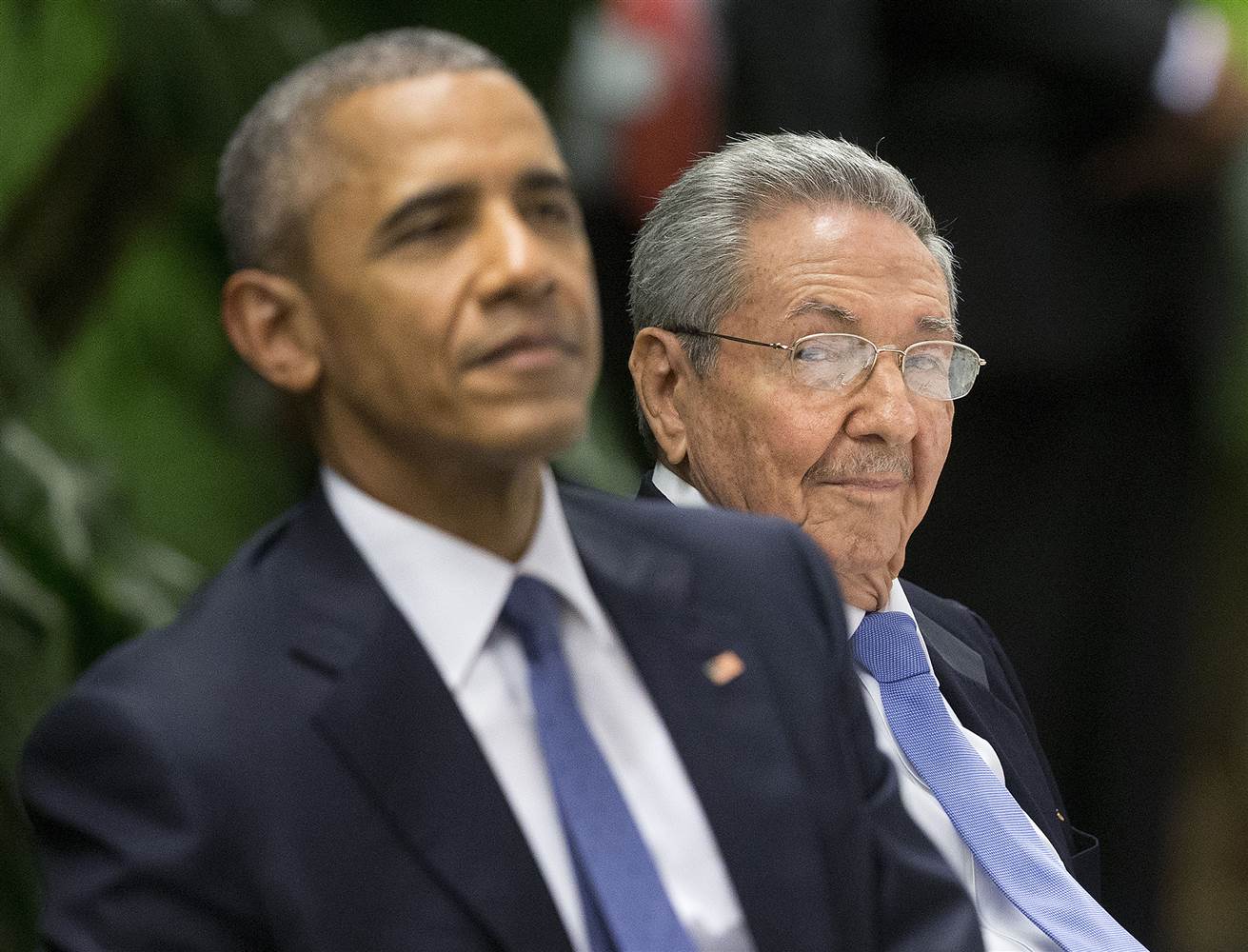
President Barack Obama with General Raul Castro in 2016
President Obama announced his new Cuba policy on December 17, 2014 to great fanfare but downplayed commuting the sentences of three Cuban spies, including Gerardo Hernandez who was serving a life sentence for his role in a murder conspiracy that claimed four innocent lives in 1996 and freed them the same day.

The argument at the time was that this opening would lead to normalized and improved relations between Cuba and the United States.

On May 29, 2015, despite a long history of sponsoring terrorism, the Obama State Department removed Cuba from the list of state sponsors of terrorism. In November of 2017 former Cuban diplomat, Jose Antonio "Tony" Lopez was linked to terrorists responsible for the June 17, 2017 bombing in Bogota, Colombia that killed three and injured nine according to prosecutors in the South American country. A mother of one of the accused denied her son's involvement in the attack but confirms the link with the former Cuban diplomat. [ Full entry ]