Showing posts with label war crimes. Show all posts

Saturday, December 28, 2024

The genocidal Assad regime in Syria was ideologically inspired by Cuban dictator Fidel Castro.

A reflection on the 54 year alliance between the Assad and Castro regimes.


Hafez al-Assad seized power in November 1970 in a bloodless coup, and remained in power through brutal means until his death on June 10, 2000. The Syrian dictator ruled his country for over 30 years, and when he died in power, was succeeded by his equally brutal son Bashar al-Assad who ruled Syria for another 24 years.  Throughout these 54 years, the Castro brothers maintained a close relationship with the Assad regime.

Fidel Castro broke relations with Israel on the eve of the Yom Kippur War in 1973. This was required for all Soviet-aligned regimes, as the international communist line defined Israel as a colonial state and an arm of U.S. imperialism. However, the Cuban dictatorship went above and beyond in their hostility to the Jewish state.  Noticias de Israel (News of Israel) provided a more in-depth description of what took place next.

From the highest levels of power in Havana, a secret operation was orchestrated to send military support to Syria. A tank brigade, helicopter pilots, communications agents, and intelligence and counterintelligence officers were meticulously selected for this mission. It was imperative that these men did not arouse suspicion and that they were perfectly prepared for the task entrusted to them.

The Military Brigade of Senén Casas Regueiro was mobilized, and under the command of General Leopoldo Cintra Frías, a recognized name in military circles, this surreptitious plan was put into action. In a carefully planned diversionary maneuver, the soldiers left Cuba dressed in civilian clothes, with forged passports that identified them as university students. They traveled on separate flights to East Germany, where they made a technical stopover, before reaching their final destination: Syria.  

Once on Syrian territory, Soviet military equipment, including modern T-62 tanks and SAM rocket artillery, was ready for operation. Figures vary, but it is estimated that between 1,800 and 4,000 Cubans were present in Syria during the 1973 confrontation.

The surprise of this operation resulted in a series of significant losses for Israel, both in human lives and military equipment. Some civilian areas were also hit during the clash. 

On March 31, 1974, Israeli Defense Minister Moshe Dayan announced on US television that 3,000 Cuban troops had been dispatched to support Syria during the Yom Kippur War. The Economist published two articles in its Foreign Report in 1978 that highlighted Cuba's role in Syria beginning shortly after the 1973 Arab-Israeli war. Cuban tank crews fought with Syrian troops. According to Foreign Report, 180 Cubans were killed and 250 were injured.  

Cuban combat troops remained in Syria until 1975

Havana remained quiet when Assad invaded Lebanon in 1976, and occupied the country for the next 30 years. In 1979, Hafez Al Assad traveled to Cuba and met Fidel Castro. Castro, and other Cuban officials made no mention of the then ongoing Syrian occupation.

The bodies of hundreds of victims of the 1982 massacre that Hafez al-Assad ordered against Palestinians and Lebanese in the Tel al-Zaatar Palestinian refugee camp, northeast of Beirut, Lebanon are still interred in unidentified graves. Between 1,500 and 2,000 people, primarily civilians, are thought to have been killed, although some estimate that the total number of victims during the siege may exceed 4,000.

No criticism was made by Havana regarding the massacre of these Palestinians by Assad. On the contrary the relationship between Havana and Damascus remained strong.

Since 1975, 17,000 Lebanese have been disappeared by the Assad regime, according to Romy Haber, of the Catholic News Agency.

In the July 1986 issue of Commentary magazine, professor and commentator Daniel Pipes wrote an article with a title that asked a provocative question: "Syria: The Cuba of the Middle East?" and offered the following data point on relations between the two regimes.

"An August 1985 cable from Assad to Fidel Castro on the 20th anniversary of diplomatic relations between Syria and Cuba praised the two countries' friendship as beneficial 'for the two peoples in their joint struggle against world imperialism and its allies.' A telegram from the Syrian foreign minister on the same occasion expressed 'Syria's admiration for the fraternal Cuban people's great achievements and their firm stands against imperialist aggression on the Latin American people.'”

Syria continued its dominance over Lebanon after 1990 with the assistance of Iran and their terrorist proxy Hezbollah. Bashar al-Assad's succession to power in July 2000 was met, less than a year later, by a visit by Fidel Castro to Damascus in May 2001 where the Cuban dictator met with his Syrian counterpart.

Lebanese nationalists rose up nonviolently against the Syrian occupation beginning in 2000, and by 2005 had forced the withdrawal of the Syrian army in what became known as the Cedar Revolution, but it was not conclusive.

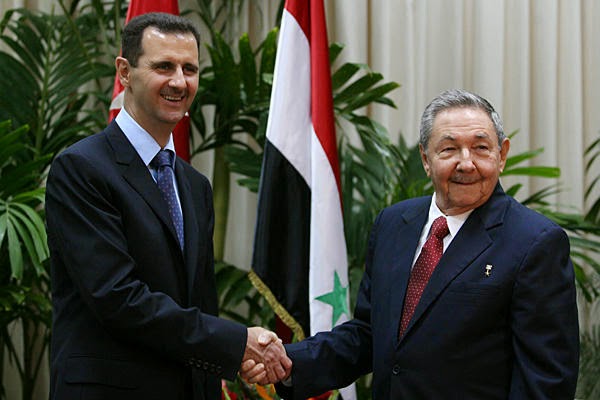
On June 28, 2010 Bashar al-Assad visited Cuba for two days, and met with Raul Castro.

In 2011, a nonviolent movement against the Assad regime emerged, which was met with extreme brutality, and resulted in a civil war. When the international community, belatedly, demanded an accounting for the rights violations committed by the Assad regime in Syria, the regime in Havana was one of a handful of governments that voted against investigating the crimes of the dynastic dictatorship in Damascus.

On August 23, 2011 the Cuban government along with China, Russia and Ecuador voted against investigating gross and systematic human rights violations in Syria.

On February 5, 2012 ALBA Countries reiterated rejection of "foreign interference" in Syria's internal affairs, expressing support for President Bashar al-Assad and confidence that he would resolve the Syrian crisis. ALBA Countries include Cuba, Venezuela, Ecuador, Bolivia, and Nicaragua. Meanwhile in Syria President al-Assad  engaged in massacres throughout the country

On June 1, 2012 at a Special Session on the deteriorating human rights situation in Syria with a special focus on the massacre in El-Houleh the Cuban regime and its allies took a stand against holding the Assad regime accountable for its gross and systematic human rights abuses.

The Associated Press reported that the U.N. Human Rights Council voted overwhelmingly on September 25, 2014, to share its evidence of Syrian atrocities in hopes it will be forwarded to the world's war crimes tribunal. By a vote of 32-5, with 10 abstentions, the 47-nation council adopted the resolution condemning the lack of cooperation by President Bashar Assad's government with a U.N. commission investigating rights violations since March 2011 in Syria.  Cuba was one of five nations—the other four being Algeria, China, Russia, and Venezuela—that voted against sharing evidence of  gross and systematic human rights violations in Syria.

Ten years of civil war and bloodshed with tens of thousands disappeared, millions displaced, and over 500,000 killed, yet the Syrian regime was being normalized in 2023 by too many in the international community.
 

Bashar al-Assad on December 8, 2024 fled to Moscow, and his dictatorship crumbled. Now the mass graves are being discovered, and the full scale of the horror is beginning to be understood.

 
It is also important to remember that Fidel Castro "was a source of ideological inspiration" for the Assad regime.

On December 8, 2024 I made the following observation in a thread of four Tweets on X:

It appears that the Assad dynasty that ruled Syria over two generations of incredible levels of brutality and terror has come to an end. Let us pray that what comes next after so many decades of depravity and repression is an improvement. Assad's decision to engage in the mass murder of the Syrian nonviolent opposition in 2011 sparked a civil war that has claimed hundreds of thousands of lives.  Now is the time to make an assessment of the governments who backed the Assad regime, and call them out as we learn of the crimes of this dynastic dictatorship. This includes the dictatorships in Cuba, Venezuela, and Nicaragua. All supported Assad, and legitimized his rule.


Saturday, May 27, 2017

Cubans in Ethiopia: Castro's unholy and silent alliance with war criminal Mengistu Haile Mariam

Castro regime's involvement in mass murder in Ethiopia documented

Fidel Castro lounging with Mengistu Haile Mariam, in Ethiopia in 1977
Today while attending the Conservatives International gathering in Miami, Senator Ben Murray Bruce of Nigeria praised the Castro regime's role in ending Apartheid in South Africa, of which  I have to admit that I am skeptical of for reasons argued here before in this blog.

Later on in the question and answer period I asked Senator Bruce if he was aware of the Cuban role in genocide in Ethiopia in alliance with later convicted war criminal Mengistu Haile Mariam.  The Senator indicated that he had no knowledge of it, but that if someone did something good on Monday and something bad on Tuesday that he would celebrate what was done on Monday and condemn what was done on Tuesday.

Fidel and Raul Castro were both deeply involved in sending 17,000 Cuban troops to Eastern Africa in order to assist Mengistu in consolidating his rule and eliminating actual and potential opposition. The last Cuban troops did not leave Ethiopia until 1989 and were present and complicit in the engineered famine that took place there.  In 1990 traveling on a train through East Germany on my way to Prague I spent some time speaking with an Ethiopian economist who told me how Cuban troops would round up starving Ethiopian farmers when they got close to the cities, with grain stores, and drove them back out into the countryside to starve.

Raul Castro and Fidel Castro with ally Mengistu Haile Mariam
Below are excerpts of some reports done on the Castro dictatorship's involvement in Ethiopia and links to the complete articles. I've highlighted the mention of Cubans in bold.  The first excerpt is taken from the September 21, 1978 Rolling Stone article "Ethiopia After the Revolution: Vultures Return to the Land of Sheba" authored by Donald R. Katz.

Toward the middle of last year [1977], Mengistu pulled out all the stops. "It is an historical obligation," he said then, "to clean up vigilantly using the revolutionary sword." He announced that the shooting was about to start and that anyone in the middle would be caught in the cross fire. In what came to be known as the "Red Terror," he proceeded to round up all those who opposed the military regime. According to Amnesty International, the Dergue killed over 10,000 people by the end of the year. One anti-government party, mostly made up of students and teachers, was singled out as "the opposition." The Red Terror operated quietly and efficiently under the media cover provided by a vicious desert war that started when Somalia invaded eastern Ethiopia 10 months ago. Around this time, President Carter abandoned a long-term military agreement with Ethiopia on the stated grounds of "gross and systematic human rights violations," and Cuban soldiers and Russian arms poured in to protect and "consolidate the gains" of the revolution. By the time the Somalis were finally chased from Ethiopia's eastern front two weeks before I arrived, the politics of the revolution had been further obscured by Mengistu's determination to fight yet another war against secessionists in the country's northern province of Eritrea. After months of killing Ethiopian youth along with assorted Somalis and Eritreans, Mengistu declared to the world that the "anti-people forces who had lined us up for their lunch – we have had them for breakfast."
Human Rights Watch in their 2008 report on Ethiopia titled outlined "Collective Punishment War Crimes and Crimes against Humanity in the Ogaden area of Ethiopia’s Somali Region" some of the practices carried out by Cuban troops sent there by Fidel and Raul Castro excerpted below:

Mengistu’s “Secret Wars” in Southeast Ethiopia, 1978-84

Although riven by internal divisions, Ogaadeeni and Oromo insurgencies continued their operations in southeast Ethiopia, sometimes from bases on Somali soil.21 By early 1979, the insurgents controlled a substantial part of the countryside.22
Africa Watch (the precursor to Human Rights Watch’s Africa Division) analyzed Ethiopian counter-insurgency operations in this period and found that they followed a four-pronged approach: i) the forced displacement of much of the civilian population into shelters and protected villages; ii) military offensives against people and economic assets outside the shelters; iii) the sponsoring of insurgent groups against the WSLF and Somali government; and iv) attempts to promote the repatriation of refugees.23 In December 1979, a new Ethiopian military offensive, this time including Soviet advisors and Cuban troops, “was more specifically directed against the population’s means of survival, including poisoning and bombing waterholes and machine gunning herds of cattle.”24 Militarily, the counter-insurgency operations succeeded in greatly weakening the insurgents or driving them across the border into Somalia.25
Charles Lane of The Washington Post joins with Senator Ben Murray Bruce of Nigeria in placing Cuban involvement in South Africa on the positive side of the ledger in the December 1, 2016 article "Castro was no liberator"  but then the journalist raises the following question that touches heavily on Ethiopia:
Answering it would require broader examination of Castro’s Cold War record in Africa, to include the eastern regions of the continent, where Cuba intervened militarily on behalf of the Ethiopian dictator, Lt. Col. Mengistu Haile Mariam, in the 1970s. Mengistu participated in a successful military coup against the U.S.-backed Emperor Haile Selassie in 1974, eventually seizing power on Feb. 3, 1977,by massacring his rivals in the officer corps. Castro admired this bloody deed as a preemptive strike against “rightists” that showed “wisdom” and cleared the way for Cuba to support Mengistu “without any constraints,” as he explained to East German dictator Erich Honecker in an April 1977 meeting whose minutes became public after the fall of European communism. [...] With the Cuban forces watching his back, Mengistu wrapped up his bloody campaign of domestic repression, known as “the Red Terror,” and sent his own Soviet-equipped, Cuban-trained troops to crush a rebellion in Eritrea. The last Cuban troops did not leave Ethiopia until September 1989; they were still on hand as hundreds of thousands died during the 1983-1985 famine exacerbated by Mengistu’s collectivization of agriculture.

Read more here: http://www.miamiherald.com/opinion/op-ed/article118362988.html#storylink=cpy

Read more here: http://www.miamiherald.com/opinion/op-ed/article118362988.html#storylink=c
 There is also video footage of the Castro regime's involvement in Ethiopia along with the testimony of victims.


Fidel and Raul Castro's comrade, Mengistu was found guilty of genocide on December 12, 2006, and was sentenced to life in prison in January 2007. He was sentenced to death in absentia on May 26, 2008 following an appeal. Mengistu currently resides in Zimbabwe under the protection of African despot Robert Mugabe.

This chapter of the Castro regime's involvement in Ethiopia should not be forgotten when discussing the Cuban presence in Africa.

Thursday, September 25, 2014

Castro regime one of five against holding Assad regime accountable for atrocities in Syria

 “Dime con quién andas y te diré quién eres”. ["Tell me with whom you walk, and I will tell you who you are."] - Spanish proverb

Bashar Hafez al-Assad and Raul Castro
 The Associated Press reported that the U.N. Human Rights Council voted overwhelmingly on Thursday, September 25, 2014, to share its evidence of Syrian atrocities in hopes it will be forwarded to the world's war crimes tribunal. By a vote of 32-5, with 10 abstentions, the 47-nation council adopted the resolution condemning the lack of cooperation by President Bashar Assad's government with a U.N. commission investigating rights violations since March 2011 in Syria, whether by the government or the opposition or the Islamic State group that controls broad areas along the Syria-Iraq border. 
Vote today on sharing evidence of Syrian atrocities with war crimes tribunal
 The five countries who voted against sharing evidence of gross and systematic human rights violations in Syria are: Algeria, China, Cuba, Russia, and Venezuela. The Castro regime that has ruled Cuba for the past 55 years has close ties with the Assad regime that goes back decades and since 2011 has repeatedly backed the Syrian government in what has been described as an "unholy alliance" ignoring evidence of torture and mass killings. This has raised questions as to why these countries are on the Human Rights Council.

Hafez al-Assad and Fidel Castro
On September 16, 2014 addressing the UN Human Rights Council I stated that "the disaster in Syria did not arise yesterday but is the long term result of the failure to have human rights respected there" and should also have added along with the failure of the international community for too many years to denounce the atrocities committed there."

At the same time the belief now that the situation has deteriorated that an expanded military response will solve the problems there is at best fool hardy if not just plain stupid.  There is another alternative between waging war and looking the other way as Syria burns and that is nonviolent resistance and solidarity.

Thursday, August 7, 2014

The Khmer Rouge, the Killing Fields, U.S. Relations and Justice

"You should also tell the Cambodians (i.e., Khmer Rouge) that we will be friends with them. They are murderous thugs, but we won’t let that stand in our way. We are prepared to improve relations with them. Tell them the latter part, but don’t tell them what I said before.”  - Henry Kissinger, The Secretary's Dining Room, November 26, 1975

We will burn the old grass and the new will grow.” - Pol Pot, leader of Cambodia under the Khmer Rouge (1975 - 1979)

Victims of the Khmer Rouge
Today, August 7, 2014 two of the most senior surviving leaders of the Khmer Rouge dictatorship, Khieu Samphan, and Nuon Chea, were found guilty of crimes against humanity and sentenced to life in prison. 

On July 26, 2010 Kaing Guek Eav whose revolutionary name “Duch” was obtained in the 1970s with the Khmer Rouge and oversaw the infamous S-21 prison was found guilty of war crimes in Cambodia and sentenced to 35 years in prison by the Extraordinary Chambers in the Courts of Cambodia (ECCC).

 Khieu Samphan, left, and Nuon Chea as their verdicts were delivered.
Photo by: Extraordinary Chambers in the Courts of Cambodia
The Khmer Rouge murdered a quarter of the entire population of Cambodia in under four years. Between 1975 and 1979 nearly 2 million people were killed. Thirty five years later and finally there is a measure of justice for the dead and their loved ones. Justice may have been delayed but it was not denied.


Nevertheless, for what were called strategic reasons at the time Secretary of State Henry Kissinger engaged in diplomatic outreach in 1975 with the Khmer Rouge who he himself recognized were murderous thugs and this "friendship" was maintained through the Carter years. 

Victims of the Khmer Rouge were photographed and numbered prior to execution
 President Carter's former US National Security Adviser, Zbigniew Brzezinski, on China and the Khmer Rouge, 1979 despite a policy supposedly predicated on human rights explained: “I encouraged the Chinese to support Pol Pot. Pol Pot was an abomination. We could never support him, but China could.” 

Chinese leader Jiang Zemin lunching with his employee Henry Kissinger in 2011
However, the true nature of the alleged realpolitik policy of the United States under the influence of Kissinger may, in fact, not have been policy decided by the United States but by the Peoples Republic of China

Phyllis Schlafly, who co-wrote with Chester Ward in 1975 Kissinger on the Couch, a 846 page expose on the Secretary of the State, in December of 2002 wrote a column exposing what really happened in the negotiations with the Soviets in the early 1970s:
John Newhouse's 1973 book "Cold Dawn: The Story of SALT" confirmed that every substantive provision of the 1972 U.S.-Soviet agreements was dictated secretly to Kissinger by the Kremlin without the knowledge of our U.S. negotiating team, was accepted by Kissinger, and was then rationalized by Kissinger to the President and Congress. Newhouse's book showed how Kissinger was personally and solely responsible for promising the Soviets that we would not build an anti-missile defense, even though the offensive- weapons provisions of the SALT I agreements guaranteed the Soviet Union superiority in numbers of missiles. In testimony to the Senate Foreign Relations Committee, Kissinger personally endorsed Newhouse and called his book "outstanding." This made Newhouse's book the authentic historic account of the Moscow agreements.
In the same way that Kissinger advanced Soviet interests while passing them off as his own ideas in the SALT I negotiations he may have done so with Mainland China. Considering that he eventually became a paid consultant of the Chinese communist government only serves to underline that the idea is not so farfetched.

Incidentally at the same time he was reaching out to Pol Pot, Henry Kissinger was also advocating lifting the embargo on Cuba and normalizing relations with Fidel Castro.  Kissinger has also had a close relationship with David Rockefeller, a man who always opposed sanctions on Fidel Castro and hosted the Cuban tyrant at a dinner at the Rockefeller family's Westchester County, N.Y., estate in 1995. 

Henry Kissinger's amoral foreign policy legacy was repudiated by Ronald Reagan in the 1980s and today in Cambodia he is considered a war criminal who should be placed on trial along side his "friends" in the Khmer Rouge.


Unfortunately, the Kissinger legacy of self interested enrichment crosses party lines and can be seen to be continued by the Clintons.

Henry Kissinger and Hillary Clinton
Below are declassified excerpts from the meeting with the Foreign Minister of Thailand were the U.S. Secretary of State expressed the desire for friendship with the Khmer Rouge while recognizing their murderous nature.


Date: November 26, 1975
Time: 1:00p.m.
Place: The Secretary's Dining Room

Subject: Secretary's Meeting with Foreign Minister Chatchai of Thailand

Participants: 

Thailand
 
Foreign Minister Chatchai Chunhawan
 [...]

US

The Secretary (Henry Kissinger)
The Deputy Secretary
Assistant Secretary for East Asian and Pacific Affairs Philip C. Habib
Mr. Brent Scowcroft, National Security Council
[...]

(At this point, the group went into the Madison Room for lunch.)

The Secretary:  What is the Cambodian attitude?

Foreign Minister: The Cambodians want salt and fish. They wanted to barter for these items.

The Secretary: Did Ieng Sary impress you?

Foreign Minister: He is a nice, quiet man.

The Secretary: How many people did he kill? Tens of thousands?

Mr. Habib: Nice and quietly!!

Foreign Minister: Not more than 10,000. That's why they need food. If they had killed everyone, they would not need salt and fish. All the bridges in Cambodia were destroyed. There was no transportation, no gas. That's why they had to chase people away from the capital.

The Secretary: But why with only two hours' notice?

Foreign Minister: (Shrugs.)

The Secretary: What do the Cambodians think of the United States? You should tell them that we bear no hostility towards them. We would like them to be independent as a counterweight to North Vietnam.

[...]

We would support this. You should also tell the Cambodians (i.e., Khmer Rouge) that we will be friends with them. They are murderous thugs, but we won’t let that stand in our way. We are prepared to improve relations with them. Tell them the latter part, but don’t tell them what I said before.” 
 
More victims of the Khmer Rouge

Monday, August 9, 2010

The tyrant, the super model and the blood diamonds

“Ms Campbell's testimony reminds us of the damage that can be done by power-hungry individuals who illegally exploit their country's natural resource wealth to wage campaigns of violence and brutality against civilians. The Taylor trial is an important moment in the history of international justice, when the survivors of his regime may finally see some reparation.” Oliver Courtney, Global Witness spokesperson.

Naomi Campbell & Charles Taylor

Charles Taylor has been described by Spiegel Online as part of the "Slaughterers' Society" of African dictators. A society in which members feed opponents to crocodiles, hack their feet off, and allow their people to starve. Supermodel Naomi Campbell over dinner flirted with "President" Taylor and enjoyed his company. Then again she's also enjoyed the company of dictators in other continents and said so proudly. For example, back in 1998 Naomi Cambpell described Fidel Castro as an "inspiration" and meeting him as "very spiritual." She's also hung out with Castro's disciple Hugo Chavez. describing him as a "rebel angel" that poses "no threat to democracy." Now it seems that her encounter with another tyrant she met in 1997 Liberia's Charles Taylor is coming back to haunt the supermodel.


Charles Taylor is now on trial for war crimes committed while he was president of Liberia. Ms. Campbell has testified denying that she knew that the former Liberian president and mass murderer Charles Taylor had sent her blood diamonds. Now other witnesses, among them her friend Mia Farrow and Carole White, her former agent are now contradicting her testimony.

"As we were eating, Naomi leaned back and Charles Taylor leaned forward, and Naomi was very excited and told me he was going to give her some diamonds." - Carole White
Whereas, Naomi Campbell only flirted with an alleged war criminal over dinner and later received contraband diamonds as a gift . Fidel Castro was also closely involved in a working relationship with the convicted genocidal war criminal former Ethiopian dictator Mengistu Haile Mariam, now a fugitive hiding out with another of Castro ally Zimbabwe's brutal Robert Mugabe, and sent thousand of Cuban troops to assist in killing Ethiopians and spreading terror.
Hopefully one day the world will demand that Fidel Castro answer for that relationship and the Ethiopians murdered with his assistance.

At the same time one cannot underestimate the seriousness of blood diamonds and what they signify. Blood or conflict diamonds are subject to an international sanctions regimen that aims to undercut a funding source for armed conflicts in Africa. A more detailed description is provided by the Security Council Affairs Division which is part of the United Nations and based out of New York which states:
On 1 December 2000, the United Nations General Assembly adopted, unanimously, a resolution on the role of diamonds in fuelling conflict, breaking the link between the illicit transaction of rough diamonds and armed conflict, as a contribution to prevention and settlement of conflicts (A/RES/55/56). In taking up this agenda item, the General Assembly recognized that conflict diamonds are a crucial factor in prolonging brutal wars in parts of Africa, and underscored that legitimate diamonds contribute to prosperity and development elsewhere on the continent.


The story is still developing, and offers an insight into the relationship between economic sanctions and attempting to improve the human rights situation in a regional context. Below on the Colbert Report, although humorous, makes a serious point about human rights and economic interests looking at business practices in China followed by the Naomi Campbell controversy.


The Colbert ReportMon - Thurs 11:30pm / 10:30c
Tip/Wag - Foxconn, Charles Taylor & Naomi Campbell
www.colbertnation.com
Colbert Report Full Episodes2010 ElectionFox News

Join the group to boycott supermodel Naomi Campbell http://bit.ly/c7dVgy

Thursday, November 19, 2009

Human Rights Watch: "New Castro, Same Cuba"

Cuba's repressive machinery remains intact under Raul Castro.

"Despite significant obstacles to research, Human Rights Watch documented more than 40 cases in which Cuba has imprisoned individuals for “dangerousness” under Raúl Castro because they tried to exercise their fundamental rights. We believe there are many more. The “dangerous” activities in these cases have included handing out copies of the Universal Declaration of Human Rights, staging peaceful marches, writing news articles critical of the government, and attempting to organize independent unions." - Human Rights Watch (2009)

A decade after Human Rights Watch released their
CUBA'S REPRESSIVE MACHINERY: Human Rights Forty Years After the Revolution which offered a well documented overview of how Cuba's legal system serves as part of the apparatus of repression and how it operated and operates today in Cuba the human rights organization released a report documenting Raul Castro's tenure as "President" titled New Castro, Same Cuba: Political Prisoners in the Post-Fidel Era and the complete report is available in pdf format online. The report offers a breakdown of repression against dissidents, but also offers insights into the regime's totalitarian nature :
The Raúl Castro government has applied the “dangerousness” law not only to dissenters and critics of the government, but to a broad range of people who choose not to cooperate with the state. We found that failing to attend pro-government rallies, not belonging to official party organizations, and being unemployed are all considered signs of “antisocial” behavior, and may lead to “official warnings” and even incarceration in Raúl Castro’s Cuba. In a January 2009 campaign called “Operation Victory,” dozens of individuals in eastern Cuba—most of them youth—were charged with “dangerousness” for being unemployed. So was a man from Sancti Spíritus who could not work because of health problems, and was sentenced to two years’ imprisonment in August 2008 for being unemployed.
One must participate in the propaganda exercise and in some cases carry out acts of repression against fellow citizens in the Cuban dictatorship's version of Orwell's 2 minutes hate which is the act of repudiation that in Cuba can go on a lot longer than two minutes or risk being on the receiving end. You can see and hear a sampling of how they operate in the video below beginning at 00:50
:


A word about Human Rights Watch
When a totalitarian regime is criticized it must attack the critic and question their motives. It is standard operating procedure. It has been repeatedly used against Amnesty International, UN Human Rights experts such as Christine Chanet, and against Human Rights Watch. Following the release of the report the Cuban diplomatic mission in Washington released a statement in which it described Human Rights Watch's "evaluation of human rights in Cuba is illegitimate and illegal." First who and what is Human Rights Watch? There vision and mission statement is clear as is the fact that they have a track record of being verbally attacked by numerous governments across the ideological divide. First Human Rights Watch does not recieve directly or indirectly any government funding and rely on private donations. Secondly, the organization arose out of Helsinki Watch which monitored Soviet and Eastern European compliance with the 1975 Helsinki Accords after their founding in 1978 and Americas Watch founded in 1981 which monitored authoritarian and military dictatorships in the Hemisphere and was criticized at the time for bias against El Salvador, Guatemala, by the Reagan Administration and was accused by The Wall Street Journal of "a gentler standard to U.S. adversaries in Central America than to U.S. friends." Now this version of events is provided by the self described"progressives" at Fairness and Accuracy in Reporting. The organization Human Rights Watch was to formally come into existence in 1998 as a fusion of these two organizations and similar counterparts in Asia, Africa, and the Middle East. Now that we have a better perspective on Human Rights Watch and in the spirit of the phrase a picture is worth a thousand words. Around the same time that Helsinki Watch and Americas Watch were doing their job on behalf of human rights Fidel Castro was hosting leaders of the Argentine military junta in Havana.

Fidel Castro, the Argentine Military Junta and the Dirty War


On the picture on the right is Fidel Castro with Argentine foreign minister Nicanor Costa Mendez of the Argentine military junta that according to a number of sources extrajudicially executed and disappeared as many as 30,000 Argentines between 1976 and 1983 in the Dirty War meeting in Havana at the Non-Aligned Movement gathering.


That is not the only member of the junta that he commiserated because he was also photographed here on the left with "President"
Reynaldo Benito Antonio Bignone Ramayón who, like Fidel Castro then and Raul Castro today , was"President" in name only, but in reality a brutal military dictator. In 2009, he is on trial for the kidnapping, torture, and murder of 56 people in a concentration camp. Sadly, whereas groups like Human Rights Watch and Amnesty International sought to expose the Dirty War and stop it and to later document the crimes committed and along with the victims demand justice the Cuban government did everything at the time to block efforts to investigate the disappearances from their perch at the United Nations Human Rights Commission.

The Castro Brothers Crimes in Ethiopia


Raul Castro & Fidel Castro with close ally Mengistu Haile Mariam

In the case of Marxist ruler Mengistu Haile Mariam or as Fidel Castro referred to him "Comrade Mengistu" there is a lot of information demonstrating the close working relationship between Mengistu and both Castro brothers. Cuba sent the first wave of what would become 5,000 Cuban troops to fight government rebels in December 1977-January 1978. In September of 1978 Fidel Castro arrived in Ethiopia to address both Ethiopian and Cuban troops and claim both victory and the Ethiopian revolution's popular support:

"Comrade Cubans, I can recall those days of December 1977 and January 1978 when we said farewell to the first Cuban internationalist combatants who were leaving for Ethiopia. [...]Eighteen months later we have returned to a Ethiopia which is victorious be cause of its combative sons' heroism and the support of international solidarity, as Comrade Mengistu stated 2 days ago. Moreover, it is also an already powerful Ethiopia. Tuesday's popular parade confirmed the enormous popular support for this revolutionary change. Yesterday's military parade tells us of the degree of organization and discipline achieved by the combative and courageous fraternal Ethiopian people. The rapid revolutionary offensive of the Ethiopian and Cuban troops practically annihilated the enemy. [...]Ethiopian brothers, together with you we have fought and we have won. Together with you we are ready to fight again and to win again. Together with you we pledge: Fatherland or death, we shall win!

Castro's September 1978 speech places Cuban combatants on the ground in December of 1977. The importance of these dates will become evident later on. The next excerpt is from a conversation with the then East German dictator Erik Honecker discussing the situation in Ethiopia and Fidel Castro's assesment of Mengistu in February of 1977 following a visit and meeting with him:


Mengistu strikes me as a quiet, serious, and sincere leader who is aware of the power of the masses. He is an intellectual personality who showed his wisdom on 3 February. The rightists wanted to do away with the leftists on 3 February. The prelude to this was an exuberant speech by the Ethiopian president in favor of nationalism. Mengistu preempted this coup. He called the meeting of the Revolutionary Council one hour early and had the rightist leaders arrested and shot. A very consequential decision was taken on 3 February in Ethiopia. The political landscape of the country changed, which has enabled them to take steps that were impossible before then. Before it was only possible to support the leftist forces indirectly, now we can do so without any constraints.

Fidel Castro with close ally Mengistu Haile Mariam

The dates are important because it coincides with the beginning of the "Red Terror" in which 2,000 Africans were slaughtered. This was a purge of political opponents. According to press accounts: "Suspects were rounded up, some shot, others garrotted. The bodies were thrown on the streets." There would be a Cuban military presence on the ground until 1988. In December 2006 Ethiopia's former dictator was found guilty of the extrajudicial killing of thousands of political opponents and his involvement in a famine which killed one million people and found guilty of genocide in absentia. A Reuters video report on the 2006 trial is available below:


Naturally the Cuban government would not have been pleased with Reed Brody Human Rights Watch's legal counsel's reaction to the trial and verdict at the time: "This is a man whose regime was marked by some of the worst atrocities of our time. Thousands of political killings [were carried out and] over 100,000 people died as a result of forced relocations."

No doubt the Castro brothers and all those officials in the dictatorship who have committed gross human rights violations feel a little uncomfortable when they see their close allies being tried and condemned for crimes against humanity and genocide as the ultimate condemnation by history. Not to mention that groups like Human Rights Watch and Amnesty International "would very much like to see [Mengistu] physically brought to justice--not justice in absentia." Has anyone given any thought to what responsibility Cuban leadership shares with the events in Ethiopia? Difficult questions that the dictatorship in Cuba would rather not answer truthfully or be held accountable.