Showing posts with label 13 de Marzo tugboat. Show all posts

Friday, January 5, 2024

R.I.P. María Victoria Garcia, truth-teller and survivor of the tugboat "13 de marzo" massacre.

María Victoria Garcia passes away in Miami. She was a survivor of the tugboat "13 de marzo" massacre, which remains an unpunished atrocity.

Three Cuban families totaling about 70 persons seeking a better life in freedom boarded the Cuban tugboat "13 de Marzo" on July 13, 1994. 17 were members of the Garcia family. The captain of the tug was among those who wanted to depart. Despite their best efforts, an informant had already reported them to State Security.  The Cuban dictatorship's actions on July 13, 1994, were premeditated.

The "13 de Marzo" left the port at 3:00am and almost immediately were being pursued by other tugboats of the Ministry of Transportation. Seven miles from the Cuban coast line the “13 de Marzo” tugboat was confronted by the tugboats. Amnesty International in their 1997 investigation reported that the vessels which attacked the “13 de Marzo” were Polargo 2”, “Polargo 3″ and “Polargo 5″ and identified as belonging to the Ministry of Transport. According to the IACHR report the attack did not appear improvised. The Amnesty International report mentions another vessel that "appeared to be directing operations was believed to belong to the Cuban Coast Guard, which is part of the Ministry of the Interior.”


Despite the “13 de Marzo” tugboat stopping and passengers attempting to surrender the other tugboats continued to ram the tug and use high pressure hoses to blast them overboard. Following this the attackers began to circle the wreckage with the aim of creating a whirlpool effect to ensure that all would drown. Sergio Perodin, one of the survivors who lost his wife and young son during the incident, explained how the massacre stopped when a boat with a Greek flag appeared in the area. "lt looked like the boat was watching what they were doing, the murder they were committing. So they stopped and decided to pick us up." It was then and only then that the attack was suspended and the survivors were picked up by the Cuban Coast Guard.

María Victoria García, was one of three members of the García family who survived the massacre. Fourteen members of the García family were murdered, including her 20 year old brother, and María Victoria's ten-year-old son Juan Mario Gutiérrez García.  

Juan Mario Gutiérrez García

Her father, Jorge García who survives his daughter also sat down and spoke on camera about what he had learned about the actions of the Cuban government both before and after the massacre.  He had been detained and interrogated on several occasions by state security. His longest detention was for 15 days.

María Victoria García spoke out but it nearly came at a great cost according to Jorge, "[t]hey tried on several occasions to kill my daughter, because she was the first to speak out and contradict the regime’s official narrative.

The massacre and the aftermath left her physically and psychologically scarred for the rest of her life..

Jorge and his daughter left Cuba for exile. He wrote a book about this crime that is a must read. During a question and answer session at Florida International University on July 13, 2004 he spoke of the need for justice:

''There are those who think that we should be full of rancor and a thirst for vengeance but I don't want revenge. I feel sorry for the people who assassinated my family. I can never be compensated for my loss. I will never be happy again with my family surrounding me. There will always be a tinge of sadness but I do want there to be a trial so that this situation can serve as a lesson and that these people or others like them in other parts of the world, don't do this kind of thing again. Not in Cuba. Not anywhere.''

María Victoria described what happened to Voces de Cuba in an interview nine years ago, about when she confronted an official saying, "I told the colonel that it had not been an accident, that they sank us."

The following persons were executed extrajudicially by the Castro regime on July 13, 1994, in the "13 de Marzo" tugboat massacre, and thirty years later justice has still not been provided them and their loved ones.

Helen Martínez Enríquez ( 5 months)
Cindy Rodríguez Fernández (age 2)
José Carlos Nicole Anaya (3)
Angel Rene Abreu Ruiz ( age 3)
Yisel Borges Alvarez (4)
Caridad Leyva Tacoronte (age 5)
Juan Mario Gutiérrez García (age 10)
Yousell E. Perez Tacoronte (age 11)
Yasser Perodin Almanza (age 11)
Eliecer Suarez Plasencia ( age 12)
Mayulis Mendez Tacoronte (age 17)
Miladys Sanabria Cabrera ( age 19 )
Odalys Muñoz García (age 21)
Yuliana Enríquez Carrazana (age 22)
Yaltamira Anaya Carrasco (age 22)
Lissett María Álvarez Guerra (age 24)
José Gregorio Balmaceda Castillo (24)
Joel García Suárez (age 24)
Ernesto Alfonso Loureiro (age 25)
María Miralis Fernández Rodríguez (age 27)
Pilar Almanza Romero (age 28)
Leonardo Notario Góngora ( age 28)
Jorge Arquímides Lebrijio Flores (age 28)
Rigoberto Feut Gonzáles (age 31)
Omar Rodriguez Suarez (age 33)
Lázaro Enrique Borges Briel (age 34)
Julia Caridad Ruiz Blanco (age 35)
Martha Caridad Tacoronte Vega (age 36)
Eduardo Suárez Esquivel ( age 39)
Martha M.Carrasco Sanabria (age 45)
Augusto Guillermo Guerra Martínez ( age 45)
Rosa María Alcalde Puig (age 47)
Estrella Suárez Esquivel (age 48)
Reynaldo Joaquín Marrero (age 48)
Manuel Cayol (age 50)
Amado Gonzáles Raices (50)
Fidelio Ramel Prieto-Hernández (51) 

María Victoria García, survivor of the July 13, 1994 “13 de Marzo” Tugboat massacre, courageously spoke out about what had happened while still in Cuba. She denounced this mass murder carried out by the Cuban dictatorship. María Victoria died on January 4, 2023 at age 58 due to complications arising from heart surgery performed in December.. My prayers go out to her, her father Jorge A. García, and her friends and family. My sincerest condolences on this terrible loss.


 Requiescat in pace María Victoria Garcia, and the 37 victims of the July 13, 1994 tugboat massacre.


Thursday, July 13, 2023

The July 13, 1994 "13 de Marzo" tugboat massacre: 29 years demanding justice

"The struggle of man against power is the struggle of memory against forgetting." - Milan Kundera.

Three Cuban families totaling about 70 persons looking for a better life away from the regime boarded the Cuban tugboat "13 de Marzo" in the early morning hours of July 13, 1994. The captain of the tug was among those who wanted to depart. Despite their best efforts, an informant had already reported them to State Security..

On July 12, 1994, around 6:00 p.m., Cuban state security knew that the "13 de Marzo" tugboat was going to be taken and had nine hours to prepare their response. What happened on July 13, 1994, was planned ahead of time.

They left the port at 3:00am on July 13, 1994 and almost immediately were being pursued by other tugboats, also of the Maritime Services Enterprise of the Ministry of Transportation. Seven miles from the Cuban coast line at a location known as "La Poceta" the “13 de Marzo” tugboat was confronted by the tugboats. Amnesty International in their 1997 investigation reported that the vessels which attacked the “13 de Marzo” were Polargo 2”, “Polargo 3″ and “Polargo 5″ and identified as belonging to the Ministry of Transport. According to the IACHR report the attack did not appear improvised:

"Polargo 2," one of the boats belonging to the Cuban state enterprise, blocked the old tug "13 de Marzo" in the front, while the other, "Polargo 5," attacked from behind, splitting the stern.  The two other government boats positioned themselves on either side and sprayed everyone on deck with pressurized water, using their hoses.
The Amnesty International report mentions another vessel that "appeared to be directing operations was believed to belong to the Cuban Coast Guard, which is part of the Ministry of the Interior.”

Despite the “13 de Marzo” tugboat stopping and passengers attempting to surrender while mothers held up their children begging for mercy the other tugboats continued to ram the tug and use high pressure hoses to blast them overboard. Following this the attackers began to circle the wreckage with the aim of creating a whirlpool effect to ensure that all would drown. Sergio Perodin, one of the survivors who lost his wife and young son during the incident, explained how the massacre stopped in the Nightline program:

"We saw in the distance a boat with a Greek flag that appeared to be what stopped them. lt looked like the boat was watching what they were doing, the murder they were committing. So they stopped and decided to pick us up."
It was then and only then that the attack was suspended and the survivors were picked up by the Cuban Coast Guard.

On August 5, 1994 Fidel Castro made a speech to the official news media justifying the incident and praising the men on the ships that attacked and sank the "13 de Marzo"tugboat:

"The workers' behavior was exemplary, there's no denying it, because they tried to stop them from stealing the boat.  What are we to say to them now, let them steal the boats, their livelihood?  The actions of the Coast Guard crews were irreproachable, they saved 25 lives.  So, this is what happened and as soon as information became available, more details were given. 

Within three years of the crime, the United Nations Human Rights Commission in 1995, the Inter-American Commission on Human Rights (IACHR) in 1996, and Amnesty International in 1997 all issued findings based on the facts available at the time. The report prepared by the IACHR was the most detailed. Human Rights Watch emphasized the importance of the IACHR report in their 1999 report "Cuba's Repressive Machinery: Human Rights Forty Years After the Revolution" in the chapter on impunity:

 On October 16, 1996, the commission approved a public report concluding that on July 13, 1994, Cuba violated the right to life of forty-one people who died when Cuban government boats rammed, flooded, and sank the 13 de Marzo, a hijacked tugboat loaded with civilians fleeing Cuba. The report also found that Cuba violated the right of personal integrity of the thirty-one survivors of the sinking, and violated the rights to transit and justice of all of the seventy-two persons who attempted to leave Cuba. The report provides shocking survivors' testimony of the Cuban government's deliberate attempts to sink the boat. Statements by President Castro and the Interior Ministry regarding responsibility for the incident provide a disturbing counterpoint to the victims' experiences. Clearly, the government's effort was to exculpate itself from responsibility, rather than conduct a serious investigation and punish those responsible for this incident.
Following the massacre, family members expected their loved ones' bodies to be returned to them. The authorities set up rapid response brigades to prevent anyone from entering their homes. The Cuban government used armed individuals to intimidate survivors and victims' families.

Jorge García who lost several family members in the July 13, 1994 attack sat down and spoke on camera about what he had learned about the actions of the Cuban government  both before and after the massacre.  He had been detained and interrogated on several occasions by state security. His longest detention was for 15 days. His daughter, María Victoria García, was one of three of his family who survived the massacre and spoke out but it nearly came at a great cost according to Jorge, "[t]hey tried on several occasions to kill my daughter, because she was the first to speak out and contradict the regime’s official narrative. Jorge and his daughter are now exiled in Miami. During a question and answer session at Florida International University on July 13, 2004 he explained his need for justice:

''There are those who think that we should be full of rancor and a thirst for vengeance but I don't want revenge. I feel sorry for the people who assassinated my family. I can never be compensated for my loss. I will never be happy again with my family surrounding me. There will always be a tinge of sadness but I do want there to be a trial so that this situation can serve as a lesson and that these people or others like them in other parts of the world, don't do this kind of thing again. Not in Cuba. Not anywhere.''
Oswaldo Payá Sardiñas, who was murdered on July 22, 2012 by state security agents, addressed the significance of this crime.
"Behind the Christ of Havana, about seven miles from the coast, "volunteers" of the Communist regime committed one of the most heinous crimes in the history of our city and of Cuba." ... "Let the silenced bells toll. But let them toll for all the victims of terror that in reality is only one sole victim: the Cuban people that without distinctions, suffers the loss of each one of their children."

The following persons were executed extrajudicially by the Castro regime on July 13, 1994, in the "13 de Marzo" tugboat massacre.

Helen Martínez Enríquez ( 5 months)
Cindy Rodríguez Fernández (age 2)
José Carlos Nicole Anaya (3)
Angel Rene Abreu Ruiz ( age 3)
Yisel Borges Alvarez (4)
Caridad Leyva Tacoronte (age 5)
Juan Mario Gutiérrez García (age 10)
Yousell E. Perez Tacoronte (age 11)
Yasser Perodin Almanza (age 11)
Eliecer Suarez Plasencia ( age 12)
Mayulis Mendez Tacoronte (age 17)
Miladys Sanabria Cabrera ( age 19 )
Odalys Muñoz García (age 21)
Yuliana Enríquez Carrazana (age 22)
Yaltamira Anaya Carrasco (age 22)
Lissett María Álvarez Guerra (age 24)
José Gregorio Balmaceda Castillo (24)
Joel García Suárez (age 24)
Ernesto Alfonso Loureiro (age 25)
María Miralis Fernández Rodríguez (age 27)
Pilar Almanza Romero (age 28)
Leonardo Notario Góngora ( age 28)
Jorge Arquímides Lebrijio Flores (age 28)
Rigoberto Feut Gonzáles (age 31)
Omar Rodriguez Suarez (age 33)
Lázaro Enrique Borges Briel (age 34)
Julia Caridad Ruiz Blanco (age 35)
Martha Caridad Tacoronte Vega (age 36)
Eduardo Suárez Esquivel ( age 39)
Martha M.Carrasco Sanabria (age 45)
Augusto Guillermo Guerra Martínez ( age 45)
Rosa María Alcalde Puig (age 47)
Estrella Suárez Esquivel (age 48)
Reynaldo Joaquín Marrero (age 48)
Manuel Cayol (age 50)
Amado Gonzáles Raices (50)
Fidelio Ramel Prieto-Hernández (51) 

This is a heinous crime, but the purpose behind it is much more disturbing. Milan Kundera, a Czech-born novelist who grew up under communism and understood its true nature. His observation regarding communist regimes in Eastern Europe is applicable to communist Cuba as well.

"Anyone who thinks that the Communist regimes of Central Europe are exclusively the work of criminals is overlooking a basic truth: The criminal regimes were made not by criminals but by enthusiasts convinced they had discovered the only road to paradise. They defended that road so valiantly that they were forced to execute many people. Later it became clear that there was no paradise, that the enthusiasts were therefore murderers."


Requiescat in pace Milan Kundera.and the 37 victims of the July 13, 1994 tugboat massacre.


Monday, July 13, 2015

Reflection on conditional forgiveness, justice and the silent vigil for July's Cuban martyrs

“ Then you shall know the truth, and the truth will set you free.” John 8:32


A version of this essay was published in The Daily Signal on July 13, 2015.

Over the past twenty years I have taken part in acts of remembrance for the 37 victims of the July 13, 1994 "13 de marzo" tugboat massacre and over the past 19 years for the four victims of the February 24, 1996 Brothers to the Rescue shoot down. What has motivated me to do this and to continue is a desire for justice and with these actions engage in preserving memory and the facts known about these two events.  Now in the case of the Brothers to the Rescue shoot down I lost two friends: Mario de la Peña, and Armando Alejandre Jr, but long ago made peace with their untimely passing.

From the start the words of the New Testament informed my political beliefs and in public forums both written and verbal cited a key passage from the Lord's Prayer: "forgive us our debts, as we forgive our debtors." A later biblical passage expands on this passage: " If you forgive others their transgressions, your heavenly Father will forgive you. But if you do not forgive others, neither will your Father forgive your transgressions."

In a letter to the editor to The Miami Herald published on July 30, 1996 I made the case against hatred and revenge and for civility:
Many in this community have suffered torture, the death of loved ones, decades of unjust imprisonment and the separation of families. They have good reason to hate Castro, and his supporters, but for the good of the Cuban nation (inside and outside of Cuba) they must overcome their hatred. In the words of Jesus Christ they must love their enemy. They must save the Cuban nation from the evils committed by this enemy, and not add to them out of a thirst for revenge. Leave revenge to God for that is to whom it belongs. The true test of respect for freedom of expression and of thought is how do we react to what we strongly disagree with. I believe that we have a moral obligation to criticize what we think is wrong in a civil manner, but we also have a moral obligation to protect those we disagree with from violations of their civil and political rights.
I still believe this, and live by it, and this belief is at the root of my profound rejection of the dictatorship in Cuba. The Castro regime's "political culture" is one of misrepresenting, slandering and seeking to destroy not only the person advocating a position they oppose when alive but also their dignity and memory after they have died or been killed.

My opposition to Castroism led not only to a rejection of physical violence but also verbal violence that attacks individuals. Cuba needs a new political culture that places Castroism on the ash heap of history. Change must first come from within each person. This is an appeal to civility. The Institute for Civility in Government offers the following definition: "“Civility is claiming and caring for one’s identity, needs and beliefs without degrading someone else’s in the process.” The democratic resistance in Cuba in order to thrive and succeed must embrace and practice civility fully because it is a necessary prerequisite for effective civic action.

However, civility does not mean accepting the rewriting of history or tolerating continuing or new atrocities committed by the unrepentant dictatorship that exists in Cuba. Like, Antonio "Tony" Ramón Díaz Sánchez, a former prisoner of conscience and secretary general of the Christian Liberation Movement, I reject hatred while at the same time forgiving past injustices but refuse to forgive those that are ongoing or that will be carried out in the future. Because to forgive ongoing and future evils raises the danger of one becoming morally complicit in them or as Tony puts it:
"Because what I do not forgive is that the year has started with the same repression that ended last year. What I can not forgive is that in my country, those who govern, do not recognize the need to change to democracy and allow the people to decide in free and pluralistic elections. I can not and do not want to forgive that right now, at this instant, there are political prisoners in Cuba and that the existing laws guarantee their imprisonment or perhaps the firing squad for others. I do not forgive that young people are living without life projects, while a group in power live as billionaires. Nor do I forgive the complicity of many interests that seek capital now in Cuba without wanting to find out today what is happening there. I do not forgive out of hate. No, no but because forgiving a present and a future of injustice and totalitarianism for your country, is not mercy but complicity with the evil of others."
The extrajudicial killings of Oswaldo José Payá Sardiñas and Harold Cepero Escalante on July 22, 2012 and the ongoing escalation of violence against activists and civilians cannot be ignored or tolerated. Clare Short, a former Labor member of parliament addressing the topic of forgiveness and justice raises two important points that underline the previous raised point of forgiving ongoing injustice and repression:
"Is anger about injustice one of the forces that drives historical progress and important social reform? Is there an important difference between the bitterness,hatred and quest for vengeance that can be so damaging to those who have been hurt or wronged, and the anger that thirsts after justice?" ... "I also agree that the quest for vengeance is also wrong because it so often inflicts harm on people who share an identity with the original perpetrator but have no guilt,and it means the evil of the original harm is recreated in the actions of the person who has been wronged. But all this said, there is such a thing as just anger and those who are subject to continuing oppression can get strength from that anger in order to join with others to liberate themselves. And so I wish to conclude by celebrating forgiveness and reconciliation but also by reminding us that reconciliation can not be the answer when there is a continuing wrong or continuing oppression."
Reconciliation with the Castro regime is presently impossible because of its unwillingness both to be reconciled and to admit any wrong doing. Secondly, according to some experts on the subject a "willingness to forgive" does not necessitate reconciliation or for that matter giving up on justice being served. However for forgiveness to take place it does require repentance and must be conditional. Author and theologian Chris Brauns outlines the argument on his blog which is reproduced below:
  •  Christians are called to forgive others as God forgave them (Matthew, 6:12, Ephesians  4:32).
  • God forgives conditionally. God only forgives those who repent of their sins and turn in saving faith to Him (1 John 1:9, John 3:36).
  • Likewise, we also should offer forgiveness to all. 
  • We forgive those who repent.  Indeed, we are obliged to forgive (Luke 17:3-4), knowing that whatever someone has done to offend us pales in comparison to what we have done to offend God (Matthew 18:32-33).
The alternative to this, according to Brauns, that in some quarters is called "unconditional forgiveness" may actually lead a victim to internalize "unforgiveness and bitterness." This is not the path to peace and reconciliation but to its opposite.

Defending memory by pursuing truth and maintaining the call for justice is an ever present opportunity for the other to repent and embrace justice and actual forgiveness. The antithesis of this is "forgiving and forgetting" while injustices are ongoing  and new ones being compounded not only harms the victims but also condemns the perpetrator to continue committing evil acts and is described as a "false reconciliation."   It is preaching forgiveness without repentance which the German theologian Dietrich Bonhoeffer described as "cheap grace." Forgetting the past and the truths that it holds is a threat to freedom.

It is important to remember what has been done within a context of justice while remaining open to forgiveness by calling on the other side to repent and for civil authorities to hold them accountable for past and present crimes. This is why on July 13, 2015 at noon people of goodwill shall gather in silence for 13 minutes in a demand for justice for the thirty seven men, women,  and children killed on July 13, 1994 and for Oswaldo Payá Sardiñas and Harold Cepero Escalante killed on July 22, 2012 in what has all the hallmarks of a state security extrajudicial execution.  Speaking to family members in both cases who with their faith have not succumbed to hatred, but continue to demand justice. Jorge García who lost 14 relatives on July 13, 1994 expressed it best during a question and answer session at Florida International University on July 13, 2004:
''There are those who think that we should be full of rancor and a thirst for vengeance but I don't want revenge. I feel sorry for the people who assassinated my family. I can never be compensated for my loss. I will never be happy again with my family surrounding me. There will always be a tinge of sadness but I do want there to be a trial so that this situation can serve as a lesson and that these people or others like them in other parts of the world, don't do this kind of thing again. Not in Cuba. Not anywhere.''

Saturday, July 12, 2014

"13 de Marzo" tugboat coverage and what gets in the news

"State crimes are never an issue exclusive to the families of the victims." - Rosa Maria Payá Acevedo, protesting in front of the Cuban Interests Section on 7/10//14

Free Cuba Foundation holds 10 minute vigil on July 13, 2004
Today in the El Nuevo Herald an image appeared from ten years ago of a silent vigil held for 10 minutes at Florida International University in memory of the thirty seven "13 de Marzo" tugboat victims murdered on July 13, 1994. The vigil was organized by the Free Cuba Foundation, an independent student movement not affiliated with anyone. Ten years later it is hard to believe that people still have to gather holding a 20 minute silent vigil because 20 years later justice has still not been achieved for these 37 victims and their families. Its also a bit of a mystery that this old photo from ten years ago gets published but that two twenty minute silent vigils one at the UN Cuban Mission in New York City and a second at the Cuban Interests Section in Washington DC photos did not appear in the newspaper especially when someone of the stature of Rosa Maria Payá Acevedo was present in the demonstration but only rated a passing mention. Hopefully, this will be remedied in Sunday's coverage of yet another observance of this crime against innocent Cubans and the numerous activities being held.

Rosa Maria Payá with activists on July 10 in Washington DC


Thursday, March 13, 2014

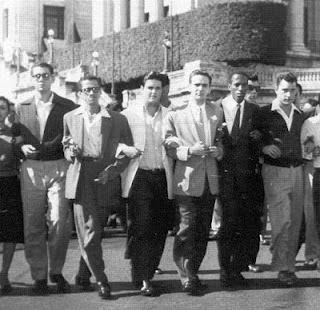
José Antonio Echeverría and The legacy of the "13 de Marzo"

"If you fight with violence, you are fighting with your enemy’s best weapon and you may be a brave but dead hero."- Gene Sharp

Student leader José Antonio Echeverría (center)
Fifty seven years ago today in the afternoon, a group of young men took up arms and charged into the presidential palace in Havana to assassinate the Cuban dictator, Fulgencio Batista, and were all gunned down. Nearby at the same time in Radio Reloj not knowing that the assault had failed student leader José Antonio Echeverría declared the dictator dead only to be himself killed in a skirmish after leaving the radio station. It was described as the day that Cuba lost its future.


More than a half century later both sides in the ongoing struggle declare José Antonio Echeverría as one of their own. However, his democratic credentials and history as an elected student leader and practicing catholic would place him at odds with the Castro dictatorship.

Nevertheless, the legacy of the "13 de Marzo" action to overthrow Fulgencio Batista by violent means ended with the deaths of many good and brave Cuban democrats, José Antonio among them, opening the way for Fidel Castro and in hindsight can be seen to have been a disastrous idea.

Michael Nagler, a long time peace scholar, presents the theorem as follows: Nonviolence sometimes “works” and always works, while by contrast, Violence sometimes “works” and never works.  Nagler offers a more detailed explanation.
The exercise of violence always has a destructive effect on human relationships even when, as sometimes happens, it accomplishes some short-term goal. The exercise of nonviolence, or Satyagraha, always brings people closer. This explains why Gandhi, after fifty years of experimentation in every walk of life, could declare that he “knew of no single case in which it had failed.” Where it seemed to fail he concluded that he or the other satyagrahis had in some way failed to live up to its steep challenge.  Taking the long view, he was able to declare that “There is no such thing as defeat in non-violence. The end of violence is surest defeat.”
Unfortunately, the "13 de Marzo" also has another and related significance in Cuban history. Twenty years ago this upcoming July 13, 1994 a tugboat named "13 de Marzo", in honor of that violent anniversary, carrying Cuban families seeking to flee the Castro dictatorship, that replaced Fulgencio Batista in 1959, was attacked by agents of the current dictatorship and 37 were killed among them 10 children.
Victims of the "13 de Marzo" Tugboat Massacre
 Hopefully the student movement in Venezuela will learn from this historic mistake by Cuban university students and maintain their nonviolent resistance to the Maduro regime.


Tuesday, August 6, 2013

Maleconazo 2013

August 5, 1994 in Havana, Cuba during "El Maleconazo" uprising
Nineteen years ago yesterday the word "liberty" was chanted through the streets of Havana, Cuba by thousands of Cubans spontaneously gathered in protest against the dictatorship and desiring freedom.
Part of the reason that they were out there was the "13 de Marzo"tugboat massacre that had taken place less than three weeks earlier just six miles from the Malecon in Havana. Family members and survivors bravely spoke out and the news of what happened had gotten out.


Thousands of Cubans beginning in the early hours of August 5, 1994 took to the streets shouting for freedom and continued throughout the day.

Plain clothes state security aiming gun during "El Maleconazo" uprising


The response by the regime was violent repression and police shooting at unarmed civilians and beating them down with night sticks. After things were under control the dictator Fidel Castro appeared on the scene and opened the borders. Before that announcement fleeing refugees had confronted snipers and grenades.


The end result was another mass exodus of Cubans. Nineteen years later the regime, as it did in 1994, opened the gates to relieve dissatisfied Cubans and like then there is another exodus of 46,662 Cubans who migrated permanently in 2012. The report also shows that over the past five years immigrants leaving averaged over 39,000 per year. At the same time repression is on the rise and scores of Cubans have been arrested.

August 5, 1994 in Havana, Cuba during "El Maleconazo" uprising

The Cuban punk rock band Porno para Ricardo on tour through Europe recalls those days of protest and frustration in 1994 in their song "El Maleconazo". They have an official video that begins with the lead singer calling for more Maleconazos. The conditions in Cuba two decades later are ripe for another social explosion.


Saturday, July 13, 2013

July 13, 2013: Nineteen years after the massacre; still no justice

 37 identified victims of the July 13, 1994 "13 de Marzo" Tugboat Massacre

July 13, 1994 at three in the morning three extended Cuban families set out for a better life aboard the "13 de Marzo" tugboat from Havana, Cuba and were massacred in a heinous crime committed by the Cuban government. The most extensive international report on the the events that took place was prepared by the Inter-American Commission on Human Rights. A Cuban women who lost 14 relatives, including her 10 year old son, Juan Mario Gutiérrez García described what she experienced.

María Victoria García Suarez and her son Juan Mario
 María Victoria García SuarezNo, they never told us to stop.  Then what they did was to shoot water at us.  Then the time came when we saw that we could not go on because it was going to be fatal and we stopped because the water was getting in.  Then we stopped and we told them:  "Look, we're turning back, we have already stopped, and they saw that we had stopped, and it was then that they split the side and turned the boat  around."  When they turned you around, what happened to you?  Those of  us on deck, we all went under and the boat sank immediately, but those of us in the water tried to get to the surface.  It was very deep.  I was carrying my son, I was holding him, I did not let go of him and then I pulled him up, but I don't know how to swim, then I came up but I went under again.  Then when I came up there was a woman who had drowned, she was floating beside me, then I grabbed her and carried my son--the waves were high--then  I could­n't... I couldn't, he had already drowned... 
The Victims

Hellen Martínez Enriquez. Age: 5 Months 
Xicdy Rodríguez Fernández. Age: 2 
Angel René Abreu Ruíz. Age: 3 
José Carlos Nicle Anaya. Age: 3 
Giselle Borges Alvarez. Age: 4 
Caridad Leyva Tacoronte. Age: 5 
Juan Mario Gutiérrez García. Age: 10 
Yousell Eugenio Pérez Tacoronte. Age: 11 
Yasser Perodín Almanza. Age: 11 
Eliécer Suárez Plasencia. Age: 12 
Mayulis Méndez Tacoronte. Age: 17 
Miladys Sanabria Leal. Age: 19 
Joel García Suárez. Age: 20 
Odalys Muñoz García. Age: 21 
Yaltamira Anaya Carrasco. Age: 22 
Luliana Enríquez Carrazana. Age: 22 
Jorge Gregorio Balmaseda Castillo. Age: 24 
Lissett María Alvarez Guerra. Age: 24 
Ernesto Alfonso Loureiro. Age: 25 
María Miralis Fernández Rodríguez. Age: 27 
Leonardo Notario Góngora. Age: 28 
Jorge Arquímedes Levrígido Flores. Age: 28 
Pilar Almanza Romero. Age: 31 
Rigoberto Feu González. Age: 31 
Omar Rodríguez Suárez. Age: 33 
Lázaro Enrique Borges Briel. Age: 34 
Julia Caridad Ruíz Blanco. Age: 35 
Martha Caridad Tacoronte Vega. Age: 35 
Eduardo Suárez Esquivel. Age: 38 
Martha Mirilla Carrasco Sanabria. Age: 45 
Augusto Guillermo Guerra Martínez. Age: 45 
Rosa María Alcalde Puig. Age: 47 
Estrella Suárez Esquivel. Age: 48 
Reynaldo Joaquín Marrero Alamo. Age: 48 
Amado González Raices. Age: 50 
Fidencio Ramel Prieto Hernández. Age: 51 
Manuel Cayol. Age: 56


This atrocity is not an aberration of the Cuban dictatorship but part of its totalitarian DNA. The men responsible for giving the orders and carrying them out 19 years later have still not had to answer for this crime.  Today, let us remember those who died, their names and how many were just children and youth who never got to live out their lives.


Friday, July 12, 2013

Oswaldo Payá Sardiñas on the heinous crime committed on July 13, 1994


A CRIME BEHIND THE BACK OF THE CHRIST OF HAVANA

Behind the Christ of Havana, about seven miles from the coast, "volunteers" of the Communist regime committed one of the most heinous crimes in the history of our city and of Cuba.

In the morning, a group of seventy people in all, fled on a tugboat, led by the ship's own crew; none was kidnapped, or there against their will. They came out of the mouth of the Bay of Havana.

They were pursued by other similar ships. When the runaway ship and its occupants stopped to surrender, the ships that had been chasing them started ramming to sink it. Meanwhile, on the deck, women with children in their arms begging for mercy, but the answer of their captors was to project high pressure water cannons against them. Some saw their children fall overboard under the murderous jets of water amid shrieks of horror. They behaved brutally until their perverse mission was fulfilled: Sink the fleeing ship and annihilate many of its occupants.

They murdered thirty two people, of them 20 children. Some would be turning 15 years old now. “Granma” the official organ of the Communist Party reported that the vessel sank because of a “rotating bell”. That continues to be the repeated official version, but the survivors tell of infernal scenes conceived and executed by diabolical minds.

They had many opportunities to not annihilate those twenty innocent children and additional women and men, but their malice was sustained. They lost the opportunity that God always gives his children not to fall into the abyss of evil, as fell those who ordered and carried out this crime.

Only the farce that ended with the murder by firing squad of eight innocent young Cuban medical students on the 27 of November of 1871 had the brutality, the arrogance, the cowardice and ruthless abuse that the crime of July 13, 1994 had.

Only the murder of 73 innocent people, many of them teenagers, Cuban athletes traveling in a Cubana airliner, exploded in midair the 6th of October of 1976 by a terrorist bomb, was full of so much sickening hatred, of so much perversion and of so much cynicism afterwards by their material and intellectual authors, as was the crime of July 13, 1994.

All of these behaviors: rage, arrogance, cowardice, ruthless abuse, sickening hatred, perversion and subsequent cynicism by the authors, overflow in the crime of the “13 de Marzo” tugboat, on the day of July 13, 1994. But impunity also overflows.

Impunity not only because the guilty have not been put on trial, but because many people in Cuba and in the world do not dare to denounce this crime and to even recognize it as such. The authors of this crime are treated as heroes by the Cuban government. The mourners were not even allowed to cry openly on our soil, not even complain, nor protest.

Before whom to make a claim? Before the tribunals that judge and unjustly condemn those who raise their voice to say the truth and those who march in silence to denounce these crimes? Too painful the events that I have mentioned, for which it is improper to use ironies. I seriously denounce that what is missing are 32 black flags that should be placed, from the Central Committee of the Communist Party, in a straight line to the Ministry of the Interior, but visible from the Ministry of Culture since its heralds of all species, Cubans and foreigners, are charged with singing to the lie and oppression, falsifying truth and freedom.

Let the silenced bells toll. But let them toll for all the victims of terror that in reality is only one sole victim: the Cuban people that without distinctions, suffers the loss of each one of their children.

The Christ of Havana is not turning his back on those who died; he is calling on those who are living so that they not live in the lie paralyzed by fear, but rather seek the truth with the hope that all of us Cubans can live free and as brothers. That way, one day soon, in that plaza and in all of Cuba, will be inundated with Cuban flags and white flags floating in the songs of all who will proclaim: at last peace and freedom!

Oswaldo José Payá Sardiñas
Havana, July 13, 2009


Original text in Spanish taken from the official page of the Christian Liberation Movement and is reproduced in its entirety below:

UN CRIMEN A ESPALDAS DEL CRISTO DE LA HABANA

A espaldas del Cristo de La Habana, a unas siete millas de la costa, “los voluntarios” del régimen comunista cometieron uno de los crímenes más horrendos en la historia de nuestra ciudad y de Cuba.
En la madrugada, un grupo de setenta  personas en total, huía en un remolcador, dirigidos por la propia tripulación de la nave. Ninguno iba secuestrado, ni en contra de su voluntad. Salieron por la boca de la  bahía de la Habana.

Le persiguieron otras naves semejantes. Al  detenerse la nave fugitiva y rendirse sus ocupantes, las naves que le perseguían comenzaron a embestirla hasta hundirla. Mientras tanto, en la cubierta, mujeres con niños en los brazos suplicaban piedad, pero la respuesta de sus captores fue proyectar contra ellos cañones de agua de gran potencia. Algunas vieron a sus hijos desprenderse bajo los chorros asesinos en medio de alaridos de horror. Se ensañaron hasta que cumplieron su misión perversa: Hundir la nave que huía y aniquilar a muchos sus ocupantes.

Asesinaron a treinta dos personas, de ellos veinte niños. Alguno estaría cumpliendo 15años ahora. El órgano oficial del Partido Comunista “Granma” informó que la nave se hundió por un giro de campana. Esa sigue siendo la versión oficial repetida, pero los sobrevivientes relatan las escenas infernales concebidas y ejecutadas por mentes diabólicas. Tuvieron  muchas oportunidades para no aniquilar a esos veinte niños inocentes y a mujeres y hombres, pero su maldad fue sostenida. Perdieron así la oportunidad que Dios siempre da para que sus hijos no caigan en el abismo del mal, como cayeron los que ordenaron y ejecutaron este crimen.

Únicamente la farsa que terminó con el asesinato por fusilamiento de ocho inocentes jóvenes cubanos estudiantes de medicina, el 27 de Noviembre de1871 tuvo la saña, la soberbia, la cobardía y el abuso despiadado, que tuvo el crimen del 13 de Julio de 1994.

Únicamente el asesinato de 73 personas inocentes, mucho de ellos adolescentes, atletas cubanos que viajaban en un avión de Cubana de Aviación,  explotado en pleno vuelo mediante bomba de terroristas, el 6 de octubre del1976, estuvo cargado de tanto odio enfermizo, de tanta perversión y de tanto cinismo posterior por sus autores materiales e intelectuales, como lo estuvo el crimen del 13 de Julio de 1994.

Todas estas conductas; saña, soberbia, cobardía, abuso despiadado, odio enfermizo, perversión y cinismo posterior de los autores, se desbordan en el crimen del Remolcador 13 de Marzo, del día 13 de Julio de 1994. Pero también se desborda la impunidad.

Impunidad no solamente porque los culpables no han sido juzgados, sino por que muchas personas en Cuba y en el mundo no se atreven a denunciar este crimen y ni siquiera a reconocerlo como tal.
Los autores de este crimen son tratados como héroes por el Gobierno cubano. Ni siquiera llorar abiertamente en nuestra tierra se permitió a los dolientes, ni siquiera quejarse, ni siquiera protestar.
¿Ante quien reclamar? ¿Ante los tribunales que juzgan y condenan injustamente a los que levantan la voz para decir la verdad y a los que desfilan en silencio para denunciar estos crímenes?

Demasiado dolorosos los eventos que aquí he mencionado, por lo que es impropio usar ironías. Denuncio seriamente que faltan 32 banderas negras que deben colocarse, desde al Comité Central del Partido Comunista, en línea directa, hasta el Ministerio del Interior, pero visible desde el Ministerio de Cultura ya que sus heraldos de todas las especies, cubanos y extranjeros, son los encargados de cantarle a la mentira y la opresión, falsificando la verdad y la libertad.

Que doblen las campanas silenciadas. Pero que doblen por todas las víctimas del terror, que en realidad son una sola víctima: el pueblo cubano que, sin hacer distinciones, sufre por la pérdida de cada uno de sus hijos.

El Cristo de la Habana no está dando la espalda a los que murieron, está llamando a los que viven para que no vivan en la mentira paralizados por el miedo, sino que busquen la verdad con la esperanza de que podemos vivir  todos los cubanos libres y como hermanos. Así, un día cercano, esa plaza y toda Cuba, se inundarán de banderas cubanas y de banderas blancas flotando en el canto de todos  que proclamará: ¡por fin la paz y la libertad¡

Oswaldo José Payá  Sardiñas
La Habana, 13 de Julio de 2009


Sunday, July 7, 2013

Placing a massacre of Cuban civilians into context

Originally published in The PanAm Post blog The Canal on July 7, 2013
“In Cuba there are missing and it is known who has disappeared them, the latter are heroes for the government….There are more than 20 murdered children waiting to be claimed and mothers and grandmothers who were not allowed to look for them when they were killed off the coast of Havana” – Oswaldo Payá Sardiñas, El Nuevo Herald, March 18, 2005*
 Cuba is being subjected to a totalitarian dictatorship that for over half a century has erased and rewritten inconvenient chapters of its history. As was the case with the Soviet Union under Stalin the scale of the crimes can not be accurately measured during the life of the dictator, but occasionally state security and the propaganda machinery unable to cover up a particular crime offers an insight into the regime’s underlying nature. The events of July 13, 1994 is one such instance. 

What happened
 The July 13, 1994 massacre that took place just six miles off the Cuban coastline and claimed 37 lives, the majority women and children is one instance where the true nature of the Cuban government was exposed. Three Cuban families seeking a better life away from the dictatorship sought passage aboard the Cuban tugboat the “13 de Marzo.” The captain of the tug was part of the group wanting to leave. The tugboat left Havana on Wednesday, July 13, 1994 in the early morning hours.

Six miles from the Cuban coast line the “13 de Marzo”tugboat was confronted by three other tugboats . Amnesty International in their 1997 investigation reported that the vessels which attacked the “13 de Marzo” were named and identified as belonging to the Ministry of Transport:
“…Polargo 2”, “Polargo 3″ and “Polargo 5″. According to survivors, “Polargo 5″ was the vessel which acted most aggressively towards them. The fourth vessel which followed along behind them and which appeared to be directing operations was believed to belong to the Cuban Coast Guard, which is part of the Ministry of the Interior.”
Despite the “13 de Marzo” tugboat attempting to surrender and the mothers holding up their children begging for mercy the other tugboats continued to ram them and use high pressure hoses to blast the passengers overboard. Following this they began to circle the wreckage with the aim of creating a whirlpool affect to ensure that any survivors would drown. Their plans were dashed however when a Greek trawler passing by witnessed the massacre. It was then and only then that the attack was suspended and the survivors picked up. 

International Investigation
International human rights bodies and organizations investigated the incident. The United Nations Human Rights Commission’s special rapporteur on Cuba made the following observation on October 24, 1995 in his report on the human rights situation in Cuba to the UN General Assembly:
Although the Government maintains that the authorities bore no responsibility for what was considered to have been an accident, the Special Rapporteur received testimony from some of the survivors indicating that Government launches from the port of Havana tried to stop the 13 de Marzo with pressurized water jets and then deliberately rammed it, causing it to sink. Non-governmental sources informed the Special Rapporteur that the number of persons who died was not 32, as the Government had stated, but at least 37 and that the families have for a year now been asking for an investigation to be initiated.
 On October 16, 1996 the Inter-American Commission on Human Rights (IACHR) released Report Nº 47/96 Case 11.436 Victims of the Tugboat “13 de Marzo” vs. Cuba. Among the conclusions reached in the investigation was that:
The Cuban State is responsible for violating the right to life (Article 1 of the American Declaration of the Rights and Duties of Man) of the 41 people who were shipwrecked and perished as a result of the sinking of the tug “13 de Marzo”, which events occurred seven miles off the Cuban coast on July 13, 1994. The persons who died that morning are: Leonardo Notario Góngora, Marta Tacoronte Vega, Caridad Leyva Tacoronte, Yausel Eugenio Pérez Tacoronte, Mayulis Méndez Tacoronte, Odalys Muñoz García, Pilar Almanza Romero, Yaser Perodín Almanza, Manuel Sánchez Callol, Juliana Enriquez Carrasana, Helen Martínez Enríquez, Reynaldo Marrero, Joel García Suárez, Juan Mario Gutiérrez García, Ernesto Alfonso Joureiro, Amado Gonzáles Raices, Lázaro Borges Priel, Liset Alvarez Guerra, Yisel Borges Alvarez , Guillermo Cruz Martínez, Fidelio Ramel Prieto-Hernández, Rosa María Alcalde Preig, Yaltamira Anaya Carrasco, José Carlos Nicole Anaya, María Carrasco Anaya, Julia Caridad Ruiz Blanco, Angel René Abreu Ruiz, Jorge Arquímides Lebrijio Flores, Eduardo Suárez Esquivel, Elicer Suárez Plascencia, Omar Rodríguez Suárez, Miralis Fernández Rodríguez, Cindy Rodríguez Fernández, José Gregorio Balmaceda Castillo, Rigoberto Feut Gonzáles, Midalis Sanabria Cabrera, and four other victims who could not be identified.
 The IACHR made three recommendations:
1) that the Cuban State conduct an exhaustive investigation in order to identify, prosecute and punish those responsible for sinking the tug “13 de Marzo”
2) that the Cuban state recover the sunken boat and the remains of the victims and hand them over to their relatives and
3) that the Cuban State pay fair compensation to the surviving victims and to the families of the dead for physical and nonphysical damages, including emotional distress.
 Placing the July 13, 1994 massacre into context
The state security apparatus in Cuba was trained by the East German intelligence service, known as the Stasi, the most brutal security apparatus behind the Iron Curtain rivaling the Soviet KGB in brutality and surpassing it in its espionage capabilities. It is also important to note that Fidel Castro visited the Berlin Wall and paid homage to the soldiers who were extrajudicially killing Germans trying to make it across to West Germany in 1972:
“The comrades of the party and the citizens of socialist Berlin have told us with great satisfaction about the activity of the border troops, speaking with great admiration for you and for your services.”
The orders issued to these border guards by the East German government were simple and without mercy:
“It is your duty to use your combat … skills in such a way as to overcome the cunning of the border breacher, to challenge or liquidate him in order to thwart the planned border breach… Don’t hesitate to use your weapon even when border breaches happen with women and children, which traitors have often exploited in the past.”
 The actions of Cuban border patrols on July 13, 1994, and instances such as the June 1993 use of machine gun fire and hand grenades on defenseless swimmers trying to reach the U.S. Guantanamo Naval base that drew an official protest from the United States government at the time, are not aberrations. Unfortunately, this was not an isolated incident, talking to Cuban exiles randomly in Miami have heard accounts of others who died in the same manner trying to flee the island over the past half century. It just happened to be one of the few times when it was properly documented and an official complaint lodged.

The men responsible for the July 13, 1994 tugboat massacre where given medals and described as heroes by Fidel Castro. This should not be a surprise when considering that he had praised the East German border guards that carried out orders to kill men, women, and children whose sole “crime” was trying to reach freedom on the other side of the Berlin Wall. 

New information that has emerged
Fifteen years after the events of July 13, 1994 I had the opportunity to sit down with Jorge García who lost 14 family members that day. Jorge learned the names of those who took part in the massacre of the “13 de Marzo” tugboat.

The one who was the most aggressive, the bloodiest and oversaw the operation was Jesús González Machín, captain of the “Polargo 5″ that sunk the “13 de Marzo” tugboat. He actually had the opportunity to meet him and photograph him. Although Machín denied having sunk the “13 de Marzo,” he said something of tremendous legal importance: “I didn’t work that day. They called me at 6 p.m. that there was an operation at the port.”

That is to say that from 6 p.m. on July 12, 1994, at the Port of Havana, Cuban state security was there to direct the operations of the sinking of the “13 de Marzo.” They knew what was going to happen. It was a double crime. They could have stopped or impeded the departure of the tugboat. They followed orders and sank the boat.

Following the massacre, family members imagined that the bodies would be returned to them. The government organized Rapid Response Brigades and blocked anyone from visiting the home. The dictatorship had persons with weapons to intimidate. Jorge García was detained and interrogated on several occasions. The longest detention was 15 days. His daughter, María Victoria García, was one of three of his family who survived the massacre and spoke out:
They tried on several occasions to kill my daughter, because she was the first to speak out and contradict the regime’s official narrative.
He and his daughter are now exiled in Miami. Jorge maintains an archive of information and has interviewed the survivors of the massacre and the families of the victims. He has also confirmed that the number killed that day was 37. The initial investigation had placed the number at 41 with four unknown but has now been confirmed to be the 37 listed above.

 The continuing need for justice
 Although it has been 19 years the bodies of the victims have not been returned to the families and the men responsible have not had to answer for their crimes before any tribunal. Nevertheless, as has been seen in Argentina, Ethiopia, and Cambodia justice may be delayed but still applied against those who commit human rights atrocities. The victims of the July 13, 1994 tugboat massacre still need justice.
* Oswaldo Payá Sardiñas was killed i n Cuba on July 22, 2012 following a suspicious car crash.