Showing posts with label Angola. Show all posts

Saturday, November 25, 2023

First Secretary, President, Prime Minister, and Secretary-General, Comandante Fidel Castro is still dead.

 Breaking news. Fidel Castro is still dead.

Fidel Castro: Cuba's absolute dictator turned power over to his brother

First Secretary of the Central Committee of the Communist Party of Cuba, President of the Council of State of Cuba, President of the Council of Ministers of Cuba, Prime Minister, and Secretary-General of the Non-Aligned Movement, Comandante Fidel Castro is still dead.   

Seven years ago, on a Black Friday that fell on November 25, 2016, Cuban tyrant Fidel Castro died at the age of 90 never having had to answer for his many crimes against humanity both in and out of Cuba. From Nicaragua, to Ethiopia, to Venezuela, and in many other places Fidel Castro assisted tyrants and dictators to take power, hold on to it, and consolidate their rule.  One day later in a blog post I predicted what would come next.

"Predictably over the next few weeks inside Cuba the world will see spectacles organized by the totalitarian dictatorship to "mourn the great leader." The regime has already started with nine days set aside for official mourning. This will not be the first time that monsters are mourned by an oppressed people through different methods of command, control and manipulation. The world has witnessed it before in the Soviet Union in 1953 and more recently in North Korea with the Kim dynasty. The death of Stalin as dramatized in the film "The Inner Circle" is recommended viewing for those about to follow the circus in Cuba in the wake of Fidel Castro's death.  Meanwhile in Cuba as the regime prepares its state funeral the Castro dictatorship's secret police begin to make threats, round up and take dissidents to undisclosed locations and commit acts of violence." 

Six years later the fans of the late Cuban dictator are out trying to defend his legacy and repeating the lies to put him in a positive light. These apologists of the dictator are silent on the role played by the United States government and The New York Times in undermining Fulgencio Batista's rule and bringing Fidel Castro to power.

There are other inconvenient truths that are well documented and available for those seeking facts about the Cuba that existed prior to 1959 with warts and all, and what came after.

On this sixth anniversary of the dictator's death it is a good time to remember some of his more memorable statements.

Relationship with the truth

Fidel Castro in the 1950s repeatedly claimed that he was not a communist because he knew that advocating a communist revolution would lead Cubans to abandon him. On December 2, 1961 he explained his reasoning.
 
"If we had paused to tell the people that we were Marxist-Leninists while we were on Pico Turquino and not yet strong, it is possible that we would never have been able to descend to the plains."

On March 26, 1964, after announcing that he had always been a Marxist Leninist, Castro explained: 
"I conceive the truth in terms of a just and noble end, and that is when the truth is truly true. If it does not serve a just, noble and positive end, truth, as an abstract entity, philosophical category, in my opinion, does not exist."  
Jose Ignacio Rasco, who knew Fidel Castro from school and afterwards concluded that the Cuban revolutionary had been a committed communist by 1950.
 
Denied universality of human rights , and erased Cuba's role in 1948 codifying them

 
Fidel Castro in the above interview in Havana in 1986 divided freedoms i.e. rights as one set being revolutionary liberties and another being bourgeois liberties and claiming that there are two different concepts of liberty he is rejecting the Latin American tradition which was best expounded in the Universal Declaration of Human Rights that there are basic human rights that are universal and not separated by political/ideological or as in the Islamic claim by religious differences but are the same for everyone. Omitted the role played by Cuban diplomats in drafting and lobbying for the passage of the Universal Declaration of Human Rights in 1948.
 
In 1961 in a speech that became known as "Words to intellectuals" Fidel Castro labeled dissenters "counterrevolutionaries" and explicitly stripped them of their rights. 

What are the rights of writers and artists, revolutionary or non-revolutionary? Within the Revolution, everything; against the Revolution, no right (applause). And this is not some special law or guideline for artists and writers. It is a general principle for all citizens. It is a fundamental principle of the Revolution. Counterrevolutionaries, that is, the enemies of the revolution, have no rights against the revolution, because the revolution has one right: the right to exist, the right to develop, and the right to be victorious." ... "In other words: Within the revolution, everything; against the revolution, nothing."
This is not an original statement, but an echo of speeches and writings made by other tyrants. A close parallel is found in Benito Mussolini's 1935 speech: "Everything is in the State, and nothing human or spiritual exists, much less has value, outside the State."   
 
Consequences of this policy in Cuba were seen internationally in the Padilla Affair in 1971. 
 
Homophobic

We would never come to believe that a homosexual could embody the conditions and requirements of conduct that would enable us to consider him a true revolutionary, a true communist militant.” ... A deviation of that nature clashes with the concept we have of what a militant communist should be.” - Fidel Castro, 1965
 

On March 13, 1963 Fidel Castro gave a speech were he openly attacked “long-haired layabouts, the children of bourgeois families,” roaming the streets wearing “trousers that are too tight,” carrying guitars to look like Elvis Presley, who took “their licentious behavior to the extreme” of organizing “effeminate shows” in public places. The Cuban dictator warned: “They should not confuse the Revolution’s serenity and tranquility with weaknesses in the Revolution. Our society cannot accept these degenerates.”

Both Gays, and rock n rollers were sent to forced labor camps. 

Ended Black Cuban agency 

"In Cuba, the exploitation of man by man has disappeared, and racial discrimination has disappeared, too." - Fidel Castro, quoted in Castro's Cuba, Cuba's Fidel By Lee Lockwood, 1967

Castro’s communist revolution ended Black Cuban's agency in Cuba. Cuban black nationalist Juan René Betancourt in his essay "Castro and the Cuban Negro" published in the NAACP publication The Crisis in 1961 detailed how it was done.

“Of the 256 Negro societies in Cuba, many have had to close their doors and others are in death agony. One can truthfully say, and this is without the slightest exaggeration, that the Negro movement in Cuba died at the hands of Sr. Fidel Castro.” … “Yet this is the man who had the cynical impudence to visit the United States in 1960 for the purpose of censuring American racial discrimination. Although this evil obviously exists in the United States, Castro is not precisely the man to offer America solutions, nor even to pass judgement.”
Between 1898 and 1959 the relationship between Black-Americans and Black-Cubans was based on their being part of an international black diaspora. This relationship ended when the Castro regime ended autonomous black civil society in 1962, and consolidated totalitarian rule. It was replaced by Castro and his white revolutionary elite allying with Black elites in the United States, and Africa while criticizing racism in the United States. 

For decades, the Castro regime expected Black Cubans to be obedient, submissive, and grateful to the white revolutionary elite, and this was reflected in official propaganda with racist tropes. Black Cubans who think for themselves are punished.

 On Walls and border controls


Fidel Castro visited Berlin in 1972 and encouraged the border guards to continue shooting Germans trying to flee to freedom by crossing the Berlin Wall. At Brandenburg gate on June 14, 1972 in the afternoon (pictured above) he addressed the men charged with shooting East Germans fleeing to West Germany as "the courageous and self-denying border guards of the GDR People's Army who stand guard in the front line of the entire-socialist community." Castro addressed the Nikolay Bezarin Barracks in East Berlin:
"It is very important to know that the people of the GDR have great confidence in you, that they are truly proud of you. The comrades of the party and the citizens of socialist Berlin have told us with great satisfaction about the activity of the border troops, speaking with great admiration for you and for your services."

No doubt this inspired the Cuban tyrant to turn the Florida Straits, and the border of the Guantanamo Naval Base into barriers to kill fleeing Cuban refugees. 

Anti-Black purge in Angola

On November 5, 1975, 30,000 Cuban troops were dispatched to Angola in what was called Operation Carlota, and today pro-Castro sympathizers over social media are celebrating this anniversary with excerpts of a speech the Cuban dictator gave announcing the move at the time. Cuban troops, beginning on May 27, 1977, took part in a massacre in Angola following a split in the governing Communist People's Movement for the Liberation of Angola (MPLA) party. Amnesty International cites reports that 30,000 Angolans "had disappeared" in the purge; other sources place the number at 80,000 killed. 

There was a racial component, with those massacred being young, black revolutionaries, and those in power who Castro allied with: mixed race and white Angolans and Eurocentric, although they were Marxist-Leninists so it was not a problem for Leftists, including those in power in Portugal. The definitive account of this massacre in English is found in Lara Pawson's 2014 book, "In the Name of the People: Angola's Forgotten Massacre." A 2017 review of the book by Fernando Arenas published in Luso-Brazilian Review provides the following summary.

In the Name of the People offers major insights regarding the history of May 1977, including the key role played by Cuban military forces, who defended Agostinho Neto and the ruling MPLA against the attempted coup, in defiance of the Soviet Union, while committing atrocities against Nito Alves's supporters. It also highlights the centrality of racial politics in Nito's movement against the perceived political dominance of mixed race and white Angolans in the MPLA to the exclusion of the majority poor black population, emphasizing the movement's rejection of endemic corruption within the MPLA and its betrayal of the socialist revolution.

Nelson Da Silva on his Youtube channel provided video excerpts of a book talk in 2015 with the author Lara Pawson, and questions and comments by Angolans.

Creating a planned famine in Ethiopia
 
Castro with ally and war criminal Mengistu Haile Mariam in Ethiopia 1977

Fidel Castro on April 3, 1977 met in East Berlin with Erich Honecker about the need to help the revolution in Ethiopia and talked up Mengistu Haile Mariam, a then emerging new Marxist-Leninist leader. Fidel Castro celebrated the initiation of the Red Terror on February 3, 1977 in Ethiopia: 

"Mengistu strikes me as a quiet, serious, and sincere leader who is aware of the power of the masses. He is an intellectual personality who showed his wisdom on February 3. [] The prelude to this was an exuberant speech by the Ethiopian president in favor of nationalism. Mengistu preempted this coup. He called the meeting of the Revolutionary Council one hour early and had the rightist leaders arrested and shot. A very consequential decision was taken on February 3 in Ethiopia. []Before it was only possible to support the leftist forces indirectly, now we can do so without any constraints."
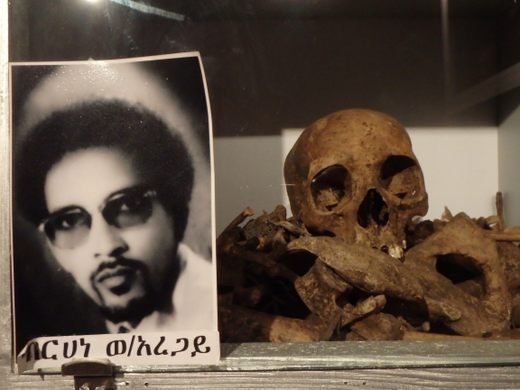
Fidel Castro took part in mass murder in Eastern Africa in the 1970s and 1980s. Between 1977-78, a conservative estimate of over 30,000 Africans perished as a result of a Red Terror unleashed in Ethiopia by Mengistu and his Cuban allies.
 
Ramiro Valdez, Raul Castro and Fidel Castro with Mengistu Haile Mariam

Amnesty International concluded that "this campaign resulted in several thousand to perhaps tens of thousands of men, women, and children killed, tortured, and imprisoned." Sweden's Save the Children Fund lodged a formal protest in early 1978 denouncing the execution of 1,000 children, many below the age of thirteen, whom the communist government had labeled "liaison agents of the counter revolutionaries."
 
 Advocating for and actively trying to start a nuclear holocaust
Castro freaked out Khrushchev with call for a first strike
 
On October 27, 1962, the same day that Fidel Castro ordered artillery to fire on American reconnaissance aircraft, successfully knocking one down, Khrushchev received a letter from the Cuban dictator, that historians call the Armageddon letter, in which he called for a Soviet first strike on the United States, in the event of a US invasion of Cuba.

If an aggression of the second variant occurs, and the imperialists attack Cuba with the aim of occupying it, then the danger posed by such an aggressive measure will be so immense for all humanity that the Soviet Union will in circumstances be able to allow it, or to permit the creation of conditions in which the imperialists might initiate a nuclear strike against the USSR as well.

Thankfully, Kennedy and Khrushchev reached a peaceful outcome, but the Castro regime continued to protest and was unhappy with their Soviet allies for not launching the intercontinental ballistic missiles that would have started a thermonuclear war.

Comandante Castro ordered students to the streets to chant "Nikita, mariquita, lo que se da no se quita" ("Nikita, little queer, what you give you don't take away").
 
The Brothers to the Rescue shoot down.
 

Dan Rather:-The incident of the Brothers to the Rescue aircraft…But you gave the order.  It was not your brother Rául or a general.

Fidel Castro:-I gave the order to communicate to the Air Force that what happened on the ninth and thirteenth could not be permitted again.  But these operations are very quick.  They enter in a matter of minutes and leave.  It is very difficult to establish a mechanism of communication and consultation.  They had the general order of not permitting them…They acted with full awareness that they were following the order.  At that moment there was not…The air force had the responsibility.  As a rule they can communicate with each other, but everyone is not always there.  In fact, they had the authority to do it, and I assume the responsibility.  I am not trying to elude the responsibility in the least, because they were instructions given in a moment of really great irritation.  They were given to the pilots, I believe, if I remember correctly, on the 14th of January. 

Source: FIDEL CASTRO INTERVIEW BY DAN RATHER -  MADE PUBLIC SEPT 3, 1996

Detailed investigation into the Brothers to the Rescue shootdown available here.

Alliances with Fascists and Nazis
 
Fidel Castro in 1962 when Otto-Ernst Remer was selling him weapons

 
In the early 1960s the Nazi who saved Adolf Hitler's Third Reich in 1944, Otto-Ernst Remer, had contacts with and assisted Fidel Castro in Cuba with the purchase of weapons. Ernst-Remer along with Ernst Wilhelm Springer sold the Cuban dictator 4,000 pistols. The German foreign intelligence agency, Bundesnachrichtendienst (BND), reported that "evidently, the Cuban revolutionary army did not fear contagion from personal links to Nazism, so long as it served its objectives." 
 
The Cuban autocrat was friendly with his Spanish counterpart Francisco Franco, and declared days of mourning when the Generalissimo, Prime Minister, Head of State, and Caudillo died on November 20, 1975. 

In the picture below is Fidel Castro with Argentine foreign minister Nicanor Costa Mendez, one of the planners of the Falkland's invasion, of the Argentine military junta that extra-judicially executed and disappeared as many as 30,000 Argentinians between 1976 and 1983 in the Dirty War meeting in Havana at the Non-Aligned Movement gathering. He died of lung cancer on August 3, 1992.

Argentine foreign minister Nicanor Costa Mendez and Fidel Castro

This is not the only member of the junta that Castro commiserated with. The Cuban dictator was also photographed with "President" Reynaldo Benito Antonio Bignone Ramayón who, like Fidel Castro then and Raul Castro today , was"President" in name only, but in reality a brutal military dictator between 1982 and 1983. On April 20, 2010, he was sentenced to 25 years in prison for the kidnapping, torture, and murder of 56 people in a concentration camp.


Reynaldo Benito Antonio Bignone Ramayón with Fidel Castro

Whereas Human Rights Watch and Amnesty International sought to expose and end the Dirty War, as well as later document the crimes committed and demand justice on behalf of the victims, the Cuban government did everything possible at the time to obstruct efforts to investigate the disappearances from their perch at the United Nations Human Rights Commission. 

Drug trafficker


John Simpson of BBC Newsnight interviewed Castro's former bodyguard, Juan Reinaldo Sanchez, where he explained how he became disillusioned with Fidel Castro because of his links to drug traffickers, despite the dictator's public denunciation of the practice. Sanchez died within a year of publishing his memoir in May 2015 at the age of 66 in Miami.

What have joint anti-drug operations with Cuba, and sharing intelligence done in concrete terms for US citizens? In 1999, the year when Washington intensified these efforts 3,186 U.S. citizens died of cocaine overdoses. In 2021, after 22 years of this "cooperation" 23,513 Americans died in 2021

Anti-Semite

Cuban Jewish family targeted by the Castro regime for being Jewish.

 
The Cuban dictatorship has a history of domestic antisemitism. Cuban officials in 2019, in an act of continuity with Fidel and Raul Castro's hatred of Jews, barred Jewish children from wearing kippahs in school. Fidel Castro in 1994 prohibited the importation of kosher meat into Cuba, despite allowing Halal food, which complies with Islamic dietary laws. Castro supported the 1975 UN resolution equating Zionism with racism and opposed its repeal in 1991.  

From 1959 through 1973, Havana maintained diplomatic relations with Israel while supporting terrorism against Israelis. Castro hailed the establishment of the Palestinian Liberation Organization (PLO) in 1965 and established ties with the Palestinian Fatah in Algiers and Damascus. Castro introduced PLO members at the Tri-Continental Conference in Havana in January 1966. This conference backed revolutionary and terrorist organizations across Europe, the Americas, and Asia with the objective of changing the world order in an authoritarian direction.

Fidel Castro compared Israel to Nazi Germany on October 15, 1979. “From the bottom of our heart, we repudiated the merciless persecution and genocide that the Nazis once visited on the Jews,” he said. “But there is nothing in recent history that parallels it more than the dispossession, persecution and genocide that imperialism and Zionism are currently practicing against the Palestinian people.”

In 2014, Castro called Israeli efforts to defend themselves from Hamas terrorism “a repugnant new form of fascism,” and a “macabre genocide against the Palestinian people.” 

The Cuban dictatorship’s hostility to Israel was not limited to rhetoric and its assistance to terrorists. Cuba also involved itself in direct military action.

Castro severed diplomatic ties with Israel on September 10, 1973, just days before the Yom Kippur War began. During that war, 3,000 Cuban soldiers participated in the attack on Israel, alongside forces from Egypt and Syria, and expeditionary forces from Saudi Arabia, Algeria, Jordan, Iraq, Libya, Kuwait, Tunisia, Morocco, and North Korea.  

Fidel Castro and Yasser Arafat meet in Havana in 1974
 

Good riddance.

Until his death in 2016, Fidel Castro was a consistent enemy of democracy and human rights. He had many titles, including First Secretary of the Central Committee of the Communist Party of Cuba, President of the Council of State of Cuba, President of the Council of Ministers of Cuba, Prime Minister and Secretary-General of the Non-Aligned Movement, and Comandante, but tyrant is the most appropriate. Fidel Castro, Cuba's despot, is still dead, and good riddance. 

 
May the death cult that has formed around this tyrant soon join him.

Sunday, November 6, 2022

Operation Carlota: What is left out from the Castro regime's official narrative on Angola

Source: Paul Trewhela
 

Communists reject nonviolence as a means to achieve lasting change because civil disobedience is incompatible with Karl Marx's theory of class struggle. This is why they demonize and misrepresent Mohandas Gandhi and downplay the real events that brought an end to apartheid in South Africa. Instead, they celebrate the start of the Cuban military intervention in Angola (Operation Carlota) on November 5, 1975, highlight a dubious military victory in 1988 involving Cuban troops, and falsely celebrate it as the agent of change.

Agostinho Neto and Fidel Castro carried out purge in Angola.

 
Purge in Angola

Not mentioned is that Cuban troops, in May 1977, took part in a massacre not long after independence in Angola following a split in the governing Communist MPLA party. Amnesty International cites reports that 30,000 "had disappeared" in the purge; others say as many as 80,000 were killed.

What of Castro's involvement in South Africa?


General Arnaldo Ochoa Sanchez walking with Fidel Castro

An opportunity to present what the Castro regime has omitted and correct the record arises from the dictatorship's attempt to paint Operation Carlota in a favorable light.

What happened to the Cuban general who headed the Cuban military mission in Angola and prosecuted the battles against the South African Defence Forces, and their allies?

Cuban General who successfully led the effort in Angola executed

General Arnaldo Ochoa Sanchez, who organized and led Cuban troop buildups in Angola (1976) and Ethiopia (1977), led Sandinista and Cuban troops in Nicaragua against Contra forces in the early 1980s, and distinguished himself in Southern Africa during a months-long military campaign against the Apartheid regime's army in Angola from August 1987 to March 1988, unfortunately for General Ochoa, it is believed that he had grown too popular among the troops and had the mistaken idea that he had the right to an opinion, was executed by firing squad on July 13, 1989.

General Arnaldo Ochoa executed on July 13, 1989.

Arturo J. Cruz's article in the November 1989 issue of Commentary Magazine titled "Anatomy of an Execution" outlined what cost General Ochoa his life. 

"On Wednesday night, June 14, Raul Castro addressed the nation on radio and television. He spoke for two hours, at times almost incoherently, and his words betrayed a barely suppressed hatred for Ochoa—an envious passion toward a colleague who was a senior general officer in the fullest, most professional military sense. Raul accused Ochoa of being irreverent; he complained about Ochoa’s jokes; he derided what he called Ochoa’s “populist deviations” with the troops (referring, evidently, to the one thing which Raul himself has never enjoyed with the Cuban enlisted man—genuine popularity)."

This was in a sensitive moment for the regime. Panamanian strong man Manuel Noriega, who had been involved, together with the Castro brothers, in drug trafficking has been indicted in U.S. courts and the American military invaded Panama captured him had been. Others like Tony de la Guardia were executed because they could have testified to the direct involvement of the Castro brothers in the drug trade.  Bad luck for his twin brother Patricio, who ended up sentenced to 30 years in prison.

It was South Africans, not the Castro regime that ended the Apartheid regime

UDF boycotted elections

Nationalist narratives tend to glorify violent narratives, at the expense of successful nonviolent initiatives. In India for example, the 3,000 nationalists who joined ranks with Hitler and the Third Reich to fight the British get credit with speeding up Indian Independence.  However the millions who took part in nonviolent actions in Gandhi's movement get short shrift as the Hindu nationalists grow in power in India.

The same holds true in South Africa. Piero Gleijeses. a professor of American foreign policy at the Johns Hopkins School of Advanced International Studies writing in The National Interest in 2014 gives a positive assessment of the Cuban intervention in Angola quoting Nelson Mandela that their victory “destroyed the myth of the invincibility of the white oppressor ... [and] inspired the fighting masses of South Africa ... Cuito Cuanavale was the turning point for the liberation of our continent—and of my people—from the scourge of apartheid.”  For the record both sides claimed victory in the battle of Cuito Canavale.

Failure of ANC violence to dislodge the Apartheid regime

Professor Gleijeses failed to look at the historical context, and Nelson Mandela's commitment to the violent overthrow of the Apartheid regime. In the case of South Africa the decision of the African National Congress (ANC) to adopt violence as a means to end Apartheid in 1961 may in fact have prolonged the life of the racist regime by decades. It also led to Nelson Mandela spending decades in prison refusing to renounce his violent stand.

Mandela became a symbol of resistance, and later an agent of national reconciliation, but he was not the agent of regime change in South Africa.

UDF nonviolent resistance, and economic sanctions ended the Apartheid regime

It was not the armed struggle of the ANC that brought the Apartheid regime to the negotiating table but the United Democratic Front (UDF).  The history of how the Apartheid regime was brought to an end is often overlooked. This is the history of the UDF and the successful nonviolent struggle it carried out that is documented in A Force More Powerful:

 In the city of Port Elizabeth, Mkhuseli Jack, a charismatic 27-year-old youth leader, understands that violence is no match for the state's awesome arsenal. Jack stresses the primacy of cohesion and coordination, forming street committees and recruiting neighborhood leaders to represent their interests and settle disputes. Nationally, a fledgling umbrella party, the United Democratic Front (UDF), asserts itself through a series of low-key acts of defiance, such as rent boycotts, labor strikes, and school stay aways. 
Advocating nonviolent action appeals to black parents who are tired of chaos in their neighborhoods. The blacks of Port Elizabeth agree to launch an economic boycott of the city's white-owned businesses. Extending the struggle to the white community is a calculated maneuver designed to sensitize white citizens to the blacks' suffering. Beneath their appeal to conscience, the blacks' underlying message is that businesses cannot operate against a backdrop of societal chaos and instability. 
Confronted by this and other resistance in the country, the government declares a state of emergency, the intent of which is to splinter black leadership through arbitrary arrests and curfews. Jack and his compatriots, however, receive an entirely different message: the country is fast becoming ungovernable. Apartheid has been cracked. 
Undaunted by government reprisals, the UDF continues to press its demands, particularly for the removal of security forces and the release of jailed African National Congress leader Nelson Mandela. White retailers, whose business districts have become moribund, demand an end to the stalemate. The movement also succeeds in turning world opinion against apartheid, and more sanctions are imposed on South Africa as foreign corporations begin to pull out many investments. In June 1986, the South African government declares a second state of emergency to repress the mass action that has paralyzed the regime.

The collapse of the violent option with the end of the Cold War coincided with Apartheid's end.

The negotiations to end Apartheid began in 1990, after the collapse of the East Bloc, and coincidently ended in 1991, the year the Soviet Union peacefully dissolved. The ANC no longer had the weapons and financial support provided by Havana and Soviets from the 1960s into the early 1980s. There were some in South Africa who in 1989 lamented the passing of the Berlin Wall, but if not for the end of the Cold War things might not have changed for the better. Paul Trewhela in PoliticsWeb offered the following analysis:

On 9 November 1989, twenty years ago, the Berlin Wall cracked open, the Cold War in Europe came to an end, the Soviet empire tottered to its grave and the ANC military option lost whatever teeth it might have had. The military/security state erected by the National Party never lost a centimeter squared of its soil. Umkhonto weSizwe, the military wing of the ANC and the South African Communist Party, never won a centimeter squared of soil. True, the repeated mass mobilizations and popular uprisings within South Africa through the Seventies and the Eighties placed a colossal strain upon the regime, and, true, the economic strain upon the state - especially in conditions of attrition exercised against it by the US banking system - placed it under further serious pressures. Nevertheless, honest accounting must say that, given the continuation of the Cold War system in Africa, this nuclear-armed state at its southern tip was nowhere near collapse.

The international situation that undermined the ANC's armed struggle, combined with the successful nonviolent campaigns of the United Democratic Front (UDF) facilitated the end of Apartheid in South Africa.

In South Africa there was a older tradition going back to 1893 - 1914 with Mohandas Gandhi's experiments with nonviolence against anti-Indian racism there. It was in South Africa on September 11, 1906 that the word Satyagraha came into existence. It is this legacy of nonviolence that has endured and gives hope for the future.

Castro regime's role in the Red Terror in Ethiopia

Left to right: Ramiro Valdes, Raul Castro, Fidel Castro and Mengistu Haile Mariam

Unfortunately, abandoning nonviolence and embracing the false and violent narrative of Castroism is a recipe for endangering South African democracy. There lies the way of mass murder and genocide. This is not conjecture. General Arnaldo Ochoa Sanchez was sent to Ethiopia in 1977 to build up Cuba's military presence. Fidel Castro, Raul Castro, and
Ramiro Valdés Menéndez were deeply involved in sending 17,000 Cuban troops to Eastern Africa to assist Lt. Col. Mengistu Haile Mariam in consolidating his rule and eliminating actual and potential opposition in Ethiopia. 

Fidel Castro and Mengistu Haile Mariam
 

The claim of anti-imperialism is also undermined by the Castro regime's actions in Ethiopia.  

Background

Ethiopia was the only African country to successfully resist the European colonial scramble for Africa in the 19th century. Ethiopia had an African monarchy that stretched back to Biblical times.

Emperor Haile Selassie I of Ethiopia had served first as regent of Ethiopia from 1916 to 1930 and as emperor from 1930 to 1974. He was the heir to a dynasty that traced its origins to the 13th century and, from there, by tradition, back to King Solomon and the Queen of Sheba. Ethiopia was invaded and occupied by Mussolini in 1935, who used chemical warfare to defeat the Ethiopians. The Ethiopians fought bravely against the Italian fascists.

At the League of Nations in 1936, Emperor Selassie condemned the use of chemical weapons by Fascist Italy against the people of Ethiopia. Ethiopia was the only independent African state during a time when the rest of the continent was under colonial rule. H.I.M. Haile Selassie, the lion of Judah, resisted the fascist invasion of his homeland, Ethiopia, and warned the world of its threat when he addressed the League of Nations. He would go into exile in Great Britain but returned home after the defeat of the fascists.

The fascist occupation ended in 1941 when Sudanese forces accompanying Ethiopian King Haile Selassie entered Addis Ababa on May 5, 1941.

Ethiopian monarch led efforts for decolonization and African unity.


Emperor Haile Selassie's internationalist views led to Ethiopia becoming a charter member of the United Nations, advocating for the decolonization of Africa, and his political thought and experience in promoting multilateralism and collective security are still viewed as part of his enduring legacy. On May 25, 1963, the Organization for African Unity (OAU) was established, and Haile Selassie, Emperor of Ethiopia, was selected as the first President of the OAU. The permanent headquarters of the OAU was in Addis Ababa, Ethiopia. He was a fierce advocate for African independence and unity, and clearly understood and condemned the history of European colonialism on the continent.

"The events of the past 150 years require no extended recitation from us. The period of colonialism into which we were plunged culminated with our continent fettered and bound; with our once proud and free peoples reduced to humiliation and slavery; with Africa’s terrain cross-hatched and chequer-boarded by artificial and arbitrary boundaries. Many of us, during those bitter years, were overwhelmed in battle, and those who escaped conquest did so at the cost of desperate resistance and bloodshed. Others were sold into bondage as the price extracted by the colonialists for the ‘protection’ which they extended and the possessions of which they disposed. Africa was a physical resource to be exploited and Africans were chattels to be purchased bodily or, at best, peoples to be reduced to vassalage and lackeyhood. Africa was the market for the produce of other nations and the source of the raw materials with which their factories were fed."

Emperor Haile Selassie was deposed in a communist military coup, and it is believed that the officers smothered him on August 27, 1975. Mengistu Haile Mariam "ordered the emperor's body to be buried head down in the palace and had a lavatory erected over the grave so that he could express daily his contempt for the monarch."

In December 1994, The New York Times reported that an Ethiopian court described "how Emperor Haile Selassie was strangled in his bed most cruelly" in 1975 by order of the leaders of the Marxist-Leninist military coup.

Castro regime's troops took part in Ethiopia's Red Terror

Source: "Red Terror" Martyrs' Memorial Museum

Human Rights Watch in their 2008 report on Ethiopia titled outlined "Collective Punishment War Crimes and Crimes against Humanity in the Ogaden area of Ethiopia’s Somali Region" some of the practices carried out by Cuban troops sent there by Fidel and Raul Castro excerpted below:

In December 1979, a new Ethiopian military offensive, this time including Soviet advisors and Cuban troops, “was more specifically directed against the population’s means of survival, including poisoning and bombing waterholes and machine gunning herds of cattle.”
Charles Lane of The Washington Post in the December 1, 2016 article "Castro was no liberator" raises the following question that touches heavily on Ethiopia:
Mengistu participated in a successful military coup against the U.S.-backed Emperor Haile Selassie in 1974, eventually seizing power on Feb. 3, 1977,by massacring his rivals in the officer corps. Castro admired this bloody deed as a preemptive strike against “rightists” that showed “wisdom” and cleared the way for Cuba to support Mengistu “without any constraints,” as he explained to East German dictator Erich Honecker in an April 1977 meeting whose minutes became public after the fall of European communism. [...] With the Cuban forces watching his back, Mengistu wrapped up his bloody campaign of domestic repression, known as “the Red Terror,” and sent his own Soviet-equipped, Cuban-trained troops to crush a rebellion in Eritrea. The last Cuban troops did not leave Ethiopia until September 1989; they were still on hand as hundreds of thousands died during the 1983-1985 famine exacerbated by Mengistu’s collectivization of agriculture. 

Mengistu fled into exile on May 21, 1991. Less than a decade later on November 5, 2000, Haile Selassie was given an Imperial funeral by the Ethiopian Orthodox church. Bob Marley's widow, Rita Marley, participated in the funeral of Ethiopia's last monarch.

Haile Selassie was honored on February 10, 2019 with a statue of his likeness unveiled at the African Union's headquarters in Addis Ababa, Ethiopia.  He was being honored for his role in establishing the African Union's predecessor, the Organization of African Unity (OAU). Hopefully, his legacy will endure and Communism's negative one will be abandoned.