Showing posts with label Haile Selassie. Show all posts

Sunday, November 6, 2022

Operation Carlota: What is left out from the Castro regime's official narrative on Angola

Source: Paul Trewhela
 

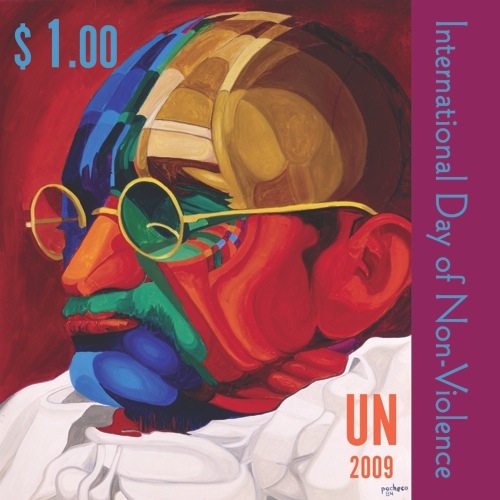
Communists reject nonviolence as a means to achieve lasting change because civil disobedience is incompatible with Karl Marx's theory of class struggle. This is why they demonize and misrepresent Mohandas Gandhi and downplay the real events that brought an end to apartheid in South Africa. Instead, they celebrate the start of the Cuban military intervention in Angola (Operation Carlota) on November 5, 1975, highlight a dubious military victory in 1988 involving Cuban troops, and falsely celebrate it as the agent of change.

Agostinho Neto and Fidel Castro carried out purge in Angola.

 
Purge in Angola

Not mentioned is that Cuban troops, in May 1977, took part in a massacre not long after independence in Angola following a split in the governing Communist MPLA party. Amnesty International cites reports that 30,000 "had disappeared" in the purge; others say as many as 80,000 were killed.

What of Castro's involvement in South Africa?


General Arnaldo Ochoa Sanchez walking with Fidel Castro

An opportunity to present what the Castro regime has omitted and correct the record arises from the dictatorship's attempt to paint Operation Carlota in a favorable light.

What happened to the Cuban general who headed the Cuban military mission in Angola and prosecuted the battles against the South African Defence Forces, and their allies?

Cuban General who successfully led the effort in Angola executed

General Arnaldo Ochoa Sanchez, who organized and led Cuban troop buildups in Angola (1976) and Ethiopia (1977), led Sandinista and Cuban troops in Nicaragua against Contra forces in the early 1980s, and distinguished himself in Southern Africa during a months-long military campaign against the Apartheid regime's army in Angola from August 1987 to March 1988, unfortunately for General Ochoa, it is believed that he had grown too popular among the troops and had the mistaken idea that he had the right to an opinion, was executed by firing squad on July 13, 1989.

General Arnaldo Ochoa executed on July 13, 1989.

Arturo J. Cruz's article in the November 1989 issue of Commentary Magazine titled "Anatomy of an Execution" outlined what cost General Ochoa his life. 

"On Wednesday night, June 14, Raul Castro addressed the nation on radio and television. He spoke for two hours, at times almost incoherently, and his words betrayed a barely suppressed hatred for Ochoa—an envious passion toward a colleague who was a senior general officer in the fullest, most professional military sense. Raul accused Ochoa of being irreverent; he complained about Ochoa’s jokes; he derided what he called Ochoa’s “populist deviations” with the troops (referring, evidently, to the one thing which Raul himself has never enjoyed with the Cuban enlisted man—genuine popularity)."

This was in a sensitive moment for the regime. Panamanian strong man Manuel Noriega, who had been involved, together with the Castro brothers, in drug trafficking has been indicted in U.S. courts and the American military invaded Panama captured him had been. Others like Tony de la Guardia were executed because they could have testified to the direct involvement of the Castro brothers in the drug trade.  Bad luck for his twin brother Patricio, who ended up sentenced to 30 years in prison.

It was South Africans, not the Castro regime that ended the Apartheid regime

UDF boycotted elections

Nationalist narratives tend to glorify violent narratives, at the expense of successful nonviolent initiatives. In India for example, the 3,000 nationalists who joined ranks with Hitler and the Third Reich to fight the British get credit with speeding up Indian Independence.  However the millions who took part in nonviolent actions in Gandhi's movement get short shrift as the Hindu nationalists grow in power in India.

The same holds true in South Africa. Piero Gleijeses. a professor of American foreign policy at the Johns Hopkins School of Advanced International Studies writing in The National Interest in 2014 gives a positive assessment of the Cuban intervention in Angola quoting Nelson Mandela that their victory “destroyed the myth of the invincibility of the white oppressor ... [and] inspired the fighting masses of South Africa ... Cuito Cuanavale was the turning point for the liberation of our continent—and of my people—from the scourge of apartheid.”  For the record both sides claimed victory in the battle of Cuito Canavale.

Failure of ANC violence to dislodge the Apartheid regime

Professor Gleijeses failed to look at the historical context, and Nelson Mandela's commitment to the violent overthrow of the Apartheid regime. In the case of South Africa the decision of the African National Congress (ANC) to adopt violence as a means to end Apartheid in 1961 may in fact have prolonged the life of the racist regime by decades. It also led to Nelson Mandela spending decades in prison refusing to renounce his violent stand.

Mandela became a symbol of resistance, and later an agent of national reconciliation, but he was not the agent of regime change in South Africa.

UDF nonviolent resistance, and economic sanctions ended the Apartheid regime

It was not the armed struggle of the ANC that brought the Apartheid regime to the negotiating table but the United Democratic Front (UDF).  The history of how the Apartheid regime was brought to an end is often overlooked. This is the history of the UDF and the successful nonviolent struggle it carried out that is documented in A Force More Powerful:

 In the city of Port Elizabeth, Mkhuseli Jack, a charismatic 27-year-old youth leader, understands that violence is no match for the state's awesome arsenal. Jack stresses the primacy of cohesion and coordination, forming street committees and recruiting neighborhood leaders to represent their interests and settle disputes. Nationally, a fledgling umbrella party, the United Democratic Front (UDF), asserts itself through a series of low-key acts of defiance, such as rent boycotts, labor strikes, and school stay aways. 
Advocating nonviolent action appeals to black parents who are tired of chaos in their neighborhoods. The blacks of Port Elizabeth agree to launch an economic boycott of the city's white-owned businesses. Extending the struggle to the white community is a calculated maneuver designed to sensitize white citizens to the blacks' suffering. Beneath their appeal to conscience, the blacks' underlying message is that businesses cannot operate against a backdrop of societal chaos and instability. 
Confronted by this and other resistance in the country, the government declares a state of emergency, the intent of which is to splinter black leadership through arbitrary arrests and curfews. Jack and his compatriots, however, receive an entirely different message: the country is fast becoming ungovernable. Apartheid has been cracked. 
Undaunted by government reprisals, the UDF continues to press its demands, particularly for the removal of security forces and the release of jailed African National Congress leader Nelson Mandela. White retailers, whose business districts have become moribund, demand an end to the stalemate. The movement also succeeds in turning world opinion against apartheid, and more sanctions are imposed on South Africa as foreign corporations begin to pull out many investments. In June 1986, the South African government declares a second state of emergency to repress the mass action that has paralyzed the regime.

The collapse of the violent option with the end of the Cold War coincided with Apartheid's end.

The negotiations to end Apartheid began in 1990, after the collapse of the East Bloc, and coincidently ended in 1991, the year the Soviet Union peacefully dissolved. The ANC no longer had the weapons and financial support provided by Havana and Soviets from the 1960s into the early 1980s. There were some in South Africa who in 1989 lamented the passing of the Berlin Wall, but if not for the end of the Cold War things might not have changed for the better. Paul Trewhela in PoliticsWeb offered the following analysis:

On 9 November 1989, twenty years ago, the Berlin Wall cracked open, the Cold War in Europe came to an end, the Soviet empire tottered to its grave and the ANC military option lost whatever teeth it might have had. The military/security state erected by the National Party never lost a centimeter squared of its soil. Umkhonto weSizwe, the military wing of the ANC and the South African Communist Party, never won a centimeter squared of soil. True, the repeated mass mobilizations and popular uprisings within South Africa through the Seventies and the Eighties placed a colossal strain upon the regime, and, true, the economic strain upon the state - especially in conditions of attrition exercised against it by the US banking system - placed it under further serious pressures. Nevertheless, honest accounting must say that, given the continuation of the Cold War system in Africa, this nuclear-armed state at its southern tip was nowhere near collapse.

The international situation that undermined the ANC's armed struggle, combined with the successful nonviolent campaigns of the United Democratic Front (UDF) facilitated the end of Apartheid in South Africa.

In South Africa there was a older tradition going back to 1893 - 1914 with Mohandas Gandhi's experiments with nonviolence against anti-Indian racism there. It was in South Africa on September 11, 1906 that the word Satyagraha came into existence. It is this legacy of nonviolence that has endured and gives hope for the future.

Castro regime's role in the Red Terror in Ethiopia

Left to right: Ramiro Valdes, Raul Castro, Fidel Castro and Mengistu Haile Mariam

Unfortunately, abandoning nonviolence and embracing the false and violent narrative of Castroism is a recipe for endangering South African democracy. There lies the way of mass murder and genocide. This is not conjecture. General Arnaldo Ochoa Sanchez was sent to Ethiopia in 1977 to build up Cuba's military presence. Fidel Castro, Raul Castro, and
Ramiro Valdés Menéndez were deeply involved in sending 17,000 Cuban troops to Eastern Africa to assist Lt. Col. Mengistu Haile Mariam in consolidating his rule and eliminating actual and potential opposition in Ethiopia. 

Fidel Castro and Mengistu Haile Mariam
 

The claim of anti-imperialism is also undermined by the Castro regime's actions in Ethiopia.  

Background

Ethiopia was the only African country to successfully resist the European colonial scramble for Africa in the 19th century. Ethiopia had an African monarchy that stretched back to Biblical times.

Emperor Haile Selassie I of Ethiopia had served first as regent of Ethiopia from 1916 to 1930 and as emperor from 1930 to 1974. He was the heir to a dynasty that traced its origins to the 13th century and, from there, by tradition, back to King Solomon and the Queen of Sheba. Ethiopia was invaded and occupied by Mussolini in 1935, who used chemical warfare to defeat the Ethiopians. The Ethiopians fought bravely against the Italian fascists.

At the League of Nations in 1936, Emperor Selassie condemned the use of chemical weapons by Fascist Italy against the people of Ethiopia. Ethiopia was the only independent African state during a time when the rest of the continent was under colonial rule. H.I.M. Haile Selassie, the lion of Judah, resisted the fascist invasion of his homeland, Ethiopia, and warned the world of its threat when he addressed the League of Nations. He would go into exile in Great Britain but returned home after the defeat of the fascists.

The fascist occupation ended in 1941 when Sudanese forces accompanying Ethiopian King Haile Selassie entered Addis Ababa on May 5, 1941.

Ethiopian monarch led efforts for decolonization and African unity.


Emperor Haile Selassie's internationalist views led to Ethiopia becoming a charter member of the United Nations, advocating for the decolonization of Africa, and his political thought and experience in promoting multilateralism and collective security are still viewed as part of his enduring legacy. On May 25, 1963, the Organization for African Unity (OAU) was established, and Haile Selassie, Emperor of Ethiopia, was selected as the first President of the OAU. The permanent headquarters of the OAU was in Addis Ababa, Ethiopia. He was a fierce advocate for African independence and unity, and clearly understood and condemned the history of European colonialism on the continent.

"The events of the past 150 years require no extended recitation from us. The period of colonialism into which we were plunged culminated with our continent fettered and bound; with our once proud and free peoples reduced to humiliation and slavery; with Africa’s terrain cross-hatched and chequer-boarded by artificial and arbitrary boundaries. Many of us, during those bitter years, were overwhelmed in battle, and those who escaped conquest did so at the cost of desperate resistance and bloodshed. Others were sold into bondage as the price extracted by the colonialists for the ‘protection’ which they extended and the possessions of which they disposed. Africa was a physical resource to be exploited and Africans were chattels to be purchased bodily or, at best, peoples to be reduced to vassalage and lackeyhood. Africa was the market for the produce of other nations and the source of the raw materials with which their factories were fed."

Emperor Haile Selassie was deposed in a communist military coup, and it is believed that the officers smothered him on August 27, 1975. Mengistu Haile Mariam "ordered the emperor's body to be buried head down in the palace and had a lavatory erected over the grave so that he could express daily his contempt for the monarch."

In December 1994, The New York Times reported that an Ethiopian court described "how Emperor Haile Selassie was strangled in his bed most cruelly" in 1975 by order of the leaders of the Marxist-Leninist military coup.

Castro regime's troops took part in Ethiopia's Red Terror
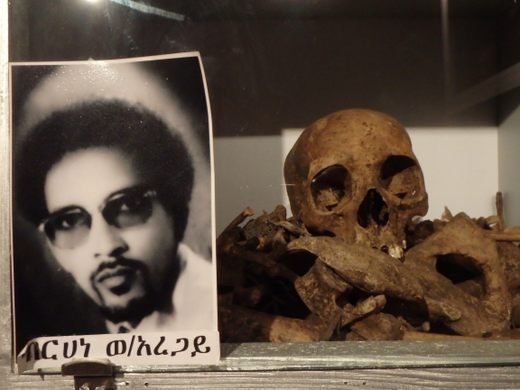
Source: "Red Terror" Martyrs' Memorial Museum

Human Rights Watch in their 2008 report on Ethiopia titled outlined "Collective Punishment War Crimes and Crimes against Humanity in the Ogaden area of Ethiopia’s Somali Region" some of the practices carried out by Cuban troops sent there by Fidel and Raul Castro excerpted below:

In December 1979, a new Ethiopian military offensive, this time including Soviet advisors and Cuban troops, “was more specifically directed against the population’s means of survival, including poisoning and bombing waterholes and machine gunning herds of cattle.”
Charles Lane of The Washington Post in the December 1, 2016 article "Castro was no liberator" raises the following question that touches heavily on Ethiopia:
Mengistu participated in a successful military coup against the U.S.-backed Emperor Haile Selassie in 1974, eventually seizing power on Feb. 3, 1977,by massacring his rivals in the officer corps. Castro admired this bloody deed as a preemptive strike against “rightists” that showed “wisdom” and cleared the way for Cuba to support Mengistu “without any constraints,” as he explained to East German dictator Erich Honecker in an April 1977 meeting whose minutes became public after the fall of European communism. [...] With the Cuban forces watching his back, Mengistu wrapped up his bloody campaign of domestic repression, known as “the Red Terror,” and sent his own Soviet-equipped, Cuban-trained troops to crush a rebellion in Eritrea. The last Cuban troops did not leave Ethiopia until September 1989; they were still on hand as hundreds of thousands died during the 1983-1985 famine exacerbated by Mengistu’s collectivization of agriculture. 

Mengistu fled into exile on May 21, 1991. Less than a decade later on November 5, 2000, Haile Selassie was given an Imperial funeral by the Ethiopian Orthodox church. Bob Marley's widow, Rita Marley, participated in the funeral of Ethiopia's last monarch.

Haile Selassie was honored on February 10, 2019 with a statue of his likeness unveiled at the African Union's headquarters in Addis Ababa, Ethiopia.  He was being honored for his role in establishing the African Union's predecessor, the Organization of African Unity (OAU). Hopefully, his legacy will endure and Communism's negative one will be abandoned.


Thursday, August 27, 2020

Communists Lie and Communism Kills: Brief overview of a terrible idea

“How do you tell a Communist? Well, it’s someone who reads Marx and Lenin. And how do you tell an anti-Communist? It’s someone who understands Marx and Lenin.” - Ronald Reagan

Communism prior to Marx
The word and idea of communism predates Karl Marx and first arises out of Enlightenment ideas that would fully express themselves in the French Revolution. French philosopher Victor d'Hupay in his 1777 book Projet de communauté philosophe, advanced Enlightenment principles that are the basis of a communist philosophy defined as a lifestyle called a "commune" that advises to "share all economic and material products between members of the commune, so that all benefit equally from each other's work". Communists are initially defined as those living in the commune


The Jacobins, supported the idea of redistributing wealth equally among the people, including Jean-Paul Marat and Gracchus Babeuf. Babeuf was involved in the Conspiracy of the Equals of 1796 intending to establish a revolutionary regime based on communal ownership, egalitarianism and the redistribution of property. The plot was however detected and he and several others involved were arrested and executed, but there attempt would inspire radicals in the future.
Karl Marx, Friedrich Engels, the Communist League, and the Communist Manifesto
On February 21, 1848, The Communist Manifesto, written by Karl Marx with the assistance and patronage of Friedrich Engels is published. This political pamphlet was commissioned by the  Communist League which had come into existence in 1847and is considered the first Marxist party.   


The darker aspects of Marxism had already been self evident to some of his contemporaries as early as 1844 as Joshua Dill, the  Assistant Director of Publications at the Victims of Communism Memorial Foundation, documented in in the September 15, 2017 article "Communism: A bad idea even in 1844." 

The Manifesto didn't offer anything new in communist theory, but a synthesis of these ideas packaged in a way that made it readily accessible, unlike some of other Marxist works such as Das Kapital

They were also blessed by some good timing because the tract predicted that revolution was imminent, a natural outcome of materialist historical processes, and within days of the publication, coincidentally, revolutions broke out first in France and then across Europe, but were put down by conservative forces.

Third time was the charm for totalitarianism: The Three Internationals 
Three international communist networks that span over a century sought to establish a global political network to destroy existing political orders around the world.

The  First International, also known as the International Workingmen's Association (IWA) 1864–1876 aimed at uniting a variety of different left-wing socialist, communist and anarchist political groups and trade union organizations that were all based on the working class and class struggle. It was founded in 1864 in London. The first congress was held two years later in 1866 in Geneva, Switzerland.  This network had over five million members but it split in 1872 over conflicts between communist and anarchist factions and  dissolved in 1876.

The Second International was founded on July 14, 1889 and excluded the anarchists. Their influence is still felt today around the world and important days of action were set up by them. In 1889 they declared May 1st as International Workers' Day. In 1910 they declared March 19th International Women's Day but then changed the day to March 8th to celebrate the women's marches during the Russian Revolution in 1917. They campaigned for the eight hour work day. Vladimir Ilyich Lenin had been a member since 1905. 


The Second international dissolved in 1916 over differences of how to respond to World War One but formed again in 1923 and a version of it continues to the present as the Socialist International. There were three primary divisions: parties that remained loyal to their nation state, anti-war socialists, and communists like Lenin who sought to exploit the war to unleash worldwide revolution with a redefinition that would come to be known as Marxism-Leninism in which a vanguard party leads the change to a communist future.
Vladimir Lenin
"There are no morals in politics; there is only expedience. A scoundrel may be of use to us just because he is a scoundrel." - Vladimir Lenin

Communist Morality
The first leader of the Soviet Union, Vladimir Lenin on October 2, 1920 in a speech to Russian communist youth stated:  "The class struggle is continuing and it is our task to subordinate all interests to that struggle. Our communist morality is also subordinated to that task. We say: morality is what serves to destroy the old exploiting society and to unite all the working people around the proletariat, which is building up a new, communist society." This is at the heart of communist morality, the ends justify the means, a profound immorality and a pillar of international communism.

The Third International was founded by Lenin in 1915 and held its first of seven world congresses on March 2, 1919 and was also known as the Communist International, and was known by its abbreviated form the Comintern. It was an international communist organization that advocated world communism. The International intended to fight "by all available means, including armed force, for the overthrow of the international bourgeoisie and for the creation of an international Soviet republic as a transition stage to the complete abolition of the State". The communists came to power in Russia on November 7, 1917. The Comintern was officially dissolved by Joseph Stalin in 1943 to calm the fears of his non-communist allies, but this totalitarian network remained intact but not as visible.


The power of propaganda
The Communists were excellent at diagnosing problems in society and using propaganda to exploit them, even if their solutions did not improve them. The Communist Manifesto is a perfect example of this. However they also operated in international totalitarian networks to spread the propaganda and to engage in coordinated international campaigns to achieve political power. These innovations would give communists an organizational and message advantage over traditional political parties.

Totalitarian networks and propaganda pioneer: Wilhelm Münzenberg
Perfecting totalitarian networks
The pioneer in totalitarian networks was Wilhelm "Willi" Münzenberg who impacted much of the 20th century. Münzenberg met the Russian communist revolutionary Lenin in Bern, Switzerland in 1915. It was León Trotsky who recognized in Münzenberg the talent to organize clandestine networks from almost nothing. He was part of the original Bolshevik network prior to the 1917 revolution. Following the arrival of the Soviets to power and the COMINTERN as a means to disseminate the Soviet revolution and consolidate dominance of Marxism-Leninism over the global Left; Münzenberg also used it to organize cultural power and further expand international influence.  

The first congress of the Communist International included delegates from communist or socialist parties from Russia, Germany, Austria, Hungary, Poland, Finland, Ukraine, Latvia, Lithuania, Belarus, Estonia, Armenia, France, Switzerland, China, Korea, Bulgaria, Switzerland, Sweden, the United States, Azerbaijan, Yugoslavia, and the Netherlands among other countries. In 1921 Münzenberg became the director of clandestine operations of propaganda aimed at the West. To create networks of supporters Münzenberg used all the resources propaganda from high culture to the most basic. He organized the media: film, radio, theater, books, magazines, and newspapers. He was able to connect to and use all types of formers of opinion respected by the public: writers, artists, actors, priests, ministers, teachers, businessmen, scientists, and psychologists

The Münzenberg network was one of the key factors for the direction taken in political attitudes that operated in the 1930s. He manipulated and influenced public opinion using a network of writers and intellectuals such as: Ernest Hemingway, John Dos Passos, Lillian Hellman, George Grosz, Erwin Piscator, André Malraux, André Gide, Bertolt Brecht, Dorothy Parker to Kim Philby, Guy Burgess and Anthony Blunt. He organized protest marches, politicized writers conferencespoliticized art festivals, ad hoc committees signed by famous celebrities for causes without end.  

These networks are still active today and have operated over the years in campaigns for Angela Davis (1970), Mumia Abdul Jamal (1982-2011), the Cuban Five (2000- 2014) just to name a few high profile cases.

Edmund Burke and Roger Scruton
Conservative Critique of Communism
It is no accident that modern conservatism is traced back to a profound and nuanced rejection of the French Revolution of 1789 found in the writings of Edmund Burke, and especially Reflections on the Revolution in France published in November of 1790. Burke knew the basis and structure of a traditional society and the threat of revolution to these important social structures that make civilization both possible and tolerable. This critique of the Revolution applies to Communism, and the followers of Edmund Burke, and Roger Scruton, one of his intellectual descendants in an essay titled  "What can Europe learn from communism?"explained one of the great errors of communism and the fragile superiority of democracy in a free society.
"The great error of the communists was to eliminate opposition, to conscript the people into a ‘unity’ that they had not chosen and were not allowed to question. The great benefit of democracy is that it makes opposition possible and also legitimate. But this has the consequence that, in a democracy, more than half the people at any moment might be living under a government that they did not choose, maybe a government that they hate. What makes that possible? Why do democracies not break down, under the pressure of popular dissent? The answer is simple: they don’t break down because the loyalty of the citizen is not towards the government, but towards something higher, something that is shared between all the citizens, regardless of their political beliefs and inclinations. This higher thing is the nation, the entity to which we all belong, and which defines the first-person plural of democratic politics."
The results time and time again when communists take power and dissent is outlawed and elections no longer contest power between political parties, but only to ratify fidelity to the ruling class, the end results are piles of dead bodies, destroyed societies, and generations of mistrust among the survivors. Despite the claims made about education and healthcare in these regimes, children have been treated horribly. The paradox of communism is that it spawns societies that are profoundly antisocial. Police states with informants spying on neighbors does not build social bonds, but paranoia and distrust.


Communists today embrace this statement when they dispute the death count of 100 million victims of communism, and manufacture their own numbers, including millions of victims of communism, in their lists claiming over a billion dead due to capitalism.

Responding to some false claims against capitalism 
Beware of the small print used by the communists. Out of the 1.6 billion deaths they blame on Capitalism a fair amount can be challenged, but some are just absurd. Consider the following taken from the embedded Tweet above in small print:

World War 2 was started by an alliance between Nazi Germany and the Communist Russia. Both regimes were hostile to capitalism and liberal democracy. On August 23, 1939 they signed the Hitler Stalin Pact and over the next month launched invasions from each country dividing up Poland and starting WW2. Therefore, the dead in that war can be laid at the feet of fascism and communism, not capitalism. However, if liberal capitalist regimes like the United States had not supplied billions in aid to the USSR, after the Nazis double crossed Stalin and invaded Russia in June 1941, the outcome of the war might have been very different.

The claim that India between 1947 and 1990 had a "capitalist policy" is not true. The first elected leader of an independent India was Jawaharlal Nehru and he was a democratic socialist who believed that "Socialism is after all not only a way of life, but a certain scientific approach to social and economic problems." India under Nehru nationalized the means of production and the banks, but despite being a socialist regime, it remained a democracy. This meant that opposition parties were able to run for office in contested elections, and there was a free press to report on the economic failures of socialism. To call this a "capitalist policy" is a falsehood.

Worse yet the Famine of 1932-33 (Kulak policy and weather) was a famine manufactured by Josef Stalin. It is a crime of communism, and to blame it on capitalism is a lie.

The Khmer Rouge took over Cambodia in a communist revolution with backing from Beijing in 1975 and were forced out of power by the Soviet backed Vietnamese in 1979 and in the space of less than four years killed over 2 million people, or a third of the entire population. They were and are true believing communists who carried out a radical and profound revolution.

Lastly, the communists blame capitalism for over 306 million deaths due to cigarettes between 1960 and 2011. Capitalism did not force individuals to buy and consume cigarettes. Liberal democracies carried out public campaigns against cigarette smoking and restricted its use, and taxed it heavily.

What is equally interesting and not mentioned is that cigarette smoking is also widespread in communist regimes that do not have capitalism, and in China it was tobacco production that drove their economy in the early 1990s.  People freely choosing to smoke, and other bad habits cannot be blamed on capitalism.

People not statistics
 
Some psychologists argue that as the number of victims increase into the hundreds, and thousands that compassion collapses out of the human fear of being overwhelmed. Soviet dictator Josef Stalin put it more succinctly: "When one man dies it's a tragedy. When thousands die it's statistics."  

Therefore will highlight specific victims of communism from around the world over different decades.

Milada Horakova of Czechoslovakia (1950)

Milada Horakova at her show trial in 1950

Milada Horakova was hanged with three others in Prague’s Pankrac Prison as a spy and traitor to the Communist Czechoslovakian government on June 27, 1950. She was a  lawyer, social democrat, and a prominent feminist in the interwar and postwar periods. She had been a member of the Czech resistance to the Nazi occupation of her homeland and survived a Nazi prison. After Czechoslovakia was liberated from the Nazis in 1945 by the Soviets she became a member of parliament in 1946 but resigned her seat after the Communist coup of 1948. However she refused to abandon her country.

Adam D. E. Watkins in his 2010 paper "The Show Trial of J U Dr. Milada Horáková: The Catalyst for Social Revolution in Communist Czechoslovakia, 1950" explains the importance of the show trial in gutting democratic traditions and replacing them with Stalinism:

The study deconstructs the show trial’s influence on inducing a country to foster the Communist movement against decades of democratic traditions. The research reveals the impact of the show trial of Dr. Milada Horáková in 1950 and how it was instrumental in reforming a society, marked the beginning of Stalinism, and ushered forth a perverted system of justice leading to a cultural transformation after the Communist putsch. Furthermore, the revolution truncated intellectual thought and signified the end of many social movements – including the women’s rights movement
According to D. E. Watkings Horáková was seen by the public as a symbol of  the First Republic and of democracy. Unlike others who did break under the relentless psychological and physical torture she never did. The communists tried to edit her testimony for propaganda purposes but as Radio Prague in their 2005 report on the discovery of the unedited tapes of her trial:
[S]he faced her show trial with calm and defiance, refusing to be broken. Audio recordings - intended to be used by the Communists for propaganda purposes - were mostly never aired, for the large part because for the Party's purposes, they were unusable.
Because she refused to cooperate her punishment was particularly severe, even for the death penalty. In 2007 her prosecutor Ludmila Brozova-Polednova who in 1950 had helped to condemn Horakova to death, now 86, was tried as an accomplice to murder. During the trial Radio Prague reported that a note written by an anonymous eye-witness to Milada Horakova's execution quoted the young prosecutor recommending: "Don't break her neck on the noose, Suffocate the bitch - and the others too." Milada Horáková  was executed in Pankrác Prison on 27 June 1950 by a particularly torturous method: "intentionally slow strangulation, which according to historians took 15 minutes. She was 48 years old." The urn with her ashes was never given to her family nor is it known what became of them.
Milada Horáková: 25 December 1901, Prague – 27 June 1950, Prague

In a letter to her 16 year old teenage daughter Milada explained why she had refused to compromise with evil. Her daughter received the letter 40 years later after the end of communist rule:

The reason was not that I loved you little; I love you just as purely and fervently as other mothers love their children. But I understood that my task here in the world was to do you good … by seeing to it that life becomes better, and that all children can live well. … Don’t be frightened and sad because I am not coming back any more. Learn, my child, to look at life early as a serious matter. Life is hard, it does not pamper anybody, and for every time it strokes you it gives you ten blows. Become accustomed to that soon, but don’t let it defeat you. Decide to fight.
June 27th, the day of Milada Horakova's execution is now recognized in the Czech Republic as “Commemoration day for the victims of the Communist regime.”

Haile Selassie of Ethiopia (1975)

Emperor of Ethiopia Haile Selassie I
Emperor of Ethiopia Haile Selassie I was believed to be the reincarnation of Jesus Christ. Selassie had served first as regent of Ethiopia from 1916 to 1930 and was emperor from 1930 to 1974. He was the heir to a dynasty that traced its origins to the 13th century, and from there by tradition back to King Solomon and the Queen of Sheba. At the League of Nations in 1936, Emperor Selassie condemned the use of chemical weapons by Fascist Italy against the people of Ethiopia. Ethiopia was the one independent African state during a time when the rest of the continent was under colonial rule. H.I.M. Haile Selassie , the lion of Judah, resisted the Fascist invasion of his homeland Ethiopia and warned the world of its threat when he addressed the League of Nations. He would go into exile in Great Britain but returned home after the defeat of the fascists.

Emperor Haile Selassie's internationalist views led to Ethiopia becoming a charter member of the United Nations, and his political thought and experience in promoting multilateralism and collective security are still viewed as part of his enduring legacy. Despite inspiring the founding of a religion that today has up to 800,000 followers he remained an Ethiopian Orthodox Christian until his death.

Raul Castro & Fidel Castro with close ally Mengistu Haile Mariam
Emperor Haile Selassie was deposed in a communist  military coup and it is believed that the officers smothered him and that Mengistu Haile Mariam: "ordered the emperor's body to be buried head down in the palace and had a lavatory erected over the grave so that he could express daily his contempt for the monarch." Winston Churchill had described Emperor of Ethiopia Haile Selassie I as "the only enlightened Abyssinian prince." In December 1994 The New York Times reported that an Ethiopian court described "how Emperor Haile Selassie was 'strangled in his bed most cruelly' in 1975 by order of the leaders of a Marxist military coup."

Less than a decade after Mengistu fled into exile on November 5, 2000, Haile Selassie was given an Imperial funeral by the Ethiopian Orthodox church. Bob Marley's widow, Rita Marley, participated in the funeral.

 Laura Inés Pollán of Cuba (2011)

Laura Pollán, founding leader of the Ladies in White
Laura Inés Pollán Toledo was a courageous woman who spoke truth to power and protested in the streets of Cuba demanding an amnesty for Cuban political prisoners. A woman who had been a school teacher, before her husband was jailed for his independent journalism in 2003.

Laura Pollán became a dissident when her husband Hector Maseda was imprisoned during the Black Cuban Spring of 2003 along with more than 75 other activists and civil society members. She was one of the founders of the Ladies in White and challenged the Castro regime on the streets of Cuba. Following brutal repression in an effort to prevent them from marching through the streets of Havana Laura Pollan directly and nonviolently challenged the regime: "We will never give up our protest. The authorities have three options — free our husbands, imprison us or kill us. 

Despite all the efforts of the Cuban communist dictatorship that has a monopoly over force and the mass media in Cuba, Laura was able with a small group of courageous women to take to the streets and demonstrate. Not once or twice but on a weekly basis since her husband was unjustly imprisoned in March of 2003. The dictatorship did everything they could to stop them, including brute violence. Bruises and broken bones did not deter these ladies and they continued marching with casts and slings.

Over a 100,000 people dressed in white took to the streets in Miami in the spring of 2010 to protest the violence against these women led by Gloria Estefan, who had organized the demonstration in solidarity with this movement.

Laura's husband marches with Ladies in White carrying image of his murdered wife
In the summer of 2010 the dictatorship finally began the process of releasing the bulk of the remaining prisoners of conscience from the group of the 75 and the last of them were released in the spring of 2011. Unfortunately, there were new prisoners of conscience whose release the Ladies in White would continue to demand.  Laura recognized that "[a]s long as this government is around there will be prisoners because while they've let some go, they've put others in jail. It is a never-ending story."

Five days before she became suddenly deathly ill, as the violence and threats escalated, she let the dictatorship know that: "We are not going to stop. If they have imprisoned our sisters thinking that we would give up, they are mistaken. We are very united (...) all the women's movements are very close."

On October 14, 2011, Laura Pollan, one of the founders of the human rights movement the Ladies in White died after years of suffering physical and psychological assaults against her person. Finally, she would become a victim of the Cuban healthcare system that following the Castroite dictum of inside the revolution everything outside of it nothing - would suffer and die in a matter of days while under the supervision of doctors who were revolutionaries first and doctors second. A Cuban doctor, who reviewed her case file, described it as a death by purposeful medical neglect.

Liu Xiaobo of China (2017)

Nobel Laureate Liu Xiaobo who died imprisoned in China in 2017
Nonviolent dissident, scholar and Nobel Peace Prize Laureate Liu Xiaobo was sentenced to 11 years in prison for the crime of speaking. He had already been jailed for more than a year for being one of the authors of Charter 08 that sought to gather signatures in a petition calling on the Chinese regime to gradually shift toward democracy. Liu Xiaobo had played a prominent role in the June 1989 protests in Tiananmen Square engaging in a hunger strike that he mentioned in a statement he made on December 23, 2009 during the political show trial he was being subjected to:

But I still want to say to this regime, which is depriving me of my freedom, that I stand by the convictions I expressed in my "June Second Hunger Strike Declaration" twenty years ago ‑ I have no enemies and no hatred. None of the police who monitored, arrested, and interrogated me, none of the prosecutors who indicted me, and none of the judges who judged me are my enemies. Although there is no way I can accept your monitoring, arrests, indictments, and verdicts, I respect your professions and your integrity, including those of the two prosecutors, Zhang Rongge and Pan Xueqing, who are now bringing charges against me on behalf of the prosecution. During interrogation on December 3, I could sense your respect and your good faith.
Hatred can rot away at a person's intelligence and conscience. Enemy mentality will poison the spirit of a nation, incite cruel mortal struggles, destroy a society's tolerance and humanity, and hinder a nation's progress toward freedom and democracy. That is why I hope to be able to transcend my personal experiences as I look upon our nation's development and social change, to counter the regime's hostility with utmost goodwill, and to dispel hatred with love.
Chinese Dissident Liu Xiaobo was arrested on June 23, 2009 and charged with “inciting subversion of state power” for co-authoring Charter 08, a declaration calling for political reform, greater human rights, and an end to one-party rule in China that has been signed by hundreds of individuals from all walks of life throughout the country. On December 25, 2009 Liu Xiaobo was sentenced to 11 years in prison and two years' deprivation of political rights. The Beijing High Court rejected his appeal on February 11, 2010."
Liu Xiaobo with his wife, Liu Xia
On January 19, 2010 Havel met with the Executive Director of Human Rights in China, Sharon Hom, and engaged her in a dialogue/interview about Liu Xiaobo, Charter 08 and the struggle for democratic reform in China. When asked about the similarities between China today and Czechloslovakia in 1977 explained that:

The similarities, I would say, are in the basic structure of human rights reflected in a democratic system, which of course the regime doesn’t want. The regime wishes for the dictatorship of one party. I think this is where Charter 08 and Charter 77 are similar: they have similar targets and similar messages to deliver to the [respective] regimes.
On February 3, 2010 both Czech and Slovak members of parliament nominated Liu Xiaobo for the Nobel Peace Prize. The nomination was also endorsed by Vaclav Havel and many of the former spokespersons of Charter 77. The 2009 Nobel Prize in Literature laureate, Herta Müller, in a letter to the Nobel Foundation on behalf of Liu Xiaobo wrote:
I have urgent request to make to you today. As you know, Vaclav Havel nominated the Chinese writer Liu Xiaobo for the Nobel Peace Prize 2010.[...]I, too, believe that Liu Xiaobo deserves the Nobel Peace Prize because in the face of countless threats from the Chinese regime and great risk to his life, he has fought unerringly for the freedom of the individual.
Eight months after the rejection of his appeal on October 8, 2010 the Nobel Committee in Norway awarded this Chinese dissident and Amnesty International prisoner of conscience the Nobel Peace Prize despite threats from the Chinese regime. As December 10th, the day for the ceremony to recognize the 2010 Nobel Peace Prize Laureate Liu Xiaobo, approached the Chinese regime engaged in a human rights crackdown in Mainland China. Neither he or his wife, Liu Xia, who has been kept under house arrest, were allowed to attend. The actress Liv Ullman read the final statement that Liu Xiaobo read out at his December 2009 trial titled: "I Have No Enemies: My Final Statement" already mentioned and cited above.

Unjustly imprisoned for over eight years China's Nobel Peace Prize Laureate Liu Xiabo was seriously ill in mid 2017 and although granted medical parole continued to be arbitrarily detained, although  in a hospital diagnosed with terminal liver cancer his access and movement continued to be restricted. His wife, Liu Xia said that her husband, according to The Guardian, "cannot be given surgery, radiotherapy or chemotherapy," allegedly "because the cancer is so advanced." Chinese Human Rights Defenders reports that individuals in custody, like Liu Xiaobo, had been denied medical treatment in what is a life threatening form of torture.

Liu Xiaobo died on July 13, 2017. Four days later on July 17, 2017 the man who had received the Nobel Prize on Xiaobo's behalf in Oslo, Dr. Yang Jianli in Washington, DC, at the monument to the Victims of Communism in an act of remembrance, spoke of his friend and the culpability of the Chinese communist regime.
In April 1989, when the Tiananmen democracy movement just broke out, he returned to Beijing from New York and became the most important intellectual leader of the movement. After the Tiananmen Massacre, he shouldered both moral and political responsibilities and continued to fight from inside China while many others left the country and even abandoned the movement. He was in and out prison and spent half of the past 28 years after the Tiananmen Massacre in incarceration. Never wavering in spirit, he shared the sufferings of his compatriots and gave his life for them. He is a martyr and saint. Yes. Liu Xiaobo is a martyr and saint who possesses a moral authority that his persecutors can only envy. His legacy of love, justice, peace and sacrifice will surely far outlive the deeds of those who persecuted him. That is exactly why the leaders of China are so afraid of him, so afraid of his words and deeds, and so afraid of his legacy. They are afraid of the inevitable comparison between Liu Xiaobo’s Chinese dream and Xi Jinping’s; they are afraid of the unavoidable likening of the Chinese Communist regime to the Nazis regime because Liu Xiaobo has been the first Nobel Peace Prize winner who died under confinement since Carl von Ossietzky, a German pacifist and an opponent of the Nazis, who died in 1938.
Milada Horakova, a feminist, was a member of the Czech resistance to Nazism. H.I.M. Haile Selassie, the lion of Judah, resisted the Fascist invasion of his homeland Ethiopia and warned the world of its threat. Laura Inés Pollán Toledo was a school teacher, turned human rights activist, to free her husband, a journalist jailed for his writings. Liu Xiaobo was a literary critic, poet and human rights activist who advocated for nonviolent change in his homeland. He was also a Nobel Peace Prize laureate. They were all murdered by communist regimes through executions or other nefarious means. These are four cases out of the over 100 million lives murdered by communist regimes.

It can happen here

Do you know what U.S. citizens have in common with Cubans, Venezuelans, and Nicaraguans? They all at one point said that "it couldn't happen here."  There are signs in the streets of the United States that some of those same forces are using the symbols and tactics of international communism and using force and intimidation on Americans to comply.

However, it is early enough in the process that a non-violent and moral stand of resistance to these forces can stop them before they take and consolidate power, but one cannot live in denial.