Showing posts with label Joel Garcia. Show all posts

Sunday, June 2, 2024

R.I.P. Jorge A. Garcia, truth teller who had 14 family members murdered by agents of Communist Cuba on July 13, 1994

Jorge A. Garcia
 

'There are those who think that we should be full of rancor and a thirst for vengeance but I don't want revenge. I feel sorry for the people who assassinated my family. I can never be compensated for my loss. I will never be happy again with my family surrounding me. There will always be a tinge of sadness but I do want there to be a trial so that this situation can serve as a lesson and that these people or others like them in other parts of the world, don't do this kind of thing again. Not in Cuba. Not anywhere.''

Jorge A. García, July 13, 2004 (A decade after July 13, 1994 tugboat massacre

Jorge A. Garcia who had 14 members of his family massacred by agents of the Cuban dictatorship on July 13, 1994 rejected revenge but demanded justice, truth, and memory has reportedly died. Cuban activist Ramon Saul Sanchez shared a statement from his son Jorge Félix García.

"My father Jorge García Más is resting after a painful illness that in recent months stole the peace of all those around him who cared for him. He accompanied me for 60 years in which at his side I learned everything I know and I am what I have become with his help.
Today, June 2, 2024, the life of a human being who, full of pain, filled the lives of so many with love, ends. What does not go away is the tireless work of this man in favor of justice, which will remain there forever, as an example of personal sacrifice and at the same time as a perpetual tribute to those who he dedicated
the last 30 years of his existence his battle for the victims of the sinking of the "13 de Marzo" Tugboat.
The legacy of a man like my father undoubtedly creates commitment, and sets an example to follow for anyone that injustice has taken away what is just. Let us give thanks for what we experienced at his side, for what we learned along the way, for the hug, the helping hand.
Jorge García Más (Jomás) is staying with us today, not leaving us."

First time I heard Jorge A. Garcia speak out about the July 13, 1994 massacre was on a television program on the eve of the arrival of Pope John Paul II to Cuba.
 
In the January 1998 Nightline interview Jorge described how he learned the news. “When I asked my daughter, ‘What about Juan Mario?’ ‘Papa, he's lost.’ ‘And Joel?’ ‘Papa, he's lost.’ ‘And Ernesto?’ ‘Papa, he's lost.’ And then we knew that other members of the family were all lost, 14 in all.” His daughter, Maria Victoria Garcia, had survived but she lost her brother, Joel García Suárez age 24;  her husband, Ernesto Alfonso Loureiro age 25; and her son, Juan Mario Gutiérrez García age 10.
 
Jorge García was detained and interrogated on several occasions. His longest detention was for 15 days. His daughter, María Victoria García, was one of three of his family who survived the massacre but was still in danger:  "They tried on several occasions to kill my daughter, because she was the first to speak out and contradict the regime’s official narrative.”

Father and daughter had spoken on camera to Nightline from Havana, Cuba about the July 13, 1994 attack on the “13 de Marzo” tugboat.  A year later in 1999 they had to go into exile as political refugees fearing for their lives.

In 2009, Jorge Garcia, agreed to address Florida International University students at a panel organized by the Free Cuba Foundation on the fifteenth anniversary of the July 13, 1994 “13 de Marzo” tugboat massacre. We meet beforehand, and I sat down with him and interviewed him in a series of short videos about the events surrounding this crime.

 María Victoria García passed away in early January 2024.

Jorge had been suffering from a serious illness for some time.

I learned he was desperately ill, and paid him a visit in hospice care on May 12, 2024. We spoke, and he remembered when we swapped t-shirts 15 years earlier at Florida International University. At the time I gave him my Free Cuba t-shirt and he in turn gave me a t-shirt that read "We will never forget" with the name Joel Garcia repeated in the back ground, and image of his murdered son Joel Garcia in the foreground.

Next month on July 13th, G-d-willing, I will be remembering the victims, demanding justice, and wearing the shirt given to me by Jorge A. Garcia, a truth teller who risked all to bear witness, and following his example.


 

Saturday, July 3, 2010

Jorge Garcia lost 14 family members on July 13, 1994

Rejects revenge offers pity for the killers and continues to demand justice


''There are those who think that we should be full of rancor and a thirst for vengeance but I don't want revenge. I feel sorry for the people who assassinated my family. I can never be compensated for my loss. I will never be happy again with my family surrounding me. There will always be a tinge of sadness but I do want there to be a trial so that this situation can serve as a lesson and that these people or others like them in other parts of the world, don't do this kind of thing again. Not in Cuba. Not anywhere.''

Jorge García, July 13, 2004 (A decade after July 13, 1994 tugboat massacre)

I had the opportunity to sit down with Jorge García days prior to and on the 15th anniversary of the "13 de Marzo" Tugboat sinking and ask him in detail about the events surrounding the "13 de Marzo" Tugboat sinking and its aftermath. I met him in a modest efficiency in Little Havana. He was wearing a black t-shirt with a photograph of his son Joel Garcia with the name repeated on the t-shirt with the phrase: "We Will Never Forget." We sat down and he offered a detailed breakdown of what occurred which are available in Spanish in five parts (if anyone would like to help in translating it would be much appreciated).


On July 19, 1994, the Archbishop of Havana and President of the Conference of Catholic Bishops of Cuba, Monsignor Jaime Ortega Alamino said that: “the sinking of the vessel, which was carrying women and children, and the difficulties of the rescue of the survivors do not appear to be in any way accidental. This adds to the sorrow a feeling of astonishment and a need for the facts to be clarified and responsibilities to be established.. What can lead a human being to set off on such risky ventures except a certain degree of desperation or despair? What can lead other human beings to use such unusual force against their brothers other than a violent mentality?”

Sixteen years later the questions he raised then are still relevant and still unanswered by the dictatorship but other institutions analyzed and documented what had taken place.


Amnesty International in their 1997 investigation reported that the vessels which attacked the “13 de Marzo” were identified as belonging to the Ministry of Transport and are called:

“Polargo 2", “Polargo 3" and “Polargo 5". According to survivors, “Polargo 5" was the vessel which acted most aggressively towards them. The fourth vessel which followed along behind them and which appeared to be directing operations was believed to belong to the Cuban Coast Guard, which is part of the Ministry of the Interior."

The previous blog entry offers a brief review of the different international organizations investigations and conclusions surrounding the events in Cuba on July 13, 1994. Nevertheless it is important to explain the role of the Cuban government and its state security apparatus.


I still can't imagine the horror and pain of losing fourteen relatives, among them children and grandchildren yet in the course of the conversation Jorge described the circumstances that led to the massacre itself but also the government's attempted cover up afterward. The reason that he lost so many family members were that three families had together planned their escape from the island therefore the massacre disproportionately impacted these families. Worse yet, Jorge offers an explanation of why there were survivors.

The other boats created a whirlpool effect to drown everyone. After sinking the tugboat the remaining 31 survivors were saved because of three factors. There were three factors that saved lives, the famous board, that turns out to have been the tugs cooler; a person who died of fear Rosa María Alcalde Preig appears to have died of a heart attack floating face down the others hung on to her; and a greek boat that appeared in the night. That led to the end of the plan of extermination, and the Cuban coastguard began to pick up the survivors. Thanks to that 31 people were saved. The total number of dead was 37 and 31 saved. A total of 68. Initially we thought there were 72 in total. Time has told us differently. I traveled through Havana visiting all the families taking photographs of the victims of which you see in the picture. The names and photos of 37 victims have been identified.

Jorge learned the names of those who took part in the massacre of the "13 de Marzo" tugboat. There were two of them that were the most aggressive and the bloodiest.
--> Jesús González Machín, patron of the "Polargo 5" that sunk the "13 de Marzo" tugboat. He actually had the opportunity to meet him and photograph him. Although Machín denied having sunk the "13 de Marzo" he said something of tremendous legal importance: "I didn't work that day. They called me at 6pm that there was an operation at the port."


That is to say that from 6pm at the Port of Havana Cuban state security was there to direct the operations of the sinking of the "13 de Marzo." They knew what was going to happen. It was a double crime. They could have stopped or impeded the departure of the tugboat. They followed orders and sank the boat. For Jorge's family it cost 14 lives of the 17 who traveled.

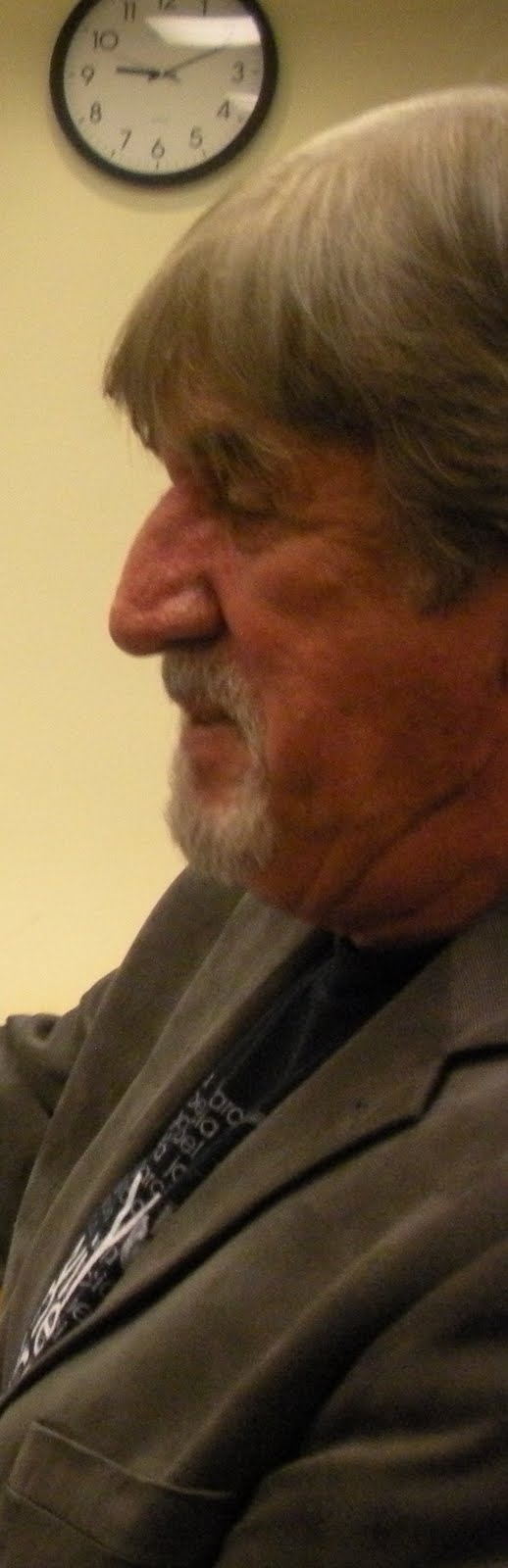
Jorge Garcia speaks with FIU students following his presentation 7/13/2009

Following the massacre family members imagined that the bodies would be returned to them. What happened was the opposite. Jorge's home was filled with people. His son had been a disc jockey in Guanabacoa. The government responded by organizing Rapid Response Brigades and blocked anyone from visiting the home.


The dictatorship had persons with weapons to intimidate. I was detained and interrogated on several occasions. The longest detention was 15 days. They tried on several occasions to kill my daughter, because she was the first to speak out and contradict the regime's official narrative.


Jorge Garcia following his presentation at FIU on July 13, 2009

At the end of Jorge's presentation at Florida International University organized and hosted by the Free Cuba Foundation on July 13, 2009 a member of the audience asked him if there was someone other than him who could renounce justice and speak of reconciliation other than you? His response was that he was in disagreement with the question adding:

"I could've easily executed the man who killed my family. The only picture of that man I took the picture of. I knew where he lived. Despite that I didn't do it. The government itself directed me towards him. They wanted to turn me into a criminal. The regime sought to justify what it had first said. The regime had said that a group of antisocials had stolen the boat and that there were an undetermined number of victims. If you look at the photographs and the profiles there were no "anti-social elements." What were there were entire families. I told the man that he would have to face trial that it might not be me but my son. It might take generations but there would be justice."
The question and answer in full (in Spanish) is posted below, and is a powerful message about the difference between justice and revenge. It also indicates the nature of the Cuban regime to try to tempt a good man to do evil to cover up its own criminal actions.
