Showing posts with label Russians. Show all posts

Thursday, January 15, 2026

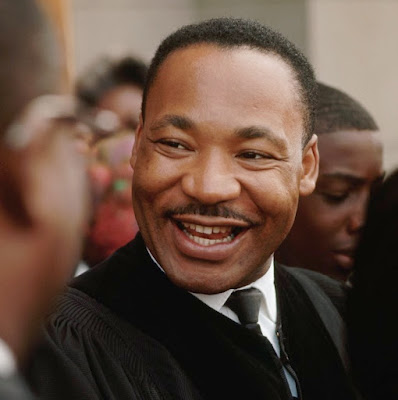
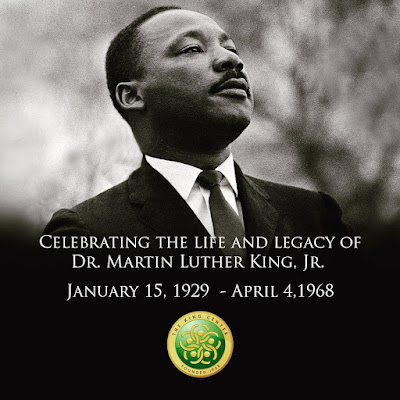
Reverend Martin Luther King Jr was born 97 years ago today

  "Nonviolence is a powerful and just weapon, which cuts without wounding and ennobles the man who wields it. It is a sword that heals." - Reverend Martin Luther King Jr., Nobel Lecture, December 11, 1964

Martin Luther King Jr. January 15, 1929 - April 4, 1968

Reverend Martin Luther King Jr. was born in Atlanta, Georgia 97 years ago today, but he never lived to see his 40th birthday because he was assassinated on April 4, 1968.

A little more than a year before his untimely death, the nonviolent icon delivered an important speech at Stanford University that is well worth hearing and studying.
"Let me say as I've always said, and I will always continue to say, that riots are socially destructive and self-defeating. I'm still convinced that nonviolence is the most potent weapon available to oppressed people in their struggle for freedom and justice. I feel that violence will only create more social problems than they will solve." 

Dr. King's message is still relevant today, and his family works at The King Center to teach new generations about nonviolence and to share his writings and speeches.

King's radical critique of the United States

Martin Luther King Jr. was an outspoken critic of American society. He repeatedly challenged the United States to live up to its own lofty ideals, seeking reforms to end segregation and ensure voting rights for African Americans through nonviolent action and democratic norms.  He was also a radical critic of communism.

Reverend King's political philosophy is best described as Christian Democracy. This school of thought, which includes parties on the center left and center right, is based, like Reverend King, on a Christian view of humanity in which "every individual is considered unique and must be treated with dignity." In his April 4, 1967 speech, Beyond Vietnam gave full expression to this outlook:

"We must rapidly begin the shift from a thing-oriented society to a person-oriented society. When machines and computers, profit motives and property rights are considered more important than people, the giant triplets of racism, militarism and economic exploitation are incapable of being conquered. A true revolution of values will soon cause us to question the fairness and justice of many of our past and present policies. On the one hand we are called to play the Good Samaritan on life’s roadside, but that will be only an initial act. One day we must come to see that the whole Jericho Road must be transformed so that men and women will not be constantly beaten and robbed as they make their journey on life’s highway. True compassion is more than flinging a coin to a beggar. It comes to see than an edifice which produces beggars needs restructuring. "

Mohandas Gandhi, a major influence on King, advocated for social responsibility and trusteeship. Gandhi,  a self-described socialist, was not an enthusiastic supporter of an expanded social-welfare state, arguing:

"The State represents violence in a concentrated and organized form. The individual has a soul, but as the State is a soulless machine, it can never be weaned from violence to which it owes its very existence. Hence I prefer the doctrine of trusteeship. [...] What I would personally prefer would be not centralization of power in the hands of the State, but an extension of the sense of trusteeship, as, in my opinion, the violence of private ownership is less injurious than the violence of the State. However, if it is unavoidable, I would support a minimum of State-ownership."

Furthermore, both King and Gandhi's critique of a "thing-oriented" society or the state as a "soulless machine" focuses on the person or the individual rather than an economic mechanism or economic class. The emphasis is on the human person and policies that recognize and respect the uniqueness and dignity of each human being. 

King was targeted by both the FBI and the KGB

KGB targeted Martin Luther King Jr. for active measures.

When he was alive, the civil rights leader was a divisive figure. The FBI in the United States wiretapped Martin Luther King Jr., monitored the Civil Rights Movement, and took active measures against him.
Many people are aware of this, but few are aware of the other campaign launched against the civil rights leader by Soviet intelligence, also known as the KGB. It is also important to remember that Russian intelligence operatives have previously attempted to sow discord, division, and hatred among citizens in the United States. 

A high-ranking Russian intelligence officer defected to the United Kingdom in 1992, bringing with him notes and transcripts compiled over the previous thirty years as he relocated entire foreign intelligence archives to a new headquarters just outside of Moscow. Vasili Mitrokhin was the Russian intelligence officer whose information became known as The Mitrokhin Archive

In Christopher Andrew and Vasili Mitrokhin's 1999 book The Sword and the The Shield: The Mitrokhin Archive and the Secret History of the KGB, details were obtained from the Mitrokhin Archive on Soviet efforts to replace Martin Luther King Jr. with a "more radical and malleable leader" such as Stokeley Carmichael in order to incite a race war in the United States.

The following excerpts from The Sword and the Shield detail elements of the Soviet intelligence campaign and the active measures arrayed against the civil rights leader:

“In August 1967 the Centre approved an operational plan by the deputy head of Service A, Yuri Modin, former controller of the Magnificent Five, to discredit King and his chief lieutenants by placing articles in the African press, which could then be reprinted in American newspapers, portraying King as an “Uncle Tom” who was secretly receiving government subsidies to tame the civil rights movement and prevent it threatening the Johnson administration." 

[...]  

"King’s assassination on April 4, 1968 was quickly followed by the violence and rioting which the KGB had earlier blamed King for trying to prevent. Within a week riots erupted in over a hundred cities, forty-six people had been killed, 3,500 injured and 20,000 arrested. To “Deke” DeLoach, it seemed that, “The nation was teetering on the brink of anarchy.”86 Henceforth, instead of dismissing King as an Uncle Tom, Service A portrayed him as a martyr of the black liberation movement and spread conspiracy theories alleging that his murder had been planned by white racists with the connivance of the authorities."

On September 28, 1999, University of Cambridge professor Christopher Andrew, who coauthored The Sword and the Shield with Vasili Mitrokhin, was interviewed by Charlie Rose on PBS about the book and, near the end of the interview, discussed how the Soviets celebrated the assassination of Martin Luther King Jr. by James Earl Ray. The Russians rejoiced because they did not want an independent African American leader over whom they had no control and who practiced principled nonviolence.

Taylor Branch wrote about the Reverend's views on the militant call to armed struggle in the streets of the United States in January 1968 in the third book of his trilogy on Martin Luther King Jr. and the civil rights movement, At Canaan's Edge.

 “Riots just don’t pay off,” said King. He pronounced them an objective failure beyond morals or faith. “For if we say that power is the ability to effect change, or the ability to achieve purpose,” he said, “then it is not powerful to engage in an act that does not do that–no matter how loud you are, and no matter how much you burn.” Likewise, he exhorted the staff to combat the “romantic illusion” of guerrilla warfare in the style of Che Guevara. No “black” version of the Cuban revolution could succeed without widespread political sympathy, he asserted, and only a handful of the black minority itself favored insurrection. King extolled the discipline of civil disobedience instead, which he defined not as a right but a personal homage to untapped democratic energy. The staff must “bring to bear all of the power of nonviolence on the economic problem,” he urged, even though nothing in the Constitution promised a roof or a meal. “I say all of these things because I want us to know the hardness of the task,” King concluded, breaking off with his most basic plea: “We must not be intimidated by those who are laughing at nonviolence now.”

These words are as true today as they were over a half-century ago. Reverend King's legacy continues to inspire activists worldwide. This Baptist minister who risked everything for the freedom of all African Americans and the redemption of the United States by fulfilling the creed that all men are created equal.

Unlike others who were funded and supported by the Soviet Union, Martin Luther King Jr. was targeted by both American and Russian intelligence agencies because he was his own man, with no one controlling him except his conscience. He did not advocate or engage in violence while changing the United States and the world for the better.

King's living legacy

Bernice King, Martin Luther King Jr.'s daughter, hosted the aforementioned Beloved Community Global Summit and continues carrying on her father's work to advance nonviolence.

Today, on what would have been his 97th birthday, let us remember him and renew our commitment to continuing his work "to shift from a thing-oriented society to a person-oriented society."  

Monday, January 15, 2024

Reverend Martin Luther King Jr was born 95 years ago today

 "Nonviolence is a powerful and just weapon, which cuts without wounding and ennobles the man who wields it. It is a sword that heals." - Reverend Martin Luther King Jr., Nobel Lecture, December 11, 1964

Martin Luther King Jr. January 15, 1929 - April 4, 1968

Reverend Martin Luther King Jr. was born in Atlanta, Georgia 95 years ago today, but he never lived to see his 40th birthday because he was assassinated on April 4, 1968.

A little more than a year before his untimely death, the nonviolent icon delivered an important speech at Stanford University that is well worth hearing and studying.
"Let me say as I've always said, and I will always continue to say, that riots are socially destructive and self-defeating. I'm still convinced that nonviolence is the most potent weapon available to oppressed people in their struggle for freedom and justice. I feel that violence will only create more social problems than they will solve." 

Dr. King's message is still relevant today, and his family works at The King Center to teach new generations about nonviolence and to share his writings and speeches.

King's radical critique of the United States

Martin Luther King Jr. was an outspoken critic of American society. He repeatedly challenged the United States to live up to its own lofty ideals, seeking reforms to end segregation and ensure voting rights for African Americans through nonviolent action and democratic norms.  He was also a radical critic of communism.

Reverend King's political philosophy is best described as Christian Democracy. This school of thought, which includes parties on the center left and center right, is based, like Reverend King, on a Christian view of humanity in which "every individual is considered unique and must be treated with dignity." In his April 4, 1967 speech, Beyond Vietnam gave full expression to this outlook:

"We must rapidly begin the shift from a thing-oriented society to a person-oriented society. When machines and computers, profit motives and property rights are considered more important than people, the giant triplets of racism, militarism and economic exploitation are incapable of being conquered. A true revolution of values will soon cause us to question the fairness and justice of many of our past and present policies. On the one hand we are called to play the Good Samaritan on life’s roadside, but that will be only an initial act. One day we must come to see that the whole Jericho Road must be transformed so that men and women will not be constantly beaten and robbed as they make their journey on life’s highway. True compassion is more than flinging a coin to a beggar. It comes to see than an edifice which produces beggars needs restructuring. "

Mohandas Gandhi, a major influence on King, advocated for social responsibility and trusteeship. Gandhi,  a self-described socialist, was not an enthusiastic supporter of an expanded social-welfare state, arguing:

"The State represents violence in a concentrated and organized form. The individual has a soul, but as the State is a soulless machine, it can never be weaned from violence to which it owes its very existence. Hence I prefer the doctrine of trusteeship. [...] What I would personally prefer would be not centralization of power in the hands of the State, but an extension of the sense of trusteeship, as, in my opinion, the violence of private ownership is less injurious than the violence of the State. However, if it is unavoidable, I would support a minimum of State-ownership."

Furthermore, both King and Gandhi's critique of a "thing-oriented" society or the state as a "soulless machine" focuses on the person or the individual rather than an economic mechanism or economic class. The emphasis is on the human person and policies that recognize and respect the uniqueness and dignity of each human being. 

King was targeted by both the FBI and the KGB

KGB targeted Martin Luther King Jr. for active measures.

When he was alive, the civil rights leader was a divisive figure. The FBI in the United States wiretapped Martin Luther King Jr., monitored the Civil Rights Movement, and took active measures against him.
Many people are aware of this, but few are aware of the other campaign launched against the civil rights leader by Soviet intelligence, also known as the KGB. It is also important to remember that Russian intelligence operatives have previously attempted to sow discord, division, and hatred among citizens in the United States. 

A high-ranking Russian intelligence officer defected to the United Kingdom in 1992, bringing with him notes and transcripts compiled over the previous thirty years as he relocated entire foreign intelligence archives to a new headquarters just outside of Moscow. Vasili Mitrokhin was the Russian intelligence officer whose information became known as The Mitrokhin Archive

In Christopher Andrew and Vasili Mitrokhin's 1999 book The Sword and the The Shield: The Mitrokhin Archive and the Secret History of the KGB, details were obtained from the Mitrokhin Archive on Soviet efforts to replace Martin Luther King Jr. with a "more radical and malleable leader" such as Stokeley Carmichael in order to incite a race war in the United States.

The following excerpts from The Sword and the Shield detail elements of the Soviet intelligence campaign and the active measures arrayed against the civil rights leader:

“In August 1967 the Centre approved an operational plan by the deputy head of Service A, Yuri Modin, former controller of the Magnificent Five, to discredit King and his chief lieutenants by placing articles in the African press, which could then be reprinted in American newspapers, portraying King as an “Uncle Tom” who was secretly receiving government subsidies to tame the civil rights movement and prevent it threatening the Johnson administration." 

[...]  

"King’s assassination on April 4, 1968 was quickly followed by the violence and rioting which the KGB had earlier blamed King for trying to prevent. Within a week riots erupted in over a hundred cities, forty-six people had been killed, 3,500 injured and 20,000 arrested. To “Deke” DeLoach, it seemed that, “The nation was teetering on the brink of anarchy.”86 Henceforth, instead of dismissing King as an Uncle Tom, Service A portrayed him as a martyr of the black liberation movement and spread conspiracy theories alleging that his murder had been planned by white racists with the connivance of the authorities."

On September 28, 1999, University of Cambridge professor Christopher Andrew, who coauthored The Sword and the Shield with Vasili Mitrokhin, was interviewed by Charlie Rose on PBS about the book and, near the end of the interview, discussed how the Soviets celebrated the assassination of Martin Luther King Jr. by James Earl Ray. The Russians rejoiced because they did not want an independent African American leader over whom they had no control and who practiced principled nonviolence.

Taylor Branch wrote about the Reverend's views on the militant call to armed struggle in the streets of the United States in January 1968 in the third book of his trilogy on Martin Luther King Jr. and the civil rights movement, At Canaan's Edge.

 “Riots just don’t pay off,” said King. He pronounced them an objective failure beyond morals or faith. “For if we say that power is the ability to effect change, or the ability to achieve purpose,” he said, “then it is not powerful to engage in an act that does not do that–no matter how loud you are, and no matter how much you burn.” Likewise, he exhorted the staff to combat the “romantic illusion” of guerrilla warfare in the style of Che Guevara. No “black” version of the Cuban revolution could succeed without widespread political sympathy, he asserted, and only a handful of the black minority itself favored insurrection. King extolled the discipline of civil disobedience instead, which he defined not as a right but a personal homage to untapped democratic energy. The staff must “bring to bear all of the power of nonviolence on the economic problem,” he urged, even though nothing in the Constitution promised a roof or a meal. “I say all of these things because I want us to know the hardness of the task,” King concluded, breaking off with his most basic plea: “We must not be intimidated by those who are laughing at nonviolence now.”

These words are as true today as they were over a half-century ago. Reverend King's legacy continues to inspire activists worldwide. This Baptist minister who risked everything for the freedom of all African Americans and the redemption of the United States by fulfilling the creed that all men are created equal.

Unlike others who were funded and supported by the Soviet Union, Martin Luther King Jr. was targeted by both American and Russian intelligence agencies because he was his own man, with no one controlling him except his conscience. He did not advocate or engage in violence while changing the United States and the world for the better.

King's living legacy

Bernice King, Martin Luther King Jr.'s daughter, is hosting the aforementioned Beloved Community Global Summit and carrying on her father's work to advance nonviolence.

Today, on what would have been his 95th birthday, let us remember him and renew our commitment to continuing his work "to shift from a thing-oriented society to a person-oriented society."  

Let us participate in the King Center's day of service today, and if you are in the Atlanta area, please join the King family in carrying on Reverend Martin Luther King Jr.'s mission.

His legacy transcends borders, and ideologies. The Glenn Show explored it, and engaged in dialogue on what MLK Day is supposed to mean, and posted it today.

Sunday, January 15, 2023

Reverend Martin Luther King Jr was born 94 years ago today

 "Nonviolence is a powerful and just weapon, which cuts without wounding and ennobles the man who wields it. It is a sword that heals." - Reverend Martin Luther King Jr., Nobel Lecture, December 11, 1964 

Martin Luther King Jr. January 15, 1929 - April 4, 1968

Reverend Martin Luther King Jr. was born in Atlanta, Georgia 94 years ago today, but he never lived to see his 40th birthday because he was assassinated on April 4, 1968.
 
A little more than a year before his untimely death, the nonviolent icon delivered an important speech at Stanford University that is well worth hearing and studying.
"Let me say as I've always said, and I will always continue to say, that riots are socially destructive and self-defeating. I'm still convinced that nonviolence is the most potent weapon available to oppressed people in their struggle for freedom and justice. I feel that violence will only create more social problems than they will solve." 

Dr. King's message is still relevant today, and his family works at The King Center to teach new generations about nonviolence and to share his writings and speeches.

King's radical critique of the United States

Martin Luther King Jr. was an outspoken critic of American society. He repeatedly challenged the United States to live up to its own lofty ideals, seeking reforms to end segregation and ensure voting rights for African Americans through nonviolent action and democratic norms.  He was also a radical critic of communism.

Reverend King's political philosophy is best described as Christian Democracy. This school of thought, which includes parties on the center left and center right, is based, like Reverend King, on a Christian view of humanity in which "every individual is considered unique and must be treated with dignity." In his April 4, 1967 speech, Beyond Vietnam gave full expression to this outlook:

"We must rapidly begin the shift from a thing-oriented society to a person-oriented society. When machines and computers, profit motives and property rights are considered more important than people, the giant triplets of racism, militarism and economic exploitation are incapable of being conquered. A true revolution of values will soon cause us to question the fairness and justice of many of our past and present policies. On the one hand we are called to play the Good Samaritan on life’s roadside, but that will be only an initial act. One day we must come to see that the whole Jericho Road must be transformed so that men and women will not be constantly beaten and robbed as they make their journey on life’s highway. True compassion is more than flinging a coin to a beggar. It comes to see than an edifice which produces beggars needs restructuring. "

Mohandas Gandhi, a major influence on King, advocated for social responsibility and trusteeship. Gandhi,  a self-described socialist, was not an enthusiastic supporter of an expanded social-welfare state, arguing:

"The State represents violence in a concentrated and organized form. The individual has a soul, but as the State is a soulless machine, it can never be weaned from violence to which it owes its very existence. Hence I prefer the doctrine of trusteeship. [...] What I would personally prefer would be not centralization of power in the hands of the State, but an extension of the sense of trusteeship, as, in my opinion, the violence of private ownership is less injurious than the violence of the State. However, if it is unavoidable, I would support a minimum of State-ownership."

Furthermore, both King and Gandhi's critique of a "thing-oriented" society or the state as a "soulless machine" focuses on the person or the individual rather than an economic mechanism or economic class. The emphasis is on the human person and policies that recognize and respect the uniqueness and dignity of each human being. 

King was targeted by both the FBI and the KGB

 KGB targeted Martin Luther King Jr. for active measures.

When he was alive, the civil rights leader was a divisive figure. The FBI in the United States wiretapped Martin Luther King Jr., monitored the Civil Rights Movement, and took active measures against him.
Many people are aware of this, but few are aware of the other campaign launched against the civil rights leader by Soviet intelligence, also known as the KGB. It is also important to remember that Russian intelligence operatives have previously attempted to sow discord, division, and hatred among citizens in the United States. 

A high-ranking Russian intelligence officer defected to the United Kingdom in 1992, bringing with him notes and transcripts compiled over the previous thirty years as he relocated entire foreign intelligence archives to a new headquarters just outside of Moscow. Vasili Mitrokhin was the Russian intelligence officer whose information became known as The Mitrokhin Archive

In Christopher Andrew and Vasili Mitrokhin's 1999 book The Sword and the The Shield: The Mitrokhin Archive and the Secret History of the KGB, details were obtained from the Mitrokhin Archive on Soviet efforts to replace Martin Luther King Jr. with a "more radical and malleable leader" such as Stokeley Carmichael in order to incite a race war in the United States.

The following excerpts from The Sword and the Shield detail elements of the Soviet intelligence campaign and the active measures arrayed against the civil rights leader:

“In August 1967 the Centre approved an operational plan by the deputy head of Service A, Yuri Modin, former controller of the Magnificent Five, to discredit King and his chief lieutenants by placing articles in the African press, which could then be reprinted in American newspapers, portraying King as an “Uncle Tom” who was secretly receiving government subsidies to tame the civil rights movement and prevent it threatening the Johnson administration." 

[...]  

"King’s assassination on April 4, 1968 was quickly followed by the violence and rioting which the KGB had earlier blamed King for trying to prevent. Within a week riots erupted in over a hundred cities, forty-six people had been killed, 3,500 injured and 20,000 arrested. To “Deke” DeLoach, it seemed that, “The nation was teetering on the brink of anarchy.”86 Henceforth, instead of dismissing King as an Uncle Tom, Service A portrayed him as a martyr of the black liberation movement and spread conspiracy theories alleging that his murder had been planned by white racists with the connivance of the authorities."

On September 28, 1999, University of Cambridge professor Christopher Andrew, who coauthored The Sword and the Shield with Vasili Mitrokhin, was interviewed by Charlie Rose on PBS about the book and, near the end of the interview, discussed how the Soviets celebrated the assassination of Martin Luther King Jr. by James Earl Ray. The Russians rejoiced because they did not want an independent African American leader over whom they had no control and who practiced principled nonviolence.

Taylor Branch wrote about the Reverend's views on the militant call to armed struggle in the streets of the United States in January 1968 in the third book of his trilogy on Martin Luther King Jr. and the civil rights movement, At Canaan's Edge.

 “Riots just don’t pay off,” said King. He pronounced them an objective failure beyond morals or faith. “For if we say that power is the ability to effect change, or the ability to achieve purpose,” he said, “then it is not powerful to engage in an act that does not do that–no matter how loud you are, and no matter how much you burn.” Likewise, he exhorted the staff to combat the “romantic illusion” of guerrilla warfare in the style of Che Guevara. No “black” version of the Cuban revolution could succeed without widespread political sympathy, he asserted, and only a handful of the black minority itself favored insurrection. King extolled the discipline of civil disobedience instead, which he defined not as a right but a personal homage to untapped democratic energy. The staff must “bring to bear all of the power of nonviolence on the economic problem,” he urged, even though nothing in the Constitution promised a roof or a meal. “I say all of these things because I want us to know the hardness of the task,” King concluded, breaking off with his most basic plea: “We must not be intimidated by those who are laughing at nonviolence now.”

These words are as true today as they were over a half-century ago. Reverend King's legacy continues to inspire activists worldwide. This Baptist minister who risked everything for the freedom of all African Americans and the redemption of the United States by fulfilling the creed that all men are created equal.

Unlike others who were funded and supported by the Soviet Union, Martin Luther King Jr. was targeted by both American and Russian intelligence agencies because he was his own man, with no one controlling him except his conscience. He did not advocate or engage in violence while changing the United States and the world for the better.

King's living legacy

Bernice King, Martin Luther King Jr.'s daughter, is hosting the aforementioned Beloved Community Global Summit and carrying on her father's work to advance nonviolence.

Today, on what would have been his 94th birthday, let us remember him and renew our commitment to continuing his work "to shift from a thing-oriented society to a person-oriented society." 

Let us participate in the King Center's day of service tomorrow, and if you are in the Atlanta area, please join the King family in carrying on Reverend Martin Luther King Jr.'s mission.

Saturday, January 15, 2022

Reverend Martin Luther King Jr was born 93 years ago today

 "Nonviolence is a powerful and just weapon, which cuts without wounding and ennobles the man who wields it. It is a sword that heals." - Reverend Martin Luther King Jr., Nobel Lecture, December 11, 1964 

Martin Luther King Jr. January 15, 1929 - April 4, 1968

Reverend Martin Luther King Jr. was born 93 years ago today in Atlanta, Georgia but never saw his 40th birthday because he was assassinated on April 4, 1968. A little over a year before his untimely death the nonviolent icon made an important speech at Stanford University which is worth listening to and studying.

"Let me say as I've always said, and I will always continue to say, that riots are socially destructive and self-defeating. I'm still convinced that nonviolence is the most potent weapon available to oppressed people in their struggle for freedom and justice. I feel that violence will only create more social problems than they will solve." 

Dr. King's message remains relevant today and his family continues  to work at The King Center in  training new generations in the ways of nonviolence, and sharing his writings and speeches. They are introducing a new immersive, self-paced online learning experience in nonviolence.

Martin Luther King Jr. had a radical critique of American society. He repeatedly challenged the United States to live up to its own aspired ideals and sought through nonviolent action and democratic norms, reforms to end segregation and ensure voting rights for African Americans

Reverend King's political outlook could best be described as falling within what is called Christian Democracy. This school of thought occupies the center with parties on the center left and the center right, but like Reverend King based on a Christian view of humanity in which "every individual is considered unique and must be treated with dignity."  In his April 4, 1967 speech, Beyond Vietnam gave full expression to this outlook:

"We must rapidly begin the shift from a thing-oriented society to a person-oriented society. When machines and computers, profit motives and property rights are considered more important than people, the giant triplets of racism, militarism and economic exploitation are incapable of being conquered. A true revolution of values will soon cause us to question the fairness and justice of many of our past and present policies. On the one hand we are called to play the Good Samaritan on life’s roadside, but that will be only an initial act. One day we must come to see that the whole Jericho Road must be transformed so that men and women will not be constantly beaten and robbed as they make their journey on life’s highway. True compassion is more than flinging a coin to a beggar. It comes to see than an edifice which produces beggars needs restructuring. "
Mohandas Gandhi, who greatly influenced King, also spoke of social responsibility and trusteeship. Gandhi, a self-described socialist, was not an enthusiastic proponent of an expanded social-welfare state as commonly understood arguing
"The State represents violence in a concentrated and organized form. The individual has a soul, but as the State is a soulless machine, it can never be weaned from violence to which it owes its very existence. Hence I prefer the doctrine of trusteeship. [...] What I would personally prefer would be not centralization of power in the hands of the State, but an extension of the sense of trusteeship, as, in my opinion, the violence of private ownership is less injurious than the violence of the State. However, if it is unavoidable, I would support a minimum of State-ownership."

Furthermore the critique made by both King and Gandhi of a "thing-oriented" society or the state as a "soulless machine" looks to the person or the individual not an economic mechanism  or economic class. The focus is on the human person and polices that recognize and respect the uniqueness of each human being and their dignity.

Martin Luther King Jr.'s daughter Bernice King  is hosting the above Beloved Community Global Summit and continuing her father's work to advance nonviolence.

When he was alive the civil rights leader was considered a controversial figure. The American FBI wiretapped Martin Luther King Jr., monitored the Civil Rights Movement, and carried out active measures against him. Many have heard about this, but not of the other campaign waged against the civil rights leader by Soviet intelligence, also known as the KGB. It is also important to remember that today when Russian intelligence operatives seek to sow discord, division and hatred in the United States between citizens that they did it before.

In 1992 a high ranking Russian intelligence officer defected to the United Kingdom and brought with him notes and transcripts compiled over the previous thirty years as he moved entire foreign intelligence archives to a new headquarters just outside of Moscow. The Russian intelligence officer’s name was Vasili Mitrokhin and the information he gathered became known as The Mitrokhin Archive.

In the book The Sword and the The Shield: The Mitrokhin Archive and the Secret History of the KGB by Christopher Andrew and Vasili Mitrokhin published in 1999 details were obtained from the Mitrokhin Archive on Soviet efforts to replace Martin Luther King Jr. with a “more radical and malleable leader” such as Stokeley Carmichael to provoke a race war in the United States.

 KGB targeted Martin Luther King Jr. for active measures.

Pages 237 and 238 of The Sword and the Shield excerpted below detail elements of the campaign waged by Soviet intelligence and the active measures arrayed against the civil rights leader:

“In August 1967 the Centre approved an operational plan by the deputy head of Service A, Yuri Modin, former controller of the Magnificent Five, to discredit King and his chief lieutenants by placing articles in the African press, which could then be reprinted in American newspapers, portraying King as an “Uncle Tom” who was secretly receiving government subsidies to tame the civil rights movement and prevent it threatening the Johnson administration." [...]  "King’s assassination on April 4, 1968 was quickly followed by the violence and rioting which the KGB had earlier blamed King for trying to prevent. Within a week riots erupted in over a hundred cities, forty-six people had been killed, 3,500 injured and 20,000 arrested. To “Deke” DeLoach, it seemed that, “The nation was teetering on the brink of anarchy.”86 Henceforth, instead of dismissing King as an Uncle Tom, Service A portrayed him as a martyr of the black liberation movement and spread conspiracy theories alleging that his murder had been planned by white racists with the connivance of the authorities."
 University of Cambridge professor Christopher Andrew, who coauthored The Sword and the Shield with Vasili Mitrokhin was interviewed by Charlie Rose on PBS on September 28, 1999 about the book and towards the end of the interview discussed how the Soviets celebrated when Martin Luther King Jr. was assassinated by James Earl Ray.  The Russians celebrated because they did not want an independent African American leader, that they could not control, who was a principled nonviolence practitioner.

Taylor Branch, in the third book of his trilogy on Martin Luther King Jr. and the civil rights movement, At Canaan's Edge wrote about the Reverend's views on the militant call to armed struggle in the streets of the United States in January of 1968.
“Riots just don’t pay off,” said King. He pronounced them an objective failure beyond morals or faith. “For if we say that power is the ability to effect change, or the ability to achieve purpose,” he said, “then it is not powerful to engage in an act that does not do that–no matter how loud you are, and no matter how much you burn.” Likewise, he exhorted the staff to combat the “romantic illusion” of guerrilla warfare in the style of Che Guevara. No “black” version of the Cuban revolution could succeed without widespread political sympathy, he asserted, and only a handful of the black minority itself favored insurrection. King extolled the discipline of civil disobedience instead, which he defined not as a right but a personal homage to untapped democratic energy. The staff must “bring to bear all of the power of nonviolence on the economic problem,” he urged, even though nothing in the Constitution promised a roof or a meal. “I say all of these things because I want us to know the hardness of the task,” King concluded, breaking off with his most basic plea: “We must not be intimidated by those who are laughing at nonviolence now.”

These words remain as true today as when he uttered them a half century ago. Reverend King's legacy continues to inspire activists from around the world. This Baptist minister who risked all for the freedom of all African Americans and the redemption of the United States through the fulfillment of its creed that all men are created equal.

Unlike others, who were funded and supported by the Soviet Union, Martin Luther King Jr was targeted by both American and Russian intelligence agencies because he was his own man, and not controlled by anyone, save his conscience. He didn't advocate or engage in violence and changed the United States and the world for the better.

Let us remember him today on what would have been his 93rd birthday, and recommit ourselves to continuing his work "to shift from a thing-oriented society to a person-oriented society."


Monday, February 4, 2019

Anatomy of a coup in Venezuela: Nicolas Maduro is an usurper

Usurper (noun): a person who takes a position of power or importance illegally or by force.

Nicolás Maduro is an usurper who has carried out a coup against Venezuelan democracy
Diego Zambrano in the Lawfare blog has outlined the constitutional validity of the presidency of Juan Guaidó and the illegitimacy of Nicolas Maduro who is an usurper. It is Maduro who has carried out a slow motion coup undermining Venezuelan democracy.
"The present Venezuelan crisis began on Jan. 10, when Maduro was sworn in for a second term scheduled to end in 2025. Nobody seems to dispute that his first term ended that day, in accordance with Articles 230 and 231 of the Venezuelan Constitution. The relevant question is whether Maduro was in fact reelected and legally president after Jan. 10.

Any plausible reading of the constitution shows that Maduro was not reelected and, indeed, that there has been no election at all for the term beginning Jan. 10. Article 293 governs the process for calling and organizing new presidential elections, delegating to the National Electoral Council control over the process. Members of that body are nominated through a complicated scheme that gives significant power to the National Assembly, the country’s unicameral legislature, under Article 296. To Maduro’s chagrin, however, the National Assembly has been under opposition control since 2015.

In an attempt to circumvent the National Assembly, Maduro created a parallel legislature under Articles 347 and 348. These provisions, however, were meant solely to call for a constitutional convention and required a national referendum (like the one in 1999). Knowing that a popular vote would defeat his proposal, Maduro concocted an “electoral” process that would ensure every member of that alternate assembly would be under his control. That entire process was outside of the constitutional structure and violated the procedures prescribed by Article 347 and Venezuelan law. Under any sensible reading of the constitution, there was no basis for a parallel legislature nor the process by which it was staffed.

Here’s the key connection between that parallel body and the Venezuelan presidential elections: In 2018, the unconstitutional assembly called for, and organized, a presidential election—in direct violation of the constitution. The alternate assembly sidelined the actual National Assembly’s role, staffed the National Electoral Council with Maduro loyalists, and ensured another “election” that would keep Maduro in power."

Undermined election, packed court to gut powers of National Assembly  2015
On December 1, 2015 on his weekly television show Nicolas Maduro spoke clearly on how he would respond to an opposition victory in the legislative elections: "I will never allow this to happen, ever. I would go out on the streets and fight side by side with the people." Even if he were to lose in the elections Maduro declared: "Were we to lose, which I find unimaginable, I will govern with the people in a civilian-military alliance."

Maduro lost the vote, but the opposition had to defend the results.

Venezuela is not a democracy, but a country where contested elections are held within an anti-democratic regime. This has meant that the opposition had to take to the street to ensure that the vote be respected on and following the December 6, 2015 election. There are prisoners of conscience today in Venezuela and the democratic opposition is demanding their release in an amnesty before Christmas which Maduro rejected. 

Bolivarian National Guard firing at protesters in Venezuela
Furthermore the Maduro regime packed the Supreme Court and used the court to undo the results of the National Assembly elections by challenging the results in 22 races. By denying the opposition its super majority it opens the path to gutting the National Assembly's powers replacing it with a newly created and un-elected communal congress. 

Maduro took things a step further using the supreme court to strip the National Assembly of the power over the Central Bank and leaving it firmly in the executive, i.e. Maduro's hands. 

Illegally suspended a recall referendum
On October 20, 2016 Nicolas Maduro illegally suspended a recall referendum because the dictatorship knew that it could not obtain a favorable result.  

Military snipers targeted and killed protesters on Sunday in Venezuela

Created an alternative to the National Assembly with a fraudulent vote (2017)
The so-called vote for a Constituent Assembly on July 30, 2017 was to do away with the last vestiges of the old democratic order following the Cuban Stalinist model as the end goal. This is why it was so profoundly unpopular.  Despite threats of reprisals from the Maduro regime for those who did not go out to vote only 12.4% of Venezuelan voters took part in the sham election and 87.6% abstained from taking part in it.

The Maduro regime's election officials claimed that 8.1 million voted in their sham election, but Smartmatic, the company that provided the voting machines issued a statement that the turnout numbers had been tampered with.

The Office of the Special Rapporteur for Freedom of Expression of the Inter-American Commission on Human Rights (IACHR) condemned "the new measures taken by the Government of Venezuela to prevent the exercise of the right to freedom of expression, freedom of the press, and to prohibit the exercise of the right to protest and peaceful assembly in the context of the electoral process convened on July 30, 2017 for the National Constituent Assembly."


Venezuela's Presidential election: If you don't vote for Nicolas Maduro, you don't eat. (2018)

Ration cards were issued for food in a country were mass hunger is an ever present reality and it is understood by many that following regime instructions, such as going to vote in a sham election, is necessary to be eligible for rations. The Maduro regime has continued, the process started under Hugo Chavez, of taking over sectors of the economy. The electoral calculus is clear: "Everyone who has this card must vote," said Nicolas Maduro and continued, "I give and you give." This is part of the reason why the international community refused to recognize the May 20, 2018 election. It was called early by Maduro, and did not respect international norms.

Maduro rally of government officials in May of 2018

Foreign power interfering in Venezuela's internal affairs for decades.
Caracas Chronicles is right when it observes: "Amazing how everything the left accuses the U.S. of wanting to do in Venezuela —siphon off oil wealth, install a puppet dictator, run hundreds of spies, crush democratic institutions— is stuff Cuba is *actually* doing. And has been. For years."

Thousands of Cuban military advisers and intelligence officials assisted the Chavez and Maduro regime's consolidate power to first form and then entrench the dictatorship in Venezuela. OAS Secretary General Luis Almagro correctly describes it as "being like an occupation army."


The Castro regime's personnel have been training the military, security services and pro-regime militias in tactics and strategies to terrorize and repress the citizenry in Venezuela. Many young Venezuelans have paid the ultimate price for standing up for freedom in their homeland. 


Ramiro Valdez, the Cuban official who constructed the police state in Cuba with the help of the East German Stasi and Soviet KGB, has spent a lot of time in Venezuela installing the police state there.

Nicolas Maduro with his Cuban handlers has undermined the National Assembly, stacking the supreme court, creating an anti-democratic parallel assembly while centralizing all power in the executive, and outlawing freedom of assembly, speech and association. Maduro's regime has invited Russian mercenaries to protect him in Venezuela.  Reports indicate that their are 2,000 Russian nationals working in intelligence roles and reporting to the Ministry of Defense.

Castro regime's Ramiro Valdez with Hugo Chavez and Nicolas Maduro
What we are witnessing today are the last elements of Venezuelan democracy found in the National Assembly seeking to mobilize itself and the country around the constitution and the rule of law to defend itself from Nicolas Maduro, the Venezuelan tyrant backed by Cuba, Russia, Mainland China, North Korea, Turkey, and Nicaragua.