Showing posts with label FBI. Show all posts

Thursday, January 15, 2026

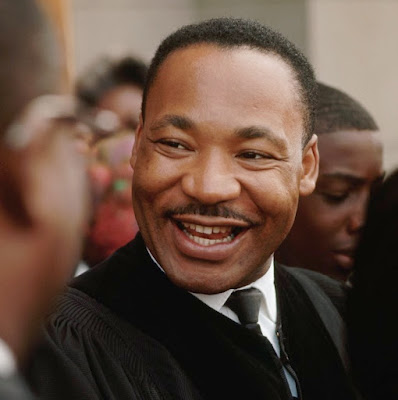
Reverend Martin Luther King Jr was born 97 years ago today

  "Nonviolence is a powerful and just weapon, which cuts without wounding and ennobles the man who wields it. It is a sword that heals." - Reverend Martin Luther King Jr., Nobel Lecture, December 11, 1964

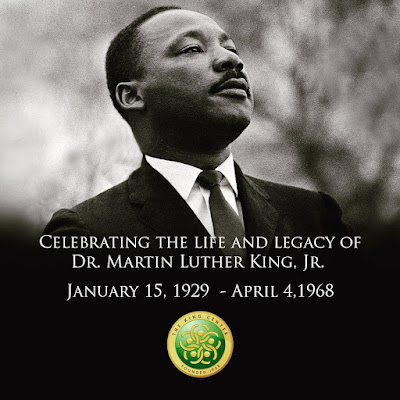
Martin Luther King Jr. January 15, 1929 - April 4, 1968

Reverend Martin Luther King Jr. was born in Atlanta, Georgia 97 years ago today, but he never lived to see his 40th birthday because he was assassinated on April 4, 1968.

A little more than a year before his untimely death, the nonviolent icon delivered an important speech at Stanford University that is well worth hearing and studying.
"Let me say as I've always said, and I will always continue to say, that riots are socially destructive and self-defeating. I'm still convinced that nonviolence is the most potent weapon available to oppressed people in their struggle for freedom and justice. I feel that violence will only create more social problems than they will solve." 

Dr. King's message is still relevant today, and his family works at The King Center to teach new generations about nonviolence and to share his writings and speeches.

King's radical critique of the United States

Martin Luther King Jr. was an outspoken critic of American society. He repeatedly challenged the United States to live up to its own lofty ideals, seeking reforms to end segregation and ensure voting rights for African Americans through nonviolent action and democratic norms.  He was also a radical critic of communism.

Reverend King's political philosophy is best described as Christian Democracy. This school of thought, which includes parties on the center left and center right, is based, like Reverend King, on a Christian view of humanity in which "every individual is considered unique and must be treated with dignity." In his April 4, 1967 speech, Beyond Vietnam gave full expression to this outlook:

"We must rapidly begin the shift from a thing-oriented society to a person-oriented society. When machines and computers, profit motives and property rights are considered more important than people, the giant triplets of racism, militarism and economic exploitation are incapable of being conquered. A true revolution of values will soon cause us to question the fairness and justice of many of our past and present policies. On the one hand we are called to play the Good Samaritan on life’s roadside, but that will be only an initial act. One day we must come to see that the whole Jericho Road must be transformed so that men and women will not be constantly beaten and robbed as they make their journey on life’s highway. True compassion is more than flinging a coin to a beggar. It comes to see than an edifice which produces beggars needs restructuring. "

Mohandas Gandhi, a major influence on King, advocated for social responsibility and trusteeship. Gandhi,  a self-described socialist, was not an enthusiastic supporter of an expanded social-welfare state, arguing:

"The State represents violence in a concentrated and organized form. The individual has a soul, but as the State is a soulless machine, it can never be weaned from violence to which it owes its very existence. Hence I prefer the doctrine of trusteeship. [...] What I would personally prefer would be not centralization of power in the hands of the State, but an extension of the sense of trusteeship, as, in my opinion, the violence of private ownership is less injurious than the violence of the State. However, if it is unavoidable, I would support a minimum of State-ownership."

Furthermore, both King and Gandhi's critique of a "thing-oriented" society or the state as a "soulless machine" focuses on the person or the individual rather than an economic mechanism or economic class. The emphasis is on the human person and policies that recognize and respect the uniqueness and dignity of each human being. 

King was targeted by both the FBI and the KGB

KGB targeted Martin Luther King Jr. for active measures.

When he was alive, the civil rights leader was a divisive figure. The FBI in the United States wiretapped Martin Luther King Jr., monitored the Civil Rights Movement, and took active measures against him.
Many people are aware of this, but few are aware of the other campaign launched against the civil rights leader by Soviet intelligence, also known as the KGB. It is also important to remember that Russian intelligence operatives have previously attempted to sow discord, division, and hatred among citizens in the United States. 

A high-ranking Russian intelligence officer defected to the United Kingdom in 1992, bringing with him notes and transcripts compiled over the previous thirty years as he relocated entire foreign intelligence archives to a new headquarters just outside of Moscow. Vasili Mitrokhin was the Russian intelligence officer whose information became known as The Mitrokhin Archive

In Christopher Andrew and Vasili Mitrokhin's 1999 book The Sword and the The Shield: The Mitrokhin Archive and the Secret History of the KGB, details were obtained from the Mitrokhin Archive on Soviet efforts to replace Martin Luther King Jr. with a "more radical and malleable leader" such as Stokeley Carmichael in order to incite a race war in the United States.

The following excerpts from The Sword and the Shield detail elements of the Soviet intelligence campaign and the active measures arrayed against the civil rights leader:

“In August 1967 the Centre approved an operational plan by the deputy head of Service A, Yuri Modin, former controller of the Magnificent Five, to discredit King and his chief lieutenants by placing articles in the African press, which could then be reprinted in American newspapers, portraying King as an “Uncle Tom” who was secretly receiving government subsidies to tame the civil rights movement and prevent it threatening the Johnson administration." 

[...]  

"King’s assassination on April 4, 1968 was quickly followed by the violence and rioting which the KGB had earlier blamed King for trying to prevent. Within a week riots erupted in over a hundred cities, forty-six people had been killed, 3,500 injured and 20,000 arrested. To “Deke” DeLoach, it seemed that, “The nation was teetering on the brink of anarchy.”86 Henceforth, instead of dismissing King as an Uncle Tom, Service A portrayed him as a martyr of the black liberation movement and spread conspiracy theories alleging that his murder had been planned by white racists with the connivance of the authorities."

On September 28, 1999, University of Cambridge professor Christopher Andrew, who coauthored The Sword and the Shield with Vasili Mitrokhin, was interviewed by Charlie Rose on PBS about the book and, near the end of the interview, discussed how the Soviets celebrated the assassination of Martin Luther King Jr. by James Earl Ray. The Russians rejoiced because they did not want an independent African American leader over whom they had no control and who practiced principled nonviolence.

Taylor Branch wrote about the Reverend's views on the militant call to armed struggle in the streets of the United States in January 1968 in the third book of his trilogy on Martin Luther King Jr. and the civil rights movement, At Canaan's Edge.

 “Riots just don’t pay off,” said King. He pronounced them an objective failure beyond morals or faith. “For if we say that power is the ability to effect change, or the ability to achieve purpose,” he said, “then it is not powerful to engage in an act that does not do that–no matter how loud you are, and no matter how much you burn.” Likewise, he exhorted the staff to combat the “romantic illusion” of guerrilla warfare in the style of Che Guevara. No “black” version of the Cuban revolution could succeed without widespread political sympathy, he asserted, and only a handful of the black minority itself favored insurrection. King extolled the discipline of civil disobedience instead, which he defined not as a right but a personal homage to untapped democratic energy. The staff must “bring to bear all of the power of nonviolence on the economic problem,” he urged, even though nothing in the Constitution promised a roof or a meal. “I say all of these things because I want us to know the hardness of the task,” King concluded, breaking off with his most basic plea: “We must not be intimidated by those who are laughing at nonviolence now.”

These words are as true today as they were over a half-century ago. Reverend King's legacy continues to inspire activists worldwide. This Baptist minister who risked everything for the freedom of all African Americans and the redemption of the United States by fulfilling the creed that all men are created equal.

Unlike others who were funded and supported by the Soviet Union, Martin Luther King Jr. was targeted by both American and Russian intelligence agencies because he was his own man, with no one controlling him except his conscience. He did not advocate or engage in violence while changing the United States and the world for the better.

King's living legacy

Bernice King, Martin Luther King Jr.'s daughter, hosted the aforementioned Beloved Community Global Summit and continues carrying on her father's work to advance nonviolence.

Today, on what would have been his 97th birthday, let us remember him and renew our commitment to continuing his work "to shift from a thing-oriented society to a person-oriented society."  

Monday, January 20, 2025

Martin Luther King Jr.'s Radical Anticommunism: Selected quotes on Communism (1956 - 1967)

"The socialists and communists say, they can do nothing to bring about economic equality today. They will just carry on propaganda in its favor and to that end they believe in generating and accentuating hatred." - Mohandas Gandhi, Gandhi's interview with Nirmal Kumar Bose, November 9 - 10, 1934

Photo of a drawing at the King Center in Atlanta, GA. Matt Lemmon 2008

Today, over social media, the debates and exchanges with different sides attempting to claim Martin Luther King Jr. as their own. Yet, when he died on April 4, 1968 he was being targeted by all sides. Today, as in 1968, the words communist and socialist get thrown around a lot.

However, the truth is more complicated. The Reverend Martin Luther King Jr. drew inspiration from the nonviolent Indian nationalist leader Mohandas Gandhi. Gandhi, although a Hindu and not a Christian, drew inspiration from the Sermon on the Mount. Reverend King traveled to India in 1959, and at the airport he told a group of reporters:“To other countries I may go as a tourist, but to India I come as a pilgrim.”

Both Gandhi and King were radical critics of communism.   

Martin Luther King, Jr. beside a picture of Gandhi. © Bob Fitch.

Many are aware of Reverend King's radical criticisms of Capitalism, but how many remember his radical criticisms of Communism?  Radical is defined here as going to the roots. Below are some of the key statements made by Reverend King on communism over the decade he was most politically active. 

"You cannot solve the problem by turning to communism, for communism is based on an ethical relativism and a metaphysical materialism that no Christian can accept. You can work within the framework of democracy to bring about a better distribution of wealth." - Martin Luther King Jr. Paul's Letter to American Christians (1956)

"Communism, avowedly secularistic and materialistic, has no place for God.4 This I could never accept, for as a Christian I believe that there is a creative personal power in this universe who is the ground and essence of all reality—a power that cannot be explained in materialistic terms. History is ultimately guided by spirit, not matter." - Martin Luther King Jr. Stride to Freedom (1958)

"Since for the Communist there is no divine government, no absolute moral order, there are no fixed, immutable principles; consequently almost anything—force, violence, murder, lying—is a justifiable means to the “millennial” end.5 This type of relativism was abhorrent to me." - Martin Luther King Jr. Stride to Freedom (1958)
 "Constructive ends can never give absolute moral justification to destructive means, because in the final analysis the end is pre-existent in the mean."  - Martin Luther King Jr. Stride to Freedom (1958)
"In communism the individual ends up in subjection to the state. True, the Marxist would argue that the state is an “interim” reality which is to be eliminated when the classless society emerges; but the state is the end while it lasts, and man only a means to that end. And if any man’s so-called rights or liberties stand in the way of that end, they are simply swept aside."  - Martin Luther King Jr. Stride to Freedom (1958)

"His liberties of expression, his freedom to vote, his freedom to listen to what news he likes or to choose his books are all restricted. Man becomes hardly more, in communism, than a depersonalized cog in the turning wheel of the state." - Martin Luther King Jr. Stride to Freedom (1958)

"Man is not made for the state; the state is made for man. To deprive man of freedom is to relegate him to the status of a thing, rather than elevate him to the status of a person. Man must never be treated as a means to the end of the state, but always as an end within himself." - Martin Luther King Jr. Stride to Freedom (1958)

"Listen to Lenin as he says 'Lying, deceit, violence, concealing and withholding the truth are all justifiable means to bring about the end of the classless society.'  This is the great weakness and tragedy of communism and any other system that argues that the end justifies the means, for in a real sense, the end is pre-existent in the means; the means represent the ideal in the making, and the end in process. In the long run of history, immoral means cannot bring about moral ends. Destructive means cannot bring about constructive goals." - Martin Luther King Jr. Address to Cornell College, Mount Vernon, Iowa (1962)
“If today I lived in a Communist country where certain principles dear to the Christian faith are suppressed, I would openly advocate disobeying that country's antireligious laws.” - MLK Jr., Letter from a Birmingham Jail (1963)
"This is the faith I commend to you Christians here in Berlin. A living, active, massive faith that affirms the victory of Jesus Christ over the world, whether it be an Eastern world or a Western world." - Martin Luther King Jr. East or West – God’s Children (1964)
 "There is nothing to keep us from molding a recalcitrant status quo with bruised hands until we have fashioned it into a brotherhood.  This kind of positive revolution of values is our best defense against communism." - Martin Luther King Jr. Beyond Vietnam (1967)
"We must not engage in a negative anticommunism, but rather in a positive thrust for democracy [applause], realizing that our greatest defense against communism is to take offensive action in behalf of justice." - Martin Luther King Jr. Beyond Vietnam (1967)

"We must with positive action seek to remove those conditions of poverty, insecurity, and injustice, which are the fertile soil in which the seed of communism grows and develops." - Martin Luther King Jr. Beyond Vietnam (1967)

"As I have walked among the desperate, rejected and angry young men I have told them that Molotov cocktails and rifles would not solve their problems."- Martin Luther King Jr. Beyond Vietnam: A Time to Break Silence (1967) 

 Martin Luther King Jr had a radical critique of American society. He repeatedly challenged the United States to live up to its own aspired ideals and sought through nonviolent action and democratic norms, reforms to end segregation and ensure voting rights for African AmericansReverend King's political outlook could best be described as falling within what is called Christian Democracy. This political school occupies the center with parties on the center left and the center right, but like Reverend King are based on a Christian view of humanity in which "every individual is considered unique and must be treated with dignity."

Mohandas Gandhi, who greatly influenced King, also spoke of social responsibility and trusteeship. He also warned that the state was a "soulless machine" that did not look out for the poor. Gandhi, a self-described socialist, was not an enthusiastic proponent of an expanded social-welfare state. Reverend King spoke of social democracy with an emphasis on democracy, but he also spoke of the need to shift "from a thing-oriented society to a person-oriented society."

The critique made by both King and Gandhi of a "thing-oriented" society or the state as a "soulless machine" looks to the person or the individual not an economic mechanism  or economic class.  The focus is on the human person and polices that recognize and respect the uniqueness of each human being and their dignity.

The Konrad Adenauer Foundation in their publication Christian Democracy: Principles and Policy Making offers a vision of this made reality in what is known as the social market economy.  This is a departure from a strict market economy, focused on individuals as economic units and one that is arrived at through a process of reforms, not revolution.

Many know of the FBI wiretapping Martin Luther King Jr., monitoring of the Civil Rights Movement, and active measures against the civil rights leader but fewer know of the campaign waged against him by Soviet intelligence, also known as the KGB. The reality is that he challenged both systems.

This was a challenge to the existing order of both the United States and the Soviet Union, but one that rejected communism, violent class struggle, and that was rooted in the Christian tradition. 

Perhaps, this is what scared so many powerful people.

Why do you think both the FBI and the KGB targeted Martin Luther King Jr.? 

Agree or disagree, please leave a comment below.

Monday, January 15, 2024

Reverend Martin Luther King Jr was born 95 years ago today

 "Nonviolence is a powerful and just weapon, which cuts without wounding and ennobles the man who wields it. It is a sword that heals." - Reverend Martin Luther King Jr., Nobel Lecture, December 11, 1964

Martin Luther King Jr. January 15, 1929 - April 4, 1968

Reverend Martin Luther King Jr. was born in Atlanta, Georgia 95 years ago today, but he never lived to see his 40th birthday because he was assassinated on April 4, 1968.

A little more than a year before his untimely death, the nonviolent icon delivered an important speech at Stanford University that is well worth hearing and studying.
"Let me say as I've always said, and I will always continue to say, that riots are socially destructive and self-defeating. I'm still convinced that nonviolence is the most potent weapon available to oppressed people in their struggle for freedom and justice. I feel that violence will only create more social problems than they will solve." 

Dr. King's message is still relevant today, and his family works at The King Center to teach new generations about nonviolence and to share his writings and speeches.

King's radical critique of the United States

Martin Luther King Jr. was an outspoken critic of American society. He repeatedly challenged the United States to live up to its own lofty ideals, seeking reforms to end segregation and ensure voting rights for African Americans through nonviolent action and democratic norms.  He was also a radical critic of communism.

Reverend King's political philosophy is best described as Christian Democracy. This school of thought, which includes parties on the center left and center right, is based, like Reverend King, on a Christian view of humanity in which "every individual is considered unique and must be treated with dignity." In his April 4, 1967 speech, Beyond Vietnam gave full expression to this outlook:

"We must rapidly begin the shift from a thing-oriented society to a person-oriented society. When machines and computers, profit motives and property rights are considered more important than people, the giant triplets of racism, militarism and economic exploitation are incapable of being conquered. A true revolution of values will soon cause us to question the fairness and justice of many of our past and present policies. On the one hand we are called to play the Good Samaritan on life’s roadside, but that will be only an initial act. One day we must come to see that the whole Jericho Road must be transformed so that men and women will not be constantly beaten and robbed as they make their journey on life’s highway. True compassion is more than flinging a coin to a beggar. It comes to see than an edifice which produces beggars needs restructuring. "

Mohandas Gandhi, a major influence on King, advocated for social responsibility and trusteeship. Gandhi,  a self-described socialist, was not an enthusiastic supporter of an expanded social-welfare state, arguing:

"The State represents violence in a concentrated and organized form. The individual has a soul, but as the State is a soulless machine, it can never be weaned from violence to which it owes its very existence. Hence I prefer the doctrine of trusteeship. [...] What I would personally prefer would be not centralization of power in the hands of the State, but an extension of the sense of trusteeship, as, in my opinion, the violence of private ownership is less injurious than the violence of the State. However, if it is unavoidable, I would support a minimum of State-ownership."

Furthermore, both King and Gandhi's critique of a "thing-oriented" society or the state as a "soulless machine" focuses on the person or the individual rather than an economic mechanism or economic class. The emphasis is on the human person and policies that recognize and respect the uniqueness and dignity of each human being. 

King was targeted by both the FBI and the KGB

KGB targeted Martin Luther King Jr. for active measures.

When he was alive, the civil rights leader was a divisive figure. The FBI in the United States wiretapped Martin Luther King Jr., monitored the Civil Rights Movement, and took active measures against him.
Many people are aware of this, but few are aware of the other campaign launched against the civil rights leader by Soviet intelligence, also known as the KGB. It is also important to remember that Russian intelligence operatives have previously attempted to sow discord, division, and hatred among citizens in the United States. 

A high-ranking Russian intelligence officer defected to the United Kingdom in 1992, bringing with him notes and transcripts compiled over the previous thirty years as he relocated entire foreign intelligence archives to a new headquarters just outside of Moscow. Vasili Mitrokhin was the Russian intelligence officer whose information became known as The Mitrokhin Archive

In Christopher Andrew and Vasili Mitrokhin's 1999 book The Sword and the The Shield: The Mitrokhin Archive and the Secret History of the KGB, details were obtained from the Mitrokhin Archive on Soviet efforts to replace Martin Luther King Jr. with a "more radical and malleable leader" such as Stokeley Carmichael in order to incite a race war in the United States.

The following excerpts from The Sword and the Shield detail elements of the Soviet intelligence campaign and the active measures arrayed against the civil rights leader:

“In August 1967 the Centre approved an operational plan by the deputy head of Service A, Yuri Modin, former controller of the Magnificent Five, to discredit King and his chief lieutenants by placing articles in the African press, which could then be reprinted in American newspapers, portraying King as an “Uncle Tom” who was secretly receiving government subsidies to tame the civil rights movement and prevent it threatening the Johnson administration." 

[...]  

"King’s assassination on April 4, 1968 was quickly followed by the violence and rioting which the KGB had earlier blamed King for trying to prevent. Within a week riots erupted in over a hundred cities, forty-six people had been killed, 3,500 injured and 20,000 arrested. To “Deke” DeLoach, it seemed that, “The nation was teetering on the brink of anarchy.”86 Henceforth, instead of dismissing King as an Uncle Tom, Service A portrayed him as a martyr of the black liberation movement and spread conspiracy theories alleging that his murder had been planned by white racists with the connivance of the authorities."

On September 28, 1999, University of Cambridge professor Christopher Andrew, who coauthored The Sword and the Shield with Vasili Mitrokhin, was interviewed by Charlie Rose on PBS about the book and, near the end of the interview, discussed how the Soviets celebrated the assassination of Martin Luther King Jr. by James Earl Ray. The Russians rejoiced because they did not want an independent African American leader over whom they had no control and who practiced principled nonviolence.

Taylor Branch wrote about the Reverend's views on the militant call to armed struggle in the streets of the United States in January 1968 in the third book of his trilogy on Martin Luther King Jr. and the civil rights movement, At Canaan's Edge.

 “Riots just don’t pay off,” said King. He pronounced them an objective failure beyond morals or faith. “For if we say that power is the ability to effect change, or the ability to achieve purpose,” he said, “then it is not powerful to engage in an act that does not do that–no matter how loud you are, and no matter how much you burn.” Likewise, he exhorted the staff to combat the “romantic illusion” of guerrilla warfare in the style of Che Guevara. No “black” version of the Cuban revolution could succeed without widespread political sympathy, he asserted, and only a handful of the black minority itself favored insurrection. King extolled the discipline of civil disobedience instead, which he defined not as a right but a personal homage to untapped democratic energy. The staff must “bring to bear all of the power of nonviolence on the economic problem,” he urged, even though nothing in the Constitution promised a roof or a meal. “I say all of these things because I want us to know the hardness of the task,” King concluded, breaking off with his most basic plea: “We must not be intimidated by those who are laughing at nonviolence now.”

These words are as true today as they were over a half-century ago. Reverend King's legacy continues to inspire activists worldwide. This Baptist minister who risked everything for the freedom of all African Americans and the redemption of the United States by fulfilling the creed that all men are created equal.

Unlike others who were funded and supported by the Soviet Union, Martin Luther King Jr. was targeted by both American and Russian intelligence agencies because he was his own man, with no one controlling him except his conscience. He did not advocate or engage in violence while changing the United States and the world for the better.

King's living legacy

Bernice King, Martin Luther King Jr.'s daughter, is hosting the aforementioned Beloved Community Global Summit and carrying on her father's work to advance nonviolence.

Today, on what would have been his 95th birthday, let us remember him and renew our commitment to continuing his work "to shift from a thing-oriented society to a person-oriented society."  

Let us participate in the King Center's day of service today, and if you are in the Atlanta area, please join the King family in carrying on Reverend Martin Luther King Jr.'s mission.

His legacy transcends borders, and ideologies. The Glenn Show explored it, and engaged in dialogue on what MLK Day is supposed to mean, and posted it today.

Sunday, January 15, 2023

Reverend Martin Luther King Jr was born 94 years ago today

 "Nonviolence is a powerful and just weapon, which cuts without wounding and ennobles the man who wields it. It is a sword that heals." - Reverend Martin Luther King Jr., Nobel Lecture, December 11, 1964 

Martin Luther King Jr. January 15, 1929 - April 4, 1968

Reverend Martin Luther King Jr. was born in Atlanta, Georgia 94 years ago today, but he never lived to see his 40th birthday because he was assassinated on April 4, 1968.
 
A little more than a year before his untimely death, the nonviolent icon delivered an important speech at Stanford University that is well worth hearing and studying.
"Let me say as I've always said, and I will always continue to say, that riots are socially destructive and self-defeating. I'm still convinced that nonviolence is the most potent weapon available to oppressed people in their struggle for freedom and justice. I feel that violence will only create more social problems than they will solve." 

Dr. King's message is still relevant today, and his family works at The King Center to teach new generations about nonviolence and to share his writings and speeches.

King's radical critique of the United States

Martin Luther King Jr. was an outspoken critic of American society. He repeatedly challenged the United States to live up to its own lofty ideals, seeking reforms to end segregation and ensure voting rights for African Americans through nonviolent action and democratic norms.  He was also a radical critic of communism.

Reverend King's political philosophy is best described as Christian Democracy. This school of thought, which includes parties on the center left and center right, is based, like Reverend King, on a Christian view of humanity in which "every individual is considered unique and must be treated with dignity." In his April 4, 1967 speech, Beyond Vietnam gave full expression to this outlook:

"We must rapidly begin the shift from a thing-oriented society to a person-oriented society. When machines and computers, profit motives and property rights are considered more important than people, the giant triplets of racism, militarism and economic exploitation are incapable of being conquered. A true revolution of values will soon cause us to question the fairness and justice of many of our past and present policies. On the one hand we are called to play the Good Samaritan on life’s roadside, but that will be only an initial act. One day we must come to see that the whole Jericho Road must be transformed so that men and women will not be constantly beaten and robbed as they make their journey on life’s highway. True compassion is more than flinging a coin to a beggar. It comes to see than an edifice which produces beggars needs restructuring. "

Mohandas Gandhi, a major influence on King, advocated for social responsibility and trusteeship. Gandhi,  a self-described socialist, was not an enthusiastic supporter of an expanded social-welfare state, arguing:

"The State represents violence in a concentrated and organized form. The individual has a soul, but as the State is a soulless machine, it can never be weaned from violence to which it owes its very existence. Hence I prefer the doctrine of trusteeship. [...] What I would personally prefer would be not centralization of power in the hands of the State, but an extension of the sense of trusteeship, as, in my opinion, the violence of private ownership is less injurious than the violence of the State. However, if it is unavoidable, I would support a minimum of State-ownership."

Furthermore, both King and Gandhi's critique of a "thing-oriented" society or the state as a "soulless machine" focuses on the person or the individual rather than an economic mechanism or economic class. The emphasis is on the human person and policies that recognize and respect the uniqueness and dignity of each human being. 

King was targeted by both the FBI and the KGB

 KGB targeted Martin Luther King Jr. for active measures.

When he was alive, the civil rights leader was a divisive figure. The FBI in the United States wiretapped Martin Luther King Jr., monitored the Civil Rights Movement, and took active measures against him.
Many people are aware of this, but few are aware of the other campaign launched against the civil rights leader by Soviet intelligence, also known as the KGB. It is also important to remember that Russian intelligence operatives have previously attempted to sow discord, division, and hatred among citizens in the United States. 

A high-ranking Russian intelligence officer defected to the United Kingdom in 1992, bringing with him notes and transcripts compiled over the previous thirty years as he relocated entire foreign intelligence archives to a new headquarters just outside of Moscow. Vasili Mitrokhin was the Russian intelligence officer whose information became known as The Mitrokhin Archive

In Christopher Andrew and Vasili Mitrokhin's 1999 book The Sword and the The Shield: The Mitrokhin Archive and the Secret History of the KGB, details were obtained from the Mitrokhin Archive on Soviet efforts to replace Martin Luther King Jr. with a "more radical and malleable leader" such as Stokeley Carmichael in order to incite a race war in the United States.

The following excerpts from The Sword and the Shield detail elements of the Soviet intelligence campaign and the active measures arrayed against the civil rights leader:

“In August 1967 the Centre approved an operational plan by the deputy head of Service A, Yuri Modin, former controller of the Magnificent Five, to discredit King and his chief lieutenants by placing articles in the African press, which could then be reprinted in American newspapers, portraying King as an “Uncle Tom” who was secretly receiving government subsidies to tame the civil rights movement and prevent it threatening the Johnson administration." 

[...]  

"King’s assassination on April 4, 1968 was quickly followed by the violence and rioting which the KGB had earlier blamed King for trying to prevent. Within a week riots erupted in over a hundred cities, forty-six people had been killed, 3,500 injured and 20,000 arrested. To “Deke” DeLoach, it seemed that, “The nation was teetering on the brink of anarchy.”86 Henceforth, instead of dismissing King as an Uncle Tom, Service A portrayed him as a martyr of the black liberation movement and spread conspiracy theories alleging that his murder had been planned by white racists with the connivance of the authorities."

On September 28, 1999, University of Cambridge professor Christopher Andrew, who coauthored The Sword and the Shield with Vasili Mitrokhin, was interviewed by Charlie Rose on PBS about the book and, near the end of the interview, discussed how the Soviets celebrated the assassination of Martin Luther King Jr. by James Earl Ray. The Russians rejoiced because they did not want an independent African American leader over whom they had no control and who practiced principled nonviolence.

Taylor Branch wrote about the Reverend's views on the militant call to armed struggle in the streets of the United States in January 1968 in the third book of his trilogy on Martin Luther King Jr. and the civil rights movement, At Canaan's Edge.

 “Riots just don’t pay off,” said King. He pronounced them an objective failure beyond morals or faith. “For if we say that power is the ability to effect change, or the ability to achieve purpose,” he said, “then it is not powerful to engage in an act that does not do that–no matter how loud you are, and no matter how much you burn.” Likewise, he exhorted the staff to combat the “romantic illusion” of guerrilla warfare in the style of Che Guevara. No “black” version of the Cuban revolution could succeed without widespread political sympathy, he asserted, and only a handful of the black minority itself favored insurrection. King extolled the discipline of civil disobedience instead, which he defined not as a right but a personal homage to untapped democratic energy. The staff must “bring to bear all of the power of nonviolence on the economic problem,” he urged, even though nothing in the Constitution promised a roof or a meal. “I say all of these things because I want us to know the hardness of the task,” King concluded, breaking off with his most basic plea: “We must not be intimidated by those who are laughing at nonviolence now.”

These words are as true today as they were over a half-century ago. Reverend King's legacy continues to inspire activists worldwide. This Baptist minister who risked everything for the freedom of all African Americans and the redemption of the United States by fulfilling the creed that all men are created equal.

Unlike others who were funded and supported by the Soviet Union, Martin Luther King Jr. was targeted by both American and Russian intelligence agencies because he was his own man, with no one controlling him except his conscience. He did not advocate or engage in violence while changing the United States and the world for the better.

King's living legacy

Bernice King, Martin Luther King Jr.'s daughter, is hosting the aforementioned Beloved Community Global Summit and carrying on her father's work to advance nonviolence.

Today, on what would have been his 94th birthday, let us remember him and renew our commitment to continuing his work "to shift from a thing-oriented society to a person-oriented society." 

Let us participate in the King Center's day of service tomorrow, and if you are in the Atlanta area, please join the King family in carrying on Reverend Martin Luther King Jr.'s mission.

Saturday, January 15, 2022

Reverend Martin Luther King Jr was born 93 years ago today

 "Nonviolence is a powerful and just weapon, which cuts without wounding and ennobles the man who wields it. It is a sword that heals." - Reverend Martin Luther King Jr., Nobel Lecture, December 11, 1964 

Martin Luther King Jr. January 15, 1929 - April 4, 1968

Reverend Martin Luther King Jr. was born 93 years ago today in Atlanta, Georgia but never saw his 40th birthday because he was assassinated on April 4, 1968. A little over a year before his untimely death the nonviolent icon made an important speech at Stanford University which is worth listening to and studying.

"Let me say as I've always said, and I will always continue to say, that riots are socially destructive and self-defeating. I'm still convinced that nonviolence is the most potent weapon available to oppressed people in their struggle for freedom and justice. I feel that violence will only create more social problems than they will solve." 

Dr. King's message remains relevant today and his family continues  to work at The King Center in  training new generations in the ways of nonviolence, and sharing his writings and speeches. They are introducing a new immersive, self-paced online learning experience in nonviolence.

Martin Luther King Jr. had a radical critique of American society. He repeatedly challenged the United States to live up to its own aspired ideals and sought through nonviolent action and democratic norms, reforms to end segregation and ensure voting rights for African Americans

Reverend King's political outlook could best be described as falling within what is called Christian Democracy. This school of thought occupies the center with parties on the center left and the center right, but like Reverend King based on a Christian view of humanity in which "every individual is considered unique and must be treated with dignity."  In his April 4, 1967 speech, Beyond Vietnam gave full expression to this outlook:

"We must rapidly begin the shift from a thing-oriented society to a person-oriented society. When machines and computers, profit motives and property rights are considered more important than people, the giant triplets of racism, militarism and economic exploitation are incapable of being conquered. A true revolution of values will soon cause us to question the fairness and justice of many of our past and present policies. On the one hand we are called to play the Good Samaritan on life’s roadside, but that will be only an initial act. One day we must come to see that the whole Jericho Road must be transformed so that men and women will not be constantly beaten and robbed as they make their journey on life’s highway. True compassion is more than flinging a coin to a beggar. It comes to see than an edifice which produces beggars needs restructuring. "
Mohandas Gandhi, who greatly influenced King, also spoke of social responsibility and trusteeship. Gandhi, a self-described socialist, was not an enthusiastic proponent of an expanded social-welfare state as commonly understood arguing
"The State represents violence in a concentrated and organized form. The individual has a soul, but as the State is a soulless machine, it can never be weaned from violence to which it owes its very existence. Hence I prefer the doctrine of trusteeship. [...] What I would personally prefer would be not centralization of power in the hands of the State, but an extension of the sense of trusteeship, as, in my opinion, the violence of private ownership is less injurious than the violence of the State. However, if it is unavoidable, I would support a minimum of State-ownership."

Furthermore the critique made by both King and Gandhi of a "thing-oriented" society or the state as a "soulless machine" looks to the person or the individual not an economic mechanism  or economic class. The focus is on the human person and polices that recognize and respect the uniqueness of each human being and their dignity.

Martin Luther King Jr.'s daughter Bernice King  is hosting the above Beloved Community Global Summit and continuing her father's work to advance nonviolence.

When he was alive the civil rights leader was considered a controversial figure. The American FBI wiretapped Martin Luther King Jr., monitored the Civil Rights Movement, and carried out active measures against him. Many have heard about this, but not of the other campaign waged against the civil rights leader by Soviet intelligence, also known as the KGB. It is also important to remember that today when Russian intelligence operatives seek to sow discord, division and hatred in the United States between citizens that they did it before.

In 1992 a high ranking Russian intelligence officer defected to the United Kingdom and brought with him notes and transcripts compiled over the previous thirty years as he moved entire foreign intelligence archives to a new headquarters just outside of Moscow. The Russian intelligence officer’s name was Vasili Mitrokhin and the information he gathered became known as The Mitrokhin Archive.

In the book The Sword and the The Shield: The Mitrokhin Archive and the Secret History of the KGB by Christopher Andrew and Vasili Mitrokhin published in 1999 details were obtained from the Mitrokhin Archive on Soviet efforts to replace Martin Luther King Jr. with a “more radical and malleable leader” such as Stokeley Carmichael to provoke a race war in the United States.

 KGB targeted Martin Luther King Jr. for active measures.

Pages 237 and 238 of The Sword and the Shield excerpted below detail elements of the campaign waged by Soviet intelligence and the active measures arrayed against the civil rights leader:

“In August 1967 the Centre approved an operational plan by the deputy head of Service A, Yuri Modin, former controller of the Magnificent Five, to discredit King and his chief lieutenants by placing articles in the African press, which could then be reprinted in American newspapers, portraying King as an “Uncle Tom” who was secretly receiving government subsidies to tame the civil rights movement and prevent it threatening the Johnson administration." [...]  "King’s assassination on April 4, 1968 was quickly followed by the violence and rioting which the KGB had earlier blamed King for trying to prevent. Within a week riots erupted in over a hundred cities, forty-six people had been killed, 3,500 injured and 20,000 arrested. To “Deke” DeLoach, it seemed that, “The nation was teetering on the brink of anarchy.”86 Henceforth, instead of dismissing King as an Uncle Tom, Service A portrayed him as a martyr of the black liberation movement and spread conspiracy theories alleging that his murder had been planned by white racists with the connivance of the authorities."
 University of Cambridge professor Christopher Andrew, who coauthored The Sword and the Shield with Vasili Mitrokhin was interviewed by Charlie Rose on PBS on September 28, 1999 about the book and towards the end of the interview discussed how the Soviets celebrated when Martin Luther King Jr. was assassinated by James Earl Ray.  The Russians celebrated because they did not want an independent African American leader, that they could not control, who was a principled nonviolence practitioner.

Taylor Branch, in the third book of his trilogy on Martin Luther King Jr. and the civil rights movement, At Canaan's Edge wrote about the Reverend's views on the militant call to armed struggle in the streets of the United States in January of 1968.
“Riots just don’t pay off,” said King. He pronounced them an objective failure beyond morals or faith. “For if we say that power is the ability to effect change, or the ability to achieve purpose,” he said, “then it is not powerful to engage in an act that does not do that–no matter how loud you are, and no matter how much you burn.” Likewise, he exhorted the staff to combat the “romantic illusion” of guerrilla warfare in the style of Che Guevara. No “black” version of the Cuban revolution could succeed without widespread political sympathy, he asserted, and only a handful of the black minority itself favored insurrection. King extolled the discipline of civil disobedience instead, which he defined not as a right but a personal homage to untapped democratic energy. The staff must “bring to bear all of the power of nonviolence on the economic problem,” he urged, even though nothing in the Constitution promised a roof or a meal. “I say all of these things because I want us to know the hardness of the task,” King concluded, breaking off with his most basic plea: “We must not be intimidated by those who are laughing at nonviolence now.”

These words remain as true today as when he uttered them a half century ago. Reverend King's legacy continues to inspire activists from around the world. This Baptist minister who risked all for the freedom of all African Americans and the redemption of the United States through the fulfillment of its creed that all men are created equal.

Unlike others, who were funded and supported by the Soviet Union, Martin Luther King Jr was targeted by both American and Russian intelligence agencies because he was his own man, and not controlled by anyone, save his conscience. He didn't advocate or engage in violence and changed the United States and the world for the better.

Let us remember him today on what would have been his 93rd birthday, and recommit ourselves to continuing his work "to shift from a thing-oriented society to a person-oriented society."