Showing posts with label Xiomara de las Mercedes Cruz Miranda. Show all posts

Thursday, November 28, 2019

Xiomara de las Mercedes Cruz Miranda Update: Lady in White and Cuban prisoner of conscience dying

She needs a humanitarian visa to get treatment

Xiomara de las Mercedes today
Xiomara de las Mercedes Cruz Miranda is a Lady in White and Cuban prisoner of conscience who is deathly ill. Due to the seriousness of her illness she was placed on a prison furlough on August 10, 2019. This is to avoid the bad press of another Cuban prisoner of conscience dying in prison. However her health continues to deteriorate and there is a campaign underway, led by the Ladies in White, for her to be granted a humanitarian visa to obtain medical care abroad.


Xiomara was arrested on April 16, 2016 for speaking out during a human rights demonstration in Havana's Central park. She was placed on parole in January of 2018. She was re-arrested in mid-September 2018 under the charge of being "threatening." On September 19, 2018 she was tried and sentenced to one year and four months in prison. She was sent to a prison 400 kilometers from her home. This was an added hardship for her family to visit her, and keep an eye on her well being.

Xiomara was sent to a punishment cell for at least 10 days for speaking to her daughter over the phone. Apparently, officials did not like the content of their conversation.

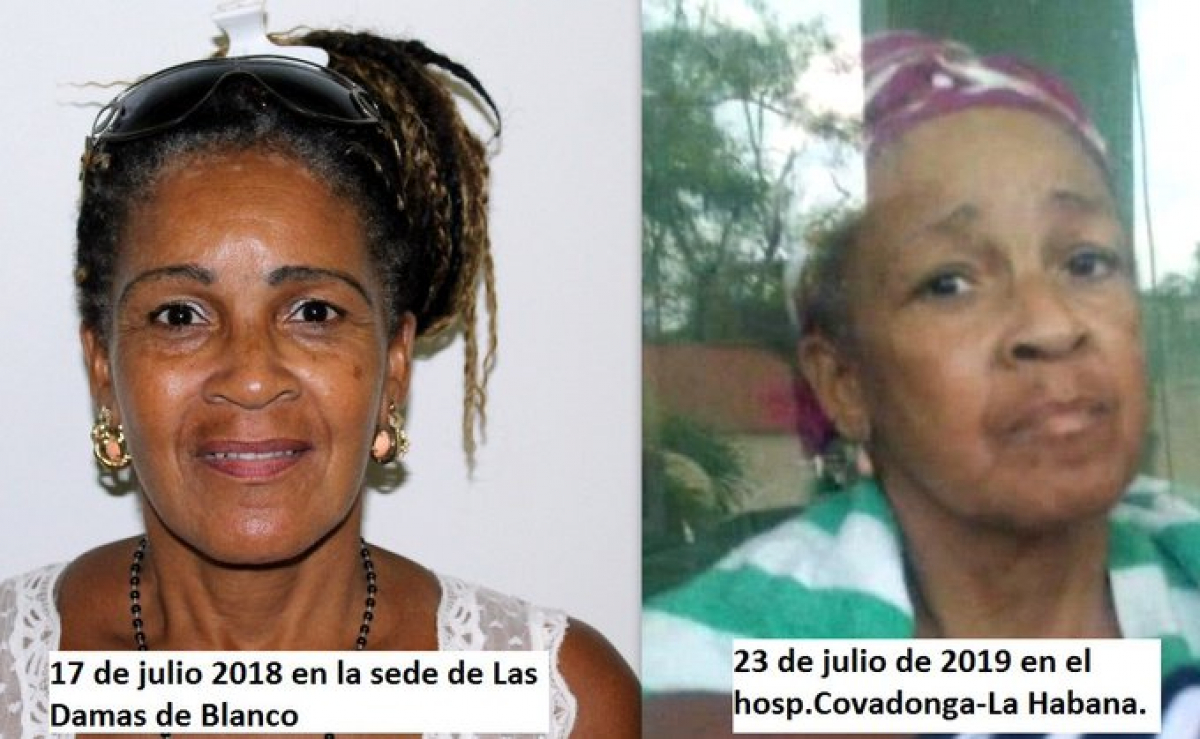
Xiomara de las Mercedes Cruz Miranda before and during her jailing.
On August 8, 2019 she was transferred to intensive care. Cuban dissident Angel Juan Moya posted videos of interviews from August 6th and August 7th with doctors at the hospital. Family members complained that they are receiving differing diagnoses and her situation continues to worsen. Xiomara was in intensive care and doctors were saying that it could be lung cancer. A doctor refused to update the family saying: "that he did not want to see those people."

Their is cause for great concern. Xiomara's condition is deteriorating, and one of the doctors raised the issue of a "political" question. Cuban healthcare has a long history of being subordinated to political considerations. The health of the patient is not the top priority.

This is why a humanitarian visa and medical care abroad to ascertain what his happening to her is a necessity.


Thursday, August 29, 2019

Amnesty International identified five new prisoners of conscience in Cuba, but there are more.

The current human rights situation.
Amnesty International on August 26, 2019 identified five new prisoners of conscience in Cuba, and states that they likely represent “a tiny fraction of those behind bars for peacefully expressing their views.”
The human rights organization goes on to explain that this is due to Cuban authorities continuing to deny independent human rights monitors access to Cuba and its prisons. Last time the Castro regime allowed such a visit was 1989.
In addition to the lack of access Amnesty International also highlights a “profound climate of fear” due to "the state’s machinery of control.” More media attention, especially by foreign correspondents based in Cuba would discourage these outrageous abuses.
Yoani Sánchez over twitter on August 27, 2019 placed the crime of "pre-criminal dangerousness" into context:
" Did you know that in Cuba you can be jailed for a crime that seems to be taken from the film ‘Minority Report’? It's called 'pre-criminal dangerousness' an they lock you up for what you could do, for the suspicion of an action in the future. Many times, that's how political reprisals are hidden."
Amnesty International should add independent journalist Roberto de Jesus Quiñones to the list of prisoners of conscience. He faces one year in prison for his journalism.

Roberto de Jesus Quiñones
Amnesty should also add Xiomara de las Mercedes Cruz Miranda, a jailed Cuban dissident to the list of prisoners of conscience. Xiomera is a member of the Ladies in White, a mother, and a prisoner of conscience. She was arrested on April 16, 2016 for speaking out during a human rights demonstration in Havana's Central park. She was placed on parole in January of 2018. She was re-arrested in mid-September 2018 under the charge of being "threatening." On September 19, 2018 she was tried and sentenced to one year and four months in prison.  


Amnesty International, August 26, 2019
Cuba: Amnesty International names five new prisoners of conscience
Just over a year since President Miguel Díaz-Canel took office, the existence of prisoners of conscience in Cuba remains a sharp indicator of how authorities there continue to restrict the fundamental rights to freedom of expression and peaceful assembly, Amnesty International said today.
“For decades, Cuba has stifled freedom of expression and assembly by locking up people for their beliefs and opposition to the government. Over the years, the names of Cuba’s prisoners of conscience have changed, but the state’s tactics have stayed almost exactly the same,” said Erika Guevara-Rosas, Americas director at Amnesty International.
For decades, Cuba has stifled freedom of expression and assembly by locking up people for their beliefs and opposition to the government. Over the years, the names of Cuba’s prisoners of conscience have changed, but the state’s tactics have stayed almost exactly the same. - Erika Guevara-Rosas, Americas director at Amnesty International
“Sadly, we know that the five prisoners of conscience we have named today likely represent a tiny fraction of those behind bars for peacefully expressing their views. As the Cuban authorities continue to deny independent human rights monitors access to the country and its prisons, and because the state’s machinery of control maintains a profound climate of fear, there are serious barriers for Amnesty International to document such cases.”
The list of prisoners of conscience includes members of political and pro-democracy groups not recognized by the state – all of whom have been imprisoned for crimes that are either inconsistent with international law or that have been used for decades in Cuba to silence critical voices. As the executive continues to tightly control lawyers and the judiciary, there are few ways to challenge such decisions.
“The government of Díaz-Canel should focus on finding real solutions to Cuba’s problems, which include increasing scarcity of food and medicine, according to news reports. Instead, it continues to lock people up for their views”, said Erika Guevara-Rosas.
The government of Díaz-Canel should focus on finding real solutions to Cuba’s problems, which include increasing scarcity of food and medicine, according to news reports. Instead, it continues to lock people up for their views. - Erika Guevara-Rosas, Americas director at Amnesty International

Amnesty International, August 26, 2019

CUBA: A SNAPSHOT OF PRISONERS OF CONSCIENCE UNDER THE GOVERNMENT OF PRESIDENT MIGUEL DÍAZ-CANEL

INTRODUCTION
In a rare press conference with former US President Obama in 2016, President Raúl Castro flatly denied that there were any “political prisoners” in Cuba. However, in the past four years, Amnesty International has named 12 prisoners of conscience in the country, and there are likely many more.
Amnesty International calls for the immediate and unconditional release of all prisoners of conscience, as they have been deprived of their liberty solely for peacefully exercising their human rights.
Just over a year after new President Miguel Díaz-Canel assumed office, NGO Cuban Prisoners Defenders claims that at least 71people are imprisoned on politically motivated charges. Having considered just a handful those cases, in which we were able to review official court sentences and other available documentation, Amnesty International believes that the below mentioned individuals are prisoners of conscience –people imprisoned solely because of the peaceful exercise of their human rights.
Without access to Cuba, and because lawyers and the judiciary remain firmly under the authorities’ control, there are serious barriers for Amnesty International to document cases of those imprisoned solely for politically motivated reasons, and as such there are highly likely to be many more cases of prisoners of conscience than our organization has been able to document.
According to information available to Amnesty International, all the individuals are members of political opposition groups, not recognized by the authorities. All of them have been imprisoned for offences that are not internationally recognizable, which have been used for decades in Cuba to silence critical voices. Amnesty International calls for the reform of Cuba’s criminal laws to remove provisions that are inconsistent with international law, such as “dangerousness” and “contempt.”

BACKGROUND: CRIMINAL LAWS USED TO SILENCE IN CUBA 

RESISTANCE AND PUBLIC DISORDER
Provisions of the criminal code such as “resistance” to public officials carrying out their duties, and “public disorder” have been used for decades to stifle the rights to freedom of expression, peaceful assembly and association in Cuba.CONTEMPT“Contempt”, defined in article 144.1 of Cuba’s Criminal Code, is an undue restriction on the right to freedom of expression, as public officials should tolerate more criticism than private individuals. The use of defamation laws with the purpose or effect of inhibiting criticism of government or public officials violates the right to freedom of expression.
DANGEROUSNESS
The provision of “dangerousness” is contained in Articles 78-84 of the Penal Code. These provisions are imprecise and subjective, which allow the authorities to apply them arbitrarily. The UN Working Group on Arbitrary Detentions has stated that detentions in Cuba are arbitrary when “persons are deprived of their liberty for a long period on the basis of their alleged dangerousness, with no reference to specific acts defined with the rigour that has been required by international criminal law since at least the eighteenth century, and which is now enshrined in article 11, paragraph 2, of the Universal Declaration of Human Rights”.
Amnesty International has further documented how the authorities use dismissals from state-employment, and harassment of self-employed workers in emerging private sector, as tactics of control over the right to freedom of expression, leaving many critical of the state’s economic or political model jobless.In multiple sentences issued for “dangerousness” reviewed by Amnesty International, the court refers to the fact that the accused does not work, as part of its reasoning for issuing the sentence of “dangerousness”. As those overtly critical of the government are frequently subject to such dismissals, this, in turn, facilitates the authorities’ ability to imprison dissenting voices for “dangerousness”.

PRISONERS OF CONSCIENCE
1. Josiel Guía Piloto (male) is president of the Republican Party of Cuba and serving a five year-sentence for “public disorder” and “contempt.”Josiel was detained after having criticized former President Fidel Castro on 1 December 2016. According to his mother, who has also been involved in activism against the Cuban government, prison officialsbeat him in prison leaving him with complications to his left lung. On 11 June 2019, the Inter-American Commission on Human Rights granted precautionary measures to respect and protect his rights to health, life and physical integrity.

Josiel Guía Piloto
2.Silverio Portal Contreras (male), former activist with the Ladies in White, is serving a 4-year sentence for "contempt" and "public disorder." According to a court document, Silverio was arrested on the 20 June 2016 in Old Havana after shouting “Down Fidel Castro, down Raúl...” The document states that the behavior of the accused is particularly offensive because it took place in a touristic area. The document further describes the accused as having “bad social and moral behavior” and mentions that he fails to participate in pro-government activities. According to Silverio’s wife, before his arrest he had campaigned against the collapsing of dilapidated buildings in Havana.  

Silverio Portal Contreras
3. Mitzael Díaz Paseiro(male) is a member of the Frente Nacional de Resistencia Cívica Orlando Zapata Tamayo (FNRC-OZT) and who was imprisoned in 2017 for four years, for “dangerousness”.Mitzael Diaz Paseiro is a political activist who was campaigning against the government’s position in the constitutional reform process. According to his wife, prior to his imprisonment the police had detained him multiple times for his activism. According to court documents, which Amnesty International was able to review, Mitzael was imprisoned for “dangerousness”, for among other things, failing to hold a job, for meeting with “citizens of terrible moral and conduct”, for drinking alcohol frequently, and using vulgar language. Mitzael’s wife says he suffers a heart condition and says he has been beaten by officials in jail for his views.

Mitzael Díaz Paseiro
4. Eliecer Bandera Barrera(male), an activist of the Unión Patriótica de Cuba (UNPACU) since 2015, is serving a sentence for “dangerousness” until 2021. Eliecer was arrested in September 2016 after having filmed videos for UNPACU about the conditions of workers interned in camps, according to his wife. Eliecer was sentenced to four years imprisonment for “dangerousness” by the Municipal Court of Rio Cauto in 2016, and subsequently further sentenced to 10 months for escaping the camp where he was interned to make a phone call to a sick family member, before voluntarily returning. According to the sentence, during his imprisonment for “dangerousness”, Eliecer “did not participate in political and educational activities” ... “showing disrespect for the officers guarding him”. He also has a prior sentence for “resistance” issued in 2003. 

Eliecer Bandera Barrera
5. Edilberto Ronal Arzuaga Alcalá (male) is an UNPACU activist, reportedly imprisoned for not paying a fine.According to information received by Amnesty International, Edilberto has been imprisoned since December 2018, reportedly for not paying fines related to his alleged distribution of political posters. Edilberto was most recently involved in the “Cuba Decide” Campaign and campaigned against the government’s position in the recent constitutional reform process. According to Cuban Prisoners Defenders, Edilberto was detained on 24 December 2018, when filming testimonies of people discussing the constitutional reform process in a public market, in the city of Camagüey. After being taken to prison, he was sentenced to 14 months of prison for failing to pay fines previously accumulated.On 22 April 2019 the Inter-American Commission on Human Rights granted precautionary measures calling on Cuban authorities to respect and protect the rights to health, life and physical integrity of Edilberto.

Edilberto Ronal Arzuaga Alcalá
RECOMMENDATIONS
These five cases show that although the leadership in Cuba might have changed, illegitimate restrictions on freedom of expression and association are still the practice. Therefore, besides other key recommendations presented in our Human Rights Agenda for Cuba, we urge the Cuban government to:
1. Immediately and unconditionally release all prisoners of conscience, and quash their convictions, which are solely based on their peaceful exercise of their human rights to freedom of expression, association and peaceful assembly;
2.Pending their release, ensure that prisoners of conscience are protected from torture and other ill-treatment, and are allowed access to their family, a lawyer of their choice, and adequate medical care; and are treated in full accordance with the UN Standard Minimum Rules for the Treatment of Prisoners (the Nelson Mandela Rules);
3.Guarantee the right to freedom of expression, assembly and association in Cuba, including for dissident, opponent or activist voices and repeal all legislation which unduly limits these rights.

Sunday, August 11, 2019

Please Take Urgent Action for Cuban Lady in White and prisoner of conscience Xiomara Cruz

Help save Xiomara de las Mercedes Cruz Miranda's life.

Xiomara de las Mercedes Cruz Miranda before and during her jailing.
Xiomara de las Mercedes Cruz Miranda is a Cuban dissident. member of the Ladies in White, a mother, and a prisoner of conscience. She was arrested on April 16, 2016 for speaking out during a human rights demonstration in Havana's Central park. She was placed on parole in January of 2018. She was re-arrested in mid-September 2018 under the charge of being "threatening." On September 19, 2018 she was tried and sentenced to one year and four months in prison. She was sent to a prison 400 kilometers from her home. This was an added hardship for her family to visit her, and keep an eye on her well being.

Xiomara was sent to a punishment cell for at least 10 days for speaking to her daughter over the phone. Apparently, officials did not like the content of their conversation.

Over the course of one year in custody of the Castro dictatorship her health has radically declined. Above and below are photos of rashes that appeared on her body in June that Cuban medical doctors in Ciego de Ávila claimed to be unable to diagnose. In mid-July she was returned to Havana to La Covadonga hospital.


On August 8, 2019 she was transferred to intensive care. Cuban dissident Angel Juan Moya has posted videos of interviews from August 6th and August 7th with doctors at the hospital. Family members are complaining that they are receiving differing diagnosis and her situation continues to worsen. Xiomara is intensive care and now doctors are saying that it could be lung cancer. A doctor refuses to update the family saying: "that he did not want to see those people."

Their is cause for great concern. Xiomara's condition is deteriorating, and one of the doctors raised the issue of a "political" question.  Healthcare in Cuba has a history of being subordinated to political considerations. The health of the patient is not the top priority.

Laura Pollán February 13, 1948 – October 14, 2011
Xiomara de las Mercedes Cruz Miranda may become the second Lady in White to be a victim of purposeful medical neglect. The first was Laura Inés Pollán Toledo, founding leader of the Ladies in White, who was a victim of a sad, tragic and unnecessary death on October 14, 2011.

This practice of politically motivated medical negligence is not just limited to members of the Ladies in White. Two other examples separated by twenty years demonstrates that this is a long term regime tactic to deal with dissidents in a manner that rises to the level of cruel and unusual punishment.

Sirley Avila Leon was denied adequate medical care in Cuba
On May 24, 2015 Sirley Avila Leon was the victim of a politically motivated machete attack carried out by Osmany Carriòn, with the complicit assistance of his wife, that led to the loss of her left hand, right upper arm nearly severed, and knees slashed into leaving her crippled. Following the attack Sirley did not receive adequate medical care and was told quietly by medical doctors in Cuba that if she wanted to get better that she would need to leave the country. She arrived in Miami on March 8, 2016 in a wheel chair unable to bend her legs, or close her remaining hand.

Sebastián Arcos Bergnes Born: 1931, Died: December 22, 1997
Sebastián Arcos Bergnes, a human rights defender and leader in the Cuban Committee for Human Rights, died from a case of purposeful medical neglect.

On January 13, 1992 the executive board of the Cuban Committee for Human Rights again issued a statement reaffirming their commitment to nonviolence and calling for dialogue with the Cuban government.

Sebastian Arcos Bergnes was detained on January 15, 1992 and charged with "enemy propaganda" and "inciting rebellion," he was sentenced to four years and eight months in prison. Sebastian was transferred to Ariza Prison in  Cienfuegos Province,  more than 130 miles from Havana, where he was imprisoned alongside dangerous criminals and systematically denied medical attention.

In 1993 the regime offered Sebastian a deal: He would be released immediately if he only agreed to leave the island for good. Sebastian rejected the deal, choosing prison in Cuba over freedom in exile.

After an international campaign that included his designation as an Amnesty International prisoner of conscience and a request by France Libertés, the organization founded by former French first lady Danielle Mitterrand, Sebastian Arcos was released in 1995.

A few weeks after his release, Arcos was diagnosed with a malignant tumor in the rectum, for which he had previously been denied medical care in prison. After a Cuban doctor was fired from his post for diagnosing Arcos, he traveled to Miami for further care. In 1996, Sebastián Arcos Bergnes testified before the UN Human Rights Commission in Geneva, Switzerland.


Sebastian died on December 22, 1997 from the cancer that could have been easily diagnosed much earlier, and saved his life.

The fear is that a similar process is being carried out against Xiomara de las Mercedes Cruz Miranda. The international community and people of good will need to make their voices heard.

Xiomara Cruz, prisoner of conscience, Covadonga Hospital intensive care, Aug 8th