Moncada vs Varela
 |
| Bodies from July 26 Moncada Assault. Dissidents turn in Project Varela petitions |
In the early morning hours of July 26, 1953 a group of Cubans led
by Fidel Castro
assaulted the Moncada barracks in Santiago de Cuba.
Approximately, 18 government officials were killed and 28 wounded in
the attack. 27 rebels were killed and 11 wounded. 51 of the surviving
99 rebels were placed on trial. Fidel Castro turned himself in after
seeking guarantees for his safety and was also put on trial.
This attack turned Fidel Castro into a national figure. He would go on to
name his movement, the July 26th Movement. Although the image of
Che Guevara
is used in the propaganda today, the Argentine hadn't met Fidel Castro yet and would not
get involved in the July 26th Movement until 1955 when he met Raul and
Fidel Castro in Mexico.
Leftists
continue to celebrate this date along with the Castro dictatorship. In time of the pandemic the Castro regime has canceled its obligatory rallies in Cuba, but encouraged their allies outside of Cuba to take their chances.
They continue the lie that the Batista dictatorship was U.S. backed, while ignoring that the United States
placed an arms embargo on Batista in March 1958 responding to a request by Fidel Castro's July 26th Movement, and the U.S. Ambassador in Havana
pressured the Cuban authoritarian despot to leave in December 1958.
Contrast this with what Oswaldo Payá Sardiñas did. In the midst of a totalitarian dictatorship were all media are controlled by the
government along with economic life he managed to lead a movement that
persuaded more than 24,000 Cubans to identify themselves, demand
democratic reforms, and the restoration of human rights knowing that
the Varela Project petition
they were signing could lead to losing their jobs, having their
children denied access to higher education and in the worse case prison.
The images of the movement, unlike the Castro regime's are nonviolent
and inclusive and focus on liberation and reconciliation not violence
and killing. They do not seek to destroy or slander anyone but
to free a people.
Oswaldo rejected hatred and violence. He never killed anyone and offered
a path to a nonviolent democratic transition.
Oswaldo's nonviolent legacy has
continued beyond him and is a positive tradition for Cuba. His nonviolent
struggle followed two of the basic principles
outlined by nonviolence practitioner Michael
N. Nagler: "We are not against other people, only what they are doing.
Means are ends in the making; nothing good can finally result from
violence."
Oswaldo
explained his position before an international
audience in December of 2002:
The first victory we can claim is that our hearts are
free of hatred. Hence we say to those who persecute us and who try to
dominate us: “You are my brother. I do not hate you, but you are not
going to dominate me by fear. I do not wish to impose my truth, nor do I
wish you to impose yours on me. We are going to seek the truth
together.” This is the liberation which we are proclaiming.
Sixty seven years after the tragic events of July 26, 1953 the Castro regime celebrates this shedding of blood between Cubans as "
the victory of ideas,"
but in reality it was the triumph of brute violence and terror in the
short term by Batista's forces on that day and in 1959 by Castro's
forces. In Cuba the government has turned it into a day of drinking,
parties, parades, speeches and the colors red and black prominently
displayed. This all occurs with prominent military displays and
propaganda images worshiping violent revolution.
Cubans have been poorly served by the events of July 26, 1953. The
Moncada Barracks attack laid the groundwork to undermine dialogue and
negotiation in favor of armed
struggle.
Secondly, this armed struggle that promised to liberate Cubans
from
dictatorship imposed a new dictatorship that continues in power 61 years
later.
This is nothing to celebrate.
Seventeen years ago on July 26, 2003 in an essay titled
Nonviolent activists writing Castro's last chapter that
profiled some of the men who fought alongside Castro for a democratic
restoration only to be betrayed by the establishment of a new and more
brutal dictatorship. Some took up arms again and paid a terrible price
while others were
imprisoned
solely for verbally dissenting. The past
decade has provided time to gain both a deeper understanding of Cuban
history and of the men who abandoned violence and embraced a
nonviolent struggle for change in Cuba.
 |
| Gustavo Arcos |
One of these men,
Gustavo Arcos, shot in the back during the Moncada attack on July 26, 1953 leaving him lame in the right leg
was imprisoned
with Castro in 1953 and imprisoned by Castro in 1966. Gustavo Arcos's
criticism of the authoritarian nature of the regime led to his
imprisonment which in turn led to his brother,
Sebastian's disenchantment with the new regime.
Both men, in 1981 would join the
Cuban Committee for Human Rights, one of the earliest dissident movements
founded in 1976 by
Ricardo Bofill.
They advocated nonviolent means to denounce human rights violations to
the international community and call for a national dialogue to
negotiate a democratic transition. The regime's response was repression
and prison. When Gustavo Arcos Bergnes, passed away in 2006 the parallel
between him and Oswaldo Payá Sardiñas was made in
one of the articles remembering the old rebel turned nonviolent human rights defender.
The assault on the Moncada Barracks is a failure not only in the
short term defeat suffered by Castro's forces
but in the long term degradation of Cuban society and the abandonment
of dialogue, moral and ethical restraints in favor of a cult of violence
nurtured by a dictatorship now in its 61st year in power.
Even the men
responsible for doing this
now complain about the society their revolution has created.They blame Cubans for their poor behavior and customs. Of course
men and
women with sound moral groundings who speak clearly what they believe and defend human dignity and
freedom have an unfortunate tendency to die under suspicious circumstances in Cuba.
There are two traditions battling for control in Cuba.
One tradition,
embodied by the Castro regime, based on violence and the destruction of
the other has dominated Cuba's political discourse for half a century.
It views dissent as treason and demands unanimity; the only acceptable
ideas are the dictatorship's.
 |
| Regime mural in Cuba: "Dissidence is Treason" |
The second, an older tradition that built
the institutions of
Cuban democracy in the 19th Century
using nonviolent means, who founded companies with a social conscience
such as Bacardi that contributed to the common good until forced out of their homeland, and of
the democrats who helped draft the
Universal Declaration of Human Rights in 1948 are still there in Cuba's nonviolent civic resistance movement.
These civic activists were courteous, and respected the dignity of all Cubans. Some were
feminists who obtained the right of Cuban women to vote
in the old Republic and went on to defend the rights of poor women to a
decent education and better opportunities. They nonviolently resisted
the imposition of Castro's totalitarian regime and either went into
exile, prison, were killed, or despite great odds are still struggling
for Cuban freedom on the streets of Cuba today.
Ten years later and it remains clear that the future belongs to the
nonviolent resistance. The dictatorship may have killed two of its great
nonviolent leaders,
Laura Inés Pollán Toledo and
Oswaldo Payá Sardiñas,
but in doing so exposed its own brutal nature and undermined its own
legitimacy.
At the same time Laura's and Oswaldo's nonviolent legacies
will continue to bear fruit and in the long term and will be an
important factor in Cuba's democratic transition. Nagler in his
studies on nonviolence
observed that "Nonviolence sometimes 'works' and always works" put
another way "in nonviolence, you can lose all the battles but still go
on to win the war!" A coherent strategic nonviolent vision is necessary
to achieve success, but practicing nonviolence over the long term does
generate positive results in the same way that violence generates
negative ones.
If Cuba is to survive as a nation then it will be freed from this
violent regime and July 26, 1953 will be viewed as the tragic day, that
it is, when Cubans killed Cubans and January 1st will only be celebrated
for the New Year. Castroism due to its violent nature can only end in
failure.
Either it will destroy Cuba as a nation or it will implode and a
democratic transition take place. The existence of people such as
Oswaldo Payá Sardiñas, Harold Cepero, Laura Inés Pollán Toledo, Orlando
Zapata Tamayo and others willing to risk all for restoring a democratic
Cuba using nonviolent means is a sign that Cuba will not be destroyed by
the violence of Castroism. The only questions are when and how will
Cuba achieve its nonviolent democratic transition.
What this post-Castro Cuba will look like can already be intimated. May
10, 2002 will be a day of celebration in Cuba commemorating the day that
the first 11,020 signatures of the Varela Project
were presented to the National Assembly demanding human rights and
democratic reforms.
International Human Rights Day will
be a day to celebrate and observe human rights in Cuba and not
a day of repression.
Oswaldo,
Harold,
Laura,
Orlando,
and many others have done the ground work and their good works will
bear fruit.
The Cuban Republic's
human rights tradition that is tied to
the Universal Declaration of Human Rights and December 10, 1948 will be
restored and Castroism will be relegated to the sad and cautionary chapter in Cuban
history that it deserves to be.
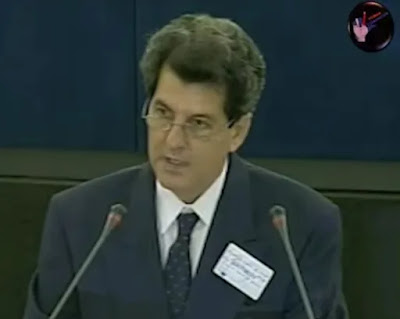 |
| Oswaldo Payá addresses the European Parliament on December 17, 2002 |
The
prophetic warning of Oswaldo Payá to the international community on December 17, 2002 was not heeded:
"The cause of human rights is a single cause, just
as the people of the world are a single people. The talk today is of
globalization, but we must state that unless there is global solidarity,
not only human rights but also the right to remain human will be
jeopardized."
The West's failure to practice global solidarity with Chinese democrats has led to a global decline in human rights
over the past 14 years, and over the past seven months with the COVID-19 pandemic we are witnessing how the lack of transparency of the Chinese Communist dictatorship has jeopardized our right to remain human amidst a global health crisis and economic collapse.
We must do better and redouble our efforts in the defense of human dignity and human rights.



 Posts
Posts

