Showing posts with label universal declaration of human rights. Show all posts

Saturday, December 9, 2023

The Universal Declaration of Human Rights, the forgotten man, and Cuba's human rights legacy

Seventy five years ago on December 10, 1948 the Universal Declaration of Human Rights was adopted by the UN General Assembly. In 2008 in commemoration of the 60th anniversary of this important milestone, Mary Ann Glendon, the United States Ambassador to the Holy See, highlighted Latin American and Catholic contributions to human rights, and made special mention of the contribution made by Cuba that was documented in a diplomatic cable.

“The principal leader of the Latin American group in 1948 was a charismatic young Cuban representative named Guy Perez Cisneros. His son, Pablo Perez-Cisneros, attended the conference and recounted his father's contributions to the UDHR, noting the gap between the Cuba of his father's day and the deplorable state of human rights under the present regime. The work of Guy Perez-Cisneros and other delegates was captured in a 12-minute video presentation featuring archival footage of Eleanor Roosevelt and Guy Perez-Cisneros' UN speech in support of the UDHR.”

However, Perez Cisneros was not the architect of the Universal Declaration of Human Rights, and until The Washington Post journalist David Hoffman explored this chapter of Cuban history in his 2022 book, Give Me Liberty: The True Story of Oswaldo Payá and his Daring Quest for a Free Cuba, this information was only available in some archives, and obscure blogs. 


Hoffman found that the 1940 Cuban Constitution, the Universal Declaration of Human Rights, and Article 88g of the 1992 Cuban Constitution that made the Varela Project possible were largely the result of one talented Cuban who over the course of his career had been a diplomat, jurist, and scholar, but you’ve never heard of him. In fact, he has been called the “forgotten man”.


Gustavo Gutierrez Sanchez (1895 - 1959)


His name was Gustavo Gutierrez Sanchez and he was born in Camajuani, in the Province of Santa Clara, Cuba on September 20, 1895, and he died in exile in Miami on July 17, 1959 at age 63. In 1916, at just 21 years of age he had obtained doctorates in Civil and Public Law, and became Assistant Professor of International Public Law in the University of Havana, and in 1919 became the department head at age 24.


Carlos Márquez Sterling, a Cuban historian and statesman who led the drafting of the country’s 1940 Constitution, in 1976 wrote an article in Diario de las Americas where he highlighted Gustavo Gutierrez’s role in the drafting of the 1940 Constitution. 

"Gustavo had formed part of the Bicameral Commission which drafted the project of the Constitution and I can assure you that many of the institutions that later found expression in our original document were based on previous works created by Gustavo Gutierrez." 

Hoffman in “Give Me Liberty” reported that the 1940 Constitution had a provision that had been drafted years earlier by Gustavo Gutierrez, and became “Article 135, Section F, which provided that laws could be proposed by congressmen and senators, government officials, courts, - and by citizens. ‘In this case,' the constitution declared, ‘it will be an indispensable prerequisite that the initiative be exercised by at least ten thousand citizens having the same status of voters.”


The Cuban jurist believed that this clause would have given Cuban citizens a voice in public affairs that could have acted as a brake on Machado’s slide into dictatorship, or led to an earlier repeal of the Platt Amendment, or prevented Batista becoming a strong man. This provision somehow was recycled into the 1992 Cuban Constitution, and was the basis for the Project Varela that challenged totalitarian rule in Cuba beginning in 2002.


Chapultapec Castle in Mexico City


Less than five years later in February 1945, with World War Two still underway, at the Chapultapec Castle in Mexico City twenty Latin American countries and a large delegation from the United States participated in the Inter-American Conference on Problems of War and Peace. Dr. Gustavo Gutierrez presented on behalf of Cuba “two detailed proposals for consideration, a Draft Declaration of the International Rights and Duties of the Individual and a "Draft Declaration on the Rights and Duties of Nations." These two drafts were written by Dr. Gustavo Gutierrez in his book La Carta Magna de la Comunidad de Naciones. Later that year the Cuban delegation in San Francisco would present his draft for consideration in the creation of a universal declaration of human rights.


French jurist René Cassin and Guy Perez-Cisneros argued strongly in the discussion over the drafting of the declaration that the right of individuals to petition “for redress of alleged human rights abuses to ‘the public authorities of the State of which he is a national or in which he resides, or with the United Nations.” was an essential human right that should be included. This was objected to by the Soviet Union, and Mexico that argued that it “violated the principle of national sovereignty and violate provisions of non-interference.” It would not end up in the declaration, but be recognized later by some states. The spirit of this clause that individuals could petition to have injustices committed against them all the way to the UN is consonant with  Gutierrez’s advocacy for giving citizens a voice in public affairs.


Canadian legal scholar John P. Humphrey is credited with preparing the first draft for the Universal Declaration of Human Rights in 1947, but in his memoirs published in 1983, Humphrey credited Gustavo Gutierrez for presenting the model that inspired the draft.

“I was no Thomas Jefferson and, although a lawyer, I had had practically no experience drafting documents. But since the Secretariat had collected a score of drafts, I had some models on which to work. One of them had been prepared by Gustavo Gutierrez (Sanchez) and had probably inspired the draft Declaration of the International Duties and Rights of the Individual which Cuba had sponsored at the San Francisco Conference.”


The Universal Declaration of Human Rights was an initiative by Latin American nations, in which Cuba played an important role proposing it, assisting to draft the document, and successfully lobbying for it.  


The Cuban diplomats that played this historic role in bringing into existence this “Magna Carta of the Community of Nations” have been erased to make way for one of the great lies of the Castro dictatorship that the political concepts of liberty, equality, and justice are not universal but differ based on geography. This is also why the communist dictatorship in Havana views the Universal Declaration of Human Rights as enemy propaganda.


This is why Cubans across the island risked everything to be heard by the international community in 2002, 2004, and 2021 in their demands for freedom and an end to dictatorship. In 2002 and 2004 this demand was made in the Project Varela petition by tens of thousands of Cubans, and in July 2021 by hundreds of thousands of Cubans across the island shouting for it at the top of their lungs. Currently there are over 1,000 political prisoners in Cuba, and on international human rights day 2023, the 75th anniversary of the signing of the declaration we call for their freedom, and the freedom of all Cubans.


Sunday, December 3, 2023

Can Cuba’s Human Rights Legacy Be Recovered?

We have memory.

Dec. 1945. Ex-PM Winston Churchill invited to lunch at the Cuban Embassy in the UK.

Human rights are an intrinsic part of Cuban history that the current dictatorship has spent decades systematically trying to erase, denigrate, and deny, but every day Cubans for decades have stood up for the defense of human rights and dignity at great cost to themselves.There are over 1,000 political prisoners today in Cuba, more than in the rest of Latin America combined for demanding the restoration of human rights and democracy.

One of the great lies of the Castro regime, and there are many, is the claim that the Universal Declaration of Human Rights contains rights that are alien to Cubans

Fidel Castro in a 1986 interview claimed that "[y]our political concepts of liberty, equality, justice are very different from ours. You try to measure a country like Cuba with European ideas. And we do not resign ourselves to or accept being measured by those standards." 

However the now dead Cuban dictator omitted that the Universal Declaration of Human Rights was an initiative led by Latin Americans, and Cubans in particular. Furthermore that language placed in the Declaration was taken from the 1940 Cuban Constitution. 

Beginning in 1945 Cuba took part in lobbying for and participating in the drafting of the declaration and submitted nine proposals of which five made it into the final document.  

Cuban diplomats invited Winston Churchill to lunch at the Cuban Embassy in London in December of 1945 and proposed the creation of a human rights commission for the United Nations.  

Cuban Ambassador Willy De Blanc hosted the former British Prime Minister with other Cuban diplomats (including delegates to the U.N. Preparatory Commission Dr. Guy Pérez-Cisneros y Bonnel and Cuban jurist Dr. Ernesto Dihigo y López Trigo) where they requested his assistance in the creation of a human rights commission for the United Nations.

Churchill recommended that the Cubans lobby Mrs. Eleanor Roosevelt, and they followed his advice. Eventually the former First Lady was selected as chairwoman to the Human Rights Commission.

The first meetings of the General Assembly and the Security Council took place in London on January 10, 1946. On December 10, 1948 the Universal Declaration of Human Rights was voted on, and a Cuban diplomat played a high profile role that day.

On December 10, 2017 in the Miami Herald's letters to the editor section, Pablo Pérez-Cisneros Barreto, the son of Guy Pérez-Cisneros y Bonnel, wrote of his family's and Cuba's legacy in drafting of the Universal Declaration of Human Rights.

    My late father believed that the declaration is the fruit of the great efforts of our civilization and human progress, a unique moment in which humanity came of age in its civic education; that it is also a source of inspiration for the formation of today’s citizens, and not cause for divisions among them. [...] Cuba had the distinction of being the country that proposed the finished declaration be put up for its final UN vote on Dec. 10, 1948. Hard to believe now but Cuba was once a leader when it came to human rights. And it is important to note that nine initiatives proposed in 1945’s Cuba became part of the final declaration, and that Cuba was the country that entrusted the Economic and Social Council of the United Nations in San Francisco to prepare the declaration as early as 1946. The third preamble of the declaration is a copy of one of the articles of the famed 1940 Cuban Constitution, and Cuba had the initiative to include in the declaration the right to honor one’s human rights and reputation, as well as protect citizens against arbitrary government interference in their private lives.  Cuba presented the first amendment to the draft declaration which was accepted, adding the right of citizens of any member country to follow the vocation they choose. Cuba presented a second amendment which was also accepted — the right of every worker to receive an equitable and satisfactory payment for their work.

 Last month Cuba underwent a universal periodic review of its human rights record at the UN Human Rights Council. On the eve of this examination, a UN side event was held with witnesses testifying on the human rights violations committed by Castroism over the past five years.

Victims of Communism Memorial Foundation, November 28, 2023

Can Cuba’s Democratic Legacy Be Recovered? 

By John Suarez  

Communist Cuba underwent its fourth Universal Periodic Review (UPR) on November 15, 2023, at the UN Human Rights Council, a process Havana repeatedly subverted since 2009 by using front groups to drown out critical human rights reports by established human rights organizations.

Cuban Foreign Minister Bruno Rodriguez began the UPR session attacking Israel, went on to blame the Cuban dictatorship’s shortcomings on U.S. sanctions, and turned the review into a politicized circus.

Over 20 years, I’ve witnessed Cuban diplomats undermine international human rights standards, first at the United Nations Human Rights Commission and later at the UN Human Rights Council, making a mockery of human rights.

What the diplomats of Cuba’s communist dictatorship do in Geneva is horrible, but it pales compared to what they do to Cubans on the island.

Human rights defenders Oswaldo Payá and Harold Cepero were killed on July 22, 2012. On June 12, 2023, the Inter-American Commission on Human Rights confirmed that the two Cuban pro-democracy leaders were assassinated by Castro regime operatives.

On July 11, 2021 when Cubans across the island protested in huge numbers called for freedom, and an end to dictatorship. Raul Castro’s hand picked president, Miguel Díaz-Canel went on national television and gave the “order of combat.” Regime agents opened fire on unarmed Cubans, the number killed remains unknown due to regime repression, and lack of transparency, but the video of 36 year old singer Diubis Laurencio Tejeda shot in the back by police, and dying in his friends’ arms is devastating.

Artists Luis Manuel Otero Alcántara and Maykel “Osorbo” Castillo Pérez are imprisoned in Cuba today for authoring a song about “homeland and life.” The dictatorship has severely restricted artistic freedoms, passed laws outlawing criticism of the regime on the internet, and passed an even more draconian penal code that expands the death penalty.

Human rights defenders Felix Navarro and his daughter Sayli Navarro, who sought to ascertain the plight of detained Cuban protesters, were themselves arrested and sentenced to long prison terms. There are over 1,000 prisoners of conscience in Cuba. 

It was not always this way. 

A democratic Cuba helped draft the Universal Declaration of Human Rights 75 years ago. Carlos Prío Socarrás, Cuba’s last democratic president, was elected in free and fair elections and took office on October 10, 1948. President Prío valued human rights, as seen by the activities of his diplomats during the United Nations’ founding.

Cuba, Panama, and Chile were the first three countries to submit full drafts of human rights charters. Latin American delegations, especially Mexico, Cuba, and Chile inserted language about the right to justice into the Universal Declaration of Human Rights, in what would become Article 8. 

Cuban delegate Guy Pérez-Cisneros addressed the UN General Assembly on December 10, 1948 proposing to vote for the Universal Declaration of Human Rights. The Cuban Ambassador celebrated that it condemned racism and sexism, and addressed the importance of the rule of law

“My delegation had the honor of inspiring the final text, which finds it essential that the rights of man be protected by the rule of law, so that man will not be compelled to exercise the extreme recourse of rebellion against tyranny and oppression.” 

Fulgencio Batista overthrew this democratic Cuba on March 10, 1952, Guy Pérez-Cisneros died of a stroke in 1953, and hopes for democratic restoration were dashed by the Castro brothers in 1959 when they imposed a communist dictatorship.

This shared democratic Cuban heritage that in 1948 made world history must be restored, and Cuban communism dumped on the garbage heap of history.

John Suarez is Executive Director of the Center for a Free Cuba.

https://victimsofcommunism.org/can-cubas-democratic-legacy-be-recovered/

Friday, December 9, 2022

International Human Rights Day: Recovering Cuba's Pre-Castro human rights legacy

Over the past 20 years, I witnessed how Cuban diplomats undermined international human rights standards, first at the United Nations Human Rights Commission and later at the UN Human Rights Council.

 Artists were arrested in Cuba in 2018 for protesting Decree 349, a law that eliminated the few artistic freedoms remaining there.

Prisoner of conscience Eduardo Cardet spent two years and 10 months in prison for speaking critically of Castro’s legacy. The sentence ended on September 30, 2019.

There are over a thousand political prisoners in Cuba today.

Luis Robles and Luis Manuel Otero are prisoners of conscience

On December 2, 2022 two prisoners of conscience observed their second birthdays behind bars. Luis Robles turned 30 years old, and was behind bars for holding up a sign silently in a public space that read " “Freedom. No more repression. #free-Denis [Solís].” He was arrested and jailed on December 20, 2020, and on March 28, 2022 was sentenced to five years in prison

Luis Manuel Otero Alcántara turned 35 years old. He was arrested and jailed on July 11, 2021 when he announced that he was heading out to join the mass protests that broke out across the island. He was also sentenced to five years in prison on June 24, 2022.

Worse yet, the penal code in Cuba on December 1, 2022 became still more draconian. Amnesty International on December 2nd reported on its severity calling it "a chilling prospect for 2023," highlighting the expansion of the death penalty to 23 crimes, and punishing expression for even longer prison sentences.

It was not always this way.

Seventy four years ago, a democratic Cuba helped draft the Universal Declaration of Human Rights and establish the UN Human Rights Commission.

Cuba’s last democratic president, Carlos Prio Socarras, was elected in free and fair elections and assumed office on Oct. 10, 1948. President Prio respected human rights, and this was reflected by the actions taken by his diplomats at the founding of the UN.

Cuba, Panama, and Chile were the first three countries to submit full drafts of human rights charters to the Commission. Latin American delegations, especially Mexico, Cuba, and Chile inserted language about the right to justice into the Universal Declaration of Human Rights, in what would become Article 8.

Guy Pérez-Cisneros (center) &  Ernesto Dihigo (right) in Palace of Chaillot, París, December 1948.

Cuban delegate Guy Pérez-Cisneros addressed the UN General Assembly on Dec. 10, 1948 proposing to vote for the Universal Declaration of Human Rights. The Cuban Ambassador celebrated that it was his colleague who submitted the first draft, that the final document condemned racism and sexism, and also addressed the importance of the rule of law:

"Cuba could not fail to participate in the choir of nations that wish to celebrate the Universal Declaration of the Rights of Man. We feel great pride that the first, very modest draft officially submitted to serve as the basis for the Universal Declaration of the Rights of Man was written by Dr. Ernesto Díhigo, an eminent professor at the University of Havana and a member of the Cuban delegation." ...

“My delegation had the honor of inspiring the final text, which finds it essential that the rights of man be protected by the rule of law, so that man will not be compelled to exercise the extreme recourse of rebellion against tyranny and oppression.”

This democratic Cuba was overthrown 70 years ago on March 10, 1952 by Fulgencio Batista and hopes of a democratic restoration frustrated by the Castro brothers in 1959.

Guy Pérez-Cisneros died of a stroke in 1953.

Ernesto Dihigo, like Pérez-Cisneros, left the diplomatic corps following the 1952 coup, but returned as Cuba’s Ambassador to the United States in January of 1959 retiring in 1960. He left Cuba in 1989 and died in Miami in 1991.

The Center for a Free Cuba will share this history on December 10, 2022 at 12 noon to remind their international community that civil and political rights are an intrinsic part of a shared Cuban heritage that in 1948 made world history and that the Castro regime has spent 63 years trying to erase.

The event will be held in English. You can RSVP here.

Sunday, February 27, 2022

Moral compromises: Cuban national Anamely Ramos again denied the right to return to her homeland by the Castro regime and American Airlines.

"Even a purely moral act that has no hope of any immediate and visible political effect can gradually and indirectly, over time, gain in political significance." - Václav Havel, Letter to the overthrown Czechoslovak Communist Party chairman Alexander Dubček (August 1969)

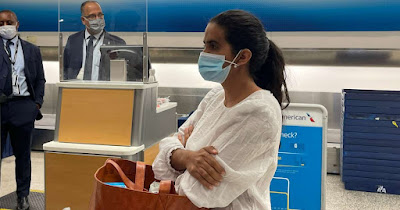
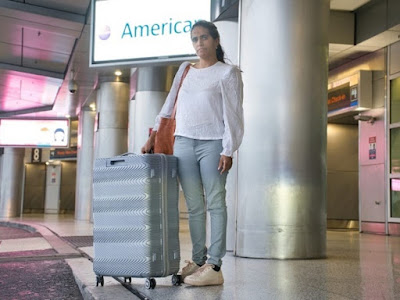
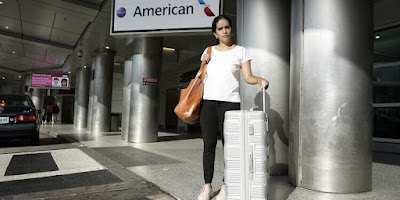
Anamely Ramos González, twice refused her right to return home to Cuba.

Earlier this morning, Anamely Ramos González tried to board a return flight to Cuba, but was told she could not return home

This time she received a document from American Airlines that it was the Cuban government that had blocked her from returning.

Eleven days earlier it happened to her for the first time.

On February 16, 2022, Anamely Ramos González, with her documents in order and plane ticket in hand, was told by a representative of American Airlines she could not board the flight home on instructions from the Cuban government. 

Anamely after being told by American Airlines she couldn't board flight home on 2/16/22

Anamely Ramos is an artist and nonviolent Cuban dissident who resides in Cuba.

She traveled abroad in January 2021 to pursue a Ph.D. in Anthropology at the Universidad Iberoamericana de México. 13 months later, in February 2022 she was twice denied entry into Cuba by American Airlines personnel on the instructions of Cuban government officials.

"'Right now I have no country, nowhere to return to, no residence in any other country in the world, no visa to anywhere and here I am,' said [ Anamely Ramos González ] in an interview with the Miami Herald outside Versailles restaurant in Little Havana," reported Nora Gámez Torres after she was turned away on February 16th. 

These were not the first two incidents of a Cuban national being arbitrarily denied the right to return home by the Castro dictatorship.

Estimates range between 70,000 to 300,000 Cubans banned by the Cuban government from returning to their homeland reported The Miami Herald on August 15, 2011 in the article titled "Many Cuban expatriates can't go home again". Despite claims made by both Havana and Washington in 2013 that the Cuban government had liberalized travel to the island, the cases of cruel family separations remain a constant.

223 Cubans have been identified that have been either denied the right to leave or enter Cuba. There are many more, but many are afraid to defy the dictatorship and have their families in the island suffer further reprisals by going public.

Anamely after being told by American Airlines she couldn't board flight home on 2/27/22

This policy of the Castro regime to divide families has a long history, and an ideological foundation. Carlos Eire, a professor at Yale University, a Cuban exile, and former Pedro Pan child in Babalu Blog on January 2, 2020 wrote how he "once had the opportunity of asking one of Fidel’s closest associates, Carlos Franqui, why the top brass of the Castro regime intentionally prevented thousands of Cuban parents from reuniting with their Pedro Pan children in the U.S.. Franqui, who served as a propaganda minister to Fidel before being purged, responded to my question with a huge smile on his face: 'We did it because anything that would destroy the bourgeois family was good for us.'"

These are violations of two fundamental human rights. 

 Article 12 of the Universal Declaration of Human Rights states: 

"No one shall be subjected to arbitrary interference with his privacy, family, home or correspondence, nor to attacks upon his honour and reputation. Everyone has the right to the protection of the law against such interference or attacks."
Article 13 of the Universal Declaration of Human Rights states: 
"Everyone has the right to freedom of movement and residence within the borders of each state.
Everyone has the right to leave any country, including his own, and to return to his
country."

Havana has systematically violated these universal human rights over 60 years. Until 2013, Cubans who stayed abroad over 11 months lost their right to return. 

In 2013 Cuban law increased the amount of time Cubans could spend overseas without losing their residency rights from 11 months to two years, but in the case of Anamely Ramos she is being denied her right to return. She has been out of the country for 13 months.

Anamely Ramos with Sirley Avila Leon

Denying Anamely Ramos her right to return to her home and be reunited with her family is not only a violation of Articles 12 and 13 of the Universal Declaration of Human Rights, but violates existing Cuban law, demonstrating the tyrannical nature of the Cuban government, and the decades long internal blockade erected against Cubans by the Castro regime. 

Until recently, Cubans would fly to Cuba, and be turned around at customs. Now, American Airlines is carrying out the instruction of the Cuban government barring Cuban nationals from boarding their flights home. 

But the dictatorship is not a reliable partner.  

On February16th American Airlines did not provide any documentation indicating why Anamely could not travel, but a verbally told her the Cuban government had denied her right to return.

Two days later on social media Prisoners Defenders released an excerpt from a Cuban government television program called "Al Filo" [ To the point] in which the spokeswoman said it was not Cuba but American Airlines that had barred Anamely from flying.

We (Cuba) know so far the same as she and the journalists, who were apparently waiting for her behind the check in table: that the airline does not allow her to travel because they allege that Cuba prohibits her entry. Just that, without further details. And although until now the most direct and objective refusal was not given by us, the media have a culprit, of course, because as always "Miami confirms it." 
This placed American Airlines in the hot seat. Their "partner government" had thrown them under the bus and claimed it was the U.S. company denying Anamely Ramos the right to travel. They have been a lot of bad press with headlines such as "American Airlines Caves to Authoritarian Communist Regime."

There is a petition underway calling American Airlines to account for this new relationship with the Cuban dictatorship, and its complicity in denying her human right to return home to her country that is found under Article 13 of the Universal Declaration of Human Rights, and calls them out for violating the UN Global Compact on Human Rights, Labor, Environment, and Anti-corruption.

"According to your letter to the United Nations Secretary General, H.E. Antonio Guterres, dated February 15th, 2021, American Airlines adhered to the 10 Principles of the UN Global Compact on human rights, labor, environment and anti-corruption." ...

"By not allowing Ms. Ramos González to go back to her country of residence, your company’s officers violated article 13 of the Universal Declaration of Human Rights, basically the right to freedom of movement. This rights is included in Principle 1 of the Global Compact stating: 'Businesses should support and respect the protection of internationally proclaimed human rights.'"

"At the same time, by following a protocol and orders by the migratory authorities of the totalitarian government of Cuba with no legal standing, you have violated Principle 2 of the Global Compact that states: 'Business should make sure that they are not complicit in human rights abuses.'"

The world is witnessing now the havoc that normalized relations that economically empowered totalitarian dictatorships ( Communist China's role in covering up and contributing to a world wide pandemic), and authoritarian dictatorships (Vladimir Putin invading Ukraine and threatening nuclear war) is threatening tens of millions of lives, but it all began with small moral compromises out of the mistaken belief that the ends justify the means.

The trouble with morally compromising with these regimes is that there is no bottom. Below is a Tweet by a Cuban government agent of influence that has images that border on racism.

Czech dissident, playwright, and president Václav Havel believed that moral actions, no matter how small or futile they may appear at the time can have profound consequences for both freedom and a just society. It is because the world is not a puzzle to be solved but incredibly much more complex that decisions of right and wrong made by each person have such great importance.

The New York Times in their October 13, 2009 issue in an article titled Vaclav Havel, Still a Man of Morals and Mischief: reported that in an interview that was supposed to be about the revolutions that overturned communism 20 years earlier that President Havel raised the question asking if it was true that President Obama had refused to meet the Dalai Lama? Havel replied:

“It is only a minor compromise,” Mr. Havel said of the nonreception of the Tibetan leader. “But exactly with these minor compromises start the big and dangerous ones, the real problems. “This is actually the first time I really do mind something Obama did,” Mr. Havel said. He minded it “much more” than Mr. Obama’s recent decision not to station elements of a missile-defense system in the Czech Republic, a move that several Central European politicians criticized but that Mr. Havel noted was ultimately “an internal American decision.”

These compromises were also seen with regard to normalizing relations with Cuba. 

Carnival Cruise Line signed an agreement with Castro regime officials on March 21, 2016 to sail to Cuba from the United States. In order to conduct their core mission Carnival had to agree to enforce the Castro dictatorship's policy that bans all Cubans from traveling into the island by water. It did not matter if Cubans born on the island were now citizens of another country.  ( Obama's Treasury Department on July 7, 2015 had signed off on the Carnival Cruise Line - Castro regime alliance ignoring that an entire class of Americans would be discriminated against based on their national origin.).

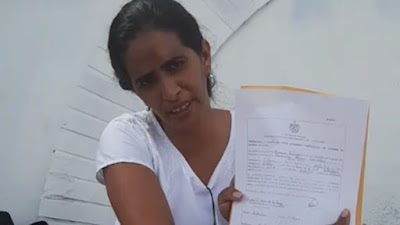
Today, American Airlines provided a Cuban government document identifying the Cuban official, representing the dictatorship in writing that Anamely Ramos would not be allowed to enter Cuba. The document is titled, "Notification to airlines of inadmissible passengers in national territory" and is signed by Lieutenant Colonel Néstor Morera.

Sadly, to obtain this information required eleven days of protests, and demands of transparency combined with the Castro regime denying the verbal statement made by American Airlines, and placing all the blame on the American carrier.

Anamely Ramos, and other Cuban dissidents, are observing that Cuba is not becoming more like the free world with normalization, but the free world is becoming more like Cuba.  Time to end normal relations with abnormal regimes, while we hopefully still can. 

Anamely Ramos shows Cuban government document provided by American Airlines.
 
Below was a live video program Anamely held on Facebook after she left the airport today and returned to the outskirts of Versailles, and further down is an excerpt from a statement she released today exposing the moral compromise made by American Airlines with Havana.

"Today I tried again to board an AA [American Airlines] flight to my country. 

Cuba reissued a notification informing the airline that I am not admitted within the national territory and that, therefore, they "recommend" AA not to board me.

I want to be explicit with this: the decision not to admit is from the Cuban State, the decision to abide by that decision and not let me get on the plane is from American Airlines. They are two different responsibilities and it is Cuba who is most interested in making them one, so as not to have to make an official pronouncement. They act with AA as they do with people who are going to do an act of repudiation of an opponent.

It is not the State Security agents who shout and appear on camera, they are the ones who softly tell people "from the town" to shout and not let other citizens out. The notification received by AA, and which was delivered to me today, is signed by a Lieutenant Colonel, a more than clear sign of who is behind a flagrant violation of human rights.

It was very convenient for Cuba that this whole operation was kept in the shadows. The agreement or protocol that AA cites all the time as the norm that they cannot violate is not public.

 Maybe it doesn't even exist in writing. Maybe it's just an oral agreement. An agreement that collides with the Global Pact that AA signed in 2021 and that speaks of respect for human rights (in this case the right to return) of people - clients."

 #RightToReturn #DerechoARegresar

Thursday, December 10, 2020

Cuba and the 1948 origins of the Universal Declaration of Human Rights

 Here are excerpts from the speech delivered by the Republic of Cuba’s Permanent Delegate to the United Nations, Dr. Guy Pérez ­Cisneros; as being one of the proponents of the Universal Declaration of Human Rights, prior to its voting, at the United Nations Third General Assembly, taking place at the Chaillot Palace, in Paris, France on December 10, 1948 .

Guy Pérez-Cisneros (center) &  Ernesto Dihigo (right) in Palace of Chaillot, París, December 1948.

CUBA could not fail to participate in the choir of nations that wish to celebrate the Universal Declaration of the Rights of Man. We feel great pride that the first, very modest draft officially submitted to serve as the basis for the Universal Declaration of the Rights of Man was written by Dr. Ernesto Díhigo, an eminent professor at the University of Havana and a member of the Cuban delegation.

Today the initiative [is presented] by the illustrious Rapporteur of the Third Committee, Senator Emile Saint‐Lot, and by its President, Charles Habib Malik Laar, Lebanon’s envoy to Havana. Cuba is deeply satisfied to see a Haitian as the bearer to humanity of the United Nation’s most valuable message. Haiti is precisely one of those privileged lands whose whole history is characterized by a heroic and constant effort to defend and enforce the rights of man. And Cuba is proud of having nominated as Rapporteur [this] outstanding son of a French‐speaking American nation, Haiti, a land in which the great Simon Bolivar, our Bolivar, found both moral encouragement and material aid to achieve his great task of liberation and freedom.

My delegation is duty bound to acknowledge the meritorious work of the Committee on the Rights of Man, which labored untiringly for two years under the inspiring leadership of Eleanor Roosevelt and wrote a truly valuable document that beautifully and forcefully express the highest aspiration of 20th Century man: The dawning of a world in which all human beings, freed from fear and want, will enjoy freedom of speech and freedom of opinion.

Another historic document that inspired the Third Committee’s work was the First Declaration of the Rights and Duties of Man, endorsed in Bogotá by the nations of the Americas. Also, through the determined effort and great power of conviction of the Mexican delegate, Dr. Pablo Campo Ortiz, [was added] the important Article Nine [freedom from arbitrary arrest, detention or exile], based on Mexico’s right of protection.

My delegation had the honor of inspiring the final text, which finds it essential that the rights of man be protected by the rule of law, so that man will not be compelled to exercise the extreme recourse of rebellion against tyranny and oppression. Further, this is an homage to France from my country, which greatly admired and watch the stages of it’s glorious résistance.

We are pleased that the social rights that are the main contribution of the 20th Century to this issue – just as legal rights were in the 19th Century – were treated in the Declaration with the importance they deserve.

We also thank the United Nations for its favorable reception of two Cuban Amendments on the subject of labor that recognize the right of man to freely pursue his vocation and to receive a fair and satisfactory wage that will guarantee him and his family an existence befitting their human dignity.

My delegation will not forget the way in which the United Nations welcomed another of our initiatives. To include in the Declaration the right to the protection of one’s honor, a high moral concept rooted deep in the soul of every Hispanic person. And we can not silence the fact that – through the joint efforts of France, Mexico and Cuba – recognition was finally granted to those who belong to the only legitimate aristocracy: Creator, be the artist, writers, or scientists. They are entitled to the protection of the moral and material gains obtained through their scientific, literary, or artistic productions.

My country and my people are highly satisfied to see that the odious racial discrimination and the unfair differences between men and women have been condemned forever.

The Cuban delegation hesitated often before submitting its numerous amendments. It went ahead with the understanding that perfection and critical severity were among its duties. A delegation that represented a nation that proudly produced the Montecristi Manifesto was entitled to be demanding. The manifesto outlined goals of Cuba’s independence movement and was drafted by José Martí and Máximo Gómez.

The members of the Cuban delegation are deeply moved when – as they review the articles of the important Declaration that we will adopt in a few minutes – they recognize that all its provisions could have been accepted by the generous spirit who was the apostle of our independence: José Martí, the hero who – as he turned his homeland into a nation – gave us forever this generous rule: “With everyone, and for the good of everyone.”

By: Guy Pérez‐Cisneros,
Permanent Delegate of the Republic of Cuba to the United Nations(1948 ‐ 1953) .

Original Spanish text and English translation available here in PDF format

Sunday, December 9, 2018

Recovering Cuba's Pre-Castro human rights legacy

"We feel great pride that the first, very modest draft officially submitted to serve as the basis for the Universal Declaration of the Rights of Man was written by Dr. Ernesto Díhigo, an eminent professor at the University of Havana and a member of the Cuban delegation." - Guy Pérez-Cisneros
Cuban diplomats in 2018 disrupt discussion on Cuban political prisoners.

 The Miami Herald, December 8, 2019

Can Cuba’s human rights legacy be recovered?

Less than a month later, Cuban diplomats led an “act of repudiation“ at the UN to prevent a discussion on political prisoners in Cuba.

Artists are now being arrested in Cuba for protesting Decree 349, a law that would eliminate the few artistic freedoms remaining there.

Prisoner of conscience Eduardo Cardet marked two years in prison on Nov. 30 for speaking critically of Castro’s legacy.

International Human Rights Day in Cuba will be a day that the Cuban secret police harass, detain, and assault human rights defenders attempting to exercise their rights.

It was not always this way.

Seventy years ago, a democratic Cuba helped draft the Universal Declaration of Human Rights and establish the UN Human Rights Commission.

Cuba’s last democratic president, Carlos Prio Socarras, was elected in free and fair elections and assumed office on Oct. 10, 1948. President Prio respected human rights, and this was reflected by the actions taken by his diplomats at the founding of the UN.

Cuba, Panama, and Chile were the first three countries to submit full drafts of human rights charters to the Commission. Latin American delegations, especially Mexico, Cuba, and Chile inserted language about the right to justice into the Universal Declaration of Human Rights, in what would become Article 8.

Cuban delegate Guy Pérez-Cisneros addressed the UN General Assembly on Dec. 10, 1948 proposing to vote for the Universal Declaration of Human Rights. The Cuban Ambassador celebrated that it condemned racism and sexism, and also addressed the importance of the rule of law:
“My delegation had the honor of inspiring the final text, which finds it essential that the rights of man be protected by the rule of law, so that man will not be compelled to exercise the extreme recourse of rebellion against tyranny and oppression.”
This democratic Cuba was overthrown on March 10, 1952 by Fulgencio Batista and hopes of a democratic restoration frustrated by the Castro brothers in 1959.

Guy Pérez-Cisneros died of a stroke in 1953.

Ernesto Dihigo, like Pérez-Cisneros, left the diplomatic corps following the 1952 coup, but returned as Cuba’s Ambassador to the United States in January of 1959 retiring in 1960. He left Cuba in 1989 and died in Miami in 1991.

Democrats should share this history with Cubans on the island to demonstrate that civil and political rights are an intrinsic part of a shared Cuban heritage that in 1948 made world history and that the regime in the island today would like erased.

On  Tuesday, December 11th in Washington, DC at 1pm we will revisit this human rights legacy with Cuban human rights defenders. Register here to join us and to obtain more information on the event.


John Suarez is a program officer for Latin America Programs at Freedom House in Washington, D.C.

Read more here: https://www.miamiherald.com/opinion/article222862140.html#storylink=cpy