Wednesday, November 18, 2020

CNN's Jake Tapper is right "Fidel Castro was a murderous despot who oppressed the LGBTQ community and many others" but there is more.

Giving credit when credit is due.

CNN journalist Jake Tapper spoke the truth when observed that "Fidel Castro was a murderous despot who oppressed the LGBTQ community and many others and pointing that out is actually part of being a news anchor."

He was responding to Afghan American filmmaker, musician, and activist, Ariana Delawari who was making a number of claims that do not stand up to scrutiny about Fidel Castro and his regime.

Mauvaise Conduite (Improper Conduct) is a 1984 documentary film directed by Néstor Almendros and Orlando Jiménez Leal that explores the oppression of the LGBTQ community in Cuba, and is required viewing.  

Fidel Castro declared in 1965 that “[w]e would never come to believe that a homosexual could embody the conditions and requirements of conduct that would enable us to consider him a true revolutionary, a true communist militant.” ... A deviation of that nature clashes with the concept we have of what a militant communist should be.” 

Castro apologists claimed that the Cuban dictatorship had changed since then, but the events of May 11, 2019 demonstrated just the opposite.

Pride March shut down by Castro regime on May 11, 2019

The hostility to Gays began early and from the top. On March 13, 1963 Fidel Castro gave a speech were he openly attacked “long-haired layabouts, the children of bourgeois families,” roaming the streets wearing “trousers that are too tight,” carrying guitars to look like Elvis Presley, who took “their licentious behavior to the extreme” of organizing “effeminate shows” in public places. The Cuban dictator warned: “They should not confuse the Revolution’s serenity and tranquility with weaknesses in the Revolution. Our society cannot accept these degenerates.”

In 1964 the Cuban government began rounding up Gays and sending them to Military Units to Aid Production or UMAPs (Unidades Militares de Ayuda a la Producción). These forced labor camps were for those suspected of or found guilty of "improper conduct."  Persons with effeminate mannerisms, what the Cuban government called "extravagant behavior," were taken to these camps.

This history should be taken into account when considering the Cuban quarantine of HIV positive Cubans from 1986 to 1997. In the early days of the AIDS epidemic it was associated with the Gay community. Furthermore the claim that HIV rates are lower in Cuba should also be taken with a grain of salt when considering the failure to report on other outbreaks.This is motivated by their need to justify the existence of the dictatorship with supposed successes in health care.
 
Cuban government officials inoculated him with HIV in 2018.
 
Cuban biologist, environmental activist, and Gay man, Dr. Ariel Ruiz Urquiola, documented his case to the International Society for Human Rights (ISHR) in Frankfurt, Germany, where he denounced how agents of the Castro regime purposefully infected him with HIV in 2018.

After a staged assault of two policemen Ariel Ruiz Urquiola was arrested on May 3rd, 2018 and sentenced to prison for twelve months by a kangaroo tribunal. He was remanded in jail on May 8th, 2018 and protested from June 16th to July 2nd with a successful hunger strike which led to an early release from prison on July 3rd, 2018. On June 16th, 2019 he got informed that he is HIV positive. He eliminates a natural infection strictly. He believes that he had been infected with the HI virus on purpose in prison.

According to a statement of Dr. Ruiz Urquiola the doctor’s reports show that he got infected during his imprisonment. The lab results also confirm an infection on purpose. That’s how the short time between hospitalization and illness with a high inoculum (infective material or one as an antigen acting part of a germ), e.g. from a lab virus, can be explained.

The Castro regime is also a murderous regime. Glenn Garvin wrote an important essay in the Miami Herald on December 1, 2016 titled "Red Ink: The high human cost of the Cuban Revolution" and in it addresses the question of how many extrajudicial executions have taken place in Cuba and cites an authoritative source.

"University of Hawaii historian R. J. Rummel, who made a career out of studying what he termed “democide,” the killing of people by their own government, reported in 1987 that credible estimates of the Castro regime’s death toll ran from 35,000 to 141,000, with a median of 73,000."

The killings have continued to the present day under Fidel Castro's replacement, his brother Raul Castro, who has head of the Cuban Communist Party remains the maximum authority in Cuba in 2020.

Inner power circle of the Castro regime (Cuban Studies Institute)

Ironically, some who attacked Mr. Tapper's claims raised the issue of racism. It is the Castro regime that has exercised white supremacy when the dictatorship's inner circle of power are old white men that have ruled over a majority black country for 61 years silencing black voices.

Black voices silenced by the Castro regime are numerous and many remain unknown. Others such as Orlando Zapata Tamayo, a brick layer and human rights activist tortured and taunted with racial insults for eight years until his death on hunger strike on February 23, 2010 became known worldwide.

Others such as Yosvany Arostegui Armenteros died on August 7, 2020 in Cuba while in police custody following a 40 day hunger strike, but due to a lack of international solidarity passed on in anonymity.

Yosvany Arostegui Armenteros

It remains a sad reality that as the world begins to pay attention to extrajudicial killings of black men by the police. There is one place that when a police man shoots a young unarmed black man in the back those who would normally speak out if it was the United States are a European country, remain quiet. 

Hansel Ernesto Hernández Galiano shot in back and killed

Castro's Revolutionary National Police shot Hansel Ernesto Hernández Galiano (age 27) in the back on June 24, 2020, but there was little or no protest outside of dissidents in Cuba, who were rounded up and roughed up for attempting to protest the killing. 

Hansel Ernesto Hernández Galiano killed at age 27

E
ven the Castro regime's propaganda apparatus launched blue lives style campaign to rehabilitate the image of their murderous police that they called "Heroes of the Blue",  the usual suspects remained silent and continued to claim that Cuba was an example to follow.

Heroes of the Blue (Heroes de Azul) campaign by the Castro regime

On the broader front, Racist attitudes persist in Cuba under the Castros and is reflected in rates of interracial marriage being lower in Cuba than in Brazil that has a much higher level of inequality, and has not undergone a communist revolution.

On the economic front the glaring differences between black and white Cubans are shocking with 95% of Afro-Cubans having the lowest incomes compared to 58% of white Cubans.

Annual income by race in Cuba.

It is too late to help Orlando, Yosvany and Hansel, but it is not too late to help Silverio Portal Contreras, but time is running out for him.

Amnesty Prisoner of Conscience Silverio Portal Contreras

Silverio Portal Contreras,a former activist with the Ladies in White, is serving a 4-year sentence for "contempt" and "public disorder." According to a court document, he was arrested on the June 20, 2016 in Old Havana after shouting “Down Fidel Castro, down Raúl...” The document states that "the behavior of the accused is particularly offensive because it took place in a touristic area." The document further describes the accused as having “bad social and moral behavior” and mentions that he fails to participate in pro-government activities. 

According to Silverio’s wife, before his arrest he had campaigned against the collapse of dilapidated buildings in Havana. Silverio was recognized as a prisoner of conscience by Amnesty International on August 26, 2019. He was beaten by prison officials in mid-May 2020 and lost sight in one eye.

Lucinda Gonzalez Gomez, wife of the activist, has put out a desperate plea for help after receiving a call from her husband on June 10, 2020. “Silverio called me and put an official on the phone to explain the situation,” said Gonzalez Gomez to CubaNet. The official told her that “he was taken to the ophthalmologist and because of temporary loss of blood flow, he was losing sight in both eyes.”

Raul Castro and Fidel Castro with Mengistu review troops in Ethiopia

Castro apologists in their push back against Jake Tapper's criticism of Fidel Castro, cited the Cuban tyrant's relationship with Nelson Mandela, but ignored the Cuban autocrat's relationship with Ethio­pian dictator, Lt. Col. Mengistu Haile Mariam, and Castro's involvement in the genocide in that African country.

Fidel Castro with Mengistu Haile Mariam in Ethiopia

These apologists also ignored that Mandela also had friendships with both war criminals Mengistu Haile Mariam of Ethiopia, and Charles Taylor of Liberia. Both men are responsible for the murder of many Africans in their respective countries. That Mandela would be friends with Fidel Castro,
Mengistu Haile Mariam, and Charles Taylor is dark corner of an otherwise bright legacy.

 Mandela was friends with Charles Taylor and Mengistu Haile Mariam

The second President of the United States, John Adams, when defending British soldiers in a court of law, who had fired on a crowd during the Boston Massacre, stated: "Facts are stubborn things; and whatever may be our wishes, our inclinations, or the dictates of our passion, they cannot alter the state of facts and evidence." This holds true today for Castro apologists, the facts are against them in their defense of the Castro dictatorship.

Sunday, November 15, 2020

High price of good journalism: Case of Gareth Jones and the Ukranian famine told in the film Mr. Jones now streaming

Honoring honor

Brave Welsh journalist Gareth Jones broke story on Soviet famine

Gareth Jones, a Welsh journalist broke the story on the Ukranian famine on March 29, 1933 despite official denials. Walter Duranty of The New York Times wrote an article a day later rebutting Jones's claims that was published in the paper of record on March 31, 1933. 

In the end seven million souls starved to death in a communist manufactured famine in the Ukraine between 1931 and 1933 under the rule of Josef Stalin. Mr. Jones was banned from returning to the Soviet Union by the Communists. 

Two years after publishing this story he was murdered in Inner Mongolia on the eve of his 30th birthday by Chinese bandits in what his family believes was a Moscow coordinated plot to eliminate him.

Mr. Gareth Jones

There are many who look the other way, remain silent, or worse defend the lie to cover up the crime, and are rewarded with prizes and a long and healthy life. This was the case of Walter Duranty, who won a Pulitzer Prize for covering up the famine. Gareth Jones took the path less traveled, that of truth and honor, and paid a high price.

Thankfully, the Polish director Agnieszka Holland has brought his story to the big screen in the 2019 film Mr. Jones

The film is not a docudrama, and takes dramatic license, but it should lead a new generation to explore what he did and the price he paid for witnessing a great crime and reporting the truth. Between 1931 and 1933 Josef Stalin weaponized famine against millions of civilians in the Ukraine, and he had willing accomplices in the West, like Mr. Walter Duranty of The New York Times.

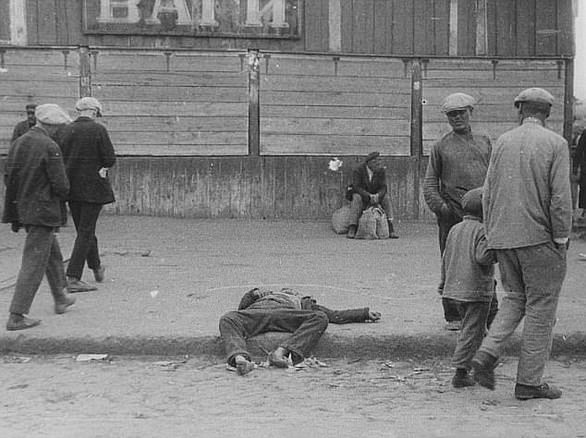
Famine victim in the Ukraine

Thankfully, there were also men of honor like Gareth Jones who risked their lives gathering the facts, and reporting the truth. These are heroes that are still needed today, and tragically all too rare. If you have not seen the film, see it, but also learn the full story of Mr. Jones.

Wednesday, November 11, 2020

Bacardi, the Castro regime, and the Havana Club Trademark: An injustice that needs to be remedied

Bacardi environmental stewardship recognized while Castro regime's rum maker harm's Cuba's, yet a travesty continues

CubaBrief by Center for a Free Cuba

Bacardi is in the news again. The rum maker founded in 1862 in Santiago de Cuba has a positive track record on environmental stewardship that has again been recognized. Bacardi USA was awarded the SmartWay® Excellence Award from the U.S. Environmental Protection Agency for the fourth time.

Meanwhile, the Castro regime continues to sell their stolen version of Havana Club, that today "pumps 1,288 cubic meters of waste liquids into the Chipriona inlet in Cuba every day, mostly vinasse (a residual liquid remaining from the fermentation and distillation of alcoholic liquors). It has been doing that since the 1990s, although the problems became more acute starting in 2007," according to Julio Batista in his 2017 report described the impact of this pollution as follows:

"The Chipriona inlet is a place where no one goes, where no one fishes, that doesn't need a fence because no one wants to swim in the boiling filth that flows into its waters every day. The waters of what used to be a beach are now soupy and have the sour smell of decomposition. No studies about the marine life in the inlet are publicly available, but fishermen say there's no fish there." ..."In the last decade, Chipriona has become the drainage point for the Ronera Sana Cruz, the biggest distillery in the country and one of the four owned by Cuba Ron S.A. It's the end point of the sewage of the only place where the white and 3-year-old brands are distilled by Havana Club International (HCI). And the dumping ground for a company that earned $118.5 million in profits in 2016 from the sale of 4.2 million boxes each with nine liters of rum."

Despite the Castro regime's poor record on environmental stewardship and overall terrible record on human rights the United States in 2016 stripped Bacardi of its right to the Havana Club brand and turned it over to a company of the Castro dictatorship. According to Reuters, "in January, the U.S. Patent and Trademark Office decided to allow Cuban state firm Cubaexport to register the Havana Club name once again in the United States." Bacardi "acquired the rights to the Havana Club trademark from its pre-revolutionary owner whose distillery was nationalized" by the communist regime.

Ambassador Otto J. Reich, president of the Center for a Free Cuba, on January 31, 2020 in The Miami Herald called on the United States to undo this wrong that continues to favor the Castro dictatorship and gutted the rights of a Cuban family business. "The Obama administration allowed Cuba to renew an expired trademark registration for the confiscated Havana Club rum. The Trump administration should reverse that action and demonstrate to unscrupulous foreign companies that there are grave risks to economic deals with a regime that has stolen billions of dollars in properties from Americans and Cubans, and thus stop dishonestly enriching the Cuban government."

This action by the United States in 2016 against Bacardi, and in favor of the Castro dictatorship was a deeply unpopular move for Cubans with a sense of history. Business Insider on October 28, 2020 broadcast a podcast on "Bacardi and the Long Fight for Cuba" that explored the company's history back to Cuba's colonial period under Spain in beginning in 1862. 


Emilio Bacardi, son of one of the two founders of Bacardi, Don Emilio Bacardi, "was a field officer for Gen. Antonio Maceo in 1895 during the invasion of Cuba by independence forces, and reached the rank of colonel by the age of 22," according to his obituary in The New York Times on October 16, 1972 when he died at the age of 95 in exile in Miami. 

Emilio Bacardi Lay

He was "the last surviving ranking officer of Cuba's war of independence with Spain," according to the paper of record. The Bacardi family throughout the struggle for independence, and during the years of the Republic defended democracy and Cuban national identity, and remain a historic example. They also resisted all of Cuba's dictators: Machado, Batista and Castro. 

This is in stark contrast to the history of the Castro family. Fidel Castro's father, Angel Castro, enlisted in the Spanish army and arrived in Cuba to defend Spain's colonial possession from forces battling for independence. He returned with the Spanish armed forces to the Iberian Peninsula following their defeat in 1898, but shortly after emigrated to Cuba and established himself there. This allegiance to Spain would continue through his sons Fidel and Raul Castro.

In 2016 TV3 produced a documentary "Franco and Fidel: A Strange Friendship" that explored this relationship between the two dictators and is available online.

The documentary revealed how pro-Castro Cuban exiles were able to celebrate Fidel Castro's triumph in 1959 with a mass protest in Retiro Park in Spain. This was at a time when Spaniards could not do that. Latin American Herald Tribune reported on this and more regarding the TV3 production.

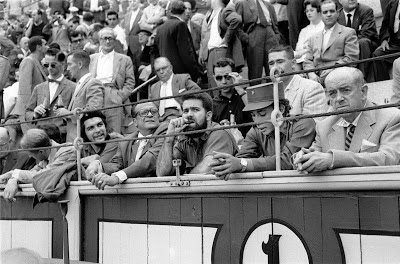
Also revealing are accounts by Castro revolutionaries who said that during their struggle against dictator Fulgencio Batista their lives were saved thanks to the help of the Spanish Embassy, as well as images of Ernesto "Che" Guevara walking in Madrid and attending a bullfight with members of Franco's secret police. 

Ernesto "Che" Guevara in Franco Spain at a Bullfight

Following the 1962 Cuban Missile Crisis, when the US pushed for tight economic sanctions on the Castro regime, the rest of Latin America, France and the United Kingdom all went along with Washington, but Franco's Spain continued trading with Havana.

On Franco's death in 1975, Fidel Castro decreed three days of mourning in Cuba, although he made sure that it went unnoticed by the press, it was an official decree signed by Cuban president Oswaldo Dorticós. This relationship with the Spanish dictator should not be a surprise when one considers that the Castro regime had a close working relationship with former high ranking Nazis.

This is why the United States siding with the Castro dictatorship in an issue of private property rights against Bacardi is so deeply offensive, and needs to be remedied. Cuban Americans and Cubans on the island would remember this gesture.

Monday, November 9, 2020

November 9, 1989: The day they started tearing down the Berlin Wall and the importance of memory

"The official Cuban press has not yet announced the fall of the Berlin Wall. Thus, year after year, many Cubans check the national newspapers in search of any allusion to this fact ... but nothing ..." - Yoani Sanchez, over Twitter, November 9, 2020

Tearing down the Berlin Wall on November 9, 1989

Today is a day to remember and cherish. 31 years ago it was the day that the Berlin Wall became no more, but in Communist regimes like Cuba, as Yoani Sanchez pointed out today, the official media has not recognized this historic episode of liberation.  

It is important to remember and share so that new generations will know what happened, and be inspired.

31 years ago today the Berlin Wall began to be physically torn down. It was a great day for freedom and the triumph of long years of nonviolent resistance throughout Eastern Europe. 

The Berlin Wall had been constructed beginning on August 13, 1961 with barbed wire fence followed by a 100 mile wall and more than 300 watch towers to spot and shoot escapees and the East German communists called it the "Anti-Fascist Protection Rampart." Minefields were laid in some sectors.

The destruction of the Berlin Wall on November 9, 1989 was not inevitable. It did not fall down. It was torn down.

In Germany, this was not a passive top down process or the Berlin Wall falling as a result of gravity and inertia. It bears repeating that it was torn down by courageous Germans.

Remember that between 1961 and the very year it was torn down at least 136 Germans were extrajudicially executed by East German border guards for trying to cross the Berlin Wall to freedom. There is The Berlin Wall Museum that offers a complete listing of the 136 known victims with details about them and their deaths.
 

Chris Gueffroy shot dead on February 5, 1989 at age 20 by East German guards while trying to cross the Berlin Wall

For example one of the last victims, Chris Gueffroy was born on June 21, 1968 and shot dead on February 5, 1989 trying to cross on the Britzer Zweigkanal, near the small garden colonies “Harmonie“ and “Sorgenfrei” on the sector border between Berlin-Treptow and Berlin-Neukölln. Dead at 20 years of age for the crime of wanting to live in freedom. A memorial column commemorating Chris Gueffroy was erected at Britzer Zweigkanal in Berlin-Treptow in 2003 in honor of his 35th birthday. A biography and account of the circumstances that led to his death and the aftermath are available online

As in Cuba today, the process of the Berlin Wall being torn down was both a struggle of ideas and of nonviolent action. Germans crossed the wall seeking freedom in an act of nonviolent defiance. Many escaped but many paid the ultimate price for freedom. The Order to Border Guards from the East German regime was clear:

"It is your duty to use your combat … skills in such a way as to overcome the cunning of the border breacher, to challenge or liquidate him in order to thwart the planned border breach... Don’t hesitate to use your weapon even when border breaches happen with women and children, which traitors have often exploited in the past.”
On June 14, 1973, Fidel Castro addressed the men charged with shooting East Germans fleeing to West Germany as "the courageous and self-denying border guards of the GDR People's Army who stand guard in the front line of the entire-socialist community." Later in the evening Premier Castro addressed the Nikolay Bezarin Barracks in East Berlin:
It is very important to know that the people of the GDR have great confidence in you, that they are truly proud of you. The comrades of the party and the citizens of socialist Berlin have told us with great satisfaction about the activity of the border troops, speaking with great admiration for you and for your services.

Some equate nonviolence with pacifism and they are profoundly mistaken. There is nothing passive and often times nothing peaceful about nonviolent resistance. It can be loud and boisterous or as in the case of the Berlin Wall the loud sound of tools smashing against an oppressive structure that denied the East German people the right to freedom of movement.

Tonight, I lift my glass and give a toast to freedom in memory of those brave souls who tore down the Berlin Wall in 1989 and those today in Belarus, China, Cuba, Nicaragua, Russia, Venezuela, and elsewhere in the world continuing the struggle for freedom. And I remember the worlds of the Czech writer Milan Kundera: "The struggle of man against power is the struggle of memory against forgetting."

This is why the Castro regime continues to try to shut out the news of this great event over the past 31 years, and why we must continue to endeavor to break through the walls of censorship. At the top of this blog, the text of Yoani Sanchez's tweet is translated to English. Below is her tweet from today.

Sunday, November 8, 2020

Cándido de Guerra Camero 1921-2020: Master of the Congas and founding father of Latin Jazz

Master of the Congo Drums

Cándido de Guerra Camero 1921-2020

Cuba lost one of her sons yesterday who changed Cuban music forever. Cándido de Guerra Camero died in New York City on November 7, 2020. He was 99 years old. Prior to Cándido only one congo drum was played at a time, and he changed that playing three congas with different tuning.

His influence on music over the past 79 years is striking. Diario Las Americas summarized his early years as follows: Born in the Havana neighborhood of El Cerro on April 22, 1921, Cándido began playing the bongo at age 4, made his professional debut at age 14 and settled in the United States at 25. He was quickly hired by the pianist Billy Taylor, later by the trumpeter and composer Dizzy Gillespie, he was a soloist in Stan Kenton's big band, and he traveled successfully through prestigious music venues in the country accompanied by his güiro and introducing the use of three congas across the United States. One of his last albums was, The Master, from 2014.

 Cándido Camero, moved from Cuba to New York City in the 1940s and avoided the censorship visited on other artists who fled the dictatorship of the Castro brothers. He would play with many of them such as Israel Cachao López (who left Cuba in 1962), Mario Bauzá, and Arsenio Rodríguez, who had all suffered the wrath of the communist dictatorship. Along with other artists such as Celia Cruz and Olga Guillot.

Below is a 2006 documentary about his life titled "Manos de Fuego"  (Hands of Fire):

Cándido also had a great influence on another great percussionist and Cuban, born in Havana, Ramón "Mongo" Santamaría Rodríguez. They were also bandmates.

Mongo is most famous for being the composer of the jazz standard "Afro Blue," recorded by John Coltrane among others. In 1950 he moved to New York where he played with Perez Prado, Tito Puente, Cal Tjader, Fania All Stars, etc. He was an integral figure in the fusion of Afro-Cuban rhythms with R&B and soul, paving the way for the boogaloo era of the late 1960s. His 1963 hit rendition of Herbie Hancock's "Watermelon Man" was inducted into the Grammy Hall of Fame in 1998. With the cover of "Watermelon Man," Santamaria found himself garnering the acclaim of his former mentors. He would even visit the pop charts once again - a feat that, among his mentors, only Prado ever accomplished - in 1969 with "Cloud Nine." And he recorded prolifically through the Sixties, Seventies and Eighties, before slowing things down in the 1990s. 

Cándido de Guerra Camero

He was a founding father of Latin Jazz, but Cándido's music extended into other genres such as Disco and House music. This musical giant changed music not only in Cuba, and in the United States, but around the world.

Requiescat in pace maestro.