
The Obama administration's Rotten Foreign Policy
Nearly a year ago on August 20, 2015 Secretary of State John Kerry in an interview with journalist Andres Oppenheimer made it known that "the United States and Cuba are talking about ways to solve the Venezuelan crisis."
In a blog post at the time I made the following comparison: "Secretary John Kerry asking the Castro regime in Cuba to help in Venezuela today is like asking Jack the Ripper to help stop knife violence in London in 1888."
Nearly a year later the results of this approach can be seen and it is a failure. Not only has Venezuela descended into dictatorship but it is a failed state. The press is already asking: "What went wrong in Venezuela?" Consider for a moment the following:
Today, August 3, 2016 Judge María Lourdes Afiuni is still being subjected to a legal process that began in 2009 on the arbitrary whims of the late caudillo Hugo Chavez. She was jailed on December 10, 2009 for following both Venezuelan and international law in a case that ran afoul of then President Hugo Chavez who called for her arrest in a television program.
The judge spent over a year in prison where she was raped, beaten, and threatened repeatedly with death. Judge Afiuni was kept under house arrest until 2013 but when she was diagnosed with cancer, it was lifted. Seven years later the harassment and continued threat of imprisonment continues. It is a message for the entire judiciary which Afiuni clearly stated in 2009:
The Penal Forum has a current list of 84 political prisoners in Venezuela with their names, profession, place of detention, and their photos. These are prisoners of conscience who are being kept in terrible conditions.
Extrajudicial killings committed by security forces are rampant in Venezuela. Fifty two members of the student movement have been killed by regime forces over the past three years with many shot in the head.
In June of 2015 Thomas Shannon, counselor to Secretary of State John Kerry met with Diosdado Cabello. Cabello, was then the head of Venezuela's National Assembly and suspected by U.S. prosecutors of being in charge of the infamous drug-trafficking organization, "Cartel de los Soles." Meeting with him may have sent a signal to the Maduro regime and not a good one.
Venezuelan strong man Nicolas Maduro named General Nestor Reverol, his new interior and justice minister one day after Gen Reverol was indicted by a US court on charges of abetting cocaine trafficking. Maduro dismissed the charges against Gen Reverol as a "US conspiracy". The fact that U.S. government officials have been willing to engage in formal diplomatic discussions with suspected drug traffickers may have played a role in the calculation to name the indicted General.
There is one independent institution remaining in Venezuela and that is the National Assembly and President Nicolas Maduro has threatened to cut off its funding.
The lack of the rule of law, the widespread infiltration of drug traffickers and corruption in the regime plays a role in the economic implosion of the country. Free markets need a regulatory environment bound by the rule of law which is non-existent in Venezuela. The slow motion imposition of a socialist economic model ruled by the military has compounded the disaster. It has gone beyond just a human rights crisis into full blown humanitarian crisis.
The most basic life saving medical supplies are unavailable in Venezuela The Venezuelan National Assembly declared a "humanitarian health crisis" that includes the lack of 872 essential medications.
Their are hunger riots in Venezuela and foot shortages. Venezuela is selling oil to Jamaica in exchange for food and medicine and seeking to resolve its food shortage using forced labor.
Inflation rates in Venezuela are reaching the levels of Zimbabwe with flour, pasta and milk consuming a month's pay according to a August 2, 2016 CNN report and the International Monetary Fund is predicting a 1,600% inflation rate in 2017.
Reuters in Caracas reported on August 3, 2016 that "growing numbers of young women are opting for sterilizations rather than face the hardship of pregnancy and child-rearing. Traditional contraceptives such as condoms or birth control pills have virtually vanished from store shelves in Venezuela, pushing women towards the hard-to-reverse surgery."
Where the Obama administration has had an active approach in the region the result is a mess. For example between January 2014 and February 24, 2016 U.S. Customs and Border protection documented 93,237 visa less Cubans had entered the United States and the numbers are increasing.
The presidential state visit to Cuba earlier this year legitimizing the Castro regime assisted in the ongoing dynastic succession of the Castro family that if successful will insure another generation of dictatorial rule in Cuba.
The U.S. policy of engaging with the Castro dictatorship, has coincided with deteriorating human rights in Cuba that is leading many Cubans to flee.
This also means another thirty years of a regime seeking to undermine democracy in the region as it has done in Venezuela, and Nicaragua.
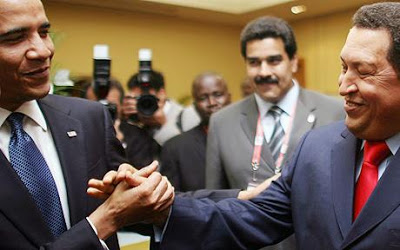 |
| Obama with Hugo Chavez and Nicolas Maduro (April 2009) |
In a blog post at the time I made the following comparison: "Secretary John Kerry asking the Castro regime in Cuba to help in Venezuela today is like asking Jack the Ripper to help stop knife violence in London in 1888."
Nearly a year later the results of this approach can be seen and it is a failure. Not only has Venezuela descended into dictatorship but it is a failed state. The press is already asking: "What went wrong in Venezuela?" Consider for a moment the following:
Today, August 3, 2016 Judge María Lourdes Afiuni is still being subjected to a legal process that began in 2009 on the arbitrary whims of the late caudillo Hugo Chavez. She was jailed on December 10, 2009 for following both Venezuelan and international law in a case that ran afoul of then President Hugo Chavez who called for her arrest in a television program.
 |
| Seven years later Judge María Lourdes Afiuni still persecuted |
"There is no judicial independence. I'm here as the president's prisoner. I'm an example to other judges of what happens if you step out of line."There is no rule of law in Venezuela. The judiciary is controlled by the executive branch which is led with an iron fist by Nicolas Maduro and his Cuban advisers.
 |
| Political prisoners in Venezuela |
Extrajudicial killings committed by security forces are rampant in Venezuela. Fifty two members of the student movement have been killed by regime forces over the past three years with many shot in the head.
In June of 2015 Thomas Shannon, counselor to Secretary of State John Kerry met with Diosdado Cabello. Cabello, was then the head of Venezuela's National Assembly and suspected by U.S. prosecutors of being in charge of the infamous drug-trafficking organization, "Cartel de los Soles." Meeting with him may have sent a signal to the Maduro regime and not a good one.
 |
| Cause and effect? Did State's meeting with Cabello lead to Gen. Reverol's appointment |
There is one independent institution remaining in Venezuela and that is the National Assembly and President Nicolas Maduro has threatened to cut off its funding.
The lack of the rule of law, the widespread infiltration of drug traffickers and corruption in the regime plays a role in the economic implosion of the country. Free markets need a regulatory environment bound by the rule of law which is non-existent in Venezuela. The slow motion imposition of a socialist economic model ruled by the military has compounded the disaster. It has gone beyond just a human rights crisis into full blown humanitarian crisis.
The most basic life saving medical supplies are unavailable in Venezuela The Venezuelan National Assembly declared a "humanitarian health crisis" that includes the lack of 872 essential medications.
Their are hunger riots in Venezuela and foot shortages. Venezuela is selling oil to Jamaica in exchange for food and medicine and seeking to resolve its food shortage using forced labor.
Inflation rates in Venezuela are reaching the levels of Zimbabwe with flour, pasta and milk consuming a month's pay according to a August 2, 2016 CNN report and the International Monetary Fund is predicting a 1,600% inflation rate in 2017.
Reuters in Caracas reported on August 3, 2016 that "growing numbers of young women are opting for sterilizations rather than face the hardship of pregnancy and child-rearing. Traditional contraceptives such as condoms or birth control pills have virtually vanished from store shelves in Venezuela, pushing women towards the hard-to-reverse surgery."
Where the Obama administration has had an active approach in the region the result is a mess. For example between January 2014 and February 24, 2016 U.S. Customs and Border protection documented 93,237 visa less Cubans had entered the United States and the numbers are increasing.
The presidential state visit to Cuba earlier this year legitimizing the Castro regime assisted in the ongoing dynastic succession of the Castro family that if successful will insure another generation of dictatorial rule in Cuba.
The U.S. policy of engaging with the Castro dictatorship, has coincided with deteriorating human rights in Cuba that is leading many Cubans to flee.
This also means another thirty years of a regime seeking to undermine democracy in the region as it has done in Venezuela, and Nicaragua.
 |
| Some of the Venezuelan youth shot in the head in 2014 during protests |




 Posts
Posts

