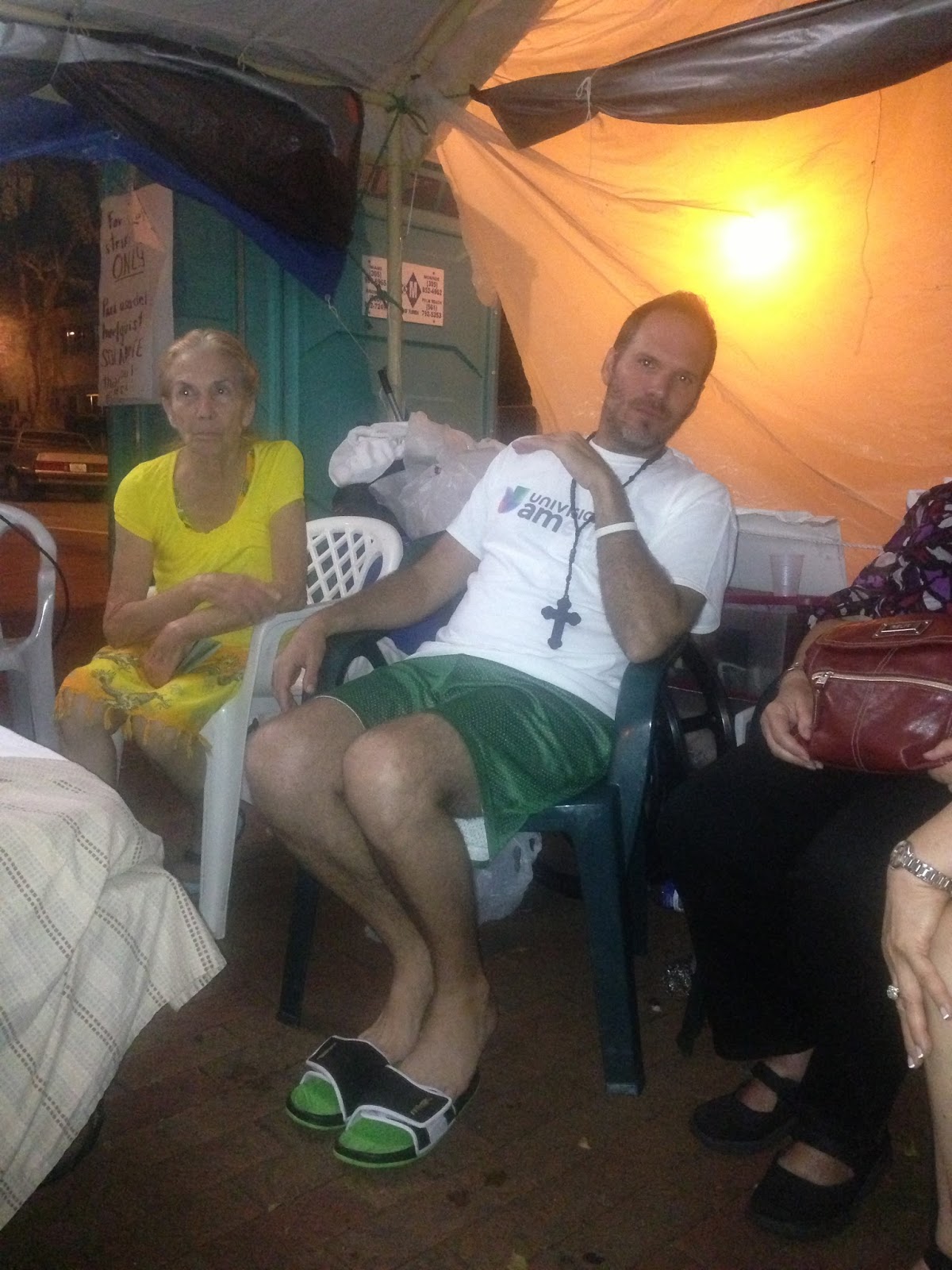
Jesus Alexis Gomez has been on hunger strike since July 19, 2013 and was joined on Friday July 26, 2013 by Ramon Saul Sanchez after Bahamian officials failed to follow through on a verbal agreement by placing it in writing. There is an online petition directed at the United Nations and also a campaign underway to boycott the Bahamas. Below is an essay by Rosa María Payá Acevedo that outlines what is being done to Cubans under custody of the Bahamian authorities.
 |
| Ramon Saul Sanchez (Left) and Jesus Alexis Gomez (Right) |
Categories of Human Beings
By
Rosa María Payá
Where are the documentaries about the
Bahamian concentration camps where there are school-age children and
women with their lips sewn shut?
It has been a few weeks since South
Florida’s media and social networks have been denouncing the systematic
abuses to which refugees from Cuba and other nations are subjected in
the Bahamas. The trigger was a series of clandestinely made cellphone
videos that showed officers kicking people and subjecting them to
different tortures. Those who made the videos public assure these were
taken in the refugee detention camps in Nassau, and even when people
have recognized their friends and relatives in the videos, the Bahamian
Chancellery has denied that these are authentic.
These detention centers seem to be the
scene of systematic human rights violations, but they are not a new
phenomenon. The oldest data I know of refers to the New York Times
of August, 1963, which discusses the intervention of Cuban air and
naval forces in the former British island during which 19 refugees were
kidnapped and taken back to Cuba. But even more astonishing is the
reaction of the international community before a situation that has been
taking place for years, and for which there are not many echoes beyond
the modest ones from the voices of Cubans and Cuban Americans.
In the past 20 years, there is no trace
of these events in two of the most important American newspapers, even
when the Interamerican Human Rights Commission (IACHR) has issued
reports thereon from allegations dating from 1998. For its part, the
Spanish newspaper El País lists the names of the two Caribbean
islands when it comes to hurricanes while other Iberian newspapers only
mention them to highlight the progress of the oil drilling carried out
in collaboration with Cuba.
The reaction is different when it comes
to the equally unjust humiliations suffered by the prisoners at the U.S.
Naval Base in Guantánamo. The acts of condemnation in this case reach
high political dimensions including the Human Rights Commission of the
Russian Chancellery, the Swiss President of the International Committee
of the Red Cross, the United Nations, the American Catholic Church, some
leftist French party and thousands, perhaps millions of people from
around the word who are in favor of the closing of this prison in the
easternmost end of Cuba.
However, curiously enough, in that very
end of my country the Provincial Prison of Guantánamo, run by Cuban
authorities, is known for its inhumane treatment, the lack of hygiene, a
poor diet and occasional beatings to which the people who are surviving
there are subjected to. Most of the country’s prisons are run in
similar conditions.
It would seem as if the men in orange
uniforms held at the naval base belonged to a different category from
that of the non-uniformed emigrants of the Caribbean. One hypothesis
could be that the people of the Middle East evoke greater sympathy or
compassion than the Caribbean people, but since it is precisely in that
region where countless human rights violations have been committed in
the past and continue to be committed to this day by the authorities of
those countries, and the international condemnation has historically
suffered its ups and downs, this argument doesn’t hold water. It would
be scandalous if the level of the scandal was related to the category of
the oppressors.
It is not the US Marines who are
torturing Cubans and Haitians in the Bahamas; it is not “the Yankee
empire” against “the oppressed people of the world.” Therefore, the
perception is that the abuses committed by the authorities of the
Commonwealth of the Bahamas are less attractive to the international
community.
I cannot help questioning the
motivations of the forces behind these reactions. If it is not
compassion for those who are suffering, a sense of justice and respect
for international treaties, could it be that the level of solidarity is
determined by the unpopularity of the oppressor? Doesn’t the Universal
Declaration of Human Rights proclaim that all human beings are born free
and equal in dignity and rights? A world in which lobbies have the last
say and pressure groups have more interests than convictions is scary.
Who is lobbying for our brothers whose
rights are violated with the same impunity in Havana and Nassau? Where
are the documentaries about the Bahamian concentration camps where there
are school-age children and women with their lips sewn shut? Where is
the absolute condemnation for the humiliations that these people who
emigrate suffer from, which are not subjected to any accusations? Why
throughout the 20 years this situation has been taking place has it not
become popular among youth to favor the closure of the prison camps in
the Bahamas?
Apparently, the sense of impunity is
contagious, and the Bahamian officials feel they can beat Cubans in the
same way in which the repressive bodies of the State Security in the
Largest of the Antilles have no mercy toward opposition members. Each of
them should know that impunity is not sustainable over time, and that
time is running out.
6 July 2013






 Posts
Posts

