Showing posts with label Bishop Agustín Román. Show all posts

Friday, April 15, 2022

Good Friday and Passover Reflection on religious freedom in Cuba. Remembering Basilio Guzmán and Bishop Agustín Román

Take up the cross and follow ...

Taking up the cross.


Source: CubaBrief

Today has powerful significance for both Christians and Jews. On April 15th Passover, also known as Pesach in Hebrew, begins at nightfall. Passover commemorates the liberation of the Hebrews from over two centuries of slavery when Moses led them out of Egypt. It has been celebrated since 1300 BC according to the Book of Exodus in the Bible, and will conclude on April 23rd at nightfall. It is a Jewish celebration of liberation

Moses leads Hebrews out of slavery.

Today also marks Good Friday, the day that Jesus of Nazareth was crucified and died in 33 AD. This was the day Jesus willingly suffered and died by crucifixion as the ultimate sacrifice for the sins of humanity. Pope John Paul II on Good Friday, April 10, 1998 at the end of the Via Crucis in Rome gave this powerful reflection on its importance.

“It is now the dead of night. As we contemplate Christ dead on the Cross, our thoughts turn to the countless injustices and sufferings which prolong his passion in every part of the world. I think of the places where man is insulted and humiliated, downtrodden and exploited. In every person suffering from hatred and violence, or rejected by selfishness and indifference, Christ continues to suffer and die. On the faces of those who have been "defeated by life" there appear the features of the face of Christ dying on the Cross. Ave, Crux, spes unica! Today too, from the Cross there springs hope for all.”

Both Passover and Good Friday are part of the religious tradition of most Cubans that speaks to the struggle for freedom both material and spiritual, but a new significance is added following 63 years of communist tyranny and repression. In the Christian Gospels Jesus Christ called on his followers to “take up the cross and follow Me.

On September 17, 1961, Castro regime agents at gunpoint collected 131 priests, brothers and a bishop, placing them on board the Spanish ship Covadonga and deported them from Cuba. Over 300 priests, brothers, and nuns were expelled from Cuba in 1961 alone.
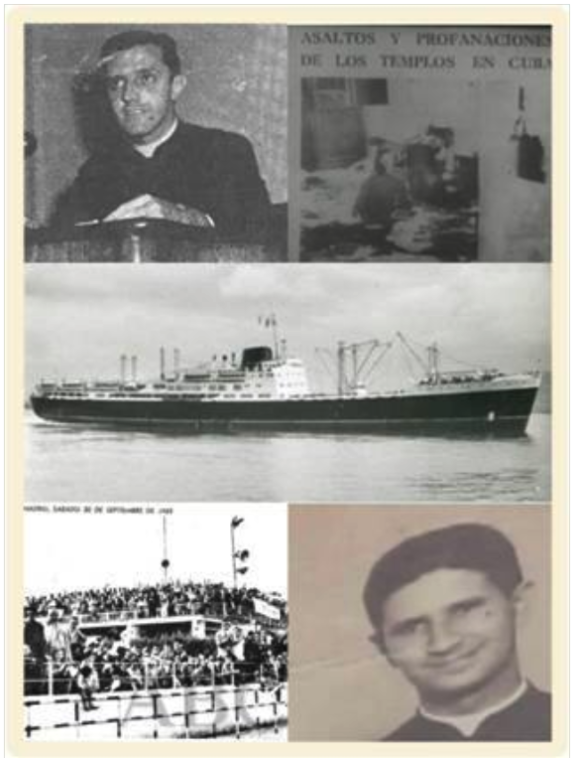
Cuban priests expelled from Cuba at gunpoint on September 17, 1961

Many of the remaining priests and nuns were sent to forced labor camps. The Castro regime declared itself an atheist state in 1962, and openly hostile to religion. Christmas ended as a holiday in Cuba in 1969. Following the collapse of the Soviet Union the dictatorship declared itself "secular" and Christmas returned to Cuba in 1997, but restrictions continued.

Judaism was not exempt from religious repression under the Castro dictatorship. Seth J. Frantzman, a Jewish academic based in Jerusalem, following the death of Fidel Castro in November 2016 wrote an analysis of the tyrant's antisemitism.

"Most Jews fled Cuba when Castro came to power, dwindling from 15,000 to around 1,500 by 2014. Once Castro entered the Soviet orbit the official anti-Zionist and anti-Israel line became common in Cuba, but most writers argue it did not flow over into anti-semitism. Only one anti-semitic incident, stone throwing at a synagogue during the 1973 war, was recorded in decades."

The attack on the synagogue coincided with Fidel Castro breaking diplomatic relations with Israel on September 10, 1973. The lack of reported antisemitic incidents had more to do with the end of independent civil society and the outlawing of human rights groups under the Castro regime.  Frantzman exposes the duplicity of Fidel Castro in Mosaic in the November 29, 2016 article, “The Truth about Fidel Castro and Anti-Semitism” , highlighting how the Cuban dictator prevented the importation of kosher meat.

In 1994, … [Israel’s chief rabbi] Rabbi Israel Meir Lau attempted to get Castro to allow kosher meat into Cuba. [Israeli diplomat Joel Barromi provided details to  Haaaretz writer Adi Schwartz in a 2006 interview.]  The Cuban leader had initially rejected Lau’s request to bring in kosher meat. “I told you that I am fighting against the phenomenon of anti-Semitism in my country…do you want to make my people anti-Semitic,” Castro asked. “We have the practice of allocating 150 grams of bread a day, but the Jews in Cuba would have meat? [The people] will have a horrible hatred for them, envy them tremendously and loot their homes if under such conditions you see to import kosher meat for the Jews, you yourself create the anti-Semitism that I have been stopping.”

This is the example of supposedly stopping anti-semitism, to threaten Jews that if they should want to eat kosher meat that they would “create” anti-semitism. Castro was at first admitting that he had starved his country by putting it on bread rations, but surely Cubans eat some meat. So why would some meat for Jewish people “make” them anti-Semitic?  One wonders whether “envy” for Muslims eating Halal would create the same excuse for Islamophobia just because Muslims celebrate Eid by eating a sheep?  According to articles the same Cuba that feared meat would force people to be anti-semitic, was welcoming to Halal food.

Havana aided, trained, and armed terrorist groups that targeted Israel for destruction. Cuban troops were sent by Castro to the Middle East to fight against Israel, with the Yom Kippur War being a high profile example.

The few Jews remaining in Cuba continue to be subjected to antisemitism.

Olainis Tejada Beltrán, Yeliney Lescaille Prebal and their kids Liusdan Martínez Lescaille, Daniel Moises

Christian Solidarity Worldwide (CSW) on December 23, 2019 reported that Liusdan Martínez Lescaille, a twelve year-old Jewish boy was forbidden by Cuban educational authorities from entering his school while wearing a kippah ( also known as a yarmulke) since December 11, 2019 with the result that he has been prevented from continuing his education. His younger brother, Daniel Moises, has also been subjected to the ban and government authorities threatened to open legal proceedings against his parents, jailing them and taking their children away, for "threatening the children’s normal development." CSW documented that Liusdan was regularly beaten up at school since the family moved to the Nuevitas municipality in 2016, and that the situation worsened in September 2019.

Many Cuban exiles have identified with the Jewish community that until 1948 would say “Next year in Jerusalem,” with their own hopeful lament of “Next year in Havana.”

This week has special significance for Cuban exiles. On April 13, 2022 Cuban exile, former prisoner of conscience and Plantado Basilio Guzmán Marrero passed away after a long illness. He was 84 years old.

On 7/10/19 Basilio Guzmán, others carry out vigil to protest 7/13/94 tugboat massacre.

Ten years ago on April 11, 2012 Cuban exiled Bishop Agustín Román died at age 83 in Miami, FL. This anniversary was observed in Miami with religious services and an OpEd by Archbishop Thomas Wenski in El Nuevo Herald

These two Cuban exiles loved Cuba and the Cuban people and wanted them to be free. Both Cubans in the diaspora and on the island understand this, but not some of the so-called Cuba experts in academia.

Bishop Agustín Román (May 5, 1928 - April 11, 2012) at La Ermita

Canadian Professor Peter McKenna would characterize both as being "anti-Cuba" because of their opposition to the Castro dictatorship. Professor McKenna's claim is Orwellian. Thankfully others in the Canadian academy challege this false narrative. Professor Yvon Grenier in his OpEd ”Since when are Cuban exiles anti-Cuba?” published in the Saltwire Network on April 15, 2022 sets the record straight.

In his April 5 opinion piece entitled “Sixty years of a misguided U.S. blockade of Cuba,” Prof. Peter McKenna characterizes many of the 1.3 million Cuban-Americans as being “anti-Cuba.” Do we ever say, by way of comparison, that members of Afghan or Guatemalan exile communities are “anti-Afghanistan” or “anti-Guatemala”? No government is its people — especially when the government is not chosen freely by its citizens.

Opposing the Castro dictatorship is thoroughly pro-Cuba. Bishop Agustín Román in a talk he gave on "The importance of the current internal dissident movement in Cuba" on December 16, 2006 argued love is the driving force to seek change in Cuba.

"If what we do for Cuba, we do not do for love, better not do it. If all of us who want the good of the nation, of the important internal dissident movement and the persevering of exile arm ourselves with these virtues, we will be effective. If we are committed to not let personalism, or the passions dilute them, we will have won. If we keep them and transmit them to all our people, we will have secured for Cuba a happy future."

Basilio Guzmán Marrero, who was jailed for 22 years, and tortured for most of that time in Cuban prisons, refused his whole life to cooperate with evil, and remained committed to a free Cuba. He fought against the dictatorships of Fulgencio Batista, and Fidel Castro. Father Agustin Roman, together with many other clerics, was escorted at gunpoint out of Cuba on September 17, 1961. Neither Basilio or Father Román was "anti-Cuban" but they were profoundly anti-dictatorship and openly hostile to any manifestation of injustice.

Basilio holds poster of Mario De La Peña, killed by Castro 2/24/96, at Cuban Embassy in Wash DC on 2/20/20.

There is one authorized biography Pastor, Profeta, Patriarca (Pastor, Prophet, Patriarch) of Bishop Agustín Román, written by Daniel Shoer, a secular Jewish journalist. Shoer described what happened to Father Román after being forcibly deported at gunpoint in a December 27, 2015 article of Rocio Granados in La Voz Catolica.

“Put aboard a ship bound for Spain along with 130 other priests and religious, including the then auxiliary bishop of Havana, Eduardo Boza Masvidal, the transatlantic trek turned into a ‘high seas retreat’ where the religious exiles discerned that their new calling was to be missionaries to the Cuban diaspora.”

In 1966 Father Román arrived in Miami and oversaw the construction of the National Shrine of Our Lady of Charity on Biscayne Bay that was completed in 1973. Bishop Román told Shoer of the challenge completing it.

“I thought I wouldn’t be able to do anything because in this country, you need money to build churches, and what we had were people picking tomatoes, working in the fields, in the factories, and all they could contribute were tarnished pennies.”

“Even more impressive, the shrine was completely paid for when it was built. ‘He said in the countryside (where he grew up) no one used credit,’ Shoer said”, in the December 27, 2015 article “New book tells life story of Bishop Agustín Román ‘Pastor, Prophet, Patriarch’ was authored by Jewish journalist, with bishop’s OK.” In 1979 Father Román became the first Cuban to be appointed a bishop in the U.S.

On 7/11/21 Basilio at Cuban Embassy (Wash DC) protesting Oswaldo Payá & Harold Cepero killings.

Basilio would protest the new injustices occurring in Cuba after his release and exile in 1984, the massacre of 37 men, women, and children on July 13, 1994 by Castro agents for trying to leave Cuba on the 13 de Marzo tugboat, the killing of four Brothers to the Rescue members on February 24, 1996 shot down in international airspace, and the killing of Oswaldo Payá Sardiñas and Harold Cepero Escalante on July 22, 2012. These are three of many examples.

Today it is up to the living to continue their legacy of integrity, love of country, desire for justice and pursuit of freedom for their homeland.

Christian Solidarity Worldwide reported on April 12, 2022 that Reverend Lorenzo Rosales Fajardo was sentenced to eight years in prison in December 2021. His family only learned of the decision last week, in a communication sent by Havana to the United Nations in response to a request for information regarding the pastor’s detention. He has two children. A son, David, aged 18, and a daughter, Lorena, aged 12. “Over the past nine months, He has only been permitted to see them, and his wife Maridilegnis Carballo, in a few fleeting visits to the maximum-security prison where he is currently being held.”  

Lorena, aged 12, David, aged 18, Rev Lorenzo Rosales Fajardo, and Maridilegnis Carballo.

“Upon finally learning of her husband’s sentencing, Maridilegnis Carballo told CSW: ‘I don’t know if I can bear so much injustice and so many lies… how painful to see the disgraceful condition of the government of this nation… They know that we are all witnesses to their lies. They no longer even have the shame to hide their lies.’“

Regime apologists in academia and the pro-Castro lobby describe denouncing these injustices and efforts to cut off support for the secret police and military apparatus that carry them out as being “anti-Cuba.” The stark reality is that those who defend and romanticize the dictatorship are the ones that are “anti-Cuba” assisting a brutal tyranny to destroy an entire people. On the first night of Passover and Good Friday we remember those, like Basilio Guzmán Marrero and Bishop Agustín Román, who refused to cooperate with evil and endured suffering for the sake of the freedom of the Cuban people. May their courageous lives inspire many more to follow their path.

Monday, April 11, 2022

Remembering Bishop Agustín Román ten years later

"Monsignor Román was the Félix Varela of our times." - Archbishop Thomas Wenski, April 11, 2022 

Bishop Agustín Román 1928 - 2012


Hard to believe it has been 10 years since Bishop Agustín Román was called home. His absence over the numerous crises that we have suffered made it feel much longer and gave us a deeper appreciation of his importance to this community.

Today, Archbishop Thomas Wenski published an Oped that celebrated the legacy of Monsignor Román and placed him in the context of Cuban history. He concluded his reflection praising the legacy of this humble and good Priest.

Archbishop Román suffered exile because of a destructive nationalism that took hold of his beloved Cuba, but he never stopped being a patriot — nor did he ever stop tirelessly preaching the good news of Jesus Christ who gives us eternal life. He totally dedicated himself to the Fatherland and to Life.
Bishop Román once said that "If what we do for Cuba, we do not do for love, better not to do it."  He had a great understanding of what was taking place in the land of his birth and the gift to lay it out in a manner that both lifted the listeners up spiritually, but also provided greater understanding and discernment.

In the realm of political struggle he was an advocate for nonviolent civil resistance who said that violence was "not be a favored option, much less a practice or method of justifiable struggle."

In 2006 he spoke of the challenges facing Cuba and of the Cuban dissident movement and his observations remain  relevant and needed.

"The greatest importance of the internal dissident movement in Cuba today, is that it has proven that political action can be consistent with what conscience knows and that is that the force of reason is, and should be more powerful than the reason of force."- Bishop Agustín Román (2006)


Sunday, February 23, 2020

Orlando Zapata Tamayo was murdered by the Castro regime 10 years ago today, but his legacy lives on

"Long live human rights! With my blood I wrote to you so that this be saved as evidence of the savagery that we of the Pedro Luis Boitel political prisoners [movement] are subjected to and are victims of." - Orlando Zapata Tamayo, letter smuggled out April of 2004*


Today at 3:00pm at our Lady of Charity in Miami, better known to Cubans as "La Ermita de la Caridad," a nun read out names of those who had died, including Bishop Agustín Román and Orlando Zapata Tamayo, and asked parishioners to pray for them.

Father Fernando E. Hería during his Homily at the 3:00pm Mass reflected on the nonviolent doctrine of the Church and the martyrdom of Orlando Zapata Tamayo, ten years ago on February 23, 2010. 
A 24 x 36 inch poster of Orlando Zapata Tamayo was on display in the front pew of the Church.


It is necessary to revisit the last eight years of Orlando Zapata's life to understand why his death made such a profound impact inside and outside of Cuba, and is remembered today. The following chronology is based on a 2010 handout by the Cuban Democratic Directorate, that documented Orlando's case closely.

It was ten years ago at 3:00pm on February 23, 2010 that it was announced that Orlando Zapata Tamayo had died. This humble bricklayer who became a human rights defender, spent nearly seven years being mistreated and tortured by the Castro regime.

Oswaldo Payá Sardiñas holds up a flier with Orlando Zapata Tamayo's photo
He had worked alongside both Oscar Elias Biscet, and Oswaldo Payá Sardiñas on projects that sought to advance the cause of human rights in Cuba with Biscet's human rights circles and Payá's Varela Project.

Orlando Zapata Tamayo was arbitrarily detained by the secret police on December 6, 2002 together with other activists, including Dr. Biscet, to stop them participating in a human rights workshop at the home of human rights defender Raúl Arencibia Fajardo. Three months later on March 8, 2003 Orlando was released.

Twelve days later on March 20, 2003 Orlando Zapata was re-arrested in the midst of the Black Cuban Spring when over 75 activists and independent journalists were jailed during a crackdown and sentenced to long prison terms. He had been taken part in a fast and vigil demanding the freedom of Dr. Biscet, who had remained jailed since the December 6, 2002 arrest.

Orlando Zapata photographed with prominent dissidents
Amnesty International reported that on October 20, 2003 Orlando was dragged along the floor of Combinado del Este Prison by prison officials after requesting medical attention, leaving his back full of lacerations. Orlando managed to smuggle a letter out that was published in April of 2004:
"My dear brothers in the internal opposition in Cuba. I have many things to say to you, but I did not want to do it with paper and ink, because I hope to go to you one day when our country is free without the Castro dictatorship. Long live human rights, with my blood I wrote to you so that this be saved as evidence of the savagery we of the Pedro Luis Boitel political prisoners [movement] are subjected to and are victims of."*
Orlando would remain jailed without charges or a trial.  On May 18, 2004 Orlando Zapata Tamayo, Virgilio Marante Güelmes, and Raúl Arencibia Fajardo were each sentenced to three years in prison for contempt for authority, disorderly conduct and resisting arrest in a one-day trial.

This did not silence him. When prison officials chose to attack his human dignity, and engaged in acts of physical and psychological torture, Orlando Zapata would respond with nonviolent defiance. He carried out hunger strikes within the prisons he was transferred to. The regime's response to his nonviolent defiance was to pile on prison years to his sentence. Between May 2004 and December 2009 they carried out nine trials without due process guarantees for a total sentence of 25 years and six months.

What we know is a partial accounting of what he suffered. On July 26, 2008 in the Holguin Provincial Prison he was brutally beaten, on the orders of the prison director, Major Orelvis Miraldea, and Orlando's body was covered in bruises, but especially suffered blows to the head that caused a intracranial hematoma in the lower part of his brain, and a year later he needed to be operated on for this brain injury. 

Despite this, because of his refusal to be re-educated and silenced, the beatings continued on August 29, 2009, September 24, 2009, and a more severe beating on November 26, 2009.

Reina Luisa Tamayo, with her son's blood stained shirt
On December 3, 2009 he is transferred to Kilo 8 in Camaguey, a maximum security prison. Upon his arrival the food that his mother had turned into him the day before was confiscated, and they wanted to force him to wear the uniform  of a common prisoner. Orlando refused and begins his last hunger strike.

Major Filiberto Hernandez Luis, director of Kilo 8 prison, retaliates placing him in isolation without clothes and sleeping on the floor. Over 18 days they deny him water in an effort force him to end his hunger strike, and break his spirit.  On January 3rd and again on January 6th he is taken to Amalia Simoni Hospital  and undergoes intravenous rehydration and is returned to his isolation cell.

On January 21, 2010 he is transferred to the Amalia Simoni Hospital prison ward where he is kept under strong air conditioning unit with a thin blanket that causes him to develop pneumonia, aggravating his health situation. At the same time on several occasions members of the political police film Orlando Zapata in his hospital bed.

On February 16, 2010 he is transferred to Havana in a military operation, and his mother is not allowed to accompany him in the ambulance. This is the last time that she sees her sons conscious.

On February 20, 2010 after strong protests by his mother to the secret police, she is able to see Orlando at the Combinado del Este prison ward, but he unconscious and intubated.

On February 22, 2010 she is called to a late night meeting with doctors, where she is filmed without her knowledge. There she is told for the first and only time that her son is alive thanks to an artificial  respirator.  ( However, in a later article in the official newspaper Granma it is reported that he had been on a respirator for days.)

On February 23, 2010 around mid-day, the secret police and military doctors in form Reina Luisa Tamayo, Orlando's mother, that he is being transferred to Hermanos Ameijeiras Hospital in a critical state. He dies three hours later at 3:00pm according to the information by the political police to his mother.

Castro regime book “The Dissidents” mentioned OZT as an opponent.
Following his death the Castro regime sought to destroy Orlando's reputation and went as far as to deny that he had been a dissident. This campaign failed, because even the dictatorship's own propaganda had recognized his activism, published a picture of him with other activists and attacked him years earlier.

This extrajudicial killing turned out to be a very costly one for the regime. Ten years later protests were carried out at the Embassy in Washington DC, in Miami, and in Cuba. It is most likely not a coincidence that the hacking of the University of Havana home page by Anonymous was carried out on the ten year anniversary of the death of this Cuban human rights defender.

They killed his body, but they did not obtain his obedience, and his spirit of defiance lives on.

Where were you the day Orlando Zapata Tamayo died? Please write down what you remember in the comments section.


Thursday, April 24, 2014

How to confront and defeat violent regimes and systems

“If we could change ourselves, the tendencies in the world would also change. As a man changes his own nature, so does the attitude of the world change towards him. ... We need not wait to see what others do.”  - Mohandas Gandhi


Promised in an earlier blog entry to explain how one can successfully confront violent regimes and unjust and exploitative systems with deep structural violence. At the time gave the CliffsNotes answer: With nonviolence, love and a coherent strategic vision that involves a constructive program as well as creative nonviolent resistance. This is not to be confused with passive resistance or being passive aggressive.

Today is the perfect day to begin to enter more concretely into this subject matter for a number of reasons: 1) Today marked the 100th day of the King Center's 100 Days of Nonviolence. 2) Today marks the official observance of the Armenian Genocide. 3) Just finished reading Michael N. Nagler's The Nonviolence Handbook: A Guide for Practical Action 4) In Venezuela saw that medical students were engaged in a combination of civil disobedience and a constructive program that bears closer examination.

Nagler describes in his book the two basic ingredients for nonviolence to work:
1. We approach out situation with right intention. We are not and do not need to be against the well-being of any person.

2. We employ right means. Wrong means such as violence can never, in the long run, bring about right ends.
Reading the two theorems or postulates above led me to recall the words of the late Bishop Agustín Román first on the importance of having the right intentions
"If what we do for Cuba, we do not do for love, better not do it. If all of us who want the good of the nation, of the important internal dissident movement and the persevering of exile arm ourselves with these virtues, we will be effective. If we are committed to not let personalism, or the passions dilute them, we will have won. If we keep them and transmit them to all our people, we will have secured for Cuba a happy future. "
Secondly Bishop Agustín Román on the importance of employing the right means or of action being consistent with conscience:
More concretely, I would say that the greatest importance of the internal dissident movement in Cuba today, is that it has proven that political action can be consistent with what conscience knows and that is that the force of reason is, and should be more powerful than the reason of force.
This is a rejection of Machiavellian power politics that claims that the ends justify the means. The Burmese opposition leader Aung San Suu Kyi  offers an explanation that should resonate with Cubans:
"I do not believe that means can be separated from ends.The means that you use to achieve your ends will in the end color those very ends themselves. If we are to march along the road to freedom full of hatred and full of the instincts of violence what we find at the end of the road will not be freedom but another kind of prison. A prison that we have constructed for ourselves through our own feelings of hatred and violence."
Mohandas Gandhi on September 11, 1906 coined the term Satyagraha which according to Michael Nagler literally means "clinging to truth" but has also been translated to mean "soul force."  Nagler goes on to explain the power of nonviolence in a nonviolent moment when overwhelming violent force is stopped by nonviolence and its dynamic citing Gandhi's explanation:
What satyagraha does in these cases is not to suppress reason but to free it from inertia, and to establish its sovereignty over prejudice, hatred, and other baser passions. In other words, if one may paradoxically put it, it does not enslave, it compels reason to be free." What he calls "reason" here is better described as the innate awareness that we are all connected and that nonviolence is "the law of our species."
 In the quote at the top of the page, Gandhi is saying that we do not need to wait to see what the world is going to do but in changing ourselves we are also changing the world. In that spirit let me close this blog entry with 5 Basic Training Practices for Nonviolent Living taken from Michael Nagler's book:

1. Avoid the major networks and media outlets.
2. Learn about nonviolence.
3.Take up a spiritual practice.
4. Be more personal with others.
5. Find a project and get active.

For Cubans reading this blog entry on nonviolence who remain skeptical please answer the following question: "How many more national saviors using violent means to dislodge a despotic regime only to become a worse version than his predecessor?  Violently overthrowing Spanish imperialism with the help of the United States ended with Independence war hero General Gerardo Machado becoming Cuba's first dictator who was then violently overthrown by a coalition of students and soldiers turning Fulgencio Batista into a national figure and next dictator who was then violently overthrown by Fidel Castro who then set up a totalitarian dictatorship that endures to the present day. Isn't it time to stick with nonviolence and try a different approach?" 

Cuba's democratic period that lasted between 1940 and 1952 was the product of a dialogue and negotiation between all political tendencies that although imperfect was the best period in Cuba's republican history between 1902 and the present. Unfortunately the regime now in power has proven that it will not change through a process of conflict resolution but that only means that creative nonviolent resistance combined with a constructive program can achieve lasting change on the island.

To be continued...

Monday, April 15, 2013

The Legacy of Bishop Agustin Roman

“Change Swords of Steel into Swords of Truth” – Bishop Agustin A. Roman, Oakdale Federal Detention Center , November 29, 1987

Mass for Bishop Agustin Roman

On Sunday, April 14, 2013 at 3:00pm at La Ermita de la Caridad we saw in action during Mass how Cubans are one people united by the Virgin of Charity or as she is affectionately known "Cachita." Several hundred Cubans came together to remember and pray for Bishop Agustin Roman at a Mass officiated by Arch-Bishop Thomas Wenski to observe the one year of his passing.

Archbishop Wenski spoke about the life of Bishop Agustin Roman and how, like Peter, he was a fisher of men and then went onto explain how the late Bishop had planned to be fishing in Cuban waters but forced at gun point to board the Covadonga and go into exile to fish in Chilean and American waters. Arch-Bishop Thomas Wenski spoke about the origins of La Ermita de la Caridad:
"As Jesus Himself told St. Peter that someone would take him where he did not want to go. Father Aleido had to allow himself to be guided by the hands of God who called him to be not only a disciple but missionary - first in Chile and then here in Miami where by the initiative of the bishop at the time, Archbishop Coleman Carroll, built this chapel to the glory of God and the Virgin Mother of Jesus, and for the spiritual good of the Cuban exile. It was built by the sea whose waters also wash the shores of Cuba. Thus, we see ourselves how God's ways are inscrutable but are providential paths."
One of the last projects  Bishop Agustin Roman presided over was the construction of a small malecón inspired by the one in Havana just behind the La Ermita.


A few days ago Yoani Sanchez made the pilgrimage there and today Rosa Maria Payá and her brother Oswaldo Payá Acevedo took part in the Mass for Bishop Agustin Roman presenting a Cuban flag while Rafael Peñalver presented the plaque of a shiv taken from the prison riot that Bishop Roman ended nonviolently.
"But for the Cuban people, here in exile and on the island, Bishop Agustin Roman occupies a place of grateful honor. And in these days I have received from the Bishops of Cuba solidarity messages on the occasion of the Mass, and a very special thank you to the children of the late Oswaldo Paya, Rosa Maria and Osvaldo, present here today in this Chapel.

Augustine Roman was a son of Cuba - that country that José Martí described as "agony and duty." And if it is true that - as Luz y Caballeros - Father Felix Varela taught the Cuban people how to think, Bishop Roman, the Felix Valera of our time, taught us to pray, and pray unceasingly for the freedom of Cuba.

Maria Rosa, I know that your dad and Bishop Roman mutually admired each other. The times I met your father in Cuba he always called on me to greet Bishop Roman in his name. (And he also told me how happy he was when Father Rumin was appointed rector of the chapel). I hope that when you go back to Cuba that you tell Cubans on the island that despite the bitter divisions Cubans remain one people. May we continue to pray that "To Jesus through Mary charity unites us."
Bishop Agustin Roman never forgot his Cuban roots and maintained contact with the island and with many families there such as the Payá family. He also continued to pray for the freedom of Cuba and of Cuba’s political prisoners.

Father Rumin, Oswaldo Payá Acevedo, ArchBishop Wenski, Rosa Maria Payá
 Bishop Roman confronted those who systematically violated human rights and promoted hatred for the love of power with the power of love found in the Gospel. Arch-Bishop Thomas Wenski explained it in his homily:
"It is true that the world lives threatened by weapons of mass destruction, we Catholics in the rosary have a weapon of mass conversion. The response of Bishop Roman to the ideologies of hatred was the gospel of love. To a people abused and badly led by men consumed by the love of power, Bishop Roman proposed another way, the path of the power of love."
 The best way to conclude this entry are with the thoughts of Agustin Roman on the subject of love and charity within the Cuban context as he expressed them back in 2006:
Charity, that is love of God and of our brothers, because we have already seen too much the fruits of hate in our people. Because charity is what God wanted for us, sent to us over the sea the image of the Mother of his beloved Son under the inspiring nickname: the Mother of Charity, Mother Love, Mother of the country. If what we do for Cuba, we do not do for love, better not do it.

If all of us who want the good of the nation, of the important internal dissident movement and the persevering of exile arm ourselves with these virtues, we will be effective. If we are committed to not let personalism, or the passions dilute them, we will have won. If we keep them and transmit them to all our people, we will have secured for Cuba a happy future.

Friday, April 12, 2013

Remembering Bishop Agustín Román one year later

"The greatest importance of the internal dissident movement in Cuba today, is that it has proven that political action can be consistent with what conscience knows and that is that the force of reason is, and should be more powerful than the reason of force."- Bishop Agustín Román (2006)


Hard to believe it has only been a year since Bishop Agustín Román was called home. His absence has made it feel much longer and a deeper appreciation of his importance to this community and all of us in it.

Over the next few days there will be services held in his honor and prayers both for his eternal repose as well as for his intercession.

Bishop Román once said that "If what we do for Cuba, we do not do for love, better not to do it."  He had a great understanding of what was taking place in the land of his birth and the gift to lay it out in a manner that most could understand.

In the realm of political struggle he was an advocate for nonviolent civil resistance who said that violence was "not be a favored option, much less a practice or method of justifiable struggle."

In 2006 he spoke of the challenges facing Cuba and of the Cuban dissident movement and his observations remain extremely relevant and needed seven years later.
