Showing posts with label Mohandas Gandhi. Show all posts

Friday, January 30, 2026

On this day 78 years ago Mohandas Gandhi was assassinated

 "Terrorism and deception are weapons not of the strong but of the weak." - Mohandas K. Gandhi

Gandhi dictates a message, after breaking his fast, Delhi, India (1948), Henri Cartier-Bresson/Magnum Photos

Seventy eight years ago Mohandas Gandhi was shot three times in the chest and killed by Hindu nationalist Nathuram Godse at 5:17pm. Godse was part of a team of assassins that had tried 10 days earlier to bomb and kill Gandhi.

Mohandas K. Gandhi and his assassin Nathuram Godse.

Gandhi, despite his successful struggle for independence and the establishment of the largest democracy on the planet was felled, after repeated assassination attempts, gunned down as he went to worship.

The assassins murdered the independence leader because they did not believe that India could survive with Gandhi promoting Satyagraha and a Muslim state next door. Gopal Godse, a co-conspirator and brother of the assassin Nathuram Godse, argued as late as February 2000 in a Time magazine interview that: “In politics you cannot follow nonviolence. You cannot follow honesty. Every moment you have to give a lie. Every moment you have to take a bullet in hand and kill someone.”

Indian leader Mahatma Gandhi lies in state at Birla House in New Delhi.
 

Despite hailing from a different ideological camp, Ernesto "Che" Guevara in a different context had shared similar sentiments. In the Message to the Tricontinental delivered to a gathering in Havana in January 1966, later published in April 1967, the Argentine communist guerilla wrote about the utility of hate.

"Hatred as an element of the struggle; a relentless hatred of the enemy, impelling us over and beyond the natural limitations that man is heir to and transforming him into an effective, violent, selective and cold killing machine. Our soldiers must be thus; a people without hatred cannot vanquish a brutal enemy."

This is in line with the ruthlessness found in Karl Marx’s writings.

"We are ruthless and ask no quarter from you. When our turn comes we shall not disguise our terrorism." - Karl Marx, Marx-Engels Gesamt-Ausgabe, vol. vi pp 503-5 (The final issue of Neue Rheinische Zeitung, 18 May 1849)

Communists view nationalists as a threat to their revolutionary project, and nationalists often have a critical view of Marxist-Leninists, but they both agreed on their hostility to Mohandas Gandhi.

The nationalists were open and transparent about their evil intent, but the communists had more guile, and their reasons for rejecting Gandhi more complex, but equally sinister.

 
"The Class Essence of Gandhism" by S.M. Vakar critiques Gandhi
 

“Although Gandhi regarded the union and independence of the Indian peoples as his goal, his reactionary-Utopian social theory and the reformist methods of struggle connected with it caused his activity to fail in facilitating overthrow of the colonial yoke [...] The social essence of the Gandhi doctrine and its fundamentally reactionary role in the history of India's national liberation movement has hardly been treated in Marxist literature. Yet this doctrine still retards the development of class awareness among the Indian masses.”

What was this social essence of Gandhian thought that so troubled the Marxist-Leninists in the Soviet Union?

First, the "reformist methods" of struggle referred to in the above quote were means of nonviolent resistance and secondly his social theory rejected class struggle as another manifestation of destructive violence.

On September 11, 1906 a new word came into existence that gave a more precise understanding of Gandhi's social theory and method of struggle which he described as follows.

'Satyagraha.' Truth (Satya) implies love, and firmness (agraha) engenders and therefore serves as a synonym for force. I thus began to call the Indian movement 'Satyagraha,' that is to say, the Force which is born of Truth and Love or non-violence, and gave up the use of the phrase 'passive resistance,' in connection with it, so much so that even in English writing we often avoided it and used instead the word 'Satyagraha' itself or some other equivalent English phrase.

The Marxist-Leninists embrace revolutionary violence and a movement led by a small vanguard of professional revolutionaries that carry out the changes by whatever means necessary and reject nonviolence as naive. They follow the doctrine of Vladimir Lenin as presented in his 1902 revolutionary tract "What is to be done."

This did not change once the Bolsheviks took power in 1917.

On October 2, 1920, the first leader of the Soviet Union, Vladimir Lenin, stated in a speech to Russian communist youth.

"The class struggle is continuing and it is our task to subordinate all interests to that struggle. Our communist morality is also subordinated to that task. We say: morality is what serves to destroy the old exploiting society and to unite all the working people around the proletariat, which is building up a new, communist society."

According to Lenin, "To speak the truth is a petite-bourgeois habit. To lie, on the contrary, is often justified by the lie's aim."

This doctrine embraces both the lie and hatred of the class enemy as necessities to achieve revolution. Gandhian Satyagraha is its philosophical anti-thesis.

Over a century has passed since both sets of ideas have been set out and applied around the world. An analysis done by Maria J. Stephen and Erica Chenoweth systematically explores the strategic effectiveness of both violent and nonviolent campaigns using data on 323 campaigns carried out between 1900 and 2006.[1] Their findings demonstrate that major non-violent campaigns were successful 53% of the time versus only 26% for major violent campaigns and terrorist campaigns had a dismal 7% success rate.

Today, India with all its flaws is the world's largest democracy with a growing economy that presents new competitive challenges to the developed world and Communism has amassed a body count of 100 million dead and counting. It would appear that Gandhi's criticisms of the communists were prescient:

"The socialists and communists say, they can do nothing to bring about economic equality today. They will just carry on propaganda in its favor and to that end they believe in generating and accentuating hatred. They say, when they get control over the State, they will enforce equality. Under my plan the State will be there to carry out the will of the people, not to dictate to them or force them to do its will." - Mohandas Gandhi

"It is my firm conviction that if the State suppressed capitalism by violence, it will be caught in the coils of violence itself, and will fail to develop non-violence at any time. The State represents violence in a concentrated and organized form. The individual has a soul, but as the State is a soulless machine, it can never be weaned from violence to which it owes its very existence." - Mohandas Gandhi

It is Satyagraha that is relevant today in 2026 and offers an alternative to the conflagrations suffered in the past century and the wars that plague the world now.

Gandhi's Satyagraha is a call to principled non-violence but even pragmatists and realists looking over the historical record cannot fail to be influenced by the fact that non-violent civic resistance works and offers a better chance of a better life for more people.

Others have embraced nonviolence based in adherence to the truth. They have achieved much, but in too many cases paid with their lives.

Like Gandhi, they also rejected communist ideology.


One was a Southern Baptist minister who transformed the United States, but did not live to see his 40th birthday. He was assassinated by a white racist in 1968. A radical critique of American society was held by Reverend Martin Luther King Jr. He consistently pushed for reforms to end segregation and guarantee African Americans' right to vote through democratic norms and nonviolent action, and he urged the United States to live up to its own aspirational ideals.

The best way to characterize Reverend King's political philosophy is as belonging to what is known as Christian democracy. This political school is centered on a Christian understanding of humanity, where "every individual is considered unique and must be treated with dignity." It includes both center-left and center-right parties.

Reverend Martin Luther King Jr. sought to end racial segregation in the United States, and build the beloved community. However, he rejected communism as the means to achieve it.

"Since for the Communist there is no divine government, no absolute moral order, there are no fixed, immutable principles; consequently almost anything—force, violence, murder, lying—is a justifiable means to the “millennial” end.5 This type of relativism was abhorrent to me." - Martin Luther King Jr. Stride to Freedom (1958)

"Constructive ends can never give absolute moral justification to destructive means, because in the final analysis the end is pre-existent in the mean." - Martin Luther King Jr. Stride to Freedom (1958)

Another was an engineer, and a Catholic layman who founded the Christian Liberation Movement, and nonviolently changed Cuba, but did no live to see his 61st birthday. He was assassinated by Cuban government agents, together with his movement's youth leader Harold Cepero in 2012.


Oswaldo Payá Sardiñas presented a radical critique of the communist dictatorship, and sought nonviolent means within the existing system to achieve a transition to democracy in Cuba based in the rule of law. In the two years prior to his untimely death, Oswaldo worked on the book "The Night is Not Eternal" in which he gave an assessment of the fraudulent change of the Cuban dictatorship that, while recognizing class differences, rejected class hatred.

"Let us remember that the Revolution here was made in the name of the poor, but after using them to suppress the rich and leave everyone who had something with nothing, the right of expression was taken away from everyone and from the poor themselves, who long ago lost their voice and cannot even say that they are poor. In this current situation of inequality sustained by oppression, if these changes are implemented, inequality will only deepen. We have always said this without class hatred or hatred of any kind, but everything indicates that this re-conversion of privilege is not implemented in a transition but in an inheritance in which the oligarchy leaves its successors with other styles and other content of inequality."

In 2002, when Oswaldo received the European Union's Sakharov Prize, and addressed the EU parliament in Brussels he spoke of the dangers of globalization, in terms that both Gandhi, and King would have appreciated and shared.

"The talk today is of globalization, but we must state that unless there is global solidarity, not only human rights but also the right to remain human will be jeopardized. If there is no solidarity between people we will be unable to preserve a fair world in which it is possible to continue living as human beings."

The critique made by Payá, King and Gandhi is against a "thing-oriented" society or a government as a "soulless machine" that looks to the person or the individual as an "economic automaton", or " the masses" that constitute an economic class because either is a dystopian system. They argue that the focus should be on the human person and policies that recognize and respect the uniqueness of each human being and their fundamental dignity.

We are living in times where their example is more needed than ever to inspire truth and firmness in defiance of evil practices.

Thursday, October 2, 2025

International Day of Nonviolence: Mohandas Gandhi born 156 years ago today on October 2, 1869

"Civil disobedience is the assertion of a right which law should give but which it denies." - Mohandas Gandhi
 

Mohandas Karamchand Gandhi was born on October 2, 1869, 156 years ago today, and his legacy continues to be passionately debated in India. The Economic Times, based in India, in 2021 published an editorial titled "Continuing relevance of Mohandas Gandhi" that highlights the challenges to Gandhian nonviolence today in his home country. 

“Gandhi is remembered for Ahimsa, non-violence. However, Gandhi’s Ahimsa was not passive acceptance of violence, but its active resistance by the force of moral purpose and mobilization of public opinion. Today, we have elected representatives who venerate Gandhi’s assassin, but few supporters who follow his example of opposing violence.”

This debate is not limited to India. The September 29, 2019 story in NPR "Gandhi Is 'An Object Of Intense Debate': A Biographer Reflects On The Indian Leader" contrasts the debate around Gandhi with how the Chinese don't debate Mao Zedong, or the Vietnamese don't debate Ho Chi Minh or the Pakistanis don't debate Muhammad Ali Jinnah.

Perhaps part of the reason for the lack of debate is that China and Vietnam are totalitarian dictatorships where such debate is forbidden, and Pakistan has been divided between periods of democratic and military rule in questioning the founder could prove unhealthy. India on the other hand has been a democracy through out its period of independence.

Gandhi liberated an entire subcontinent from imperial rule without firing a shot. The United Nations, beginning in 2007, has designated his birthday, October 2nd, as the International Day of Nonviolence. Nevertheless,  he did not win the Nobel Peace Prize and is recognized by the Nobel Committee as the "Missing Laureate."


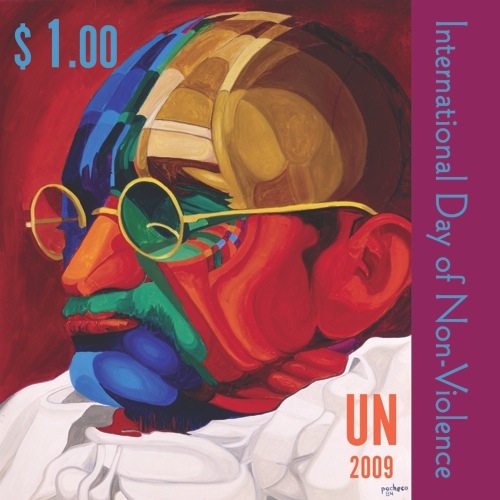
In 2009 the United Nations released a one-dollar postal stamp of Mohandas Gandhi to commemorate his 140th birth anniversary. The stamp was designed by Miami-based artist Ferdie Pacheco.
 
He wasn't a rich man. He never held formal political office. He wasn't a saint or divine figure. He was just a man. An attorney who had taken a vow of poverty and celibacy. His full name was Mohandas Karamchand Gandhi.   
 
Gandhi transformed himself into a principled strategic non-violent activist in South Africa at the end of the 19th century struggling against racist laws and policies of the colonial authorities. An important theoretical result of his South African campaign was the development of Satyagraha
 
Gandhi announced on September 11, 1906 in his newspaper Indian Opinion a contest to submit names to describe this movement. The final name was the fusion of two words as explained by Gandhi: “Truth (Satya) implies love, and firmness (agraha) engenders and therefore serves as a synonym for force…the Force which is born of Truth and love or nonviolence.”

He was the antithesis of Mao Zedong who took power and killed tens of millions to impose his political ideology on the Chinese. Marxist-Leninists view "truth" as something malleable and in the service of achieving power. 

Gandhi's explicit rejection of Marxist class struggle as hateful, his embrace of truth and love,
 and his critique that socialists and communists did nothing to solve problems are powerful:

The socialists and communists say, they can do nothing to bring about economic equality today. They will just carry on propaganda in its favor and to that end they believe in generating and accentuating hatred. They say, when they get control over the State, they will enforce equality. Under my plan the State will be there to carry out the will of the people, not to dictate to them or force them to do its will. I shall bring about economic equality through non-violence, by converting people to my point of view by harnessing the forces of love as against hatred. I will not wait till I have converted the whole society to my view but will straight away make a beginning with myself. It goes without saying that I cannot hope to bring about economic equality of my conception, if I am the owner of fifty motor-cars or even of ten bighas of land. For that I have to reduce myself to the level of the poorest of the poor.
Gandhi's description of the nature of a regime that sought to use violence to crush capitalism offers an excellent description of what has taken place in Marxist Leninist states that promised paradise but delivered the opposite:
It is my firm conviction that if the State suppressed capitalism by violence, it will be caught in the coils of violence itself, and will fail to develop non-violence at any time. The State represents violence in a concentrated and organized form. The individual has a soul, but as the State is a soulless machine, it can never be weaned from violence to which it owes its very existence. [...] It can be easily demonstrated that destruction of the capitalist must mean destruction in the end of the worker and as no human being is so bad as to be beyond redemption, no human being is so perfect as to warrant his destroying him whom he wrongly considers to be wholly evil.

This explains in large part the hostility from communists to Mohandas Gandhi's social political agenda, and many on the Left who share the Marxist belief in class struggle.

Gandhi's approach is reflected in what is considered his greatest act of nonviolence, the 1930 Salt March, in which he wrote two letters to his British adversary in India, Viceroy Lord Irwin, who he addressed as a friend in which he outlined both his grievances, and the act of civil disobedience he planned to carry out.

The contrast between those who advocate class struggle and those who advocate nonviolent resistance could not be more stark.


The heirs of Mao Zedong, who were inspired by his violent revolutionary tradition generated great suffering: Ernesto "Che"Guevara in Cuba,  the Khmer Rouge in Cambodia, the Black Panther Party in the United States and Shining Path guerillas in Peru are but just four of many bloody examples.

Contrast these with the heirs of Mohandas Gandhi, who were inspired by his non-violent resistance to injustice and the good they achieved:  Martin Luther King Jr. in the United StatesSteve Biko in South Africa, Abdul Ghaffar Khan in Pakistan, Oswaldo Payá Sardiñas in Cuba, Vaclav Havel in Czechoslovakia, Lech Walesa in Poland, and Corazon Aquino in the Philippines are but just seven of many inspirational examples.

Mohandas Gandhi changed political protests and empowered millions with Satyagraha and the use of strategic nonviolence to battle powerful and violent regimes and great injustices in an effective manner that frustrates those who want to preserve or change the status quo using violence.

Today, as we witness Cubans nonviolently defying the communist dictatorship in Cuba, the legacy of Gandhi continues to shake the foundations of tyrannies around the world.


Nonviolent resistance does not mean the absence of violence. It is a courageous decision to challenge the oppressors using nonviolent means. Telling the truth and resisting a violent adversary with nonviolent means is not without risk, but it has a greater chance of success than violent resistance. Oswaldo Payá spoke truth to power on July 20, 2012, denouncing the fraudulent change of the dictatorship and offering a vision of real change in Cuba.


"The Christian Liberation Movement (MCL) and the opposition do not kill, sabotage or exclude, everyone knows that. Our motto is Liberty and Life. We do not want power for ourselves; we want peace and civil rights for all, because where there are no rights there is no justice. We seek only the power of the people, popular sovereignty, as Martin Luther King did, remember? Power to the people!... We denounce institutionalized corruption. Those who have power declare us enemies and do not compete with the opposition but rather sentence it, stigmatize it and annihilate it." ... "The peaceful, logical and fair solution that can lead to change and genuine dialogue is to recognize these rights. Enough of reactionary justifications that say that the people are not ready, that they do not want change. Do you think that fifty-four years without freedom and without rights are not enough? Others say that the people do not want rights, what an insult! Others may say that many Cubans want this government. I do not believe it, but in any case no Cuban can decide what they want in this environment. With these laws and with this system, Cubans cannot choose who they want to govern them, what system to have. We demand rights for all, without hatred or offense, with justice. Everyone knows that not even the National People's Assembly can decide freely, it also receives orders. This will change only when they are elected by the people, only then will they obey the people. That is our demand. We continue to call on all Cubans, no matter how they think or where they come from, to be part of the solution and the changes. Only the people can do that. Why say no to our rights? Why elitism? Philosophies and theologies? What oppresses us is fear, intolerance and the determination of a group to maintain absolute power. Let us abandon pretense! Let us take the path of the people, which is the path of democracy."

This vision is still relevant today, and the price Payá had to pay for speaking the truth to power and acting accordingly cost him his life and Harold Cepero two days later, on July 22, 2012, when both were murdered by agents of the Cuban dictatorship. They were killed because with their truth telling and their non-violent resistance they threatened the continuity of the dictatorship.

Nonviolence and it's culture of life is a force more powerful, and it offers an alternative to war that threatens humanity's existence with its culture of death. 

Friday, April 18, 2025

Reflection On Nonviolence On Good Friday : Jesus’ Third Way

How to resist evil without doing evil.

And behold, one of those who accompanied Jesus put his hand to his sword, drew it, and struck the high priest's servant, cutting off his ear. Then Jesus said to him, "Put your sword back into its sheath, for all who take the sword will perish by the sword. Matthew 26.51-52


The essence of Jesus's teachings is found in his Sermon on the Mount, and it moved Mohandas Gandhi greatly, and he embraced it.

"I have not been able to see any difference between the Sermon on the Mount and the Bhagavadgita. What the Sermon describes in a graphic manner, the Bhagavadgita reduces to a scientific formula. It may not be a scientific book in the accepted sense of the term, but it has argued out the law of love — the law of abandon as I would call it — in a scientific manner. The Sermon on the Mount gives the same law in wonderful language.  ... Today supposing I was deprived of the Gita and forgot all its contents but had a copy of the Sermon, I should derive the same joy from it as I do from the Gila."

This video contains audio and text of the entire Sermon on the Mount.

Christians who believe in the message of Jesus of Nazareth demonstrate that belief in actual practice as did a group of Catholic Monks in Algeria in 1996 now made known to the world in the film Of Gods and Men.  

Others continue to do so today around the world. What better day than Good Friday to reflect on those who took up the cross and followed and continue to follow Jesus?

James Morris Lawson Jr.spent his entire life following Jesus until his death at age 95 in June 2024. He was a Methodist minister, and a nonviolence practitioner.

Reverend James Lawson, prepared students for nonviolent action at a Fellowship of Reconciliation workshop  over half a century ago where he revealed its fundamental Christian nature.

"When you are a child of God... you try thereby to imitate Jesus, in the midst of evil. Which means, if someone slaps you on the one cheek, you turn the other cheek, which is an act of resistance. It means that you do not only love your neighbor, but you recognize that even the enemy has a spark of God in them, has been made in the image of God and therefore needs to be treated as you, yourself, want to be treated Jesus is very clear about this: "do unto others as you want others to do unto you." — which is a rather powerful ethic for personal relationships, regardless of whether family or school or community or nation." 

The documentary "A Force More Powerful" is about non-violence, and its power to change the world over the past century. It is worth noticing that faith and belief played a major role in these movements that achieved positive and lasting change.

Reverend Lawson is featured in the documentary and has been called the "architect of the civil rights movement." The good Reverend observed that “if you want to understand King, you must look at Jesus.” The message of Jesus and the example of what he went through on Good Friday, and the manner in which he did it is a powerful study in nonviolence, of taking on suffering, while forgiving your enemies.

Holy Week is a good moment to reflect on the teachings of Jesus, and especially this passage from  Matthew 5.38-41.

"You have learnt how it was said: 'Eye for eye and tooth for tooth.' But I say to you, Offer the wicked man no resistance. If anyone strikes you on the right cheek, turn the other also; if a man takes you to law and would have your tunic, let him have your cloak as well. And if anyone orders you to go one mile, go two miles with him." Matthew 5.38-41

 Biblical scholar Walter Wink offers the following analysis, and looks to both history, and language to examine the third way offered by Jesus.

Thursday, January 30, 2025

On this day 77 years ago Mohandas Gandhi was assassinated: Today we initiate a Season of Nonviolence

"Terrorism and deception are weapons not of the strong but of the weak." - Mohandas K. Gandhi

"We are ruthless and ask no quarter from you. When our turn comes we shall not disguise our terrorism." - Karl Marx, Marx-Engels Gesamt-Ausgabe, vol. vi pp 503-5 (The final issue of Neue Rheinische Zeitung, 18 May 1849)


 “In politics you cannot follow nonviolence. You cannot follow honesty. Every moment you have to give
a lie. Every moment you have to take a bullet in hand and kill someone.” -  Gopal Godse,  co-conspirator in Gandhi's assassination, Time Magazine, February 2000.

Seventy seven years ago Mohandas Gandhi was shot three times in the chest and killed by Hindu nationalist Nathuram Godse at 5:17pm. Godse was part of a team of assassins that had tried 10 days earlier to bomb and kill Gandhi.

Mohandas K. Gandhi and his assassin Nathuram Godse.

Gandhi, despite his successful struggle for independence and the establishment of the largest democracy on the planet was felled, after repeated assassination attempts, gunned down as he went to worship. 

The assassins murdered the independence leader because they did not believe that India could survive with Gandhi promoting Satyagraha and a Muslim state next door. Gopal Godse, a co-conspirator and brother of the assassin Nathuram Godse, argued as late as February 2000 in a Time magazine interview that: “In politics you cannot follow nonviolence. You cannot follow honesty. Every moment you have to give a lie. Every moment you have to take a bullet in hand and kill someone.”

Indian leader Mahatma Gandhi lies in state at Birla House in New Delhi.
 

Communists view nationalists as a threat to their revolutionary project, and nationalists often have a critical view of Marxist-Leninists, but they both agreed in their hostility to Mohandas Gandhi. 


The nationalists were open and transparent about their evil intent, but the communists had more guile, and their reasons for rejecting him more complex. 
 
"The Class Essence of Gandhism" by S.M. Vakar critiques Gandhi


The Soviet press published an article written by S.M. Vakar in 1948 following Gandhi's assassination on January 30, 1948 titled "The Class Nature of the Gandhi Doctrine" subtitled "Gandhi as a Reactionary Utopian" in the Soviet philosophy journal Voprosy filosofii (Questions of Philosophy). The Marxist Leninist argument was outlined as follows:
Although Gandhi regarded the union and independence of the Indian peoples as his goal, his reactionary-Utopian social theory and the reformist methods of struggle connected with it caused his activity to fail in facilitating overthrow of the colonial yoke [...] The social essence of the Gandhi doctrine and its fundamentally reactionary role in the history of India's national liberation movement has hardly been treated in Marxist literature. Yet this doctrine still retards the development of class awareness among the Indian masses.
What was this social essence of Gandhian thought that so troubled the Marxist-Leninists in the Soviet Union? 
 
First, the "reformist methods" of struggle referred to in the above quote were means of nonviolent resistance and secondly his social theory rejected class struggle as another manifestation of destructive violence. 
 
On September 11, 1906 a new word came into existence that gave a more precise understanding of Gandhi's social theory and method of struggle which he described as follows.
'Satyagraha.' Truth (Satya) implies love, and firmness (agraha) engenders and therefore serves as a synonym for force. I thus began to call the Indian movement 'Satyagraha,' that is to say, the Force which is born of Truth and Love or non-violence, and gave up the use of the phrase 'passive resistance,' in connection with it, so much so that even in English writing we often avoided it and used instead the word 'Satyagraha' itself or some other equivalent English phrase.
The Marxist-Leninists embrace revolutionary violence and a movement led by a small vanguard of professional revolutionaries that carry out the changes by whatever means necessary and reject nonviolence as naive. They follow the doctrine of  Vladimir Lenin as presented in his 1902 revolutionary tract "What is to be done."  
 
This did not change once the Bolsheviks took power in 1917.
 

On October 2, 1920, the first leader of the Soviet Union, Vladimir Lenin, stated in a speech to Russian communist youth.

 "The class struggle is continuing and it is our task to subordinate all interests to that struggle. Our communist morality is also subordinated to that task. We say: morality is what serves to destroy the old exploiting society and to unite all the working people around the proletariat, which is building up a new, communist society."
According to Lenin, "To speak the truth is a petite-bourgeois habit. To lie, on the contrary, is often justified by the lie's aim."
 
This doctrine embraces both the lie and hatred of the class enemy as necessities to achieve revolution. Gandhian Satyagraha is its philosophical anti-thesis.

Over a century has passed since both sets of ideas have been set out and applied around the world. An analysis done by Maria J. Stephen and Erica Chenoweth systematically explores the strategic effectiveness of both violent and nonviolent campaigns using data on 323 campaigns carried out between 1900 and 2006.[1] Their findings demonstrate that major non-violent campaigns were successful 53% of the time versus only 26% for major violent campaigns and terrorist campaigns had a dismal 7% success rate.

Today, India with all its flaws is the world's largest democracy with a growing economy that presents new competitive challenges to the developed world and Communism has amassed a body count of 100 million dead and counting. It would appear that Gandhi's criticisms of the communists were prescient:
"The socialists and communists say, they can do nothing to bring about economic equality today. They will just carry on propaganda in its favor and to that end they believe in generating and accentuating hatred. They say, when they get control over the State, they will enforce equality. Under my plan the State will be there to carry out the will of the people, not to dictate to them or force them to do its will." - Mohandas Gandhi

"It is my firm conviction that if the State suppressed capitalism by violence, it will be caught in the coils of violence itself, and will fail to develop non-violence at any time. The State represents violence in a concentrated and organized form. The individual has a soul, but as the State is a soulless machine, it can never be weaned from violence to which it owes its very existence." - Mohandas Gandhi

It is Satyagraha that is relevant today in 2025 and offers an alternative to the conflagrations suffered in the past century and the wars that plague the world now. 

Gandhi's Satyagraha is a call to principled non-violence but even pragmatists and realists looking over the historical record cannot fail to be influenced by the fact that non-violent civic resistance works and offers a better chance of a better life for more people.

Others have embraced nonviolence based in adherence to the truth. They have achieved much, but in too many cases paid with their lives.

Like Gandhi, they also rejected communist ideology. 


One was a Southern Baptist minister who transformed the United States, but did not live to see his 40th birthday. He was assassinated by a white racist in 1968. A radical critique of American society was held by Reverend Martin Luther King Jr. He consistently pushed for reforms to end segregation and guarantee African Americans' right to vote through democratic norms and nonviolent action, and he urged the United States to live up to its own aspirational ideals

The best way to characterize Reverend King's political philosophy is as belonging to what is known as Christian democracy. This political school is centered on a Christian understanding of humanity, where "every individual is considered unique and must be treated with dignity." It includes both center-left and center-right parties. 

Reverend Martin Luther King Jr. sought to end racial segregation in the United States, and build the beloved community. However, he rejected communism as the means to achieve it.

"Since for the Communist there is no divine government, no absolute moral order, there are no fixed, immutable principles; consequently almost anything—force, violence, murder, lying—is a justifiable means to the “millennial” end.5 This type of relativism was abhorrent to me." - Martin Luther King Jr. Stride to Freedom (1958)

 "Constructive ends can never give absolute moral justification to destructive means, because in the final analysis the end is pre-existent in the mean."  - Martin Luther King Jr. Stride to Freedom (1958)

Another was an engineer, and a Catholic layman who founded the Christian Liberation Movement, and nonviolently changed Cuba, but did no live to see his 61st birthday. He was assassinated by Cuban government agents, together with his movement's youth leader Harold Cepero in 2012.


Oswaldo Payá Sardiñas presented a radical critique of the communist dictatorship, and sought nonviolent means within the existing system to achieve a transition to democracy in Cuba based in the rule of law. In the two years prior to his untimely death, Oswaldo worked on the book "The Night is Not Eternal" in which he gave an assessment of the fraudulent change of the Cuban dictatorship that, while recognizing class differences, rejected class hatred.

"Let us remember that the Revolution here was made in the name of the poor, but after using them to suppress the rich and leave everyone who had something with nothing, the right of expression was taken away from everyone and from the poor themselves, who long ago lost their voice and cannot even say that they are poor. In this current situation of inequality sustained by oppression, if these changes are implemented, inequality will only deepen. We have always said this without class hatred or hatred of any kind, but everything indicates that this re-conversion of privilege is not implemented in a transition but in an inheritance in which the oligarchy leaves its successors with other styles and other content of inequality."

In 2002, when Oswaldo received the European Union's Sakharov Prize, and addressed the EU parliament in Brussels he spoke of the dangers of globalization, in terms that both Gandhi, and King would have appreciated and shared.
"The talk today is of globalization, but we must state that unless there is global solidarity, not only human rights but also the right to remain human will be jeopardized. If there is no solidarity between people we will be unable to preserve a fair world in which it is possible to continue living as human beings." 
The critique made by Payá, King and Gandhi is against a "thing-oriented" society or a government as a "soulless machine" that looks to the person or the individual as an "economic automaton", or " the masses" that constitute an economic class because either is a dystopian system. They argue that the focus should be on the human person and policies that recognize and respect the uniqueness of each human being and their fundamental dignity.
 
Let us initiate a season of nonviolence, and examine these and other nonviolent thinkers, and exemplars, on January 30th, following up on April 4th, and July 22nd to coincide with the death anniversaries of these three nonviolent icons.
 
We are living in times where their example is more needed than ever to inspire truth and firmness in defiance of evil practices.

Monday, January 20, 2025

Martin Luther King Jr.'s Radical Anticommunism: Selected quotes on Communism (1956 - 1967)

"The socialists and communists say, they can do nothing to bring about economic equality today. They will just carry on propaganda in its favor and to that end they believe in generating and accentuating hatred." - Mohandas Gandhi, Gandhi's interview with Nirmal Kumar Bose, November 9 - 10, 1934

Photo of a drawing at the King Center in Atlanta, GA. Matt Lemmon 2008

Today, over social media, the debates and exchanges with different sides attempting to claim Martin Luther King Jr. as their own. Yet, when he died on April 4, 1968 he was being targeted by all sides. Today, as in 1968, the words communist and socialist get thrown around a lot.

However, the truth is more complicated. The Reverend Martin Luther King Jr. drew inspiration from the nonviolent Indian nationalist leader Mohandas Gandhi. Gandhi, although a Hindu and not a Christian, drew inspiration from the Sermon on the Mount. Reverend King traveled to India in 1959, and at the airport he told a group of reporters:“To other countries I may go as a tourist, but to India I come as a pilgrim.”

Both Gandhi and King were radical critics of communism.   

Martin Luther King, Jr. beside a picture of Gandhi. © Bob Fitch.

Many are aware of Reverend King's radical criticisms of Capitalism, but how many remember his radical criticisms of Communism?  Radical is defined here as going to the roots. Below are some of the key statements made by Reverend King on communism over the decade he was most politically active. 

"You cannot solve the problem by turning to communism, for communism is based on an ethical relativism and a metaphysical materialism that no Christian can accept. You can work within the framework of democracy to bring about a better distribution of wealth." - Martin Luther King Jr. Paul's Letter to American Christians (1956)

"Communism, avowedly secularistic and materialistic, has no place for God.4 This I could never accept, for as a Christian I believe that there is a creative personal power in this universe who is the ground and essence of all reality—a power that cannot be explained in materialistic terms. History is ultimately guided by spirit, not matter." - Martin Luther King Jr. Stride to Freedom (1958)

"Since for the Communist there is no divine government, no absolute moral order, there are no fixed, immutable principles; consequently almost anything—force, violence, murder, lying—is a justifiable means to the “millennial” end.5 This type of relativism was abhorrent to me." - Martin Luther King Jr. Stride to Freedom (1958)
 "Constructive ends can never give absolute moral justification to destructive means, because in the final analysis the end is pre-existent in the mean."  - Martin Luther King Jr. Stride to Freedom (1958)
"In communism the individual ends up in subjection to the state. True, the Marxist would argue that the state is an “interim” reality which is to be eliminated when the classless society emerges; but the state is the end while it lasts, and man only a means to that end. And if any man’s so-called rights or liberties stand in the way of that end, they are simply swept aside."  - Martin Luther King Jr. Stride to Freedom (1958)

"His liberties of expression, his freedom to vote, his freedom to listen to what news he likes or to choose his books are all restricted. Man becomes hardly more, in communism, than a depersonalized cog in the turning wheel of the state." - Martin Luther King Jr. Stride to Freedom (1958)

"Man is not made for the state; the state is made for man. To deprive man of freedom is to relegate him to the status of a thing, rather than elevate him to the status of a person. Man must never be treated as a means to the end of the state, but always as an end within himself." - Martin Luther King Jr. Stride to Freedom (1958)

"Listen to Lenin as he says 'Lying, deceit, violence, concealing and withholding the truth are all justifiable means to bring about the end of the classless society.'  This is the great weakness and tragedy of communism and any other system that argues that the end justifies the means, for in a real sense, the end is pre-existent in the means; the means represent the ideal in the making, and the end in process. In the long run of history, immoral means cannot bring about moral ends. Destructive means cannot bring about constructive goals." - Martin Luther King Jr. Address to Cornell College, Mount Vernon, Iowa (1962)
“If today I lived in a Communist country where certain principles dear to the Christian faith are suppressed, I would openly advocate disobeying that country's antireligious laws.” - MLK Jr., Letter from a Birmingham Jail (1963)
"This is the faith I commend to you Christians here in Berlin. A living, active, massive faith that affirms the victory of Jesus Christ over the world, whether it be an Eastern world or a Western world." - Martin Luther King Jr. East or West – God’s Children (1964)
 "There is nothing to keep us from molding a recalcitrant status quo with bruised hands until we have fashioned it into a brotherhood.  This kind of positive revolution of values is our best defense against communism." - Martin Luther King Jr. Beyond Vietnam (1967)
"We must not engage in a negative anticommunism, but rather in a positive thrust for democracy [applause], realizing that our greatest defense against communism is to take offensive action in behalf of justice." - Martin Luther King Jr. Beyond Vietnam (1967)

"We must with positive action seek to remove those conditions of poverty, insecurity, and injustice, which are the fertile soil in which the seed of communism grows and develops." - Martin Luther King Jr. Beyond Vietnam (1967)

"As I have walked among the desperate, rejected and angry young men I have told them that Molotov cocktails and rifles would not solve their problems."- Martin Luther King Jr. Beyond Vietnam: A Time to Break Silence (1967) 

 Martin Luther King Jr had a radical critique of American society. He repeatedly challenged the United States to live up to its own aspired ideals and sought through nonviolent action and democratic norms, reforms to end segregation and ensure voting rights for African AmericansReverend King's political outlook could best be described as falling within what is called Christian Democracy. This political school occupies the center with parties on the center left and the center right, but like Reverend King are based on a Christian view of humanity in which "every individual is considered unique and must be treated with dignity."

Mohandas Gandhi, who greatly influenced King, also spoke of social responsibility and trusteeship. He also warned that the state was a "soulless machine" that did not look out for the poor. Gandhi, a self-described socialist, was not an enthusiastic proponent of an expanded social-welfare state. Reverend King spoke of social democracy with an emphasis on democracy, but he also spoke of the need to shift "from a thing-oriented society to a person-oriented society."

The critique made by both King and Gandhi of a "thing-oriented" society or the state as a "soulless machine" looks to the person or the individual not an economic mechanism  or economic class.  The focus is on the human person and polices that recognize and respect the uniqueness of each human being and their dignity.

The Konrad Adenauer Foundation in their publication Christian Democracy: Principles and Policy Making offers a vision of this made reality in what is known as the social market economy.  This is a departure from a strict market economy, focused on individuals as economic units and one that is arrived at through a process of reforms, not revolution.

Many know of the FBI wiretapping Martin Luther King Jr., monitoring of the Civil Rights Movement, and active measures against the civil rights leader but fewer know of the campaign waged against him by Soviet intelligence, also known as the KGB. The reality is that he challenged both systems.

This was a challenge to the existing order of both the United States and the Soviet Union, but one that rejected communism, violent class struggle, and that was rooted in the Christian tradition. 

Perhaps, this is what scared so many powerful people.

Why do you think both the FBI and the KGB targeted Martin Luther King Jr.? 

Agree or disagree, please leave a comment below.