Showing posts with label Captive Nations Week. Show all posts

Tuesday, July 19, 2022

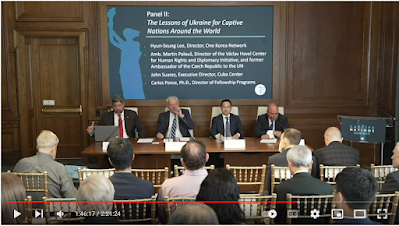
Five lessons from Ukraine for the captive nation of Cuba.

Right now the destiny of our country is being decided. The destiny of our people, whether Ukrainians will be free, whether they will be able to preserve their democracy. -  Volodymyr Oleksandrovych Zelenskyy Address to the US Congress (16 March 2022)
Cubans and Ukrainians suffered under communist regimes. In Cuba today, a Marxist-Leninist dictatorship continues in power. Last year on July 11th, tens of thousands of Cubans took to the streets demanding freedom, and were met with deadly repression across the country. The aftermath? Political show trials, militarized streets, new censorship laws, and hundreds of new political prisoners. Despite this, sporadic protests continue.

It is also important to mention that in three days we will be observing the day 10 years ago when Oswaldo Payá Sardiñas and Harold Cepero Escalante were murdered by the secret police in Cuba. You can learn about Oswaldo in this building at the Museum of the Victims of Communism.  

I want to review some lessons from what has happened in Ukraine, and not just over the past few months, but over the longer term.

Lesson #1 Appeasement encourages more aggression

On January 16, 2022, in an OpEd co-authored by myself and Frank Calzon titled " Flashback to 1962, but Vladimir Putin is no Nikita Khrushchev, Joe Biden is no John F. Kennedy," in which we called on the Western world not to wait for an invasion, but to apply tough sanctions to avoid war. We return to an earlier lesson given by Winston Churchill following the Munich Agreement, when Western democracies believed they had achieved peace by giving Hitler parts of Czechoslovakia.
 
Abandoning Ukraine in the short term may appear to guarantee peace, but the words of Winston Churchill following the 1938 Munich betrayal should give today’s policymakers pause; "You were given the choice between war and dishonour. You chose dishonour, and you will have war. "

Lesson #2 Words must be backed by actions.

"People don't really believe in words. Or rather, people believe in words only for a stretch of time. Then they start to look for action." - Volodymyr Zelensky (2020 on joining the EU).

President Volodymyr Zelensky

President Zelensky's observation, made in 2020 with reference to Ukraine's relations with the European Union, applies today with Western promises of support for Kiev following Russia's invasion of Ukraine.

Prior to the 2014 Russian seizure of Crimea, Ukraine did believe in words from the West.

When negotiations between Ukraine and Russia broke down on removing nuclear weapons from Ukraine in September 1993, Washington engaged in a trilateral process with Ukraine and Russia. Yes, Ukraine had nuclear weapons in the 1990s. This resulted in the January 1994 Trilateral Statement. Ukraine agreed to transfer its nuclear warheads to Russia. In exchange, Ukraine received security assurances from the United States, Russia, and the United Kingdom.

The failure of the West to restrain Russia from invading Ukraine in 2014 and expanding the war of conquest in 2022 gives a lesson to captive nations and others that giving up nuclear weapons in exchange for security guarantees is a foolish bargain. Putin's war in Ukraine is a blow against nuclear disarmament.

By 2019, with regards to Russia and the West, President Zelensky observed in a Time interview: " I don’t trust anyone at all." 

Many Cubans understand that statements condemning the actions of the Cuban dictatorship after July 11th without specific actions by the international community to hold the regime accountable will not end the ongoing repression by the dictatorship in the same manner that Vladimir Putin's aggression was not met with strong resolve, and stopped.

The Christian Liberation Movement, Oswaldo Payá's movement that still exists in Cuba, offered an eleven point action plan to the international community to isolate the Cuban dictatorship, but the international community has failed to take action and the Cuban regime continues to go forward with its repressive practices.

Lesson #3 We must not confuse the dictatorship with the people.

I know that they [the Russian state] won’t show my address on Russian TV, but Russian people have to see it. They need to know the truth, and the truth is that it is time to stop now, before it is too late. And if the Russian leaders don’t want to sit with us behind the table for the sake of peace, maybe they will sit behind the table with you. Do Russians want the war? I would like to know the answer. But the answer depends only on you, citizens of the Russian Federation.” - President Zelensky, February 23, 2022

Ukraine also provides an important lesson in distinguishing between the Cuban dictatorship and the Cuban people.

Ukraine's deputy foreign minister, Emine Dzheppar

Ukraine's deputy foreign minister, Emine Dzheppar, on February 27, 2022,  tweeted: "The MFA of Ukraine in a diplomatic note expresses its strong protest against the statements of the Government of Cuba in support of Russia's aggression against Ukraine and calls on Cuba to urge Russia to put an end to this aggression."

Free Cubans in Cuba, in contrast, were, and are, demonstrating their solidarity with Ukraine, criticizing the Castro regime's support for Putin's actions, leading to arrest by the political police.

Many Cubans rejected (and continue to reject) the war on social media and in messages to the Ukrainian Embassy in Havana. The volume of the calls was so "extraordinary," the Ukrainian embassy in Havana said, that it asked Cubans to send their messages of support to a dedicated email address to clear the phone lines.

Cuban activist Pablo Enrique Delgado Hernández on Saturday, February 26, 2022 went to the Ukrainian Embassy in Havana to demonstrate his solidarity. Pablo Enrique after meeting with a Ukrainian diplomat and presenting her flowers was arrested by the National Revolutionary Police and taken to the Seventh Unit police headquarters and interrogated.

 Lesson #4 Importance of disobedience

“Liberation from dictatorships ultimately depends on the people's ability to liberate themselves.”
Gene Sharp, a nonviolent scholar made that observation in his work From Dictatorship to Democracy

Resistance to tyrants, defined by a total refusal to obey them, is key to achieving a democratic transition or the end of a foreign occupation.
 
This sounds like a simple answer, and this is where I will close with the fifth lesson.

Lesson #5 There are simple answers, but no easy answers.

"There are no easy answers, but there are simple answers. We must have the courage to do what we know is morally right." - Ronald Reagan


Monday, July 18, 2016

President Obama's Proclamation for Captive Nations Week (2016)

Today the White House issued the following proclamation for Captive Nations Week. What is amazing is that the proclamation makes no mention of the scourge of communism which continues to oppress over one in five human beings in the world. Thankfully the Victims of Communism Foundation is observing Captive Nations Week and identifying the continuing evils of communism.


Presidential Proclamation -- Captive Nations Week, 2016

CAPTIVE NATIONS WEEK, 2016
- - - - - - -
BY THE PRESIDENT OF THE UNITED STATES OF AMERICA
A PROCLAMATION

Since our earliest days, the United States has worked to uphold the rights enshrined in our founding documents. The ideals that sparked our revolution find their truest expression in democracy, and our enduring belief in the right to self-govern is not limited to our borders -- we believe the human impulse toward freedom is universal. During Captive Nations Week, we recognize the inherent dignity of all people, and we renew our support for those struggling under oppressive regimes and striving to secure the blessings of liberty for themselves and their posterity.

After World War II, America joined with other nations to remake the world -- to rebuild, to forge a new international order, and to advance a more just and lasting peace. And following a decades-long Cold War, with strength and resolve and the power of our ideals, we rejoiced as an Iron Curtain was brought down and a new beginning was set in motion. But although more people live in democracies today -- and despite the fact that we are witness to the most peaceful and prosperous era in human history -- such progress is not inevitable, and dangerous forces threaten to pull the world backward.

We must bolster our commitment to upholding freedom and democracy wherever they are jeopardized. That means ensuring the people of Ukraine have the right to choose their own destiny and ensure their independence; it means helping the millions of those displaced from Syria seek a better and safer future, while continuing our efforts to bring an end to this brutal conflict and destroy ISIL. It also means discussing our differences with nations more directly. And we have opened a new chapter in our relationship with Cuba, which includes direct engagement with their government on human rights and steps to empower and create opportunity for the Cuban people.

Around the world, a new generation of young people -- connected by technology and driven by idealism and a willingness to stand up for their beliefs -- is calling for more accountability in government. As heirs to a struggle for freedom that has long defined our character, Americans must lead by example and chart new paths to liberty and opportunity. We will continue to stand for equality and dignity beyond our borders and encourage economic and political reforms that foster democracy. And we remain dedicated to leading and working with others to build security, prosperity, and justice, and to fighting for any person still suffering under the grasp of tyranny.

This week, let us rededicate ourselves to broadening democracy's reach and promoting its true pillars -- the rule of law, fair elections, a free press, and a vibrant civil society. As we work to lift up the lives of those whose governments still rule by fear and intimidation, let us stay vigilant in defense of democratic values and the ideals that keep us free.

The Congress, by joint resolution approved July 17, 1959 (73 Stat. 212), has authorized and requested the President to issue a proclamation designating the third week of July of each year as "Captive Nations Week."

NOW, THEREFORE, I, BARACK OBAMA, President of the United States of America, do hereby proclaim July 17 through July 23, 2016, as Captive Nations Week. I call upon the people of the United States to reaffirm our deep ties to all governments and people committed to freedom, dignity, and opportunity for all.

IN WITNESS WHEREOF, I have hereunto set my hand this eighteenth day of July, in the year of our Lord two thousand sixteen, and of the Independence of the United States of America the two hundred and forty-first.

BARACK OBAMA

Captive Nations Week and the 4 Ingredients for Real Freedom

Captive Nations Week is the third week of July


In 1959 President Dwight D. Eisenhower signed Public Law 86-90 which compels every President of the United States to proclaim the third week of July of each year as Captive Nations Week in commemoration of the "captive nations" (those still with Communist governments). In 2016 there are five openly communist dictatorships in the world: China, Cuba, Laos, North Korea, and Vietnam.


Due to the normalization of diplomatic relations last year with the Communist regime in Cuba and the official visit by President Obama and his family earlier this year that Captive Nations Week will focus this year on Cuba and the continuing need for freedom. The Victims of Communism Foundation outlines with a cool presentation titled "Cuba Libre?" what are the four ingredients of a real free Cuba.


 More often than not the words “Cuba Libre” bring to mind that combination of good quality rum, Coke, and lime that refreshes in an almost medicinal way, especially on a hot and humid summer day. When we at VOC hear “Cuba Libre,” however, our thoughts turn to the Cuban people and their dreams of freedom, peace, and prosperity. A real “Cuba Libre” requires four crucial ingredients.

First, the rule of law. The communist dictatorship of the Castros is capricious, with Cubans (such as the Ladies in White and street artist El Sexto) subject to repeated and arbitrary detention. Furthermore, Cuban courts are subordinated to the executive and legislative branches (i.e., to Castro and the Communist Party), thereby denying them independence. The only rule in Cuba is that there is no rule beyond the will of Raúl. It is truly the rule of man over men.

What is desperately needed in Cuba is the rule of men under law. In other words, Cuba requires a government that is administered according to a publicly declared set of rules applied in an equal manner to all people regardless of the will of those making the decisions. One of the surest safeguards of the rule of law is an independent judiciary where the decisions of the courts in the particular cases before them are binding upon the executive and legislative branches.

Second, democratic self-governance. The Cuban regime represents not the interests of the Cuban people, but rather those of the Cuban Communist Party, and of its leader Raúl Castro in particular. One need only look at the example of Sirley Ávila León, a rural Cuban farmer turned community activist, to see this truth. Between 2005 to 2013, she was elected three times by her community as an unpaid delegate to an official legislative body. When she tried to fulfil the representative role she supposedly held and protest the lack of adequate schools in her district, eventually sharing her story on Radio Martí, she was labeled a mercenary, setting off a string of harassment and severe vandalism that culminated in May 2015 when she was brutally attacked with a machete.

One of the causes of the American Revolution was the denial of the right to petition the government for the redress of grievances, the right to ask the government to act in the interests of those whose persons and property it exists to protect. As Ms. Ávila’s example shows, Cubans enjoy no such right. They are punished simply for asking that the state fulfill its most basic duties. Until the Cuban people have a say in how they are governed, their interests will continue to count for nothing.

Third, free speech. Not only are Cubans prevented from speaking up to ask the Castro regime to improve their lives, but they are prohibited from speaking openly about matters of public interest at all. Dissidents are detained, arrested, or placed under house arrest before and during major meetings, like the Community of Latin American and Caribbean States (CELAC) summit in January 2014. Private media ownership is prohibited. Plays are subject to regime approval before they can be performed, and some, like “The King is Dying,” by Juan Carlos Cremata, are banned.
Without free speech, the intellectual, cultural, and political life of the Cuban people will remain constrained. A robust civic spirit and an empowered citizenry require a public sphere where individuals can come together to clearly identify and openly discuss the most pressing issues of the day. Free speech is foundational to a genuinely representative government, as the limits enforced upon speech will always favor the interests of those who enforce the limits.

Fourth, free enterprise. The Cuban economy is centrally planned and dominated by state owned enterprises. Moreover, the most significant of these enterprises are under the control of the Cuban regime’s security apparatus and thus report directly to Raúl Castro. Any investment in Cuba requires government approval, and typically requires that the investor partner with the state. The government controls prices and allocates food rations to the people. Moreover, as Julio Shiling notes, “The regime has enormous businesses outside the territory of Cuba which have siphoned money away from the Cuban people.”

A system of free enterprise unleashes the creative potential of individuals. These individuals come together voluntarily to cooperate to meet the needs and wants of their fellows. Unlike a planned economy—where associations are compulsory and coercive and the kind, quality, and quantity of products and services produced are decided upon by those with political power—a system of free enterprise responds to human beings. Rather than shaping them, it is shaped by them.
Taken together, these four elements are the necessary ingredients to for a real Cuba Libre. It is our hope that, Cuba Libre raised in hand, we will one day soon toast Cuba’s freedom.
In Washington D.C.at the Heritage Foundation on July 13th the Victims of Communism Memorial Foundation held the 2016 National Captive Nations Week Luncheon with Lee Edwards, Marion Smith and Michael Ryan presiding over the event. In addition country reports were made of the five remaining communist regimes in the world: China, Cuba, Laos, North Korea, Vietnam.  


On Tuesday, July 19, 2016 from 6:30 PM at The Landmark Theater E Street - 555 11th St NW , Washington, DC will premiere the documentary HAVANA MOTOR CLUB  whose subject matter is Cuba's vibrant community of underground drag racers and their quest to hold Cuba's first official car race since they being outlawed by the Castro Regime in the early days of the revolution in Cuba.

After the premiere of the documentary the Victims of Communism Foundation is also delighted to be premiering their third addition to the Witness Project series. This 5 minute short features Sirley Ávila León, a courageous champion of human rights who was brutally attacked in her native Cuba and lived to not only tell her story but continue her fight for freedom on behalf of Cubans.

Get your tickets here while they are still available. Seats are limited.
