Showing posts with label Vietnam. Show all posts

Tuesday, April 3, 2018

Reverend Martin Luther King Jr.'s radicalism and his rejection of revolutionary violence

50 years later


"All criticism is not intolerance. I have criticized the revolutionary because I have felt for him. He has the same right to hold me to be in error as I believe him to be in error." - Mohandas Gandhi 2/12/1925

"As I have walked among the desperate, rejected and angry young men I have told them that Molotov cocktails and rifles would not solve their problems." - Reverend Martin Luther King Jr., Beyond Vietnam: A Time to Break Silence (1967) 


Reverend Martin Luther King Jr. was assassinated fifty years ago on April 4, 1968 by a racist white southerner who hated African Americans. Mohandas Gandhi was assassinated seventy years ago on January 30, 1948 by a Hindu nationalist driven by hatred, who rejected the Indian non-violent leaders teachings.  In both the assassinations of Gandhi and of King there is evidence of a conspiracy by several actors.  

Martin Luther King Jr. had a radical critique of American society, but despite his own claims at times, was not a revolutionary. He repeatedly challenged the United States to live up to its own aspired ideals and sought through nonviolent action and democratic norms, reforms to end segregation and ensure voting rights for African AmericansReverend King's political outlook could best be described as falling within what is called Christian Democracy. This political school occupies the center with parties on the center left and the center right, but like Reverend King are based on a Christian view of humanity in which "every individual is considered unique and must be treated with dignity."  In his April 4, 1967 speech, Beyond Vietnam gave full expression to this outlook:
"We must rapidly begin the shift from a thing-oriented society to a person-oriented society. When machines and computers, profit motives and property rights are considered more important than people, the giant triplets of racism, militarism and economic exploitation are incapable of being conquered. A true revolution of values will soon cause us to question the fairness and justice of many of our past and present policies. On the one hand we are called to play the Good Samaritan on life’s roadside, but that will be only an initial act. One day we must come to see that the whole Jericho Road must be transformed so that men and women will not be constantly beaten and robbed as they make their journey on life’s highway. True compassion is more than flinging a coin to a beggar. It comes to see than an edifice which produces beggars needs restructuring. "
Mohandas Gandhi, who greatly influenced King, also spoke of social responsibility and trusteeship. Gandhi, a self-described socialist, was not an enthusiastic proponent of an expanded social-welfare state as commonly understood arguing
"The State represents violence in a concentrated and organized form. The individual has a soul, but as the State is a soulless machine, it can never be weaned from violence to which it owes its very existence. Hence I prefer the doctrine of trusteeship. [...] What I would personally prefer would be not centralization of power in the hands of the State, but an extension of the sense of trusteeship, as, in my opinion, the violence of private ownership is less injurious than the violence of the State. However, if it is unavoidable, I would support a minimum of State-ownership."
Furthermore the critique made by both King and Gandhi of a "thing-oriented" society or the state as a "soulless machine" looks to the person or the individual not an economic mechanism  or economic class. The focus is on the human person and polices that recognize and respect the uniqueness of each human being and their dignity. The Konrad Adeneur Foundation in their publication Christian Democracy: Principles and Policy Making offers a vision of this made reality in what is known as the social market economy.
"[T]he principle of  solidarity  is first and foremost an  aspect of human behaviour that arises from the idea of a common humanity and altruism. The idea of solidarity obliges the strong to stand up for the weak. Solidarity comes to play in a social market economy in situations where individuals are temporarily unable  to participate in the workforce.  this may apply, in  particular, to those who are sick, pregnant woman,  the old and the unemployed.  In order to do justice to its socio-political responsibilities – while also meeting other responsibilities of the state including the  guaranteeing of internal and external security, the  provision of education, and the development of infrastructure – the state imposes taxes on its citizens  along with other social contributions dependent upon  the individual’s wage or other sources of income."
This is a departure from a strict market economy, focused on individuals as economic units and one that is arrived at through a process of reforms, not revolution.

This is in stark contrast to what actual revolutionaries in the United States were saying and doing at the same time as King organized in the 1960s and in India were saying and doing in the 1940s as Gandhi continued the nonviolent push for independence. Seeking to harness hatred to violently overthrow the existing power structure through the use of armed violence and embracing totalitarian ideologies.

Hindu nationalist leader Subhash Chandra Bose allied with Nazis against British
Subhash Chandra Bose who was born in 1897 was an Indian nationalist leader who rejected Gandhi's nonviolent approach. He advocated an armed struggle against British imperialism, and allied with Nazi, Germany and Imperial Japan in 1941 to mobilize 60,000 Indian troops to fight against the British in India. The nationalist leader met with Hitler and other high ranking Nazis in Germany between 1941 and 1943. Chandra Bose exalted violence and bloodshed: "India is calling. Blood is calling to blood. Get up, we have no time to lose. Take up your arms! we shall carve our way through the enemy's ranks, or if God wills, we shall die a martyr's death. And in our last sleep we shall kiss the road that will bring our Army to Delhi." The defeat of the Axis powers meant that this violent approach failed and Gandhi's steadfast nonviolent posture made independence possible in 1948.

Stokely Carmichael with Che Guevara banner in the background
In the case of the United States, Stokely Carmichael who had derisively called the 1963 March on Washington, a "middle class picnic" emerged from the Civil Rights movement and rejected King's nonviolent approach. It is worth reviewing his evolution from an activist to a revolutionary.

Stokely Carmichael, born in 1941, attended the select Bronx High School of Science in New York City in the later 1950s, became friends with the son of Communist Party leader Eugene Dennis and became active in socialist youth politics. Carmichael joined a Marxist discussion group and participated in demonstrations against the House Committee on Un-American Activities that focused on communist subversion in the United States.

Carmichael joined the emerging Civil Rights movement led by the Reverend Martin Luther King Jr., who advocated nonviolent resistance as a method to achieve profound change. Carmichael enrolled in Howard University and joined "the school's Non-Violent Action Group, a civil-rights organization. In 1961 he participated in a number of anti-segregation initiatives in the Deep South, including "freedom rides" organized by the Congress of Racial Equality (CORE). Carmichael graduated from Howard University in 1964, with a degree in philosophy. Two years later he replaced John Lewis as head of the Student Nonviolent Coordinating Committee (SNCC).

In 1967 Carmichael was interviewed by Mario Menendez, editor of Sucesos, a Mexican magazine, while he was staying in Havana, Cuba attending the Organization of Latin American Solidarity (OLAS), a communist alternative to the Organization of American States (OAS) and made claims about the SNCC that others would reject:

  "Now, we used the word nonviolent because at that time the central figure in the struggle to defend the black race was no one less than Martin Luther King and anyone who resorted to violence was considered a traitor. Consequently we resolved to use the word nonviolent. However we knew that our struggle would end up in violence, that it was only necessary to wait for the right time. So we accepted this name for the grouping and coordinated activities from city to city, wherever we could engage in nonviolent demonstrations."
Stokely Carmichael told an audience in Havana in 1967: ''We are moving toward guerrilla warfare in the United States. We are going to develop urban guerrilla warfare and we are going to beat them in this field because there is one thing the imperialists do not have: their men don't want to fight, they don't want to fight what they call guerilla warfare, which is really hand-to-hand combat." 

During his tenure as SNCC chairman, Carmichael urged African Americans to engage in urban guerrilla warfare against the United States. He stepped down from the position of chairman in May of 1967. Carmichael went on to have a leadership position in the Black Panthers. He believed that, "[u]rban guerrilla warfare is the only means by which we can win in the United States because they cannot use bombs against us, since we are inside the country. They will have to fight us in hand-to-hand combat and we will defeat them." 

On February 17, 1968 H. Rap Brown and Stokely Carmichael addressed the Oakland Auditorium. Carmichael made the case for armed insurrection  stating that, "We have to recognize the major enemy is the honky and his institutions of racism." ... "Whenever anyone prepares for revolutionary warfare you concentrate on the major enemy." ... "We will not fight each other. There will be no fights in the black community among black people. There will just be people who will be offed." ... "We must first develop an undying love for our people ... an undying love as is personified in brother Huey P. Newton ... If we do not do that, we will be wiped out."

One day after the assassination of Martin Luther King Jr. Stokely Carmichael repeated his call for an armed uprising to overthrow the government of the United States. Below are excerpts of the press conference where he spoke out.
 

Diane Nash, a great pioneer of nonviolence from the sit-ins to the Selma march, rejected nonviolence and took up with the call of Black Power. Nash described her reasoning:
"If we've done all this through nonviolence, think what we could do if we were just willing to be urban guerrillas and knock over a few banks. [...] "Of course, ten years later I looked up and I hadn't knocked over any banks and I hadn't been a guerilla. I hadn't even been to the rifle range. But I had withdrawn from this painful, creative engagement with nonviolence and democracy behind a big smokescreen of noise."
In addition to deactivating serious activists the lure of violence and urban guerrilla warfare would exact a terrible cost.  

KGB carried out active measures campaign against Martin Luther King Jr.
No one controlled Martin Luther King Jr. and it bothered many 
Reverend King's nonviolent posture was not convenient for those who wanted bloody chaos and violence in the United States.

The world has been made well aware of the FBI’s wiretapping of Martin Luther King Jr. on the orders of then Attorney General Robert F. Kennedy Jr. and monitoring of the Civil Rights Movement, but what was only learned decades later was that a campaign had been waged against Martin Luther King Jr. by the Soviet Intelligence agency known as the KGB.

In 1992 a high ranking Russian intelligence officer defected to the United Kingdom and brought with him notes and transcripts compiled over the previous thirty years as he moved entire foreign intelligence archives to a new headquarters just outside of Moscow. The Russian intelligence officer’s name was Vasili Mitrokhin and the information he gathered became known as The Mitrokhin Archive. In the groundbreaking book, The Sword and the The Shield: The Mitrokhin Archive and the Secret History of the KGB by Christopher Andrew and Vasili Mitrokhin published in 1999 details were obtained from The Mitrokhin Archive on Soviet efforts to replace Martin Luther King Jr. with a “more radical and malleable leader” such as Stokely Carmichael to provoke a race war in the United States. 


Fifty years later Russian trolls over social media seek to polarize an already deep racial divide in the United States.  Meanwhile the King family following Reverend Martin Luther King Jr.'s legacy continues to strive for unity in the beloved community.

Sunday, February 11, 2018

Fidel Castro, the Berlin Wall, the My Lai massacre and the Tu Quoque Fallacy

Answering some questions and refuting a logical fallacy

Castro honors E. German border guards for their deadly work in 1972
From 1961 to 1989 the Berlin Wall divided what is today Germany's capital and the world. February 5, 2018 marked the date on which the Wall had been down for as long as it once stood: 28 years, 2 months and 27 days. This generated a lot of buzz on social media and a day later on February 6, 2018 I revisited an old blog entry that mentioned how Fidel Castro visited Berlin in 1972 and encouraged the border guards to continue shooting Germans trying to flee to freedom by crossing the Berlin Wall and tweeted it and it got dozens of retweets and likes.

This morning @Bezigrajcan responded with a question "what is the point of your tweet?" and then raised the My Lai Massacre carried out during the Vietnam War, and concluded with a second question "Satisfied?"

This blog entry seeks to answer both questions while pointing out the logical fallacy in between, but still exploring the atrocities separately.

The point of my tweet on the Cuban dictator's 1972 visit to the Berlin Wall, at a moment that the Wall was trending over social media, was to provide a pertinent historical anecdote that also gives insight into the character of Fidel Castro. At Brandenburg gate on June 14, 1972 in the afternoon (pictured above) he addressed the men charged with shooting East Germans fleeing to West Germany as "the courageous and self-denying border guards of the GDR People's Army who stand guard in the front line of the entire-socialist community." Later in the evening Premier Castro addressed the Nikolay Bezarin Barracks in East Berlin:

It is very important to know that the people of the GDR have great confidence in you, that they are truly proud of you. The comrades of the party and the citizens of socialist Berlin have told us with great satisfaction about the activity of the border troops, speaking with great admiration for you and for your services.
 Responding to this item by raising the 1968 My Lai Massacre is a tu quoque fallacy or an appeal to hypocrisy. It is a logical fallacy and a diversionary tactic that seeks to distract from the initial claim without disproving it.

Thy My Lai massacre was a terrible crime, committed during the Vietnam War, in which between 340 and 504 Vietnamese civilians were massacred by U.S troops on March 16, 1968. Lt. William L. Calley Jr., was court-martialed at Fort Benning, Ga and convicted of killing of 22 civilians in the Vietnamese village of My Lai. He was sentenced to life in prison, but President Richard Nixon had him placed under house arrest. Calley would serve three months in a disciplinary barracks and three and a half years under house arrest.

Meanwhile in East Germany there are 136 documented cases of German civilians killed by East German border guards between 1961 and 1989 with their names provided. An estimated 1,000 were killed trying to cross.  The East German government had given a clear Order to Border Guards on October 1, 1973 that left no doubt to their criminal nature:

"It is your duty to use your combat … skills in such a way as to overcome the cunning of the border breacher, to challenge or liquidate him in order to thwart the planned border breach... Don’t hesitate to use your weapon even when border breaches happen with women and children, which traitors have often exploited in the past.”
The Communist East German regime did not prosecute any of the border guards for their crimes. It was only after the end of the communist regime and the fall of the Berlin Wall that some of the guards had to answer for their crimes. Even so, "most of the border guards were given short or suspended sentences, because they were found to have acted under standing orders."

Furthermore when discussing massacres carried out during the Vietnam War and other war crimes, it is important to look at the Huế Massacre that took place between January 31 and February 28, 1968 that claimed the lives of between 2,800 and 6,000 civilians and prisoners of war by the Viet Cong and People's Army of Vietnam. Twenty years later the communist Vietnamese admitted that some mistakes had been made.

There are several Castro regime links to Vietnam, but for this entry will focus on the torture of American POWs. During the Vietnam War, the Cuban government sent advisers to Vietnam who tortured U.S. prisoners of war between 1967 and 1969 in what became known as The Cuban Program in an effort to demonstrate to the Vietnamese how to most effectively break the will of American soldiers.

Crimes against humanity and war crimes are unacceptable and those responsible need to be held accountable. However, when communist apologists criticize the actions of the United States, it is a case of the pot calling the kettle black

Monday, July 18, 2016

Captive Nations Week: Reagan 1988 versus Obama 2016

Some years ago, two friends of mine were talking to a refugee from Communist Cuba. He had escaped from Castro. And as he told the story of his horrible experiences, one of my friends turned to the other and said, ``We don't know how lucky we are.'' And the Cuban stopped and said, ``How lucky you are? I had some place to escape to.'' - President Ronald Reagan, July 13, 1988, Remarks on Signing the Captive Nations Week Proclamation 

 
President Ronald Reagan on July 13, 1988 issued his final Captive Nations Week proclamation in the last year of his presidency with an inspiring call for freedom and solidarity with the victims of communism  that contrasts dramatically with the final proclamation issued by President Obama today
in the last year of his presidency. The excerpt below from 1988 is clear in its denunciation of totalitarianism while at the same time offering specificity:
The citizens of the captive nations daily hear the mighty call of freedom and answer it boldly, sending an echo around the globe to remind totalitarians and all mankind that their voices cannot be quelled -- because they are the voices of the human spirit.

Across the continents and seas, the cry for freedom rings out and the struggle for its blessings continues, in the republics of the Soviet Union, in the Baltic States and throughout Eastern Europe, in Cuba and Nicaragua, in Ethiopia and Angola, and in Vietnam, Laos, and Cambodia. It also continues in Afghanistan, despite initial Soviet withdrawal, because the Najibullah regime imposes its will upon the Afghan people. We in America, who have held high the torch of liberty for 2 centuries and more, pause during Captive Nations Week to express our solidarity with those who strive at great personal risk and sacrifice to win justice for their nations. We commemorate as well the many freedom fighters and individuals such as Polish Father Jerzy Popieluszko and Ukrainian poet Vasyl Stus who have given their lives in the imperishable cause of liberty. We cannot and will not shirk our duty and responsibility to insist on the speediest end to subjugation, persecution, and discrimination in the captive nations. We repeat our call for all governments to respect and honor the letter and the spirit of the United Nations Charter and the Helsinki Accords.
Whereas President Reagan highlighted specific countries under the grips of communism in 1988 the current occupant of the White House offers no such details with the exception of Cuba and there is no inspiring call for freedom or solidarity with or naming of the victims.
"It also means discussing our differences with nations more directly. And we have opened a new chapter in our relationship with Cuba, which includes direct engagement with their government on human rights and steps to empower and create opportunity for the Cuban people."
No mention of the victims of communism in Cuba during President Obama's watch.  Why not commemorate those Cubans such as Oswaldo Payá Sardiñas, Harold Cepero, Laura Inés Pollán Toledo, Orlando Zapata Tamayo, and others who gave their lives in the cause of freedom in Cuba while the Obama Administration pursued detente with the Castro regime who played a role in their deaths?

Oswaldo Payá Sardiñas and Harold Cepero murdered four years ago on 7/22
No mention of the crisis underway in Venezuela where a communist regime is being imposed in slow motion and where the results are hunger riots, political repression, the imprisonment of democratic opposition leaders such as Leopoldo Lopez and the murder of student leaders by the Maduro regime's agents.

President Reagan addressed the legacy of communism in 1988 in clear terms that are needed today to avoid having others fall under the siren call of communist apologists who promise an earthly paradise but time and time again deliver Hell on Earth.
We cannot forget decades of tragedy, the tens of millions of lives lost, or the enormity of the suffering inflicted on the innocent. We applaud the courage and faith that have sustained countless people and kept alive the dream of freedom against unthinkable odds. Despite starvation, torture, and murder, the indomitable human spirit will outlast all oppression. We continue to stand ready to cooperate in meeting the just aspirations of the oppressed and needy of the world. We will remain forever steadfast in our commitment to speak out for those who cannot, to seek justice for those to whom it is denied, and to assist freedom-seeking peoples everywhere. 
28 years ago Ronald Reagan made his final remarks after signing the Captive Nations Week Proclamation and today he is honored and remembered in countries that are now free across the world. Unfortunately, all indications are that President Obama will not repeat this legacy.

The author in Poland next to a statue of Ronald Reagan

President Obama's Proclamation for Captive Nations Week (2016)

Today the White House issued the following proclamation for Captive Nations Week. What is amazing is that the proclamation makes no mention of the scourge of communism which continues to oppress over one in five human beings in the world. Thankfully the Victims of Communism Foundation is observing Captive Nations Week and identifying the continuing evils of communism.


Presidential Proclamation -- Captive Nations Week, 2016

CAPTIVE NATIONS WEEK, 2016
- - - - - - -
BY THE PRESIDENT OF THE UNITED STATES OF AMERICA
A PROCLAMATION

Since our earliest days, the United States has worked to uphold the rights enshrined in our founding documents. The ideals that sparked our revolution find their truest expression in democracy, and our enduring belief in the right to self-govern is not limited to our borders -- we believe the human impulse toward freedom is universal. During Captive Nations Week, we recognize the inherent dignity of all people, and we renew our support for those struggling under oppressive regimes and striving to secure the blessings of liberty for themselves and their posterity.

After World War II, America joined with other nations to remake the world -- to rebuild, to forge a new international order, and to advance a more just and lasting peace. And following a decades-long Cold War, with strength and resolve and the power of our ideals, we rejoiced as an Iron Curtain was brought down and a new beginning was set in motion. But although more people live in democracies today -- and despite the fact that we are witness to the most peaceful and prosperous era in human history -- such progress is not inevitable, and dangerous forces threaten to pull the world backward.

We must bolster our commitment to upholding freedom and democracy wherever they are jeopardized. That means ensuring the people of Ukraine have the right to choose their own destiny and ensure their independence; it means helping the millions of those displaced from Syria seek a better and safer future, while continuing our efforts to bring an end to this brutal conflict and destroy ISIL. It also means discussing our differences with nations more directly. And we have opened a new chapter in our relationship with Cuba, which includes direct engagement with their government on human rights and steps to empower and create opportunity for the Cuban people.

Around the world, a new generation of young people -- connected by technology and driven by idealism and a willingness to stand up for their beliefs -- is calling for more accountability in government. As heirs to a struggle for freedom that has long defined our character, Americans must lead by example and chart new paths to liberty and opportunity. We will continue to stand for equality and dignity beyond our borders and encourage economic and political reforms that foster democracy. And we remain dedicated to leading and working with others to build security, prosperity, and justice, and to fighting for any person still suffering under the grasp of tyranny.

This week, let us rededicate ourselves to broadening democracy's reach and promoting its true pillars -- the rule of law, fair elections, a free press, and a vibrant civil society. As we work to lift up the lives of those whose governments still rule by fear and intimidation, let us stay vigilant in defense of democratic values and the ideals that keep us free.

The Congress, by joint resolution approved July 17, 1959 (73 Stat. 212), has authorized and requested the President to issue a proclamation designating the third week of July of each year as "Captive Nations Week."

NOW, THEREFORE, I, BARACK OBAMA, President of the United States of America, do hereby proclaim July 17 through July 23, 2016, as Captive Nations Week. I call upon the people of the United States to reaffirm our deep ties to all governments and people committed to freedom, dignity, and opportunity for all.

IN WITNESS WHEREOF, I have hereunto set my hand this eighteenth day of July, in the year of our Lord two thousand sixteen, and of the Independence of the United States of America the two hundred and forty-first.

BARACK OBAMA

Captive Nations Week and the 4 Ingredients for Real Freedom

Captive Nations Week is the third week of July


In 1959 President Dwight D. Eisenhower signed Public Law 86-90 which compels every President of the United States to proclaim the third week of July of each year as Captive Nations Week in commemoration of the "captive nations" (those still with Communist governments). In 2016 there are five openly communist dictatorships in the world: China, Cuba, Laos, North Korea, and Vietnam.


Due to the normalization of diplomatic relations last year with the Communist regime in Cuba and the official visit by President Obama and his family earlier this year that Captive Nations Week will focus this year on Cuba and the continuing need for freedom. The Victims of Communism Foundation outlines with a cool presentation titled "Cuba Libre?" what are the four ingredients of a real free Cuba.


 More often than not the words “Cuba Libre” bring to mind that combination of good quality rum, Coke, and lime that refreshes in an almost medicinal way, especially on a hot and humid summer day. When we at VOC hear “Cuba Libre,” however, our thoughts turn to the Cuban people and their dreams of freedom, peace, and prosperity. A real “Cuba Libre” requires four crucial ingredients.

First, the rule of law. The communist dictatorship of the Castros is capricious, with Cubans (such as the Ladies in White and street artist El Sexto) subject to repeated and arbitrary detention. Furthermore, Cuban courts are subordinated to the executive and legislative branches (i.e., to Castro and the Communist Party), thereby denying them independence. The only rule in Cuba is that there is no rule beyond the will of Raúl. It is truly the rule of man over men.

What is desperately needed in Cuba is the rule of men under law. In other words, Cuba requires a government that is administered according to a publicly declared set of rules applied in an equal manner to all people regardless of the will of those making the decisions. One of the surest safeguards of the rule of law is an independent judiciary where the decisions of the courts in the particular cases before them are binding upon the executive and legislative branches.

Second, democratic self-governance. The Cuban regime represents not the interests of the Cuban people, but rather those of the Cuban Communist Party, and of its leader Raúl Castro in particular. One need only look at the example of Sirley Ávila León, a rural Cuban farmer turned community activist, to see this truth. Between 2005 to 2013, she was elected three times by her community as an unpaid delegate to an official legislative body. When she tried to fulfil the representative role she supposedly held and protest the lack of adequate schools in her district, eventually sharing her story on Radio Martí, she was labeled a mercenary, setting off a string of harassment and severe vandalism that culminated in May 2015 when she was brutally attacked with a machete.

One of the causes of the American Revolution was the denial of the right to petition the government for the redress of grievances, the right to ask the government to act in the interests of those whose persons and property it exists to protect. As Ms. Ávila’s example shows, Cubans enjoy no such right. They are punished simply for asking that the state fulfill its most basic duties. Until the Cuban people have a say in how they are governed, their interests will continue to count for nothing.

Third, free speech. Not only are Cubans prevented from speaking up to ask the Castro regime to improve their lives, but they are prohibited from speaking openly about matters of public interest at all. Dissidents are detained, arrested, or placed under house arrest before and during major meetings, like the Community of Latin American and Caribbean States (CELAC) summit in January 2014. Private media ownership is prohibited. Plays are subject to regime approval before they can be performed, and some, like “The King is Dying,” by Juan Carlos Cremata, are banned.
Without free speech, the intellectual, cultural, and political life of the Cuban people will remain constrained. A robust civic spirit and an empowered citizenry require a public sphere where individuals can come together to clearly identify and openly discuss the most pressing issues of the day. Free speech is foundational to a genuinely representative government, as the limits enforced upon speech will always favor the interests of those who enforce the limits.

Fourth, free enterprise. The Cuban economy is centrally planned and dominated by state owned enterprises. Moreover, the most significant of these enterprises are under the control of the Cuban regime’s security apparatus and thus report directly to Raúl Castro. Any investment in Cuba requires government approval, and typically requires that the investor partner with the state. The government controls prices and allocates food rations to the people. Moreover, as Julio Shiling notes, “The regime has enormous businesses outside the territory of Cuba which have siphoned money away from the Cuban people.”

A system of free enterprise unleashes the creative potential of individuals. These individuals come together voluntarily to cooperate to meet the needs and wants of their fellows. Unlike a planned economy—where associations are compulsory and coercive and the kind, quality, and quantity of products and services produced are decided upon by those with political power—a system of free enterprise responds to human beings. Rather than shaping them, it is shaped by them.
Taken together, these four elements are the necessary ingredients to for a real Cuba Libre. It is our hope that, Cuba Libre raised in hand, we will one day soon toast Cuba’s freedom.
In Washington D.C.at the Heritage Foundation on July 13th the Victims of Communism Memorial Foundation held the 2016 National Captive Nations Week Luncheon with Lee Edwards, Marion Smith and Michael Ryan presiding over the event. In addition country reports were made of the five remaining communist regimes in the world: China, Cuba, Laos, North Korea, Vietnam.  


On Tuesday, July 19, 2016 from 6:30 PM at The Landmark Theater E Street - 555 11th St NW , Washington, DC will premiere the documentary HAVANA MOTOR CLUB  whose subject matter is Cuba's vibrant community of underground drag racers and their quest to hold Cuba's first official car race since they being outlawed by the Castro Regime in the early days of the revolution in Cuba.

After the premiere of the documentary the Victims of Communism Foundation is also delighted to be premiering their third addition to the Witness Project series. This 5 minute short features Sirley Ávila León, a courageous champion of human rights who was brutally attacked in her native Cuba and lived to not only tell her story but continue her fight for freedom on behalf of Cubans.

Get your tickets here while they are still available. Seats are limited.

Saturday, June 18, 2016

Victims of Communism: 100 Million Killed and Counting

"To forget would be not only dangerous but offensive; to forget the dead would be akin to killing them a second time.” - Elie Wiesel, Night

Wreath laying ceremony at Victims of Communism Monument in Washington DC
Great crimes against humanity must not be forgotten and new generations must learn what happened in order that they not be repeated. Communism in the 20th century claimed over 100 million lives and unfortunately the body count continues to rise in the 21st Century. Although communism imploded in Eastern Europe in 1989 the number of people living under it in the world today is one in five and that is a greater percentage than lived under communism before the fall of the Berlin Wall.

Following the collapse of the Soviet Union in 1991 and the opening up of the archives there and elsewhere it was revealed that the crimes of communism had caused the deaths of 100 million human beings and counting where it is still being applied around the world. One cannot forget that beyond the body count there was also spiritual wreckage generated from regimes that required friends and family members to spy on each other and betray each other for the sake of the totalitarian state.

Last week on June 9th and June 10th the Victims of Communism Memorial Foundation for the ninth year gathered victims of communism from around the world to remember all the past victims and the ongoing crimes of communism in Washington DC. On June 9th there were two panel discussions one that focused on witness accounts of communism in Cuba and another on educating Americans about the history of communist regimes.

The panel on Cuba provided an overview of the past six decades of repression and death by the Castro regime, the current situation in Cuba under the Obama administration's new Cuba policy, and the first hand testimony of one of its victims, Sirley Ávila León, now in the United States receiving medical care for her injuries.

On June 10th there was a Roll Call of Nations Wreath Laying Ceremony at the Victims of Communism Memorial located on (Corner of Massachusetts Ave and New Jersey Ave NW, Washington, DC). 20 embassies participated in the wreath laying ceremony along with 30 non-governmental organizations who with flowers came together to pray and pay their respects for the 100 million plus victims of communism and those who still live under the totalitarian darkness.

Former prisoner of conscience Dr. Oscar Elías Biscet addressed the gathering at the memorial and spoke of the communist terror that still exists in Cuba today. The presentation of the Truman-Reagan Medal of Freedom was realized there and the 2016 laureate, Paul A. Goble, gave an important talk on the ten reasons why we must remain anti-communists.


President Obama in Cuba photographed with mass murderer in the background
It is of great importance to remember the horrific crimes of communism such as what these regimes did to children;  the genocides they carried out in Africa, Asia, and Europe.  Attention needs to be paid to the communist ideas that resulted in so much horror and loss of life. For example, Ernesto "Che" Guevara, who President Obama felt comfortable being photographed with the Argentine communist revolutionary's image in the background, despite Guevara's calls to mass murder in Havana, Cuba on April 16, 1967:
"Hatred as an element of the struggle; a relentless hatred of the enemy, impelling us over and beyond the natural limitations that man is heir to and transforming him into an effective, violent, selective and cold killing machine. Our soldiers must be thus; a people without hatred cannot vanquish a brutal enemy."
The failure to address the legacy of communism and its continuing threat with seriousness is without a doubt a contributing factor to the decade long decline in human rights in the world. Furthermore failing to remember the international consensus achieved in 1948 when all the countries in the world signed on to the Universal Declaration of Human Rights, and engaging in relativism, as President Obama did in Cuba earlier this year, reopens a debate on the universality of rights that had been settled.

Forgetting the role played by international business in strengthening totalitarian regimes has resulted in the practice being repeated in China, Vietnam and Cuba prolonging the lives of those communist regimes to the detriment of their respective peoples. Not to mention the seizure of investor assets, the arbitrary detention of investors, and the theft of trade secrets.

This is why in 2017, the hundredth anniversary of the Bolshevik revolution that brought the first communist regime into power and the tenth anniversary of the Victims of Communism Monument's dedication on June 12, 2007 needs to be truthfully remembered.


Friday, June 3, 2016

Tiananmen at 27: We are all Chinese now

“Any man's death diminishes me, because I am involved in mankind, and therefore never send to know for whom the bells tolls; it tolls for thee.”  - John Donne, Meditation XVII 
What Chinese students demanded from the Chinese regime in June 1989
Cubans both in the island and in the diaspora have used the phrase "we are not Chinese" when discussions arise of imposing a "Chinese model" on Cuba or, in other words, economic reforms without accompanying political reforms. In some cases the impression is given that Cubans would not tolerate what the Chinese have tolerated under communism in China.

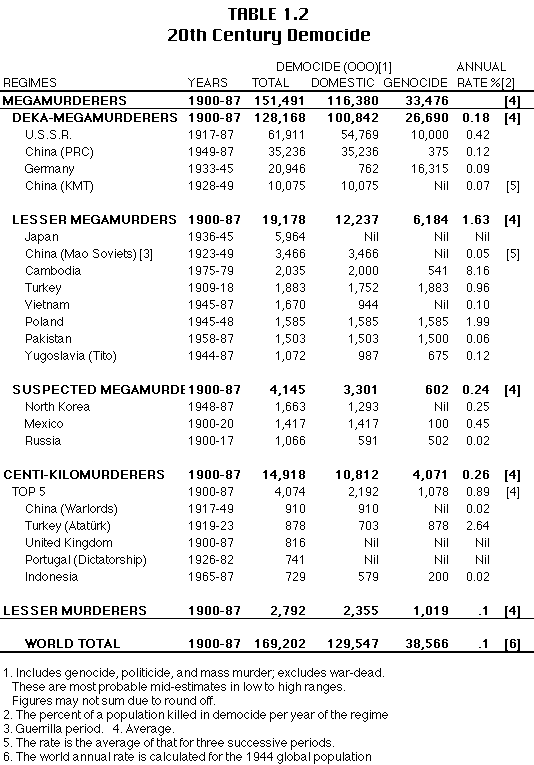
This analysis is mistaken, not because Cubans will not resist a policy that condemns them to decades more under communist tyranny, but because the Chinese have resisted and paid a high price for their desire for freedom. More than 35 million Chinese were killed under this regime between 1949 and 1987. The Chinese regime also demonstrated that the founding generation of leaders, as they neared death, initiated one last spasm of sustained mass killings in the Cultural Revolution.

Today the world observes, refusing to forget as communist China tries to minimize and erase, the anniversary of a massacre. However it is important to also recall the courage, persistence and sacrifice of millions of Chinese citizens who stood up for freedom between April 15th and June 5th of 1989 and how close they came to achieving a democratic China. More than one million Chinese students and workers occupied Beijing's Tiananmen Square and held it for six weeks. This square covers an area of 100 acres and is the seat of communist China's political power with a history that predates it to 1651. By mid-May over 400 cities across China were participating in the protests demanding democratic reforms and on May 20, 1989 martial law was declared.


Troops moved into the center of Beijing on May 20, 1989 but refused to fire on the nonviolent demonstrators and left four days later. The Chinese communist leadership, humiliated began identifying troops that would brutally put down the nonviolent demonstrators.

On June 2, 1989 the communist party elders issued the orders to put down the "counterrevolutionary riot." The savage suppression by military forces was not just in Beijing but across China in all those cities that had participated in the protests demanding reform.

Time magazine in 2015 reported on the brutality visited on protesters in Chengdu, the capital of China’s Sichuan province. On June 4, 1989 the protesters at the center of town voluntarily left but when they learned of the massacre in Beijing things changed:
"Then crowds swelled and protesters, fully aware of the danger they were putting themselves in, took to the streets holding banners that read: “We are not afraid of death.”Street fights erupted, and, over the course of June 4, June 5 and June 6, turned into riots. Protesters stormed the gates and ransacked the Jinjiang Hotel, about 1.5 km from the main square, after which “the police rounded up about 70 protesters and began to beat them brutally in front of guests,” Lim tells TIME. Vehicles were set on fire and eventually a major market in the city was razed (which would later be used by Communist propaganda to discredit the protesters). ...[C]onservative estimates from a U.S. diplomatic cable, the Los Angeles Times and an Amnesty International report from Sept. 19, 1990, around 30 people died in the clashes. Others, including Western eyewitnesses, put the estimate as high as 400."
Imagine these scenes played out in 20 other cities in China along with the huge massacre in Beijing, the terror inflicted on the Chinese people over those days begins to be placed in context, despite the full number of dead still not being known.

Tank Man on June 5, 1989 stops a column of tanks in Beijing
In the midst of all this on June 5, 1989 one man with his shopping bags infuriated by what had happened, and was still happening, challenged and stopped a column of tanks. 27 years later the fate of that man remains unknown, as does the fate of the tank driver who refused to run him over. Thousands of people of good will from around the world are asking the Chinese government to reveal what happened to these two individuals.

Sadly, we must also remember the betrayal of the Western world that for the sake of economic interests paid lip service in support of Chinese democrats while quietly backing the Chinese communist dictatorship.

Unfortunately, as one can see in Cuba and Vietnam with the United States and other Western powers marginalizing pro-democracy activists, paying lip service on human rights, while embracing communist dictatorships for economic, or other perceived strategic objectives, as was done three decades ago in China that today in a real and tragic way "we are all Chinese."

Cuban American students over the years have gathered to remember what happened to their counterparts in June of 1989 but now let us all take concrete action on behalf of the Chinese seeking to be free. Here are four thing you can do. The first three are requests made by the NGO Human Rights in China and the last by Initiatives for China:
The world is witnessing today, with human rights in decline worldwide for the past decade, the fulfillment of martyred Cuban opposition leader Oswaldo Payá Sardiñas's December 17, 2002 warning when he called for global solidarity and explained the consequences of failing to do so. 
"The cause of human rights is a single cause, just as the people of the world are a single people. The talk today is of globalization, but we must state that unless there is global solidarity, not only human rights but also the right to remain human will be jeopardized."
Erazim V. Kohák in his book Jan Patočka: philosophy and selected writings provides an idea of what this global solidarity would look like when he refers to Patočka’s “solidarity of the shaken” as a community freed “from the preoccupation with the pursuits of peace and prosperity that inevitably lead to war and turn it instead to the pursuit of the Good, the care of the soul” that is “living with a clear conscience, living in truth, or in far older terms, seeking first the Kingdom of God.”

Therefore let us identify with our Chinese brothers and sisters, not only in our shared suffering of  totalitarian regimes, in a world too often complicit with tyranny, but also in our shared struggle for freedom.

We are all human and therefore ought to be free.