Showing posts with label Havana Club. Show all posts

Wednesday, November 11, 2020

Bacardi, the Castro regime, and the Havana Club Trademark: An injustice that needs to be remedied

Bacardi environmental stewardship recognized while Castro regime's rum maker harm's Cuba's, yet a travesty continues

CubaBrief by Center for a Free Cuba

Bacardi is in the news again. The rum maker founded in 1862 in Santiago de Cuba has a positive track record on environmental stewardship that has again been recognized. Bacardi USA was awarded the SmartWay® Excellence Award from the U.S. Environmental Protection Agency for the fourth time.

Meanwhile, the Castro regime continues to sell their stolen version of Havana Club, that today "pumps 1,288 cubic meters of waste liquids into the Chipriona inlet in Cuba every day, mostly vinasse (a residual liquid remaining from the fermentation and distillation of alcoholic liquors). It has been doing that since the 1990s, although the problems became more acute starting in 2007," according to Julio Batista in his 2017 report described the impact of this pollution as follows:

"The Chipriona inlet is a place where no one goes, where no one fishes, that doesn't need a fence because no one wants to swim in the boiling filth that flows into its waters every day. The waters of what used to be a beach are now soupy and have the sour smell of decomposition. No studies about the marine life in the inlet are publicly available, but fishermen say there's no fish there." ..."In the last decade, Chipriona has become the drainage point for the Ronera Sana Cruz, the biggest distillery in the country and one of the four owned by Cuba Ron S.A. It's the end point of the sewage of the only place where the white and 3-year-old brands are distilled by Havana Club International (HCI). And the dumping ground for a company that earned $118.5 million in profits in 2016 from the sale of 4.2 million boxes each with nine liters of rum."

Despite the Castro regime's poor record on environmental stewardship and overall terrible record on human rights the United States in 2016 stripped Bacardi of its right to the Havana Club brand and turned it over to a company of the Castro dictatorship. According to Reuters, "in January, the U.S. Patent and Trademark Office decided to allow Cuban state firm Cubaexport to register the Havana Club name once again in the United States." Bacardi "acquired the rights to the Havana Club trademark from its pre-revolutionary owner whose distillery was nationalized" by the communist regime.

Ambassador Otto J. Reich, president of the Center for a Free Cuba, on January 31, 2020 in The Miami Herald called on the United States to undo this wrong that continues to favor the Castro dictatorship and gutted the rights of a Cuban family business. "The Obama administration allowed Cuba to renew an expired trademark registration for the confiscated Havana Club rum. The Trump administration should reverse that action and demonstrate to unscrupulous foreign companies that there are grave risks to economic deals with a regime that has stolen billions of dollars in properties from Americans and Cubans, and thus stop dishonestly enriching the Cuban government."

This action by the United States in 2016 against Bacardi, and in favor of the Castro dictatorship was a deeply unpopular move for Cubans with a sense of history. Business Insider on October 28, 2020 broadcast a podcast on "Bacardi and the Long Fight for Cuba" that explored the company's history back to Cuba's colonial period under Spain in beginning in 1862. 


Emilio Bacardi, son of one of the two founders of Bacardi, Don Emilio Bacardi, "was a field officer for Gen. Antonio Maceo in 1895 during the invasion of Cuba by independence forces, and reached the rank of colonel by the age of 22," according to his obituary in The New York Times on October 16, 1972 when he died at the age of 95 in exile in Miami. 

Emilio Bacardi Lay

He was "the last surviving ranking officer of Cuba's war of independence with Spain," according to the paper of record. The Bacardi family throughout the struggle for independence, and during the years of the Republic defended democracy and Cuban national identity, and remain a historic example. They also resisted all of Cuba's dictators: Machado, Batista and Castro. 

This is in stark contrast to the history of the Castro family. Fidel Castro's father, Angel Castro, enlisted in the Spanish army and arrived in Cuba to defend Spain's colonial possession from forces battling for independence. He returned with the Spanish armed forces to the Iberian Peninsula following their defeat in 1898, but shortly after emigrated to Cuba and established himself there. This allegiance to Spain would continue through his sons Fidel and Raul Castro.

In 2016 TV3 produced a documentary "Franco and Fidel: A Strange Friendship" that explored this relationship between the two dictators and is available online.

The documentary revealed how pro-Castro Cuban exiles were able to celebrate Fidel Castro's triumph in 1959 with a mass protest in Retiro Park in Spain. This was at a time when Spaniards could not do that. Latin American Herald Tribune reported on this and more regarding the TV3 production.

Also revealing are accounts by Castro revolutionaries who said that during their struggle against dictator Fulgencio Batista their lives were saved thanks to the help of the Spanish Embassy, as well as images of Ernesto "Che" Guevara walking in Madrid and attending a bullfight with members of Franco's secret police. 
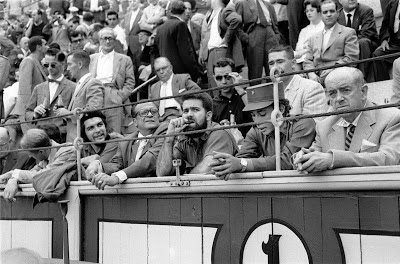
Ernesto "Che" Guevara in Franco Spain at a Bullfight

Following the 1962 Cuban Missile Crisis, when the US pushed for tight economic sanctions on the Castro regime, the rest of Latin America, France and the United Kingdom all went along with Washington, but Franco's Spain continued trading with Havana.

On Franco's death in 1975, Fidel Castro decreed three days of mourning in Cuba, although he made sure that it went unnoticed by the press, it was an official decree signed by Cuban president Oswaldo Dorticós. This relationship with the Spanish dictator should not be a surprise when one considers that the Castro regime had a close working relationship with former high ranking Nazis.

This is why the United States siding with the Castro dictatorship in an issue of private property rights against Bacardi is so deeply offensive, and needs to be remedied. Cuban Americans and Cubans on the island would remember this gesture.

Tuesday, April 28, 2020

Bacardi leads in sustainable rum production while Cuban rum distilleries destroy the environment

Private property rights are human rights.


Source: CubaBrief

Earth Day was celebrated on April 22nd around the world, and Nicola Carruthers writing in The Spirits Business highlighted companies with initiatives to protect the environment and support sustainable development. According to Carruthers, "in 2018, Bacardi teamed up with environmental charity Lonely Whale to clamp down on single-use plastic and eradicate one billion plastic straws by 2020. The Future Doesn’t Suck campaign saw Bacardi remove “non-essential”, non-recyclable single-use plastic across its global supply chain."


Bacardi shifted some of its production last month to produce hand sanitizer in response to COVID-19, much of which is being given to police, nurses, non-profits and others battling coronavirus on the frontlines. The company has also set up a $ 3 million dollar fund to provide financial support, meals and other necessities to help bar owners and bar staff impacted by the pandemic.


Meanwhile, in Cuba there is a crackdown underway for those who are providing independent information on the situation on the ground. Independent journalists are jailed for doing their job. Amnesty International has issued a second urgent action for "63-year-old independent journalist Roberto Quiñones Haces." He was "imprisoned on 11 September 2019 for “resistance” and “disobedience”, remains in the Provincial Prison of Guantánamo in concerning sanitary conditions, according to reports. His family stated he has also developed health conditions, which may put him at increased risk in face of COVID-19."


Amnesty International is demanding that "Cuban authorities to immediately and unconditionally release [ Roberto Quiñones ] and other prisoners of conscience in the country, amid grave fears over the spread of COVID-19 in Cuba’s prisons." Independent journalists have broken important stories in the past such as the Cuban government's 2012 response to the cholera outbreak that netted independent journalist Calixto Martinez prison time and recognition as a prisoner of conscience. In 2018, Julio Batista was the winner of the King of Spain Journalism Award for his reporting on pollution from Cuba's main rum distillery in a long 2017 investigative piece titled "The dead waters of Havana Club". (An English excerpt of the report is included below.)


Sadly, the communist takeover of Cuba's main rum distillery, and taking of Havana Club from "the Arechabala Family on June 1, 1960 at gun point ended a family rum-making business that had started in 1878 in Cuba. The Arechabala family lost everything and was forced to flee their homeland, with a scant few of their remaining possessions – the precious Havana Club recipe being one of them.

Since the 1980s, liquid wastes have been a major problem for the Ronera. Photo Julio Batista.
Meanwhile, the Castro regime started to sell their stolen version of Havana Club, that today "pumps 1,288 cubic meters of waste liquids into the Chipriona inlet every day, mostly vinasse (a residual liquid remaining from the fermentation and distillation of alcoholic liquors). It has been doing that since the 1990s, although the problems became more acute starting in 2007," according to Julio Batista in his 2017 report.

Ronera Santa Cruz produces 60 million liters per year. More than half are Havana Club products.
Bacardi, founded in Cuba in 1862, has demonstrated over the years a concern for sustainable development and rootedness to Cuba with a multigenerational sense of belonging and protection of their properties, and surrounding communities. The late British philosopher Roger Scruton explained that " for it is only private ownership that confers responsibility for the environment as opposed to the unqualified right to exploit it, a right whose effect we saw in the ruined landscapes and poisoned waterways of the former Soviet empire." Unfortunately, these ruined landscapes and poisoned waterways are found all too often today in Castro's Cuba. The video below is in Spanish, but the images of environmental destruction at Chipriona inlet are understood in any language.

Thursday, February 6, 2020

Don’t tell us we’re not Cuban: The Real Havana Club

#ForeverCuban #TheRealHavanaClub #Amparo


Bacardi is synonymous with Republican Cuba. Two generations of the Bacardi family fought for Cuban independence with one family member fighting alongside General Antonio Maceo. During the Republic the family not only had enlightened business practices but also engaged in civic activities that promoted a democratic culture.

Each time dictatorship arose in Cuba under Machado, Batista and Castro the Bacardis joined the democratic resistance. They have recognized the work of Oswaldo Payá Sardiñas, and in 2017 that of his daughter, Rosa María Payá and they are supporting the Cuba Decide initiative to push for a democratic transition.


Bacardi embodies the love of freedom and a good party.  They are also patrons of the arts and were also involved in an immersive theater experience called The Amparo Experience.

The anti-Bacardi's, the antithesis of a free Cuba are the Castros throughout Cuban history beginning with the war for independence through to the present day with the Castro dictatorship. Angel Castro, Fidel and Raul Castro's father fought for the Spanish crown against Cuban independence. The Castro brothers emerged out of the worse elements of political gangsterism to impose a dictatorship that has lasted 60 years and destroyed a great people.

Now they are setting the record straight and defending the legacy of Havana Club with a challenge: Don’t tell us we’re not Cuban.
"The Arechabala Family started their rum-making business in 1878 in Cuba and first registered the original Havana Club trademark in 1934. It wasn’t long before Havana Club Rum became a beloved and iconic Cuban brand – becoming a favorite amongst locals as well as American and European tourists.

Then everything changed. On January 1st, 1960, at gunpoint, the Cuban regime unrightfully seized the company’s assets without compensation. The Arechabala family lost everything and was forced to flee the homeland they loved, with a scant few of their remaining possessions – the precious Havana Club recipe being one of them. Meanwhile, the Cuban Government started to sell their stolen version of Havana Club, and continues to do so to this day.

It wasn’t until 1995 – after decades of rebuilding, the Arechabala family finally joined forces with another Cuban family in exile: Bacardi. The latter acquired the Havana Club brand and began producing rum based on the original Havana Club recipe and selling it in the one country that didn’t recognize the Cuban Government’s 1960 illegal expropriation, the United States.

The Havana Club brand is an example of how, despite the circumstances, Cubans in exile have never accepted their fate. Havana Club rum holds onto its rich Cuban culture." 
Worse yet the Castro regime's rum business in addition to providing a substandard product uses child labor. Back in 2016 news broke that Cuba wanted to pay off $276 million dollars in Czech debt with rum. "This Film Used To Be About Rum" is an interesting attempted exploration of this agreement between the Czech Republic and the Cuban dictatorship to negotiate Cuba's debt with the Central European country through rum shipments.
The filmmakers interviewed Tomas Zdechovsky, a Czech representative of the European Parliament who made a shocking revelation in the film.
"I don't think we've mentioned that the whole rum industry is based on child labor. When you come out to the countryside and take a look at who's working on the fields, you'll see ten, twelve-year-old children working there.  And then we go ahead and drink the rum wth no ethical dilemmas whatsoever. We just accept it as being part of a culture.But when you think about it, when you drink Cuban rum, you're helping the Cuban regime survive."
Let us look forward to the day that both Bacardi and the real Havana Club can return to Cuba, and make the rum on their home turf and not in exile. But that necessitates the return of freedom that also means private property rights, freedom of expression and freedom of association. It will also mean an end to child labor and a return to enlightened business practices were workers would get stock options as they did before the communist revolution.


Sunday, November 19, 2017

Don’t tell us we’re not Cuban: The Real Havana Club

#ForeverCuban #TheRealHavanaClub


The Bacardi family is the antithesis of the Castro family in Cuban history through to the present day.

Consider for a moment that Angel Castro, Fidel and Raul Castro's father fought for the Spanish crown against Cuban independence. The Castro brothers emerged out of the worse elements of political gangsterism to impose a dictatorship that has lasted 58 years.

In contrast two generations of the Bacardi family fought for Cuban independence with one family member fighting alongside General Antonio Maceo. During the Republic the family not only had enlightened business practices but also engaged in civic activities that promoted a democratic culture. Each time that dictatorship arose in Cuba under Machado, Batista and Castro the Bacardis joined the democratic resistance. They have recognized the work of Oswaldo Payá Sardiñas, and earlier this year that of his daughter, Rosa María Payá and they are supporting the Cuba Decide initiative to push for a democratic transition.


Now they are setting the record straight and defending the legacy of Havana Club with a challenge: Don’t tell us we’re not Cuban.
"The Arechabala Family started their rum-making business in 1878 in Cuba and first registered the original Havana Club trademark in 1934. It wasn’t long before Havana Club Rum became a beloved and iconic Cuban brand – becoming a favorite amongst locals as well as American and European tourists.

Then everything changed. On January 1st, 1960, at gunpoint, the Cuban regime unrightfully seized the company’s assets without compensation. The Arechabala family lost everything and was forced to flee the homeland they loved, with a scant few of their remaining possessions – the precious Havana Club recipe being one of them. Meanwhile, the Cuban Government started to sell their stolen version of Havana Club, and continues to do so to this day.

It wasn’t until 1995 – after decades of rebuilding, the Arechabala family finally joined forces with another Cuban family in exile: Bacardi. The latter acquired the Havana Club brand and began producing rum based on the original Havana Club recipe and selling it in the one country that didn’t recognise the Cuban Government’s 1960 illegal expropriation, the United States.

The Havana Club brand is an example of how, despite the circumstances, Cubans in exile have never accepted their fate. Havana Club rum holds onto its rich Cuban culture." 
Let us look forward to the day that both Bacardi and the real Havana Club can return to Cuba and make the rum on their home turf and not in exile. But that necessitates the return of freedom that also means private property rights, freedom of expression and freedom of association.
