Showing posts with label covid-19. Show all posts

Wednesday, June 4, 2025

Many viewed the Tiananmen Square massacre as a crime, but the Cuban dictatorship saw it as an opportunity.

How the events of June 4, 1989 in China allowed Havana to rekindle relations with Beijing


A crime against the Chinese people by the Chinese Communist Party

Thirty six years ago the non-violent Chinese Pro-Democracy Movement was subjected to a military crackdown in which at least 10,000 Chinese people were killed.

The United States, Britain, France, West Germany, Italy, Spain, the Netherlands, Sweden, and Chinese students condemned the crackdown by the “People’s Liberation Army.” Chinese students around the world took to the streets and protested the bloodshed in Beijing.

People of conscience the world over were horrified. Beijing was diplomatically shunned.

Cuba’s dictatorship endorsed the Tiananmen massacre to normalize relations with Beijing

In contrast, the dictatorship in Cuba saw an opportunity to rekindle and old friendship. Together with North Korea, and East Germany expressed their support for the actions taken by Beijing.

Cuban foreign minister Isidoro Malmierca commended Chinese authorities for “defeating the counterrevolutionary acts.” Fidel Castro openly supported Beijing’s Tiananmen Square massacre in 1989, as a means to both preempt reform elements in the Cuban regime, and improve relations with Beijing.

Chinese foreign minister Qian Qichen’s visit to Latin America took place in the midst of the crackdown, and he described the contrast between Havana’s warm welcome and the disapproval of many other countries in the region.

“The crackdown in Beijing, Qian says, completely changed the atmosphere around his tour: many Latin American governments expressed their disapproval of the suppression and cancelled his visits, and even the overseas Chinese, who usually greeted visiting Chinese officials with enthusiasm, had“stern faces” and questioned the reasons for using force. Qian had planned a visit to Mexico before Cuba. The Mexican government cancelled his visit but allowed him to go to Cuba via Mexico City.”

[…]

“But Qian’s reception in Havana exceeded his expectations. He was greeted by the Cuban foreign minister at the airport and brought to a welcome dinner the next evening hosted by Fidel Castro himself. Castro had a long talk with Qian at dinner which continued in his office until midnight. Understanding Qian’s situation, Castro gave him a detailed description of what had happened in Beijing since 4 June and the international response, based on his collection of information and from his own perspective. Castro said that he “completely supported the Chinese government” and would offer “whatever occasions and facilities” Qian might need to make his government’s voice heard.”

Cuba-Sino relations: From a warm embrace in 1960 to a decades long chill in relations

Communist China and Cuba had been close in the first years of the Castro regime. Mao Zedong had already been in power in China for a decade when the Castro regime took power in Cuba in 1959.

On September 28, 1960 the Cuban dictatorship diplomatically recognized the People’s Republic of China.

Ernesto “Che” Guevara led a Cuban delegation’s visit to Mainland China and met with Mao Zedong, Zhou Enlai, and other high ranking Chinese officials in November 1960 to discuss conditions in Cuba and in Latin America, and the prospects for communist revolution in the Americas.

Subsequently, between 1960 and 1964 the two regimes collaborated closely together.

Mao's regime in 1958 had embarked on the Great Leap Forward, a campaign to reorganize the Chinese populace to improve its agricultural and industrial production along communist ideological lines. The campaign was a disaster that led to mass famine and a death toll of at least 45 million which did not end until 1962.

The visit by the Cuban delegation at the time did not go unnoticed in Mainland China. Dimon Liu was born in China and immigrated to the United States in 1965. She wrote about her early experiences growing up in the midst of the Great Leap Forward in 2017 and her first encounter with Cuba while still in China.

It was 1960, the height of famine during the years of Great Leap Forward. I was a child living in the southern city of Guangzhou in China. Meal time meant a little rice, and whatever we could scrape together. For nearly two years, we had no meat, fish or even cooking oil. We were starving.

All of a sudden, there was cane sugar from Cuba, and we school kids had to learn Cuban songs. We had been on rations even before the Great Leap Forward which began in 1958. Thirty jin (one jin is about 1.1 pound) of grains per month for an adult, and fifteen jin for a child above the age of seven. Two jin of meat and two ounces of cooking oil, also for a month. [...] People on our streets were dying of many infectious diseases, though no one dared to say anyone died of hunger.[...]

Frank Dikotter, the historian at the University of Hong Kong who wrote "Mao's Great Famine", a book about this period, said in a social media post that "the first thing the regime did in September 1960 was to procure an extra 100,000 tons of grain and ship it to Cuba," in order to help break the economic blockade imposed by Washington on the island. Dikotter added that "you can feed about 2000 people for a day with a ton of rice... Or over half a million people for a year."

Properly fed people rarely existed in China at that time, unless you belonged in the very small and exclusive club of Chinese Communist elite. For a child like me who received coupons for under 8 pounds of rice a month, you could have fed more than 2 million of us for a year; or about half a million Chinese adults for a year on a standard ration of 30 jin, or 33 pounds of rice per month for the amount of grain sent to Cuba.

Cuba was not the only place that China exported food to during those harrowing years.

In the midst of the Great Famine, while tens of millions of Chinese died of hunger, Beijing exported food to their communist ally in Cuba.

Relations between China and the Castro regime cooled, and completely deteriorated following a February 6, 1966 speech by Fidel Castro that was heavily critical of the Peoples Republic of China. Havana finally sided with Moscow in the Sino-Soviet split.

Criticizing Mao

Castro, while receiving Soviet subsidies, would continue to slam the Chinese Communists in the 1970s.

Journalist Chieu Luu, in his CNN article “Castro’s Cuba and Mao’s China: Communist regimes that never saw eye to eye” published on November 26, 2016 recalled the late Cuban dictator’s critique of Mao Zedong in 1977.

“I believe that Mao (Zedong) destroyed with his feet what he did with his head for many years. I’m convinced of that. And some day the Chinese people, the Communist party of China will have to recognize that,” Castro told American journalist Barbara Walters in May 1977. He went on to list what he said were Mao’s grave mistakes: a cult personality and abuse of great power. “I also acquired that power, but I never abused it, nor did I retain it in my hands,” Castro said. Although both Cuba and China were functioning Communist states, Castro told Walters he viewed China as a “good ally” of the US, which was a bitter enemy of Cuba.

How Moscow drove Cuba into improving relations with Beijing

Russia’s democratic spring in the mid to late 1980s under Mikhail Gorbachev led to a cooling of relations between Havana and Moscow.

Perestroika was a policy that recognized economic central planning was a failure, and pursued reforming and restructuring the Soviet economy, and Glasnost was a policy that sought “more open consultative government and wider dissemination of information.”

These policies both instituted were viewed with great dread, and rejected by the Castro brothers. This was at a time when 75% of Cuba’s commercial exchanges were with the Soviet Union, but that did not stop Havana from censoring Soviet publications, and the beginning of the Castro brothers’ outreach to Beijing in 1989.

Havana’s successful engagement with Beijing: Harming U.S. interests and security

Backing the massacre of thousands of Chinese nationals by the People’s Liberation Army (PLA) on the orders of the Chinese Communist Party (CCP) resulted in Chinese President Jiang Zemin’s high-level visit to Cuba in 1993. This was followed by Raul Castro’s first visit to China in 1997.

Prior to this, Beijing quietly began in 1992 jointly operating intelligence bases targeting the United States from Cuba, according to Chris Simmons, a former head of the U.S. Defense Intelligence Agency’s Western Hemisphere counterintelligence research section, revealed to the Miami Herald on July 4, 2024. He said that U.S. surveillance services were unaware of the arrangement until 2001, operating undetected for a period of nine years.

The Center for Strategic and International Studies (CSIS) published a report in December 2024 that identified four places in Cuba it believes are most likely to be aiding China’s intelligence activities against the United States. One of the authors of the report Ryan C. Berg, Director, Americas Program, Center for Strategic and International Studies, and Andrés Martínez-Fernández, Senior Policy Analyst, Latin America, Allison Center for National Security, testified before Congress on May 6, 2025. They point to these spy bases in Cuba being upgraded with new technology.

This restored “special friendship” between two Communist dictatorships was founded on the mass killing of Chinese civilians by the PLA in June 1989, and Havana’s public support for this crime against humanity.

Following this rapprochement, it is believed Havana began offering their biotech knowledge, gained from Moscow, to their counterparts in Beijing, and in 2002, China and Cuba signed a formal agreement to produce monoclonal antibodies.

By 2004 Cuba had joint ventures in China that included both biotech, and genetic engineering. Douglass Starr in Wired Magazine on December 1, 2004 reported on this phenomenon in the article “ The Cuban Biotech Revolution“.

What Cubans call “the Special Period” produced one notable success: pharmaceuticals. In the wake of the Soviet collapse, Cuba got so good at making knockoff drugs that a thriving industry took hold. Today the country is the largest medicine exporter in Latin America and has more than 50 nations on its client list. Cuban meds cost far less than their first-world counterparts, and Fidel Castro’s government has helped China, Malaysia, India, and Iran set up their own factories: “south-to-south technology transfer.”

In 2015, then vice-president Miguel Diaz-Canel visited Beijing and praised Havana’s collaboration with Communist China in the sphere of biotechnology. Granma, Cuba’s official national communist newspaper, reported on the Cuban vice-president’s visit to a biotech facility in China.

“Díaz-Canel emphasized the notable progress made by Cuba and China in the sphere of biotechnology over recent years while also highlighting the close collaboration that the two countries share in the sector; providing great benefits and knowledge for both peoples.”

Without Havana’s joint ventures over the past 20 years in Cuba, Beijing may not have been in a position to have the capability to run a biotech / genetic engineering lab like the one in Wuhan that caused so much tragedy during the COVID pandemic.

Modernizing big brother for the 21st century

Raúl Castro met with China’s Minister of Public Security on December 1, 2024, and Chinese companies ZTE and Huawei are providing Havana censorship tools that are used to block information, track dissidents, silence dissent, and shut down the internet during anti-government protests.

Communist China’s Foreign Ministry spokeswoman Mao Ning on June 4, 2024 described Cuban Minister of Foreign Affairs Bruno Rodríguez Parrilla as a “good old friend of China.” Rodríguez’s official visit from June 5 to 9, 2024 as a special envoy of Cuban President Miguel Díaz-Canel highlighted the two communist regimes’ “special friendship.” Never forget that this rekindled friendship was forged in the blood spill 36 years ago in Tiananmen Square.

Friday, November 25, 2022

Handpicked communist president from Cuba visits Communist China and celebrate 60 years of diplomatic relations between the two regimes.

A long relationship that began while Cuba had normal diplomatic relations with the United States.

Diaz-Canel met with Xi Jinping earlier today.
 

Castro regime president Miguel Diaz-Canel met in Beijing on November 25, 2022 with president for life Xi Jinping.

The relationship between the two dictatorships stretches back 62 years, and began while the United States had a policy of patience and forbearance at the time believing they could maintain normal diplomatic relations with Havana. They were wrong, and the relationship between Beijing and Havana has grown closer since 1989.

President Xi, who is also general secretary of the Communist Party of China Central Committee, exchanged congratulatory messages with Raul Castro Ruz, first secretary of the Communist Party of Cuba Central Committee, and Miguel Diaz-Canel in September 2020 to celebrate the 60th anniversary of diplomatic relations between the two communist dictatorships.

In September 1960 the Cuban government diplomatically recognized the Peoples Republic of China. Between 1960 and 1964 the two regimes would collaborate closely together. 

Ernesto 'Che' Guevara and Chairman Mao Zedong dining in 1960

Ernesto "Che" Guevara with a Cuban delegation visited Mainland China and met with Mao Zedong, Zhou Enlai, and other high ranking Chinese officials in November 1960 to discuss conditions in Cuba and in Latin America, and the prospects for communist revolution in the Western Hemisphere.

This was at a time that Havana still had normal diplomatic relations with the United States. Diplomatic relations between Cuba and the United States were severed on January 3, 1961.

Relations between China and Cuba cooled in 1964 when the Castro regime sided with the Soviet Union in the Sino-Soviet  split, but warmed again in 1989 following the Tiananmen Massacre. The Castro regime was one of the few governments to support the massacre, and the Castro regime had distanced itself from the Soviet Union viewing Perestroika and Glasnost  as existential threats to their rule.

Chinese Premier Li Peng and Fidel Castro in Havana in 1995

Cuba's relationship with the Soviet Union provided Havana with expertise in biological warfare and biotech that had been denied the Chinese due to the above mentioned split. The Castro regime beginning in the late 1980s began offering that knowledge to their counterparts in Beijing and signed a  formal agreement to produce monoclonal antibodies in 2002.

The two regimes worked closely together during the COVID-19 pandemic that originated in Wuhan, China in December 2019.  Above is a video presentation given in April 2020 on this relationship.

At the United Nations Human Rights Council on July 1, 2020 the Castro regime took the lead in backing the new security law in Hong Kong that effectively ends autonomy there.

Diaz-Canel doubled down on Havana's alliance with Beijing during this visit to mainland China.


Monday, February 7, 2022

Remembering Dr. Li Wenliang: the hero who warned about the COVID-19 outbreak in Wuhan, China and paid a terrible price

How the Chinese Communist Party prioritized power, punishing whistleblowers such as Dr. Li Wenliang, and plunged the world into a pandemic.

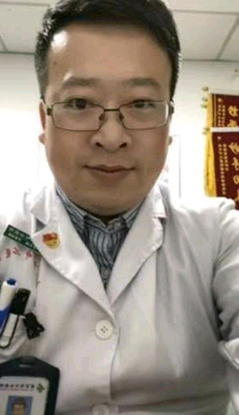
Dr. Li Wenliang warned about Covid-19
 

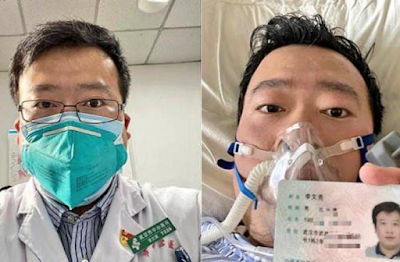
Today remembering Dr. Li Wenliang, the hero who warned about the initial COVID-19 outbreak in Wuhan, China. He was grabbed by secret police in the middle of the night and threatened with prosecution for making "untrue statements." 

He died two years ago today on February 7, 2020. The police state had silenced him and COVID-19 took his life, but the whistleblower is not forgotten despite the efforts of Beijing to erase him. 

On March 15, 2020 this blog warned about Communist regimes, such as the ones operating in China and Cuba, to engage in the "denial of objective reality, truth and an ability to systematically lie to achieve is sometimes effective in taking over a country and imposing a totalitarian dictatorship, but is a disaster when dealing with infectious diseases, and an outbreak such as the coronavirus."

Dr. Li Wenliang warned about intitial COVID-19 outbreak in Wuhan

Others in China, who questioned the Chinese Communist dictatorship's response to COVID-19 went missing. A high profile case was Chinese tycoon Ren Zhiqiang who "wrote in a scathing essay that China’s leader, Xi Jinping, was a power-hungry 'clown.' He said the ruling Communist Party’s strict limits on free speech had exacerbated the coronavirus epidemic," reported  Javier C. Hernández in The New York Times on March 14, 2020

Mr. Zhiqiang went missing at the time, and reappeared in September 2020 when he was found "guilty of corruption, bribery and embezzlement of public funds" in a Beijing court fined $620,000 and sentenced to 18 years in prison.

The message to the Chinese populace is clear: criticize the Chinese Communist leadership at your own peril. Transparency and the free exchange of ideas and data are non-existent in such an environment. 

This is not good in the midst of a pandemic.

Rewarding this behavior that has led to the loss of millions of lives with a Winter Olympics is an outrage. This is part of the reason why I am boycotting the Winter Olympics in Beijing this year, and encourage others to do so.

Please watch and share "The Story Of Coronavirus Whistleblower: Dr Li Wenliang" made by Brut India.

Tuesday, February 1, 2022

Berlin 1936 and Beijing 2022: Legitimizing genocidal totalitarian regimes through sports is a profound immorality with bad outcomes

 "Those who cannot remember the past are condemned to repeat it."- George Santayana


Legitimizing genocidal totalitarian regimes through sports is a profound immorality with bad outcomes

The 2008 Summer Olympic Games in Beijing were a human rights disaster for China with scenes of Tibetan demonstrators gunned down by Chinese soldiers. 

14 years later, and the world has suffered over 5.6 million deaths due to COVID-19, and the Chinese Communist dictatorship of  Xi Jinping bears responsibility. The Chinese government did not reveal for weeks what it knew about COVID-19, allowing it to spread into a worldwide pandemic. The Frontline Documentary "China's COVID Secrets" is required viewing to understand what happened.

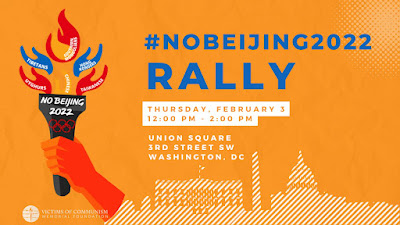
#NoBeijing2022 has listed some of the other outrages committed by the ruling Chinese Communist Party in Beijing.  "The Beijing 2022 Winter Olympics is set to happen amid one of the world’s worst crackdowns against freedom, democracy, and human rights."

  • At least TWO million Uyghur, Kazakh, and Uzbek Muslims are detained in “re-education camps” undergoing systematic torture, rape, and political re-education.
  • 80% of Tibetan children – as young as 4 – are forced away from their parents and housed in China’s colonial boarding schools, cut off from their families they face intense political indoctrination.
  • In Hong Kong, the Chinese government has implemented a draconian National Security Bill that effectively criminalises protest and curtails any remaining human rights.
  • Protests by Southern Mongolians, whose rights, language and culture being eradicated, are put down with force
  • Detention & disappearance of countless Chinese lawyers, feminists & activists
  • Intimidation and geopolitical bullying of Taiwan and aggression and expansion across borders – in the South China Sea and India-Tibet border – present a clear threat to regional and global security.

A second Frontline Documentary from April 2020, "China Undercover" examined the systematic crackdown on Chinese Muslims.

Despite this the International Olympic Committee (IOC) chose China once again to host the Olympics in 2022 in the midst of the historic crimes of the Chinese Communist Party dictatorship.  

As was the case in the lead up to the 2008 Olympics friends of a free China need to increase scrutiny on the Chinese regime and boycott these Olympics. The consequences of  the IOC legitimizing such a regime cannot be overstated. If you are in the Washington DC area on Thursday, February 3rd at 12 noon please join the #NoBeijing2022 Rally at Union Square 3rd Street SW.

The 1936 Olympics held in Berlin and hosted by the Nazi Third Reich with the ceremonies formally opened by Adolph Hitler should serve as a cautionary example. The United States Holocaust Memorial Museum described the impact of the games as follows:

On August 1, 1936, Hitler opened the XIth Olympiad. Musical fanfares directed by the famous composer Richard Strauss announced the dictator's arrival to the largely German crowd. Hundreds of athletes in opening day regalia marched into the stadium, team by team in alphabetical order. Inaugurating a new Olympic ritual, a lone runner arrived bearing a torch carried by relay from the site of the ancient Games in Olympia, Greece.
[...] Concerted propaganda efforts continued well after the Olympics with the international release in 1938 of "Olympia," the controversial documentary directed by German film maker and Nazi sympathizer Leni Riefenstahl. She was commissioned by the Nazi regime to produce this film about the 1936 Summer Games. Germany emerged victorious from the XIth Olympiad. German athletes captured the most medals, and German hospitality and organization won the praises of visitors. Most newspaper accounts echoed the New York Times report that the Games put Germans "back in the fold of nations," and even made them "more human again." Some even found reason to hope that this peaceable interlude would endure. 

The 1936 Olympics whitewashed the brutality of the Nazi regime in Germany and led to acceptance of Hitler's criminal regime. The 2008 Olympics whitewashed the brutality of the Communist regime in China further legitimizing that criminal regime.

In 2022,  returning the Olympics to China and making this decision in the midst of the COVID-19 pandemic, the destruction of Hong Kong's democracy, threats against Taiwan, and the Uyghur genocide creates a historic moral hazard.

This is why I will not watch the Olympics, and encourage others to join me in this boycott, instead I will stand with Hong Kong, and Taiwan, share documentaries and films that reveal the facts of the genocidal regime in Beijing, and calls to nonviolent protests against the Chinese Communist dictatorship, and their enablers.

Below is a documentary about the 2019-2020 protests in Hong Kong titled "Do Not Split." Please share it with others.

Sunday, December 26, 2021

Media coverage of the Covid-19 response in Cuba reveals crisis in U.S. journalism

Yander Zamora/EPA

Newspapers, TV news, and their websites  are losing an audience to levels never seen before. Some blame it on the departure of Trump, and others on the arrival of Biden. However, there is a more troublesome reason, and I will focus on an area that this blog is knowledgeable about to explain. The 2016 campaign accelerated negative trends, and the media has never recovered

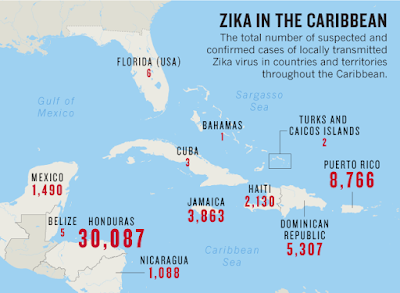
According to media reports, Zika was raging through all of the Caribbean in 2016, except Cuba. This blog at the time repeatedly raised concerns about these claims and found circumstantial evidence and a past history of coverups and underreporting by Havana that should have given one pause. 

Fake news in Cuba: PAHO chart from 2016 was wrong (Source: PAHO/WHO)

On April 5, 2021, The Washington Post published a letter to the editor were I highlighted part of this history of regime obfuscation of health data, including Zika.

Desi Mendoza Rivero was arrested on June 25, 1997, for warning about a dengue epidemic in Cuba. On Nov. 24, 1997, he was sentenced to eight years in prison for “enemy propaganda.” Amnesty International declared him a prisoner of conscience and campaigned for his freedom. Dr. Rivero’s claims were eventually confirmed, and he was forcibly exiled.

On Sept. 2, 2016, the Associated Press reported that Cuba had “remarkable success in containing Zika virus.” On Jan. 8, 2019, New Scientist reported the whole story when the facts became known: “Cuba failed to report thousands of Zika virus cases in 2017.”

Repression patterns during this pandemic in Cuba indicate officials seek to downplay covid-19’s severity on the island. According to Duane Gubler at the Duke-NUS Medical School in Singapore, “Cuba has a history of not reporting epidemics until they become obvious,” and that is pretty bad.

Havana had claimed to be Zika free, until the impending March 2016 state visit by President Barack Obama necessitated their admitting to its existence on the island to avoid embarrassment if someone in the US delegation contracted the illness. [This is my hypothesis.] Meanwhile, Scientific American, the Associated Press, and too many others to list here continued peddling the official line that all was under control.

Cuba in August 2016 was reporting three confirmed cases and 30 cases brought in from abroad while having mounted a propaganda campaign in February 2016 claiming to have deployed 9,000 troops in a preventive battle against Zika reported The Guardian.

This turned out to be false, and scores of sick foreign tourists exposed the lie.

New Scientist broke the story on January 8, 2019 that "thousands of Zika virus cases went unreported in Cuba in 2017, according to an analysis of data on travelers to the Caribbean island. Veiling them may have led to many other cases that year."  Based on analysis based on the number of travelers infected in Cuba, the number of Zika infections were 5,400. Nowhere near the numbers reported by Cuban health officials.

What is shocking is that less than three years later the media continue to report Havana's claims without qualification, including New Scientist. They are doing this now with the deadly COVID-19 pandemic, and once again it does not pass the smell test. 

Castro regime officials decided not to acquire vaccines from their allies, China and Russia, or sign up with the United Nation's COVAX program. Russian and Chinese vaccines became available in Latin America as early as February 2021. Reports of Russian and Chinese COVID-19 vaccines reaching Latin America made news in early March 2021, but Havana declined them preferring to promote their still unavailable domestic vaccines while most other countries in Latin America did.

Official regime journalist Leticia Martinez Hernandez over Twitter on May 18, 2021 bragged that "Cuba will be the first country in the world to vaccinate their whole population with their own vaccines. Live to see!" She even replied to her own Tweet that she would keep the above "tweet fixed until then. I want to remember the feat on which we have bet." Havana's foreign ministry on June 9, 2021 repeated the same campaign theme as the official journalist: "Cuba could be the first country to immunize its entire population with its own vaccines. The population wants and trusts the vaccine candidates, our science, and the country's experience in vaccine development."  

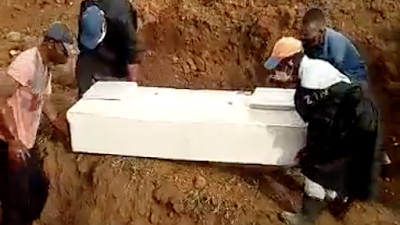
Officials rejected using alternative vaccines over the six months that they were available because their first "homegrown vaccines" were not ready for clinical trials until May 2021 in Havana and June 2021 in the rest of the island. Meanwhile thousands of Cubans died, and the regime could not cover it up. This was one of the causes of the July 2021 protests.

Tîcö Äwö Ôrümîlä, buried his grandmother in a mass grave at the Juan González cemetery, in Santiago, Cuba. (Facebook)

No mention of this was made in the NBC News or New Scientist reports, which echoed glowing claims about vaccination and COVID-19 rates made by officials in Havana. The NBC News article in the first paragraph reads like Prensa Latina.

"Cuba has vaccinated more of its citizens against Covid-19 than most of the world’s largest and richest nations, a milestone that will make the poor, communist-run country a test case as the highly contagious Omicron variant begins to circle the globe."

 It is only way down in paragraph nine that the NBC News article reveals that none of the Cuban vaccines have been peer reviewed.  The Hill goes even further with a video extolling the regime's successes and claims that the regime will submit to being peer reviewed in 2022 by the World Health Organization.

Where are the fact checkers? Where is the institutional memory? These acts of journalistic malpractice are part of the reason that Newspapers, TV news, and their websites  are losing their audiences. They want news not recycled government propaganda.

The data provided by Havana cannot be independently verified, but that is not revealed in the reporting. Also, why not compare Cuba's COVID-19 response with Taiwan's? They are both islands with powerful nations next door with competing ideologies.

Wednesday, April 7, 2021

Exposing the Castro regime's record of not reporting epidemics, and when an attack backfires

Engaging in the conversation over the human rights situation in Cuba leads to ad hominem attacks against ones character, in order to avoid a substantive conversation of the facts presented and the arguments put forward. 

Yesterday, The Washington Post published a letter to the editor on the important topic of the regime in Cuba covering up past epidemics and punishing whistleblowers with prison, and tweeted it out upsetting some folks. The letter is reproduced below.

The Washington Post, April 5, 2021

Letters to the Editor

Opinion: Cuba’s powerhouse status comes through repression

April 5, 2021 at 4:35 p.m. EDT

Patient receives Sputnik V vaccine dose against Covid-19 in Almaty, Kazakhstan. (Pavel Mikheyev/Reuters)

The March 31 news article “Cuba could become a vaccine powerhouse” pointed out that Havana wants to soften its image as a “broadly authoritarian country” that has done “some pretty bad things.” Cuban doctors and journalists who raised the alarm in prior outbreaks on the island were locked up and punished.

Desi Mendoza Rivero was arrested on June 25, 1997, for warning about a dengue epidemic in Cuba. On Nov. 24, 1997, he was sentenced to eight years in prison for “enemy propaganda.” Amnesty International declared him a prisoner of conscience and campaigned for his freedom. Dr. Rivero’s claims were eventually confirmed, and he was forcibly exiled.

On Sept. 2, 2016, the Associated Press reported that Cuba had “remarkable success in containing Zika virus.” On Jan. 8, 2019, New Scientist reported the whole story when the facts became known: “Cuba failed to report thousands of Zika virus cases in 2017.”

Repression patterns during this pandemic in Cuba indicate officials seek to downplay covid-19’s severity on the island. According to Duane Gubler at the Duke-NUS Medical School in Singapore, “Cuba has a history of not reporting epidemics until they become obvious,” and that is pretty bad.

John Suarez, Falls Church

The writer is executive director of the Center for a Free Cuba.

https://www.washingtonpost.com/opinions/letters-to-the-editor/cubas-powerhouse-status-comes-through-repression/2021/04/05/5956ab80-93c6-11eb-aadc-af78701a30ca_story.html


This led to attacks against the author, including for being formerly of Freedom House, raising questions about the organization because it has received public funds. It is a ridiculous argument, because the organization has also been critical of the U.S. government and human rights deficits in the United States.

Anti-Nazi, Anti-Communist, Pro-Freedom org founded 1941

On May 30, 2006, The New York Times announced the death of one of the founders of Freedom House, George Field, and in the obituary revealed the pedigree of this human rights and pro-democracy organization.

"George Field, who fought isolationism, Fascism, Communism, racism, McCarthyism, anti-Semitism and other extremisms for three decades as the guiding spirit behind Freedom House, a nonpartisan organization dedicated to democracy and human rights, died Friday in Kennett Square, Pa. He was 101."

It is ironic that Castro regime apologists question the bonafides of Freedom House, but not surprising because they have done the same to Amnesty International in the past. Meanwhile conservatives are upset with Freedom House because it has also viewed with a critical eye Western Democracies, including the United States.

Civil rights icon Bayard Rustin was called by some "the unknown hero" of the civil rights movement. He was a "tireless crusader for justice, a disciple of [Mohandas] Gandhi, a mentor to Martin Luther King Jr., and the architect of the legendary [1963] March on Washington." Rustin debated Malcolm X in 1962 from both a principled and strategic nonviolent position and would go on to play an important role at Freedom House.

It is doubly ironic because of Soviet Communism's and Castroism's alliances with Nazism and embrace of antisemitism and other extremisms to create new levels of misery for those unlikely enough to fall under their rule.

Sorry, but the fight against tyranny, racism, and other bigotries over the past 80 years beginning in 1941, the same year that Nazi Germany and the Soviet Union began still allied together to conquer the rest of the world imposing the perpetual darkness of totalitarianism, and Freedom House came into existence to resist both of them, and their ideologies on October 31, 1941.

Being linked to Freedom House is high praise, now defending the Castro regime on the other hand is shameful.


Sunday, February 7, 2021

China, Cuba, and COVID-19: How communists prioritzed power, silencing whistleblowers like Dr. Li Wenliang, and plunged the world into a pandemic

Remembering a hero one year later.


Today remembering Dr. Li Wenliang, the hero who warned about the initial COVID-19 outbreak in Wuhan, China. He was grabbed by secret police in the middle of the night and threatened with prosecution for making "untrue statements." He died a year ago today on February 7, 2020. The police state had silenced him and COVID-19 took his life, but the whistleblower is not forgotten despite the efforts of Beijing to erase him.

Dr. Li Wenliang warned about intitial COVID-19 outbreak in Wuhan

On March 15, 2020 this blog warned about the ability of Communist regimes, such as the ones operating in China and Cuba, to engage in the "denial of objective reality, truth and an ability to systematically lie to achieve is sometimes effective in taking over a country and imposing a totalitarian dictatorship, but is a total disaster when dealing with infectious diseases, and an outbreak such as the coronavirus."

Others in China, who questioned the Chinese Communist dictatorship's response to COVID-19 went missing this past March 2020. A high profile case was the Chinese tycoon Ren Zhiqiang "wrote in a scathing essay that China’s leader, Xi Jinping, was a power-hungry 'clown.' He said the ruling Communist Party’s strict limits on free speech had exacerbated the coronavirus epidemic," reported  Javier C. Hernández in The New York Times on March 14, 2020. Mr. Zhiqiang went missing at the time, and reappeared in September 2020 when he was found "guilty of corruption, bribery and embezzlement of public funds" in a Beijing court fined $620,000 and sentenced to 18 years in prison.

The message to the Chinese populace is clear: criticize the Chinese Communist leadership at your own peril. Transparency and the free exchange of ideas and data are non-existent in such an environment. This is not good in the midst of a pandemic.

Regimes in China and Cuba both seek political advantage in viral outbreaks

This is also not unique to China, but is also taking place in Cuba. This blog initially looked at the Chinese response to COVID-19 in Wuhan, and compared it with what Havana had done in 2016 and 2017 with Zika. In both cases the severity of the outbreak was covered up, and the result was the spread of the disease around the world which was traced back to China and Cuba respectively.

Duane Gubler at the Duke-NUS Medical School in Singapore commenting on the 2017 Zika outbreak said Cuba had "a history of not reporting epidemics until they become obvious," and that this was due to their desire to maintain high levels of tourism into the country.

What happened with Zika appears to have also taken place with COVID-19 in Cuba.


Above is an advertisement posted on March 9, 2020 by Havanatur, a tourism company owned by the Cuban military that claims that because "Cuba is bathed in the rays of the sun all year, and taking pertinent measures they have greater strengths before COVID-19 and that Cuba is a safe destination"  showing a picture of folks on the beach in Cuba, without masks contrasted with two women with masks in an urban setting somewhere else.  Many tourists who believed Havana's propaganda as a safe haven, ended up having a bad time in Cuba in 2020.

Castro regime officials falsely claimed throughout February and March 2020 that Cuba was a safe harbor with effective treatments for (SARS-CoV-2) virus for visiting tourists, and found it echoed elsewhere.

Officials refused to close schools, or take other precautions, Cubans desperately began to take steps on their own against the pandemic, having learned about it on the internet. Teachers, ignoring the regime's orders, closed schools and sent children home. The Catholic church, aware of the danger presented by public gatherings, suspended religious services. 

Cuba’s independent journalists raised the alarm while the official media insisted that the country was prepared for the epidemic, that tourists were welcomed while the pandemic ran its course elsewhere. Officials falsely said that Cuba’s sun was “a good antidote” that "Coronavirus doesn't replicate at high temperatures" and continued to advertise their false claims on social media targeting European and North American audiences.

Cuban-American economist Carmelo Mesa-Lago observed in a Harvard webinar on May 1, 2020 that in Cuba, “there is no independent entity that can report its own [coronavirus] figures or criticize the government’s data.”

According to data reviewed by the Miami Herald and reported by Nora Gamez, "in the week ending on March 21 there were 144,095 newly reported 'acute respiratory illnesses.' By March 28, the number of new weekly cases of people with acute respiratory diseases rose to 188,816, more than double the weekly average this year. 'Not only could the increase be explained by a COVID-19 outbreak, it most likely does reflect the COVID-19 outbreak based on when it started and what has been going on in the world,' said Dr. Aileen Marty, an expert on infectious tropical diseases and director of the Florida International University Health Travel Medicine Program."

In less than a month (March 15 - April 4th) the Cuba based, Pedro Kourí Institute of Tropical Medicine, "reported 491,494 cases of acute respiratory diseases."  This was a dramatic increase from measurements taken in Cuba over the past five years, and the months prior to March 2020.

It also points to a far more serious outbreak that probably killed many more than the number officially reported by Cuban officials. In January and February 2021 reports emerged from Santiago of hospitals and morgues overwhelmed with COVID-19 dead in the second largest city in Cuba, while regime authorities continue to present low numbers of dead that do not correspond with anecdotal reports around the island.

Castro regime continues to pitch Cuba as a medical superpower to attract tourists.

This lack of transparency by communist officials in China led to a global pandemic that has so far killed 2,323,593 people around the world and infected over 100 million, and caused an economic downturn that has impacted millions more.

The repetition of these practices to silence health workers in Cuba does no favors for combating the pandemic in the island, and protecting visitors from the present threat.  The regime has attempted to return to the propaganda line they ran with a year ago, of Cuba as a safe haven, but now promise "beaches, mojitos and vaccines all in the same place" in their pitch to tourists.

A year into this global pandemic and the question arises what would have happened if instead of silencing Dr. Li Wenliang, they had listened to him, and raised an international call to alert the world to the danger and contained the outbreak? Will we ever learn what really happened (and is happening in China) or the true impact of the pandemic in Cuba?

Tuesday, December 29, 2020

Notes from the Cuban Exile Quarter's Top 5 Most-Read Articles in 2020

 2020 was the 75th anniversary of the end of WW2, but the anniversary was over shadowed by the worse global pandemic since the 1918 Spanish Flu. COVID-19 and examinations of what communist regimes in China, Cuba and elsewhere could be covering up dominated the top five most read articles with three entries. On a "lighter" note the documentary "Operation Odessa" came in second place.

#1


 #2


#3


 #4

#5


Monday, September 28, 2020

Communist China and Cuba celebrate 60 years of diplomatic relations

A long relationship that began while Cuba had normal diplomatic relations with the United States.

Chinese Premier Li Peng and Fidel Castro in Havana in 1995

President Xi, who is also general secretary of the Communist Party of China Central Committee, exchanged congratulatory messages with Raul Castro Ruz, first secretary of the Communist Party of Cuba Central Committee, and Cuban President Miguel Diaz-Canel to celebrate the 60th anniversary of diplomatic relations between the two communist dictatorships.

In September 1960 the Cuban government diplomatically recognized the Peoples Republic of China. Between 1960 and 1964 the two regimes would collaborate closely together. 

Ernesto "Che" Guevara with a Cuban delegation visited Mainland China and met with Mao Zedong, Zhou Enlai, and other high ranking Chinese officials in November 1960 to discuss conditions in Cuba and in Latin America, and the prospects for communist revolution in the Western Hemisphere.

Ernesto 'Che' Guevara and Chairman Mao Zedong dining in 1960

This was at a time that Havana still had normal diplomatic relations with the United States. Diplomatic relations between Cuba and the United States were severed on January 3, 1961.

Relations between China and Cuba cooled in 1964 when the Castro regime sided with the Soviet Union in the Sino-Soviet  split, but warmed again in 1989 following the Tiananmen Massacre. The Castro regime was one of the few governments to support the massacre, and the Castro regime had distanced itself from the Soviet Union viewing Perestroika and Glasnost  as existential threats to their rule.

Cuba's relationship with the Soviet Union provided Havana with expertise in biological warfare and biotech that had been denied the Chinese due to the above mentioned split. The Castro regime beginning in the late 1980s began offering that knowledge to their counterparts in Beijing and signed a  formal agreement to produce monoclonal antibodies in 2002.

The two regimes have been working closely together during the COVID-19 pandemic that originated in Wuhan, China in December 2019.  Above is a video presentation given in April 2020 on this relationship.

At the United Nations Human Rights Council on July 1, 2020 the Castro regime took the lead in backing the new security law in Hong Kong that effectively ends autonomy there.

President Miguel Diaz-Canel and his wife with President Xi Jinping and his wife in Beijing,  Nov. 8, 2018.