Showing posts with label Antonio Maceo. Show all posts

Monday, May 20, 2024

Cuba Independence Day 2023: A reflection on the first 467 years [ 1492 - 1959 ]

  Before the arrival of the totalitarian darkness

Independence Day in Havana, Cuba on May 20, 1902

One hundred and twenty two years ago today at noon the flag of the United States was brought down and the Cuban flag raised over Havana as Cuba became an independent republic. However, when looking at Cuba one should look back over the first 467 years [1492 - 1959] and where it is situated today to gain greater understanding of the unfolding tragedy.

Cuba is just 90 miles south of the United States with a population of approximately 11 million people. It is 780 miles long and has a land area of 40,369 square miles and is the largest island in the Caribbean and 17th-largest island in the world by land area.

Cuba seen from space.

Columbus’s second stop in the New World was on October 28, 1492 when he landed in Cuba. (The first place he landed on October 12 was the Bahamas). Cuba was a Spanish colony from Columbus’s landing in 1492 until 1898 when Spain lost Cuba in the Spanish-American War.

President Tomas Estrada de Palma

Cubans engaged in two protracted wars of independence. The first was the 10 Years War that took place between 1868 and 1878 and the second took place between 1895 and 1898 ending with U.S. intervention and a 4-year occupation that ended on May 20, 1902. Cuba's first president was a Cuban exile named Tomas Estrada de Palma.

Future first Cuban president Tomas Estrada de Palma travels to Havana

There are many important figures and entities that emerge in the 19th century but for the sake of brevity will mention Father Felix Varela, Jose Marti, Antonio Maceo, Maximo Gomez and the Bacardi family.

Father Varela was a catholic priest who is said to “have taught the Cubans how to think” and entertained ideas of independence that led to his exile to the United States. 

Antonio Maceo and Maximo Gomez were Cuban generals that played important roles in both wars of independence. Antonio Maceo was of a mixed racial background: part Spanish and part African.

Maximo Gomez, was an experienced military man of Dominican origin who oversaw the overall military campaign in the second war of independence and of the three previously mentioned was the only one who survived the war to see the arrival of the Republic.

José Martí and Antonio Maceo

Jose Marti was a journalist, poet and revolutionary who organized and advocated for the 1895 war of independence and spent most of his adult life exiled in the United States in New York City.

The Bacardi family, began their world famous Rum business in Santiago de Cuba. Don Facundo Bacardí Massó and Don Emilio Bacardi founded Bacardi Limited on February 4, 1862.

Emilio Bacardi Lay, son of one of the two founders of Bacardi, Don Emilio Bacardi, "was a field officer for Gen. Antonio Maceo in 1895 during the invasion of Cuba by independence forces, and reached the rank of colonel by the age of 22," according to his obituary in The New York Times on October 16, 1972 when he died at the age of 95 in exile in Miami. 

Emilio Bacardi Lay

The family would also play an important role in civic life in Cuba, especially Santiago over the 20th century, and were constant opponents of dictatorship, political corruption and remained ardent Cuban nationalists over several generations.

Forced into exile by the Castro regime the Bacardi family has maintained the traditions of the Cuban Republic celebrating independence day, carrying on the family business and continuing the fight for a free Cuba.

The beginning of the Cuban republic on May 20, 1902 had an asterisk – The Platt Amendment: which allowed the United States to intervene in Cuban affairs if U.S. interests were threatened. This Amendment was gotten rid of in 1933 but left a bad taste in the mouth of Cuban nationalists.

Between 1902 and 1952 Cuba progressed socially and economically but faced challenges on the political front. For example in the late 1920s Gerardo Machado, the democratically elected president did not want to leave power becoming a dictator. He was driven from office and into exile in 1933 by a general strike

This was followed by a revolution led by university students and enlisted men in what became known as the sergeants revolt.  

During this period labor unions made great strides for worker's rights in Cuba, especially after the ousting of President Gerardo Machado in 1933.  

Ramon Grau San Martin's provisional government marked a before and after in Cuban history. Between October and December of 1933, it issued a first package of popular and nationalist measures that strengthened labor rights in Cuba.

  1. Created the Ministry of Labor, since there was no body specifically in charge of labor matters.
  2. Established employer liability for accidents; he suspended the evictions of tenants and canceled 50% of the taxes and contributions not paid in due time.
  3. Established the eight-hour work day and the right to unionize. He promulgated the Labor Nationalization Law that established the obligation that 50% of the workers and employees had to be native Cubans.

Labor legislation passed in 1938 guaranteed Cuban workers' additional rights: 

  1.  A minimum wage; 
  2. Pensions that assumed a constitutional character;
  3. Creation of the Central of Workers of Cuba Central de Trabajadores de Cuba (CTC in Spanish) 

In 1940 all the political tendencies in Cuba met to draft what became known as the 1940 Constitution and a presidential election was held and Fulgencio Batista elected. He served out his term as president from 1940 to 1944. Due to a clause in the new Constitution he was unable to run for re-election. Cuba's 1940 Constitution further enshrined workers’ rights into law with 26 articles which included:

A maximum work day of no more than 8 hours and a maximum working week of 44 hours equivalent to 48 in wages (Article 66); The right to paid vacation of one month for each 11 months of work in each calendar year (Article 67); The right of unionization (Article 69); The right to strike (Article 71); The system of collective labor contracts (Article 72); a non-discriminatory practice in the distribution of opportunities to work ( Article 74).

Strong trade unions and labor legislation in the Cuban Republic were a factor in rising living standards, and improved healthcare outcomes.

In the election of 1944 the opposition candidate, Ramon Grau San Martin, won and served a term as president from 1944-1948 and in the election of 1948, Batista’s political party again lost at the general elections and Carlos Prios Socarras was elected president.

Cuba's republic during this democratic period played an important role in the drafting of the Universal Declaration of Human Rights of the United Nations and the establishment of the UN Human Rights Commission.

This democratic renaissance was brought to an end within days of the 1952 presidential elections, when on March 10th Fulgencio Batista organized a coup against the last democratically elected president.

A little over a year later on July 26, 1953, Fidel Castro organized an armed assault on the Moncada Military barracks that was a military disaster but a public relations success. Although most of the men involved with Fidel Castro in the assault were killed, Fidel Castro became a national figure at his trial for organizing the attack. At the trial he portrayed himself as a democrat that wanted to restore the previous democratic order and attacked the Batista dictatorship for its usurpation of the democratic order.


How the totalitarian darkness arrived in Cuba

Upon Batista’s departure from Cuba on January 1, 1959 Fidel Castro began his triumphal trek across Cuba to Havana where he began to consolidate power while continuing publicly to claim that he was a democrat but privately began to infiltrate his movement with communists, alienating many who had fought with him. 

On January 22, 1959 the CTC was replaced by the CTC-Revolucionaria. In the X Congress, held in November 1959, the Secretary General, David Salvador Manso,"said that the workers had not gone to the event to raise economic demands but to support the revolution." And in the XI Congress, November 1961, the delegates renounced almost all the achievements of the labor movement, including  "the nine days of leave for sickness, the supplementary Christmas bonus, the weekly shift of 44 x 48 hours, the right to strike and an increase of 9.09%, among many others. Workers were required to do "voluntary work" that was actually mandatory.

Castro began to approach the mass media threatening them with violence if they reported anything critical. As the months passed all independent media were taken over. Mass televised executions imposed fear in the populace.

 Ramiro Valdez oversaw the installation of the totalitarian communist apparatus in Cuba beginning in 1959. He is now probably doing the same thing in Venezuela.  It was on his watch that the East German Stasi, and KGB created and trained Cuban State Security.

This is how the darkness of totalitarianism took over Cuba and 64 years later remains entrenched there. Cuba gained its independence on May 20, 1902 after centuries of Spanish colonial rule and four years of U.S. occupation following the Spanish American war.

Half of Cuba's post colonial history, thus far, has been under the boot of communist caudillos whose father, ironically, fought for the Spanish crown in the war of independence.

What would José Martí say?

José Julián Martí Pérez: January 28, 1853 - May 19, 1895

José Martí was killed in battle against Spanish troops at the Battle of Dos Ríos, near the confluence of the rivers Contramaestre and Cauto, on May 19, 1895. He is buried in the Santa Efigenia Cemetery in Santiago de Cuba. Cubans the world over honor his memory and Cuban independence follows a day later. Seven years and one day after Martí's death Cuba formally obtained its independence on May 20, 1902.

Cubans across the ideological divide claim José Martí as their own. The claims of the dictatorship led by the Castro brothers that Martí is the intellectual author of their political project is ironic considering that the life and writings of this Cuban patriot is the antithesis of the Castro regime.

José Martí believed that "Peace demands of Nature the recognition of human rights." A 64 year old dictatorship that rejects fundamental human rights is the antithesis of what the Cuban independence leader fought and died for.

Furthermore, José Martí proclaimed the idea that: "One just principle from the depths of a cave is more powerful than an army." 

A principle shared not only by dissidents in Cuba today but also echoed by Vaclav Havel, one of the dissidents who had an important role in ending Communism in Eastern Europe in 1989 said: "I really do inhabit a system in which words are capable of shaking the entire structure of government, where words can prove mightier than ten military divisions."

On this Cuban Independence Day we observe that Cubans have lived without democracy for 72 years, and rededicate ourselves to the struggle for a free Cuba. 


May 20, 1902 the Cuban flag is raised and the Republic born

Saturday, May 20, 2023

Cuba Independence Day 2023: A reflection on the first 467 years

 Before the arrival of the totalitarian darkness


Independence Day in Havana, Cuba on May 20, 1902

One hundred and twenty one years ago today at noon the flag of the United States was brought down and the Cuban flag raised over Havana as Cuba became an independent republic. However, when looking at Cuba one should look back over the first 467 years and where it is situated today to gain greater understanding of the unfolding tragedy.

Cuba is just 90 miles south of the United States with a population of approximately 11 million people. It is 780 miles long and has a land area of 40,369 square miles and is the largest island in the Caribbean and 17th-largest island in the world by land area.

Cuba seen from space.

Columbus’s second stop in the New World was on October 28, 1492 when he landed in Cuba. (The first place he landed on October 12 was the Bahamas). Cuba was a Spanish colony from Columbus’s landing in 1492 until 1898 when Spain lost Cuba in the Spanish-American War.


President Tomas Estrada de Palma

 Cubans engaged in two protracted wars of independence. The first was the 10 Years War that took place between 1868 and 1878 and the second took place between 1895 and 1898 ending with U.S. intervention and a 4-year occupation that ended on May 20, 1902. Cuba's first president was a Cuban exile named Tomas Estrada de Palma.


Future first Cuban president Tomas Estrada de Palma travels to Havana

There are many important figures and entities that emerge in the 19th century but for the sake of brevity will mention Father Felix Varela, Jose Marti, Antonio Maceo, Maximo Gomez and the Bacardi family.

Father Varela was a catholic priest who is said to “have taught the Cubans how to think” and entertained ideas of independence that led to his exile to the United States. 

Antonio Maceo and Maximo Gomez were Cuban generals that played important roles in both wars of independence. Antonio Maceo was of a mixed racial background: part Spanish and part African.

Maximo Gomez, was an experienced military man of Dominican origin who oversaw the overall military campaign in the second war of independence and of the three previously mentioned was the only one who survived the war to see the arrival of the Republic.

José Martí and Antonio Maceo

Jose Marti was a journalist, poet and revolutionary who organized and advocated for the 1895 war of independence and spent most of his adult life exiled in the United States in New York City.

The Bacardi family, began their world famous Rum business in Santiago de Cuba. Don Facundo Bacardí Massó and Don Emilio Bacardi founded Bacardi Limited on February 4, 1862.

Emilio Bacardi Lay, son of one of the two founders of Bacardi, Don Emilio Bacardi, "was a field officer for Gen. Antonio Maceo in 1895 during the invasion of Cuba by independence forces, and reached the rank of colonel by the age of 22," according to his obituary in The New York Times on October 16, 1972 when he died at the age of 95 in exile in Miami.  

Emilio Bacardi Lay

The family would also play an important role in civic life in Cuba, especially Santiago over the 20th century, and were constant opponents of dictatorship, political corruption and remained ardent Cuban nationalists over several generations.

Forced into exile by the Castro regime the Bacardi family has maintained the traditions of the Cuban Republic celebrating independence day, carrying on the family business and continuing the fight for a free Cuba.

The beginning of the Cuban republic on May 20, 1902 had an asterisk – The Platt Amendment: which allowed the United States to intervene in Cuban affairs if U.S. interests were threatened. This Amendment was gotten rid of in 1933 but left a bad taste in the mouth of Cuban nationalists.

Between 1902 and 1952 Cuba progressed socially and economically but faced challenges on the political front. For example in the late 1920s Gerardo Machado, the democratically elected president did not want to leave power becoming a dictator. He was driven from office and into exile in 1933 by a general strike

This was followed by a revolution led by university students and enlisted men in what became known as the sergeants revolt.  


During this period labor unions made great strides for worker's rights in Cuba, especially after the ousting of President Gerardo Machado in 1933.  

Ramon Grau San Martin's provisional government marked a before and after in Cuban history. Between October and December of 1933, it issued a first package of popular and nationalist measures that strengthened labor rights in Cuba.

  1. Created the Ministry of Labor, since there was no body specifically in charge of labor matters.
  2. Established employer liability for accidents; he suspended the evictions of tenants and canceled 50% of the taxes and contributions not paid in due time.
  3. Established the eight-hour work day and the right to unionize. He promulgated the Labor Nationalization Law that established the obligation that 50% of the workers and employees had to be native Cubans.

Labor legislation passed in 1938 guaranteed Cuban workers' additional rights: 

  1.  A minimum wage; 
  2. Pensions that assumed a constitutional character;
  3. Creation of the Central of Workers of Cuba Central de Trabajadores de Cuba (CTC in Spanish) 

In 1940 all the political tendencies in Cuba met to draft what became known as the 1940 Constitution and a presidential election was held and Fulgencio Batista elected. He served out his term as president from 1940 to 1944. Due to a clause in the new Constitution he was unable to run for re-election. Cuba's 1940 Constitution further enshrined workers’ rights into law with 26 articles which included:

A maximum work day of no more than 8 hours and a maximum working week of 44 hours equivalent to 48 in wages (Article 66); The right to paid vacation of one month for each 11 months of work in each calendar year (Article 67); The right of unionization (Article 69); The right to strike (Article 71); The system of collective labor contracts (Article 72); a non-discriminatory practice in the distribution of opportunities to work ( Article 74).

Strong trade unions and labor legislation in the Cuban Republic were a factor in rising living standards, and improved healthcare outcomes.

In the election of 1944 the opposition candidate, Ramon Grau San Martin, won and served a term as president from 1944-1948 and in the election of 1948, Batista’s political party again lost at the general elections and Carlos Prios Socarras was elected president.

Cuba's republic during this democratic period played an important role in the drafting of the Universal Declaration of Human Rights of the United Nations and the establishment of the UN Human Rights Commission.

This democratic renaissance was brought to an end within days of the 1952 presidential elections, when on March 10th Fulgencio Batista organized a coup against the last democratically elected president.

A little over a year later on July 26, 1953, Fidel Castro organized an armed assault on the Moncada Military barracks that was a military disaster but a public relations success. Although most of the men involved with Fidel Castro in the assault were killed, Fidel Castro became a national figure at his trial for organizing the attack. At the trial he portrayed himself as a democrat that wanted to restore the previous democratic order and attacked the Batista dictatorship for its usurpation of the democratic order.


How the totalitarian darkness arrived in Cuba

Upon Batista’s departure from Cuba on January 1, 1959 Fidel Castro began his triumphal trek across Cuba to Havana where he began to consolidate power while continuing publicly to claim that he was a democrat but privately began to infiltrate his movement with communists, alienating many who had fought with him. 

On January 22, 1959 the CTC was replaced by the CTC-Revolucionaria. In the X Congress, held in November 1959, the Secretary General, David Salvador Manso,"said that the workers had not gone to the event to raise economic demands but to support the revolution." And in the XI Congress, November 1961, the delegates renounced almost all the achievements of the labor movement, including  "the nine days of leave for sickness, the supplementary Christmas bonus, the weekly shift of 44 x 48 hours, the right to strike and an increase of 9.09%, among many others. Workers were required to do "voluntary work" that was actually mandatory.

Castro began to approach the mass media threatening them with violence if they reported anything critical. As the months passed all independent media were taken over. Mass televised executions imposed fear in the populace.

 Ramiro Valdez oversaw the installation of the totalitarian communist apparatus in Cuba beginning in 1959. He is now probably doing the same thing in Venezuela.  It was on his watch that the East German Stasi, and KGB created and trained Cuban State Security.

This is how the darkness of totalitarianism took over Cuba and 64 years later remains entrenched there. Cuba gained its independence on May 20, 1902 after centuries of Spanish colonial rule and four years of U.S. occupation following the Spanish American war.

Half of Cuba's post colonial history, thus far, has been under the boot of communist caudillos whose father, ironically, fought for the Spanish crown in the war of independence.

What would José Martí say? 

José Julián Martí Pérez: January 28, 1853 - May 19, 1895


José Martí was killed in battle against Spanish troops at the Battle of Dos Ríos, near the confluence of the rivers Contramaestre and Cauto, on May 19, 1895. He is buried in the Santa Efigenia Cemetery in Santiago de Cuba. Cubans the world over honor his memory and Cuban independence follows a day later. Seven years and one day after Martí's death Cuba formally obtained its independence on May 20, 1902.

Cubans across the ideological divide claim José Martí as their own. The claims of the dictatorship led by the Castro brothers that Martí is the intellectual author of their political project is ironic considering that the life and writings of this Cuban patriot is the antithesis of the Castro regime.

José Martí believed that "Peace demands of Nature the recognition of human rights." A 64 year old dictatorship that rejects fundamental human rights is the antithesis of what the Cuban independence leader fought and died for.

Furthermore, José Martí proclaimed the idea that: "One just principle from the depths of a cave is more powerful than an army." 

A principle shared not only by dissidents in Cuba today but also echoed by Vaclav Havel, one of the dissidents who had an important role in ending Communism in Eastern Europe in 1989 said: "I really do inhabit a system in which words are capable of shaking the entire structure of government, where words can prove mightier than ten military divisions."

On this Cuban Independence Day we observe that Cubans have lived without democracy for 71 years, and rededicate ourselves to the struggle for a free Cuba. 

May 20, 1902 the Cuban flag is raised and the Republic born


Friday, May 20, 2022

Cuba Independence Day 2022: A reflection on the first 530 years

 Before the arrival of the totalitarian darkness

Independence Day in Havana, Cuba on May 20, 1902

One hundred and twenty years ago today at noon the flag of the United States was brought down and the Cuban flag raised over Havana as Cuba became an independent republic. However, when looking at Cuba one should look back over the past 530 years and where it is situated today to gain greater understanding of the unfolding tragedy.

Cuba is just 90 miles south of the United States with a population of approximately 11 million people. It is 780 miles long and has a land area of 40,369 square miles and is the largest island in the Caribbean and 17th-largest island in the world by land area.

Columbus’s second stop in the New World was on October 28, 1492 when he landed in Cuba. (The first place he landed on October 12 was the Bahamas). Cuba was a Spanish colony from Columbus’s landing in 1492 until 1898 when Spain lost Cuba in the Spanish-American War.

Cubans engaged in two protracted wars of independence. The first was the 10 Years War that took place between 1868 and 1878 and the second took place between 1895 and 1898 ending with U.S. intervention and a 4-year occupation that ended on May 20, 1902. Cuba's first president was a Cuban exile named Tomas Estrada de Palma.


Future first Cuban president Tomas Estrada de Palma on way to Havana

There are many important figures and entities that emerge in the 19th century but for the sake of brevity will mention Father Felix Varela, Jose Marti, Antonio Maceo, Maximo Gomez and the Bacardi family.

Father Varela was a catholic priest who is said to “have taught the Cubans how to think” and entertained ideas of independence that led to his exile to the United States. 

Antonio Maceo and Maximo Gomez were Cuban generals that played important roles in both wars of independence. Antonio Maceo was of a mixed racial background: part Spanish and part African.

Maximo Gomez, was an experienced military man of Dominican origin who oversaw the overall military campaign in the second war of independence and of the three previously mentioned was the only one who survived the war to see the arrival of the Republic.

José Martí and Antonio Maceo

Jose Marti was a journalist, poet and revolutionary who organized and advocated for the 1895 war of independence and spent most of his adult life exiled in the United States in New York City.

The Bacardi family, began their world famous Rum business in Santiago de Cuba. Don Facundo Bacardí Massó and Don Emilio Bacardi founded Bacardi Limited on February 4, 1862.

Emilio Bacardi Lay, son of one of the two founders of Bacardi, Don Emilio Bacardi, "was a field officer for Gen. Antonio Maceo in 1895 during the invasion of Cuba by independence forces, and reached the rank of colonel by the age of 22," according to his obituary in The New York Times on October 16, 1972 when he died at the age of 95 in exile in Miami.  

Emilio Bacardi Lay

The family would also play an important role in civic life in Cuba, especially Santiago over the 20th century, and were constant opponents of dictatorship, political corruption and remained ardent Cuban nationalists over several generations. 

Forced into exile by the Castro regime the Bacardi family has maintained the traditions of the Cuban Republic celebrating independence day, carrying on the family business and continuing the fight for a free Cuba.

The beginning of the Cuban republic on May 20, 1902 had an asterisk – The Platt Amendment: which allowed the United States to intervene in Cuban affairs if U.S. interests were threatened. This Amendment was gotten rid of in 1933 but left a bad taste in the mouth of Cuban nationalists.

Between 1902 and 1952 Cuba progressed socially and economically but faced challenges on the political front. For example in the late 1920s Gerardo Machado, the democratically elected president did not want to leave power becoming a dictator. He was driven from office and into exile in 1933 by a general strike

This was followed by a revolution led by university students and enlisted men in what became known as the sergeants revolt. This put Fulgencio Batista into the national spotlight and by 1934 he was the strong man behind the scenes even though democratic formalities were restored.

In 1940 all the political tendencies in Cuba met to draft what became known as the 1940 Constitution and a presidential election was held and Fulgencio Batista elected. He served out his term as president from 1940 to 1944. Due to a clause in the new Constitution he was unable to run for re-election. 

In the election of 1944 the opposition candidate, Ramon Grau San Martin, won and served a term as president from 1944-1948 and in the election of 1948, Batista’s political party again lost at the general elections and Carlos Prios Socarras was elected president.

Cuba's republic during this democratic period played an important role in the drafting of the Universal Declaration of Human Rights of the United Nations and the establishment of the UN Human Rights Commission.

This democratic renaissance was brought to an end within days of the 1952 presidential elections, when on March 10th Fulgencio Batista organized a coup against the last democratically elected president.

A little over a year later on July 26, 1953, Fidel Castro organized an armed assault on the Moncada Military barracks that was a military disaster but a public relations success. Although most of the men involved with Fidel Castro in the assault were killed, Fidel Castro became a national figure at his trial for organizing the attack. At the trial he portrayed himself as a democrat that wanted to restore the previous democratic order and attacked the Batista dictatorship for its usurpation of the democratic order.


How the totalitarian darkness arrived in Cuba

Upon Batista’s departure from Cuba on January 1, 1959 Fidel Castro began his triumphal trek across Cuba to Havana where he began to consolidate power while continuing publicly to claim that he was a democrat but privately began to infiltrate his movement with communists, alienating many who had fought with him, and began to approach the mass media threatening them with violence if they reported anything critical. As the months passed all independent media were taken over. Mass televised executions imposed fear in the populace.

Ramiro Valdez oversaw the installation of the totalitarian communist apparatus in Cuba beginning in 1959. He is now probably doing the same thing in Venezuela.  It was on his watch that the East German Stasi trained Cuban State Security.

This is how the darkness of totalitarianism took over Cuba and 63 years later remains entrenched there. Cuba gained its independence on May 20, 1902 after centuries of Spanish colonial rule and four years of U.S. occupation following the Spanish American war.

Half of Cuba's post colonial history, thus far, has been under the boot of communist caudillos whose father, ironically, fought for the Spanish crown in the war of independence.


José Martí
What would José Martí say? 

José Martí was killed in battle against Spanish troops at the Battle of Dos Ríos, near the confluence of the rivers Contramaestre and Cauto, on May 19, 1895. He is buried in the Santa Efigenia Cemetery in Santiago de Cuba. Cubans the world over honor his memory and Cuban independence follows a day later. Seven years and one day after Martí's death Cuba formally obtained its independence on May 20, 1902.

Cubans across the ideological divide claim José Martí as their own. The claims of the dictatorship led by the Castro brothers that Martí is the intellectual author of their political project is ironic considering that the life and writings of this Cuban patriot is the antithesis of the Castro regime.

José Martí believed that "Peace demands of Nature the recognition of human rights." A 63 year old dictatorship that rejects fundamental human rights is the antithesis of what the Cuban independence leader fought and died for.

Furthermore, José Martí proclaimed the idea that: "One just principle from the depths of a cave is more powerful than an army." 

A principle shared not only by dissidents in Cuba today but also echoed by Vaclav Havel, one of the dissidents who had an important role in ending Communism in Eastern Europe in 1989 said: "I really do inhabit a system in which words are capable of shaking the entire structure of government, where words can prove mightier than ten military divisions."

On this Cuban Independence Day we observe that Cubans have lived without democracy for 70 years, and rededicate ourselves to the struggle for a free Cuba. 

May 20, 1902 the Cuban flag is raised and the Republic born


Friday, December 31, 2021

Top 12 Notes from the Cuban Exile Quarter 2021 blog entries

Year of pandemic and protest


These are the top 12 monthly blog entries of the year arranged in chronological order. George Santayana understood the importance of remembering the past in order to avoid repeating the same mistakes.


Thursday, January 28, 2021

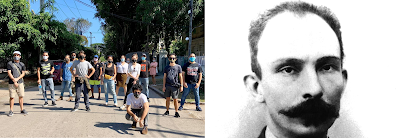
José Julián Martí Pérez at 168: The heirs of José Martí and those who repress them now

"I think they kill my child every time they deprive a person of their right to think." - José Martí


On 27J, the eve of the 168th anniversary of the birth of José Julián Martí Pérez, better known as José Martí, approximately 20 artists, journalists and intellectuals gathered to read some of his works. [...]  Preemptive arrests, an act of repudiation against gathered artists and intellectuals, the Minister of Culture Alpidio Alonso and his Vice-Minister Fernando León Jacomino, caught on camera physically assaulting nonviolent demonstrators, and the dissidents arrested and crammed into a small bus by secret police and beaten up while already detained, reported Diario de Cuba.  [ Full blog entry]


Wednesday, February 17, 2021

Celebrating real Cuban culture and the artists defying totalitarian efforts to rewrite it

Let us no longer shout "Homeland and Death" but "Homeland and Life"
 
Artists from the San Isidro Movement celebrating Cuban culture
 
 
"Totalitarianism demands, in fact, the continuous alteration of the past, and in the long run probably demands a disbelief in the very existence of objective truth," observed George Orwell in his essay, "The Prevention of Literature" in the journal Polemic, published in January 1946. Writers that refuse to go along with alteration of the past all too often pay a terrible price. This is also true for artists in other fields because totalitarians seek to control the culture. [ Full blog entry ]
 

Tuesday, March 23, 2021

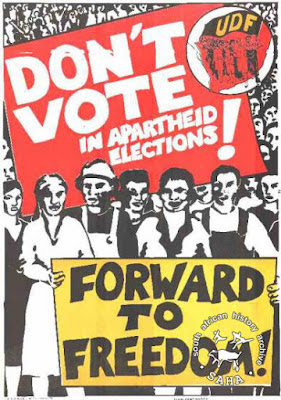
Setting the record straight on Cuito Cuanavale, General Arnaldo Ochoa, and how South African democrats overcame and defeated Apartheid in 1991

Revisiting the nonviolent victory over Apartheid, Castro's genocidal crimes in Africa, and the show trial of the Cuban general that spent months battling the South African Defence forces. 

 
UDF boycotted elections

Communists reject nonviolence as a means to achieve lasting change, because civil disobedience to them is incompatible with Karl Marx's theory of class struggle. This is why they demonize and misrepresent Mohandas Gandhi, downplay the real events that brought an end to Apartheid in South Africa, highlight a dubious military victory in 1988 involving Cuban troops and falsely celebrate it as the agent of change. [ Full blog entry
 

Sunday, April 4, 2021

The Radical Left's Contempt for Martin Luther King Jr. in his final years

"But first He must suffer many things and be rejected by this generation." - Luke 17:25
 
MLK Jr. shot in Memphis, TN at the Lorraine Motel on 4/4/68 at 6:01pm CST

Today is Easter Sunday, but it is also the 53rd observance of the assassination of Reverend Martin Luther King Jr. On Good Friday, I quoted Reverend James Lawson, who like King is an apostle of nonviolence and a Christian pastor, said that “if you want to understand King, you must look at Jesus.” Dr. Martin Luther King Jr., like Jesus, was rejected by all.  He was rejected by conservatives, by liberals, by radicals, and by communists.  [ Full blog entry ]
 

Sunday, May 2, 2021

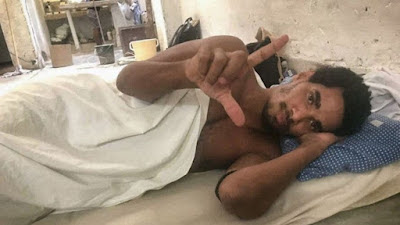
Cuban Dissident Luis Manuel Otero Alcántara on Day 8 of a hunger and thirst strike: Some context informed by past actions and nonviolence theory

"I think they kill my child every time they deprive a person of their right to think." - José Martí

 
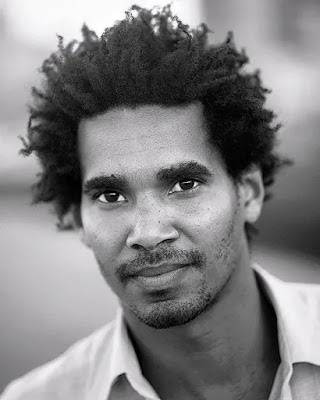
Artist and human rights defender Luis Manuel Otero Alcántara
 
Luis Manuel Otero Alcántara is on the eighth day of a hunger and thirst strike, and in increasingly poor health. He is engaged in a profound dialogue with a regime that for decades has refused to listen, to really listen, to Cuban citizens petitioning for and demanding change. This dialogue has been going on for at least three years. He has tried all types of protests, petitions, performance art pieces, and music videos in defense of freedom of expression, especially artistic expression. [ Full blog entry ]
 

Monday, June 14, 2021

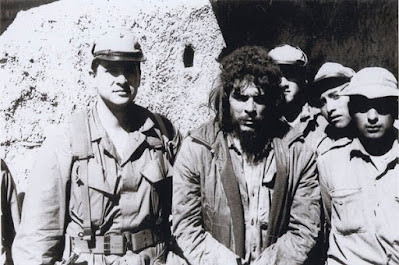
Ernesto "Che" Guevara born on this day in 1928. Nothing to celebrate.

A mass murdering racist, who dined with Mao as millions died of hunger is not someone to celebrate.

"All they that take the sword shall perish with the sword." - Matthew 26, 26:52
 
Some wish to celebrate Ernesto Guevara's birthday today. If he and his comrades had their way the world would have been subjected to a nuclear holocaust in October 1962, and they were bitterly disappointed that it did not happen.

Thankfully, John F. Kennedy and Nikita Khrushchev reached a peaceful outcome to the Cuban Missile Crisis, but the Castro regime protested it and was unhappy with their Soviet allies not launching their nuclear missiles. [ Full blog entry ]

 
Monday, July 19, 2021

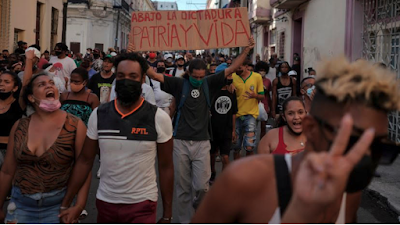
#11July: One week later and nonviolent resistance continues in Cuba

For freedom and justice.

On the streets of Cuba on July 11, 2021

One week later and the protests continue, despite the most brutal efforts of the Castro regime to silence Cubans on the island. It began on July 11, 2021 in San Antonio de los Baños, just South East of Havana when Cubans took to the streets in protest. Others saw it streaming live, and also took to the street in cities and towns across the country chanting "Freedom" and "Down with the dictatorship." 

President Miguel Diaz-Canel appeared on official television threatening: "They [protesters] would have to pass over our dead bodies if they want to confront the revolution, and we are willing to resort to anything."  [ Full blog entry


Sunday, August 22, 2021

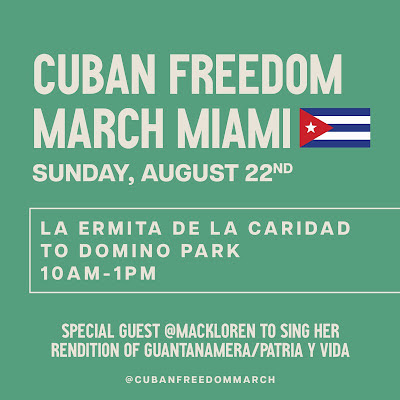
Cuban Freedom March Miami today August 22nd from 10am to 1pm: A reflection on its significance

"If there is to be any chance at all of success, there is only one way to strive for decency, reason, responsibility, sincerity, civility and tolerance, and this is decently, reasonably, responsibly, sincerely, civilly, and tolerantly" - Václav Havel 

 
The Cuban Freedom March arrives in Miami, Florida today on August 22, 2021 with a march from la Ermita de la Caridad to Domino Park. The protest starts at 10:00am. Organizers have carried out successful marches in Washington DC, and Los Angeles.

On August 11, 2021 the leader of this movement, Alian Collazo, moderated a conversation on "what's really happening in Cuba" that is necessary viewing to listen to different perspectives, from young Cuban and Cuban American voices both inside and outside of Cuba.

This is a freedom movement led by young Cubans and Cuban Americans with a presence on social media on Instagram, Facebook, and Twitter. [ Full blog entry ]

Saturday, September 11, 2021

Twenty years after 9/11: Remembering a horrible day

"Are you ready? Okay. Let's roll."—Todd Morgan Beamer, November 24, 1968–September 11, 2001


2,977 men, women and children were murdered on September 11, 2001 over the course of a few hours on a sunny Tuesday morning in three different states. The victims were distributed as follows: 246 on the four planes converted into flying missiles. Two of the planes flew into the Twin Towers which collapsed and led to the deaths of 2,606 human beings in New York City in the towers and on the ground, and a third struck the Pentagon taking 125 lives. The fourth plane, heading to Washington D.C., never arrived and crashed into an open field near Shanksville, Pennsylvania as the passengers of the flight fought the terrorists over control of the flight.  [ Full blog entry ]
 

Saturday, October 2, 2021

Join the non-violent movement for democracy and human rights in Cuba

"Use truth as your anvil, nonviolence as your hammer, and anything that does not stand the test when it is brought to the anvil of truth and hammered with nonviolence, reject it." - Mohandas Gandhi

Luis Manuel Otero Alcántara on day six of hunger strike in Cuba
 
Today in Cuba there are thousands of Cubans jailed for their nonviolent demand for an end to the Castro dictatorship expressed during the mid July 2021 protests. Hundreds have been identified that were jailed or disappeared. It is known that some have resorted to going on hunger strike to protest their unjust imprisonment. Luis Manuel Otero Alcántara is on a hunger strike that he began on September 27, 2021 and is still weak from a bout of COVID-19, and prior hunger strikes. This is part of the movement's repertoire of nonviolent tactics to resist the Castro regime. [ Full blog entry ]
 

Sunday, November 21, 2021

Testimony by John Suarez at the Transatlantic Parliamentary Forum on November 20, 2021

Transatlantic Parliamentary Forum testimony: November 20, 2021
 
Miami City Hall 
 
July 11, 2021 national nonviolent protests in Cuba marked a before and after in the history of the island. Tens of thousands of Cubans across the island demanded an end to the dictatorship, rejected the official slogan Patria o Muerte (Homeland or Death) and chanted Patria y Vida (Homeland and Life). The reaction of the dictatorship was swift and brutal. Boinas Negras (black berets) formally known as the National Special Brigade of the Ministry of the Interior, fired on unarmed protesters, and were captured on video. The dictatorship handed out clubs to regime agents to attack protesters. Thousands were detained, and hundreds remain jailed and face summary trials with prison sentences in excess of 25 years. [ Full blog entry ]
 

Tuesday, December 7, 2021

125 years ago today Antonio Maceo Grajales died fighting for Cuban independence and 31 years ago Reinaldo Arenas died after decades rebelling against the Castro dictatorship

 "My duties to country and to my own political convictions are above all human effort; with these I shall reach the pedestal of freedom or I shall perish fighting for my country's redemption." -  Antonio Maceo, November 3, 1890


Today marks the day 125 years ago on December 7, 1896 when Lieutenant General Antonio Maceo Grajales died fighting for Cuban independence.  

Today, also marks the day 31 years ago on December 7, 1990 Cuban novelist Reinaldo Arenas killed himself in New York City, after battling AIDS for several years. He was an important critic of the Castro regime, and those intellectuals who supported it. As a Gay man he also suffered discrimination because of the communist dictatorship's hostility to homosexuals. [ Full blog entry ]