Showing posts with label Ileana Ros-Lehtinen. Show all posts

Wednesday, March 8, 2023

International Women's Day 2023: Reflection on women's resistance in Cuba and Iran

  "We still think of a powerful man as a born leader and a powerful woman as an anomaly". - Margaret Atwood, author of The Handmaid's Tale


In 2022 focused on the different treatment of women under capitalist and communist regimes. Explored how a communist regime in Romania was a main inspiration for Margaret Atwood's dystopian novel, The Handmaid's Tale.

Shannon Quinn, an author at History Collection, in her post  "17 Moments In History that Inspired the Handmaid’s Tale" in History Collection cited Nicolae Ceausescu's Decree 770 policy targeting Romanian women.

One of the specific events that Margaret Atwood found during her research process was “Decree 770” in Romania. This was a law that passed in 1967 that made abortions and all forms of contraception illegal. This had nothing to do with religious beliefs. It was an action that the government believed was necessary for the future of their country. The government already taxed married couples a 6% income tax if they did not have children between the ages of 25 and 50, but they realized that this was not enough to stop people from using contraception. 


In 2020 focused on the problematic origins of International Women's Day, but today reflect on women who are resisting tyranny.

Specifically, this year will examine how women in Cuba and Iran are challenging totalitarian rule in a communist and theocratic regime respectively. 

Cuba

Over the past sixty four years the Castro dictatorship has systematically violated the human rights of prisoners of conscience and political prisoners in Cuba. Between 1959 and 1988 no international organizations were allowed to visit prisons in Cuba. This included the International Committee of the Red Cross. Lilo Vilaplana’s film Plantadas, screened on Sunday at the Miami Film Festival, examines this chapter of Cuban history, how it impacted Cuban women, and offers viewers the opportunity to revisit some important works to accompany this important movie.

In 1995 Ana Rodriguez with the assistance of Glenn Garvin wrote her memoir DIARY OF A SURVIVOR: Nineteen Years in a Cuban Women's Prison. Ana Rodriguez, a medical student who first conspired against the Batista dictatorship, first welcoming the arrival of Fidel Castro to power she soon became disillusioned and turned against the emerging communist dictatorship. Captured, Ana was sentenced to a 30 year prison sentence for her non-violent dissent in the anti-Castro underground. Over the 19 years she spent in prison, Ana "consistently defied the authorities' brutal and at times comically inept efforts to break her will." She is an example of a plantada, and she was not alone.

Sadly, there were many others like Ana Rodriguez, Gloria Argudín and Luisa Pérez who endured years of torture and mistreatment in Cuban prisons for their political beliefs.

The testimony of Luisa Pérez, another former plantada ( defiant) political prisoner about Cuban prisons in "Nobody listened" (1987), a documentary by Néstor Almendros and Jorge Ulla, is consistent with the testimony of Dora Delgado "Japón" on pages. 175-176 of the 2007 book Todo Lo Dieron Por Cuba (They Gave Everything For Cuba) by Mignon Medrano:

... Mother's Day falls on the 14th again. It was a month full of fights with the militia, of beatings, it was a terrible month. On the 6th they came to galley 1 with a list and called Caridad Roque, me and others. As they called, the others said, "Hey, save me a good bed, and if there are mangoes, pick one for me," because we thought we were going to the farm. But when they noticed that they were taking five from here, two from there and four from another place, and they heard the names, they said, "This smells rotten to us... that the first transfer to the farm is with these people? ... listen, girls, whatever happens, shout!" ...

Indeed, at the end of the long and dark corridor, Ramiro Valdés himself was waiting for us in front of about 600 men. I could not shout and alert because the galleys were open and they would have launched into a certain massacre. I kept walking, behind me came Pola and noticing my reaction she also hid it. That helped the others do the same. But when those who stayed behind found out that we had been taken to Guanajay with the general prison population, they began to break everything that was within their reach and clang metal objects against the iron bars of the cells that was so loud that it became famous in the history of the prison...

... I would like to add to the story of the escape from Guanabacoa that when the verdeolivos caught us and they dragged us to the galley, they had some long weapons that looked like old muskets, which we began to make fun of. We didn't know they were gas launchers. They fired them at point-blank range and with the flashes they burned her face, shattered the face of Luisa Pérez… It was a tremendous fight, blows come and go… They burned all of us with flashes.

Without giving us medical attention, they threw us into the cells like pigs and several days later they separated us in different places…"

Today there are at least 125 Cuban women jailed for exercising their fundamental human rights, and many of them are Plantadas.

 
The women political prisoners who signed with their blood a letter demanding that Miguel Díaz-Canel fulfill Pope Francis' wish that the protesters of July 11, 2021 be released, were taken this past Thursday to a disciplinary court in the women's prison of Guatao in Havana.
 

In 1987 the documentary "Nobody Listened" captured Cuba's human rights reality combining interviews with former political prisoners, including some Plantadas, archival footage of firing squads and other instances of repression. Former prisoners described show trials, extajudicial executions, and cruel and unusual punishment that rose to the level of torture. This is the perfect documentary to accompany the new film, Plantadas and provides historical context to the new movie, and is available online and for purchase on Amazon
 
Please follow these courageous Cuban women: Anamely Ramos González @AnamelyRamos, Berta Soler Fernández @bertasolerf, Carolina Barrero @carolinabferrer, Damas de Blanco @DamasdBlanco, Mar por Cuba @MARporCuba, Omara @OmaraRUrquiola, Ileana Ros-Lehtinen @RosLehtinen, Rosa María Payá A. @RosaMariaPaya, Sirley Avila Leon @Sirleyavilaleon and there are many more that are impossible to list all here.

,

Iran

In September 2022 this blog published a "Call for solidarity with protesters in Iran. Please share hashtags: #MahsaAmini #ZhinaAmini #IranProtests," that highlighted the killing of Mahsa Amini by the Guidance Patrol, also called the morality police, massive nationwide protests that followed, how to help, provided some historic context on relations between Tehran and Cuba, and highlighted the important role of Iranian women in this nationwide uprising. A revolution driven by a celebration and defense of Women, Life, Freedom.

In July 2022, Tehran tried to kidnap, then murder Masih Alinejad.

Iranian journalist Masih Alinejad, who was repeatedly cited in the previous blog post, was targeted by the Iranian Intelligence Services in a plot to kidnap her for Rendition to Iran, revealed the FBI on July 13, 2021. A little over a year later on July 31, 2022 Khalid Mehdiyev, age 23, was found outside her home with an AK-47, a high-capacity magazine and more than $1,000 in cash.

Khalid Mehdiyev is from Azerbaijan, and according to Jason Brodsky at the United Against Nuclear Iran nonprofit the dictatorship in Iran has been known to contract "Azeri hitmen to target Israelis in Cyprus."   

Ayatollah Khomeini, then supreme leader of Iran, issued a fatwa on February 14, 1989 condemning Salman Rushdie to death for blasphemy, and it was never rescinded. Salman Rushdie was attacked by Hadi Matar, age 24, on August 12, 2022 and stabbed in the stomach, chest, eye, hand and thigh. Rushdie needed to be placed on a respirator following the attack, and nearly died. 

U.S. residents are being targeted for kidnapping and murder by agents of Iran in 2022. This is happening in America. This is unacceptable.

Ignoring the injustices taking place in Iran, brought them to New York. Time to pay attention, and hold the mullahs accountable.

Seven months later and it appears that the Mullahs in Iran, in their desperation before women's and young girls resistance to their theocratic rule, may be poisoning young girls who attend school in a war against girl's education.  

The time for solidarity with Iranian women continues.

Please follow Masih Alinejad @AlinejadMasih on Twitter and amplify her voice, and that of other Iranian women such as:  Nazanin Nour @NazaninNour, Roya Hakakian @RoyaTheWriter, Nazanin Boniadi @NazaninBoniadi, Nazenin Ansari @NazeninA, Nazanin Afshin-Jam MacKay @NazaninAJ, and Mariam Memarsadeghi @memarsadeghi

On Saturday at 2:00pm in Washington DC Iranian activists will gather at Freedom Plaza and hold a Global Women's March for Iran.


Wednesday, February 5, 2020

Cubans not exceptional in Latin America. Nicaraguans and Venezuelans are also fleeing communism

Setting the record straight on Cuban exceptionalism

Cubans and Cuban Americans of all ages celebrate Fidel Castro's death in 2016.
The February 5, 2020 article by Rebecca Bodenheimer titled “Analysis: Beyond Cuban exceptionalism and toward the 2020 elections” is “problematic” on several levels and circulating on the internet and needs a response.

First, it misrepresents Cuban-Americans and events in the island. The photograph at the top of the page of her article claims that “Cuban Americans protest Raul Castro leaving office.” The fact of the matter is that Cuban Americans are protesting because Raul Castro remains in power and Miguel Diaz Canel is a puppet and not a real political leader. Hence the protest sign that reads “Raul Castro thwarts the peoples will for self-rule.”

Second, there have been other refugee exoduses in Latin America. There are over 1.272 million Cubans in the United States. It is true that for decades Cubans had been the exception to the rule of immigrants from Latin America. They were political refugees fleeing a communist dictatorship. However, there were also political refugees fleeing Guatemala due to a civil war (involving Marxist guerillas with Cuban aide) between 1960 and 1996 with a total today of 1.364 million Guatemalans. Civil war in El Salvador (again with guerrillas backed by the Castro regime) erupted in the mid-1970s and lasted for 12 years with 1.387 million El Salvadorians now in the United States.

In 1979 when Marxists took over in Nicaragua with the Sandinistas sparking a huge exodus to neighboring countries and to the United States. However, Nicaragua being a smaller country the numbers were smaller than the Cuban exodus. Today there are 405,601 Nicaraguans in the United States, but those numbers will rise with the Ortega regime cracking down on dissent (again with help from the Castro regime). But the Castro takeover in Venezuela, first with Chavez and continued with Maduro, has led to an exodus that dwarfs in absolute numbers, all others with over 3 million in mid-2019 and on track to reach five million. Venezuelans are topping asylum claims to the United States. If you ask Venezuelans you will find that many will point out the negative role of the Castro regime in helping cause this disaster.

Third, Venezuelans are the largest group of refugees fleeing communism in Latin America and seeking asylum in the United States.  Bodenheimer identifies “Cuban migrants” as “one of the largest groups seeking asylum at the US-Mexico border in recent years”, but the top group are Venezuelans. Special programs were created for Cuban refugees because their situation was unique. When one leaves Cuba, especially in the early years of the Castro regime, one was not able to return and their property was confiscated. It did not matter if you rich or poor, you were left with nothing when arriving in the United States after the regime consolidated.

Sadly, Bodenheimer is partially right but for the wrong reasons. Cubans fleeing the island are political refugees fleeing a communist dictatorship, but they are no longer exceptional in the Americas because Nicaraguans, and many more Venezuelans are also fleeing their respective communist regimes. Many of them are also moving to Florida. They also need assistance and special programs to prevent a humanitarian crisis.

Fourth, this is not preferential treatment, but dealing with human tragedies created by communist dictatorships. The U.S. in the past assisted Eastern European refugees, Vietnamese boat people, Cuban refugees, and today should be doing the same with Nicaraguan and Venezuelans refugees.

Fifth, Bodenheimer calls Fidel Castro’s communist regime socialist. Cuba is not Sweden, it has more in common with North Korea.

Ignoring that reality and the negative role it has played and is playing in this hemisphere is seriously problematic. The Castro dictatorship, like their North Korean counterpart, should not be normalized because it has been around for six decades. Bodenheimer plays the race card highlighting the first wave of refugees, which she claims were immigrants, as “wealthy and white,” raising the question of their political status when she says “these Cubans were treated not as economic migrants, but political refugees fleeing a repressive dictatorship.” Nor does she mention that later waves reflected the racial demographics on the island.

Long time allies: Kim Il Sung and Fidel Castro in North Korea
Despite her claims, and that of unidentified experts, Cubans continue to suffer under a totalitarian dictatorship that systematically denies them of all their human rights. Furthermore, many Cuban “migrants” are not able to return to their homeland because of arbitrary restrictions of the Castro dictatorship. This is something that Mexicans and most Central Americans (with the possible exception of Nicaraguans) do not have to suffer.

Sixth, Bodenheimer makes the astounding claim that “Cuba is one of the least violent countries in the hemisphere.” Unlike the rest of Central America there is no legal free press in Cuba, and reporting on crime, health epidemics and other matters embarrassing to the regime are forbidden and invite prison and forced exile. How would one know what the actual levels of violence are? We do know that in the past Cubans have been shot by government snipers, their bodies pulled out with gaff hooks by agents of the Castro regime for trying to leave. Cubans on rafts in the high seas have had sand bags dropped on them for trying to leave. We also know that they have sunk a boatload of refugees for trying to leave.


We also know that when a government dissident tried to get a school reopened that she ended up the victim of a machete attack in May 2015, and a friend who warned her that the regime was going to harm her, was also killed. This woman, Sirley Avila Leon, fled Cuba for her life in November 2016.

Sirley Avila Leon lost her hand and use of her knees in 2015
Seventh, the claim that Cuban Americans have not backed other Latin American refugees and migrants is a libelous lie.

The 1997 Nicaraguan Adjustment and Central American Relief Act or NACARA was sponsored by Cuban American member of Congress Lincoln Diaz-Balart and co-sponsored by Cuban American members of Congress Ileana Ros-Lehtinen, and Robert Menendez that provided protections to Nicaraguans, El Salvadorans, and Guatemalans.

Cuban-American members of Congress, Ileana Ros-Lehtinen, Lincoln Diaz Balart and Robert Menendez also co-sponsored the Haitian Refugee Immigration Fairness Act in 1998 that provided protections to Haitian migrants.

Immigration champions: Lincoln Diaz Balart, Ileana Ros-Lehtinen, Robert Menendez
Eighth, Ms. Bodenheimer’s negative view of Cuban Americans is probably that they view with horror Latin Americans in the United States who wear Che Guevara t-shirts and express a positive view of the Castro dictatorship. This cools victims of the Castro dictatorship to their Latino counterparts. To expect Cuban-Americans not to push back and warn other Latin Americans of this folly is unrealistic.

The author quotes Cuban American sociologist Guillermo Grenier saying that Cubans have never viewed themselves as “illegals.” Question for Ms. Bodenheimer what Latin American migrant self identifies as “illegal”?

Ms. Bodenheimer also tries to frame the Cuban American vote within the immigration debate, ignoring the Obama Administration’s normalization of relations with the Castro dictatorship that involved the freeing of Cuban spies that had murdered four Cuban Americans in 1996.

Furthermore, many Cuban Americans were terrified when President Obama issued a presidential directive in October 2016 that instructed U.S. intelligence agencies to share information with the Castro regime’s state security services.  Many remembered the 1998 WASP spy net work and their plan to carry out bombing campaigns and assassinations in South Florida.

This had much more to do with the Cuban American vote for Trump then immigration, and considering that the Democratic candidates today want to return to that policy it is more than likely that the President will do equally as well with Cuban Americans in 2020 or better.


The first individual in 2016 that told me in Spanish: “Sorry John, but Trump has to win was a middle-aged black Cuban who arrived in the United States in the early 2000s.”

Ms. Bodenheimer may want to look at Cuba and Venezuela policy to see what is driving Cuban American voters. Both Bill Clinton and Barack Obama understood this and ran as pro-sanctions candidates and did well in Florida. Hillary Clinton ran as an anti-sanctions pro-engagement candidate and lost the state.

Cubans are not exceptional, because Nicaraguans also vote Republican because of their anti-communism, and so will many Venezuelans when they get their citizenship.

Cubans, Nicaraguans, and Venezuelans have a common foe.


Tuesday, November 8, 2016

Pro-Embargo candidates sweep in Florida

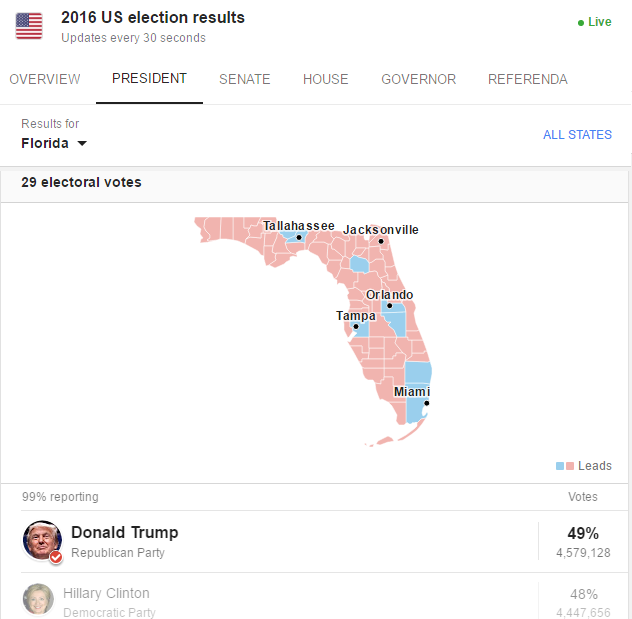
2016 US Election Florida: Cuban Americans repudiated Obama Cuba policy and Hillary Clinton


Hillary Clinton should sue the Pro-Cuba trade lobby for fraud. They used push polls to peddle the false narrative that the Cuban-American community had changed and that backing an opening with the Castro dictatorship would not harm her electoral prospects. They should have seen it coming. On September 28, 2016 this blog reported:
"Cuba, so far this election cycle has not been high on the radar, but with this announcement the Obama Administration's controversial Cuba policy will be debated and at a time when polls indicate that the race in Florida is tightening the Cuban American vote could be decisive in swinging the state and its 29 electoral votes."
Let there be no doubt that this election in Florida was a rejection of Obama's Cuba policy consider the following:

Democratic candidate Joe Garcia running in 26th Congressional District that favored Democrats lost to Republican Carlos Curbelo by 11 points. Garcia had been a high profile champion of President Obama's failed and troubling Cuba policy.

Congresswoman Ileana Ros-Lehtinen defeated anti-embargo candidate Scott Furhman by ten points: 55% to 45% in the 27th Congressional District.

Congressman Mario Diaz-Balart defeated Democratic candidate Dr. Alina Valdes who supports Obama's Cuba policy by 62% to 38% in the 25th Congressional District.

Statewide Marco Rubio, who has been a severe critic of President Obama's Cuba policy defeated anti-embargo candidate Patrick Murphy 52% to 45% and was returned to the U.S. Senate.

Incidentally neither Carlos Curbelo or Ileana Ros-Lehtinen campaigned for Donald Trump

However Donald Trump who initially received 33% of the Cuban American vote while supporting Obama's Cuba policy until mid September 2016 found that when he rejected Obama's Cuba policy and promised repeatedly to back the aspirations of Cubans and Venezuelans to live in freedom his numbers went up to 52% and were probably even higher on election day.

The outcome of the Presidential election in the United States is still being determined tonight but the repudiation of Obama's Cuba policy legacy was felt today with Cuban Americans voting across Florida. 

The question asked by the Wall Street Journal: "Will Obama’s Cuba Policy Lose Florida for Clinton?" has been answered and the answer is yes.

AP Florida State wire reported the following on the exit polls:
"There was a significant divide between Cuban voters and non-Cuban Hispanics in Florida, the state with the nation's third-largest Hispanic population. Trump led with Cuban voters, but more almost three-quarters of non-Cuban Hispanics preferred Clinton. Trump's anti-immigration rhetoric has turned off many Hispanics, but Trump appealed to Cuban voters in September by saying he would reverse the deal Democratic President Barack Obama made with Cuba to reopen diplomatic relations - unless Cuba expands political freedoms."
Anti-embargo lobbyists and pollsters who pitched the lie to Democratic candidates in Florida did Donald Trump a solid that was part of the puzzle that gave him Florida. Mike Fernandez didn't campaign for Donald Trump but with the misrepresentation of the Cuban American community by some of its wealthy members did more to help the Republican nominee than the money showered on Hillary Clinton.