Showing posts with label Donald Trump. Show all posts

Thursday, November 5, 2020

Florida Vote 2020: A post mortem analysis

 "We've seen this movie before."

Contested elections in a free society where we don't know the outcome ahead of time because citizens are actually free to choose is something that those living in dictatorships aspire to one day experience. Cuban Americans want their countrymen on the island to have their sovereignty restored, and the Castro dictatorship brought to an end.

 There has been controversy in the aftermath of 2020 election in Florida where the screen shot above shows a Telemundo Poll with 71% of Cuban Americans polled in favor of President Donald Trump while 23% supported Vice President Joe Biden. Meanwhile The New York Times polled 58% for Trump and 41% for Biden among Cuban Americans. Many have expressed both surprise and outrage at this result, but Cuba observers, and those versed in American politics should not have been surprised. 

Andres Oppenheimer's column "Biden blew it with Miami’s Cuban, Venezuelan voters, and got clobbered" was published on Nov. 4, 2020 and he laid out a pre-existing problem the Vice President had with Cuban American voters. "Many Cuban exiles, especially older ones, still resent President Obama’s 2014 decision to restore full diplomatic relations with Cuba. Biden, then vice president, was part of that move." ... "But Biden could have overcome that by admitting that the Obama administration’s opening with Cuba has not worked as it should." Instead for far too long in 2020 the campaign engaged in gaslighting claiming that things had been better under the Obama Administration. An abbreviated examination should disabuse one of this notion.

Having President Obama campaign in Miami for Biden probably drove up vote for Trump in 2020 and Scott in 2018.

The Obama thaw with the Castro regime did not begin in 2014, but started in 2009 with deadly consequences for Cubans, and five years of arbitrary detention for an innocent American

In 2009 the Obama Administration sought to distance itself from the Cuban dissident movement, while pursuing a diplomatic strategy of engaging with Hugo Chavez, Daniel Ortega, and Raul Castro that critics alleged involved ignoring regime abuses.

President Obama met with Hugo Chavez in 2009, with Maduro in the background

On April 17, 2009 President Barack Obama said that his Administration sought "a new beginning with Cuba" and stated further that he was “prepared to have my administration engage with the Cuban government on a wide range of issues — from human rights, free speech, and democratic reform to drugs, migration, and economic issues.” 

Towards the end of 2009 the White House was tested when U.S. citizen Alan Gross was taken and held hostage by the Castro regime. U.S. diplomats did not see him until 25 days later. Furthermore, the policy of rapprochement and loosening of sanctions continued despite Gross's continued detention.

Alan Gross before and after his captivity in a Cuban prison (2009 - 2014)

On January 14, 2010 the "illegal" Cuban Commission for Human Rights, reported the confirmed deaths of at least 20 mental patients at the Psychiatric Hospital known as Mazorra due to "criminal negligence by a government characterized by its general inefficiency" and that a day later the Cuban government confirmed that 26 patients had died due to “prolonged low temperatures that fell to 38 degrees.” This only occurred because the images of the victims had been leaked and reported by independent journalists. 

On February 23, 2010 Cuban prisoner of conscience Orlando Zapata Tamayo died after a prolonged hunger strike. He had been the victim of numerous beatings and ill treatment that rose to the level of torture over nearly seven years that drove him to go on a water only hunger strike. Prison guards periodically cut off his access to water, contributing to his death.

Extrajudicial killings continued at a higher documented rate than in previous years.


Cuban human rights defender Juan Wilfredo Soto García died on May 8, 2011, three days after being beaten up by police officers in a public park in Santa Clara, Cuba. Amnesty International raised concerns on the circumstances surrounding his death. In the past Juan Wilfredo had been a political prisoner for 12 years.

Laura Inés Pollán Toledo, a courageous woman spoke truth to power and protested in the streets of Cuba demanding an amnesty for Cuban political prisoners. She had been a school teacher, before her husband was jailed for his independent journalism in 2003 along with more than 75 other civil society members. Laura was greatly admired both inside and outside of the island.

Laura reached out to the wives, mothers, sisters, and daughters of the 75 prisoners of conscience jailed in March of 2003 among them was her husband, they founded the Ladies in White, and they carried out a sustained nonviolent campaign that after nine years obtained the freedom of their loved ones. Since she did not dissolve the Ladies in White when her husband returned home because she recognized that the laws had not changed, and that political prisoners remained behind bars and that she would continue her human rights activism, the Castro regime did away with her on October 14, 2011.

On July 22, 2012 Oswaldo Payá Sardiñas, founder and leader of the Christian Liberation Movement and Harold Cepero Escalante, member of the cited movement, lost their lives on the Las Tunas-Bayamo highway, in Cuba. Evidence that the "car accident" was a premeditated act arranged for Oswaldo Paya was that this was not the first time; the regime had also tried with another vehicle 20 days earlier while he was in Havana. The East German Stasi trained the Cuban State Security service known as "G2" and one of its standard tactics was arranging car accidents. Calls for an international investigation continue to circulate and fall on deaf ears. Their movement had launched a petition drive that obtained over 24,000 signatures demanding human rights reforms in an initiative called the Varela Project that forced the regime to change the Constitution to block this type of petition in the future.

The Obama White House and the Castro regime began having secret meetings in June 2013 in Canada. These meetings continued throughout 2013 and 2014. Reporting on these meetings do not mention any reaction to provocative actions by the Cuban dictatorship.

On July 15, 2013 the Cuban government was caught red handed smuggling tons of weapons to North Korea.  This was confirmed by a March 6, 2014 report by a panel of experts for the United Nations Security Council that also reported:

 6. In addition, various parts for three SA-2 and six SA-3 missiles were in the cargo, such as the nose cones housing proximity fuses, auto-pilots and transponders, transmitter antennas and some actuators (figure 4). 4 __________________ 4 The Panel notes that some of the SA-2 and SA-3 parts could also meet the criteria defined in the list of items, materials, equipment, goods and technology related to ballistic missile programmes (S/2012/947), whose export and import by the Democratic People’s Republic of Korea are prohibited. See in particular the Category II, Item 9 of S/2012/947 covering “instrumentation, navigation and direction finding”

There were no consequences for this action of the Castro regime that was also illegal under international law because the White House had prioritized the normalization of relations with the Castro regime, and pressed ahead with their secret negotiations.

On December 17, 2014 both President Obama and General Raul Castro announced that they intended to normalize relations. Alan Gross was finally free after nearly five years in captivity, travel would be further liberalized and that some Cuban political prisoners were to be freed was news that would be received positively.

The President and the dictator address their respective countries on 12/17/14

Nevertheless it was a sobering exercise for Cuban Americans for a number of reasons. Three spies who had spied on military installations and congressmen on American soil, that had plotted terrorist acts in the United States, and were implicated in the February 24, 1996 murder of three American citizens and one American resident were freed in a swap to return to Cuba setting a terrible precedent. Regime hardliners had won, thanks to the Obama Administration's actions. Kidnapping an American and holding him for ransom for five years paid off.  Moderate elements within the dictatorship, seeking to transition Cuba into a responsible member of the family of nations, would remain silent. Gerardo Hernandez, who was serving a double life sentence for espionage and murder conspiracy, returned to Cuba and is now in charge of spying on Cubans domestically through the Committees in Defense of the Revolution.

On February 3, 2015, Rosa María Payá, in testimony before a subcommittee of the Senate Foreign Relations Committee, indicted the indifference of the US government and the international community: "The Cuban government wouldn’t have dared to carry out its death threats against my father if the U.S. government and the democratic world had been showing solidarity. If you turn your face, impunity rages. While you slept, the regime was conceiving their cleansing of the pro-democracy leaders to come."

Rosa María Payá testifies before the Senate Foreign Relations Committee

  On April 8, 2015 Cuban diplomats streamed out of the the Cuban Embassy in Panama attacked civil society representatives who were laying flowers at a bust of Jose Marti in a public park nearby. Several activists were injured and at least one required surgery. During the Summit of the Americas Cuban diplomats disrupted official meetings in order to block Cuban and Venezuelan dissidents from taking part, despite being officially accredited 

Cuban diplomats assaulted nonviolent protesters in Panama

 Cuban dissident Sirley Ávila León, age 56, was gravely wounded in a machete attack on May 24, 2015 by Osmany Carrión who had been "sent by state security thug  s" and that she is sure that the aggression "was politically motivated." The attack was severe enough that she suffered deep cuts to her neck and knees, lost her left hand and nearly lost her right arm. 

On May 29, 2015 the State Department removed Cuba from the list of state sponsors of terrorism, despite evidence of continued bad actions.

Sirley Avila Leon was the victim of regime engineered machete attack.

On Monday, July 20, 2015 at the State Department, Rosa Maria Payá Acevedo attended a press conference with Secretary of State John Kerry and Castro's foreign minister Bruno Rodriguez. Rosa Maria had proper accreditation as a member of the press. Rear Admiral John Kirby, the State Department spokesman, took Rosa Maria aside and warned her that she would be physically removed if she asked any questions.

Secretary of State John Kerry in an interview with journalist Andres Oppenheimer before his trip to Cuba made it known that "the United States and [the Castro regime] are talking about ways to solve the Venezuelan crisis." 

The United States reopened its Embassy in Havana, Cuba on August 14, 2015, but did not invite Cuban human rights defenders to the flag raising ceremony in what the media labeled a snub. The State Department argued that it was a government to government affair and that there was not enough space to accommodate the dissidents. However, the State Department did accommodate "entrepreneurs and Cuban American activists" who flew down with Kerry and his official delegation. Despite the plane load of lobbyists and businessmen CNN anchor Jake Tapper in a tweet observed that there was plenty of space to have invited Cuban dissidents.

On January 7, 2016 The Wall Street Journal broke the story that in 2014 an inert US Hellfire missile sent to Europe for a training exercise was wrongly shipped on to Cuba. Since then the United States has been asking the Cuban dictatorship to return the missile but it has not done so. Only after the embarrassing news broke was it returned, but no doubt all the technical specs had been deciphered by then and given (or sold) to America's enemies.

Three days before President Obama arrived in Cuba, in March 2016 Roberto Ampuero, a Chilean former Minister of Culture and former Ambassador to Mexico tweeted in Spanish: "Paradox: After decades backing Right wing dictatorships in Latin America, now the United States could end up backing a Left wing dictatorship."

Barack Obama and Raul Castro in Havana in March 2016

International consequences were terrible

The European Union announced in 2016 that its two decade policy linking engagement with the Castro regime to improved human rights conditions in the 1996 EU Common position with respect to Cuba was ended to keep up with Obama's detente with Havana.  The old agreement had been consonant with fundamental EU values as expressed below:

“The objective of the European Union in its relations with Cuba is to encourage a process of transition to pluralist democracy and respect for human rights and fundamental freedoms, as well as a sustainable recovery and improvement in the living standards of the Cuban people. A transition would most likely be peaceful if the present regime were itself to initiate or permit such a process. It is not European Union policy to try to bring about change by coercive measures with the effect of increasing the economic hardship of the Cuban people. The European Union considers that full cooperation with Cuba will depend upon improvements in human rights and political freedom”
Unfortunately, it was the Obama Administration's Cuba policy announced on December 17, 2014 and the President's official state visit in March 2016 that both negatively impacted international solidarity and human rights in Cuba, and this included Europe. The decision of the European Union to "open a new chapter" on relations with Cuba that dropped human rights as a condition for normalization ended the 1996 European Common Position. This abandonment of a linkage between human rights and commerce was formalized in a December 12, 2016 signing ceremony that did great harm to the cause of human rights in Cuba.

There is much more and the opening ended with scores of brain damaged U.S. diplomats stationed in Cuba, beginning in November 2016.  Cuban troops reviewed by Raul Castro on January 2, 2017 chanting that they would shoot President Obama so many times in the head that he would have a hat made out of bullets.  Despite this affront, the White House continued meeting Raul Castro's demands that negatively impacted Cubans: ended wet foot dry foot policy for Cuban refugees, and shut down asylum program for trafficked doctors at the end of the Obama Administration. 

Cuban troops in military parade chant they'll shoot President Obama in the head

Candidate Donald Trump in 2016 initially said that he backed the Obama opening, but that he would have gotten a better deal. While holding this position he was polling in the low 30s with Cuban Americans, but when he changed and began advocating undoing the Obama Cuba policy his poll numbers jumped into the 50s, and the Cuban American vote in 2016 played a key role in his election. Hillary Clinton had publicly supported continuing the Obama Cuba policy.

President Trump followed through in dismantling much of the Obama opening, and pressed further than other Presidents in fully enforcing Helms-Burton, and this led to higher levels of support among Cuban American voters. 

Bay of Pigs Veterans endorsed Donald Trump

The Sanders wing of the Democratic Party also raised new concerns that drove many Cuban Americans to the Republican Party. They were also concerned about the future of America when Vice President Biden partially embraced Senator Bernie Sanders who described himself as a "democratic socialist." 

Many  Cubans in South Florida that fled Cuba in the early 1960s had seen this movie before. They supported Fidel Castro, who had promised to restore democracy and bring an end to the authoritarian dictatorship of Fulgencio Batista, only to install a totalitarian communist dictatorship that ended free speech, freedom of assembly, religious freedom, locked up tens of thousands of Cubans for their political or religious views, and executed thousands more. 

Senator Sanders celebrated the Castro regime's education system (which is a center of indoctrination) and healthcare system, which is not only mediocre for most Cubans, but conditional on political loyalty.

James Freeman writing in The Wall Street Journal on November 4, 2020 called the Vice President to task. "Attempting to generate leftist enthusiasm for a listless campaign, Vice President Joe Biden did the country a disservice by partially embracing the radical Sen. Bernie Sanders (Socialist, Vt.), rather than appropriately shunning him."

Cuban Americans understood that there is a chasm of difference between a "social-democrat" and a "democratic socialist" such as the self-identified Senator Sanders of Vermont. Social democracy works within the framework of democratic governance and the rule of law. It also recognizes the market as a necessary mechanism for the creation of human riches, but that it should be tempered by regulations and legislation to protect the environment, and seek a society that is more equitable. This movement is popular in Europe and can be seen in action in Germany, Sweden, Norway, and many other places.

Democratic socialism views private markets and capitalism as evils that need to be replaced by a system that achieves public control over the means of production with government control. Maximizing government control over the private sector took place in Nicaragua, and Venezuela through democratic socialism that transitioned into communist regimes that took over the economic private sphere, and began to silence free speech, shut down independent media, and enforce a particular political ideology on students that destroyed the democratic framework of governance replacing it with dictatorship.

The vote for Trump by Cuban Americans had a three fold significance: 1. Punishing Obama-Biden for the failed detente with Castro that they continued to gaslight Cubans as a success doubling its offensiveness. 2. Gratitude for Trump-Pence dismantling the Obama detente and identifying the true nature of the dictatorship. 3. To vote against the Party who had major candidates such as Bernie Sanders celebrating the "achievements" of the Castro regime, and omitting its bloody history.


Thursday, October 22, 2020

Latin America went unmentioned in tonight's Presidential debate. Here is why that was a mistake.

Revisiting recent Latin American history and U.S. policy

President Donald Trump and Vice President Joe Biden debate.

Regardless who wins in November, the international environment will continue to present challenges to U.S. national security. We heard about China, Russia and North Korea, but nothing was said about an important region neighboring the United States, or the presence of the above mentioned countries in the region. In Latin America, there are three countries with incredibly problematic records on human rights that have translated into massive and systematic human rights violations, economic downturns, mass exoduses of refugees, and engagement with outlaw regimes hostile to America: Cuba, Nicaragua, and Venezuela. They were not mentioned in tonight's debate, and that is a pity. Latin America was relegated without much detail to a question

It is important to examine the historical record.

In January of 1958 the United States was pressuring Batista to restore Constitutional guarantees in exchange for the sale of arms. On March 14, 1958 the State Department in a telegram to the U.S. Embassy in Cuba  requested that the export license for 1,950 M-1 rifles for the Cuban Army awaiting shipment be suspended. This was done because State felt that the Cuban government had failed to "create conditions for fair elections." 


On March 17, 1958 Fidel Castro's candidate for provisional president Manuel Urrutia, along with a delegation of other supporters in exile of the future Cuban dictator's July 26th movement, met with officials at the State Department. They lobbied the U.S. government and argued that arms shipments to Cuba were for hemispheric defense, and they claimed that Batista using them against Cuban nationals was in violation of the conditions agreed to between the two countries.  Months later the U.S. Ambassador to Cuba was pressuring Batista to abandon the country.


The Castro regime took power in 1959, and its objective from the beginning was to consolidate a Marxist Leninist dictatorship in Cuba, and export armed guerillas to overthrow democracies, such as Romulo Betancourt's social democracy in Venezuela in the early 1960s, and replace those governments with communist regimes. 
Dictator Fidel Castro and Vice President Richard Nixon meet in 1959

Containment worked as a policy in the 1960s and 1970s, but when that bipartisan consensus broke down in the mid 1970s, first with President Ford's National Security Advisor and Secretary of State Henry Kissinger beginning in 1974 pursued secret negotiations to normalize relations with Cuba, but the Castro dictatorship intervened again in Africa in 1976 in Angola and later in Ethiopia.  This angered Kissinger, who ended the efforts to normalize relations during the Ford Administration.

Ford lost to Jimmy Carter in the 1976 Presidential election, and the approach to Cuba changed.

On April 27, 1977 representatives of the Carter Administration and the Castro regime sat down and personally negotiated an international fishery agreement. This was the first time since 1958 that any officials of the United States government sat down with representatives of the Castro regime to formally negotiate an agreement.  


Former President Carter in an interview with Robert Fulghum on December 19, 1996 quoted on page 310 of the book Conversations with Carter said: "When I had only been in office two months in 1977, I opened up all travel for American citizens to go to Cuba and vice versa. And we opened up an entry section, which is just one step short of a full embassy in both Havana and Washington. And those offices, by the way, are still open."

Within the Carter administration there were from the beginning low expectations on the limits of what normalizing relations would achieve. The Secretary of the Treasury, W. Micheal Blumenthal, in a August 12, 1977 memorandum to the president titled "Subject: Next Steps on Normalization of U.S. Cuba Relations" addressed Castro regime priorities and the tendency to "overestimate" US leverage:

"I do not believe that our lifting the trade embargo completely, let alone relaxing it partially, would be sufficient to deflect Cuba from pursuits which it considers central to its own national interests, presumably including its involvement in Africa."
Also on August 12, 1977, U.S. Senator Frank Church sent a memorandum to President Carter detailing the conversation he had with Fidel Castro and resulting U.S. policy recommendations for Cuba which included: relaxing restrictions on financial transactions with Cuba in order to make it easier for a tourist to pay a hotel bill. Meeting with Fidel Castro during the United Nations General Assembly later that fall (Clinton would shake hands with Fidel Castro there in 2000). Look for ways to cooperate on controlling the international drug traffic. Explore ways to ease the embargo on trade.

Robert A. Pastor, of The Carter Center in July 1992 in the report "The Carter Administration and Latin America: A Test of Principle" summed the outcome of the Carter policy on Cuba:
In November 1977 there were 400 Cuban military advisers in Ethiopia; by April 1978 there were 17,000 Cuban troops there serving under a Soviet general. The line had been crossed. Carter's hopes for a major improvement in relations with Cuba were dashed, and he said so publicly: "There is no possibility that we would see any substantial improvement in our relationship with Cuba as long as he's [Castro] committed to this military intrusion policy in the internal affairs of African people.
However, according to Pastor in the same article the Castro regime sought to sweeten the pot using political prisoners as political leverage. Unlike  the small, and debated, number of political prisoners released in the recent negotiations with the Castro by the Obama's administration the Carter administration achieved the release of thousands:
"Rhetoric aside, Castro might have thought he could change Carter's mind on normalization if he changed his policy on political prisoners. In the summer of 1978, Castro informed U.S. officials that he was prepared to release as many as 3,900 political prisoners to the United States. (He released about 3,600; 1,000 immigrated to the United States.) During the next year he also released all U.S. prisoners - both political and criminal - and people with dual citizenship. This represented a reversal from a position he had taken in an interview with Barbara Walters one year before. Castro also tried to do the impossible: to transform the Cuban-American community from his enemy to his lobbyist. He invited a group to Havana in November 1978 and left them believing they had persuaded him to release the prisoners." 
Concretely in addition to opening up the interests sections in Havana and Washington D.C. and ending the travel ban the negotiations between the Carter administration and the Castro regime, according to Pastor achieved some additional concrete agreements:
"The U.S. Coast Guard and its Cuban counterpart coordinated their search-and-rescue and anti-drug efforts, and Cuba lifted its 17-year ban on the use of Cuban water and air space by the U.S. Coast Guard. 46 But Cuba's military cooperation with the U.S.S.R. in Africa was an insurmountable obstacle to normalization, and as it expanded, it also began to affect American relations with the Soviet Union."
At the same time as this process was underway the Castro regime also played a crucial role in the Sandinista victory in Nicaragua while the Carter Administration imposed sanctions on the Somoza regime when it refused to pursue democratic reforms. According to Robert Pastor:
Somoza pretended the sanctions had no effect on him. He doubled the size of the National Guard and evidently believed he was secure. However, by May 1979, with Cuban President Fidel Castro's help, the three Sandinista factions had united and established a secure and ample arms flow from Cuba through Panama and Costa Rica. The United States tried to end all arms transfers to both sides. It urged Torrijos and Costa Rican President Rodrigo Carazo to cooperate; both pretended not to be involved. Public opinion in both countries viewed Somoza as the threat to their nations' security and the Sandinistas as the solution to the crisis. The United States did not know the magnitude of the arms flows nor did it have conclusive evidence of the involvement of Costa Rica, Panama, or Cuba. 

Towards the end of the Carter Administration the discovery of a Soviet ground forces brigade operating on Cuban territory and the ineptness in handling the Mariel boatlift crisis spelled not only the end of the policy but was also a contributing factor to the defeat of President Carter during his 1980 re-election bid.  The Cuba policy set out by President Carter in the 1970s was proven a disaster at the time. 

Daniel Ortega and the Sandinista rebels in 1979 financed and backed by the Cubans, took power and a civil war erupted in El Salvador in 1979 with efforts of Cuban backed guerillas to overthrow the existing government. Central America became a blood bath. A communist beach head was established in Central America.

Ronald Reagan entered the White House in 1981 and re-imposed the Cuba travel ban, toughened economic sanctions undoing Jimmy Carter's detente with Fidel Castro, in 1982 placed the Castro regime on the list of state sponsors of terrorism, and started Radio Marti to break through the communist monopoly with uncensored information for Cubans on the island. 

On March 1, 1982 the Castro regime was placed on the list of state sponsors of terrorism. less than three months after the US State Department confirmed that the Castro regime was using a narcotics ring to funnel both arms and cash to the Colombian M19 terrorist group then battling to overthrow Colombia’s democratic government.  

 With Cuba Ronald Reagan backed the creation of a Radio Free Cuba to break Castro regime's information monopoly over the Cuban people beginning in 1981. In a 1983 address, President Reagan explained the importance of getting the truth to oppressed peoples:

The Soviets are terrified of the truth. They understand well and they dread the meaning of St. John's words: "You will know the truth, and the truth will set you free." The truth is mankind's best hope for a better world. That's why in times like this, few assets are more important than the Voice of America and Radio Liberty, our primary means of getting the truth to the Russian people.[...]  We've repeatedly urged the Congress to support our long-term modernization program and our proposal for a new radio station, Radio Marti, for broadcasting to Cuba. The sums involved are modest, but for whatever reason this critical program has not been enacted. Today I'm appealing to the Congress: Help us get the truth through. Help us strengthen our international broadcasting effort by supporting increased funding for the Voice of America, Radio Free Europe, Radio Liberty, and by authorizing the establishment of Radio Marti.

When it finally went on the air in 1985 Radio Marti marked a before and after inside Cuba. At the time President Reagan hoped that Radio Marti would ''help defuse the war hysteria on which much of current Cuban Government policy is predicated.'' The Castro regime's response was to end an immigration agreement and suspend the visits to Cuba by Cubans living in the United States.The Hoover Institution in 1989 listed it as one of a 100 conservative victories.  

The Reagan Administration also named former Cuban political prisoner Armando Valladares Ambassador to the United Nations Human Rights Commission and made human rights in Cuba a priority there. The end result was that for the first and last time Amnesty International, the International Committee of the Red Cross and the UN Human Rights Commission were able to visit Cuban political prisoners.

Dr. Ricardo Bofill co-founded the Cuban Committee for Human Rights in 1976, dedicated his entire life to and suffered years in Cuban prisons for defending human rights. Reagan invited him to the White House in 1988.

Dr. Ricardo Bofill meets President Reagan in The White House in 1988

 
Ronald Reagan was an unapologetic anti-communist who empowered dissidents and engaged in acts of solidarity to underline their importance.  Lastly, President Reagan went to Russia in the midst of Perestroika and Glasnost which meant improving human rights standards and greater freedoms along with dissidents empowered. 

This policy reversed Castroism's gains in Grenada and in Central America. The collapse of the Soviet empire between 1989 through the peaceful dissolution of the Soviet Union in 1991 put the Castro regime into a crisis. However in the midst of this collapse, the remaining communist parties from around the world gathered in Brazil at the Sao Paulo Forum and planned their comeback.


Clinton resurrects Carter's Cuba policy with deadly results
Carter's  détente policy would reassert itself first during the Clinton Administration beginning in 1994 when President Bill Clinton authorized the U.S. military to have permanent contacts and joint exercises with the Castro regime's military.

The Clinton administration stopped calling Cubans refugees declaring them migrants. The General Accounting Office (GAO) explained this change "for over 30 years, fleeing Cubans had been welcomed to the United States; however, the U.S. government reversed this policy on August 19, 1994, when President Clinton announced that Cuban rafters interdicted at sea would no longer be brought to the United States."  Wet foot, dry foot" was a massive set back for Cuban refugees. At the same time a  1995 agreement with the Castro regime empowered them to control who would arrive in the United States by registering Cubans for a lottery and up to 20,000 "immigrants" would be eligible to enter the United States annually. This is a large part of what has led to South Florida being filled with regime oppressors and who knows how many spies. This, not the Cuban Adjustment Act, is what needs to be ended. 

This normalization effort peaked when Bill Clinton shook hands with Fidel Castro in 2000 and opened cash and carry trade with the dictatorship loosening sanctions.  This was done in spite of tightened sanction in 1996 following the Brothers to the Rescue shoot down. This new period of engagement coincided with the rise of Hugo Chavez and reversals of the democratic gains made in the 1980s and early 1990s.

Fidel Castro greets Hugo Chavez in Cuba on December 13, 1994

George W. Bush cools relations without rejecting Clinton normalization advances
During the George W. Bush Administration the cash and carry trade continued as did the joint military exercises. Even though in 2003 in the aftermath of the Black Cuban spring in which 75 dissidents were jailed following show trials the Bush administration responded by tightening sanctions limiting travel by Cuban exiles to Cuba and remittances. In 2006 the Sandinistas return to power in Nicaragua with the old dictator Daniel Ortega now winning a democratic election with 38% of the vote. Despite all of this, under the Bush Administration, the United States became the fifth leading trade partner with the Castro regime in 2008.

Obama's back to the future retread of Carter era Cuba policies

The December 17, 2014 announcement by President Obama broke new ground in U.S.-Cuba relations only one area, when compared to President Carter, releasing Gerardo Hernandez, a Cuban spy and terrorist, convicted of murder conspiracy of three U.S. citizens and a resident. Not only did President Obama commute the sentence but tried to rewrite history calling an act of international terrorism, the Brothers to the Rescue shoot down, a tragedy.  Freeing unrepentant killers is not a good policy for promoting human rights.

More extreme machete attack in 2015

Six months after the announcement of normalizing relations on May 24, 2015, Sirley Ávila León was the victim of a brutal machete attack that cost her her left hand and also left her right upper arm nearly severed and knees slashed, leaving her crippled. She was denied adequate medical care and was told quietly by medical doctors that if she wanted to get better she would need to leave Cuba. The regime had been embarrassed by a campaign she organized to keep a school open. She arrived in Miami on March 8, 2016 unable to bend her legs, or use her remaining had.Thanks to a team of medical doctors treating her, by September 2016 Sirley had regained the use of her hand, and was able to walk short distances.

Negative international trends for human rights in Cuba under Obama Cuba policy.  

Human rights worsened in Cuba as the dictatorship was legitimized internationally by the Obama Administration's Cuba policy, and March 2016 state visit that led to Cuban dissidents and human rights defenders becoming more isolated.  

The Obama administration's Cuba policy of engagement and detente with the Castro regime in the past served to empower other anti-democratic actors in the region with the aide of the Cuban intelligence service and military. Latin American democrats in the region, despite some positive signs, should remain vigilant. These are dangerous times. It is important to recall that the long term policy goals first enunciated by Fidel Castro on July 26, 1959 continue into the present: "We promise to continue making Cuba the example that can convert the cordillera of the Andes into the Sierra Maestra of the American continent." This vision was reaffirmed by Fidel Castro at the VII Cuban Communist Party Conference shortly before his death in 2016

"Lenin’s work insulted after 70 years of revolution. What a historical lesson! We can say that it should not take another 70 years before another event like the Russian Revolution occurs, so that humanity has another example of a great social revolution that meant a huge step in the fight against colonialism and its inseparable companion: imperialism."

With or without sanctions Castro regime's hostility will continue
With or without sanctions the confrontation with the United States will continue as long as the government of the United States is a democracy. Furthermore, the propaganda of the regime in Cuba and its allies in Venezuela, Nicaragua, and elsewhere is that the United States is an imperial power. 

Opening up to the United States economically as it has with other countries will present a new line of argument to justify its continued totalitarian control: the threat of economic domination by the imperialists. 

This can already be seen in the arrests of Western businessmen and the confiscation of their assets with preferences to companies from ideologically friendly countries such as communist China, Vietnam, Venezuela, Brazil, etc. The increased hard currency that the Castro regime is getting its hands on will go towards reinforcing the dictatorship's repressive apparatus at home and expanding its power and influence abroad at the expense of U.S. and regional interests.

Nicaragua: A deteriorating situation
Ominous signs in Nicaragua for Central America with the purchase of 50 new T-72B1 battle tanks at a cost of 80 million dollars in 2016 sent a message to the domestic opposition that has been demonstrated with the Ortega regime.

Ortega's dictatorship shut down independent media and violently crushed non-violent protests in Nicaragua beginning on April 18, 2018 murdering dozens, torturing and arbitrarily detaining many more but failed to silence Nicaraguans, who have continued to protest against the Sandinista dictatorship.

Cuba and Nicaragua then vs Cuba, Nicaragua and Venezuela now

When one looks at different flash points in Latin America over the past sixty one years, the Castro regime has systematically played a negative role.

Wednesday, January 1, 2020

Cuba 2009 - 2019: US - Cuba policy and trends over a decade

The failure of détente.
President Obama with Raul Castro and the moment that symbolized his visit to Cuba
The past decade in Cuba was a difficult one for human rights defenders and pro-democracy activists. Over eight years the Obama Administration attempted to normalize relations with the Castro regime. This was the third such attempt, and the results were similar to the prior two, but in some respects far worse, although predictable.

Under Carter, and Clinton attempts to normalize relations with the Castro regime led to a worsening human rights situation in Cuba, the regime projecting itself more into hemispheric affairs, undermining governments, and coinciding with the rise of other communist regimes: Nicaragua in 1979, and Venezuela in 1999. Migration crises from Cuba that negatively impacted the United States also coincided with Carter, Clinton and Obama who pursued an engagement policy with the dictatorship in Cuba.

President Obama met with Hugo Chavez in 2009, with Maduro in the background
In 2009 the Obama Administration sought to distance itself from the Cuban dissident movement, while pursuing a diplomatic strategy of engaging with Hugo Chavez, Daniel Ortega, and Raul Castro that critics alleged involved ignoring regime abuses.

Daniel Ortega meets with President Obama
On April 17, 2009 President Barack Obama said that his Administration sought "a new beginning with Cuba" and stated further that he was “prepared to have my administration engage with the Cuban government on a wide range of issues — from human rights, free speech, and democratic reform to drugs, migration, and economic issues.”

On May 28, 2009 the Cuban regime backed a Sri Lankan-proposed resolution describing the conflict in Sri Lanka as a “domestic matter that doesn’t warrant outside interference”. Castro's diplomats took the lead in blocking efforts to address the wholesale slaughter then taking place in Sri Lanka. The Foreign Policy Association reported that "Cuba succeeded in blocking debate on abuses in Sri Lanka, which many countries have pushed for after the extreme violence that rocked the country earlier this month." Amnesty International at the time said that “[t]he vote is extremely disappointing and is a low point for the Human Rights Council. It abandons hundreds of thousands of people in Sri Lanka to cynical political considerations.”

Alan Gross before and after his captivity in a Cuban prison (2009 - 2014)
Towards the end of 2009 the White House was tested when U.S. citizen Alan Gross was taken and held hostage by the Castro regime. U.S. diplomats did not see him until 25 days later. Furthermore, the policy of rapprochement and loosening of sanctions continued despite Gross's continued detention.

On January 14, 2010 the "illegal" Cuban Commission for Human Rights, reported the confirmed deaths of at least 20 mental patients at the Psychiatric Hospital known as Mazorra due to "criminal negligence by a government characterized by its general inefficiency" and that a day later the Cuban government confirmed that 26 patients had died due to “prolonged low temperatures that fell to 38 degrees.” This only occurred because the images of the victims had been leaked and reported by independent journalists. 

On February 23, 2010 Cuban prisoner of conscience Orlando Zapata Tamayo died after a prolonged hunger strike. He had been the victim of numerous beatings and ill treatment that rose to the level of torture over nearly seven years that drove him to go on a water only hunger strike. Prison guards periodically cut off his access to water, contributing to his death.

Other prisoners of conscience, such as Ariel Sigler Amaya, who survived the ordeal of Cuban prisons emerged emaciated and completely incapacitated from their captivity in the summer of 2010. The International Committee of the Red Cross had not been able to visit Cuban prisons since 1988-89. Prior to that there had not been a visit allowed since 1959, and no other visits permitted to the present date.
Ariel Sigler Amaya: Before and after his imprisonment in Cuba
 Extrajudicial killings continued at a higher documented rate than in previous years.

Cuban human rights defender Juan Wilfredo Soto García died on May 8, 2011, three days after being beaten up by police officers in a public park in Santa Clara, Cuba. Amnesty International raised concerns on the circumstances surrounding his death. In the past Juan Wilfredo had been a political prisoner for 12 years.


On May 22, 2010 Norwegian media reported that Cuban diplomat, Carmen Julia Guerra, insulted, threatened, and bit a young Norwegian woman, Alexandra Joner age 19, of Cuban descent on her mother's side while she was across the street from the Cuban embassy in Oslo. She was filming a non-violent demonstration in solidarity with the Ladies in White and in remembrance of martyred Cuban dissident Orlando Zapata Tamayo. The main national newspaper in Norway, Aftenposten,  photographed the young girl with bite marks on her hand.

Human rights defender and opposition leader Laura Inés Pollán Toledo died on October 14, 2011 from heart failure at the age of 63. One week after she had fallen suddenly ill from a respiratory infection compounded with dengue fever and already existing condition as a diabetic. A medical professional described her death as"painful, tragic and unnecessary."

Sample of  documented extrajudicial killings in Cuba: 2010 - 2014
On the international seen the Castro regime allied with the worse regimes to undermine international human rights standards. On August 23, 2011 the Cuban government voted against investigating gross and systematic human rights violations in Syria.

In January 2012 there were reports in the media of Cuban, Iranian and Venezuelan diplomats meeting in Mexico to discuss cyber attacks on U.S. soil and allegedly seeking information about nuclear power plants in the United States. 

On July 22, 2012 Oswaldo Payá Sardiñas, founder and leader of the Christian Liberation Movement and Harold Cepero Escalante, member of the cited movement, lost their lives on the Las Tunas-Bayamo highway, in Cuba. Evidence that the "car accident" was a premeditated act arranged for Oswaldo Paya was that this was not the first time; the regime had also tried with another vehicle 20 days earlier while he was in Havana. The East German Stasi trained the Cuban State Security service known as "G2" and one of its standard tactics was arranging car accidents. Calls for an international investigation continue to circulate and fall on deaf ears.


The Castro regime in January 2013 announced a "liberalization" in Cubans being able to travel out of the country, but with qualifiers that maintained the secret police's power to stop anyone from entering or exiting their own homeland.

The Obama White House and the Castro regime began having secret meetings in June 2013 in Canada. These meetings continued throughout 2013 and 2014. Reporting on these meetings do not mention any reaction to provocative actions by the Cuban dictatorship.

On July 15, 2013 the Cuban government was caught red handed smuggling tons of weapons to North Korea.  This was confirmed by a March 6, 2014 report by a panel of experts for the United Nations Security Council that also reported:
 6. In addition, various parts for three SA-2 and six SA-3 missiles were in the cargo, such as the nose cones housing proximity fuses, auto-pilots and transponders, transmitter antennas and some actuators (figure 4). 4 __________________ 4 The Panel notes that some of the SA-2 and SA-3 parts could also meet the criteria defined in the list of items, materials, equipment, goods and technology related to ballistic missile programmes (S/2012/947), whose export and import by the Democratic People’s Republic of Korea are prohibited. See in particular the Category II, Item 9 of S/2012/947 covering “instrumentation, navigation and direction finding”
There were no consequences for this action of the Castro regime that was also illegal under international law.

Despite the worsening situation the White House continued to push for unilateral concessions and the loosening of sanctions on the Castro regime, and pressed ahead with their secret negotiations.

The President and the dictator address their respective countries on 12/17/14
On December 17, 2014 both President Obama and Dictator Raul Castro announced that they intended to normalize relations. Alan Gross was finally free after nearly five years in captivity, travel would be further liberalized and that some Cuban political prisoners were to be freed was news that would be received positively.

Nevertheless it was a sobering and worrisome exercise for a number of reasons. Three spies who had spied on military installations and congressmen on American soil, that had plotted terrorist acts in the United States, and were implicated in the February 24, 1996 murder of three American citizens and one American resident were freed in a swap to return to Cuba set a terrible precedent. Regime hardliners had won, thanks to the Obama Administration's actions. Kidnapping an American and holding him for ransom for five years paid off.  Moderate elements within the dictatorship, seeking to transition Cuba into a responsible member of the family of nations, would continue to remain silent.

Rosa María Payá testifies before the Senate Foreign Relations Committee
On February 3, 2015, Rosa María Payá, in testimony before a subcommittee of the Senate Foreign Relations Committee, indicted the indifference of the US government and the international community: "The Cuban government wouldn’t have dared to carry out its death threats against my father if the U.S. government and the democratic world had been showing solidarity. If you turn your face, impunity rages. While you slept, the regime was conceiving their cleansing of the pro-democracy leaders to come."

Cuban diplomats assaulted nonviolent protesters in Panama
On April 8, 2015 Cuban diplomats streamed out of the the Cuban Embassy in Panama attacked civil society representatives who were laying flowers at a bust of Jose Marti in a public park nearby. Several activists were injured and at least one required surgery. During the Summit of the Americas Cuban diplomats disrupted official meetings in order to block Cuban and Venezuelan dissidents from taking part, despite being officially accredited 

Cuban dissident Sirley Ávila León, age 56, was gravely wounded in a machete attack on May 24, 2015 by Osmany Carrión who had been "sent by state security thug  s" and that she is sure that the aggression "was politically motivated." The attack was severe enough that she suffered deep cuts to her neck and knees, lost her left hand and nearly lost her right arm.

Sirley Avila Leon was the victim of regime engineered machete attack.
On May 29, 2015 the State Department removed Cuba from the list of state sponsors of terrorism, despite evidence of continued bad actions.

On Monday, July 20, 2015 at the State Department, Rosa Maria Payá Acevedo attended a press conference with Secretary of State John Kerry and Castro's foreign minister Bruno Rodriguez. Rosa Maria had proper accreditation as a member of the press. Rear Admiral John Kirby, the State Department spokesman, took Rosa Maria aside and warned her that she would be physically removed if she asked any questions.

Secretary of State John Kerry in an interview with journalist Andres Oppenheimer before his trip to Cuba made it known that "the United States and [the Castro regime] are talking about ways to solve the Venezuelan crisis." 

The United States reopened its Embassy in Havana, Cuba on August 14, 2015, but did not invite Cuban human rights defenders to the flag raising ceremony in what the media labeled a snub. The State Department argued that it was a government to government affair and that there was not enough space to accommodate the dissidents. However, the State Department did accommodate "entrepreneurs and Cuban American activists" who flew down with Kerry and his official delegation. Despite the plane load of lobbyists and businessmen CNN anchor Jake Tapper in a tweet observed that there was plenty of space to have invited Cuban dissidents.

On January 7, 2016 The Wall Street Journal broke the story that in 2014 an inert US Hellfire missile sent to Europe for a training exercise was wrongly shipped on to Cuba. Since then the United States has been asking the Cuban dictatorship to return the missile but it has not done so. Only after the embarrassing news broke was it returned, but no doubt all the technical specs had been deciphered by then and given (or sold) to America's enemies.

Three days before President Obama arrived in Cuba, Roberto Ampuero, a Chilean former Minister of Culture and former Ambassador to Mexico tweeted in Spanish: "Paradox: After decades backing Right wing dictatorships in Latin America, now the United States could end up backing a Left wing dictatorship."

President Obama and Dictator Raul Castro do the wave at a baseball game in Cuba
President Barack Obama and his family visited Cuba on an official state visit on March 20, 2016 and left for Argentina on March 22nd.  The image of President Obama photographed with the Ministry of the Interior in the background with Che Guevara prominently featured and used by Cuban official media as endorsement of the violent revolutionary martyr sent an unfortunate message. As did the photo of Raul Castro with President Obama doing the wave at a baseball game in Havana.

 
The picture at the top of the page with the limp handshake is symbolic of the efforts to engage with the Castro regime. President Obama tried to embrace Raul Castro, but the wily old dictator intercepted it, and tried to turn it into a revolutionary salute, and the US president went limp to avoid it. The loser in the exchange was the American President who came across looking weak. The short video above demonstrates the exchange.

Lady in White Xiomara de las Mercedes Cruz Miranda was arrested on April 16, 2016 for speaking out during a human rights demonstration in Havana's Central park.


Rosa Escalona, member of “The Ladies in White”, a human rights group in Cuba, along with her husband and three sons were subjected to a savage beating by Castro thugs. All four family members suffered great bodily injury, with her husband Alberto Pedro Freire Leiva being the most critically injured. This unprovoked attack took place May 8, 2016 in the city of Holguín, Cuba.

On September 23, 2016 Cuban state security agents raided Cubalex headquarters in Havana and confiscated their equipment and records. Members of the human rights group Cubalex, along with their family members, requested political asylum in the United States.  The organization had formed in 2010 and provided legal representation in Cuba, and documented human rights violations inside the island. They are now all in exile due to the intensification of repression.

The Obama administration issued a Presidential policy directive on United States-Cuba Normalization on October 14th that called for US intelligence agencies to share information with the Castro dictatorship's secret police 

Fidel Castro died at age 90 on November 25, 2016 reported the Castro dictatorship. Cubans that gave a critical assessment of the dictator's legacy or refused to mourn his passing were beaten up, detained, and jailed.

U.S. diplomats began suffering brain injuries in Havana, Cuba in November 2016, and the Obama Administration did not raise this serious issue in the remaining months of their tenure, but continued with their unilateral concessions.

In the midst of the so-called Cuban thaw with the situation for Cubans growing increasingly dire, the international community following the White House's lead abandoned Cuban democrats.   

On December 6, 2016 the European Council of the European Union abandoned Cuban democrats when it "repealed the EU 1996 Common Position on Cuba. The main objective of EU's 1996 common position on Cuba was to encourage transition to pluralist democracy and respect for human rights and fundamental freedoms, as well as a sustainable recovery and improvement in the living standards of the Cuban people." (This may have been pushed by the Obama Administration, in exchange for the release of Alan Gross.)

On January 2, 2017 Raúl Castro presided over a military parade in Havana where marching troops chanted about shooting the American President in the head: “Obama! Obama! with what fervor we’d like to confront your clumsiness, to give you a cleansing with rebels and mortar, and send you a hat of lead to the head.”

Cuban troops chant sending Obama "a hat of lead to the head" in January 2017
On January 4, 2017 former U.S. ambassadors ask President-Elect Trump to stop U.S. intelligence cooperation with Cuban spy agencies.

The Office of the Press Secretary at The White House on January 12, 2017 released a "Statement by the President on Cuban Immigration Policy" that did two concrete things: further restrict the Cuban Adjustment Act and end the Cuban Medical Professional Parole Program. This closed the door on Cuban refugees and victims of the Castro regime's human trafficking.

On January 18, 2017 President Obama commuted the prison sentence of Oscar López Rivera, a terrorist backed by the Castro regime. López Rivera, a founder of the Armed Forces of National Liberation (FALN). The FALN placed more than 130 bombs in American cities — including one in New York City on January 24, 1975. The explosive went off in busy Fraunces Tavern during lunch hour. Four people died. The New York Daily News on January 16, 2017 described another bombing attack that claimed a young life, injured six and caused the evacuation of a 100,000 workers from Manhattan offices.When López Rivera was arrested in 1981, the FBI found six pounds of dynamite and four blasting caps in his Chicago apartment along with numerous fake IDs.

Terrorist Oscar López Rivera freed by Obama in 2017
On February 3, 2017 White House spokesman Sean Spicer announced that the Trump Administration was in the midst "of a full review of all U.S. policies towards Cuba" and that human rights was a priority. 

The Trump Administration on June 6, 2017 released the "National Security Presidential Memorandum on Strengthening the Policy of the United States Toward Cuba" that begins by defining what will guide this new policy: "My Administration's policy will be guided by the national security and foreign policy interests of the United States, as well as solidarity with the Cuban people.  I will seek to promote a stable, prosperous, and free country for the Cuban people.  To that end, we must channel funds toward the Cuban people and away from a regime that has failed to meet the most basic requirements of a free and just society."

President Trump addresses Cuba policy in Miami to the Cuban American community.
On September 19, 2017 President Trump addressed the United Nations and outlined Cuba's negative role in the international community and pledged to maintain sanctions: "That is why in the Western Hemisphere, the United States has stood against the corrupt and destabilizing regime in Cuba and embraced the enduring dream of the Cuban people to live in freedom.  My administration recently announced that we will not lift sanctions on the Cuban government until it makes fundamental reforms."
Alejandro Pupo Echemendía died from police beating on August 9, 2018
Alejandro Pupo Echemendía, a 46 year old Cuban national was beaten to death by the Revolutionary National Police on August 9, 2018 while he was in their custody. Elizama Mujica Cabrera, the wife of the victim courageously denounced the extrajudicial killing despite threats against her and her family by the regime.

Xiomara de las Mercedes Cruz Miranda was placed on parole in January of 2018. She was re-arrested in mid-September 2018 under the charge of being "threatening." On September 19, 2018 she was tried and sentenced to one year and four months in prison. She was sent to a prison 400 kilometers from her home.

Cuban "diplomats" try to shout down side event on political prisoners

On October 16, 2018 Cuban diplomats led an "act of repudiation" at the United Nations to prevent a discussion on the plight of political prisoners in Cuba at a side event organized by the United States.

Police officers in Old Havana brutally beat Cuban citizen Iván Michel Ponce de León on April 19, 2019. Iván Michel died of his injuries eight days later on April 27th. Spanish newspaper ABC covered the story on May 1, 2019.

Iván Michel Ponce de León beaten up by police on April 19th and died of his injuries
On April 22, 2019 independent Cuban journalist Roberto de Jesús Quiñones was beaten up for covering the trial of a religious couple sentenced to prison for homeschooling their kids.  

Roberto Quiñones was physically assaulted on April 22, 2019.
The Trump Administration on May 2, 2019 began to enforce Title III of the LIBERTAD Act, after prior U.S. Presidents beginning with Bill Clinton in 1996 had waived the measure. This has meant a chance for justice in the courts for property owners who had everything stolen from them by the Castro dictatorship.

On May 11, 2019 the Castro regime's efforts at Pinkwashing its totalitarian edifice came crashing down as gay rights activists were beaten down, arrested and taken away for carrying out a Gay Pride march in Havana.

On August 8, 2019 Xiomara de las Mercedes Cruz Miranda was transferred to intensive care. Cuban dissident Angel Juan Moya posted videos of interviews from August 6th and August 7th with doctors at the hospital. Family members complained that they are receiving differing diagnoses and her situation continues to worsen. Xiomara was in intensive care and doctors were saying that it could be lung cancer. A doctor refused to update the family saying: "that he did not want to see those people."

Roberto de Jesús Quiñones Haces
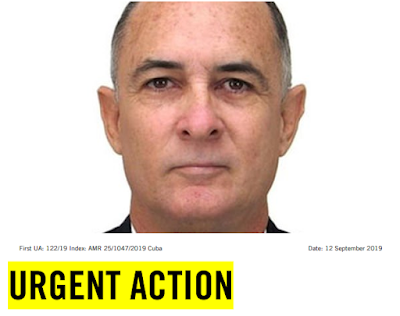
On September 11, 2019 authorities arrested independent Cuban journalist Mr Roberto de Jesús Quiñones Haces in Cuba, after he was convicted of resistance and disobedience in August 2019. He is a prisoner of conscience and serving a one year prison sentence.


Cuban opposition activist José Daniel Ferrer García  was detained on October 1, 2019, by Cuban authorities. He is the leader of the unofficial political opposition group “Patriotic Union of Cuba” (UNPACU) in Santiago de Cuba. He was taken along with three other UNPACU members.

Christian Solidarity Worldwide (CSW) on December 23, 2019 reported that Liusdan Martínez Lescaille, a twelve year-old Jewish boy has been forbidden by Cuban educational authorities from entering his school while wearing a yarmulke since December 11, 2019 with the result that he has been prevented from continuing his education. His younger brother, Daniel Moises, has also been subjected to the ban and government authorities threatened to open legal proceedings against his parents, jailing them and taking their children away.

According to the Ladies in White on December 26, 2019 over Twitter, the Lady in White Xiomara Cruz lost consciousness early in the morning, is currently in intensive care, and according to the Doctor who took her in, she should be receiving medication intravenously.

The past decade has demonstrated that the Castro regime has the will and ruthlessness to hang on to power and is willing to commit atrocities to do so. This has included the murder of opposition figures that could have managed a non-violent transition. Furthermore that engaging, legitimizing and subsidizing the regime leads the Castro dictatorship to expand its international projection with the objective of duplicating its revolutionary project in other countries.