Showing posts with label Josef Stalin. Show all posts

Monday, April 13, 2026

April 13th is the Day of Remembrance for the Victims of the Katyn Massacre.

 "To forget would be not only dangerous but offensive; to forget the dead would be akin to killing them a second time.” - Elie Wiesel, Night


The Soviet Union claimed to enter Poland in September of 1939 to "take care" of the people and seven months later beginning in April 1940 they had executed 22,000 Polish officers and buried them in mass graves in what became known as the Katyn Massacre.

Today is the day of remembrance for the victims. Let us remember and place this crime into its historic context.

On September 17, 1939 with "between 600–650,000 soldiers and over 5,000 thousand Red Army tanks  [of the Soviet Union] invaded the Second Polish Republic, which had been fighting against German aggression since 1 September."

The Soviet Union "invaded Poland on the pretext that ‘the Polish country and its government ceased to exist’. Consequently, ‘the USSR had to take care of the people who lived in Western Ukraine and Western Belarus and their possessions’ as the Soviet propaganda referred to the eastern regions of the Second Polish Republic." ... " About 230,000 [Polish] soldiers and officers and thousands of military service representatives were taken captive by the Bolsheviks."

The reality was that the Soviets had entered into a non-aggression pact with Nazi Germany that included secret protocols dividing up Poland. Nazi and Soviet troops met in the middle of Poland and exchanged pleasantries in September of 1939. 

The Soviet precursor to the KGB was the NKVD. "From October 1939, the delegated NKVD officials from Moscow heard the prisoners, encouraged them to cooperate and collected data. Only a few of the prisoners agreed to collaborate. The commanding officers’ reports included opinions about hostile attitudes of the Poles and a minimal chance of them being useful to the USSR authorities."

The decision to shoot the prisoners was signed on March 5, 1940 by seven members of the All- Union Communist Party (Bolsheviks) authorities: Joseph Stalin, Lavrentiy Beria (proposer), Kliment Voroshilov, Vyacheslav Molotov, Anastas Mikoyan, Mikhail Kalinin and Lazar Kaganovich.


The lists of those sent to death were to be prepared and signed by Piotr Soprunienko, commander-in-chief of the Prisoners of War Board of People’s Commissariat of Internal Affairs, which was created by the order of Beria in September 1939

In the Spring of 1940 the Soviet secret police began to shoot the prisoners in the back of the head or in the neck and burying them in mass graves.

Smolensk–Katyn
On 3 April, the first prisoners from Kozelsk were transported in cattle trucks through Smolensk to Gniezdovo, where smaller groups were transported by prison cars commonly called ‘czornyje worony’ (‘black ravens’) to the wilderness called Kozie Gory in Katyn Forest. The functionaries of the NKVD killed each person by shooting in the back of the head. By 11 May, 1940, 4,421 Polish citizens had been killed and buried in Katyn death pits. There is an assumption that some officers had been killed in Smolensk28.
Kharkov–Piatykhatky
The first group of prisoners from Starobelsk camp was transported to the headquarters of the Board of Kharkov NKVD district on 5 April 1940. Every night in the basement of the building in Dscherschinski Street executioners killed prisoners by shooting in the neck. The trucks carried the bodies to the pits in Forest Park in Kharkov, a kilometer and a half to Piatykhatky village. By 12 May 3,820 Polish citizens had been killed in Kharkov29.
Kalinin (Tver)–Miednoye
On 4 April, 1940, the NKVD started to send prisoners from Ostashkov to the headquarters of the Board of Kalinin NKVD district (today’s Tver) at 6 Soviet Street. The executions took place in the basements. The same method of killing was used: a shot to the neck. In the mornings trucks carried the bodies to the pits in Miednoye village, 30 kilometers further away. By 22 May, 1940, 6,311 Polish citizens had been killed in Kalinin. What is worth mentioning when it comes to the Katyn lie, is that the territory of Miednoye cemetery has never belonged to Germany30.
Polish authorities built war cemeteries at the places where the officers’ bodies had been buried. The cemeteries were officially opened in the year 2000. (in Kharkov on 17 June, in Katyn on 28 July and on 2 September in Miednoye)31.
Survivors
Only 395 people from the three camps survived. Some of them owed their rescue to pure chance. Several people were willing to fight on the Soviet side in case of German invasion. There were also agents among them, the same ones as the NKVD had in the camps. The officers who were arrested in the camps and transported to NKVD Lubyanka prison in Moscow also managed to escape death in the summer of 194032.

The Guardian summed up the crime as follows: "Joseph Stalin ordered his secret police to execute 22,000 Polish army officers and civilians in 1940, in one of the greatest mass murders of the 20th century."


Eighty years ago in the Spring of 1943 the crime of Katyn was first discovered, but the Soviets denied their role in the crime. 

Forty seven years later on April 13, 1990 the Soviet Union admitted its guilt in the 1940 Katyn Massacre.

Monday, September 15, 2025

Why the UK's victory in the Battle of Britain makes the International Day of Democracy today possible

"Fascism was the shadow or ugly child of communism… As Fascism sprang from Communism, so Nazism developed from Fascism. Thus were set on foot those kindred movements which were destined soon to plunge the world into more hideous strife, which none can say has ended with their destruction." - Winston Churchill, The Second World War, Volume 1, The Gathering Storm (1948)
 
Prime Minister Winston Churchill, the greatest Briton
 
Today the United Nations is observing International Day of  Democracy and the United Kingdom is observing Battle of Britain Day. It is fair to say if the British Democracy had not triumphed over Nazi Germany in that great battle, then we would not have an International Day of Democracy, and the past 80 years would be very different.  
 
This double observance heightens the importance of remembering the wisdom of Winston Churchill and honor the man who twice saved democracy from Nazi and Soviet totalitarianism.  
 
Today in 1940, the Battle of Britain's most decisive clash saw the Royal Air Force repel the largest Luftwaffe air strike against the United Kingdom. Months earlier on June 18, 1940 in a speech in The House of Commons titled "Their Finest Hour" Prime Minister Churchill explained the stakes of World War II and the start of the existential clash for Great Britain: 
I expect that the Battle of Britain is about to begin. Upon this battle depends the survival of Christian civilization. Upon it depends our own British life, and the long continuity of our institutions and our Empire. The whole fury and might of the enemy must very soon be turned on us. Hitler knows that he will have to break us in this Island or lose the war. If we can stand up to him, all Europe may be free and the life of the world may move forward into broad, sunlit uplands. But if we fail, then the whole world, including the United States, including all that we have known and cared for, will sink into the abyss of a new Dark Age made more sinister, and perhaps more protracted, by the lights of perverted science. Let us therefore brace ourselves to our duties, and so bear ourselves that, if the British Empire and its Commonwealth last for a thousand years, men will still say, “This was their finest hour.”
It is shocking in 2025 that some today claim that it was a mistake to go to war against Nazi Germany, and attempt to white wash the profound evil of Hitler's regime in Berlin. 
 
At the same time the apologists for international communism like to extol their so-called "antifascist"credentials while remaining silent or finding bizarre revisionist explanations on the connections between fascism and communism that Mr. Churchill succinctly outlined in the quote at the top of the page. 
 
Of equal concern is the attempt to deny the fact that Adolf Hitler and Josef Stalin signed a pact in August of 1939, that secretly included the division of Central and Eastern Europe between Nazi Germany and Communist Russia, that started World War II
 
This alliance lasted until the summer of 1941 when Hitler ordered the invasion of the Soviet union. Consider for a moment that it was Britain and France who honoring their alliance declared war on Nazi Germany on September 1, 1939 when Poland was invaded by Hitler's Third Reich. 
 
Churchill did not equivocate and in a radio address on October 1, 1939 described the Russian's role as invaders along with the Nazis days after.
 "Poland has been again overrun by two of the great Powers which held her in bondage for 150 years, but were unable to quench the spirit of the Polish nation. The heroic defense of Warsaw shows that the soul of Poland is indestructible, and that she will rise again like a rock, which may for a spell be submerged by a tidal wave, but which remains a rock."
Britain and France were convinced that Russia and Germany were allies and plans were drawn up to attack Russian oil fields in order to deny them to the Nazis in what became known in the planning stages as Operation Pike.  Months later the reversals continued for Christendom. The Fall of France to the Nazi war machine took place between May 10 and June 25, 1940 over the span of 46 days ending in the evacuation of Dunkirk. This disaster is what led to Operation Pike being scrapped.

The British Empire was alone for almost a year between June 25, 1940 through June 22, 1941 as the sole main resistance to Nazi Germany. The United States would remain neutral until Pearl Harbor on December 7, 1941 and the Soviet Union was a de facto ally of Nazi Germany until Hitler invaded communist Russia on June 22, 1941 in Operation Barbarossa. The United Kingdom was all that stood between the survival of Christian civilization and a new Dark Age that Adolf Hitler called the Thousand Year Reich. If one is truly Anti-Nazi then one must celebrate and honor the legacy of Winston Churchill, who early on identified the Nazi threat and issued calls to to resistance with one of the most important in a radio address to London and the United States on October 16, 1938.

"Dictatorship – the fetish worship of one man – is a passing phase. A state of society where men may not speak their minds, where children denounce their parents to the police, where a business man or small shopkeeper ruins his competitor by telling tales about his private opinions; such a state of society cannot long endure if brought into contact with the healthy outside world. The light of civilised progress with its tolerances and co-operation, with its dignities and joys, has often in the past been blotted out. But I hold the belief that we have now at last got far enough ahead of barbarism to control it, and to avert it, if only we realise what is afoot and make up our minds in time. We shall do it in the end. But how much harder our toil for every day’s delay! Is this a call to war? Does anyone pretend that preparation for resistance to aggression is unleashing war? I declare it to be the sole guarantee of peace. We need the swift gathering of forces to confront not only military but moral aggression; the resolute and sober acceptance of their duty by the English-speaking peoples and by all the nations, great and small, who wish to walk with them."
Four years earlier on November 16, 1934, after the Nazis had just been in power a little over two years Winston Churchill warned of their threat to peace:
There is a nation which has abandoned all its liberties in order to augment its collective strength. There is a nation which, with all its strength and virtue, is in the grip of a group of ruthless men, preaching a gospel of intolerance and racial pride, unrestrained by law, by parliament, or by public opinion. In that country all pacifist speeches, all morbid war books are forbidden or suppressed, and their authors rigorously imprisoned. From their new table of commandments they have omitted “thou shall not kill.”
Sadly the world did not listen to Churchill until it was too late to avoid a major conflict, but at least it was not too late to stop the Nazi war machine although it came at great cost and suffering. Churchill understood that to defeat Hitler the Soviet Union would have to change sides and when the Nazis invaded Russia the British Prime Minister joked, "If Hitler invaded Hell, I would at least make a favourable reference to the Devil in the House of Commons.” The price of ending Hitler was cozying up to Josef Stalin, another genocidal totalitarian monster.

Churchill was not blind to the nature of his wartime ally and understood the threat of Josef Stalin and the Soviet Union and thankfully his warnings on March 5, 1946 at Westminster College in Fulton Missouri were listened to this time and may have avoided World War III, albeit with a cold peace.
"From Stettin in the Baltic to Trieste in the Adriatic, an iron curtain has descended across the Continent. Behind that line lie all the capitals of the ancient states of Central and Eastern Europe. Warsaw, Berlin, Prague, Vienna, Budapest, Belgrade, Bucharest and Sofia, all these famous cities and the populations around them lie in what I must call the Soviet sphere, and all are subject in one form or another, not only to Soviet influence but to a very high and, in many cases, increasing measure of control from Moscow." 
He then went on to make a remarkable statement about the circumstances that led to World War II and how it was completely avoidable:
Last time I saw it all coming and cried aloud to my own fellow-countrymen and to the world, but no one paid any attention. Up till the year 1933 or even 1935, Germany might have been saved from the awful fate which has overtaken her and we might all have been spared the miseries Hitler let loose upon mankind. There never was a war in all history easier to prevent by timely action than the one which has just desolated such great areas of the globe. It could have been prevented in my belief without the firing of a single shot, and Germany might be powerful, prosperous and honoured to-day; but no one would listen and one by one we were all sucked into the awful whirlpool. We surely must not let that happen again.

Churchill was not only an Anti-Nazi but also an Anti-Communist and a conservative who on May 24, 1948 observed: "Socialism is the philosophy of failure, the creed of ignorance and the gospel of envy." 

He also understood and celebrated the importance of free speech. In the midst of the war in 1943 he observed

"Everyone is in favour of free speech. Hardly a day passes without its being extolled, but some people's idea of it is that they are free to say what they like, but if anyone says anything back, that is an outrage."  

Today let us remember this great statesman, democrat, and conservative and call on all people of good will to learn form this greatest of Britons. His moral clarity, and the victory in the Battle of Britain 85 years ago, makes possible the celebration of the International Day of Democracy.


Sunday, April 13, 2025

April 13th is the Day of Remembrance for the Victims of the Katyn Massacre.

 "To forget would be not only dangerous but offensive; to forget the dead would be akin to killing them a second time.” - Elie Wiesel, Night


The Soviet Union claimed to enter Poland in September of 1939 to "take care" of the people and seven months later beginning in April 1940 they had executed 22,000 Polish officers and buried them in mass graves in what became known as the Katyn Massacre.

Today is the day of remembrance for the victims. Let us remember and place this crime into its historic context.

On September 17, 1939 with "between 600–650,000 soldiers and over 5,000 thousand Red Army tanks  [of the Soviet Union] invaded the Second Polish Republic, which had been fighting against German aggression since 1 September."

The Soviet Union "invaded Poland on the pretext that ‘the Polish country and its government ceased to exist’. Consequently, ‘the USSR had to take care of the people who lived in Western Ukraine and Western Belarus and their possessions’ as the Soviet propaganda referred to the eastern regions of the Second Polish Republic." ... " About 230,000 [Polish] soldiers and officers and thousands of military service representatives were taken captive by the Bolsheviks."

The reality was that the Soviets had entered into a non-aggression pact with Nazi Germany that included secret protocols dividing up Poland. Nazi and Soviet troops met in the middle of Poland and exchanged pleasantries in September of 1939. 

The Soviet precursor to the KGB was the NKVD. "From October 1939, the delegated NKVD officials from Moscow heard the prisoners, encouraged them to cooperate and collected data. Only a few of the prisoners agreed to collaborate. The commanding officers’ reports included opinions about hostile attitudes of the Poles and a minimal chance of them being useful to the USSR authorities."

The decision to shoot the prisoners was signed on March 5, 1940 by seven members of the All- Union Communist Party (Bolsheviks) authorities: Joseph Stalin, Lavrentiy Beria (proposer), Kliment Voroshilov, Vyacheslav Molotov, Anastas Mikoyan, Mikhail Kalinin and Lazar Kaganovich.

The lists of those sent to death were to be prepared and signed by Piotr Soprunienko, commander-in-chief of the Prisoners of War Board of People’s Commissariat of Internal Affairs, which was created by the order of Beria in September 1939

In the Spring of 1940 the Soviet secret police began to shoot the prisoners in the back of the head or in the neck and burying them in mass graves.

Smolensk–Katyn
On 3 April, the first prisoners from Kozelsk were transported in cattle trucks through Smolensk to Gniezdovo, where smaller groups were transported by prison cars commonly called ‘czornyje worony’ (‘black ravens’) to the wilderness called Kozie Gory in Katyn Forest. The functionaries of the NKVD killed each person by shooting in the back of the head. By 11 May, 1940, 4,421 Polish citizens had been killed and buried in Katyn death pits. There is an assumption that some officers had been killed in Smolensk28.
Kharkov–Piatykhatky
The first group of prisoners from Starobelsk camp was transported to the headquarters of the Board of Kharkov NKVD district on 5 April 1940. Every night in the basement of the building in Dscherschinski Street executioners killed prisoners by shooting in the neck. The trucks carried the bodies to the pits in Forest Park in Kharkov, a kilometer and a half to Piatykhatky village. By 12 May 3,820 Polish citizens had been killed in Kharkov29.
Kalinin (Tver)–Miednoye
On 4 April, 1940, the NKVD started to send prisoners from Ostashkov to the headquarters of the Board of Kalinin NKVD district (today’s Tver) at 6 Soviet Street. The executions took place in the basements. The same method of killing was used: a shot to the neck. In the mornings trucks carried the bodies to the pits in Miednoye village, 30 kilometers further away. By 22 May, 1940, 6,311 Polish citizens had been killed in Kalinin. What is worth mentioning when it comes to the Katyn lie, is that the territory of Miednoye cemetery has never belonged to Germany30.
Polish authorities built war cemeteries at the places where the officers’ bodies had been buried. The cemeteries were officially opened in the year 2000. (in Kharkov on 17 June, in Katyn on 28 July and on 2 September in Miednoye)31.
Survivors
Only 395 people from the three camps survived. Some of them owed their rescue to pure chance. Several people were willing to fight on the Soviet side in case of German invasion. There were also agents among them, the same ones as the NKVD had in the camps. The officers who were arrested in the camps and transported to NKVD Lubyanka prison in Moscow also managed to escape death in the summer of 194032.

The Guardian summed up the crime as follows: "Joseph Stalin ordered his secret police to execute 22,000 Polish army officers and civilians in 1940, in one of the greatest mass murders of the 20th century."


Eighty three years ago in the Spring of 1943 the crime of Katyn was first discovered, but the Soviets denied their role in the crime. 

Forty seven years later on April 13, 1990 the Soviet Union admitted its guilt in the 1940 Katyn Massacre.

Wednesday, March 5, 2025

We Remember: 85 years ago today Josef Stalin, and several others of the Soviet Politboro, signed the order that led to the Katyn Massacre.

To forget would be not only dangerous but offensive; to forget the dead would be akin to killing them a second time.” - Elie Wiesel, Night

Josef Stalin in the foreground, Lavrentiy Beria seated behind him.

On March 5, 1940 the Political Bureau of the Central Committee of the Communist Party of the Soviet Union passed a resolution to shoot Polish prisoners of war held in the camps in Kozelsk, Starobielsk and Ostashkov and those detained by the NKVD in prisons in Western Belarus and Ukraine. 

Eighty five years ago today Josef Stalin, Vyacheslav Molotov, Lazar Kaganovich, Kliment Voroshilov, Anastas Mikoyan, and Mikhail Kalinin signed Lavrentiy Pavlovich Beria's order, condemning over  22,000 Polish POWs and civilians to death. Beria was Stalin's  head of the People's Commissariat for Internal Affairs (NKVD) from 1938 until 1945. He was the head of the secret police in the Soviet Union.


Beria's March 5, 1940 note requested that the cases of the Polish POWs and those arrested in a special manner should be dealt the highest penalty - by shooting them and without a formal trial.
 

This crime would forever be linked to the Katyn Forest, where some of the mass graves were first discovered. This dark anniversary was observed five years ago in a conference titled "Generations of Memory - Testimonies."

This mass execution was carried out while Communist Russia and Nazi Germany were allies that divided Poland and the rest of Central Europe between the two totalitarian powers in the August 24, 1939 Molotov-Ribbentrop Pact.

During this one year 10 month "honeymoon" between Nazi Germany and the Soviet Union, Stalin's regime also handed over Jewish refugees to the Nazi Gestapo. 

Mass grave in the Katyn forest.

The crimes of Katyn and the Soviet Union's aiding of Nazi Germany's crimes against the Polish and Jewish peoples between September 1939 and June 22, 1941 must not be forgotten at a time that Russia's Vladimir Putin is trying to rewrite history in an Orwellian fashion, while he continues to write new chapters of infamy in Ukraine.


Tuesday, March 5, 2024

We Remember: 84 years ago today the order that led to the Katyn Massacre was signed by Josef Stalin

 To forget would be not only dangerous but offensive; to forget the dead would be akin to killing them a second time.” - Elie Wiesel, Night


Josef Stalin in the foreground, and Lavrentiy Beria seated behind him.

On March 5, 1940 the Political Bureau of the Central Committee of the Communist Party of the Soviet Union passed a resolution to shoot Polish prisoners of war held in the camps in Kozelsk, Starobielsk and Ostashkov and those detained by the NKVD in prisons in Western Belarus and Ukraine. 

Eighty four years ago today Josef Stalin signed Lavrentiy Pavlovich Beria's order, condemning 22,000 Polish POWs and civilians to death. Beria was Stalin's  head of the People's Commissariat for Internal Affairs (NKVD) from 1938 until 1945. He was the head of the secret police in the Soviet Union.

Beria's March 5, 1940 note requested that the cases of the Polish POWs and those arrested in a special manner should be dealt the highest penalty - by shooting and without a formal trial.

This crime would forever be linked to the Katyn Forest, where some of the mass graves were first discovered. This dark anniversary was observed four years ago in a conference titled "Generations of Memory - Testimonies."

This mass execution was carried out while Communist Russia and Nazi Germany were allies that divided Poland and the rest of Central Europe between the two totalitarian powers in the 1939 Molotov-Ribbentrop Pact.

During this one year 10 month "honeymoon" between Nazi Germany and the Soviet Union, Stalin's regime also handed over Jewish refugees to the Nazi Gestapo. 

The crimes of Katyn and the Soviet Union's aiding of Nazi Germany's crimes against the Polish and Jewish peoples between September 1939 and June 1941 must not be forgotten at a time that Russia's Vladimir Putin is trying to rewrite history in an Orwellian fashion, while he writes new chapters of infamy in Ukraine.

Thursday, April 13, 2023

April 13th is the Day of Remembrance for the Victims of the Katyn Massacre.

 "To forget would be not only dangerous but offensive; to forget the dead would be akin to killing them a second time.” - Elie Wiesel, Night


The Soviet Union claimed to enter Poland in September of 1939 to "take care" of the people and seven months later beginning in April 1940 they had executed 22,000 Polish officers and buried them in mass graves in what became known as the Katyn Massacre.

Today is the day of remembrance for the victims. Let us remember and place this crime into its historic context.

On September 17, 1939 with "between 600–650,000 soldiers and over 5,000 thousand Red Army tanks  [of the Soviet Union] invaded the Second Polish Republic, which had been fighting against German aggression since 1 September."

The Soviet Union "invaded Poland on the pretext that ‘the Polish country and its government ceased to exist’. Consequently, ‘the USSR had to take care of the people who lived in Western Ukraine and Western Belarus and their possessions’ as the Soviet propaganda referred to the eastern regions of the Second Polish Republic." ... " About 230,000 [Polish] soldiers and officers and thousands of military service representatives were taken captive by the Bolsheviks."


The reality was that the Soviets had entered into a non-aggression pact with Nazi Germany that included secret protocols dividing up Poland. Nazi and Soviet troops met in the middle of Poland and exchanged pleasantries in September of 1939. 

The Soviet precursor to the KGB was the NKVD. "From October 1939, the delegated NKVD officials from Moscow heard the prisoners, encouraged them to cooperate and collected data. Only a few of the prisoners agreed to collaborate. The commanding officers’ reports included opinions about hostile attitudes of the Poles and a minimal chance of them being useful to the USSR authorities."

The decision to shoot the prisoners was signed on March 5, 1940 by seven members of the All- Union Communist Party (Bolsheviks) authorities: Joseph Stalin, Lavrentiy Beria (proposer), Kliment Voroshilov, Vyacheslav Molotov, Anastas Mikoyan, Mikhail Kalinin and Lazar Kaganovich.

The lists of those sent to death were to be prepared and signed by Piotr Soprunienko, commander-in-chief of the Prisoners of War Board of People’s Commissariat of Internal Affairs, which was created by the order of Beria in September 1939

In the Spring of 1940 the Soviet secret police began to shoot the prisoners in the back of the head or in the neck and burying them in mass graves.

Smolensk–Katyn
On 3 April, the first prisoners from Kozelsk were transported in cattle trucks through Smolensk to Gniezdovo, where smaller groups were transported by prison cars commonly called ‘czornyje worony’ (‘black ravens’) to the wilderness called Kozie Gory in Katyn Forest. The functionaries of the NKVD killed each person by shooting in the back of the head. By 11 May, 1940, 4,421 Polish citizens had been killed and buried in Katyn death pits. There is an assumption that some officers had been killed in Smolensk28.
Kharkov–Piatykhatky
The first group of prisoners from Starobelsk camp was transported to the headquarters of the Board of Kharkov NKVD district on 5 April 1940. Every night in the basement of the building in Dscherschinski Street executioners killed prisoners by shooting in the neck. The trucks carried the bodies to the pits in Forest Park in Kharkov, a kilometer and a half to Piatykhatky village. By 12 May 3,820 Polish citizens had been killed in Kharkov29.
Kalinin (Tver)–Miednoye
On 4 April, 1940, the NKVD started to send prisoners from Ostashkov to the headquarters of the Board of Kalinin NKVD district (today’s Tver) at 6 Soviet Street. The executions took place in the basements. The same method of killing was used: a shot to the neck. In the mornings trucks carried the bodies to the pits in Miednoye village, 30 kilometers further away. By 22 May, 1940, 6,311 Polish citizens had been killed in Kalinin. What is worth mentioning when it comes to the Katyn lie, is that the territory of Miednoye cemetery has never belonged to Germany30.
Polish authorities built war cemeteries at the places where the officers’ bodies had been buried. The cemeteries were officially opened in the year 2000. (in Kharkov on 17 June, in Katyn on 28 July and on 2 September in Miednoye)31.
Survivors
Only 395 people from the three camps survived. Some of them owed their rescue to pure chance. Several people were willing to fight on the Soviet side in case of German invasion. There were also agents among them, the same ones as the NKVD had in the camps. The officers who were arrested in the camps and transported to NKVD Lubyanka prison in Moscow also managed to escape death in the summer of 194032.

The Guardian summed up the crime as follows: "Joseph Stalin ordered his secret police to execute 22,000 Polish army officers and civilians in 1940, in one of the greatest mass murders of the 20th century."

Eighty years ago in the Spring of 1943 the crime of Katyn was first discovered, but the Soviets denied their role in the crime.  

Forty seven years later on April 13, 1990 the Soviet Union admitted its guilt in the 1940 Katyn Massacre.

#TVPWorld, Poland's first English-language channel, reported on the Katyn anniversary observed today.

Tuesday, June 22, 2021

#OTD in 1941 the Stalin - Hitler Alliance ended when Nazi Germany invaded the Soviet Union

 "Fascism was the shadow or ugly child of communism… As Fascism sprang from Communism, so Nazism developed from Fascism. Thus were set on foot those kindred movements which were destined soon to plunge the world into more hideous strife, which none can say has ended with their destruction." - Winston Churchill, The Second World War, Volume 1, The Gathering Storm (1948)

Soviet and Nazi soldiers fraternize in Poland. Their alliance ended 80 years ago today


On August 23, 1939 the world was shocked to learn that Communist Russia and Nazi Germany had signed a non-aggression pact, the Molotov-Ribbentrop pact. It was named after their respective foreign ministers, Vyacheslav Molotov and Joachim von Ribbentrop. Observers would have been even more horrified had they known of the secret protocols that divided Eastern Europe between the two totalitarian powers. What they called a "peace treaty" in reality was a war treaty.

On September 22, 1939 the German Nazi army joined with the Soviet Communist army in a military parade in Brest-Litovsk (Poland) and celebrated together.  

On March 5, 1940 Joseph Stalin ordered his secret police to execute 22,000 Polish army officers and civilians in 1940, and the order was carried out. 

Stalin deported hundreds of refugees to Nazi authorities. Most of them were German anti-fascists, communists, and Jews who were seeking asylum in the Soviet Union. 

Secret protocols of the Hitler-Stalin Pact not only partitioned Poland but also divided up Lithuania, Latvia, Estonia, Finland & Romania into Nazi and Soviet "spheres of influence."

This alliance ended on June 22, 1941 when Hitler double crossed Josef Stalin and launched Operation Barbarossa, the invasion of the Soviet Union.     

"Stalin was shocked; he had received a plethora of warnings of an imminent invasion – notably from Winston Churchill, informed by British intelligence briefings. The communist dictator had refused to believe them," reported Agence France Press. Stalin refused to listen to Churchill, and had relied on Hitler's assurances. 

It is important to recall that for the first 18 months of WW2 that the Soviet Union was allied with Nazi Germany.  Soviet Foreign Minister Vyacheslav Molotov in a October 31, 1939  speech spoke candidly about this alliance, and ridiculed its victims.

"The ruling circles of Poland boasted quite a lot about the ‘stability’ of their state and the ‘might’ of their army. However, one swift blow to Poland, first by the German Army and then by the Red Army, and nothing was left of this ugly offspring of the Versailles Treaty which had existed by oppressing non-Polish nationalities." 

Saturday, November 28, 2020

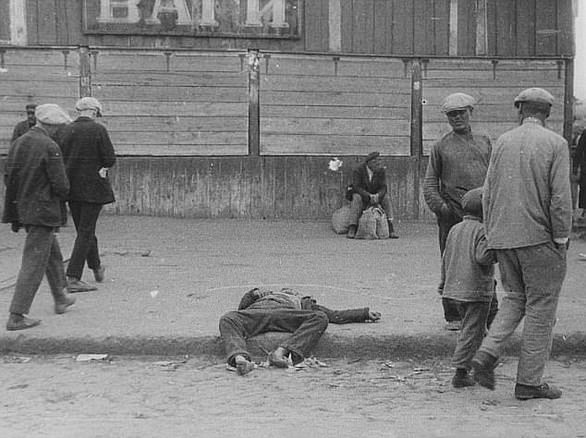
Holodomor Remembrance Day: Memory and witness for the victims of Stalin's Ukrainian Famine

 "In the future, there will be fewer but better Russians." - Greta Garbo, Ninotchka, 1939


The genocide in Ukraine is known as the Holodomor and took place between 1932 -1933. Millions of children died in an artificial famine. This crime was ignored by the United States as it formally recognized the Soviet Union in 1933The Economist in 2012 reported on the 80th anniversary of this man-made famine:

Holodomor literally means death by hunger. In 1932 and 1933, a vast famine in Soviet Ukraine killed three to seven million people, according to estimates. While people starved, the grain was shut away in barns for export.

The deadliest famines in the 20th century were not in Africa but in Europe (Ukraine) and China.
Social science research has demonstrated that famines "happen only with some degree of human complicity."  Human decisions "determine whether a crisis deteriorates into a full-blown famine."


According to Felix Wemheuer, professor of Modern China Studies at the University of Cologne, in his book Famine Politics in Maoist China and the Soviet Union," during the twentieth century, 80 percent of all famine victims worldwide died in China and the Soviet Union." 

Millions starved to death under brutal famine imposed by Joseph Stalin

However, to understand the nature of famine politics in communist regimes the monograph of Andrea Graziosi and Frank E. Sysyn in the East/West: Journal of Ukranian Studies titled "Communism and Hunger" is required reading. Consider the following:

"In fact, with the exception of the 1943 Bengal famine with its approximately two million victims, all of the other major famines of the twentieth century are directly connected to socialist "experiments": in 1921 and 1922 in Russia and Ukraine ( 1million - 1.5 million deaths); in 1931, 1932, and 1933 in the USSR (6.5 million - 7.5 million deaths, of which 4 million were in Ukraine and 1.3 million - 1.5 million in Kazakhstan); in 1946 and 1947 in the USSR (1 million - 1.5 million deaths); from 1958 to 1962 in China (30 million - 45 million deaths); from 1983 to 1985 in Ethiopia (0.5 million - 1.0 million deaths); and from 1994 to 1998 in North Korea ( estimates vary from a few hundred thousand to more than 2 million deaths)."

This was not due to poor central planning and socialist inefficiencies, but a deliberate policy of genocide against targeted population to consolidate political control by eliminating those who do not support their regime. The percentage of victims in the USSR and China relative to their respective overall populations were the same (5%). In the case of the USSR that meant around 7 million deaths out of a population of 160 million and in the case of China  estimates between 30 million and 45 million deaths out of a population of 600 million.


 We must also remember those who bore witness and spoke truth, and those who covered it up. 


Gareth Jones, a Welsh journalist broke the story on the Ukranian famine on March 29, 1933 despite official denials. Walter Duranty of The New York Times wrote an article a day later rebutting Jones's claims that was published in the paper of record on March 31, 1933. 


Sunday, November 15, 2020

High price of good journalism: Case of Gareth Jones and the Ukranian famine told in the film Mr. Jones now streaming

Honoring honor

Brave Welsh journalist Gareth Jones broke story on Soviet famine

Gareth Jones, a Welsh journalist broke the story on the Ukranian famine on March 29, 1933 despite official denials. Walter Duranty of The New York Times wrote an article a day later rebutting Jones's claims that was published in the paper of record on March 31, 1933. 

In the end seven million souls starved to death in a communist manufactured famine in the Ukraine between 1931 and 1933 under the rule of Josef Stalin. Mr. Jones was banned from returning to the Soviet Union by the Communists. 

Two years after publishing this story he was murdered in Inner Mongolia on the eve of his 30th birthday by Chinese bandits in what his family believes was a Moscow coordinated plot to eliminate him.

Mr. Gareth Jones

There are many who look the other way, remain silent, or worse defend the lie to cover up the crime, and are rewarded with prizes and a long and healthy life. This was the case of Walter Duranty, who won a Pulitzer Prize for covering up the famine. Gareth Jones took the path less traveled, that of truth and honor, and paid a high price.

Thankfully, the Polish director Agnieszka Holland has brought his story to the big screen in the 2019 film Mr. Jones

The film is not a docudrama, and takes dramatic license, but it should lead a new generation to explore what he did and the price he paid for witnessing a great crime and reporting the truth. Between 1931 and 1933 Josef Stalin weaponized famine against millions of civilians in the Ukraine, and he had willing accomplices in the West, like Mr. Walter Duranty of The New York Times.

Famine victim in the Ukraine

Thankfully, there were also men of honor like Gareth Jones who risked their lives gathering the facts, and reporting the truth. These are heroes that are still needed today, and tragically all too rare. If you have not seen the film, see it, but also learn the full story of Mr. Jones.

Tuesday, August 25, 2020

Communist Morality: Why Fidel Castro denied he was a communist as he planned to turn Cuba into a communist dictatorship

"'To speak the truth is a petit-bourgeois habit. To lie, on the contrary, is often justified by the lie's aim." - Vladimir Ilyich Ulyanov (Lenin)

"If we had paused to tell the people that we were Marxist-Leninists while we were on Pico Turquino and not yet strong, it is possible that we would never have been able to descend to the plains."  - Fidel Castro, December 2, 1961 


Fidel Castro and his revolutionaries wore medallions of the Virgin Mary
Fidel Castro was a shrewd rascal, as his classmate and future political adversary Jose Ignacio Rasco described him in his writings, but there was more to the wholesale lying and denial of his political ideology and the regime he and others imposed by stealth on Cubans in 1959 and together with his brother remained in total control for six decades. 

Before they consolidated total control in early 1959 they spoke publicly of democracy, human rights and respect for press freedom while privately threatening Cuban journalists of dire consequences if they published anything negative. In the February 14, 1959 letter to journalist Jules Dubois, Fidel Castro claimed that "every person in the society of free nations -- and even those who are oppressed under the heels of dictators -- has a right to express his or her opinion," and in the letter he also recognized the freedom of the press.


Once the Castro brothers had consolidated power and declared their regime openly Marxist Leninist, freedom of expression was subordinated to the goal of a building a communist state, and freedom of the press declared a "bourgeois liberty" that no longer applied to Cuba. Fidel Castro in a 1986 interview spoke on freedom:

"There is revolutionary liberty and there are other liberties which are bourgeois. It's difficult for me to talk about them to Europeans because bourgeois liberties were born there. In England, France, those countries. You talk of equality, liberty, fraternity. I think only our society can truly speak of equality. There's no equality between millionaires and beggars."
Mr. Castro had a point, that with wide disparities of wealth, the poor are at a disadvantage in exercising their rights. However in Cuba the disparity between those in the inner circle of power and the rest of the population is far more extreme and an even worse assault on human dignity. Cuban author Reinaldo Arenas in his book Before Night Falls described it as follows: “The difference between the communist and capitalist systems is that, although both give you a kick in the ass, in the communist system you have to applaud, while in the capitalist system you can scream."


What Castro failed to mention, and Arenas described in the quote above, is that in a society where the rule of law exists a beggar has greater protections that is to say "more equality" than a poor person in Cuba who is entirely subject to the whims of Mr. Castro who also happens to be worth $900 million dollars while the vast majority of Cubans live in squalor.  In the same interview the Cuban dictator expanded on his argument:
"Bourgeois liberties, no. We have two different concepts of freedom. Europeans have one, we have another.  Capitalism and socialism are not at all alike. Your political concepts of liberty, equality, justice are very different from ours. You try to measure a country like Cuba with European ideas. And we do not resign ourselves to or accept being measured by those standards."
For a Marxist Leninist there is no morality beyond whatever serves you to take power. Vladimir Lenin stated it clearly in a speech to Russian communist youth on October 2, 1920:
"The class struggle is continuing and it is our task to subordinate all interests to that struggle. Our communist morality is also subordinated to that task. We say: morality is what serves to destroy the old exploiting society and to unite all the working people around the proletariat, which is building up a new, communist society."
Years later on March 26, 1964, after announcing that he had always been a Marxist Leninist in 1961, Fidel Castro explained: "I conceive the truth in terms of a just and noble end, and that is when the truth is truly true. If it does not serve a just, noble and positive end, truth, as an abstract entity, philosophical category, in my opinion, does not exist." Jose Ignacio Rasco, who knew Fidel Castro from school and afterwards concluded that the Cuban revolutionary had been a committed communist by 1950.

This is why Fidel Castro denied being a communist and along with his fellow guerillas wore medallions of the Virgin Mary when they emerged from the Sierra Maestra in 1959, why Hugo Chavez called Fidel Castro a dictator during his first presidential campaign in 1998, and why Senator Sanders claimed to be critical of Cuba and Nicaragua, in 2020 when he has been a long time apologist. Because to tell the truth would deny them power, and their revolutionary objective is to seize absolute power, transform society into a totalitarian dictatorship that cannot be removed at the polling booth.

Morality and truth are means to an end, and if they do not serve the end of achieving absolute power then they are not recognized as either moral or truthful.
Nazi Foreign minister von Ribbentrop (L), Josef Stalin, Soviet Foreign minister Ribbentrop (R)
This also means that in the service of seeking power everything is moral. Communists in Weimar Germany allied with Nazis to destroy German democracy in the mistaken belief that the National Socialists would quickly implode and they would take over.  

On the international stage Josef Stalin allied with Adolf Hitler on August 23, 1939 and their foreign ministers, Vyacheslav Molotov and Joachim von Ribbentrop, signed a Non-Aggression Pact that was in reality an Aggression Pact to divide up Eastern Europe and led to Soviet and Nazi armies meeting and marching together in the middle of Poland to celebrate their victory. 

Nearly two years later, Hitler double crossed Stalin and invaded the Soviet Union ending the totalitarian dictatorships honeymoon, but after the end of WW2 Stalin and the East German Stasi were funding Neo-Nazi parties to undermine and embarrass West Germany's democracy.
Fidel Castro in 1962 bought weapons from Otto-Ernst Remer
In the early 1960s Otto-Ernst Remer, the Nazi who saved Hitler's Third Reich from being overthrown internally in early 1944, had contacts with and assisted Fidel Castro in Cuba with the purchase of weapons. Ernst-Remer along with Ernst Wilhelm Springer sold the Cuban dictator 4,000 pistols. German foreign intelligence agency Bundesnachrichtendienst (BND) reported: "Evidently, the Cuban revolutionary army did not fear contagion from personal links to Nazism, so long as it served its objectives." 


This is not saying that the Soviet and Castro Communists are Nazis, but that their moral vision does not preclude allying with Nazis to advance their class struggle agenda to achieve power. It is saying that Communists will say and do anything to achieve power. Communists will ally with the worse of the worse and lie about their beliefs and intentions to deceive their way into power. Venezuelans and Nicaraguans have learned this lesson the hard way.


If a political leader honestly told  the citizens of his or her nation: "I am going to take absolute power, strip you of your rights, erect a police state, and rule the country for life, and if you disagree then you have three options: death, prison, or exile" how many votes would they get?


This is why they lie.


Postscript: Fidel Castro and his communist revolutionaries wore medallions of the Virgin Mary, but on September 17, 1961 the communists at gun point collected 131 priests, brothers and a bishop, placing them on board the Spanish ship Covadonga and deported them from Cuba. 

The US State Department 2003 International Religious Freedom Report reported that "from 1965-67 the Government forced many priests, pastors, and others 'who made religion a way of life' into forced labor camps called Military Units to Aid Production (UMAPS), alongside homosexuals, vagrants, and others considered by the regime to be 'social scum.'" 

Fidel Castro canceled Christmas in 1969 under the pretext to prevent work shortages for the 1970 ten million ton sugar harvest but continued the ban until 1997, and sent mobs to intimidate Cubans who attended religious services. Three Kings Day and Easter were also abolished.  In 1976 the Castro dictatorship adopted a constitution which turned Cuba into an atheist state.  

Things improved in the 1990s, but  still today, the Office of Religious Affairs (ORA), an arm of the Central Committee of the Cuban Communist Party, oversees religious affairs in Cuba, and exists to monitor, hinder and restrict religious activities.  


Priests were taken at gun point and forced out of Cuba in 1961