
I too am with Maria Corina Machado
2014 has been the latest bad year in the decade and a half downward spiral of Venezuelan rights and freedoms. Venezuela with a population of 30.41 million according to the Venezuelan Observatory on Violence, estimates that 24,000 people were murdered in 2013, according to the United Nations and the World Bank the number per capita is 54 per 100,000 inhabitants and is considered the second most likely place to be murdered on the planet with Honduras in first place. If trends hold the numbers in 2014 will be even worse.
Venezuelans who protested the rising insecurity and violence were themselves subjected to government repression and violence. The series of events that sparked the student demonstrations in Venezuela began in Táchira on February 4, 2014 when a student at the University of Los Andes in the Botanical Garden of the University was the victim of an attempted rape. Students protested that "insecurity had taken over the campus." The protest was repressed and a number of students arrested and physically mistreated by the authorities. The news of the abuse by government officials sparked additional protests.
On February 10th in an open letter tweeted by student leader Juan Requesens, who has more than 528,000 followers called for dialogue with the government under two conditions 1) that students who were arrested exercising their legitimate right to protest be freed and 2) that calling them "coup plotters" or "terrorists" for engaging in nonviolent protests to demand their rights is unacceptable.
February 12 in Venezuela is a national youth day and students across the country in 2014 organized nonviolent mass demonstrations in response to the earlier repression and were met with violence by regime officials working in coordination with paramilitary groups known as "colectivos." Students were shot in the head and killed.
On February 18, 2014 opposition leader, Leopoldo Lopez, who had advocated nonviolent protests and civil disobedience turned himself over to authorities and as of December 5, 2014 remains imprisoned unjustly in what the United Nations and Amnesty International have described as an arbitrary detention. There is no longer an independent judiciary in Venezuela.
Rodrigo Diamanti, president of the human rights organization, A World Without A Gag ( Un Mundo Sin Mordaza), denounced that his office had been raided on May 1, 2014. On May 3, 2014 he was detained and held for a week.
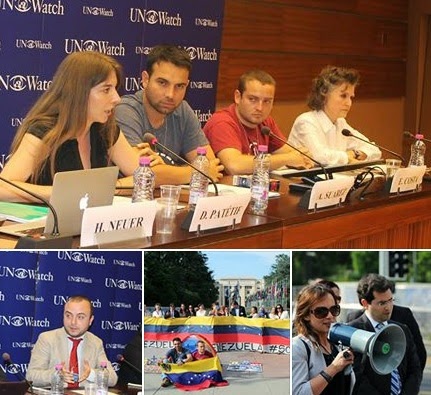
On June 11, 2014 the Venezuelan secret police, otherwise known as the Sebin, called human rights defender Tamara Suju in for questioning. This was another example of a systematic pattern of harassment and repression against human rights defenders. On December 1, 2014 she outlined the reasons for her exile from Venezuela in Prague in La Razon.
On December 3rd a Venezuelan judge charged opposition leader and human rights defender Maria Corina Machado with conspiracy to kill President Nicolas Maduro. The "judge" told her that she faces a maximum prison sentence of eight to 16 years if convicted. This is the latest outrage in a long series of acts of intimidation and violence against this courageous woman outlined in Caracas Chronicles:
Tamara Suju in the photo above demonstrates her solidarity with María Corina Machado and at her side is a placard with the image of the late Czech president Vaclav Havel and the words "thank you."
The world owes the late dissident, statesman, and writer a debt of gratitude for his good works. However, he should also be thanked for his insights into the importance and need for principled and moral politics.
In 1968, after Soviet tanks crushed the Prague Spring, an effort by Czechoslovak communist reformers to build socialism with a human face, Havel wrote the following to the Czechoslovak President Alexander Dubcek who had been one of the reformers later purged: "Even a purely moral act that has no hope of any immediate and visible political effect can gradually and indirectly, over time, gain in political significance."
Havel believed that moral actions, no matter how small or futile they may appear at the time can have profound consequences for both freedom and a just society. It is because the world is not a puzzle to be solved but incredibly much more complex that decisions of right and wrong made by each person have such great importance.
Over 40 years later, when President Barack Obama backed out of meeting with the Dalai Lama due to an upcoming trip to China, Havel offered the corollary to the theorem expounded to Dubcek in 1968 at the October 12, 2009 of the Forum 2000 conference he had organized:
During a conference in Mexico related to Cuba, a speaker made the case for the need of Latin America to open to Cuba and re-insert it into the family of nations in the Americas regardless of the moral implications.
Unfortunately, for Venezuela, the speaker was 40 years too late. Diplomatic relations were restored between Venezuela and Cuba in December of 1974, oil deliveries resumed, and the democratic government of Venezuela under Carlos Andres Perez's first presidency advocated Cuba's readmission to the Organization of American States. At the start of his second presidency (1988 - 1993) ,Carlos Andres Perez invited the tyrant Fidel Castro to his inauguration. These small compromises that overlooked the systematic denial of human rights and freedoms for the Cuban people in favor of a political opening to the Castro dictatorship did not even register on the radar of Machiavellian realpolitik. However these small compromises combined with corruption and rising disgust with the Venezuelan government would lead to disastrous consequences.
In 1992 Hugo Chavez was involved in a failed coup against the democratic government. Pardoned by Andrez Perez's successor, Rafael Caldera, in March 1994 Hugo Chavez made his way to Cuba later that same year where he was received by Fidel Castro as a hero not a failed coup plotter. Four years later, in a reaction to generalized disgust with the corruption endemic to the Venezuelan democratic order epitomized by the Carlos Andres Perez administration the former coup plotter was elected president. Caldera, who had pardoned Chavez, handed power over to him in 1999. Together with Fidel Castro, as a mentor, Chavez began the process of turning a flawed democratic order into the totalitarian regime it is becoming today.
Twenty years ago human rights victims sought refuge in Venezuela today Venezuelan human rights defenders seek refuge in the Czech Republic. Hopefully the small compromises of the Czech government today will not lead to Venezuela like results in their country.
In the meantime, I raise my voice on behalf Leopoldo Lopez, María Corina Machado, Tamara Suju, the students arbitrarily detained, tortured or extra-judicially executed in Venezuela.
 |
| Exiled Venezuelan human rights defender's solidarity with Maria Corina |
Venezuelans who protested the rising insecurity and violence were themselves subjected to government repression and violence. The series of events that sparked the student demonstrations in Venezuela began in Táchira on February 4, 2014 when a student at the University of Los Andes in the Botanical Garden of the University was the victim of an attempted rape. Students protested that "insecurity had taken over the campus." The protest was repressed and a number of students arrested and physically mistreated by the authorities. The news of the abuse by government officials sparked additional protests.
On February 10th in an open letter tweeted by student leader Juan Requesens, who has more than 528,000 followers called for dialogue with the government under two conditions 1) that students who were arrested exercising their legitimate right to protest be freed and 2) that calling them "coup plotters" or "terrorists" for engaging in nonviolent protests to demand their rights is unacceptable.
February 12 in Venezuela is a national youth day and students across the country in 2014 organized nonviolent mass demonstrations in response to the earlier repression and were met with violence by regime officials working in coordination with paramilitary groups known as "colectivos." Students were shot in the head and killed.
On February 18, 2014 opposition leader, Leopoldo Lopez, who had advocated nonviolent protests and civil disobedience turned himself over to authorities and as of December 5, 2014 remains imprisoned unjustly in what the United Nations and Amnesty International have described as an arbitrary detention. There is no longer an independent judiciary in Venezuela.
Rodrigo Diamanti, president of the human rights organization, A World Without A Gag ( Un Mundo Sin Mordaza), denounced that his office had been raided on May 1, 2014. On May 3, 2014 he was detained and held for a week.
On June 11, 2014 the Venezuelan secret police, otherwise known as the Sebin, called human rights defender Tamara Suju in for questioning. This was another example of a systematic pattern of harassment and repression against human rights defenders. On December 1, 2014 she outlined the reasons for her exile from Venezuela in Prague in La Razon.
On December 3rd a Venezuelan judge charged opposition leader and human rights defender Maria Corina Machado with conspiracy to kill President Nicolas Maduro. The "judge" told her that she faces a maximum prison sentence of eight to 16 years if convicted. This is the latest outrage in a long series of acts of intimidation and violence against this courageous woman outlined in Caracas Chronicles:
Since 2010, María Corina Machado has been accused of ordering buses burned. Of instigating lawlessness. Of seeking to generate chaos and panic. Of infiltrating provocateurs into queues for scarce basic goods. Of palling around with Lorent Saleh. Of killing six guards. Of killing Robert Serra. Of plotting to kill the president, (on the basis of forged evidence). Of paying a hacker to delete the evidence against her. Of “plotting a silent coup.” Of “seeking a civil war.” Of conspiracy. Of murder. Of terrorism. Of treason.How did it come to this?
She’s been called an “enemy of the people.” A “shake-down artist of the empire.” A “whore of the empire“. A “hydra-headed monster of coup-plotting“. An “imbecile sell-out lackey.” “Evil for the people.” “The worst the homeland has borne.” “The face of fascism.”
She’s been threatened with detention at INOF, the notoriously violent women’s prison in Los Teques. She’s been told a jail cell is ready for her.
She’s been banned from leaving the country. Stripped of her parliamentary immunity. Stripped of her seat in parliament. Denied any forum to defend herself or present evidence to challenge this decision.
She’s been openly spied on. She’s had her private emails read out on state TV. Her phone calls tapped and the recordings played on state TV. She’s been spied on inside a private home (not on the phone) and had recordings of her conversations broadcast on state TV.
She’s been assaulted in Caricuao. Detained in Maiquetía. Shoved in Chacao. Attacked in Puerto Ordaz. Assaulted in Turmero.
She’s had her followers’ motorbikes burned in Sabaneta de Barinas. She’s had bottles thrown at her in a military parade in Los Próceres. She’s had her face kicked in on the floor of the National Assembly. She’s been threatened with war.
She’s been threatened with the death penalty. In a country that doesn’t even have the death penalty.
Tamara Suju in the photo above demonstrates her solidarity with María Corina Machado and at her side is a placard with the image of the late Czech president Vaclav Havel and the words "thank you."
The world owes the late dissident, statesman, and writer a debt of gratitude for his good works. However, he should also be thanked for his insights into the importance and need for principled and moral politics.
In 1968, after Soviet tanks crushed the Prague Spring, an effort by Czechoslovak communist reformers to build socialism with a human face, Havel wrote the following to the Czechoslovak President Alexander Dubcek who had been one of the reformers later purged: "Even a purely moral act that has no hope of any immediate and visible political effect can gradually and indirectly, over time, gain in political significance."
Havel believed that moral actions, no matter how small or futile they may appear at the time can have profound consequences for both freedom and a just society. It is because the world is not a puzzle to be solved but incredibly much more complex that decisions of right and wrong made by each person have such great importance.
Over 40 years later, when President Barack Obama backed out of meeting with the Dalai Lama due to an upcoming trip to China, Havel offered the corollary to the theorem expounded to Dubcek in 1968 at the October 12, 2009 of the Forum 2000 conference he had organized:
I believe that when the new Laureate of the Nobel Peace Prize postpones receiving the Dalai Lama until after he has accomplished his visit to China, he makes a small compromise, a compromise which actually has some logic to it. However, there arises a question as to whether those large, serious compromises do not have their origin and roots in precisely these tiny and very often more or less logical compromises.Sadly the current government in the Czech Republic appears bent on abandoning Havel's moral foreign policy and follow the rest of the world in prioritizing economic interests over human rights with the result being a general deterioration of both.
During a conference in Mexico related to Cuba, a speaker made the case for the need of Latin America to open to Cuba and re-insert it into the family of nations in the Americas regardless of the moral implications.
 |
| Carlos Andres Perez's small moral compromises with Castro |
 |
| Coup plotter Chavez greeted by Fidel Castro in Cuba in 1994 |
Twenty years ago human rights victims sought refuge in Venezuela today Venezuelan human rights defenders seek refuge in the Czech Republic. Hopefully the small compromises of the Czech government today will not lead to Venezuela like results in their country.
In the meantime, I raise my voice on behalf Leopoldo Lopez, María Corina Machado, Tamara Suju, the students arbitrarily detained, tortured or extra-judicially executed in Venezuela.





 Posts
Posts

