Showing posts with label students. Show all posts

Tuesday, June 3, 2025

Tiananmen Square Massacre: 36 years later still no justice or freedom.

 “This is for the lost souls of June 4th.” - Liu Xiaobo, Nobel Peace Prize Lecture, 2010


Thirty six years ago the Chinese Pro-Democracy Movement that had taken to the streets in April of 1989 and occupied Tiananmen Square for months was violently crushed by the Chinese communist dictatorship beginning on the evening of June 3, 1989. By dawn on June 4, 1989 scores of demonstrators were shot and killed or run over and crushed by tanks of the so-called "People's Liberation Army."

 A 2017 declassified British diplomatic cable revealed that "at least 10,000 people were killed. The Chinese Communist regime still defends committing this massacre, and is punishing those who seek to remember and observe the date.

George Orwell wrote in "As I Please" in the Tribune on February 4, 1944 that "[t]he really frightening thing about totalitarianism is not that it commits 'atrocities' but that it attacks the concept of objective truth; it claims to control the past as well as the future." 

We are witnessing this attempt to silence the victims, erase and rewrite the history of the 1989 Tiananmen protests and the crackdown and massacre that began on June 3, 1989 through social media and in the real world. People are being arrested for engaging in silent, nonviolent protests in remembrance of students and workers murdered by the Peoples Liberation Army (PLA) on orders of the Chinese Communist Party (CCP). 

Making this known is the most effective method to combat it by amplifying the voices of those impacted, and who continue to demand justice. Below is the 2025 declaration by the Tiananmen Mothers, translated by Human Rights in China. 

The Czech writer Milan Kundera wrote that "[t]he struggle of man against power is the struggle of memory against forgetting."  This is the challenge presented by the Chinese Communist Party in its effort to erase the mass protests, months long occupation and crackdown in Tiananmen Square, and across China. It is also why we must remember and honor courageous Chinese dissidents such as Liu Xiaobo martyred for his commitment to nonviolence and democracy.

If you are in the Washington DC area then join the Victims of Communism Memorial Foundation on June 4 at 8:00pm at the Victims of Communism Memorial located on the corner of New Jersey and Massachusetts Avenues to honor the legacy of the brave men and women who stood for freedom, and paid the ultimate price, at their annual Tiananmen Square Massacre candlelight vigil 

Please also share over social media documentary information on what happened. For example, the three hour 1995 documentary, The Gate of Heavenly Peace, provides an over view of the entire protest, and its context in Chinese history, and it is available online. The BBC in 2019 provided a more concise synopsis of the crackdown which is shared below.  

Monday, June 3, 2024

Tiananmen Square Massacre: 35 years later still no justice or freedom.

  “This is for the lost souls of June 4th.” - Liu Xiaobo, Nobel Peace Prize Lecture, 2010


Thirty five years ago the Chinese Pro-Democracy Movement that had taken to the streets in April of 1989 and occupied Tiananmen Square for months was violently crushed by the Chinese communist dictatorship beginning on the evening of June 3, 1989. By dawn on June 4, 1989 scores of demonstrators were shot and killed or run over and crushed by tanks of the so-called "People's Liberation Army."

 A 2017 declassified British diplomatic cable revealed that "at least 10,000 people were killed. The Chinese Communist regime still defends committing this massacre, and is punishing those who seek to remember and observe the date.

George Orwell wrote in "As I Please" in the Tribune on February 4, 1944 that "[t]he really frightening thing about totalitarianism is not that it commits 'atrocities' but that it attacks the concept of objective truth; it claims to control the past as well as the future."

We are witnessing this attempt to silence the victims, erase and rewrite the history of the 1989 Tiananmen protests and the crackdown and massacre that began on June 3, 1989 through social media and in the real world. People are being arrested for engaging in silent, nonviolent protests in remembrance of students and workers murdered by the Peoples Liberation Army (PLA) on orders of the Chinese Communist Party (CCP). Making this known is the most effective method to combat it.

The Czech writer Milan Kundera wrote that "[t]he struggle of man against power is the struggle of memory against forgetting."  This is the challenge presented by the Chinese Communist Party in its effort to erase the mass protests, months long occupation and crackdown in Tiananmen Square, and across China. It is also why we must remember and honor courageous Chinese dissidents such as Liu Xiaobo martyred for his commitment to nonviolence and democracy.


Saturday, June 3, 2023

Tiananmen Square Massacre: 34 years later still no justice or freedom.

 “This is for the lost souls of June 4th.” - Liu Xiaobo, Nobel Peace Prize Lecture, 2010


Thirty four years ago the Chinese Pro-Democracy Movement that had taken to the streets in April of 1989 and occupied Tiananmen Square for months was violently crushed by the Chinese communist dictatorship beginning on the evening of June 3, 1989. By dawn on June 4, 1989 scores of demonstrators were shot and killed or run over and crushed by tanks of the so-called "People's Liberation Army."

 A 2017 declassified British diplomatic cable revealed that "at least 10,000 people were killed. The Chinese Communist regime still defends committing this massacre, and is punishing those who seek to remember and observe the date.

 George Orwell wrote in "As I Please" in the Tribune on February 4, 1944 that "[t]he really frightening thing about totalitarianism is not that it commits 'atrocities' but that it attacks the concept of objective truth; it claims to control the past as well as the future."

We are witnessing this attempt to silence the victims, erase and rewrite the history of the 1989 Tiananmen protests and the crackdown and massacre that began on June 3, 1989 through social media and in the real world. People are being arrested for engaging in silent, nonviolent protests in remembrance of students and workers murdered by the Peoples Liberation Army (PLA) on orders of the Chinese Communist Party (CCP). Making this known is the most effective method to combat it.

The Czech writer Milan Kundera wrote that "[t]he struggle of man against power is the struggle of memory against forgetting."  This is the challenge presented by the Chinese Communist Party in its effort to erase the mass protests, months long occupation and crackdown in Tiananmen Square, and across China. It is also why we must remember and honor courageous Chinese dissidents such as Liu Xiaobo martyred for his commitment to nonviolence and democracy.

Last night participated in a candlelight vigil hosted by the Victims of Communism Memorial Foundation where I listened to eyewitnesses who were present in the square in 1989, and those persecuted today for holding vigils in remembrance.

This blog will continue to do its small part by sharing the 2023 declaration by the Tiananmen Mothers, and translated by Human Rights in China.

Tiananmen Mothers: “We Persist in Our Three Demands as Always: Truth, Compensation, and Accountability 
— On the 34th Anniversary of the June Fourth Massacre” (Statement)

Essay by the Tiananmen Mothers

May 27, 2023

HRIC Note: On the 34th anniversary of the June Fourth Massacre, the Tiananmen Mothers have authorized Human Rights in China to publish this essay. See our website for more information on June Fourth and the Tiananmen Mothers.

[Translation by Mi Ling Tsui]

The year 2023 marks the 34th anniversary of the June Fourth Massacre that unfolded on the night of June 3-4, 1989, on the ten-mile-long Chang'an Avenue in Beijing, the capital of China.

Though 34 years have passed, for us, family members of those killed, the pain of losing our loved ones in that one night has tormented us to this day, in a nightmare that has never let go. In a time of peace, the Chinese government flouted the world’s condemnation and brazenly mobilized the nation’s military power against unarmed students and ordinary people, in a massacre that shocked the world—the June Fourth Massacre. We, families of June Fourth victims, will not relinquish our determination to seek justice for our loved ones every single day that the authorities refuse to make public the truth about the massacre—until justice is done.

Since the 33rd anniversary of June Fourth, in 2022, seven members of our group have passed away (one of them died of old age and physical decline in the first half of the year, and the other six died in the second half of the year). Every time we heard the news of the passing of a fellow family member, we were struck with great sorrow, especially because we could not visit the families of the deceased immediately due to pandemic restrictions. Our hearts are heavy, with no relief.

As we commemorate our loved ones on this 34th anniversary of June Fourth, we honor the deceased family members here—in order to restore history, bear witness to how the victims were killed, recall the harm and suffering inflicted on the victims’ families by the troops who perpetrated the massacre, and so that people can know their misery and remember their desire and unwavering determination to defend their lawful rights and seek justice for their loved ones. Although their lives are gone, their final wishes are still with us.

[ Full document here ]

Signers (116)

Saturday, March 13, 2021

Legacy of the March 13, 1957 assault on Batista's presidential palace in Havana, Cuba

"If you fight with violence, you are fighting with your enemy’s best weapon and you may be a brave but dead hero."- Gene Sharp


Student leader José Antonio Echeverría (center)
 
Sixty four years ago today in the afternoon, a group of young men took up arms and charged into the presidential palace in Havana to assassinate the Cuban dictator, Fulgencio Batista, and were all gunned down. Nearby at the same time in Radio Reloj not knowing that the assault had failed student leader José Antonio Echeverría declared the dictator dead only to be himself killed in a skirmish after leaving the radio station. It was described as the day that Cuba lost its future.

Over six decades later both sides in the ongoing struggle declare José Antonio Echeverría as one of their own. However, his democratic credentials and history as an elected student leader and practicing catholic would place him at odds with the Castro dictatorship.


Jose Antonio's sister Lucy Echeverría  on August 27, 2014 spoke at a panel discussion, "The Urban Insurrection Against Batista: The Life and Times of Jose Antonio Echeverria" at Florida International University about her brother's leadership at the University of Havana: "My brother held the presidency of the Federation of University Students (FEU) four times elected by overwhelmingly majorities. There the troubles began with Castro. As he never became president, he always kept that inside." 

Not mentioned in the Castro regime's official press is how the Echeverria family rejected the Castro regime's totalitarian turn to dictatorship and ended up in exile by 1961. According to Lucy, objects found in the Birthplace Museum of  José Antonio Echeverría in Cárdenas do not belong to her brother. She also explained how a televised tribute by the dictatorship in Cuba, had imposters play the supposed parents of the martyred leader, while the real ones were already exiled in the United States.

Nevertheless, the legacy of the "13 de Marzo" action to overthrow Fulgencio Batista by violent means ended with the deaths of many good and brave Cuban democrats, José Antonio among them, opening the way for Fidel Castro and in hindsight can be seen to have been a disastrous idea.

Michael Nagler, a long time peace scholar, presents the theorem as follows: Nonviolence sometimes “works” and always works, while by contrast, Violence sometimes “works” and never works.  Nagler offers a more detailed explanation.
The exercise of violence always has a destructive effect on human relationships even when, as sometimes happens, it accomplishes some short-term goal. The exercise of nonviolence, or Satyagraha, always brings people closer. This explains why Gandhi, after fifty years of experimentation in every walk of life, could declare that he “knew of no single case in which it had failed.” Where it seemed to fail he concluded that he or the other satyagrahis had in some way failed to live up to its steep challenge.  Taking the long view, he was able to declare that “There is no such thing as defeat in non-violence. The end of violence is surest defeat.”
Unfortunately, the "13 de Marzo" also has another and related significance in Cuban history. Twenty seven years ago this upcoming July 13, 1994 a tugboat named the "13 de Marzo", in honor of that violent anniversary, carrying Cuban families seeking to flee the Castro dictatorship, that replaced Fulgencio Batista in 1959, was attacked by agents of the current dictatorship and 37 were killed among them 10 children.

Victims of the "13 de Marzo" Tugboat Massacre

Wednesday, February 12, 2020

Venezuela's National Youth Day on February 12, 2014 was a defining moment: Students rose up and Maduro murdered them.

"Gentlemen, he who is here will go out tomorrow to find a better future." - Bassil Alejandro Dacosta, age 24 , over Facebook on February 11, 2014. He was murdered the next day by the Maduro regime.

Robert Redman and Bassil Alejandro Dacosta murdered six years ago today
Six years ago today nonviolent student protesters Bassil Da Costa and Robert Redman were gunned down on February 12, 2014 in Venezuela, while engaged in nonviolent street protests against the government of Nicolas Maduro. Robert Redman was shot and killed hours after he had carried Bassil, who had also been shot and died earlier that same day, and tweeted about it.

"Today I was hit with a rock in the back, a helmet in my nose. I swallowed tear-gas, carried the kid who died, and what did you do?" - Robert Redman, age 28 over twitter on February 12, 2014 
On February 12, 2014 Venezuela's National Youth Day millions of young students took to the streets to nonviolently protest "the social and economic crisis caused by the illegitimate government that Venezuela has today."  

Robert Redman with other youths carrying Bassil Dacosta on February 12, 2014.
Young Venezuelans inside and outside of the country mobilized in a coherent and sustained effort to expose the anti-democratic nature of the Maduro regime. A full and brief explanation was offered by Andreina Nash at the time in the video titled: What's going on in Venezuela in a nutshell.

The violence had escalated in the days prior to February 12th. On February 11, 2014 in an update via twitter from Roderick Navarro and Guido Mercado they reported: wounded by bullets today: Jorge Monsalve 20 years old, Franco Perez 15 years old (Thorax), Pedro Alison 24 years old (Left arm), Anny Paredes 36 years old (Abdomen). 

These students continue to face a government that over the past eighteen years has been stripping Venezuela's democracy of all its constitutional and institutional democratic safeguards in order to consolidate power into the United Socialist Party of Venezuela and in the presidency. At the same time the presence of both Cuban state security and military officials in the country who have presided over the building of a totalitarian apparatus is cause for great concern. They have used technological tools to censor images over twitter. Over the past 20 years independent television press outlets have been taken over or shutdown by the government.

Six years later and across Venezuela the youth still remember the fallen and the Maduro regime's repressive forces who murdered them. They have not forgotten and it marked a before and after in the history of the South American country. Ana Karina Garcia over twitter stated in Spanish that, " February 12, 2014 marked us as a generation. Bassil Da Costa, Juancho Montoya and Robert Redman were murdered by the tyranny while they were in the streets demanding a country of opportunities. #AHeroIsNotForgotten"    

Wednesday, August 30, 2017

The education system in Cuba: curriculum politicized, dissent punished, and systemic censorship

Time to set the record straight on education in Cuba 
 
Students entering the University of Havana


Amnesty Global Insights on August 28, 2017 reported on how the internet is controlled and censored in Cuba, but then makes an assertion on the Cuban education system that many Cubans familiar with what existed before and after the Castro Revolution of 1959 would dispute and that is that the current dictatorship has had "achievements in education" citing that "UNESCO and UNICEF have commended Cuba’s educational achievements. Students from across the Caribbean, particularly medical students, graduate from its universities yearly." The Castro regime's diplomats have been very active in both UN organizations and impacted on their reporting. Meanwhile foreign students who studied in Cuba have not been sufficiently prepared to pass their medical license exams. In Pakistan, Cuban trained doctors are demanding an exemption from medical licensing exams to practice medicine there.

The Slovak-based People in Peril conducted a study between 2005 and 2006 that generated a 77 page analysis, What is the future of education in Cuba?,  that a decade a go found an educational system in ruins . Eliska Slavikova of People in Peril interviewed by El Nuevo Herald on October 23, 2007 observed ''Cuban education is destroyed, with grave problems like the deterioration of the schools, the predominance of ideology over teaching  and the bad preparation of teachers.'' The study made the following findings:
• There's been a ''pronounced'' departure of teachers to other jobs because of low salaries and the lack of social recognition.
• Many teachers also left their jobs because of the government's growing ideological pressures. The primary objective of education is the formation of future revolutionary communists.
• The great majority of schools lack the equipment and installations needed to provide a good education.
• High school graduates have been put to teach after only an eight-month special course. But much of the teaching now is done through educational TV channels.
A later analyses of Cuba's educational system in 2008 and more recently in 2015 arrived at the same conclusions on lack of quality, resources and continued politicization of the curriculum. Although Amnesty International mentions "people who have been expelled from university for accessing 'unapproved' information" there is no mention of students expelled and professors fired for their political views or familial ties to Cuban dissidents.

Clockwise: Harold Cepero, Sayli Navarro, David Mauri, Fếlix Yuniel, Karla Pérez,
Meanwhile at the University of Miami in the midst of a controversy where the Institute of Cuban and Cuban American Studies was shut down, all staff fired, and the director, Professor Jaime Suchlicki, apparently forced out on August 15, 2017 because the new president of the University of Miami Julio Frenk wanted to go in a different direction which involved engaging the Castro regime and shutting down a center of academic inquiry. The controversy led UM president Frenk to backpedal and pledge that ICCAS would be reopened and that there would be no institutional relationship with the Castro regime, although they already do exist in other departments.

Inside Higher Education in an article titled "A U.S. University Cuts Itself off From Cuba" quotes "Caleb Everett, a professor and the chair of the anthropology department" who said that  "we understand the dilemma that Frenk is facing in this kind of case where he has a very vocal minority that understandably has strong opinions on the matter. Our strong belief is that to move forward with Cuba from an academic perspective we need collaborative efforts."

This ignores that collaboration with the Cuban government has led in other universities with Cuban Studies self censoring to maintain the relationship with the dictatorship to have access the island compromising academic inquiry. Furthermore students have been targets of espionage and targeted for recruitment by Castro's intelligence service.

Dr. Carlos & Elsa Alvarez: Castro spies at FIU
Florida International University's Cuban Research Institute has had such a "collaborative" relationship in the past that generated bad press for the school. FIU Psychology professor Carlos Alvarez who was the associate professor for educational leadership and policy studies, and his wife Elsa Alvarez, counselor for the psychological services department at Florida International University were arrested by the FBI on January 6, 2006. Professor Alvarez conducted trips to Cuba with young professionals in the late 1990s in what was billed a conflict resolution project.  Carlos Alvarez was sentenced to five years in prison and Elsa Alvarez to three years in prison on February 28, 2007 for conspiring to act as unregistered Cuban agents spying on FIU students.

Casa Bacardi shut down at the University of Miami
UM Professor Everett would like to frame this discussion as a "vocal minority" in the community with "strong opinions" in order to not address the substance of the irregular manner in which ICCAS was shut down and the questions of academic freedom that were raised in the subsequent dialogue along with questions about the complete lack of academic freedom in Cuba and its links to the Cuban dictatorship's spying apparatus. At a time when American and Canadian diplomats have suffered hearing loss and brain damage in Cuba, due either to an attack or espionage gone wrong, these questions have new and urgent relevance as does the need for UM's the Institute of Cuban and Cuban American Studies to maintain its independence and ability to debunk the Castro regime's false narrative with serious scholarship. Both Amnesty International and Professor Everett should know better and not repeat the false narrative propagated by the Castro regime.


Monday, March 13, 2017

The legacy of the March 13, 1957 assault on Batista's presidential palace

"If you fight with violence, you are fighting with your enemy’s best weapon and you may be a brave but dead hero."- Gene Sharp

Student leader José Antonio Echeverría (center)
  Sixty years ago today in the afternoon, a group of young men took up arms and charged into the presidential palace in Havana to assassinate the Cuban dictator, Fulgencio Batista, and were all gunned down. Nearby at the same time in Radio Reloj not knowing that the assault had failed student leader José Antonio Echeverría declared the dictator dead only to be himself killed in a skirmish after leaving the radio station. It was described as the day that Cuba lost its future.

Six decades later both sides in the ongoing struggle declare José Antonio Echeverría as one of their own. However, his democratic credentials and history as an elected student leader and practicing catholic would place him at odds with the Castro dictatorship.


Jose Antonio's sister Lucy Echeverría  on August 27, 2014 spoke at a panel discussion, "The Urban Insurrection Against Batista: The Life and Times of Jose Antonio Echeverria" at Florida International University about her brother's leadership at the University of Havana: "My brother held the presidency of the Federation of University Students (FEU) four times elected by overwhelmingly majorities. There the troubles began with Castro. As he never became president, he always kept that inside." 

Not mentioned in the Castro regime's official press is how the Echeverria family rejected the Castro regime's totalitarian turn to dictatorship and ended up in exile by 1961. According to Lucy, objects found in the Birthplace Museum of  José Antonio Echeverría in Cárdenas do not belong to her brother. She also explained how a televised tribute by the dictatorship in Cuba, had imposters play the supposed parents of the martyred leader, while the real ones were already exiled in the United States.

Nevertheless, the legacy of the "13 de Marzo" action to overthrow Fulgencio Batista by violent means ended with the deaths of many good and brave Cuban democrats, José Antonio among them, opening the way for Fidel Castro and in hindsight can be seen to have been a disastrous idea.

Michael Nagler, a long time peace scholar, presents the theorem as follows: Nonviolence sometimes “works” and always works, while by contrast, Violence sometimes “works” and never works.  Nagler offers a more detailed explanation.

The exercise of violence always has a destructive effect on human relationships even when, as sometimes happens, it accomplishes some short-term goal. The exercise of nonviolence, or Satyagraha, always brings people closer. This explains why Gandhi, after fifty years of experimentation in every walk of life, could declare that he “knew of no single case in which it had failed.” Where it seemed to fail he concluded that he or the other satyagrahis had in some way failed to live up to its steep challenge.  Taking the long view, he was able to declare that “There is no such thing as defeat in non-violence. The end of violence is surest defeat.”
Unfortunately, the "13 de Marzo" also has another and related significance in Cuban history. Twenty three years ago this upcoming July 13, 1994 a tugboat named the  "13 de Marzo", in honor of that violent anniversary, carrying Cuban families seeking to flee the Castro dictatorship, that replaced Fulgencio Batista in 1959, was attacked by agents of the current dictatorship and 37 were killed among them 10 children.

Victims of the "13 de Marzo" Tugboat Massacre

Tuesday, March 10, 2015

Bloody Tuesday in Burma

Students and monks brutally beaten down today in Burma


Students in Burma have been protesting a new education law that they say limits academic freedom in their country. Today the students were brutally beaten down by police along with monks and journalists. Police detained more than 100 people while dispersing demonstrators who had been protesting for more than a week.

More than 100 students and monks beaten and detained today in Burma
 The Burmese regime needs to drop all charges against the arrested students, and unconditionally free any students still in detention. There also needs to be an investigation that holds accountable those responsible for the violence today and institutionalize nationwide measures to prevent recurrence of similar incidents.

Thursday, November 20, 2014

86 Students Taken in Latin America 2014: 43 in Mexico and 43 in Venezuela

“Those who falsify history do not protect the freedom of a nation but, rather, constitute a threat to it.” – Vaclav Havel, The Salzburg Festival, July 26, 1990 


 The situation in Mexico demands concrete attention and actions in the hopes that a resolution can quickly be reached such as:
  • Over social media there are numerous opportunities to demonstrate one's solidarity using hash tags such as: and #GlobalActionForAyotzinapa
  • In Miami on November 20, 2014 at 5pm in the Mexican Consulate in downtown (1399 SW 1st Avenue Miami, FL 33130) join with Mexican activists in a nonviolent protest denouncing the crime while demanding justice and the return of the 43 missing students to their loved ones. Please dress in black Protests also planned in Santa Ana, CA; Dallas, TX and elsewhere.
  • Signing an online letter from Amnesty International calling on the Mexican government to bring all responsible to justice, acknowledge that this is not an isolated case, and for the government to uphold 2012 commitment to eradicate torture and ill treatment of all detainees.
  • Writing opeds, letters to the editor, spreading the word over social media on the internet in order that others may take concrete action on behalf of these 43 students.
Meanwhile efforts by political partisans to take advantage of the situation to advance a particular agenda needs to be quashed while truth and justice serve as a guide to action on behalf of the 43. For example,  Venezuelan Analysis republished an article of Tamara Pearson of the Venezuela and Cuban sponsored television network TELESUR titled 43 Lives, 2 Countries slandering the victims of the Maduro government killed during anti-government protests in 2014 while at the same time failing to mention that in the case of the 43 disappeared students in Mexico the government officials identified as having colluded with a drug gang in taking the students are members of a left wing political party with ties to both Venezuela and Cuba.

Both Mexico and Venezuela are in the grips of waves of violence that have claimed tens of thousands of lives. Mexico with a population of 122.3 million according to the preliminary numbers published by the National Statistics Institute, (Inegi) had 22,732 homicides in 2013, equivalent to 22 per 100,000 inhabitants.  Meanwhile, Venezuela with a population of 30.41 million according to the Venezuelan Observatory on Violence, estimates that 24,000 people were murdered in 2013, according to the United Nations and the World Bank the number per capita is 54 per 100,000 inhabitants and is considered the second most likely place to be murdered on the planet with Honduras in first place. The bottom line on murder rates is that you are 2.5 times more likely to be murdered in Venezuela than in Mexico.

Some of the Venezuelan youth shot in the head in 2014 during protests
 However, the questions surrounding the 43 Venezuelans and 43 Mexicans murdered in a political context in 2014 resonate in both countries and raise fundamental questions of governance.

The mayor of Iguala, José Luis Abarca, and his wife Maria de los Angeles Pineda are suspected of ordering the disappearance of 43 students which took place on September 26, 2014 and colluding with a drug gang called Guerreros Unidos (United Warriors) who allegedly murdered the students.  The governor of Guerrero state, Angel Aguirre has taken a leave of absence due to growing criticism over his role in the affair. Both the mayor and governor are members of the Party of the Democratic Revolution (PRD). Leaked diplomatic cables of the U.S. embassy in Mexico indicate that the Mexican president Calderon believed that Hugo Chavez's government had secretly funded the PRD candidate's election in 2006.  The PRD also has good relations with the Cuban dictatorship.

Since February 12, 2014 forty three Venezuelans have been killed during protests against rising insecurity and vanishing rights in their country. Over 5,000 have been injured and 3,000 arbitrarily detained. Among them is the opposition leader Leopoldo Lopez who advocated for nonviolent protests and remains arbitrarily detained despite the UN Working Group on Arbitrary Detention on August 26, 2014 calling for his immediate release.The students shot and killed in the demonstrations by government soldiers and paramilitaries that work with the Maduro government.

The pattern of conduct and impunity that took place in Venezuela and Iguala with their respective 43 students is troublingly similar. A government official unhappy with student protesters orders troops to put down their demonstration and uses non-government para-military groups as shock troops to terrorize nonviolent students. This includes unarmed Venezuelan students shot and killed at point blank range. The difference between what happened in Mexico and in Venezuela is that in the Mexican case it is a local official while in the Venezuelan case national officials are involved.

What happened in Venezuela?
The series of events that sparked the student demonstrations in Venezuela began in Táchira on February 4, 2014 when a student at the University of Los Andes in the Botanical Garden of the University was the victim of an attempted rape. Students protested that "insecurity had taken over the campus." The protest was repressed and a number of students arrested and physically mistreated by the authorities. The news of the abuse by government officials sparked additional protests

The February 10th open letter tweeted by student leader Juan Requesens, who has more than 528,000 followers the message is one that is open to dialogue with the government on two conditions 1) that students who were arrested exercising their legitimate right to protest be freed and 2) that calling them "coup plotters" or "terrorists" for engaging in nonviolent protests to demand their rights is unacceptable.

February 12 in Venezuela is a national youth day and students across the country organized nonviolent mass demonstrations in response to the earlier repression and were met with violence by regime officials working in coordination with paramilitary groups known as "colectivos." Students were shot in the head and killed. This escalated the protests and as the violence increased the demands expanded and began to focus on Maduro. These facts are conveniently ignored by Ms. Pearson in her article.

What happened in Mexico?

Students trashed City Hall in Iguala in 2013 after the slaying of a leftist social activist. Iguala is located 80 miles south of Mexico City in the state of Guerrero. The murdered activist's widow, Sofia Mendoza, a City Council member, blames Mayor Abarca for that killing. The Mayor and his wife, Maria de los Angeles Pineda, were believed to have ordered local police to intercept and do away with the students who were en route to Iguala and might have disrupted a party and speech by Ms. Pineda on September 26, 2014 and were attacked before reaching their destination: six were killed, 25 were wounded and 43 went missing and have not been seen again.

More than 50 people have been arrested in connection with the disappearances, the majority of them police officers or members of the local drug gang Guerreros Unidos, all of whom authorities say were working together. It now appears that the mayor's wife, Pineda was the “principal operator” of Guerreros Unidos in Iguala.

The governor, Angel Aguirre, took a leave of absence because of the scandal, which has also handed President Enrique Peña Nieto his worst crisis during his presidency. Several top leaders of the left who had given Abarca their support have now distanced themselves from the tainted mayor. 

The Mexican government is saying that those arrested have admitted to killing the students and burning their remains. Family members are questioning the official version as one parent stated: "We are not going to believe anything until the experts tell us: You know what? It is them,"

International Coverage
Searching Google 212 reports mention protesters killed in Venezuela versus 220 reports mentioning 43 students killed in Mexico. Unfortunately, the campaign by Maduro apologists to slander the student movement in Venezuela while restricting the access of independent international human rights organizations to investigate what has taken place in Venezuela in stark contrast to the cooperation by the national Mexican government welcoming the Inter-American Commission on Human Rights to investigate and not expelling or demonizing human rights organizations such as Human Rights Watch.


From Military Dictators to Populists

Forty years ago military dictatorships in Latin America were murdering left wing students and in 2014 in Venezuela and Mexico populist left wing politicians are using police, para-militaries and gangs to murder left wing students who do not obey them. One constant during these 40 years is that the dictatorship in Cuba has had and continues to have good relations with regimes that murder students.

This is Latin America in 2014.

Venezuelan students showing their solidarity with their Mexican counterparts

Thursday, June 19, 2014

UN Summit of Venezuelan Dissidents

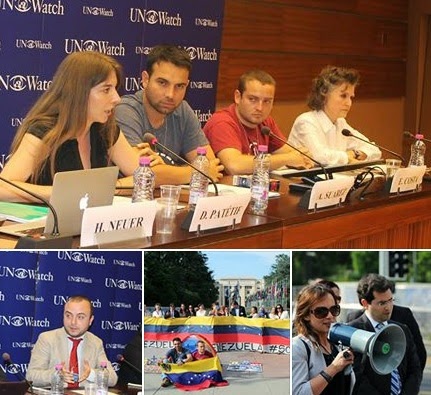
On Tuesday, June 17, 2014 a Summit of Venezuelan Dissidents was held at the United Nations in Geneva. Video and text taken and reproduced from from UN Watch 


GENEVA, June 18, 2014 – Dissidents from Cuba and Venezuela testified at a UN panel yesterday about being subjected to arbitrary arrest, torture and other human rights abuses, sparking shouts and accusations from delegates of both governments, who sat in the corner of a packed Geneva hall huddled with allied delegates from Syria, North Korea and other dictatorships.


However, U.S. Ambassador Keith Harper delivered strong remarks (see below) in support of human rights protection in both countries.

“We were afraid to come here today,” said 33-year-old Alejandro Suarez Teppa, a Venezuelan philosophy student and protest camp leader who was arrested and brutally detained last month.
He was joined on the podium by Eusebio Costa, 22, also a student protest leader from Caracas.
Also, an outdoor rally to honor the young activists was held in front of the UNHRC after the panel. Click here for photo album; selected hi-res photos here.

Invited by the non-governmental human rights group UN Watch, which organized yesterday’s panel at the UN Human Rights Council in Geneva as well as a press conference today, both students made the journey in defiance of a televised attack against them by powerful National Assembly President Diosdado Cabello.

“These students are human rights heroes who put their freedom and safety on the line for the basic democratic freedoms that so many of us take for granted,” said Hillel Neuer, executive director of UN Watch.

“Despite the real risk of reprisal back home, and insults hurled at them here at the UN by their own countries’ delegates, the students succeeded in speaking truth to power.”

Neuer called on the UN to "heed their calls and send an expert mission to investigate the worsening situation in Venezuela, which must be held to account as an elected member of the Human Rights Council.”


Addressing the outdoor rally, Neuer echoed the banner of the students' Caracas protest camp (see above), asking "ONU, donde estas" -- "UN, where are you?"
Yesterday’s panel also heard from Ángel Carromero, the driver in the suspicious crash that killed Cuba’s most famous pro-democracy figure, Oswaldo Payá. (See below.)
María Corina Machado, a leading Venezuelan opposition figure with 2 million Twitter followers, sent a video message expressing solidarity.(See video message below.)


QUOTES FROM VENEZUELAN DISSIDENTS

Eusebio Costa 22-year-old student activist, President of the Student Center at the Catholic University Santa Rosa in Caracas; member of the protest camp in Las Mercedes:
""We came to Geneva to ask the U.N. to send a mission to Venezuela to evaluate the cases of human rights violations that students have been subjected to."
“[The Venezuelan government] has been talking about a conspiracy that we are part of a war, that we were sent here by the CIA, which we weren’t.”
"Thirty-two people were murdered while protesting; I hope that the United Nations will not remain indifferent to violations in Venezuela."
Alejandro Suarez Teppa – activist and philosophy student; National Board Member of the United Active Youth of Venezuela (Juventud Activa Venezuela Unida), and leader of protest camp in Santa Fé.
He recalled witnessing students being shot in February and said his student camp was attacked on the night of May 8: "They put drugs and weapons inside the camps and U.S. dollars to indicate we were financed by foreign powers," he told reporters, saying he was beaten then held in isolation for 72 hours."
"We urge the United Nations to investigate the abuses."
 Julieta Lopez - Aunt of opposition leader Leopoldo Lopez who has been imprisoned since February
 "My nephew [Leopoldo Lopez] has been imprisoned for speaking on behalf of an ill-treated nation. He was put in solitary confinement in harsh conditions for promoting peaceful protest."
 “[The Venezuelan government] are accusing him [Lopez] of having used subliminal language inciting people to take to the streets, and having killed the students; it was not him, but the police!”

QUOTES FROM U.S. AMBASSADOR KEITH HARPER

 On Venezuela:
“Venezuela cannot solve its problems by criminalizing dissent.”
“Venezuela infringes upon fundamental freedoms, using violence against protesters and journalists, restricting the media and Internet.”

On Cuba:
“We call for the release of Alan Gross, detained since 2009 for merely facilitating access to the Internet Cuba.”
“We reiterate our call for an independent international investigation into the death of Oswaldo Payá.”
"We have a simple question: What is Cuba afraid of?"
 Tweet: "Cuba [is] trying to stifle dissent at the UN, just as it does at home."