Showing posts with label Maykel Castillo (Osorbo). Show all posts

Monday, February 27, 2023

Observing Black History Month in Cuba

the U.S. Embassy in Havana disrespecting the people of Cuba "by celebrating Black History Month with the Cuban Ministry of Culture and Cuban Institute of Music, two communist regime agencies responsible for targeting and censoring Black artists and dissidents."

The U.S. Embassy's invitation was tone deaf, and the date selected to announce it, February 23rd, problematic. 

Orlando Zapata Tamayo, a human rights activist and black Cuban prisoner of conscience was subjected to systematic physical and psychological torture between 2003 and 2010. Denied water by prison officials during a hunger strike, contributed to his death. Following his killing on February 23, 2010, Orlando was subjected to a campaign of vilification by Cuba's Communist authorities. 

Today, the plight of political prisoners such as Virgilio Mantilla Arango, Luis Manuel Otero Alcántara, Maykel Castillo Pérez (Osorbo), and their health status raise great concerns in the international human rights community. It is also no coincidence that all are black Cubans. 

These and other cases raise questions on the racist nature of the Castro regime.

In his book Racial Politics in Post-Revolutionary Cuba, Mark Q. Sawyer, a professor of African American Studies at UCLA, describes encounters with members of the Ministry of Interior that reveal the paradox of revolutionary racism. Since Fidel Castro ended systemic racism and capitalism in Cuba, so these government officials claim - any difference in outcomes between black and white Cubans - according to them - is due to "black deficiency."

Based on the Institute for Crime and Justice Policy Research, according to the January 13, 2020 article by EuropaPress, Cuba today has the largest per capita prison population in the world. Although official data is unavailable, it is known that a disproportionate number are Black Cubans.

On March 22, 1959 Fidel Castro declared that racism no longer existed in Cuba, to question that was to be a counter-revolutionary. The regime claimed over the next six decades that there is no racism in Cuba while poverty disproportionately impacts black Cubans with 95% having the lowest incomes compared to 58% of white Cubans, after six decades of communism, and independent black voices continue to be silenced

Decades imprisoned for defying Castro regime


Eusebio Peñalver opposed the Batista regime and fought with the rebel army to restore Cuba's constitutional democracy."But when Castro hijacked the revolution for himself, Peñalver broke ranks rather than 'sell my soul to the same devil that here on earth is Castro and communism,’”wrote Mary O'Grady in 2013 and quoted him. He took up arms against Castro's military in the Escambray Mountains, he was captured in October 1960. He spent 28 years in Cuban prisons and was banished from the island upon his release in 1988. "From exile in Los Angeles he wrote about the 'naked brutality' and round-the-clock beating and harassment that he had endured: 'They made the men eat grass, they submerged them in sewage, they beat them hard with bayonets and they hit them with fence posts until their bones rattled.’" Eusebio passed away in 2006 still banished from Cuba. 

Jorge Luis Garcia Perez "Antunez" served 17 years and 38 days in prison for calling for democratic reforms in a public space in Cuba in 1990. 

In August 1999 Dr. Oscar Elias Biscet was beaten and burned with a cigarette when police detained him at a provincial station in Matanzas. In November 1999 he was imprisoned for three years after holding a press conference where he was accused of displaying the Cuban flag upside down.  

Oscar was freed for 36 days on October 31, 2002 after serving a three year sentence and then arbitrarily imprisoned again on December 6, 2002, only to be subjected during the 2003 Black Spring crackdown, to a show trial and sentenced to 25 years in prison. Oscar Elías was released on March 11, 2011 after a total of more than 12 years in prison.On both occasions he was considered a prisoner of conscience.

Died or executed by Castro regime

Three black men executed by firing squad for trying to leave Cuba
 

Lorenzo Enrique Copello Castillo, Bárbaro Leodán Sevilla García, and Jorge Luis Martínez Isaac, were shot by firing squad following a speedy "trial" on April 11, 2003 for trying to leave Cuba. On April 2, 2003 eleven Cubans hijacked a ferry traveling to Regla from Havana with 40 people on board with the intention of traveling to the United States of America but ran out of fuel 28 miles off the Cuban coast and were towed back to the island. Despite verbal threats made against the safety of the passengers to maintain control of the vessel, the situation, according to the authorities, ended without violence and that “all of those who had been on board were rescued and saved without so much as a shot or a scratch.” They were captured, tried and executed in nine days. 

Hansel Ernesto Hernández Galiano

On June 24, 2020 in Guanabacoa, Cuba 27 year old unarmed black Cuban, Hansel Ernesto Hernández Galiano was shot in the back and killed by the police. The official version claims that he was stealing pieces and accessories from a bus stop when he was spotted by two Revolutionary National Police (PNR in Spanish). Upon seeing the police Hansel ran away and the officers pursued him nearly two kilometers. PNR claimed that during the pursuit Hansel threw rocks at the officers. Police fired two warning shots and a third in his back killing him. Hansel's body was quickly cremated.

This prevented an independent autopsy to verify official claims, or a proper funeral. When activists attempted to organize to protest the death of Hansel, secret police preemptively shut them down surrounding homes, and detaining scores of activists. The Castro regime launched a Heroes of the Blue ( #HeroesDeAzul ) campaign at the national level and social media in Cuba to portray their police positively to counter negative feelings after the killing. 

Yosvany Arostegui died on hunger strike on August 7, 2020


Cuban dissident Yosvany Arostegui Armenteros died on August 7, 2020 in Cuba while in police custody following a 40 day hunger strike. He had been jailed on false charges in the Kilo 8 prison of Camagüey. His body was quickly cremated by the dictatorship. 

Diubis Laurencio Tejeda, (age 36) was shot in the back by regime officials on July 12, 2021 during nationwide protests in Cuba. Video emerged on July 15th of the aftermath of Diubis being shot and killed and posted over Twitter. 


Christian Díaz, age 24, disappeared after joining the protests. Relatives on July 12 reported him missing to the PNR in Cárdenas. Police told his father that Christian was jailed in Matanzas. On Aug. 5, officials informed his family he’d drowned in the sea and was buried in a mass grave. His family is convinced he was beaten to death.

Pablo Moya Delá died on August 26, 2021 at the Clinical Surgical Hospital in Santiago de Cuba. He was jailed on October 23, 2020 for protesting socioeconomic conditions and overall repression. He was beaten, mistreated for months, weakened following a hunger strike and after destroying his health released on probation earlier this month near death. His plight had drawn international attention.

Pablo Moya Delá: Before Oct 23, 2020 jailing and after being "probation" Aug 2021.

The Castro regime has sought to create a negative narrative of the Cuban Republic on all fronts, including race, but as in other matters, the record of the regime is worse than what preceded it.

The Spanish Congress of Deputies on January 19, 1880 voted to abolish slavery in Cuba. The last vestiges of slavery ended in Cuba by royal decree on October 7, 1886. Juan Gualberto Gómez Ferrer, a free Cuban black, and leader of the independence struggle defended the rights of Black Cubans for his entire career.  

Cuban statesman and founder of Directory of Colored Societies

Between 1886 and 1892 in Cuba, free black people were able to organize into a network of societies formally founded by Gómez Ferrer in 1892 in the “Directory of Colored Societies” to press for black social, economic and political advancement in Cuba. Gómez Ferrer represented Havana in the Cuban House of Representatives (1914–1917) and Senate (1917–1925). The Central Directory of Societies of Color would spend the next seventy six years pushing for Black advancement in Cuba. 

The Spanish Congress of Deputies on January 19, 1880 voted to abolish slavery in Cuba. The last vestiges of slavery ended in Cuba by royal decree on October 7, 1886. Juan Gualberto Gómez Ferrer, a free Cuban black, and leader of the independence struggle defended the rights of Black Cubans for his entire career. 

Between 1886 and 1892 in Cuba, free black people were able to organize into a network of societies formally founded by Gómez Ferrer in 1892 in the “Directory of Colored Societies” to press for black social, economic and political advancement in Cuba. Gómez Ferrer represented Havana in the Cuban House of Representatives (1914–1917) and Senate (1917–1925). The Central Directory of Societies of Color would spend the next seventy five years pushing for Black advancement in Cuba. 

L to R: Gobardo Pérez Oliva, Marta Sarduy Vargas; Conrado Pérez Oliva, Antonia Armenteros at Bella Unión Society, Santa Clara, Las Villas.

Cuba during the later colonial period, and during the Republic wrestled with the legacy of slavery, and racism, but it was part of the public discussion – with its high and low points. Ugly periods in the early Cuban Republic, such as the 1912 race war, and private discrimination persisted, but so did black agency to advocate for each other.

Political leaders had to answer to these black societies, and provide patronage to them, and in a vibrant free press, and in publishing houses debates on race, and racism, and the need for redress took place. 

Some of the more prominent clubs that are still remembered are the Sociedad Buena Vista ( Buena Vista Social Club), Amantes del Progreso, Unión Fraternal, Progreso, Nueva Era, and El Club Atenas. 

The Central Directory of Societies of Color succeeded in lobbying for the 1940 Constitution to address racism in Articles 10, 20, 74, and 102, and in labor legislation to provide greater inclusion for black Cubans over the next 20 years. 

All of this came crashing down with Castro’s communist revolution. Cuban black nationalist Juan René Betancourt in his essay "Castro and the Cuban Negro" published in the NAACP publication The Crisis in 1961.

“Of the 256 Negro societies in Cuba, many have had to close their doors and others are in death agony. One can truthfully say, and this is without the slightest exaggeration, that the Negro movement in Cuba died at the hands of Sr. Fidel Castro.” … “Yet this is the man who had the cynical impudence to visit the United States in 1960 for the purpose of censuring American racial discrimination. Although this evil obviously exists in the United States, Castro is not precisely the man to offer America solutions, nor even to pass judgement.”

Between 1898 and 1959 the relationship between Black-Americans and Black-Cubans was based on their being part of an international black diaspora. This relationship ended when the Castro regime ended autonomous black civil society in 1962, and consolidated totalitarian rule.

Juan René Betancourt: Forced into exile

Castro and his white revolutionary elite replaced it by allying with Black elites in the United States, Africa, and condemning American racism. For 64 years, black agency in Cuba was put to an end. Instead, a policy based on deference, submission, and appreciation to the white revolutionary leadership was implemented, and this was represented in state propaganda using racist tropes. 

Castro regime's publication Verde Olivo 1, no. 29 (October 1, 1960)

The elimination of Afro-Cubans from this dynamic by the new communist revolutionary elite turned racism into a political tool outside of Cuba to advance the Castro regime's communist agenda, but turned it into a taboo topic by "ungrateful" blacks, labeled counter-revolutionaries by the dictatorship.

Cuban blacks today that would have been political leaders in the 1940s and 1950s are dissidents persecuted, hunted and killed by the secret police.

Sunday, November 21, 2021

Testimony by John Suarez at the Transatlantic Parliamentary Forum on November 20, 2021

Transatlantic Parliamentary Forum testimony: November 20, 2021 

Miami City Hall


July 11, 2021 national nonviolent protests in Cuba marked a before and after in the history of the island. Tens of thousands of Cubans across the island demanded an end to the dictatorship, rejected the official slogan Patria o Muerte (Homeland or Death) and chanted Patria y Vida (Homeland and Life). The reaction of the dictatorship was swift and brutal. Boinas Negras (black berets) formally known as the National Special Brigade of the Ministry of the Interior, fired on unarmed protesters, and were captured on video. The dictatorship handed out clubs to regime agents to attack protesters. Thousands were detained, and hundreds remain jailed and face summary trials with prison sentences in excess of 25 years.

The lack of transparency in Cuba took on a new urgency in the current context. The International Committee of the Red Cross has not been allowed in Cuban prisons since 1989, and that was a brief period between 1988-1989. In comparison, the prison for Al Qaeda prisoners at the U.S. Guantanamo Naval Base had over 100 visits between 2002 and 2014, and have continued to the present date.

Cuba is the only country in the Americas where Amnesty International, Human Rights Watch, and other international and regional human rights organizations are unable to visit

We are deeply concerned with the plight of political prisoners such as Virgilio Mantilla Arango, Luis Manuel Otero Alcántara, Maykel Castillo Pérez (Osorbo), and their health status. It is also no coincidence that all are black Cubans. 

These and other cases raise questions on the racist nature of the Castro regime.

Based on the Institute for Crime and Justice Policy Research, according to the January 13, 2020 article by EuropaPress, Cuba today has the largest per capita prison population in the world. Although official data is unavailable, it is known that a disproportionate number are Black Cubans.

On March 22, 1959 Fidel Castro declared that racism no longer existed in Cuba, to question that was to be a counter-revolutionary. The regime claimed over the next six decades that there is no racism in Cuba while poverty disproportionately impacts black Cubans with 95% having the lowest incomes compared to 58% of white Cubans, after six decades of communism, and independent black voices continue to be silenced

Decades imprisoned for defying Castro regime


 Eusebio Peñalver opposed the Batista regime and fought with the rebel army to restore Cuba's constitutional democracy."But when Castro hijacked the revolution for himself, Peñalver broke ranks rather than 'sell my soul to the same devil that here on earth is Castro and communism,’”wrote Mary O'Grady in 2013 and quoted him. He took up arms against Castro's military in the Escambray Mountains, he was captured in October 1960. He spent 28 years in Cuban prisons and was banished from the island upon his release in 1988. "From exile in Los Angeles he wrote about the 'naked brutality' and round-the-clock beating and harassment that he had endured: 'They made the men eat grass, they submerged them in sewage, they beat them hard with bayonets and they hit them with fence posts until their bones rattled.’" Eusebio passed away in 2006 still banished from Cuba. 


Jorge Luis Garcia Perez "Antunez" served 17 years and 38 days in prison for calling for democratic reforms in a public space in Cuba in 1990. 


In August 1999 Dr. Oscar Elias Biscet was beaten and burned with a cigarette when police detained him at a provincial station in Matanzas. In November 1999 he was imprisoned for three years after holding a press conference where he was accused of displaying the Cuban flag upside down. 

Oscar was freed for 36 days on October 31, 2002 after serving a three year sentence and then arbitrarily imprisoned again on December 6, 2002, only to be subjected during the 2003 Black Spring crackdown, to a show trial and sentenced to 25 years in prison. Oscar Elías was released on March 11, 2011 after a total of more than 12 years in prison.On both occasions he was considered a prisoner of conscience.

Died or executed by Castro regime

Three black men executed by firing squad for trying to leave Cuba

Lorenzo Enrique Copello Castillo, Bárbaro Leodán Sevilla García, and Jorge Luis Martínez Isaac, were shot by firing squad following a speedy "trial" on April 11, 2003 for trying to leave Cuba. On April 2, 2003 eleven Cubans hijacked a ferry traveling to Regla from Havana with 40 people on board with the intention of traveling to the United States of America but ran out of fuel 28 miles off the Cuban coast and were towed back to the island. Despite verbal threats made against the safety of the passengers to maintain control of the vessel, the situation, according to the authorities, ended without violence and that “all of those who had been on board were rescued and saved without so much as a shot or a scratch.” They were captured, tried and executed in nine days.

Orlando Zapata Tamayo, a human rights activist and black Cuban prisoner of conscience was subjected to systematic physical and psychological torture between 2003 and 2010, and following his death on February 23, 2010 was subjected to a campaign of vilification by Cuba's Communist authorities. 

Reina Luisa Tamayo, with her son's bloody shirt

Orlando's mother, Reina Luisa Tamayo, denounced her son's mistreatment and held up a blood stained shirt that belonged to her son, who had been beaten up by prison guards, for rejecting communist re-education and continuing to denounce human rights violations in the prisons. 


On June 24, 2020 in Guanabacoa, Cuba 27 year old unarmed black Cuban, Hansel Ernesto Hernández Galiano was shot in the back and killed by the police. The official version claims that he was stealing pieces and accessories from a bus stop when he was spotted by two Revolutionary National Police (PNR in Spanish). Upon seeing the police Hansel ran away and the officers pursued him nearly two kilometers. PNR claimed that during the pursuit Hansel threw rocks at the officers. Police fired two warning shots and a third in his back killing him. Hansel's body was quickly cremated.

This prevented an independent autopsy to verify official claims, or a proper funeral. When activists attempted to organize to protest the death of Hansel, secret police preemptively shut them down surrounding homes, and detaining scores of activists. The Castro regime launched a Heroes of the Blue ( #HeroesDeAzul ) campaign at the national level and social media in Cuba to portray their police positively to counter negative feelings after the killing. 

Yosvany Arostegui died on hunger strike on August 7, 2020

Cuban dissident Yosvany Arostegui Armenteros died on August 7, 2020 in Cuba while in police custody following a 40 day hunger strike. He had been jailed on false charges in the Kilo 8 prison of Camagüey. His body was quickly cremated by the dictatorship. 

Diubis Laurencio Tejeda, (age 36) shot in the back by regime officials on July 12, 2021.

Diubis Laurencio Tejeda, (age 36) was shot in the back by regime officials on July 12, 2021 during nationwide protests in Cuba. Video emerged on July 15th of the aftermath of Diubis being shot in the back and posted over Twitter. 
Pablo Moya Delá: Before Oct 23, 2020 jailing and after being "probation" Aug 2021.

Pablo Moya Delá died on August 26, 2021 at the Clinical Surgical Hospital in Santiago de Cuba. He was jailed on October 23, 2020 for protesting socioeconomic conditions and overall repression. He was beaten, mistreated for months, weakened following a hunger strike and after destroying his health released on probation earlier this month near death. His plight had drawn international attention.

The Castro regime has sought to create a negative narrative of the Cuban Republic on all fronts, including race, but as in other matters, the record of the regime is worse than what preceded it.

Cuban statesman and founder of Directory of Colored Societies

The Spanish Congress of Deputies on January 19, 1880 voted to abolish slavery in Cuba. The last vestiges of slavery ended in Cuba by royal decree on October 7, 1886. Juan Gualberto Gómez Ferrer, a free Cuban black, and leader of the independence struggle defended the rights of Black Cubans for his entire career. 

Between 1886 and 1892 in Cuba, free black people were able to organize into a network of societies formally founded by Gómez Ferrer in 1892 in the “Directory of Colored Societies” to press for black social, economic and political advancement in Cuba. Gómez Ferrer represented Havana in the Cuban House of Representatives (1914–1917) and Senate (1917–1925). The Central Directory of Societies of Color would spend the next seventy six years pushing for Black advancement in Cuba. 

L to R: Gobardo Pérez Oliva, Marta Sarduy Vargas; Conrado Pérez Oliva, Antonia Armenteros at Bella Unión Society, Santa Clara, Las Villas.

Cuba during the later colonial period, and during the Republic wrestled with the legacy of slavery, and racism, but it was part of the public discussion – with its high and low points. Ugly periods in the early Cuban Republic, such as the 1912 race war, and private discrimination persisted, but so did black agency to advocate for each other.

Political leaders had to answer to these black societies, and provide patronage to them, and in a vibrant free press, and in publishing houses debates on race, and racism, and the need for redress took place. 

Some of the more prominent clubs that are still remembered are the Sociedad Buena Vista ( Buena Vista Social Club), Amantes del Progreso, Unión Fraternal, Progreso, Nueva Era, and El Club Atenas.

The Central Directory of Societies of Color succeeded in lobbying for the 1940 Constitution to address racism in Articles 10, 20, 74, and 102, and in labor legislation to provide greater inclusion for black Cubans over the next 20 years. 

Juan René Betancourt

All of this came crashing down with Castro’s communist revolution. Cuban black nationalist Juan René Betancourt in his essay "Castro and the Cuban Negro" published in the NAACP publication The Crisis in 1961.

“Of the 256 Negro societies in Cuba, many have had to close their doors and others are in death agony. One can truthfully say, and this is without the slightest exaggeration, that the Negro movement in Cuba died at the hands of Sr. Fidel Castro.” … “Yet this is the man who had the cynical impudence to visit the United States in 1960 for the purpose of censuring American racial discrimination. Although this evil obviously exists in the United States, Castro is not precisely the man to offer America solutions, nor even to pass judgement.”

Between 1898 and 1959 the relationship between Black-Americans and Black-Cubans was based on their being part of an international black diaspora. This relationship ended when the Castro regime ended autonomous black civil society in 1962, and consolidated totalitarian rule.

It was replaced by Castro and his white revolutionary elite allying with Black elites in the United States, and Africa while criticizing racism in the United States. This ended black agency in Cuba for decades, replaced with a policy based in obedience, submission, and gratitude to the white revolutionary elite, and this was reflected in official propaganda with racist tropes. 

Castro regime's publication Verde Olivo 1, no. 29 (October 1, 1960)

The elimination of Afro-Cubans from this dynamic by the new communist revolutionary elite turned racism into a political tool outside of Cuba to advance the Castro regime's communist agenda, but turned it into a taboo topic by ungrateful blacks, labeled counter-revolutionaries by the dictatorship.

Cuban blacks today that would have been political leaders in the 1940s and 1950s are dissidents persecuted, hunted and killed by the secret police.

What are we requesting of the international community?

  • Issue joint statements on the current situation in Cuba and denounce the crackdown on pro-democracy activists perpetrated by the Castro regime, and advise Cuban officials of further sanctions due to November 15th repression.
  • Call on the UN Security Council to respond to the situation by sending a delegation to Cuba, and by establishing a humanitarian corridor for direct emergency assistance to needy Cubans, and a referral of the situation in Cuba to the International Criminal Court.
  • Establish a global arms embargo on Cuba.
  • Suspend economic and military cooperation agreements with the Cuban dictatorship, such as the EU-Cuba cooperation agreement.
  • Support civil society in Cuba and the implementation of reforms that respect international human rights norms.
  • Apply Magnitsky Sanctions to regime repressors such as Miguel Diaz Canel.
  • Carry out a public diplomacy campaign on the internal blockade officials impose on Cubans.

Thank you very much.


Sunday, May 23, 2021

Truth and Memory: Update on Luis Manuel Otero Alcántara, Mary Karla Ares, and Maykel Castillo (Osorbo) and others taken by secret police in Cuba

Update on kidnapped Cuban dissident taken from his home at 5:00am on May 2, 2021, possibly subjected to electroshock and other dissidents and journalists jailed since April 30th for protesting on his behalf.
 

Luis Manuel Otero Alcántara

Luis Manuel Otero Alcántara has been arbitrarily detained ( held hostage) for 21 days in the Calixto Garcia hospital in Havana. The facility is militarized: those who have tried to see him are now incarcerated. It is not known what Havana is doing to Otero's mind and body. However it is evident that the Castro regime wants to destroy the artist who has challenged the regime both in Havana, the national, and international stage.

The regime has also sought to send a message to other Cubans willing to show their solidarity for the artist. Mary Karla Ares, Esteban Rodríguez, Yuisán Cancio Vera, Inti Soto Romero, Luis Ángel Cuba Alfonso and Thais Mailén Franco remain jailed after 23 days  for reporting on or participating in the nonviolent protest on Obispo Street on April 30, 2021 for the life and freedom of Luis Manuel.

Still detained from April 30, 2021 protest in Obispo Street in Havana 

The human rights NGO Cubalex reported on May 22nd that "Mary Karla Ares is taken out of her cell nightly to be interrogated, then stopped, and a few minutes later a new interrogation. This is done again and again in the early morning hours. The intention is not to let her sleep, to torture her. She is a journalist and lives in Cuba." According to Cubalex she "suffers from endometriosis, and during the weeks that she has been detained she has not received specialized care or medication, despite severe pain." 

Amnesty International reported that Maykel Castillo (Osorbo) was taken by police on May 18 and has been missing over the past 72 hours. According to Erika Guevara-Rosas of Amnesty International in a tweet on May 22nd, "musician and human rights defender Maykel Osorbo, more than 72 hrs after his arbitrary detention, does not appear in police system records. Unaccounted for, authorities do not provide information, which could constitute forced disappearance, a crime under international law."

Memory against power

The Castro regime would like to disappear Luis Manuel, and the other persons they have taken who nonviolently protested against the abuses visited upon the Cuban artist. Milan Kundera, the Czech writer, in his 1999 novel The Book of Laughter and Forgetting observed that "the struggle of man against power is the struggle of memory against forgetting." This blog post will revisit what happened that led to where we are today.

Origin of the San Isidro Movement

San Idisdro Movement founded in 2018 to protest Decree 349

The San Isidro Movement, a dissident movement made up of artists that came into existence in 2018 to protest Decree 349, a new law that further tightened the dictatorship's grip over the arts in Cuba. headquarters in Old Havana. Their mission is to campaign against Decree 349 and defend the freedom of expression of artists. Luis Manuel is one of the leaders of this movement, and his home is the headquarters of the San Isidro Movement. Over the past three years, Amnesty International has on three occasions recognized Luis Manuel Otero a prisoner of conscience. With the most recent designation being on May 21, 2021

Luis Manuel Otero Alcantara since 2018 has been engaged in a dialogue with the Cuban government demanding that artistic freedom in Cuba be respected and expanded.  The dialogue was initiated when the Cuban government announced Decree 349, a dystopian law that further restricted artistic freedoms in the already existing state of repression that existed. 

In an interview with Amnesty International in 2019, Luis Manuel said: “I’m like the tip of the iceberg. We are talking about an endless number of artists in Cuba. [The authorities] come after me, because as I am supposedly the most visible of the youth, activists-artists, they send the message ‘Well, if we lock this one up, look what we can do to you lot.’”

Prisoner of conscience first time

Luis Manuel Otero Alcántara and Claudia Genlui

In March 2020, the World Movement for Democracy condemned the violent arrest and detention of artist and civil society activist Luis Manuel Otero Alcántara by Cuban authorities and joined organizations like PEN America and the San Isidro Movement in demanding his release. "He was arrested in Havana on March 1 as he was leaving his home to attend an independent anti-censorship demonstration organized by the local LGBTQ community. During the arrest a policewoman threw Otero Alcántara’s girlfriend, Claudia Genlui, to the floor and hit her for attempting to record the arrest on her cellphone," reported the World Movement.  Many feared that he would be subjected to a political show trial. March 13, 2020 was the first time that Amnesty International recognized Luis Manuel as a prisoner of conscience.

On November 9, 2020, during the Covid-19 pandemic Luis Manuel Otero Alcántara and the San Isidro Movement were confronted with a new challenge. Their colleague Denis Solís González was arrested for recording and speaking critically of a police officer searching his home without a warrant. He was subjected to a summary trial on  November 11, 2020 and sentenced to eight months in prison for “contempt” (desacato). Denis was taken to Valle Grande, a maximum-security prison just  outside Havana to serve out his prison sentence.

 Luis Manuel, together with other artists and intellectuals started holding protests outside the police station. They were roughed up and their protests shut down. The activists moved the protests to the San Isidro Movement's headquarters, Luis Manuel's home and beginning on November 15, 2020 they were surrounded by police. They were protesting the arbitrary detention of Denis Solís González.

On November 18, 2020 when it became clear that officials would not allow anyone to deliver them food, and in the early morning hours of that day had used a chemical agent to poison their water supply that nine of them decided to go on hunger strike, and four of them took the additional step to also start a thirst strike. This was done to conserve food and water for those among them in a more vulnerable situation.

Luis Manuel was one of the four that initiated the hunger and thirst strike on November 18, 2020. Four days later around midnight, despite a cordon of state security and revolutionary national police surrounding the San Isidro Movement headquarters a Luis Manuel Alcantara was attacked with by an unidentified man who broke into the San Isidro Movement's headquarters on November 22, 2020. This was suspicious because police had blocked neighbors, friends, and family members from reaching them in the previous four days. 

On November 26 at 8:00pm regime officials shutoff their access to internet and to their phones and organized a rapid response brigade for an act of repudiation. Secret police dressed as doctors raided the San Isidro Movement headquarters and forcibly expelled and arrested everyone inside and beat them up.  

Prisoner of conscience a second time on 27N 

Prisoners of conscience: Luis Manuel Otero and Anamely Ramos González

On November 27, 2020 Amnesty International recognized Cuban artist Luis Manuel Otero Alcántara and academic Anamely Ramos González prisoners of conscience. This was the second time that Luis Manuel was recognized a prisoner of conscience. Hundreds of artists and intellectuals gathered outside of the Ministry of Culture for several hours to protest the raid on the San Isidro Movement, and demand greater artistic freedom in Cuba. They met with officials, peacefully presented their demands, and dispersed.

Level of surveillance and harassment against Luis Manuel and other members of the San Isidro Movement grew exponentially after the events of November 27, 2020. 

On December 15, 2020 Amnesty International released  a statement titled "Cuba: San Isidro movement and allies under frightening levels of surveillance," and raised the alarm of how they were being treated. “The disturbing level of restrictions to which activists and independent journalists are now being subjected is like something out of an Orwell novel set in Havana’s palm-lined streets. The police presence outside their homes, and constant threat of arrest, is so relentless that activists are essentially being imprisoned in their own homes,” said Erika Guevara-Rosas, Americas director at Amnesty International.

Homeland and Life 

San Isidro Movement artists in the music video Patria y Vida.

Despite the surveillance and harassment Maykel Osorbo, El Funky, and Luis Manuel Otero Alcántara were able to collaborate on a song and video with other artists that demanded an end to repression in Cuba. The song rejects violence and death in favor of life, and calls for understanding and treating each other with humanity.

Cuban artists both in the diaspora and on the island: Yotuel Romero, Gente de Zona, Descemer Bueno, Maykel Osorbo, El Funky, and Luis Manuel Otero Alcántara, collaborated in the song and video Homeland and Life (Patria y Vida) that challenges the regime's official narrative. On February 16, 2021 the video was premiered live with Yotuel Romero, Gente de Zona, Descemer Bueno on Youtube, and Maykel Osorbo briefly speaking live from Cuba before the secret police cut him off.

Performance highlighting precarious position of dissidents

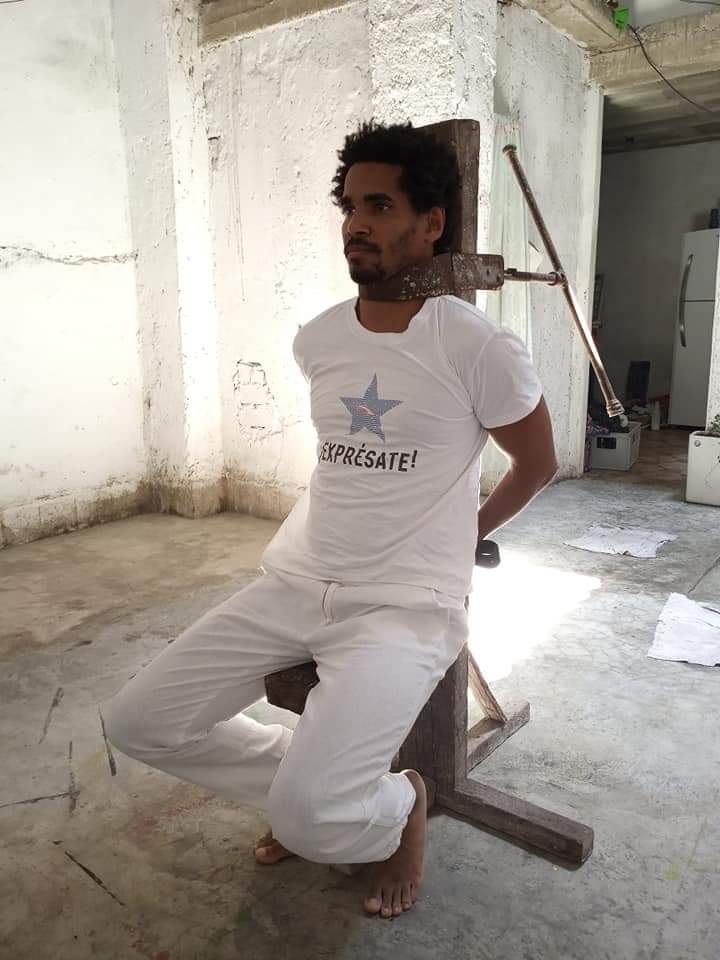
Vile Garrote performance on April 16, 2021

The dictatorship responded with escalating acts of random violence against San Isidro members. On April 16, 2021 over Facebook, Luis Manuel Otero Alcantara, one of the leaders of the San Isidro Movement announced a performance to dramatize the vulnerability of dissidents on the island. He explained the dramatic protest he was undertaking.

"From today I will be for 8 h daily for 5 days, sitting in a Garrote, days when I remain besieged by the DSE (State Security), I call on the authorities to turn this lathe and execute me publicly. Today Cuban activists and opponents live more vulnerable than ever, every day we are more exposed, and that vulnerability is coming from a dictatorship that is 62 years old. That 62-year-old dictatorship that copies the most repressive models of many dictatorships and security and repression organs like Russia, and those of the world.

This work is the result of a series of videos where we denounce the arbitrary way in which activists and opponents in Cuba are accused. From Law 88 that can sentence you to up to 20 years in jail, coming with the black spring, to the charge of contempt, a crime for which Denis Solis is now in prison, and Luis Robles is also in prison for expressing himself .. The law against insulting patriotic symbols is another one of those laws that criminalize free speech, crimes made up by State security. This performance is based on the garrote technique of killing activists or criminals in dictatorships like Franco's and in the Spanish Colonies. It is a wake-up call to what this dictatorship is capable of doing. Imagine if Luis Robles was handed down a six years prison sentence for expressing himself with a sign, what can happen to an activist who actually succeeds in having millions of followers for Cuban Freedom?"

The political police arrived that same day and took him away then returned with a mob to seize and steal or destroy his artwork located there at his home and studio. It was captured on video by a neighbor. 

"Following his release, [Luis Manuel] had planned to protest the repeated persecution he and other independent artists have faced in recent months at the parliament building in Havana, but officials blocked his movements, reportedly throwing him in jail every time he attempted to leave his apartment. Authorities have reportedly cut off his internet access, and police have surrounded his apartment, preventing anyone from entering. 

Hunger and thirst strike 

Luis Manuel Otero Alcantara on hunger and thirst strike

On Sunday [April 25, 2021], Otero Alcántara announced his hunger and thirst strike, intended as an act of protest against the seizure of his works and the ongoing persecution of artists," reported PEN America on April 26, 2021. They are arbitrarily detaining activists, like rapper and poet AfrikReina for trying to visit him at his home.

'This is not a performance or a work of art, it is demanding rights' in a protest that is life threatening to Luis Manuel. Havana Times on April 28, 2021 also outlined the circumstances that led to the hunger and thirst strike, and listed the demands of the San Isidro Movement for it to end.

1- Lift the police cordon on Luis Manuel Otero Alcantara in force since November 2020, and get rid of the state of siege as a practice to stop the free movement of artists, journalists and activists.

2- Return the art works that were stolen from Luis Manuel Otero Alcantara and compensate him for any damages that they’ve incurred.

3- Respect for Cuban artists and them exercising their freedoms fully.

Protest and crackdown 

It was obvious that his physical condition was deteriorating, and in desperation friends and colleagues held a sit-in protest at the intersection of Obispo Street and Aguacate Street in Havana on April 30, 2021. Surrounded by police and state security agents they shouted "We want to see Luis Manuel!", "Luis Manuel is dying!", "Homeland and Life", and "We are more than them!" and other phrases. Passersby joined in, and the situation grew tense when police and intelligence officials arrested the nonviolent protesters and took them away.

Anamely Ramos González, a former prisoner of conscience, listed some of those arrested on April 30th either at the Obispo Street protest, or detained when leaving their homes to see Luis Manuel: Thais Mailen Franco, Esteban Rodríguez, Douglas Batista, Lara Yumila, Mary Karla Ares, Nancy Vera, Yuisan Cancio Vera, Luis Ángel, Inti Soto, Félix Modesto Valdés, Carolina Barrero, Joe Luis Cerutti, Maykel Castillo (Osorbo), Héctor Luis Valdés, Félix David Estévez and Leonardo Romero.

 Taken hostage

At 5:00am on Sunday, May 2, 2021 state security agents forced their way into Luis Manuel Otero Alcántara's home. Officials gave contradictory statements to attempt to discredit the dissident. Activists and family members demanded proof of life. Over the next three weeks the dictatorship released private medical information claiming that Luis Manuel had not been on hunger strike and sporadic videos that show an emaciated activist in a worsening condition. The San Isidro Movement continues to demand access to Luis Manuel Otero, and only some relatives have been permitted limited access. 21 days later and Luis Manuel Otero Alcántara remains a hostage and their are fears that he is being subjected to electroshock and other psychological instruments to destroy his identity.  

We continue to fear for his wellbeing, and his life, and that of his friends who are still jailed.

Screen grab of Luis Manuel from video released by regime