Showing posts with label Maykel Osorbo. Show all posts

Sunday, May 23, 2021

Truth and Memory: Update on Luis Manuel Otero Alcántara, Mary Karla Ares, and Maykel Castillo (Osorbo) and others taken by secret police in Cuba

Update on kidnapped Cuban dissident taken from his home at 5:00am on May 2, 2021, possibly subjected to electroshock and other dissidents and journalists jailed since April 30th for protesting on his behalf.
 

Luis Manuel Otero Alcántara

Luis Manuel Otero Alcántara has been arbitrarily detained ( held hostage) for 21 days in the Calixto Garcia hospital in Havana. The facility is militarized: those who have tried to see him are now incarcerated. It is not known what Havana is doing to Otero's mind and body. However it is evident that the Castro regime wants to destroy the artist who has challenged the regime both in Havana, the national, and international stage.

The regime has also sought to send a message to other Cubans willing to show their solidarity for the artist. Mary Karla Ares, Esteban Rodríguez, Yuisán Cancio Vera, Inti Soto Romero, Luis Ángel Cuba Alfonso and Thais Mailén Franco remain jailed after 23 days  for reporting on or participating in the nonviolent protest on Obispo Street on April 30, 2021 for the life and freedom of Luis Manuel.

Still detained from April 30, 2021 protest in Obispo Street in Havana 

The human rights NGO Cubalex reported on May 22nd that "Mary Karla Ares is taken out of her cell nightly to be interrogated, then stopped, and a few minutes later a new interrogation. This is done again and again in the early morning hours. The intention is not to let her sleep, to torture her. She is a journalist and lives in Cuba." According to Cubalex she "suffers from endometriosis, and during the weeks that she has been detained she has not received specialized care or medication, despite severe pain." 

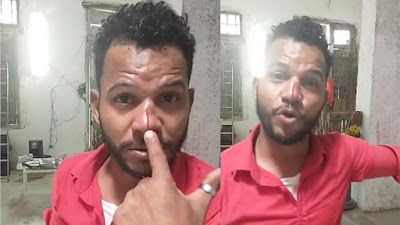
Amnesty International reported that Maykel Castillo (Osorbo) was taken by police on May 18 and has been missing over the past 72 hours. According to Erika Guevara-Rosas of Amnesty International in a tweet on May 22nd, "musician and human rights defender Maykel Osorbo, more than 72 hrs after his arbitrary detention, does not appear in police system records. Unaccounted for, authorities do not provide information, which could constitute forced disappearance, a crime under international law."

Memory against power

The Castro regime would like to disappear Luis Manuel, and the other persons they have taken who nonviolently protested against the abuses visited upon the Cuban artist. Milan Kundera, the Czech writer, in his 1999 novel The Book of Laughter and Forgetting observed that "the struggle of man against power is the struggle of memory against forgetting." This blog post will revisit what happened that led to where we are today.

Origin of the San Isidro Movement

San Idisdro Movement founded in 2018 to protest Decree 349

The San Isidro Movement, a dissident movement made up of artists that came into existence in 2018 to protest Decree 349, a new law that further tightened the dictatorship's grip over the arts in Cuba. headquarters in Old Havana. Their mission is to campaign against Decree 349 and defend the freedom of expression of artists. Luis Manuel is one of the leaders of this movement, and his home is the headquarters of the San Isidro Movement. Over the past three years, Amnesty International has on three occasions recognized Luis Manuel Otero a prisoner of conscience. With the most recent designation being on May 21, 2021

Luis Manuel Otero Alcantara since 2018 has been engaged in a dialogue with the Cuban government demanding that artistic freedom in Cuba be respected and expanded.  The dialogue was initiated when the Cuban government announced Decree 349, a dystopian law that further restricted artistic freedoms in the already existing state of repression that existed. 

In an interview with Amnesty International in 2019, Luis Manuel said: “I’m like the tip of the iceberg. We are talking about an endless number of artists in Cuba. [The authorities] come after me, because as I am supposedly the most visible of the youth, activists-artists, they send the message ‘Well, if we lock this one up, look what we can do to you lot.’”

Prisoner of conscience first time

Luis Manuel Otero Alcántara and Claudia Genlui

In March 2020, the World Movement for Democracy condemned the violent arrest and detention of artist and civil society activist Luis Manuel Otero Alcántara by Cuban authorities and joined organizations like PEN America and the San Isidro Movement in demanding his release. "He was arrested in Havana on March 1 as he was leaving his home to attend an independent anti-censorship demonstration organized by the local LGBTQ community. During the arrest a policewoman threw Otero Alcántara’s girlfriend, Claudia Genlui, to the floor and hit her for attempting to record the arrest on her cellphone," reported the World Movement.  Many feared that he would be subjected to a political show trial. March 13, 2020 was the first time that Amnesty International recognized Luis Manuel as a prisoner of conscience.

On November 9, 2020, during the Covid-19 pandemic Luis Manuel Otero Alcántara and the San Isidro Movement were confronted with a new challenge. Their colleague Denis Solís González was arrested for recording and speaking critically of a police officer searching his home without a warrant. He was subjected to a summary trial on  November 11, 2020 and sentenced to eight months in prison for “contempt” (desacato). Denis was taken to Valle Grande, a maximum-security prison just  outside Havana to serve out his prison sentence.

 Luis Manuel, together with other artists and intellectuals started holding protests outside the police station. They were roughed up and their protests shut down. The activists moved the protests to the San Isidro Movement's headquarters, Luis Manuel's home and beginning on November 15, 2020 they were surrounded by police. They were protesting the arbitrary detention of Denis Solís González.

On November 18, 2020 when it became clear that officials would not allow anyone to deliver them food, and in the early morning hours of that day had used a chemical agent to poison their water supply that nine of them decided to go on hunger strike, and four of them took the additional step to also start a thirst strike. This was done to conserve food and water for those among them in a more vulnerable situation.

Luis Manuel was one of the four that initiated the hunger and thirst strike on November 18, 2020. Four days later around midnight, despite a cordon of state security and revolutionary national police surrounding the San Isidro Movement headquarters a Luis Manuel Alcantara was attacked with by an unidentified man who broke into the San Isidro Movement's headquarters on November 22, 2020. This was suspicious because police had blocked neighbors, friends, and family members from reaching them in the previous four days. 

On November 26 at 8:00pm regime officials shutoff their access to internet and to their phones and organized a rapid response brigade for an act of repudiation. Secret police dressed as doctors raided the San Isidro Movement headquarters and forcibly expelled and arrested everyone inside and beat them up.  

Prisoner of conscience a second time on 27N 

Prisoners of conscience: Luis Manuel Otero and Anamely Ramos González

On November 27, 2020 Amnesty International recognized Cuban artist Luis Manuel Otero Alcántara and academic Anamely Ramos González prisoners of conscience. This was the second time that Luis Manuel was recognized a prisoner of conscience. Hundreds of artists and intellectuals gathered outside of the Ministry of Culture for several hours to protest the raid on the San Isidro Movement, and demand greater artistic freedom in Cuba. They met with officials, peacefully presented their demands, and dispersed.

Level of surveillance and harassment against Luis Manuel and other members of the San Isidro Movement grew exponentially after the events of November 27, 2020. 

On December 15, 2020 Amnesty International released  a statement titled "Cuba: San Isidro movement and allies under frightening levels of surveillance," and raised the alarm of how they were being treated. “The disturbing level of restrictions to which activists and independent journalists are now being subjected is like something out of an Orwell novel set in Havana’s palm-lined streets. The police presence outside their homes, and constant threat of arrest, is so relentless that activists are essentially being imprisoned in their own homes,” said Erika Guevara-Rosas, Americas director at Amnesty International.

Homeland and Life 

San Isidro Movement artists in the music video Patria y Vida.

Despite the surveillance and harassment Maykel Osorbo, El Funky, and Luis Manuel Otero Alcántara were able to collaborate on a song and video with other artists that demanded an end to repression in Cuba. The song rejects violence and death in favor of life, and calls for understanding and treating each other with humanity.

Cuban artists both in the diaspora and on the island: Yotuel Romero, Gente de Zona, Descemer Bueno, Maykel Osorbo, El Funky, and Luis Manuel Otero Alcántara, collaborated in the song and video Homeland and Life (Patria y Vida) that challenges the regime's official narrative. On February 16, 2021 the video was premiered live with Yotuel Romero, Gente de Zona, Descemer Bueno on Youtube, and Maykel Osorbo briefly speaking live from Cuba before the secret police cut him off.

Performance highlighting precarious position of dissidents
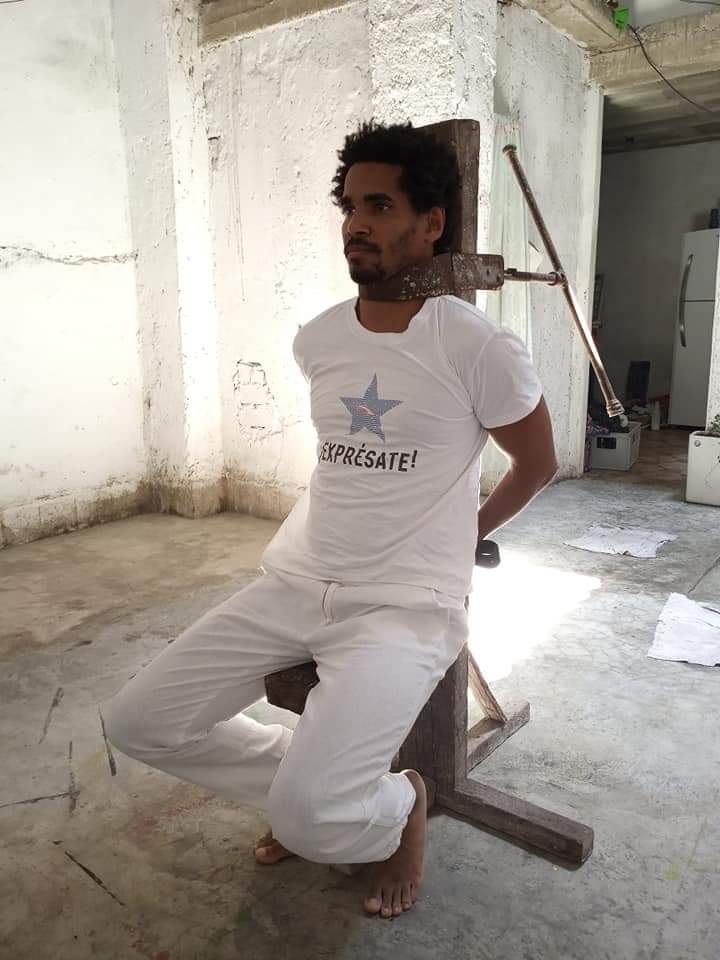
Vile Garrote performance on April 16, 2021

The dictatorship responded with escalating acts of random violence against San Isidro members. On April 16, 2021 over Facebook, Luis Manuel Otero Alcantara, one of the leaders of the San Isidro Movement announced a performance to dramatize the vulnerability of dissidents on the island. He explained the dramatic protest he was undertaking.

"From today I will be for 8 h daily for 5 days, sitting in a Garrote, days when I remain besieged by the DSE (State Security), I call on the authorities to turn this lathe and execute me publicly. Today Cuban activists and opponents live more vulnerable than ever, every day we are more exposed, and that vulnerability is coming from a dictatorship that is 62 years old. That 62-year-old dictatorship that copies the most repressive models of many dictatorships and security and repression organs like Russia, and those of the world.

This work is the result of a series of videos where we denounce the arbitrary way in which activists and opponents in Cuba are accused. From Law 88 that can sentence you to up to 20 years in jail, coming with the black spring, to the charge of contempt, a crime for which Denis Solis is now in prison, and Luis Robles is also in prison for expressing himself .. The law against insulting patriotic symbols is another one of those laws that criminalize free speech, crimes made up by State security. This performance is based on the garrote technique of killing activists or criminals in dictatorships like Franco's and in the Spanish Colonies. It is a wake-up call to what this dictatorship is capable of doing. Imagine if Luis Robles was handed down a six years prison sentence for expressing himself with a sign, what can happen to an activist who actually succeeds in having millions of followers for Cuban Freedom?"

The political police arrived that same day and took him away then returned with a mob to seize and steal or destroy his artwork located there at his home and studio. It was captured on video by a neighbor. 

"Following his release, [Luis Manuel] had planned to protest the repeated persecution he and other independent artists have faced in recent months at the parliament building in Havana, but officials blocked his movements, reportedly throwing him in jail every time he attempted to leave his apartment. Authorities have reportedly cut off his internet access, and police have surrounded his apartment, preventing anyone from entering. 

Hunger and thirst strike 

Luis Manuel Otero Alcantara on hunger and thirst strike

On Sunday [April 25, 2021], Otero Alcántara announced his hunger and thirst strike, intended as an act of protest against the seizure of his works and the ongoing persecution of artists," reported PEN America on April 26, 2021. They are arbitrarily detaining activists, like rapper and poet AfrikReina for trying to visit him at his home.

'This is not a performance or a work of art, it is demanding rights' in a protest that is life threatening to Luis Manuel. Havana Times on April 28, 2021 also outlined the circumstances that led to the hunger and thirst strike, and listed the demands of the San Isidro Movement for it to end.

1- Lift the police cordon on Luis Manuel Otero Alcantara in force since November 2020, and get rid of the state of siege as a practice to stop the free movement of artists, journalists and activists.

2- Return the art works that were stolen from Luis Manuel Otero Alcantara and compensate him for any damages that they’ve incurred.

3- Respect for Cuban artists and them exercising their freedoms fully.

Protest and crackdown 

It was obvious that his physical condition was deteriorating, and in desperation friends and colleagues held a sit-in protest at the intersection of Obispo Street and Aguacate Street in Havana on April 30, 2021. Surrounded by police and state security agents they shouted "We want to see Luis Manuel!", "Luis Manuel is dying!", "Homeland and Life", and "We are more than them!" and other phrases. Passersby joined in, and the situation grew tense when police and intelligence officials arrested the nonviolent protesters and took them away.

Anamely Ramos González, a former prisoner of conscience, listed some of those arrested on April 30th either at the Obispo Street protest, or detained when leaving their homes to see Luis Manuel: Thais Mailen Franco, Esteban Rodríguez, Douglas Batista, Lara Yumila, Mary Karla Ares, Nancy Vera, Yuisan Cancio Vera, Luis Ángel, Inti Soto, Félix Modesto Valdés, Carolina Barrero, Joe Luis Cerutti, Maykel Castillo (Osorbo), Héctor Luis Valdés, Félix David Estévez and Leonardo Romero.

 Taken hostage

At 5:00am on Sunday, May 2, 2021 state security agents forced their way into Luis Manuel Otero Alcántara's home. Officials gave contradictory statements to attempt to discredit the dissident. Activists and family members demanded proof of life. Over the next three weeks the dictatorship released private medical information claiming that Luis Manuel had not been on hunger strike and sporadic videos that show an emaciated activist in a worsening condition. The San Isidro Movement continues to demand access to Luis Manuel Otero, and only some relatives have been permitted limited access. 21 days later and Luis Manuel Otero Alcántara remains a hostage and their are fears that he is being subjected to electroshock and other psychological instruments to destroy his identity.  

We continue to fear for his wellbeing, and his life, and that of his friends who are still jailed.

Screen grab of Luis Manuel from video released by regime

Sunday, May 2, 2021

Cuban Dissident Luis Manuel Otero Alcántara on Day 8 of a hunger and thirst strike: Some context informed by past actions and nonviolence theory

"I think they kill my child every time they deprive a person of their right to think." - José Martí


Artist and human rights defender Luis Manuel Otero Alcántara

Luis Manuel Otero Alcántara is on the eighth day of a hunger and thirst strike, and in increasingly poor health. He is engaged in a profound dialogue with a regime that for decades has refused to listen, to really listen, to Cuban citizens petitioning for and demanding change. This dialogue has been going on for at least three years. He has tried all types of protests, petitions, performance art pieces, and music videos in defense of freedom of expression, especially artistic expression.

In his third lecture in 2006 of his peace and conflict studies course "164A: Intro to Nonviolence" non-violence practitioner and academic at Berkeley University Michael Nagler explained that "it would not be appropriate for a person who had not tried in every way possible, first, to communicate with the person, then when they refused to listen to you, you move into various forms of civil disobedience. Or in other ways, you take on the suffering and the situation. And finally, when all that has failed – if all that has failed, then you move into something drastic like refusal to eat."

Luis Manuel Otero Alcantara since 2018 has been engaged in a dialogue with the Cuban government demanding that artistic freedom in Cuba be respected and expanded.  The dialogue was initiated when the Cuban government announced Decree 349, a dystopian law that further restricted artistic freedoms in the already existing state of repression that existed. 

In an interview with Amnesty International in 2019, Luis Manuel said: “I’m like the tip of the iceberg. We are talking about an endless number of artists in Cuba. [The authorities] come after me, because as I am supposedly the most visible of the youth, activists-artists, they send the message ‘Well, if we lock this one up, look what we can do to you lot.’”
 

Cuban artists against Decree 349 | Photo © Facebook / Luis Manuel Otero

In March 2020, the World Movement for Democracy condemned the violent arrest and detention of artist and civil society activist Luis Manuel Otero Alcántara by Cuban authorities and joined organizations like PEN America and the San Isidro Movement in demanding his release. "He was arrested in Havana on March 1 as he was leaving his home to attend an independent anti-censorship demonstration organized by the local LGBTQ community. During the arrest a policewoman threw Otero Alcántara’s girlfriend, Claudia Genlui, to the floor and hit her for attempting to record the arrest on her cellphone," reported the World Movement.  Many feared that he would be subjected to a political show trial.

Luis Manuel Otero Alcántara and his girlfriend Claudia Genlui

Amnesty International on March 13, 2020 identified Luis Manuel Otero Alcántara a prisoner of conscience, "imprisoned solely because of his consciously held beliefs, and should be released immediately."

Eight months later in the midst of the Covid-19 pandemic Luis Manuel Otero Alcántara and the San Isidro Movement were confronted with a new injustice. On November 9, 2020, their colleague Denis Solís González was arrested for recording and speaking critically of a police officer searching his home without a warrant. He was subjected to a summary trial on  November 11, 2020 and was sentenced to eight months in prison for “contempt” (desacato). Denis was taken to Valle Grande, a maximum-security prison just  outside Havana to serve out his prison sentence.

Denis Solís González jailed for protesting police harassment

 Luis Manuel, along with other artists and intellectuals began holding protests outside the police station, and were roughed up and their protests shut down. They moved the protests to the San Isidro Movement's headquarters, Luis Manuel's home and beginning on November 15, 2020 they were surrounded by police. They were protesting the travesty of justice carried out against Denis Solís González.

On November 18th when it became clear that officials would not allow anyone to deliver them food, and in the early morning hours of that day had used a chemical agent to poison their water supply that nine of them decided to go on hunger strike, and four of them took the additional step to also start a thirst strike. This was done to conserve food and water for those among them in a more vulnerable situation.

Luis Manuel was one of the four that initiated the hunger and thirst strike on November 18, 2020. Four days later around midnight, despite a cordon of state security and revolutionary national police surrounding the San Isidro Movement headquarters a Luis Manuel Alcantara was attacked with by an unidentified man who broke into the San Isidro Movement's headquarters on November 22, 2020. This was particularly suspicious because secret police had blocked neighbors, friends, and family members from reaching them for the previous four days.

Luis M. Alcantara attacked on November 22, 2020

On November 26 at 8:00pm regime officials shutoff their access to internet and to their phones and organized a rapid response brigade for an act of repudiation. Secret police dressed as doctors raided the San Isidro Movement headquarters and forcibly expelled and arrested everyone inside and beat them up.

Luis Manuel and the San Isidro Movement responded to each escalation of violence with a non-violent response that challenged the regime.  Restrictions on getting food, and regime contaminating the water supply with a chemical agent, the strongest started a hunger and thirst strike to conserve supplies for the weakest among them. 

State security raid San Isidro Movement in Havana on November 26th

Following an individual knocking down the door to the entrance with a hammer, they carried out their call for Cubans across the country to go to public parks and peacefully protest.  When they were dislodged and beaten on November 26th the following day hundreds of young people gathered outside of the Castro regime's Ministry of Culture and challenged the dictatorship. This led to the founding of the movement 27N, and a pledge by regime officials to dialogue in good faith that they immediately reneged on and began publicly demonizing protesters in the official media.

Hundreds of artists and intellectuals gather outside Ministry of Culture on Nov 27th

Level of surveillance and harassment against Luis Manuel and other members of the San Isidro Movement grew exponentially after the events of November 27, 2020. On December 15, 2020 Amnesty International released  a statement titled "Cuba: San Isidro movement and allies under frightening levels of surveillance," and raised the alarm of how they were being treated. “The disturbing level of restrictions to which activists and independent journalists are now being subjected is like something out of an Orwell novel set in Havana’s palm-lined streets. The police presence outside their homes, and constant threat of arrest, is so relentless that activists are essentially being imprisoned in their own homes,” said Erika Guevara-Rosas, Americas director at Amnesty International.

 In spite of the surveillance and harassment Maykel Osorbo, El Funky, and Luis Manuel Otero Alcántara were able to collaborate on a song and video with other artists that would place the Castro regime on the defensive.

Artists from the San Isidro Movement in the music video Patria y Vida.

Cuban artists both in the diaspora and on the island: Yotuel Romero, Gente de Zona, Descemer Bueno, Maykel Osorbo, El Funky, and Luis Manuel Otero Alcántara, collaborated in the song and video Homeland and Life (Patria y Vida) that challenges the regime's propaganda narrative. On February 16, 2021 the video was premiered live with Yotuel Romero, Gente de Zona, Descemer Bueno on Youtube, and Maykel Osorbo briefly speaking live from Cuba before the secret police cut him off.

The Albert Einstein Institution, a center for research on nonviolence, would identify this as an "Act of commission", "that is, people may perform acts that they do not usually perform, are not expected by custom to perform, or are forbidden to perform." 

Above is the music video Patria y Vida (Homeland and Life) that is not only a non-violent creative act, but contains a message that rejects violence and death in favor of life, understanding and treating each other with humanity.

Luis Manuel  on the garrote demonstrating vulnerability of dissidents

Regime responded with escalating acts of random violence against San Isidro members. On April 16, 2021 over Facebook, Luis Manuel Otero Alcantara, one of the leaders of the San Isidro Movement announced a performance to dramatize the vulnerability of dissidents on the island. Luis Manuel explained the dramatic protest he was undertaking.

"From today I will be for 8 h daily for 5 days, sitting in a Garrote, days when I remain besieged by the DSE (State Security), I call on the authorities to turn this lathe and execute me publicly. Today Cuban activists and opponents live more vulnerable than ever, every day we are more exposed, and that vulnerability is coming from a dictatorship that is 62 years old. That 62-year-old dictatorship that copies the most repressive models of many dictatorships and security and repression organs like Russia, and those of the world.

This work is the result of a series of videos where we denounce the arbitrary way in which activists and opponents in Cuba are accused. From Law 88 that can sentence you to up to 20 years in jail, coming with the black spring, to the charge of contempt, a crime for which Denis Solis is now in prison, and Luis Robles is also in prison for expressing himself .. The law against insulting patriotic symbols is another one of those laws that criminalize free speech, crimes made up by State security. This performance is based on the garrote technique of killing activists or criminals in dictatorships like Franco's and in the Spanish Colonies. It is a wake-up call to what this dictatorship is capable of doing. Imagine if Luis Robles was handed down a six years prison sentence for expressing himself with a sign, what can happen to an activist who actually succeeds in having millions of followers for Cuban Freedom?"

The political police arrived that same day and took him away then returned to seize and steal or destroy his artwork located there at his home and studio. It was captured on video by a neighbor. 

"Following his release, [Luis Manuel] had planned to protest the repeated persecution he and other independent artists have faced in recent months at the parliament building in Havana, but officials blocked his movements, reportedly throwing him in jail every time he attempted to leave his apartment. Authorities have reportedly cut off his internet access, and police have surrounded his apartment, preventing anyone from entering. On Sunday [April 25, 2021], Otero Alcántara announced his hunger and thirst strike, intended as an act of protest against the seizure of his works and the ongoing persecution of artists," reported PEN America on April 26, 2021. They are arbitrarily detaining activists, like rapper and poet AfrikReina for trying to visit him at his home.

'This is not a performance or a work of art, it is demanding rights' in a protest that is life threatening to Luis Manuel. Havana Times on April 28, 2021 also outlined the circumstances that led to the hunger and thirst strike, and listed the demands of the San Isidro Movement for it to end.

1- Lift the police cordon on Luis Manuel Otero Alcantara in force since November 2020, and get rid of the state of siege as a practice to stop the free movement of artists, journalists and activists.

2- Return the art works that were stolen from Luis Manuel Otero Alcantara and compensate him for any damages that they’ve incurred.

3- Respect for Cuban artists and them exercising their freedoms fully.

He and the San Isidro Movement have demonstrated that they know what they are doing with great courage and creativity.

Non-violence educator Michael Nagler in the second lecture of his 2006 course for Peace and Conflict Studies 164A: Intro to Nonviolence offered a great analysis of fasts and hunger strikes beginning at 46 minutes 38 seconds, and is highly recommended for a deeper understanding of  this radical and dangerous type of protest. In the video Nagler offers a word of caution: "Nonviolence is not a feel good operation its very scientific you have to know when to do what."

Nagler's Five rules for Fasting: Persuasion vs. Coercion 

  1. Have to be the right person for the job. Not to be used by just anybody.
  2. Right audience. (You should only fast against someone who cares about your well being.)
  3. Doable demand
  4. Last Resort
  5. Consistent with the rest of your life

In the third lecture of his peace and conflict studies course "164A: Intro to Nonviolence" Nagler describes fasting unto the death within nonviolence:

What you’re saying to a person - remember, we’re trying to make two distinctions here when we talk about fasting within satyagraha. One, it’s not a case of suicide. You’re not killing yourself, you are risking death. And what you’re doing is actually putting your life in the other person’s hands. 

So in a way, it’s an act of extreme intimacy. It’s an act of love, in the non-modern sense of the word. You’re actually putting your life in that person’s hands. You are not killing yourself, but you’re saying to the person, “Your behavior is so unacceptable that if you continue it, it’s going to kill me.” So this is simply an extreme case of taking on the suffering that’s in the situation. We’re going to get back to that principle at some point. I’m sure it will come up very soon. The other distinction we need to make is this is different from a threat because what you’re saying to the person is, “I am going to exhibit to you, I’m going to mirror back to you the ultimate consequences of what you’re doing.” 

So you’re not saying, “If you don’t do what I want, I’m going to die and then you’ll be sorry.” It’s not quite like that. It’s like this is an act of truth. You’re killing us. You’re killing us. You’re killing our people and I’m going to show you that you’re doing to wake up your conscious. And once you realize what you’re doing, you’ll make your choice whether to continue doing it or not. So that’s why you have to be carrying on this conversation. And incidentally, nonviolent actions can be thought of as conversation on a nonverbal level with someone who’s not listening to you verbally anymore.

There are no guarantees in nonviolent resistance, as there are not in violent resistance, but in studying the terrain and observing the strategy and tactics carried out one can gain an idea of what the likelihood is of success. 

There is a danger in a hunger strike of a yogic death. This is when the protester has been engaging in meditation and withdrawing consciousness from the body that eventually leads to a loss of the fear of death. These actions are not for the timid, but for the brave, especially when confronting the dictatorship in Cuba. They are extreme, but the situation on the island is extreme and literally a "do or die" situation.

Michael N. Nagler's book, "The Nonviolence Handbook: A Guide for Practical Action" has a passage that should be a familiar description to pro-democracy activists with regards to the struggles now taking place in Cuba:

"Conflicts escalate when they are not resolved, and if they are left untended they can rapidly get out of control." From the nonviolence point of view, the intensity of a conflict is not necessarily a question of how many guns or how many people are involved (the same metric would work for a quarrel between lovers as between nations); it is primarily about how far dehumanization has proceeded. If someone no longer listens to you, is calling you names or is labeling you, it’s probably too late for petitions. In terms of knowing how to respond, we can conveniently think of this escalation in three stages that call for distinct sets of responses. Let’s call these three stages Conflict Resolution, Satyagraha (active nonviolent resistance), and—hopefully this is rare, but it helps to know it exists—Ultimate Sacrifice (see Figure)."
In Cuba the regime in power call opponents: worms, mercenaries, and fascists. The Cuban government does not only not recognize the opposition, but it is also illegal under the constitution along with independent media, human rights organizations, and civil society in practice. It is a totalitarian dictatorship with few non-formal spaces for dissent.

Tuesday, April 13, 2021

Cuban dissident and artist Maykel Castillo Pérez, "El Osorbo" beaten up while attack was recorded by secret police

"I won again. They beat me and I crossed my arms, I didn't answer you [with violence]. I will continue to tell truths " " - Maykel Castillo "Osorbo", April 12, 2021

On April 12, 2021 two individuals attacked Maykel Castillo and secret police recorded it

On April 9, 2021 Reuters published a profile on Cuban dissidents that highlighted Cuban rapper Maykel Castillo, a member of the San Isidro Movement, and an artist who sang and appeared in the video Patria y Vida that has been a viral sensation in Cuba. Yesterday, Maykel was assaulted in Havana by strangers as state security agents filmed the assault. They were probably recording to see if he hit back to defend himself, and use that as a basis for prosecution, but he took the blows, and remained nonviolent. Maykel Castillo also known as "Osorbo" denounced the incident on a live broadcast through Luis Manuel Otero Alcántara's social networks: "Something happened today, which probably should have happened many days ago." “I knew that something like this could happen to me; you broke my nose."

Over the past three years he has fought against censorship and the dystopian Decree 349, that further restricts artistic freedom in Cuba. He has paid for his defiance with threats, beatings, and prison. This blog has periodically given updates on his plight.

Maykel Castillo Pérez, "El Osorbo"

In September of 2018 Cuban rapper Maykel Castillo Pérez, "El Osorbo" protested against Decree 349/2018 during a show. This is a new law that further outlaws independent art in Cuba. Three days after the concert, he was detained by the Cuban secret police. On November 15th Maykel sewed his mouth shut and began a hunger strike demanding to be freed. An official told him that they would meet his demand, and he ended the strike. But as the days turned into weeks, and the imprisonment continued, the Cuban artist on December 4th re-started the hunger strike. The Cuban Rapper completed a prison sentence of one year one month for protesting Decree 349.

Maykel Castillo Pérez, "El Osorbo"
 
This was not the first time that he had been the victim of a politically motivated prosecution. On January 28, 2015, Maykel Castillo Pérez was sentenced to a year in prison in Havana. He was targeted for having used music to express his dissenting political opinions. He was charged with ‘peligrosidad predelictiva’ (‘pre-crime dangerousness’), which is used to imprison Cubans for what they  may potentially do in the future due to their associations and/or views.. 
 
His defense attorney told a reporter from Diario de Cuba that prosecutors wanted the judge to sentence him to five years. He once described his musical style as that of someone who “doesn’t make concessions with a system full of liars.” 
 
Being locked up for what one may potentially do in the future, as was done to Maykel, is a widely applied charge by the Castro dictatorship.
 
According to a January 13, 2020 report in The New York Times a former high-ranking judge in Cuba provided documents which "showed that approximately 92 percent of those accused in the more than 32,000 cases that go to trial in Cuba every year are found guilty. Nearly 4,000 people every year are accused of being “antisocial” or “dangerous,” terms the Cuban government uses to jail people who pose a risk to the status quo, without having committed a crime." Furthermore, the article says that "records show that Cuba’s prison system holds more than 90,000 prisoners. 

Yesterday, following the attack Maykel declared, "I'm a tough black," he said. "Not even a thousand beatings are going to make me cross my arms and close my mouth," he warned. He underscored the danger facing him, and the possible escalation of violence by the dictatorship, and his commitment to nonviolence. “If you break a bone, it stays broken. If I die for that, the fault will be yours, because you are a murderer, " he said, addressing the government.  

 The attack on April 12, 2021 was an outrage, and we will continue to monitor the situation on the island, and report on acts of violence and repression.

Patria y Vida. Homeland and Life. Estamos conectados. We are connected. 

Wednesday, February 17, 2021

Celebrating real Cuban culture and the artists defying totalitarian efforts to rewrite it

Let us no longer shout "Homeland and Death" but "Homeland and Life"
 
Artists from the San Isidro Movement celebrating Cuban culture

 
"Totalitarianism demands, in fact, the continuous alteration of the past, and in the long run probably demands a disbelief in the very existence of objective truth," observed George Orwell in his essay, "The Prevention of Literature" in the journal Polemic, published i
n January 1946. Writers that refuse to go along with alteration of the past all too often pay a terrible price. This is also true for artists in other fields because totalitarians seek to control the culture.
 
Ángel Cuadra, who passed away on February 13, 2021, was a Cuban lawyer, writer, poet, and actor who in 1967 was sentenced to 15 years in prison and in February 1977 Amnesty International highlighted his case and recognized him as a prisoner of conscience. He was paroled for four months in 1976, but returned to prison to serve out his sentence after a book of his poems were published abroad. Castro could not tolerate independent cultural expression and punished him with another five years in prison followed by forced exile.
 
 
Ángel Cuadra defending Cuban culture and ideas prior to his arrest.

Those who wish to be fooled by the totalitarians fall for their lies time and time again, but facts intrude for those seeking the truth. On February 12, 2021 the Inter American Press Association (IAPA) "described as a mockery against freedom of the press and expression a series of measures of economic opening that the Cuban regime dictated and that leaves out the exercise of independent journalism." No doubt those seeking to legitimize the dictatorship in Havana will want to once again give it the benefit of the doubt.
 
But those who recognize Cuba's past and listen to its authentic cultural expressions in the present have captured truths that point to the regime monstrous nature.  New generations in Cuba today, such as the San Isidro Movement, continue the work of Ángel Cuadra defending the existence of objective truth, and recovering the past the dictatorship in Havana continues trying to erase.
 

Patria y Vida (Homeland and Life)

By Yotuel with Gente De Zona, Descemer Bueno, Maykel Osorbo, El Funky

And you are my siren song
Because with your voice my sorrows go away
And this feeling is already stale
You hurt me so much though you are far away

Today I invite you to walk through my building
To show you what your ideals are worth
We are human although we do not think alike
Let's not treat or harm ourselves like animals

This is my way of telling you
My people cry and I feel their voice
You five nine me double two
Sixty years without the dominoes shuffled
Celebrating the five hundred of Havana
While at home, their pots are empty

What do we celebrate if people are hurrying
Trading Che Guevara and Martí for foreign currency
Everything has changed it is no longer the same
Between you and me there is an abyss
Advertising a paradise in Varadero
While mothers cry for their children who left

It's over, you five nine me double two
It's over, sixty years without the dominoes shuffled, look
It's over, you five nine me double two
It's over,
sixty years without the dominoes shuffled

We are artists, we are sensitive
The true story, not the fabricated one
We are the dignity of a whole people trampled on
At gunpoint and words that are still nothing

No more lies, my people ask for freedom, no more doctrines,
Let us no longer shout "Homeland and Death" but "Homeland and Life",
And start building what we dream, what they destroyed with their hands ...
That blood not continue to flow, for wanting to think differently,
Who told you that Cuba belongs to you, if my Cuba belongs to all my people

It's over, your time is up, the silence is broken
It's over, the laughter is over and the tears are already running
It's over, and we're not afraid, the deception is over
It's over now, it's sixty-two doing harm

There we live with the uncertainty of the past, planted
Fifteen friends standing, ready to die,
We raise the flag still the repression of the regime to the day,
Anamely Ramos steadfast with her poetry,
Omara Ruiz Urquiola giving us encouragement, of life
They broke down our door, they violated our temple,
And the world is aware that the San Isidro movement continues, since

We continue in the same, security imposing their perspective,
These things make me indignant, the enigma is over
I know your malignant revolution, I’m funky’style here is my signature
You are already left over, no more left, you are already going down,
The people got tired of holding on, we are waiting for
a new dawn

It's over, you five nine me double two
It's over, sixty years without the dominoes shuffled, look
It's over, you five nine me double two
It's over, sixty years without the dominoes shuffled

HOMELAND AND LIFE
HOMELAND AND LIFE
HOMELAND AND LIFE
HOMELAND AND LIFE

(SIXTY YEARS WITHOUT THE DOMINOES SHUFFLED)

HOMELAND AND LIFE
HOMELAND AND LIFE
HOMELAND AND LIFE
HOMELAND AND LIFE