Showing posts with label decree 349. Show all posts

Sunday, May 2, 2021

Cuban Dissident Luis Manuel Otero Alcántara on Day 8 of a hunger and thirst strike: Some context informed by past actions and nonviolence theory

"I think they kill my child every time they deprive a person of their right to think." - José Martí


Artist and human rights defender Luis Manuel Otero Alcántara

Luis Manuel Otero Alcántara is on the eighth day of a hunger and thirst strike, and in increasingly poor health. He is engaged in a profound dialogue with a regime that for decades has refused to listen, to really listen, to Cuban citizens petitioning for and demanding change. This dialogue has been going on for at least three years. He has tried all types of protests, petitions, performance art pieces, and music videos in defense of freedom of expression, especially artistic expression.

In his third lecture in 2006 of his peace and conflict studies course "164A: Intro to Nonviolence" non-violence practitioner and academic at Berkeley University Michael Nagler explained that "it would not be appropriate for a person who had not tried in every way possible, first, to communicate with the person, then when they refused to listen to you, you move into various forms of civil disobedience. Or in other ways, you take on the suffering and the situation. And finally, when all that has failed – if all that has failed, then you move into something drastic like refusal to eat."

Luis Manuel Otero Alcantara since 2018 has been engaged in a dialogue with the Cuban government demanding that artistic freedom in Cuba be respected and expanded.  The dialogue was initiated when the Cuban government announced Decree 349, a dystopian law that further restricted artistic freedoms in the already existing state of repression that existed. 

In an interview with Amnesty International in 2019, Luis Manuel said: “I’m like the tip of the iceberg. We are talking about an endless number of artists in Cuba. [The authorities] come after me, because as I am supposedly the most visible of the youth, activists-artists, they send the message ‘Well, if we lock this one up, look what we can do to you lot.’”
 

Cuban artists against Decree 349 | Photo © Facebook / Luis Manuel Otero

In March 2020, the World Movement for Democracy condemned the violent arrest and detention of artist and civil society activist Luis Manuel Otero Alcántara by Cuban authorities and joined organizations like PEN America and the San Isidro Movement in demanding his release. "He was arrested in Havana on March 1 as he was leaving his home to attend an independent anti-censorship demonstration organized by the local LGBTQ community. During the arrest a policewoman threw Otero Alcántara’s girlfriend, Claudia Genlui, to the floor and hit her for attempting to record the arrest on her cellphone," reported the World Movement.  Many feared that he would be subjected to a political show trial.

Luis Manuel Otero Alcántara and his girlfriend Claudia Genlui

Amnesty International on March 13, 2020 identified Luis Manuel Otero Alcántara a prisoner of conscience, "imprisoned solely because of his consciously held beliefs, and should be released immediately."

Eight months later in the midst of the Covid-19 pandemic Luis Manuel Otero Alcántara and the San Isidro Movement were confronted with a new injustice. On November 9, 2020, their colleague Denis Solís González was arrested for recording and speaking critically of a police officer searching his home without a warrant. He was subjected to a summary trial on  November 11, 2020 and was sentenced to eight months in prison for “contempt” (desacato). Denis was taken to Valle Grande, a maximum-security prison just  outside Havana to serve out his prison sentence.

Denis Solís González jailed for protesting police harassment

 Luis Manuel, along with other artists and intellectuals began holding protests outside the police station, and were roughed up and their protests shut down. They moved the protests to the San Isidro Movement's headquarters, Luis Manuel's home and beginning on November 15, 2020 they were surrounded by police. They were protesting the travesty of justice carried out against Denis Solís González.

On November 18th when it became clear that officials would not allow anyone to deliver them food, and in the early morning hours of that day had used a chemical agent to poison their water supply that nine of them decided to go on hunger strike, and four of them took the additional step to also start a thirst strike. This was done to conserve food and water for those among them in a more vulnerable situation.

Luis Manuel was one of the four that initiated the hunger and thirst strike on November 18, 2020. Four days later around midnight, despite a cordon of state security and revolutionary national police surrounding the San Isidro Movement headquarters a Luis Manuel Alcantara was attacked with by an unidentified man who broke into the San Isidro Movement's headquarters on November 22, 2020. This was particularly suspicious because secret police had blocked neighbors, friends, and family members from reaching them for the previous four days.

Luis M. Alcantara attacked on November 22, 2020

On November 26 at 8:00pm regime officials shutoff their access to internet and to their phones and organized a rapid response brigade for an act of repudiation. Secret police dressed as doctors raided the San Isidro Movement headquarters and forcibly expelled and arrested everyone inside and beat them up.

Luis Manuel and the San Isidro Movement responded to each escalation of violence with a non-violent response that challenged the regime.  Restrictions on getting food, and regime contaminating the water supply with a chemical agent, the strongest started a hunger and thirst strike to conserve supplies for the weakest among them. 

State security raid San Isidro Movement in Havana on November 26th

Following an individual knocking down the door to the entrance with a hammer, they carried out their call for Cubans across the country to go to public parks and peacefully protest.  When they were dislodged and beaten on November 26th the following day hundreds of young people gathered outside of the Castro regime's Ministry of Culture and challenged the dictatorship. This led to the founding of the movement 27N, and a pledge by regime officials to dialogue in good faith that they immediately reneged on and began publicly demonizing protesters in the official media.

Hundreds of artists and intellectuals gather outside Ministry of Culture on Nov 27th

Level of surveillance and harassment against Luis Manuel and other members of the San Isidro Movement grew exponentially after the events of November 27, 2020. On December 15, 2020 Amnesty International released  a statement titled "Cuba: San Isidro movement and allies under frightening levels of surveillance," and raised the alarm of how they were being treated. “The disturbing level of restrictions to which activists and independent journalists are now being subjected is like something out of an Orwell novel set in Havana’s palm-lined streets. The police presence outside their homes, and constant threat of arrest, is so relentless that activists are essentially being imprisoned in their own homes,” said Erika Guevara-Rosas, Americas director at Amnesty International.

 In spite of the surveillance and harassment Maykel Osorbo, El Funky, and Luis Manuel Otero Alcántara were able to collaborate on a song and video with other artists that would place the Castro regime on the defensive.

Artists from the San Isidro Movement in the music video Patria y Vida.

Cuban artists both in the diaspora and on the island: Yotuel Romero, Gente de Zona, Descemer Bueno, Maykel Osorbo, El Funky, and Luis Manuel Otero Alcántara, collaborated in the song and video Homeland and Life (Patria y Vida) that challenges the regime's propaganda narrative. On February 16, 2021 the video was premiered live with Yotuel Romero, Gente de Zona, Descemer Bueno on Youtube, and Maykel Osorbo briefly speaking live from Cuba before the secret police cut him off.

The Albert Einstein Institution, a center for research on nonviolence, would identify this as an "Act of commission", "that is, people may perform acts that they do not usually perform, are not expected by custom to perform, or are forbidden to perform." 

Above is the music video Patria y Vida (Homeland and Life) that is not only a non-violent creative act, but contains a message that rejects violence and death in favor of life, understanding and treating each other with humanity.

Luis Manuel  on the garrote demonstrating vulnerability of dissidents

Regime responded with escalating acts of random violence against San Isidro members. On April 16, 2021 over Facebook, Luis Manuel Otero Alcantara, one of the leaders of the San Isidro Movement announced a performance to dramatize the vulnerability of dissidents on the island. Luis Manuel explained the dramatic protest he was undertaking.

"From today I will be for 8 h daily for 5 days, sitting in a Garrote, days when I remain besieged by the DSE (State Security), I call on the authorities to turn this lathe and execute me publicly. Today Cuban activists and opponents live more vulnerable than ever, every day we are more exposed, and that vulnerability is coming from a dictatorship that is 62 years old. That 62-year-old dictatorship that copies the most repressive models of many dictatorships and security and repression organs like Russia, and those of the world.

This work is the result of a series of videos where we denounce the arbitrary way in which activists and opponents in Cuba are accused. From Law 88 that can sentence you to up to 20 years in jail, coming with the black spring, to the charge of contempt, a crime for which Denis Solis is now in prison, and Luis Robles is also in prison for expressing himself .. The law against insulting patriotic symbols is another one of those laws that criminalize free speech, crimes made up by State security. This performance is based on the garrote technique of killing activists or criminals in dictatorships like Franco's and in the Spanish Colonies. It is a wake-up call to what this dictatorship is capable of doing. Imagine if Luis Robles was handed down a six years prison sentence for expressing himself with a sign, what can happen to an activist who actually succeeds in having millions of followers for Cuban Freedom?"

The political police arrived that same day and took him away then returned to seize and steal or destroy his artwork located there at his home and studio. It was captured on video by a neighbor. 

"Following his release, [Luis Manuel] had planned to protest the repeated persecution he and other independent artists have faced in recent months at the parliament building in Havana, but officials blocked his movements, reportedly throwing him in jail every time he attempted to leave his apartment. Authorities have reportedly cut off his internet access, and police have surrounded his apartment, preventing anyone from entering. On Sunday [April 25, 2021], Otero Alcántara announced his hunger and thirst strike, intended as an act of protest against the seizure of his works and the ongoing persecution of artists," reported PEN America on April 26, 2021. They are arbitrarily detaining activists, like rapper and poet AfrikReina for trying to visit him at his home.

'This is not a performance or a work of art, it is demanding rights' in a protest that is life threatening to Luis Manuel. Havana Times on April 28, 2021 also outlined the circumstances that led to the hunger and thirst strike, and listed the demands of the San Isidro Movement for it to end.

1- Lift the police cordon on Luis Manuel Otero Alcantara in force since November 2020, and get rid of the state of siege as a practice to stop the free movement of artists, journalists and activists.

2- Return the art works that were stolen from Luis Manuel Otero Alcantara and compensate him for any damages that they’ve incurred.

3- Respect for Cuban artists and them exercising their freedoms fully.

He and the San Isidro Movement have demonstrated that they know what they are doing with great courage and creativity.

Non-violence educator Michael Nagler in the second lecture of his 2006 course for Peace and Conflict Studies 164A: Intro to Nonviolence offered a great analysis of fasts and hunger strikes beginning at 46 minutes 38 seconds, and is highly recommended for a deeper understanding of  this radical and dangerous type of protest. In the video Nagler offers a word of caution: "Nonviolence is not a feel good operation its very scientific you have to know when to do what."

Nagler's Five rules for Fasting: Persuasion vs. Coercion 

  1. Have to be the right person for the job. Not to be used by just anybody.
  2. Right audience. (You should only fast against someone who cares about your well being.)
  3. Doable demand
  4. Last Resort
  5. Consistent with the rest of your life

In the third lecture of his peace and conflict studies course "164A: Intro to Nonviolence" Nagler describes fasting unto the death within nonviolence:

What you’re saying to a person - remember, we’re trying to make two distinctions here when we talk about fasting within satyagraha. One, it’s not a case of suicide. You’re not killing yourself, you are risking death. And what you’re doing is actually putting your life in the other person’s hands. 

So in a way, it’s an act of extreme intimacy. It’s an act of love, in the non-modern sense of the word. You’re actually putting your life in that person’s hands. You are not killing yourself, but you’re saying to the person, “Your behavior is so unacceptable that if you continue it, it’s going to kill me.” So this is simply an extreme case of taking on the suffering that’s in the situation. We’re going to get back to that principle at some point. I’m sure it will come up very soon. The other distinction we need to make is this is different from a threat because what you’re saying to the person is, “I am going to exhibit to you, I’m going to mirror back to you the ultimate consequences of what you’re doing.” 

So you’re not saying, “If you don’t do what I want, I’m going to die and then you’ll be sorry.” It’s not quite like that. It’s like this is an act of truth. You’re killing us. You’re killing us. You’re killing our people and I’m going to show you that you’re doing to wake up your conscious. And once you realize what you’re doing, you’ll make your choice whether to continue doing it or not. So that’s why you have to be carrying on this conversation. And incidentally, nonviolent actions can be thought of as conversation on a nonverbal level with someone who’s not listening to you verbally anymore.

There are no guarantees in nonviolent resistance, as there are not in violent resistance, but in studying the terrain and observing the strategy and tactics carried out one can gain an idea of what the likelihood is of success. 

There is a danger in a hunger strike of a yogic death. This is when the protester has been engaging in meditation and withdrawing consciousness from the body that eventually leads to a loss of the fear of death. These actions are not for the timid, but for the brave, especially when confronting the dictatorship in Cuba. They are extreme, but the situation on the island is extreme and literally a "do or die" situation.

Michael N. Nagler's book, "The Nonviolence Handbook: A Guide for Practical Action" has a passage that should be a familiar description to pro-democracy activists with regards to the struggles now taking place in Cuba:

"Conflicts escalate when they are not resolved, and if they are left untended they can rapidly get out of control." From the nonviolence point of view, the intensity of a conflict is not necessarily a question of how many guns or how many people are involved (the same metric would work for a quarrel between lovers as between nations); it is primarily about how far dehumanization has proceeded. If someone no longer listens to you, is calling you names or is labeling you, it’s probably too late for petitions. In terms of knowing how to respond, we can conveniently think of this escalation in three stages that call for distinct sets of responses. Let’s call these three stages Conflict Resolution, Satyagraha (active nonviolent resistance), and—hopefully this is rare, but it helps to know it exists—Ultimate Sacrifice (see Figure)."
In Cuba the regime in power call opponents: worms, mercenaries, and fascists. The Cuban government does not only not recognize the opposition, but it is also illegal under the constitution along with independent media, human rights organizations, and civil society in practice. It is a totalitarian dictatorship with few non-formal spaces for dissent.

Tuesday, April 13, 2021

Cuban dissident and artist Maykel Castillo Pérez, "El Osorbo" beaten up while attack was recorded by secret police

"I won again. They beat me and I crossed my arms, I didn't answer you [with violence]. I will continue to tell truths " " - Maykel Castillo "Osorbo", April 12, 2021

On April 12, 2021 two individuals attacked Maykel Castillo and secret police recorded it

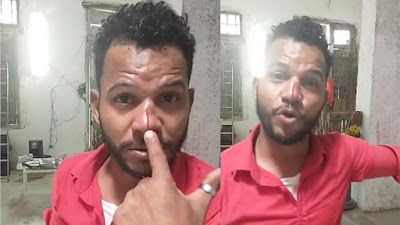
On April 9, 2021 Reuters published a profile on Cuban dissidents that highlighted Cuban rapper Maykel Castillo, a member of the San Isidro Movement, and an artist who sang and appeared in the video Patria y Vida that has been a viral sensation in Cuba. Yesterday, Maykel was assaulted in Havana by strangers as state security agents filmed the assault. They were probably recording to see if he hit back to defend himself, and use that as a basis for prosecution, but he took the blows, and remained nonviolent. Maykel Castillo also known as "Osorbo" denounced the incident on a live broadcast through Luis Manuel Otero Alcántara's social networks: "Something happened today, which probably should have happened many days ago." “I knew that something like this could happen to me; you broke my nose."

Over the past three years he has fought against censorship and the dystopian Decree 349, that further restricts artistic freedom in Cuba. He has paid for his defiance with threats, beatings, and prison. This blog has periodically given updates on his plight.

Maykel Castillo Pérez, "El Osorbo"

In September of 2018 Cuban rapper Maykel Castillo Pérez, "El Osorbo" protested against Decree 349/2018 during a show. This is a new law that further outlaws independent art in Cuba. Three days after the concert, he was detained by the Cuban secret police. On November 15th Maykel sewed his mouth shut and began a hunger strike demanding to be freed. An official told him that they would meet his demand, and he ended the strike. But as the days turned into weeks, and the imprisonment continued, the Cuban artist on December 4th re-started the hunger strike. The Cuban Rapper completed a prison sentence of one year one month for protesting Decree 349.

Maykel Castillo Pérez, "El Osorbo"
 
This was not the first time that he had been the victim of a politically motivated prosecution. On January 28, 2015, Maykel Castillo Pérez was sentenced to a year in prison in Havana. He was targeted for having used music to express his dissenting political opinions. He was charged with ‘peligrosidad predelictiva’ (‘pre-crime dangerousness’), which is used to imprison Cubans for what they  may potentially do in the future due to their associations and/or views.. 
 
His defense attorney told a reporter from Diario de Cuba that prosecutors wanted the judge to sentence him to five years. He once described his musical style as that of someone who “doesn’t make concessions with a system full of liars.” 
 
Being locked up for what one may potentially do in the future, as was done to Maykel, is a widely applied charge by the Castro dictatorship.
 
According to a January 13, 2020 report in The New York Times a former high-ranking judge in Cuba provided documents which "showed that approximately 92 percent of those accused in the more than 32,000 cases that go to trial in Cuba every year are found guilty. Nearly 4,000 people every year are accused of being “antisocial” or “dangerous,” terms the Cuban government uses to jail people who pose a risk to the status quo, without having committed a crime." Furthermore, the article says that "records show that Cuba’s prison system holds more than 90,000 prisoners. 

Yesterday, following the attack Maykel declared, "I'm a tough black," he said. "Not even a thousand beatings are going to make me cross my arms and close my mouth," he warned. He underscored the danger facing him, and the possible escalation of violence by the dictatorship, and his commitment to nonviolence. “If you break a bone, it stays broken. If I die for that, the fault will be yours, because you are a murderer, " he said, addressing the government.  

 The attack on April 12, 2021 was an outrage, and we will continue to monitor the situation on the island, and report on acts of violence and repression.

Patria y Vida. Homeland and Life. Estamos conectados. We are connected. 

Monday, May 6, 2019

Amnesty International: Tomorrow, May 7th. Twitter Hackathon

Ars Gratia Artis

 
According to the Danish NGO Free Muse in their 2019 report, Cuba was second in the world, after Turkey, with 19 artists detained over the course of 2018. On May 7th durng the Biennale Art Festival in Havana a Twitter Hackathon will be taking place. Let us remember Cuban artists such as Maykel Castillo Pérez, jailed for protesting Decree 349 and Cuban American artists such as  Coco Fusco, denied entry to Cuba to attend the Biennale because of her criticism of censorship of the arts in Cuba.

Cuba – AI Twitter Hackathon Tuesday 7th May 2019


Attached are some examples of images to tweet, but you can create your own with your own face or another in the picture.

What the Twitter Hackathon is all about
On Tuesday, 7th May 2019, during the Havana Biennale Art Festival, we are asking you to take part in a Twitter Hackathon, to raise awareness of a new law in Cuba which stands to censor artistic freedom.

Decree 349 was one of the first laws signed by the new President, Miguel Díaz-Canel. It prohibits artistic expression which the state decides is “obscene”, “vulgar”, or “harmful to ethical and cultural values”. It forces artists, musicians, and performers to have prior approval from the Ministry of Culture, and those working without it can have their materials confiscated or suffer heavy fines. The Cuban authorities have argued that Decree 349 aims to protect Cuban society from “mediocrity” and “banality” in art. In reality, it aims to bring artistic expression in line with the “cultural policy of the state”.


 WHY A TWITTER HACKATHON?
In 2018, president Díaz-Canel and other high-ranking government officers launched Twitter accounts and created the hashtag #SomosContinuidad (“We are continuity”). Using a storm of tweets on May 7th, we expect to “hack” the official hashtag by highlighting what that “continuity” really implies for artists in terms of restrictions on freedom of expression and censorship.

WHAT IS OUR GOAL WITH THIS ACTION?
The goal is to achieve trending levels on Twitter using the official hashtag to communicate our messages. Therefore, all our posts must have the #SomosContinuidad hashtag. We aim to have at least 2,500 tweets from our entire movement and allies on the day of the hackathon.

HOW TO TAKE PART IN THE HACKATHON

1. On 7th May please tweet the suggested messages which target the President and the Vice-Minister of Culture, Rafael Fernando Rojas G. You can also include the images supplied, of Cuban artists who are speaking out against the decree.

2. Upload a photo of you and/or your colleagues or friends holding a sign with the #SomosContinuidad and #NoToDecree349 hashtags, and use one of the suggested messages in the tweet as well.

 
Suggested messages:

The leadership of #Cuba might have changed, but censorship of artists and restrictions on artistic expression are still the norm. Is this what the government of @DiazCanelB means by ‘continuity’? #SomosContinuidad #NotoDecree349 #NoAlDecreto349

We show our solidarity with all independent artists in #Cuba standing up for a space in which they can work freely and without fear of reprisals! @DiazCanelB @fernandorojas_6 #SomosContinuidad #NoToDecree349 #NoAlDecreto349

@DiazCanelB @fernandorojas_6 Artists in #Cuba do not need to be protected from “mediocrity” and “banality”. “Continuity” must not = censorship. They need free space to express themselves without fear of reprisals! #SomosContinuidad

Leadership of #Cuba didn't change @DiazCanelB is Raul Castro's puppet but censorship changed, it got worse with #Decree349. #SomosContinuidad #NotoDecree349 #NoAlDecreto349


Examining Artistic Freedom in Cuba: Castro regime jailed the second largest number of artists in the world in 2018

According to Danish NGO Free Muse, Cuba was second in the world with 19 artists detained over the course of 2018.

The Castro regime in Cuba continues to repress and censor artists. ArtNews and Art Forum reported in April of 2019 on how Cuban American artist Coco Fusco was denied entry to Cuba and declared inadmissible. She was barred because she had discussed censorship of the arts in Cuba.

The Danish non-governmental organization, Free Muse, focuses on artistic freedom around the world and has released its 2019 report "The State of Artistic Freedom 2019" revealing that, "[a]t least 157 artists were imprisoned or detained in 29 countries.  Spain, Turkey and Russia jailed the highest number of artists in the Global North, while China, Egypt, Iran and Cuba jailed the highest number of artists  in  the Global South. Free Muse detailed those with highest numbers of arrests. In 2018 there were "97 artists detained in 25 countries, including: 20 in Turkey, 19 in Cuba, 11 in Russia, 9 in Egypt, 6 in China."
Maykel Castillo Pérez: Artist sentenced to 1 year 6 months in prison
The Castro regime further tightened down on the few remaining artistic freedoms in Cuba with Decree 349 in 2018. Censorship had already existed in Cuba since 1959 but now with Decree 349 artists are specifically targeted and radically restricted from their work. Cuban artist Coco Fusco in Frieze magazine outlined the full breadth of this law.
Decree 349, was made public last summer and went into effect on 7 December. It criminalizes independent cultural activity that is not authorized by the state. It entails the creation of a cadre of roving inspectors that will be empowered to shut down activities in private recording studios, home-based galleries and clubs. Sanctions range from stiff fines to confiscation of privately-owned equipment to the seizure of homes. Artists on the island see the law as a return to the repressive cultural policies of the 1970s. Before it became law, Amnesty International called Decree 349 a ‘dystopian prospect’ for Cuba’s artists.
In September of 2018 Cuban rapper Maykel Castillo Pérez, "El Osokbo" protested against Decree 349/2018 during a show in Cuba. Three days after the concert, he was detained by the Cuban secret police, and remained jailed. On March 20, 2019 Maykel was sentenced to one year six months in prison, and learned of his sentence on April 22, 2019.
On May 6, 2019 the General Secretary of the OAS and the US Ambassador to the OAS hosted at the Organization of American States an event which was streamed live in both Spanish and English on the lack of artistic freedom in Cuba with independent journalists and independent artists from the island presenting their testimony.

Hopefully, they will be able to return to Cuba without joining the long list of arbitrarily detained artists.

Thursday, April 11, 2019

Cuban American Artist Denied Entry to Cuba Ahead of Havana Biennial

"L'art pour l'art" - Théophile Gautier (1811–1872)

Cuban American artist Coco Fusco

ArtNews and Art Forum are reporting on how Cuban American artist Coco Fusco was denied entry to Cuba and declared inadmissible. Artistic freedom of expression is an important topic for this blog. Notes from the Cuban Exile Quarter came into being on August 23, 2009 in reaction to attempts to censor Juanes in Miami for wanting to put on a concert in Cuba. Defending both freedom of expression and art for art's sake are both important.  ArtNews reproduced a Facebook entry by Cuban American artist Coco Fusco describing what happened to her when she tried to enter Cuba. Furthermore Cuban rappers Maykel Castillo Pérez, "El Osokbo"  and  Lazaro Rodriquez Betancourt “Pupito en Sy” remained jailed for their opposition to censorship of the arts in Decree 349. This should outrage friends of liberty everywhere.

"INADMISSIBLE"

I am currently sitting in the immigration area of José Marti Airport in Havana. I have been denied entry to Cuba for the second time in the past year. I heard one of the Immigration officials refer to me as an "inadmissible." I'm not a live plant, cheese, a narcotic or a pornographic publication, but expressing critical views of repressive measures carried out against artists constitutes grounds for barring my entry to Cuba.

I am not the first or the last intellectual with close ties to Cuba who has been punished in this way for expressing my views and advocating for greater freedom of expression in Cuba. It has become a sad routine.

The immigration officials in the airport do not give reasons for my imminent expulsion. I am sure that this is due to my writings on Cuban art and cultural politics, and my steadfast support for the artists-led movement in Cuba against Decree 349. It strikes me as a tragic that a government would harass its artists and silence critical debate about its culture in order to impress visitors by creating the false impression that the only art in Cuba is what the state wants to show. The state is counting on favorable coverage from visitors who know little and who will stay on the tour buses and remain inside their art corrals. It also counts on the complicity of artists who remain silent in order to be promoted by the state. They benefit from skeptics who believe that political interventions are carried by artists who lack better (i.e. more artistic) ways of getting attention.

Cuban nationals often believe they have no choice because speaking up means social death. How foreigners rationalize their silence Is another very complicated story, in which unwavering support for the Cuban revolution functions as a kind of anti-American chic for globe trotting intellectuals who haven’t had their own lives turned upside down by a state security apparatus.

Those who suggest that every biennial is selective and that Cuba is no different are missing the point or evading it. Since when do biennials in other countries arrest artists who open their studios or run parallel events? Since when do museums arrest artists that protest their practices? Since when is is ok to threaten foreigners who show up for an independently produced art event with deportation? Cuba is indeed different from many other countries in its harsh repression of criticism and cultural activism. It is also different in that culture is the last valuable product for export and whitewashing of its image that the state has left. If artists can determine what aesthetic value is the government will lose the last jewel in its crown.

I find it disturbing that it takes beheadings, stoning and long prison sentences to get most people in the artworld to protest censorship and repression of artists. Violence is not reducible to physical aggression. Creativity, imagination and hope die slow deaths in a country where any expression of dissent is criminalized. A biennial every few years doesn’t upend that deterioration.

Friday, August 24, 2018

Amnesty International denounces new Cuban law as dystopian attack on Cuba's artists

 "Within the Revolution, everything; outside of the Revolution, nothing." - Fidel Castro, June 30, 1961


Cuba: New administration’s Decree 349 is a dystopian prospect for Cuba’s artists

24 August 2018, By Amnesty International

In response to Decree 349, one of the first laws signed by Cuba’s new President Miguel Díaz-Canel in April 2018, which will come into force in December and has provoked protests by independent artists in Cuba, Erika Guevara-Rosas, Americas Director at Amnesty International said:
“Amnesty International is concerned that the recent arbitrary detentions of Cuban artists protesting Decree 349, as reported by Cuban independent media, are an ominous sign of things to come. We stand in solidarity with all independent artists in Cuba that are challenging the legitimacy of the decree and standing up for a space in which they can work freely without fear of reprisals.”
“As far back as the 1980s, Amnesty International has documented the harassment and arbitrary detention of independent artists in Cuba simply for peacefully expressing their opinions through art. Instead of consolidating their control over artists perceived to overstep state-sanctioned criticism, the Cuban authorities should be making progressive changes to protect human rights.”

Background:
Signed by President Díaz-Canel in April and published in Cuba’s Official Gazette in July, Decree 349 is expected to come into force in December 2018.

Under the decree, all artists, including collectives, musicians and performers, are prohibited from operating in public or private spaces without prior approval by the Ministry of Culture. Individuals or businesses that hire artists without the authorization can be sanctioned, and artists that work without prior approval can have their materials confiscated or be substantially fined. Under the new decree, the authorities also have the power to immediately suspend a performance and to propose the cancelation of the authorization granted to carry out the artistic activity. Such decisions can only be appealed before the same Ministry of Culture (Article 10); the decree does not provide an effective remedy to appeal such a decision before an independent body, including through the courts.

Amnesty International is concerned that the decree contains vague and overly broad restrictions on artistic expression. For example, it prohibits audiovisual materials that contain, among other things: “use of patriotic symbols that contravene current legislation” (Article 3a), “sexist, vulgar or obscene language” (Article 3d), and “any other (content) that violates the legal provisions that regulate the normal development of our society in cultural matters” (Article 3g). Furthermore, it makes it an offence to “commercialize books with content harmful to ethical and cultural values” (Article 4f).

Prohibiting artistic expression based on concepts such as “obscene”, “vulgar” or “harmful to ethical and cultural values” does not meet the tests of legitimate purpose, necessity and proportionality required under international human rights law. The lack of precision in the wording of the decree opens the door for its arbitrary application to further crackdown on dissent and critical voices in a country where artists have been harassed and detained for decades. This would not only contravene the right to freedom of expression of artists in Cuba, but the right of every person in the country to seek and receive information and ideas of all kinds.

International human rights law and standards require that any restriction to the right to freedom of expression, including through art, must be provided by law and formulated with sufficient precision to avoid overly broad or arbitrary interpretation or application, and in a manner that is accessible to the public and that clearly outlines what conduct is or is not prohibited.

Restrictions must also be demonstrably necessary and proportionate for the purpose of protecting a specified public interest which, under international human rights law, are only national security, public order, and public health or morals, or the rights or reputations of others.

As signatory to the International Covenant on Civil and Political Rights (ICCPR), Cuba is required to refrain from acts that would defeat the object and purpose of the treaty. Article 19 of the ICCPR specifically protects the right to freedom of expression, which includes the “freedom to seek, receive and impart information and ideas of all kinds…” including “in the form of art”.

The rights to freedom of opinion and expression are essential for the full development of any person or society, and are key to enabling individuals to exercise other human rights. As such, under international law, states have a duty to protect the free expression of ideas and opinions of all kinds, including when deeply offensive. Laws restricting insult or disrespect of heads of state or public figures, the military or other public institutions, flags or symbols are prohibited under international human rights law.

The blanket requirement for prior authorization by the Ministry of Culture of an artist’s work to be shown in public, as set out in Article 2.1, would also impose controls over the exercise of artistic expression that may amount to prior censorship and would exceed the permissible restrictions on the right to freedom of expression.

Amnesty International is further concerned that Decree 349 is likely to have a general chilling effect on artists in Cuba, preventing them from carrying out their legitimate work for fear of reprisals.

Cuba: Transform Confrontation into Dialogue: A Human Rights Agenda for Cuba, 16 April 2018,

Cuba: “Your Mind is in Prison” – Cuba’s web of control over freedom of expression and its chilling effect on everyday life, 16 November 2017,

Urgent Action: Urban artist at risk in Cuba, 24 August 2017,