"The first victory we can claim is that our hearts are free of hatred. Hence we say to those who persecute us and who try to dominate us: ‘You are my brother. I do not hate you, but you are not going to dominate me by fear. I do not wish to impose my truth, nor do I wish you to impose yours on me. We are going to seek the truth together’. THIS IS THE LIBERATION WHICH WE ARE PROCLAIMING."
Oswaldo José Payá Sardiñas (2002)
Covering up human trafficking for tyrants and despots worldwide
(L-R) Obama joins hands with Burma, China tyrants & Malaysia's PM + Raul Castro
Nice to see the mainstream media catching up and breaking an important story. Last week on July 28, 2015 this blog reported on how the State Department was undermining the integrity of the Trafficking in Persons Report by politicizing it when it took Cuba off the list of worse offenders. According to Reuters, in the Special Report: State Department watered down human trafficking report by Jason Szep and Matt Spetalnick, it is even worse that initially imagined:
In the weeks
leading up to a critical annual U.S. report on human trafficking that
publicly shames the world’s worst offenders, human rights experts at the
State Department concluded that trafficking conditions hadn’t improved
in Malaysia and Cuba. And in China, they found, things had grown worse.
The State Department’s senior political staff saw it differently — and they prevailed.
A
Reuters examination, based on interviews with more than a dozen sources
in Washington and foreign capitals, shows that the government office
set up to independently grade global efforts to fight human trafficking
was repeatedly overruled by senior American diplomats and pressured into
inflating assessments of 14 strategically important countries in this
year’s Trafficking in Persons report.
In
all, analysts in the Office to Monitor and Combat Trafficking in
Persons - or J/TIP, as it’s known within the U.S. government — disagreed
with U.S. diplomatic bureaus on ratings for 17 countries, the sources
said.
The analysts, who
are specialists in assessing efforts to combat modern slavery - such as
the illegal trade in humans for forced labor or prostitution - won only
three of those disputes, the worst ratio in the 15-year history of the
unit, according to the sources.
As a result, not only Malaysia, Cuba and China, but countries such as India, Uzbekistan and Mexico,
wound up with better grades than the State Department’s human-rights
experts wanted to give them, the sources said. (Graphic looking at some
of the key decisions here: reut.rs/1gF2Wz5)
This may seem like another small compromise to having the U.S. Interests Section re-designated an Embassy in Havana but it once again returns me to the words of Vaclav Havel nearly six years ago. Back in 2009, President Barack Obama had backed out of meeting with the Dalai Lama due to
an upcoming trip to China, Havel offered the following reflection on October 12, 2009 at the Forum 2000
conference:
I believe that when the new
Laureate of the Nobel Peace Prize postpones receiving the Dalai Lama
until after he has accomplished his visit to China, he makes a small
compromise, a compromise which actually has some logic to it. However,
there arises a question as to whether those large, serious compromises
do not have their origin and roots in precisely these tiny and very
often more or less logical compromises.
Now the State Department's human trafficking report will be taken less seriously than it may have been in the past and the authority of the United States on this subject is now lessened than it was before. What impact will this reduced authoritative and moral stature have on victims of the trafficking around the world? What other unintended consequences will it generate.
More than 100 students and monks beaten and detained today in Burma
The Burmese regime needs to drop all charges against the arrested students, and unconditionally free any students still in detention. There also needs to be an investigation that holds accountable those responsible for the violence today and institutionalize nationwide measures to prevent recurrence of
similar incidents.
The debate on Cuba often degenerates into a conversation of sanctions versus dialogue. It is at best a failure of imagination. A more useful conversation would be one that combines strong sanctions and boycotts while pursuing dialogue to obtain a democratic opening with concrete measures. In a meeting with reporters and editors of The New York Times on September 26, 2012 Aung San Suu Kyi responded to the following two questions concerning sanctions in Burma and on whether or not they have been and how it has impacted the Burmese: Q: Is it fair to say the sanctions worked?
A: Yes, I always say
that sanctions work. Not in the way people think it did. Now the
emphasis is on the economic effect of the sanctions, but I always quote
the IMF by saying that for years IMF reports have consistently made the
point that the sanctions have affected Burma’s economy very little and
it was mismanagement that put us in a terrible mess. But partly, the
regime started believing their own propaganda that sanctions are
responsible for the ills of the country. This always happens. I think
the eagerness to go ahead economically, I think the perception was that
if you improve the economy, everything else would improve. I don’t
subscribe to that view, I think you need political reforms as well as
economic reforms. So the sanctions needed to be removed, because a lot
of people saw them as an obstacle to progress.
Q: So the sanctions hurt ordinary Burmese but they helped evoke change?
A:
I do not think sanctions hurt ordinary Burmese, as much as the IMF has
gone into this and they have concluded that they did not hurt ordinary
Burmese. If you remember, the garment industry had a setback after 2007
[when the U.S. prohibited imports] but it picked up very quickly… I
think it had picked up within a little over a year.
The full transcript of the meeting is available here.
The reason why I've emphasized the rule of law so much in my political work is because this is what we all need if we are to really proceed towards democracy. - Aung San Suu Kyi
Aung San Suu Kyi delivers her acceptance speech upon receiving her honorary degree from the University of Oxford at the June 20, 2012 Encaenia ceremony. This took place in the midst of her first visit to Europe in 24 years following being released from years of unjust imprisonment.
While in London, Suu Kyi also had a private meeting with His Holiness the Dalai Lama. On June 21, 2012 she delivered a speech in the British parliament.
Allow International Monitors to Account for All Remaining Detainees
Pyone Cho, an activist of the 88 Generation Students Group, center, was released from prison on Friday, Jan. 13, 2012. Photo by Associated Press
(New York) – The release of key political prisoners on January 13, 2012 is a crucial development in promoting respect for human rights in Burma, but all remaining political prisoners should be freed immediately and unconditionally, Human Rights Watch said today.
Among those released are members of the 88 Generation student group that led the 1988 uprising, including leader Min Ko Naing, Nilar Thein, her husband Kyaw Min Yu, known as Ko Jimmy, as well as Htay Kywe. Shan ethnic leader Khun Tun Oo, monk leader U Gambira, journalists Zaw Thet Htwe, Ngwe Soe Linn, Hla Hla Win, and blogger Nay Phone Latt were also released today.
Burma state media said on January 12 that 651 prisoners would be freed so they can participate in the task of nation-building.
“Years of international calls to release long-detained political prisoners seem to have pushed the government to finally do the right thing,” said Elaine Pearson, deputy Asia director at Human Rights Watch. “The government should ensure that there are no obstacles to these activists participating in public life and upcoming elections.”
The US State Department had estimated that at least 1,100 political prisoners were detained in Burma and the Thai-based Assistance Association of Political Prisoners in Burma counted more than 1,500. Given the closed nature of Burma's justice system, the lack of a free press and unsophisticated communications in one of Asia's poorest countries – particularly in remote ethnic areas affected by conflict – each of these lists may omit significant numbers of people being held for the peaceful expression of their political views.
Human Rights Watch called on the Burmese government to allow international independent monitors to publicly account for all remaining political prisoners.
“The latest releases are wonderful news for the individuals and their families, but foreign governments should continue to push for the release of all political prisoners, and for international monitors to verify the process,” said Pearson. “For years Burma's prisons have been off-limits to any independent monitoring mechanism. The next step for Burma’s government is to allow international monitors to verify the whereabouts and conditions of remaining political prisoners.”
"I would like you all to think about what has happened and not forget" - Aung San Suu Kyi
Twenty three years ago today, on August 8, 1988, thousands of Burmese civilians died protesting for democracy and against military rule. Burmese opposition leader, Daw Aung San Suu Kyi attended a ceremony remembering that terrible day, telling people that "I would like you all to think about what has happened and not forget" the victims of 08-08-88.
The “8888” uprising refers to a series of protests that took place in Burma during 1988 that culminated on the date 8/8/1988, giving this uprising its name. These protests, which began in March of 1988, were initially incited largely by students to express their disgust with the military government’s hostile economic, political, and monetary policies. The one-party rule led by the Burmese Socialist Program Party (BSPP) suppressed the democratic desires of the people, and the economic situation in Burma placed it on the “Least Developed Country” list by the United Nations Economic and Social Council by 1987. The government at that time was headed by General Ne Win, who ruled Burma from 1962-1988 as an oppressive and violent ruler. Despite Ne Win’s resignation in July of ’88, the protests and anger continued since his successor, Sein Lwin, was also hated by the Burmese people, and he refused to address the issues that the protesters were calling for action on.
Although the center of the uprising was in the Burmese capital city of Rangoon, rural areas were also the scene of protests and strikes. From August 1-7 of that year, the protests intensified as students called upon everyone to become involved and to participate in the mass demonstration planned for August 8. The people responded, and the streets were filled with monks, workers, intellectuals, and members of all ethnic groups and walks of life. The August 8 demonstration stretched into a 5-day strike that took the Burmese military government aback, with promises from the leadership that the people’s demands would be considered, although of course, these promises were never meant to be fulfilled. Rather, during this time, it is estimated that around 3,000 people were killed as the police and military massacred peaceful protestors under orders from the BSPP.
Many believed that had the United Nations or the United States become involved during these protests or refused to recognize the coup during its takeover, the military regime would have failed to take hold and would have collapsed. To commemorate the bloody “8888” uprising, groups around the world have been holding remembrances on August 8 since then, and on the 20th anniversary of the uprising, Burma Center Prague, like other groups around the world, held a special event to honor the past and present victims of the Burmese dictatorship.
Another effect of both the 8888 uprising and the ethnic persecution is that hundreds of thousands of people in the past two decades have been forced to flee their homes to seek shelter elsewhere in Myanmar or in neighbouring countries. No fewer than half a million people in a nation of approximately 51 million are internally displaced within Myanmar. As I have witnessed myself, most live in deplorable conditions and constant fear, wondering if the world even knows about them.
As she emerges from her captivity as a moral exemplar and a symbol of nonviolent resistance they are exposed as the small and pathetic bullies that they are. Large crowds of thousands of Burmese greeted the end of her captivity chanting “Long live Daw Aung San Suu Kyi” near her home on University Avenue in Rangoon. Aung San Suu Kyi emerged and addressed the crowd, saying: "There is a time to be quiet and a time to talk. People must work in unison. Only then can we achieve our goal," but was drowned out by jubilant chants celebrating her release.
Update:Burma Democratic Concern sent me the following e-mail message: Burma's legitimate leader Daw Aung San Suu Kyi is free today and she will ADDRESS the public tomorrow at the NLD headquarters at 12:00 pm Burma Standard Time (GMT+6.5). As I post this it is 10:53pm EST and the time in Burma is 10:23am on Sunday which means that she will be making her address in about an hour and a half which will be 12:30am Eastern Standard Time.
The embedded video below is the first part of a 1996 five part documentary Burma - Land of Fear by John Pilger exposing the brutal nature of the military junta in Burma.
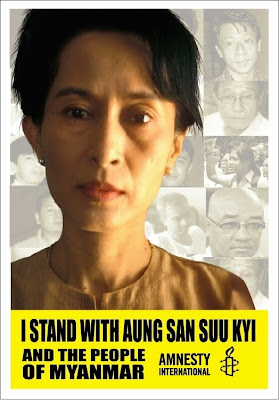
Please sign the letter located at http://3freedoms.amnesty.org/ and use your freedom to help the people of Burma. Takes less than a minute.
"Please use your freedom to promote ours." - Aung San Suu Kyi, prisoner of conscience since 1990
Ours is a nonviolent movement that depends on faith in the human predilection for fair play and compassion. Some would insist that man is primarily an economic animal interested only in his material well-being. This is too narrow a view of a species which has produced numberless brave men and women who are prepared to undergo relentless persecution to uphold deeply held beliefs and principles. It is my pride and inspiration that such men and women exist in my country today.
Aung San Suu Kyi, Please Use Your Liberty to Promote Ours (1997)
On a just peace
Where there is no justice there can be no secure peace. ...That just laws which uphold human rights are the necessary foundations of peace and security would be denied only by closed minds which interpret peace as the silence of all opposition and security as the assurance of their own power.
Aung San Suu Kyi, In Quest of Democracy
Relationship between fear, power and corruption
It is not power that corrupts but fear. Fear of losing power corrupts those who wield it and fear of the scourge of power corrupts those who are subject to it.
Aung San Suu Kyi, Freedom from Fear (Acceptance message for the 1990 Sakharov Prize for Freedom of Thought, July 1991)
It would be difficult to dispel ignorance unless there is freedom to pursue the truth unfettered by fear. With so close a relationship between fear and corruption it is little wonder that in any society where fear is rife corruption in all forms becomes deeply entrenched.
Aung San Suu Kyi, Freedom from Fear (Acceptance message for the 1990 Sakharov Prize for Freedom of Thought, July 1991)
Within a system which denies the existence of basic human rights, fear tends to be the order of the day. Fear of imprisonment, fear of torture, fear of death, fear of losing friends, family, property or means of livelihood, fear of poverty, fear of isolation, fear of failure.
Aung San Suu Kyi, Freedom from Fear (Acceptance message for the 1990 Sakharov Prize for Freedom of Thought, July 1991)
A most insidious form of fear is that which masquerades as common sense or even wisdom, condemning as foolish, reckless, insignificant or futile the small, daily acts of courage which help to preserve man's self-respect and inherent human dignity.
Aung San Suu Kyi, Freedom from Fear (Acceptance message for the 1990 Sakharov Prize for Freedom of Thought, July 1991)
It is not easy for a people conditioned by fear under the iron rule of the principle that might is right to free themselves from the enervating miasma of fear. Yet even under the most crushing state machinery courage rises up again and again, for fear is not the natural state of civilized man.
Aung San Suu Kyi, Freedom from Fear (Acceptance message for the 1990 Sakharov Prize for Freedom of Thought, July 1991)
On Investments and Sanctions
Investment that only goes to enrich an already wealthy elite bent on monopolizing both economic and political power cannot contribute toward égalité and justice — the foundation stones for a sound democracy. I would therefore like to call upon those who have an interest in expanding their capacity for promoting intellectual freedom and humanitarian ideals to take a principled stand against companies that are doing business with the Burmese military regime. Please use your liberty to promote ours.
Aung San Suu Kyi, Please Use Your Liberty to Promote Ours (1997)





 Posts
Posts

