Showing posts with label Pope Benedict XVI. Show all posts

Thursday, April 5, 2012

Amnesty International issues urgent action for Cuban arrested during Papal mass


Document - Cuba: Cuban government detains critic

UA: 100/12 Index: AMR 25/013/2012 Cuba Date: 4 April 2012

URGENT ACTION

CUBAN GOVERNMENT DETAINS CRITIC

A government critic has been detained, apparently without charge, for more than a week for peacefully expressing his right to freedom of expression .

Andrés Carrión Álvarez was arrested in the city of Santiago de Cuba on 28 March where he was attending an open air mass celebrated by Pope Benedict XVI. Five minutes before the mass began in Antonio Maceo Square, he apparently shouted, “freedom” (libertad) and “down with communism” (abajo el comunismo).

He was removed by security personnel and was apparently arrested by officials from the Department of State Security. Local human rights organizations have been unable to confirm his whereabouts or whether he has been charged.

Amnesty International believes he may be a prisoner of conscience, detained solely for peacefully exercising his right to freedom of expression.


Please write immediately in Spanish or your own language:

Calling on the authorities to reveal immediately the whereabouts of Andrés Carrión Álvarez, who was arrested on 28 March;

Urging them to release him immediately if he is detained, unless there is sufficient evidence to charge him with an internationally-recognizable criminal offence;

Urging them to cease immediately the harassment and intimidation of citizens who peacefully exercise their rights to freedom of expression and association.

PLEASE SEND APPEALS BEFORE 16 MAY 2012 TO :

Head of State and Government

Raúl Castro Ruz

Presidente de la República de Cuba

La Habana, Cuba

Fax: +53 7 83 33 085 (via Foreign Ministry)

+1 212 779 1697 (via Cuban Mission to UN)

Email: cuba@un.int (c/o Cuban Mission to UN)

Salutation: Your Excellency

Interior Minister

General Abelardo Coloma Ibarra

Ministro del Interior y Prisiones

Ministerio del Interior, Plaza de la Revolución, La Habana, Cuba

Fax: +1 212 779 1697 (via Cuban Mission to UN)

Email: correominint@mn.mn.co.cu

Salutation: Your Excellency

And copies to:

Attorney General

Dr. Darío Delgado Cura

Fiscal General de la República, Fiscalía General de la República, Amistad 552, e/Monte y Estrella, Centro Habana

La Habana, Cuba

Salutation: Dear Attorney General

Also send copies to diplomatic representatives accredited to your country.

Please check with your section office if sending appeals after the above date.

URGENT ACTION

CUBAN GOVERNMENT DETAINS CRITIC

Additional Information

Pope Benedict XVI visited Cuba from 28-30 March, and celebrated open air masses in the city of Santiago de Cuba and the capital, Havana, and held meetings with the leaders of the Cuban Catholic Church and the Cuban authorities. Government critics had hoped the Pope’s visit might herald an opening on the part of the Cuban authorities, but instead they were subjected to further repression. Over 200 government critics were apparently detained during the Pope's visit, and many others held under house arrest, with the express purpose of preventing them from travelling to attend the masses and take part in protest activities. Those who were detained or placed under house arrest are all believed to have been released. Since just before the Pope arrived in Cuba, the mobile and landline connections belonging to government critics, human rights activists and independent journalists have been tampered with, preventing them from reporting on repression to audiences within Cuba and also to the outside world.

Name: Andrés Carrión Alvarez

Gender m/f: m

UA: 100/12 Index: AMR 25/013/2012 Issue Date: 4 April 2012

Friday, March 30, 2012

Oswaldo Payá denounces attempt to make victims participate in their own oppression

“If you continue in my word, you are truly my disciples, and you will know the truth, and the truth will make you free” (Jn 8:31).
Oswaldo Payá at Papal Mass in Havana, Cuba with banner that reads "the truth will make you free"

Christian Liberation Movement

CHANGE NOT FRAUD, YES TO LIBERATION

On the one hand we are grateful that His Holiness Benedict XVI has come to Cuba to preach to our people the Word of God and to bless them. On the other hand the unfair maneuvers by the regime to seize the encounters of the Pope with the people and the repression of the nonviolent opposition have been a scandal of which many Cubans are aware.

We believe that this repression against the opposition has not been immune to the contempt, exclusion and disqualification opponents, Catholic or not, that we have been suffering from a certain elite within the Church. This elite through their media in such magazines as Palabra Nueva (New Word), Espacio Laical (Lay Space) and in many events, has over the years carried out a practice of disqualification of the nonviolent opposition and promoted support for the alleged changes along government lines. It is in this environment that today in the Father Felix Varela Center, a former seminary, "the Cuban businessman and politician based in the United States, Mr. Carlos Saladrigas" will speak on: Attitudes and policies we have to take to achieve the inclusion of the Cuban Diaspora in the social activity of the Island.

The Christian Liberation Movement denounces that same elite we mentioned that insists publicly that in Cuba there are no independent movements and parties. We have never sought political space within the Church, but the rights for all Cubans in society. Everyone knows that. But it is painfully obvious that the space that the Church could offer for dialogue among all Cubans, Catholics or not, with respect to plurality and open to participation, has been seized, at least in Havana, by this elite that with support from the hierarchy acts as the political party of the Church, which is neither a party nor should have parties.

This small group that takes over the space of all lay people on the political and social issues, not only excludes others, but denies the reality of our struggle for freedom and our right to exist. They coincide with the Communist Party's claim to be a single party, but in the church and agree on the exclusion and disqualification of those who do not submit.

Not only is given the coincidence of this elite with the methods of exclusion and imposition of the Communist Party, but have largely agreed on the promotion of the line attributed to the oligarchy the lead role in the alleged changes and call for the vote of confidence for the government of Raúl Castro.

Our Movement denounces the regime's attempt to impose a fraudlent change, i.e. change without rights and the inclusion of many interests in this change that sidesteps democracy and the sovereignty of the people of Cuba. The attempt to link the Diaspora in this fraudulent change is to make victims participate in their own oppression. The Diaspora does not have to "assume attitudes and policies in entering the social activity of the island." The Diaspora is a Diaspora because they are Cuban exiles to which the regime denied rights as it denies them to all Cubans. It is not in that part of oppression, without rights, and transparency that the Diaspora has to be inserted, that would be part of fraudulent change.

The gradual approach makes sense only if there are transparent prospects of freedom and rights. We Cubans have a right to our rights. Why not rights? It's time. That is the peaceful change that we promote and claim. Changes that signifies freedom, reconciliation, political pluralism and free elections. Then the Diaspora will cease being a Diaspora, because all Cubans will have rights in their own free and sovereign country. That is why we fight.

Oswaldo José Payá Sardiñas ... On Behalf of the Christian Liberation Movement

Havana, March 30, 2012

Listen to Oswaldo Payá (in Spanish)

Original text in Spanish available here.

Thursday, March 29, 2012

Why are some disappointed by the Pope's visit to Cuba?

The truth is a desire of the human person, the search for which always supposes the exercise of authentic freedom. Many, without a doubt, would prefer to take the easy way out, trying to avoid this task. Some, like Pontius Pilate, ironically question the possibility of even knowing what truth is (cf. Jn 18:38), ... There are too many who, like the Roman governor, wash their hands and let the water of history drain away without taking a stand. - Pope Benedict XVI, March 28 , 2012

Projection of Pope Benedict XVI's image onto the Havana Cathedral in Cuba

Why are some saddened and disappointed by the Pope's visit to Cuba while others are profoundly satisfied by it? There are three main reasons (listed further below) as to why some people were disappointed. However the top issue is that the Pope met with Fidel Castro (who is no longer head of state) but had no time to meet with Catholic dissidents such as the Ladies in White or Oswaldo Paya. Berta Soler, the spokeswoman for the Ladies in White in an interview with the Spanish newspaper ABC explained the reason for her disappointment:
“the Pope forgot to grant all of the oppressed and marginalized in his flock the one minute of contact that we begged for, but, in spite of our great disappointment, we have not lost our faith or our love for Christ.”
Oswaldo Paya of the Christian Liberation Movement who was able to attend the Mass in Havana carrying a banner that said "The truth will set you free" although condemning the repression celebrated the Pope's visit:

"I speak to you at the end of the Mass, despite the harassment and the persecution that we have been subjected to, have been able to arrive to the homily in which there was much vigilance and where many persons that have nothing to do with this were called to attend, but where also the People of God were also there listening to the Word of the Holy Father.

Our first words are for hundreds of our fellow dissidents who were not able to be here because of the wave of fear. There was a great absence in these Masses of precisely those of us who defend human rights. I speak of them and in the name of those who have no voice and have only suffered scorn and repression, and we must remember. They are the ones who defend reconciliation, peace and liberty in Cuba, despite that they are the ones who have been excluded. Terror has excluded them.

But we prayed with the Holy Father, we opened our hearts to hope. As John Paul II said: we have to be the protagonists of our history. Liberation is a task for the Cuban people – now with greater hope because we are definitely on the verge, on the threshold of truth and liberation. That is our hope."

Three main reasons behind disappointment with the visit:

1. Not as an effective communicator as his predecessor
Blessed John Paul II

Pope Benedict XVI, in addition to being a man of God, is a intellectual heavy weight, but compared to Blessed John Paul II doesn't have the same communication skills as his predecessor. I followed all the services that the Pope presided over and listened carefully but still managed to miss or not appreciate the depth of what His Holiness was saying until I went back and read his homilies.

Over the two days he said a number of things that in my opinion went further than what Pope John Paul II had said in 1998 on freedom and struggle, but the delivery was much more difficult to absorb. Hopefully, all that Pope Benedict XVI spoke about Cuba during his trip will be republished in a format that can be read by Cubans on the island. Not only would it be extremely valuable for evangelizing into the Catholic faith but also providing insights for the opposition on the moral/spiritual dimension of nonviolent struggle.


2. Didn't meet with opposition or denounce ongoing repression during his visit

Furthermore, remaining silent about the wave of repression unleashed just prior to his arrival in order to prevent nonviolent dissidents from attending Mass in both Santiago and Havana and not mentioning or commenting on the public spectacle of regime officials detaining an individual for shouting against the dictatorship and calling for freedom prior to the Mass and physically assaulting the protester repeatedly as he was taken away was disappointing. In light of the detention of over 250 dissidents and the blocking of communications during the Pope's visit Amnesty International made the following request:
“In view of this situation, which contradicts his appeal for a ‘more open society’ in Cuba, the Pope should take a stand and lend his voice to those that have been left voiceless due to the ongoing repression and condemn the lack of freedoms in Cuba.”
His Holiness Pope Benedict XVI with regards to Amnesty International's request and the heavy handedness with the few who spoke out prior to the Mass who were taken away didn't say anything explicitly but in the final Homily in Havana offered a biblical teaching on resistance and sacrifice.
In today’s first reading, the three young men persecuted by the Babylonian king preferred to face death by fire rather than betray their conscience and their faith. They experienced the strength to “give thanks, glorify and praise God” in the conviction that the Lord of the universe and of history would not abandon them to death and annihilation. Truly, God never abandons his children, he never forgets them. He is above us and is able to save us by his power. At the same time, he is near to his people, and through his Son Jesus Christ he has wished to make his dwelling place among us in.
However, the regime did respond explicitly to the Pope's subtle calls for reform and openness: government minister Marino Murillo said “In Cuba, there will not be political reform.”

3. Cardinal Ortega's actions clouded Pope's visit before he even arrived

Even before His Holiness Pope Benedict XVI arrived on the island on March 15, Cardinal Jaime Ortega responded to the occupation of a Church in Cuba by 13 dissidents by calling on the political police to enter the Church and forcefully remove the occupiers. This upset many Cuban Catholics, who although not agreeing with the occupation of the Church, were horrified by the use of regime agents to expel and detain the dissidents at the request of the Cardinal. When Church's have been occupied in other countries, Church officials have sought dialogue and mediation to end the occupations internally. In Boston, Massachusetts when occupiers took over a Church the Bishop did not resort to legal recourse until dialogue and discussion would not resolve the situation and several months had passed. At the same time one must take into account that the legal system in Boston and the police function in a democratic society were parishioners have rights not a totalitarian communist dictatorship with a horrible human rights record. All the more reason for Cardinal Ortega to have resolved the matter internally with patience and dialogue but instead, unfortunately, invited in the agents of the dictatorship to resolve the problem for him.


Of lasting importance and cause for both hope and frustration

Pope Benedict XVI's homilies most importantly preached the Holy Gospel and evangelized hundreds of thousands of Cubans. That in and of itself is of primary importance and plants the seeds of spiritual liberation that is anathema to totalitarian regimes. His Holiness also inspired many with his words on the true nature of liberty and truth, and he made a call to nonviolent action.

At the same time many were disappointed because Pope Benedict XVI extensively mentioned relations with the communist regime; met with high ranking officials but made no explicit mention of the democratic opposition over his three day visit to Cuba much less meet with them; and spoke about "progress" by the regime when things on many fronts have gotten worse in the midst of massive crackdown.

In his last Homily in Havana, Cuba on March 28, 2012 His Holiness Pope Benedict XVI spoke many profound truths that are well worth reading, studying and reflecting on. Among these truths is one that bears repeating in this age of compromise and relativism: "Each man and woman has to seek the truth and to choose it when he or she finds it, even at the risk of embracing sacrifices."

Ray Walser, a researcher at the conservative think tank Heritage offered the following conclusion of his analysis on the impact of the Pope's visit to Cuba: "His Holiness did not light a fire of freedom as many hoped; he did not reach out directly to the dissidents, but he stirred an already simmering pot. He offered an alternative vision of a future Cuba as “a home for all,” not as the last bastion of communism."

Cuban Catholics Carlos Eire & Geandy Pavon weigh in on Pope Benedict XVI's Cuba pilgrimage

Deeply concerned that the aftermath of Pope Benedict XVI's visit to Cuba and the policies pursued by the Church on the island will, as was the case following the wars of independence in the nineteenth century in Cuba, result in an even weaker Catholic Church after communism.

The essay by Carlos Eire and the video projected by Geandy Pavon over La Ermita de la Caridad demonstrate that influential and practicing Cuban catholics have been deeply disturbed by the moral implications of the visit.

From Babalu Blog:

Let Peter weep

by Carlos Eire

Immediately the rooster crowed the second time. Then Peter remembered the word Jesus had spoken to him: “Before the rooster crows twice you will disown me three times.” And he broke down and wept. Mark 14:72


When Jesus chose Peter as his chief apostle, he knew he was delegating his authority to a very weak, and very flawed man. Peter was impulsive, inconstant, given to cowardice, and – by his own description – quite a sinner. Yet Jesus, the all-knowing Son of God, chose him over all the others.

And Peter's denial of Jesus just before the crucifixion was not the end of his constant screw-ups. He tried to lie to the apostle Paul, in regard to his opinion on keeping Kosher, and even tried to cover his tracks about having lied (Galatians 2:11). Up until the end he kept screwing up, and those around him kept recording his faults. Legend has it that when Nero began his persecution of the Christians in Rome, Peter headed straight out of town, and would have kept going if the risen Jesus had not bumped into him and asked “quo vadis?”, hey, where are you going? But legend also has it that he came to his senses, returned to Rome, and was crucified upside down on the Vatican hill.

Every pope after him screwed up in various ways. Three examples should be enough.

Pope Honorius I (625 -638) agreed with the monophysite heretics in a private letter, and his remains were later dug up and thrown into the Tiber River.

Pope Alexander VI (1492-1503) had several mistresses and fathered a brood of ruthless illegitimate children, one of whom – Cesare Borgia -- was not only made bishop at the age of 15 and cardinal at the age of 18, but actually went on to become a formidable back-stabbing warrior, and the inspiration for Machiavelli’s book The Prince, the ultimate how-to manual for unprincipled tyrants. As if this were not enough, he also inspired the lurid and dreadful Showtime television series, "The Borgias."

In 1517, when Pope Leo X first heard of an Augustinian monk in Saxony named Martin Luther who had angered a Dominican preacher by challenging the legitimacy of indulgences, he dismissed all the fuss as nothing more than another “monkish squabble” between religious orders. Of course, we all know what happened next: the Protestant Reformation.

What are we to make of this, those of us who are Catholics? And those who are not?

The First Vatican Council proclaimed in 1871 that the successors of Peter are infallible in questions of faith and doctrine, that is, they are incapable of leading the faithful astray when it comes to their salvation. But it said nothing about the pope’s private life and his behavior concerning earthly matters.

Up until today, all of this had been a very abstract issue for me. Yes, I knew all this, and have studied it and taught my students about it ad nauseam, but I had never been affected by a papal failure of character until today.

Today reminded me of Good Friday. It felt like it, more than any Good Friday in recent memory. There was an abject despondency in the air, an oppressive grief beyond words. A crucifixion, multiplied eleven million times.

Nemesis at "Ermita de la Caridad del Cobre" in Miami by Geandy Pavon

Today His Holiness Benedict XVI disowned Christ in Cuba. Today, he averted his eyes from the eleven million crucified Cubans in his midst, as he celebrated the holy sacrifice of the Eucharist. Today, he chose not to speak for the crucified, or to chasten their tormentors. Instead, he spent his time criticizing the so-called embargo, blessing the tyrants, and preaching a platitudinous sermon written for the theological faculty at the University of Regensburg rather than for the Cuban people.

And his subaltern, Cardinal Jaime Ortega y Alamino, archbishop of Havana, beamed with satisfaction at the abject submission of Church to state.

I am saddened, yes, as are many other Cubans. I wept today. I am beyond sad: today has been one of the blackest days for me in a long time. The clouds hung low. At one point the sun was blotted out. I could not help but see eleven million crosses, with bodies writhing on them, stretched from one end of Cuba to the other. But I am not broken. Nor is my faith shaken. God works in mysterious ways. The Vicar of Jesus Christ on earth, Pope Benedict XVI has betrayed Cuba. So what? Aside from questions of faith and doctrine, he is as fallible as all of us are, and as prone to moral failure. And as a Catholic, it is my duty to pray for him.

I am angry too, yes. Mad as hell. I am angry at the old man, Joseph Ratzinger, and at the subalterns who advised him and made excuses for him. But popes have screwed up before, and will continue screwing up. And it isn’t up to any pope, or cardinal, or any foreign power to free Cuba from its tyrants. It is up to us, and to us alone, whether there or in exile.

His Holiness Benedict XVI did all Cubans a great favor today, when you look at his behavior from a certain perspective. He showed us that we cannot depend on anyone to help us.

Forget the pope. Let Peter weep, when he comes to his senses. Weeping is not for us, nor is whining. Forget any power on earth. Forget the differences between Catholics and non-Catholics. Forget heaven above, forget hell below . Cuba is hell on earth, our hell. Our task is to fight the tyrants and those who set up the eleven million crosses. Our role is to stand up to the tyrants and the henchmen who set up the crosses, wherever we are, and to remind the world constantly of their crimes against humanity.

Eventually, we shall overcome. Yes, we will.

But first, we have to realize where we are, and what the hour demands of us. Right now, for every Cuban, everywhere, there is but one question to answer: “quo vadis?”

Wednesday, March 28, 2012

Amnesty International call on Pope to take a stand and lend his voice to Cubans left voiceless due to repression

28 March 2012

Cuban authorities round up activists and block communications as Pope ends visit
While the pope has toured the country, Cuban activists have been intimidated.© L'Osservatore Romano Vatican-Pool/Getty Images

Cuban human rights activists are facing a surge in harassment in a bid to silence them during the Pope's visit, Amnesty International said.

The clampdown has seen an increase in arrests, activists' phones have been disconnected and some have had their houses surrounded to prevent them denouncing abuses during Pope Benedict's tour.

Local human rights organizations, including the Cuban Commission on Human Rights and National Reconciliation, had their phone lines cut off since Monday. The mobile phones of prominent activists and government critics are suddenly unreachable.

“The communications’ blockade and the detention of more than 150 political opponents is yet another example of how authorities in Cuba completely disregard human rights,” said Javier Zúñiga, Special Advisor at Amnesty International.

“The Cuban authorities must urgently stop harassing activists and ensure everybody in Cuba is free to voice their opinions so activists can carry out their legitimate activities,” said Javier Zúñiga.

“In view of this situation, which contradicts his appeal for a ‘more open society’ in Cuba, the Pope should take a stand and lend his voice to those that have been left voiceless due to the ongoing repression and condemn the lack of freedoms in Cuba.”

On Monday 26 March, dozens of government opponents were detained in Santiago de Cuba where the Pope gave a public mass at the start of his visit.

Police and state security officers also surrounded the homes of many opponents and kept them under siege preventing them from attending the Pope’s mass or moving freely.

Short-term detentions of government opponents, human rights activists and independent journalists are routine in Cuba. On the lead up to the Pope’s visit, hundreds of government opponents were detained for short-periods of time, threatened or prevented from traveling freely.

http://www.amnesty.org/en/news/cuban-authorities-round-activists-and-block-communications-pope-ends-visit-2012-03-28

Tuesday, March 27, 2012

Pope Benedict XVI's call to nonviolent action in Cuba

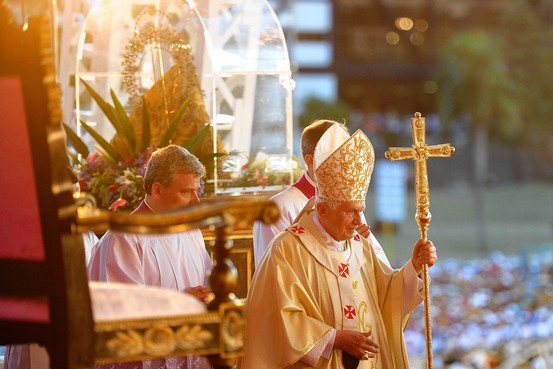
Pope Benedict XVI in Santiago, Cuba Agence France-Presse/Getty Images

Pope Benedict XVI's visit to Cuba is of immense significance on numerous levels: spiritual, historic and political. In preaching the gospel of Jesus Christ the Pope is also preaching the nonviolent nature of Christ's message and sacrifice which also informs the current situation in Cuba.

In the days leading up to the visit and presently there is a wave of repression along with increased restrictions on cell phone usage and home phone lines. Over a hundred Cuban opposition activists have been detained to prevent them attending the Papal Mass. Historically, Pope Benedict XVI's visit on the 400th anniversary of the discovery of the image of "La Virgen de la Caridad del Cobre" has great significance because it was a predecessor, Benedict XV who in 1916 granted the request of veterans of the war of Cuban Independence to name her the patron saint of Cuba. It also underlines the fact that Cuba's catholic roots long predate the current totalitarian communist nightmare.


Univision News: Anti-communism protest during Pope's first mass in Cuba

The Pope's message is in sharp contrast to both the militaristic image and message projected by Raul Castro and the dictatorship. A low point captured on video by international media was the detention of a man who shouted "down with communism" who was taken away and beaten by men dressed in Red Cross uniforms prior to the Pope's mass in Santiago de Cuba. His whereabouts remain unknown.


Man in Cuba at Mass screams down with communism taken away and beaten by Globovision

Thus far the Pope on this visit to Mexico and Cuba has said a number of things of great interest to Cubans and all people of faith.

On Nonviolence

"Dear brothers and sisters, before the gaze of Our Lady of Charity of El Cobre, I appeal to you to reinvigorate your faith, that you may live in Christ and for Christ, and armed with peace, forgiveness and understanding, that you may strive to build a renewed and open society, a better society, one more worthy of humanity, and which better reflects the goodness of God. Amen." - Pope Benedict XVI , March 26, 2012 Santiago de Cuba, Plaza Antonio Maceo Square

Recognizing the just aspirations of all Cubans

"I come to Cuba as a pilgrim of charity, to confirm my brothers and sisters in the faith and strengthen them in the hope which is born of the presence of God’s love in our lives. I carry in my heart the just aspirations and legitimate desires of all Cubans, wherever they may be, their sufferings and their joys, their concerns and their noblest desires, those of the young and the elderly, of adolescents and children, of the sick and workers, of prisoners and their families, and of the poor and those in need." - Pope Benedict XVI , March 26, 2012 Antonio Maceo International Airport, Santiago de Cuba

Cuba looking to the future

"Dear friends, I am convinced that Cuba, at this moment of particular importance in its history, is already looking to the future, and thus is striving to renew and broaden its horizons. Of great help in this enterprise will be the fine patrimony of spiritual and moral values which fashioned the nation’s true identity, and which stand out in the work and the life of many distinguished fathers of the country, like Blessed José Olallo y Valdés, the Servant of God Félix Varela, and the acclaimed José Martí." - Pope Benedict XVI , March 26, 2012 Antonio Maceo International Airport, Santiago de Cuba

Church not a political power but has something to say about politics

"Naturally the church must always ask itself if it’s doing enough on behalf of social justice in this great continent. This is a question of conscience which we must always ask ourselves. That means asking what the church can and must do, and also which it can’t and shouldn’t do. The church is not a political power, it’s not a party, but it’s a moral power. Since politics fundamentally should be a moral enterprise, the church in this sense has something to say about politics. I repeat which I’ve already said: the first thought to the church is to educate conscience, thereby creating the necessary sense of responsibility. That means educating conscience in individual ethics as well as in public ethics, and perhaps that’s where the problem lies." - Pope Benedict XVI, March 23, 2012 with journalists during the flight to Mexico

On Church's approach to Cuba

As I’ve already said, I feel in absolute continuity with the words of the Holy Father John Paul II, which are still extremely relevant. That visit of this pope inaugurated a path of collaboration and constructive dialogue, a path which is long and demands patience, but which goes forward. Today it’s evident that the Marxist ideology as it was conceived does not correspond to reality, and thus a society cannot any longer be built upon it. New models must be found, with patience and in a constructive way. In this process, which demands patience but also determination, we want to help in a spirit of dialogue, in order to avoid new trauma, and to serve progress towards a fraternal and just society which we desire for the whole world. We want to cooperate in this sense. It’s obvious that the church will always be on the side of liberty: liberty of conscience, liberty of religion. We make a contribution in that sense, including the simple faithful who contribute to this progress going forward. - Pope Benedict XVI, March 23, 2012 with journalists during the flight to Mexico

Relevant to this conversation is the essay by Franciscan Friar, Daniel P. Horan citing Thomas Merton's writings on Christian nonviolence and explaining that at its heart it arises from the common good:
Nonviolence is perhaps the most exacting of all forms of struggle, not only because it demands first of all that one be ready to suffer evil and even face the threat of death without violent retaliation, but because it excludes mere transient self-interest, even political, from its consideration. In a very really sense, he [or she] who practices nonviolent resistance must commit himself [or herself] not to the defense of his [or her] own interests or even those of a particular group: he [or she] must commit himself [or herself] to the defense of objective truth and right and above all of [humanity]. His [or her] aims then not simply to “prevail” or to prove that he [or she] is right and the adversary wrong, or to make the adversary give in and yield what is demanded (Faith and Violence, 14).
Conclusion

His Holiness Pope Benedict XVI has recognized the just and deliberate aspirations of all Cubans. Also that since politics should fundamentally be a moral enterprise, the Pope recognizes that the Church has something to say about politics. His Holiness has stated that Marxist ideology does not correspond to reality and Cuba needs a different model. Furthermore that "armed with peace, forgiveness and understanding" Cubans may strive to achieve a better and more open society. The "arms" he outlined in his homily are the weapons of nonviolent civic action.

What went unmentioned was that the dialogue initiated by Blessed John Paul II in 1998 with the Cuban dictatorship must include the Cuban democratic opposition if the Church is to play a role as mediator between the different sides in this long running conflict.

In the short run this may not serve the Church's own interests due to the regime's violent anti-christian history but it would serve the common good. This is the underlying reason as to the importance of His Holiness Pope Benedict XVI recognizing and meeting with the democratic Cuban opposition.


Tuesday, March 20, 2012

Biscet's prayer for Pope Benedict XVI published in The Wall Street Journal

Dr. Oscar Elias Biscet
The Wall Street Journal

OPINION

March 20, 2012

A Cuban's Prayer for Pope Benedict

What will the Castro brothers hear during the first papal visit in over a decade?

By OSCAR ELIAS BISCET

Havana, Cuba

Next week, Pope Benedict XVI is coming here to Cuba, marking the first papal visit to my country in over a decade. During the planned three-day trip, His Holiness is set to meet with both Castro brothers and their subordinates, and to bring his spiritual message to the Cuban people.

The stakes couldn't be higher. This trip is a unique opportunity for the leader of the Catholic Church to leverage his considerable prestige and influence to support the oppressed and help the Cuban people claim our liberty and establish democracy.

My country continues to be run by a brutal regime that oppresses the people, systematically violating our basic freedoms. That regime is a relic of the Cold War, and there's little hope for change without substantial international pressure.

Cuba is a police state. Government agents spy on and harass anyone advocating for human rights. They beat and imprison anyone seeking peaceful political change. They arbitrarily arrest and detain Cubans for Orwellian infractions like "disrespecting patriotic symbols" and "insulting symbols of the fatherland."

Cuban state security closely monitors citizens' daily life, including all of our incoming mail, telephone calls and emails. The only legal press and the only newspaper are run by the dictatorship. Independent journalists who seek to challenge state propaganda are threatened and jailed.

Cuban jails are living hells in which flagrant violations of human dignity occur daily. I've spent over 12 years incarcerated, most recently for "crimes against state security"—that is, asking the Cuban state to respect the fundamental human rights of every Cuban citizen.


The prison system in Cuba flagrantly violates the minimum requirements for prisoner care established by the United Nations. During my years in prison, I personally witnessed prisoners left for 12-24 hours with their hands and feet handcuffed behind their backs, stripped naked in groups without any regard for human modesty, tortured physically and psychologically with tasers, beaten to death for requesting basic medical attention, and kept for months in cells without ventilation, natural light, drinkable water or restroom facilities.

If prisoners attempt to push for better treatment, they risk death. In one case in 2010, on the second floor of the Combinado del Este prison in Havana, a young prisoner who suffered from two chronic medical conditions—asthma and cardiac problems related to valve pathologies—was beaten and died after complaining that he was not allowed to see a doctor. While I was imprisoned, three prisoners tried to assassinate me on different occasions. Two of them later told me that they had been hired to do so by military officials.

I continue to witness the personal ruin that the regime inflicts on anyone who offers an alternative voice. For me, the harassment started in 1998 when, while giving a conference at a hospital on the right to life, I was violently attacked and expelled by a mob dispatched by the Communist Party. Since then, I've been denied the ability to practice medicine.

My wife and son have had their lives threatened and have been pressured to abandon me. We have been evicted from our house. I had my right foot fractured from a beating by state police.

Yet there are still thousands of brave Cubans standing up to the Castro brothers and demanding their basic rights, even under threat of torture and death. Our ranks are growing. But we need the help of the international community.

The Arab Spring is simply the latest demonstration that organic, people-driven democratic change is possible. In past years we have seen peaceful, democratic movements succeed in the rest of Latin America and in the former Soviet bloc. In most places, their advent has brought freedom, national reconciliation and prosperity. We can achieve the same results in Cuba, and we will do just that—building a Cuba where the people are free and sovereign.

The international community, for its part, has the responsibility to provide the attention and diplomatic resources that the movement can't muster from here.

The Pope's visit is important because the Catholic Church has played a crucial role in expanding and protecting Cuban freedoms in the past. My own most recent release from prison, along with that of other dissidents, was chiefly negotiated by the Catholic Church.

For those of us desiring a free Cuba, our demands are simple: free speech, freedom of association and assembly, free and fair multiparty elections, and a country from which no person will ever again be exiled for political beliefs.

Pope Benedict's visit represents a unique opportunity for the Cuban people to pressure their tyrants to hold elections in which all Cubans can unite with the free and democratic countries of the world. I ask Pope Benedict to focus on this idea so that there can be rapid change in my country, and so we can live in freedom. I pray that he will succeed.

Dr. Biscet, a physician, is president of the Lawton Foundation for Human Rights. While in prison in 2007, he was awarded the Presidential Medal of Freedom by President George W. Bush.

Monday, March 19, 2012

Nine years later: Another Cuban Black Spring?

Nine years to the day after major March 18 crackdown on nonviolent activists 70 Cuban women arrested including Cuban human rights leader Berta Soler (pictured below)

Berta Soler

The ninth anniversary of the Cuban Black Spring providentially fell on a Sunday just 8 days before Pope Benedict XVI's arrival in Cuba on March 26. Today, approximately 70 members of the Ladies in White were arrested by the Castro regime and taken away. A majority of the 70 women were detained while trying to attend Mass.

The Cuban Spring: Part 1 / Part 2 / Part 3


The Ladies in White and the Cuban Black Spring

In March of 2003 following a crackdown on nonviolent opposition activists, known as the "Black Spring", their wives, mothers, and sisters formed the Ladies in White and begin their weekly Sunday pilgrimages to attend Mass and march through the streets of Cuba demanding their loved ones freedom. The women would suffer harassment, beatings and detentions over the next nine years.

Many of the activists who had been unjustly imprisoned had been organizers of nationwide petition drive called the Varela Project , named after Father Felix Varela, that sought legal and constitutional reforms to bring the Cuban regime in line with international human rights norms.


Today, nine years later thanks to the sacrifice of the Ladies in White the men unjustly imprisoned in 2003 are no longer in prison. Most of them were forced into exile while a small number remain on the island. The founder of the Ladies in White, Laura Pollán, died under mysterious circumstances on October 14, 2011. The new head of the Ladies in White "Laura Pollán" , Berta Soler was arrested today and remains detained tonight. They continue to demand the release of the remaining political prisoners in Cuba and that human rights be respected.

Elements within the Catholic Church in Cuba have been accused of not defending human rights on the island and on occasion siding with those in power there or ignoring evils perpetrated by the regime which has led to frustration in some opposition circles.

Hopefully, in addition to his important pastoral message, His Holiness Pope Benedict XVI will address the importance of human rights as he did on April 18, 2008 in his address to the United Nations General Assembly:
Human rights are increasingly being presented as the common language and the ethical substratum of international relations. At the same time, the universality, indivisibility and interdependence of human rights all serve as guarantees safeguarding human dignity. It is evident, though, that the rights recognized and expounded in the Declaration apply to everyone by virtue of the common origin of the person, who remains the high-point of God’s creative design for the world and for history. They are based on the natural law inscribed on human hearts and present in different cultures and civilizations. Removing human rights from this context would mean restricting their range and yielding to a relativistic conception, according to which the meaning and interpretation of rights could vary and their universality would be denied in the name of different cultural, political, social and even religious outlooks. This great variety of viewpoints must not be allowed to obscure the fact that not only rights are universal, but so too is the human person, the subject of those rights.
Catholic layman and Cuban dissident Oswaldo Paya tweeted today that the "arrests and mistreatment of the Ladies in White were part of the regime's maneuvers in its murky preparation of the Pope's Cuba visit." Hopefully the arrest of 70 nonviolent women attempting to attend Mass and march peacefully through the streets of Cuba on the ninth anniversary of the crackdown that brought the Ladies in White into existence will serve as a bright beacon for all observing the situation in Cuba.

Monday, February 20, 2012

German NGO: Escalating repression on eve of Pope's visit to Cuba


Republic Cuba
Arrests of dissidents are escalating before the visit of the Pope

ISHR: Nervousness of the Cuban regime increases

Havana/ Frankfurt am Main (20th of February 2012) – As the International Society for Human Rights (ISHR) reports, around 30 members of the prisoner relief association “Ladies in White” were arrested on the 19th of February in the Eastern Cuban cities of Holguín, Santiago de Cuba and Guantanamo, in order to prevent them from participating in the Sunday Mass and from doing protest marches for the release of political prisoners. Sara Marta Fonseca, of the “Ladies in White” and of the “Pro Human Rights” party that was forbidden by the regime, was arrested on her way to Mass in Havana, 12 members of the oppositional “Patriotic Union of Cuba” were arrested in Palma Soriano, only two protesters have already been released. ISHR sees a direct relationship between the new wave of political arrests in Cuba and the planned visit of the Pope from the 26th until the 28th of March.

According to ISHR, 16 “Ladies in White” managed to get from their hometown Palma Soriano to El Cobre – despite all the reprisals of the Castro regime – in order to take part in the Sunday Mass of the church of pilgrimage El Cobre and to pray for the release of all political prisoners like every Sunday. But when they got the message that civil servants of the state security were waiting on their way back for them, in order to arrest them – 14 “Ladies in White” stayed in the church and went home hours later accompanied and under protection by representatives of the Catholic Church.

Ladies in White marching on February 19, 2012.
Photo by Ivan Hernandez Carrillo


Authorities inhibit meeting between bishop and “Lady in White”

The independent journalist and “Lady in White” Caridad Caballero Batista and her family were - by her own account – prevented from participating in the mass, threatened, maltreated and arrested by civil servants of the Cuban state security on six Sundays in a row. To end these reprisals, Caballero Batista arranged a meeting with the bishop of the Eastern Cuban city of Holguín for the 17th of February. On this day, her house was observed till the early morning and policemen prevented her from going on the street. Moreover a meeting of the “Ladies in White”, that had been planned for this day, couldn't take place.

New “fireworks of hope” on the occasion of the visit of the Pope

ISHR sees the increase of the arbitrary arrests in Cuba as a sign of weakness and nervousness of the Cuban regime before the visit of the Pope. “Furthermore the installation of monitoring cameras and the imposing of a curfew in the city El Cobre, which is said to be the destination of the visit of the Pope, shows the fear of the regime of protests. That exile Cubans are reportedly planning a new “fireworks of hope” in international water, enforces this fear”, says ISHR.

According to ISHR, the Castro regime is afraid of negative press reports more than ever. Amongst others the telephone line of the independent journalist and former political prisoner José Daniel Ferrer García, member of the UNPACU, was lopped, in order to prevent him from sending reports about human rights violations in Cuba to media abroad. The former political prisoner and doctor Dr. Oscar Elías Bíscet demanded in an interview with the department for foreign relations of the US-House of Representatives on Pope Benedict XVI., to use his power and position to point at human rights abuses in Cuba and at the political repression of the Castro regime.

More information about the human rights situation in the Republic Cuba:
http://www.igfm.de/Kuba.456.0.html

Facebook-page of the International Society for Human Rights:
https://www.facebook.com/igfmdeutschland

Translation to English from the original German by Christine Pierk

Friday, February 3, 2012

An Epiphany on the upcoming Papal visit to Cuba

"You cultivate the essential virtues: high purpose, intelligence, decency, humility, fear of the Lord, and the passion for freedom." - William F. Buckley Jr.

Pontifical Mass at the Church of the Epiphany

Thursday night February 2, 2012 at 7:30pm I was seated inside the Church of the Epiphany attending the first Pontifical Mass in Florida in 40 years presided over by the Archbishop of Miami Thomas Wenski. It was a Candlemas in the Extraordinary Form also known as The Purification of the Blessed Virgin Mary. It is the last day of the Christmas season. The Pontifical Mass lasted three hours. More than a thousand people participated in the Mass. Outside of the Church demonstrators gathered to protest the upcoming visit of Pope Benedict XVI to Cuba. In between prayers for a sick friend and the well being of friends and family members the Mass in Latin drew this participant further into spiritual reflection than the Mass normally does in the vernacular.


Archbishop Wenski's homily delivered in a steady and calm voice was powerful and stirring an excerpt is reproduced below:
Mary’s life – and our own lives – if we, like her, follow Jesus to the end, will be lived under the sign of the cross. For in a fallen world, in a world that has turned its back on God, those who live “ad orientam,” that is, looking, in joyful expectation, towards the coming of Our Lord, Jesus Christ, inevitably will encounter opposition and resistance. Such was the life of Christ – and such was the life of his mother who at Calvary shared in his sufferings; such is the life of the Church.

The “thoughts of many hearts” have been revealed in the betrayals and apostasies of the Church’s sinners but also in the constancy of her confessors, in the purity of her virgins and in the courage of her martyrs. Blessed John Paul II, when as Karol Wojtyla he preached a Lenten retreat to Pope Paul VI, said that “sign of contradiction” maybe be the “distinctive definition of Christ and his Church.”

Today, the witness of the Church on behalf of the dignity and right to life of the human person from the first moment of conception till natural death is itself a “sign that will be contradicted” – and is in fact contradicted in the present mandate of the Obama administration’s Department of Health and Human Services’ mandate to deny a religious exemption to Catholic institutions and thus force us to violate our consciences and to make us accomplices in evil.

Today’s feast of the Presentation of the Lord – thanks to the initiative of Blessed John Paul II – is also observed as the World Day of Prayer for Consecrated Life. Those who live their Christian baptism through vows of poverty, chastity and obedience as religious sisters, brothers and priests, should see the oblation of the Son of God presented today in the temple as the model for religious life. We pray for them – may their perseverance in seeking first the Kingdom of God above all else inspire all of us to seek to live holy lives in fidelity to the promises of our baptism.

The lighted candles carried in procession this evening are a sign of the divine splendor of the Christ who comes to expel the dark shadows of evil. May our lives as Catholics reflect the light of Christ to all who meet us; and may that same light guide us, as it guided that righteous and devout man, Simeon, when we go forth from this life to meet Christ.
The full homily is available online at the website of the Archdiocese of Miami and worth reading.

The following day I was invited to briefly address the Pope's visit to the island on a local television station giving me an opportunity to further reflect on it. Reading medieval scholar Carlos Eire on the subject offers historical context to what is happening in relations between the Church and the communist dictatorship in Cuba. At the same time reading Carlos Espinosa gives insights into the impact it is having within some families.


Firing Line with William F. Buckley Jr. "The Fight over Catholic Orthodoxy" (1980)

Although not as pessimistic about the Pope's visit to the island as the individuals who protested outside of the Church of the Epiphany one can understand their concern considering some of the historical and modern currents in the Catholic Church. There was a time that Liberation theology was on the upswing in the Catholic Church but Pope John Paul II put an end to that. In his sermon "An option for the poor" given in Mexico in 1990 His Holiness spoke plainly:
When the world begins to notice the clear failures of certain ideologies and systems, it seems all the more incomprehensible that certain sons of the Church in these lands - prompted at times by the desire to find quick solutions - persist in presenting as viable certain models whose failure is patent in other places in the world.

You, as priests, cannot be involved in activities which belong to the lay faithful, while through your service to the Church community you are called to cooperate with them by helping them study Church teachings...

...Be careful, then, not to accept nor allow a Vision of human life as conflict nor ideologies which propose class hatred and violence to be instilled in you; this includes those which try to hide under theological writings.

There are other currents within the Church that do give reason for encouragement. Pope Benedict XVI emerged from a current within the Church that has accomplished great things on behalf of orthodoxy and tradition. The question that Cuban exiles need to ask themselves is how to encourage and support those currents that will more robustly challenge the militant atheistic communist dictatorship in Cuba?

At the same time remembering that Pope Benedict XVI's visit to the island (March 26-28, 2012) will offer an opportunity for Cubans in large numbers to hear the Gospel and the message of hope and freedom that resides in it. The visit of Pope John Paul II that met with similar criticism at the time was, in spiritual terms, incredibly important to the millions of Cubans who heard his message and his exhortation not to be afraid and to be the protagonists of their own history.

Fourteen years later many Cubans who heeded his message are being persecuted for seeking change using ethical, nonviolent means. This is part of the legacy of John Paul II. It is no accident that the largest sustained dissident action was the Varela Project petition drive (named after a Cuban catholic priest) that obtained more than 25,000 signatures demanding fundamental changes to the Cuban constitution to bring it in line with international human rights standards. Nor is it an accident that the largest sustained opposition action are the weekly marches by the Ladies in White to attend Sunday Mass demanding their loved one's freedom. Since March of 2003 following the Black Cuban Spring these women have been subjected to acts of repudiation, physical assaults, and in the case of Laura Pollan - premature death at the hands of agents of the Cuban government.

One understands that the Pope will meet with sinners, possibly including Fidel Castro, excommunicated by John XXIII on January 3, 1962, but at the same time one would also hope that some of those who have suffered beatings, tortures and assaults on their dignity at the hands of this regime would also be ministered to by His Holiness.

At the same time one cannot forget that the Church in Cuba is a suffering Church that has endured decades of repression and has engaged in important evangelical and charitable work at the parish level that has saved countless souls and lives.

Protesters outside the Church of the Epiphany on Thursday evening during the Mass

The protesters sign outside of the Mass on Thursday night said a profound truth that perhaps they did not themselves understand the full significance of: "We must not forget. Faith is not negotiable. Long live Christ the King!" The good works of the Church transcend the princes and principalities of this fallen world and calls all of humanity to Jesus Christ and his teachings as set out in the Bible as the only way to real freedom. Don't forget it. An epiphany long to be remembered.