Showing posts with label Project Varela. Show all posts

Saturday, July 26, 2025

Cuba's Dueling Legacies: Moncada July 26, 1953 and Varela May 10, 2002

Moncada vs Varela

July 26, 1953: Moncada Assault. May 10, 2002: MCL turns in Project Varela petitions


Today, the Castro regime, its fellow travelers and agents of influence will continue the lie that something positive occurred on July 26, 1953. The only way that they can accomplish this exercise is by rewriting and omitting history.

Here is some of what they won't tell you.

July 26, 1953 was a tragic day when Cubans killed Cubans in a failed attempt to overthrow Cuban dictator Fulgencio Batista with an attack on the Moncada Barracks.

In the early morning hours of July 26, 1953 a group of Cubans led by Fidel Castro assaulted the Moncada barracks in Santiago de Cuba. Approximately, 18 government officials were killed and 28 wounded in the attack. 27 rebels were killed and 11 wounded. 51 of the surviving 99 rebels were placed on trial. Fidel Castro turned himself in after seeking guarantees for his safety and was also put on trial.

Aftermath of the July 26, 1953 assault on the Moncada Barracks

This attack turned Fidel Castro into a national figure. He would go on to name his movement, the July 26th Movement.

Between 1902 and 1952 with moments of glory and shame the Cuban Republic transited through 17 democratically elected presidents. One of them, Gerardo Machado elected in 1925, despite constitutional prohibitions, he had the constitution modified and ran for re-election in 1928. He became a despot, and was removed from office by force in 1933. This led to a return to democracy.

Cuban presidents from 1902 to 1952, and dictator Batista 1952-1959.


Tragically, this democratic republic was brought to an end on March 10, 1952 by Fulgencio Batista. Batista was a military man who had entered the presidency in free and fair elections in 1940 ( in coalition with the communist party) and left office in 1944. He returned to Cuba under the presidency of Cuba's last democratically elected president, Carlos Prio and within days of the next presidential elections, when Batista saw that he could not win at the ballot box, carried out a successful coup against the democratic order that had existed from 1902 - 1952.

Fidel Castro during his trial on October 16, 1953 addressed the court in what became known as the "“History Will Absolve Me” speech:

“Let me tell you a story: Once upon a time there was a Republic. It had its Constitution, its laws, its freedoms, a President, a Congress and Courts of Law. Everyone could assemble, associate, speak and write with complete freedom." …"Public opinion was respected and heeded and all problems of common interest were freely discussed. There were political parties, radio and television debates and forums of public meetings. The whole nation pulsated with enthusiasm.”

The promise made by the July 26th Movement was to restore the preexisting democratic order along with reforms. The Castro brothers ended a seven year authoritarian dictatorship, and replaced it with a communist dictatorship that has ruled over Cuba for 66 years and counting.

#TheyAreContinuity #TheyAreDictators ( #SomosContinuidad #SonDictadores)

The Castro dictatorship was not a break from Batista but a continuity into more profound tyranny that continues to kill Cubans.

Contrast this with what Oswaldo Payá Sardiñas and the Christian Liberation Movement (MCL) did. In the midst of a totalitarian dictatorship were all media are controlled by the government along with economic life they managed to lead a movement that persuaded more than 35,000 Cubans to identify themselves, demand democratic reforms, and the restoration of human rights knowing that the Varela Project petition they were signing could lead to losing their jobs, having their children denied access to higher education and in the worse case prison.

MCL delivers 11,020 Varela Project petitions to the National Assembly. (J Goitia/AP)


The images of the movement, unlike the Castro regime's are nonviolent and inclusive and focus on liberation and reconciliation not violence and killing. They do not seek to destroy or slander anyone but to free a people.

Coordinators of the Varela Project


Oswaldo and his movement rejected hatred and violence. They never killed anyone and offered a path to a nonviolent democratic transition.

Oswaldo's nonviolent legacy has continued beyond him and is a positive tradition for Cuba. His nonviolent struggle followed two of the basic principles outlined by nonviolence practitioner Michael N. Nagler: "We are not against other people, only what they are doing. Means are ends in the making; nothing good can finally result from violence."

Oswaldo Payá receives the Sakharov Prize in Strasbourg, France in 2002

In December 2002, thanks to lobbying and pressure from Spain, Oswaldo Payá was able to travel to Strasbourg, France to receive the European Union's Sakharov Prize and address the chamber where he outlined the movement's position to an international audience.

The first victory we can claim is that our hearts are free of hatred. Hence we say to those who persecute us and who try to dominate us: “You are my brother. I do not hate you, but you are not going to dominate me by fear. I do not wish to impose my truth, nor do I wish you to impose yours on me. We are going to seek the truth together.” This is the liberation which we are proclaiming.

Seventy two years after the tragic events of July 26, 1953 the Castro regime celebrates this shedding of blood between Cubans as "the victory of ideas," but in reality it was the triumph of brute violence and terror in the short term by Batista's forces on that day and in 1959 by Castro's forces.

In Cuba the government has turned it into a day of drinking, parties, parades, speeches and the colors red and black prominently displayed. This all occurs with prominent military displays and propaganda images worshiping violent revolution.

There are two traditions battling for control in Cuba.

One tradition, embodied by the Castro regime, based on violence and the destruction of the other has dominated Cuba's political discourse for over six and a half decades. It views dissent as treason and demands unanimity; the only acceptable ideas are the dictatorship's.

The second tradition built the institutions of Cuban democracy in the 19th Century using nonviolent means. They founded companies with a social conscience such as Bacardi that contributed to the common good until forced out of their homeland in 1960. The Cuban democrats who helped draft the Universal Declaration of Human Rights in 1948. Their counterparts are still there in Cuba's nonviolent civic resistance movement.


These civic activists were courteous, and respected the dignity of all Cubans. Some were feminists who obtained the right of Cuban women to vote in the old Republic and went on to defend the rights of poor women to a decent education and better opportunities.

They nonviolently resisted the imposition of Castro's totalitarian regime and either went into exile, prison, were killed, or despite great odds are still struggling for Cuban freedom on the streets of Cuba today.

Thirteen years after the July 22, 2012 murders of Oswaldo Payá Sardiñas, and Harold Cepero Escalante and it remains clear that the future belongs to the nonviolent resistance. The dictatorship may have killed two of its great nonviolent leaders, Laura Inés Pollán Toledo and Oswaldo Payá Sardiñas, but in doing so exposed its own brutal nature and undermined itself.

What a post-Castro Cuba will look like can already be intimated.

Castroism will be relegated to a sad and cautionary chapter in Cuban history that it deserves to be.

May 10, 2002 will be a day of celebration in Cuba commemorating the day that the first 11,020 signatures of the Varela Project were presented to the National Assembly demanding human rights and democratic reforms.

July 11, 2021 will also be a day of celebration for the day that tens of thousands of Cubans peacefully gathered across the island demanding freedom and an end to dictatorship.

International Human Rights Day will once again become a day to celebrate and observe human rights in Cuba and not a day of repression. The Cuban Republic's human rights tradition and the role it played in the drafting and passage of the Universal Declaration of Human Rights on December 10, 1948 will be restored and celebrated in Cuba.

Today, Chinese and Cuban dissidents, inspired by Mohandas Gandhi, Martin Luther King Jr., and Vaclav Havel, exchange their visions for a democratic future challenging the totalitarian alternative.


Saturday, May 10, 2025

Project Varela at Twenty Three

 "The solution to the Cuban problem lies with the Cubans, and that's why we created the Varela Project." - Oswaldo Payá , Havana, February 2012

Oswaldo Payá, Regis Iglesias, and Antonio Diaz, turn in petitions

Twenty three years ago today on May 10, 2002, carrying 11,020 signed petitions in support of the Varela Project, the Christian Liberation Movement's Oswaldo Payá Sardiñas, Antonio Diaz Sanchez, and Regis Iglesias Ramirez delivered them to the Cuban National Assembly.

Milan Kundera, the Czech writer, in his 1999 novel The Book of Laughter and Forgetting observed that "the struggle of man against power is the struggle of memory against forgetting." Memory provides context to unfolding events today, and helps to render informed judgements.

This blog entry is an exercise in preserving memory.

The Varela Project, named after the Cuban Catholic Priest Felix Varela, sought to reform the Cuban legal system to bring it in line with international human rights standards. They had followed the letter of the law in organizing the campaign. They specifically asked for the following in the petition.

  • Guarantee the right to free expression and free association that guarantee pluralism, opening Cuban society to political debate and facilitating a more participatory democracy. 
  • Amnesty for all those imprisoned for political reasons.  
  • Right of Cubans to form companies, both individually owned and in cooperatives. 
  • Proposal for a new electoral law that truly guarantees the right to elect and be elected to all Cubans and the holding of free elections

The Christian Liberation Movement was founded by Catholic lay people in Havana in September 1988, and is part of a non-violent dissident movement that traces its origins and influences to the Cuban Committee for Human Rights that was founded in 1976.

President James Carter at the University of Havana.

Former President James Carter visited Cuba in May 2002 and on May 15th gave a speech at the University of Havana, where he advocated for the lifting of economic sanctions on Cuba and "called for the Varela Project petition to be published in the official newspaper so that people could learn about it."

Yet the dictatorship's response to the nonviolent citizen's initiative, and to President Carter's request, was to coerce Cubans into signing another petition declaring the Constitution unchangeable and quickly passed it through the rubber stamp legislature.

The Varela Project was not presented for debate before the National Assembly, which according to then existing law drafted by the Cuban government meant that it should have been deliberated in that legislative body. 

Less than a year after the petitions were turned in, starting on March 18, 2003 the Cuban Spring would end with a massive crackdown on Cuban civil society with many of the Project Varela organizers, imprisoned and summarily sentenced up to 28 years in prison. 

The 75 activists with long prison sentences became known as the "group of the 75."

With the end of the Cuban Spring Antonio Diaz Sanchez was sentenced to 20 years in prison, and Regis Iglesias Ramirez was sentenced to 18 years in prison.

The Castro regime announced, at the time, that the Cuban dissident movement had been destroyed. 

They spoke prematurely. 

First, the remaining activists who were still free continued gathering signatures and would turn in another 14,384 petition signatures on October 5, 2003, and they continued to gather more. 

Secondly, the mothers, wives, sisters and daughters of the activists who had been detained and imprisoned organized themselves into the "Ladies in White." A movement that sought the freedom of their loved ones and organized regular marches through the streets of Cuba, despite regime organized violence visited upon them. This new movement was led by Laura Inés Pollán Toledo, a former school teacher.

Antonio Diaz Sanchez and Regis Iglesias Ramirez were released from prison into forced exile in 2010. 

President Carter made a second trip to Cuba in March 2011, and did not publicly mention Project Varela during that visit, but instead focused efforts on trading Alan Gross for the remaining members of the WASP network jailed in the United States on charges of espionage, and murder conspiracy that killed three Americans and a US resident in 1996, and calling for the lifting of economic sanctions on the Castro regime. President Carter also downplayed the threat of FARC, ETA, and ELN terrorists harbored in Cuba.

Less than two months after the visit, Cuban dissident and former political prisoner, Juan Wilfredo Soto Garcia (age 46) was arrested and beaten to death by Cuban regime police while protesting the dictatorship and died early on Sunday May 8, 2011. Months later on October 15, 2011 Laura Inés Pollán Toledo died under suspicious circumstances at the Calixto Garcia hospital.

Oswaldo Payá Sardiñas was killed on July 22, 2012 together with Harold Cepero, a youth leader of the Christian Liberation Movement, in a car "accident" that all the hallmarks of a state security operation copied after the East German Stasi, who trained intelligence operatives in the Castro regime.

Revisiting and remembering these historic moments is part of the struggle against forgetting, and the conversation that it may arouse will only serve, when backed up with facts, to strengthen memory with truth. Memory, and retentiveness are defenses against the Castro regime's totalitarian rewriting of history. 

Oswaldo Payá Sardiñas in a July 14, 2003 opinion piece in the Los Angeles Times provided context to the aftermath of Project Varela, and the March 18, 2003 crackdown in which 75 Cuban dissidents, many of them organizers of the petition drive were sentenced to prison terms of up to 28 years. 

"Cuba finds itself in a grave crisis. In the last few years, thousands of its citizens have participated in what’s known as the Varela Project, overcoming a culture of fear and calling for a national referendum on civil rights, the peaceful evolution of freedom and reconciliation. But now a cloud of terror hangs over that quest for change."

This analysis remains relevant today. 

In 2023 Antonio Diaz Sanchez, Regis Iglesias Ramirez and other members of the Christian Liberation Movement reflected on the significance of the Varela Project. 

Saturday, March 1, 2025

Oswaldo Payá Sardiñas born 73 years ago: Honoring Cuba's Consistent Human Rights Defender

 "In Cuba we are being prohibited from preparing that future, working now at night for the following morning, because someone has said that the night will not end. But the night will not be eternal, it is ending." - Oswaldo Payá Sardiñas


Oswaldo Payá Sardiñas

Oswaldo José Payá Sardiñas was born 73 years ago on February 29, 1952 and was extrajudicially executed in Cuba by Castro's secret police on July 22, 2012 along with Harold Cepero.

Thirteen years ago Robert F. Kennedy Human Rights petitioned the  Inter-American Commission on Human Rights (IACHR) to examine the evidence around the deaths of Oswaldo and Harold on July 22, 2012.

On June 12, 2023 the IACHR published their report on the merits that found Cuban government agents responsible for the deaths of the two pro-democracy leaders and Christian Liberation Movement leaders.

Twenty three years ago, Oswaldo Payá along with other members of the Christian Liberation Movement in May 2002 turned in thousands of signatures from the Varela Project, a petition that called for human rights to be respected in Cuba, and that the matter be debated before the National Assembly.  

In December of 2002, thanks to lobbying and pressure from Spain, Oswaldo Payá was able to travel to Strasbourg, France to receive the European Union's Sakharov Prize and address the chamber. 

In 2011, seven Norwegian members of parliament nominated Oswaldo Payá for the Nobel Peace Prize. (Václav Havel had also twice nominated Oswaldo Payá ).

Following the untimely deaths of Oswaldo and Harold, the Cuban opposition leader's family was subjected to death threats and heightened surveillance by state security.   

On June 21, 2022 David Hoffman's book on Oswaldo Payá, "Give Me Liberty: The True Story of Oswaldo Payá and his Daring Quest for a Free Cuba" was made available for purchase. You can purchase it here.

Today on his birth anniversary, let us also remember and pray for the soul of this good man, who sacrificed all for the freedom of the Cuban people.


Thursday, February 29, 2024

Oswaldo Payá Sardiñas born 72 years ago: Honoring Cuba's Consistent Human Rights Defender

"In Cuba we are being prohibited from preparing that future, working now at night for the following morning, because someone has said that the night will not end. But the night will not be eternal, it is ending." - Oswaldo Payá Sardiñas

Oswaldo Payá Sardiñas


Oswaldo José Payá Sardiñas was born 72 years ago on February 29, 1952 and was extrajudicially executed in Cuba by Castro's secret police on July 22, 2012 along with Harold Cepero.

Ten years ago Robert F. Kennedy Human Rights petitioned the  Inter-American Commission on Human Rights (IACHR) to examine the evidence around the deaths of Oswaldo and Harold on July 22, 2012.

On June 12, 2023 the IACHR published their report on the merits that found Cuban government agents responsible for the deaths of the two pro-democracy leaders and Christian Liberation Movement leaders

Twenty two years earlier, Oswaldo Payá along with other members of the Christian Liberation Movement in May 2002 turned in thousands of signatures from the Varela Project, a petition that called for human rights to be respected in Cuba, and that the matter be debated before the National Assembly. 

In December of 2002, thanks to lobbying and pressure from Spain, Oswaldo Payá was able to travel to Strasbourg, France to receive the European Union's Sakharov Prize and address the chamber. 

In 2011, seven Norwegian members of parliament nominated Oswaldo Payá for the Nobel Peace Prize. (Václav Havel had also twice nominated Oswaldo Payá ).


 Following the untimely deaths of Oswaldo and Harold, the Cuban opposition leader's family was subjected to death threats and heightened surveillance by state security.   

On June 21, 2022 David Hoffman's book on Oswaldo Payá, "Give Me Liberty: The True Story of Oswaldo Payá and his Daring Quest for a Free Cuba" was made available for purchase. You can purchase it here.


Today on his birth anniversary, let us also remember and pray for the soul of this good man, who sacrificed all for the freedom of the Cuban people.

Wednesday, May 10, 2023

Project Varela at Twenty One


Oswaldo Payá, Regis Iglesias, and Antonio Diaz, walk to turn in petitions

Twenty one years ago today on May 10, 2002, carrying 11,020 signed petitions in support of the Varela Project, the Christian Liberation Movement's Oswaldo Payá Sardiñas, Antonio Diaz Sanchez, and Regis Iglesias Ramirez delivered them to the Cuban National Assembly.

Milan Kundera, the Czech writer, in his 1999 novel The Book of Laughter and Forgetting observed that "the struggle of man against power is the struggle of memory against forgetting." Memory provides context to unfolding events today, and helps to render informed judgements.

This blog entry is an exercise in recovering memory.


The Varela Project, named after the Cuban Catholic Priest Felix Varela, sought to reform the Cuban legal system to bring it in line with international human rights standards. They had followed the letter of the law in organizing the campaign. They specifically asked for the following in the petition.

  • Guarantee the right to free expression and free association that guarantee pluralism, opening Cuban society to political debate and facilitating a more participatory democracy. 
  • Amnesty for all those imprisoned for political reasons.  
  • Right of Cubans to form companies, both individually owned and in cooperatives. 
  • Proposal for a new electoral law that truly guarantees the right to elect and be elected to all Cubans and the holding of free elections

The Christian Liberation Movement was founded by Catholic lay people in Havana in September 1988, and is part of a non-violent dissident movement that traces its origins and influences to the Cuban Committee for Human Rights that was founded in 1976.

President James Carter at the University of Havana.

Former President James Carter visited Cuba in May 2002 and on May 15th gave a speech at the University of Havana, where he advocated for the lifting of economic sanctions on Cuba and "called for the Varela Project petition to be published in the official newspaper so that people could learn about it."

Yet the dictatorship's response to the nonviolent citizen's initiative, and to President Carter's request, was to coerce Cubans into signing another petition declaring the Constitution unchangeable and quickly passed it through the rubber stamp legislature.

The Varela Project was not presented for debate before the National Assembly, which according to then existing law drafted by the Castro dictatorship meant that it should have been debated in that legislative body. 

Less than a year after the petitions were turned in, starting on March 18, 2003 the Cuban Spring would end with a massive crackdown on Cuba's civil society with many of the Project Varela organizers, imprisoned and summarily sentenced up to 28 years in prison. 

The 75 activists with long prison sentences became known as the "group of the 75."


With the end of the Cuban Spring Antonio Diaz Sanchez was sentenced to 20 years in prison, and Regis Iglesias Ramirez was sentenced to 18 years in prison.

The Castro regime announced, at the time, that the Cuban dissident movement had been destroyed. 

They spoke prematurely. 

First, the remaining activists who were still free continued gathering signatures and would turn in another 14,384 petition signatures on October 5, 2003, and they continued to gather more. 

Secondly, the mothers, wives, sisters and daughters of the activists who had been detained and imprisoned organized themselves into the "Ladies in White." A movement that sought the freedom of their loved ones and organized regular marches through the streets of Cuba, despite regime organized violence visited upon them. This new movement was led by Laura Inés Pollán Toledo, a former school teacher.

Antonio Diaz Sanchez and Regis Iglesias Ramirez were released from prison into forced exile in 2010. 

President Carter made a second trip to Cuba in March 2011, and did not publicly mention Project Varela during that visit, but instead focused efforts on trading Alan Gross for the remaining members of the WASP network jailed in the United States on charges of espionage, and murder conspiracy that killed three Americans and a US resident in 1996, and calling for the lifting of economic sanctions on the Castro regime. President Carter also downplayed the threat of FARC, ETA, and ELN terrorists harbored in Cuba.

Less than two months after the visit, Cuban dissident and former political prisoner, Juan Wilfredo Soto Garcia (age 46) was arrested and beaten to death by Cuban regime police while protesting the dictatorship and died early on Sunday May 8, 2011. Months later on October 15, 2011 Laura Inés Pollán Toledo died under suspicious circumstances at the Calixto Garcia hospital.

Oswaldo Payá Sardiñas was killed on July 22, 2012 together with Harold Cepero, a youth leader of the Christian Liberation Movement, in a car "accident" that all the hallmarks of a state security operation copied after the East German Stasi, who trained intelligence operatives in the Castro regime.

Revisiting and remembering these historic moments is part of the struggle against forgetting, and the conversation that it may arouse will only serve, when backed up with facts, to strengthen memory with truth. Memory, and retentiveness are defenses against the Castro regime's totalitarian rewriting of history. 

Oswaldo Payá Sardiñas in a July 14, 2003 opinion piece in the Los Angeles Times provided context to the aftermath of Project Varela, and the March 18, 2003 crackdown in which 75 Cuban dissidents, many of them organizers of the petition drive were sentenced to prison terms of up to 28 years. 

"Cuba finds itself in a grave crisis. In the last few years, thousands of its citizens have participated in what’s known as the Varela Project, overcoming a culture of fear and calling for a national referendum on civil rights, the peaceful evolution of freedom and reconciliation. But now a cloud of terror hangs over that quest for change."

This analysis remains relevant today. 


Tuesday, July 26, 2022

Cuba's Dueling Legacies: July 26, 1953 and May 10, 2002

Moncada vs Varela

Bodies from July 26 Moncada Assault. MCL turns in Project Varela petitions

Today, the Castro regime, its fellow travelers and agents of influence will continue the lie that something positive occurred on July 26, 1953.  The only way that they can accomplish this exercise is by rewriting and omitting history. Here is some of what they won't tell you.

July 26, 1953 was a tragic day when Cubans killed Cubans in a failed attempt to overthrow Cuban dictator Fulgencio Batista with an attack on the Moncada Barracks.

In the early morning hours of July 26, 1953 a group of Cubans led by Fidel Castro assaulted the Moncada barracks in Santiago de Cuba. Approximately, 18 government officials were killed and 28 wounded in the attack. 27 rebels were killed and 11 wounded. 51 of the surviving 99 rebels were placed on trial. Fidel Castro turned himself in after seeking guarantees for his safety and was also put on trial.

Aftermath of the July 26, 1953 assault on the Moncada Barracks

This attack turned Fidel Castro into a national figure. He would go on to name his movement, the July 26th Movement.  

Between 1902 and 1952 with moments of great glory and great shame the Cuban Republic transited through 17 democratically elected presidents. One of them, Gerardo Machado elected in 1925, despite constitutional prohibitions, he had the constitution modified and ran for re-election in 1928. He became a despot, and was removed from office by force in 1933. This led to a return to democracy.

Cuban presidents from 1902 to 1952, and dictator Batista 1952-1959.

Tragically, this democratic republic was brought to an end on March 10, 1952 by Fulgencio Batista. Batista was a military man who had entered the presidency in free and fair elections in 1940 ( in coalition with the communist party) and left office in 1944. He returned to Cuba under the presidency of Cuba's last democratically elected president, Carlos Prio and within days of the next presidential elections, when Batista saw that he could not win at the ballot box, carried out a successful coup against the democratic order that had existed from 1902 - 1952.

Fidel Castro during his trial on October 16, 1953 addressed the court in what became known as the "“History Will Absolve Me” speech:

“Let me tell you a story: Once upon a time there was a Republic. It had its Constitution, its laws, its freedoms, a President, a Congress and Courts of Law. Everyone could assemble, associate, speak and write with complete freedom." …"Public opinion was respected and heeded and all problems of common interest were freely discussed. There were political parties, radio and television debates and forums of public meetings. The whole nation pulsated with enthusiasm.”

The promise made by the July 26th Movement was to restore the preexisting democratic order along with reforms. The Castro brothers ended a seven year authoritarian dictatorship, and replaced it with a communist dictatorship that has ruled over Cuba for 63 years and counting. 

#TheyAreContinuity #TheyAreDictators ( #SomosContinuidad #SonDictadores)

The Castro dictatorship was not a break from Batista but a continuity into more profound tyranny that continues to kill Cubans

Contrast this with what Oswaldo Payá Sardiñas and the Christian Liberation Movement (MCL) did. In the midst of a totalitarian dictatorship were all media are controlled by the government along with economic life they managed to lead a movement that persuaded more than 35,000 Cubans to identify themselves, demand democratic reforms, and the restoration of human rights knowing that the Varela Project petition they were signing could lead to losing their jobs, having their children denied access to higher education and in the worse case prison.

On 5/10/02, MCL members delivered 11,020 Varela Project signatures to the National Assembly. (Jose Goitia/AP)

The images of the movement, unlike the Castro regime's are nonviolent and inclusive and focus on liberation and reconciliation not violence and killing. They do not seek to destroy or slander anyone but to free a people.

Coordinators of the Varela Project

Oswaldo and his movement rejected hatred and violence. They never killed anyone and offered a path to a nonviolent democratic transition.

Oswaldo's nonviolent legacy has continued beyond him and is a positive tradition for Cuba. His nonviolent struggle followed two of the basic principles outlined by nonviolence practitioner Michael N. Nagler: "We are not against other people, only what they are doing. Means are ends in the making; nothing good can finally result from violence."

Oswaldo Payá receives the Sakharov Prize in Strasbourg, France in 2002

In December 2002, thanks to lobbying and pressure from Spain, Oswaldo Payá was able to travel to Strasbourg, France to receive the European Union's Sakharov Prize and address the chamber where he outlined the movement's position to an international audience.

The first victory we can claim is that our hearts are free of hatred. Hence we say to those who persecute us and who try to dominate us: “You are my brother. I do not hate you, but you are not going to dominate me by fear. I do not wish to impose my truth, nor do I wish you to impose yours on me. We are going to seek the truth together.” This is the liberation which we are proclaiming.

Sixty nine years after the tragic events of July 26, 1953 the Castro regime celebrates this shedding of blood between Cubans as "the victory of ideas," but in reality it was the triumph of brute violence and terror in the short term by Batista's forces on that day and in 1959 by Castro's forces. 

In Cuba the government has turned it into a day of drinking, parties, parades, speeches and the colors red and black prominently displayed.  This all occurs with prominent military displays and propaganda images worshiping violent revolution.

There are two traditions battling for control in Cuba.

One tradition, embodied by the Castro regime, based on violence and the destruction of the other has dominated Cuba's political discourse for half a century. It views dissent as treason and demands unanimity; the only acceptable ideas are the dictatorship's.
 
The second tradition that built the institutions of Cuban democracy in the 19th Century using nonviolent means, who founded companies with a social conscience such as Bacardi that contributed to the common good until forced out of their homeland, and of the democrats who helped draft the Universal Declaration of Human Rights in 1948 are still there in Cuba's nonviolent civic resistance movement.


These civic activists were courteous, and respected the dignity of all Cubans. Some were feminists who obtained the right of Cuban women to vote in the old Republic and went on to defend the rights of poor women to a decent education and better opportunities. 

They nonviolently resisted the imposition of Castro's totalitarian regime and either went into exile, prison, were killed, or despite great odds are still struggling for Cuban freedom on the streets of Cuba today.

Ten years after the July 22, 2012 murders of Oswaldo Payá Sardiñas, and Harold Cepero Escalante and it remains clear that the future belongs to the nonviolent resistance. The dictatorship may have killed two of its great nonviolent leaders, Laura Inés Pollán Toledo and Oswaldo Payá Sardiñas, but in doing so exposed its own brutal nature and undermined itself.

What a post-Castro Cuba will look like can already be intimated. 

Castroism will be relegated to a sad and cautionary chapter in Cuban history that it deserves to be.

May 10, 2002 will be a day of celebration in Cuba commemorating the day that the first 11,020 signatures of the Varela Project were presented to the National Assembly demanding human rights and democratic reforms.

"Down with the dictatorship - Homeland and Life" Cuba, July 11, 2021

July 11, 2021 will also be a day of celebration for the day that tens of thousands of Cubans peacefully gathered across the island demanding freedom and an end to dictatorship.

International Human Rights Day will once again become a day to celebrate and observe human rights in Cuba and not a day of repression. The Cuban Republic's human rights tradition and the role it played in the drafting and passage of the Universal Declaration of Human Rights on December 10, 1948 will be restored and celebrated in Cuba. 

Finally, the phrase "Patria o Muerte" will be rejected, and "Patria, Libertad y Vida" embraced.

Tuesday, May 10, 2022

Project Varela at Twenty

Oswaldo Payá, Regis Iglesias, and Antonio Diaz, walk to turn in petitions

Twenty years ago today on May 10, 2002, carrying 11,020 signed petitions in support of the Varela Project, the Christian Liberation Movement's Oswaldo Payá Sardiñas, Antonio Diaz Sanchez, and Regis Iglesias Ramirez delivered them to the Cuban National Assembly.

Milan Kundera, the Czech writer, in his 1999 novel The Book of Laughter and Forgetting observed that "the struggle of man against power is the struggle of memory against forgetting." Memory provides context to unfolding events today, and helps to render informed judgements.

This blog entry is an exercise in recovering memory. 

The Varela Project, named after the Cuban Catholic Priest Felix Varela, sought to reform the Cuban legal system to bring it in line with international human rights standards. They had followed the letter of the law in organizing the campaign. They specifically asked for the following in the petition.

  • Guarantee the right to free expression and free association that guarantee pluralism, opening Cuban society to political debate and facilitating a more participatory democracy. 
  • Amnesty for all those imprisoned for political reasons.  
  • Right of Cubans to form companies, both individually owned and in cooperatives. 
  • Proposal for a new electoral law that truly guarantees the right to elect and be elected to all Cubans and the holding of free elections

The Christian Liberation Movement was founded by Catholic lay people in Havana in September 1988, and is part of a non-violent dissident movement that traces its origins and influences to the Cuban Committee for Human Rights that was founded in 1976.

President James Carter at the University of Havana.

Former President James Carter visited Cuba in May 2002 and on May 15th gave a speech at the University of Havana, where he advocated for the lifting of economic sanctions on Cuba and "called for the Varela Project petition to be published in the official newspaper so that people could learn about it."

Yet the dictatorship's response to the nonviolent citizen's initiative, and to President Carter's request, was to coerce Cubans into signing another petition declaring the Constitution unchangeable and quickly passed it through the rubber stamp legislature. 

 The Varela Project was not presented for debate before the National Assembly, which according to then existing law drafted by the Castro dictatorship meant that it should have been debated in that legislative body. 

On May 7, 2022 at the West Dade Regional Library (9445 Coral Way) in Miami, Florida,  the Christian Liberation Movement  hosted a discussion that commemorated the 20th anniversary of the Varela project in Cuba, its legacy and impact.

Project Varela organizers gathered at the West Dade Regional Library on May 7, 2022

Many of the participants on Saturday focused on the immediate aftermath of the first signatures being turned in, and the wave of repression that followed. 

Less than a year after the petitions were turned in, starting on March 18, 2003 the Cuban Spring would end with a massive crackdown on Cuba's civil society with many of the Project Varela organizers, imprisoned and summarily sentenced up to 28 years in prison. 

The 75 activists with long prison sentences became known as the "group of the 75."

With the end of the Cuban Spring Antonio Diaz Sanchez was sentenced to 20 years in prison, and Regis Iglesias Ramirez was sentenced to 18 years in prison.

The Castro regime announced, at the time, that the Cuban dissident movement had been destroyed. 

They spoke prematurely. 

First, the remaining activists who were still free continued gathering signatures and would turn in another 14,384 petition signatures on October 5, 2003, and they continued to gather more. 

Secondly, the mothers, wives, sisters and daughters of the activists who had been detained and imprisoned organized themselves into the "Ladies in White." A movement that sought the freedom of their loved ones and organized regular marches through the streets of Cuba, despite regime organized violence visited upon them. This new movement was led by Laura Inés Pollán Toledo, a former school teacher.

Antonio Diaz Sanchez and Regis Iglesias Ramirez were released from prison into forced exile in 2010. Today marking this anniversary of the Varela Project, the Christian Liberation Movement released the following statement.

"Exactly 20 years ago, with hundreds of political prisoners in jail and a mostly terrified people, 11,020 Cubans peacefully demanded the freedom of political prisoners and free elections, so that Cubans could freely choose their political and economic model. 

The response of the tyranny was repression, exile and even murder. 

Two decades later, political prisoners multiply and terror expands on the island through repression, while the solidarity of many bows to petty interests, providing impunity to the regime, today more tyrannical and more despotic than ever. 

On the 20th anniversary of that civic gesture of the people of Cuba, honoring the memory of Oswaldo Paya and Harold Cepero and all those who have fallen in this struggle, thinking of the thousands of political prisoners who are today in communist dungeons, living with the Cuban people the lack of freedom and rights, we proclaim our will to continue working indefinitely together with the people, until freedom and democracy arrive in Cuba, which by right belongs to all Cubans. 

ALL CUBANS! 

ALL BROTHERS! 

AND NOW FREEDOM.

President Carter made a second trip to Cuba in March 2011, and did not publicly mention Project Varela during that visit, but instead focused efforts on trading Alan Gross for the remaining members of the WASP network jailed in the United States on charges of espionage, and murder conspiracy that killed three Americans and a US resident in 1996, and calling for the lifting of economic sanctions on the Castro regime. President Carter also downplayed the threat of FARC, ETA, and ELN terrorists harbored in Cuba.

Less than two months after the visit, Cuban dissident and former political prisoner, Juan Wilfredo Soto Garcia (age 46) was arrested and beaten to death by Cuban regime police while protesting the dictatorship and died early on Sunday May 8, 2011. Months later on October 15, 2011 Laura Inés Pollán Toledo died under suspicious circumstances at the Calixto Garcia hospital.

Oswaldo Payá Sardiñas was killed on July 22, 2012 together with Harold Cepero, a youth leader of the Christian Liberation Movement, in a car "accident" that all the hallmarks of a state security operation copied after the East German Stasi, who trained intelligence operatives in the Castro regime.

Revisiting and remembering these historic moments is part of the struggle against forgetting, and the conversation that it may arouse will only serve, when backed up with facts, to strengthen memory with truth. Memory, and retentiveness are defenses against the Castro regime's totalitarian rewriting of history. 

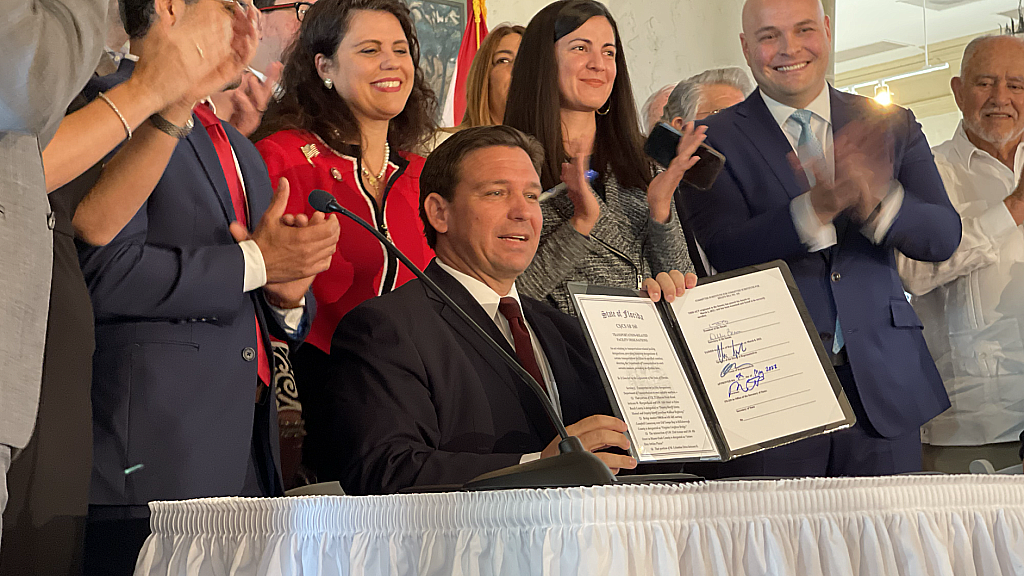
Florida Governor Ron DeSantis signs bill designating Le Jeune Rd Oswaldo Payá Way

On May 9, 2022, the eve of the 20th anniversary of the first Varela Project petitions being turned in to the National Assembly in Cuba, Florida Governor Ron DeSantis signed a bill that designated "a portion of State Road 953, known as Le Jeune Road, between Northwest 11th Street and Northwest 14th Street in Miami-Dade County" as Oswaldo Payá Way. 

This was a concrete act against forgetting and in defense of this important legacy by free Cubans. 

Oswaldo Payá Sardiñas in a July 14, 2003 opinion piece in the Los Angeles Times provided context to the aftermath of Project Varela, and the March 18, 2003 crackdown in which 75 Cuban dissidents, many of them organizers of the petition drive were sentenced to prison terms of up to 28 years. 

"Cuba finds itself in a grave crisis. In the last few years, thousands of its citizens have participated in what’s known as the Varela Project, overcoming a culture of fear and calling for a national referendum on civil rights, the peaceful evolution of freedom and reconciliation. But now a cloud of terror hangs over that quest for change."

This analysis remains relevant today.