Showing posts with label WASP network. Show all posts

Monday, September 9, 2024

Why is Cuba on the state sponsor of terrorism list? Because it continues to sponsor and support terrorism.

“Fidel Castro helped the M-19 in many of its interventions in Colombia. It must even be said that M-19 troops were trained in Cuba, which separated the Cuban government from the Colombian government. Relations were broken,” said Gustavo Petro, a former member of the terrorist group M-19, and today president of Colombia, in 2016.

The State Sponsors of Terrorism list came into existence in 1979, and Cuba was added to the list in 1982 due to its links to the M-19 terrorist group in Colombia, facilitating drug smuggling to the U.S., and providing arms.

Terrorism is a fundamental aspect of Castroism. Fidel Castro, and his fellow revolutionaries, seized power in 1959 through domestic terrorism. Throughout the 1950s, Castro’s July 26th Movement carried out numerous bombings that terrorized and killed Cuban citizens.

The Cuban dictatorship has a track record of sponsoring international terrorism over its entire 65 year rule. This 2024 short documentary “Terrorism: The Cuban Connection” offers some highlights, and this CubaBrief will highlight a few episodes that focus on the United States, Europe and the role played by Cuban diplomats, resulting in their expulsion from France and the United States.

The Failed 1962 Black Friday Plot

Elsa Montero Maldonado and Jose Gomez Abad, a husband and wife team, Roberto Santiesteban Casanova, an attache at the Cuba Mission to the United Nations in New York City, diplomats who in reality were State Security agents, along with Antonio Sueiro and Jose Garcia Orellana, plotted to murder large numbers of New Yorkers  in a planned terrorist attack on the Friday after Thanksgiving in 1962, detonating 500 kilos of explosives inside Macy’s, Gimbel’s, Bloomingdale’s and Manhattan’s Grand Central Terminal.

Cuban diplomats Elsa Montera Maldonado and Jose Gomez Abad, a husband and wife team at the Cuba Mission in NYC.


Fortunately, the FBI discovered the plot and prevented what would have been a significant loss of life. Both Elsa Montero Maldonado and Jose Gomez Abad were expelled for their role in the planned terrorist attack. Roberto Santiesteban Casanova,  Antonio Sueiro, and Jose Garcia Orellana were prosecuted, and later traded for Americans jailed in Cuba.
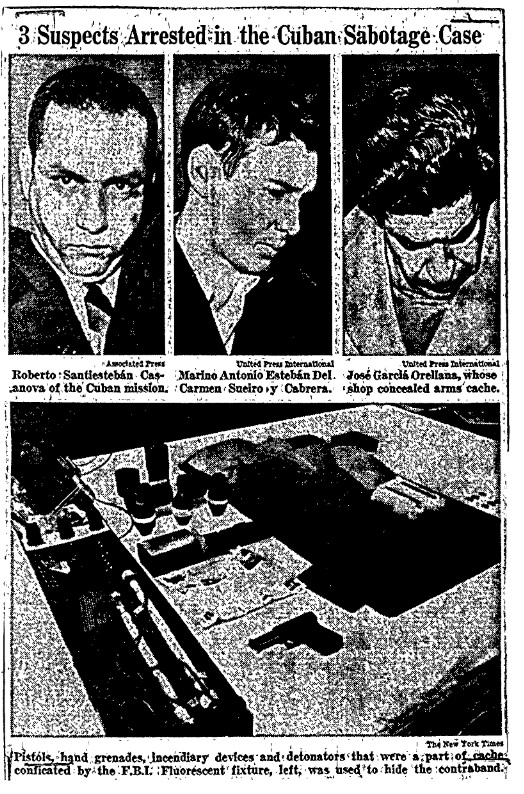

Three suspects, and their weapons stash.

Carlos and the Tricontinental

Havana would go on to redouble its efforts to improve its capacity to promote and carry out terrorist attacks around the world. The Tricontinental Conference, held in Havana from January 3-16, 1966, and the establishment of the Organization for the Solidarity of the Peoples of Asia, Africa, and Latin America OSPAAL sought to support and train terrorist groups worldwide, including in the United States.

Havana would go on to have “successes”.

One of them was a young Venezuelan named after the Soviet Union’s founding leader, Vladimir Ilyich Ulyanov, also known as Vladimir Lenin.
Ilyich Ramírez Sánchez (age 17) attended the 1966 Tricontinental Conference. Afterwards, Ilyich spent the summer at Camp Matanzas, a guerrilla warfare school run by the Cuban DGI.  Following a string of terrorist attacks across Europe, he picked the alias “Carlos.

Nan Robertson in a special to The New York Times on July 11, 1975 published the article “FRANCE EXPELLING 3 CUBAN OFFICIALS” that reports on the link between Cuban diplomats and Carlos the Jackal.

“France expelled three high‐ranking Cuban diplomats today in connection with the worldwide search for a man called Carlos, who is believed to be an important link in an international terrorist network.” […]”The French Interior Ministry said that investigators were convinced that the terrorist network had been helped significantly by the intelligence services of “certain nations.”[…] French authorities have also said that Carlos may have been directly involved with a siege at the French Embassy in The Hague last September and a grenade attack the same month on Le Drugstore on the Left Bank here, in which 3 persons were killed and 22 wounded.  France expelled three high‐ranking Cuban diplomats on July 10, 1975. ”The Cubans, according to the French Interior Ministry, were “constant visitors” to the Paris hideout of Carlos”. The Cuban diplomats on whom expulsion orders were served today were Raul Rodriguez Sainz, 32 years old, first secretary for cultural affairs; Pedro Lara Zamora, 33, deputy cultural attache, and Ernesto Reyes Herrera, 32, the chief of protocol. André Mousset, spokesman for the Interior Ministry, added that the Carlos affair was looking more and more like an “international terrorist plot.”

FALN Terrorists backed by Cuba, and the bombing campaign in New York City


Six months earlier on the other side of the Atlantic another group of Puerto Rican terrorists linked to Havana carried out an act of terrorism that claimed the lives of New Yorkers.

The FALN was responsible for the January 24, 1975 explosion at Fraunces Tavern, which killed Alejandro Berger ( age 28), James Gezork (age 32), Frank Connor (age 33), Harold H. Sherburne (age 66) and wounded over 60 others.


 Zach Dorfman’s June 8, 2017 article “How Fidel Castro Supported Terrorism in America” published in The Wall Street Journal reveals:  “the FALN was started in the mid-1960’s with a nucleus of Puerto Rican terrorists that received advanced training in Cuba. . . . After their advanced training in Cuba they returned to Puerto Rico and a wave of bombings and incendiary incidents struck the [latter] island. Within the last few years they have shifted their activities to the mainland. . . . It is believed that they have maintained close links and may in fact work closely with Cuban intelligence operatives.”


Furthermore Mr. Dorfman reported that “[a]ccording to court documents, Filiberto Ojeda Ríos, who is believed to have helped co-found the FALN, told an undercover NYPD officer in 1983 that he had received explosives training in Cuba. And the FBI estimated that by 1973, roughly 135 Puerto Rican militants had received “extensive instruction in guerilla war tactics, preparation of explosive artifacts, and sophisticated methods of sabotage” from Fidel Castro’s intelligence services.”

The Puerto Rican terrorist group, Fuerzas Armadas de Liberación Nacional Puertorriqueña, (FALN), from the mid-1970s through the mid-1980s, carried out more than 130 bombings, including more in New York City.

Cuban backed American terrorists carried out attack on the U.S. Capitol in the 1980s.

Windows blown out by bomb placed in the U.S. Capitol in 1983 to protest rout of Cubans in Grenada

The Castro regime aided and abetted American terrorists that attacked and bombed the U.S. capitol, and then doubled down when one of those terrorists died. Radio Havana Cuba, official media of the Castro regime, published in 2010 an article titled “Political Activist Marilyn Buck Dies at 62” in which it referred to Marilyn Buck as an “activist and former political prisoner.” In reality she was a terrorist who bombed the U.S. Capitol in 1983 to protest the Grenada Invasion.

“At two minutes before 11 o’clock in the evening on this day in 1983, a thunderous explosion tore through the second floor of the U.S. Capitol’s Senate wing. Since the area was virtually deserted at the time, there were no casualties. Minutes before the bomb went off, a caller claiming to represent the “Armed Resistance Unit” warned a Capitol switchboard operator that a bomb had been placed near the chamber — purportedly in retaliation for the recent U.S. military actions in Grenada and Lebanon. The force of the device, hidden under a bench outside the Senate chamber, blew the hinges off the door to the office of Sen. Robert Byrd (D-W.Va.), the minority leader. It also damaged five paintings, particularly a stately portrait of Massachusetts Sen. Daniel Webster. (The blast tore away Webster’s face and left it scattered across the floor tiles in one-inch canvas shards. Senate officials recovered the fragments from debris-filled trash bins. Over the coming months, a conservator painstakingly restored the painting to a credible, if somewhat diminished, version of the original.) The blast also punched a hole in a partition that sent a shower of pulverized brick, plaster and glass into the Republican cloakroom behind the chamber. Although the explosion caused no structural damage to the Capitol, it shattered mirrors, chandeliers and furniture. Officials placed the damage at $250,000.”

“After a five-year investigation, in May 1988 FBI agents arrested seven members of the ‘Resistance Conspiracy’: Marilyn Jean Buck, Linda Sue Evans, Susan Rosenberg, Timothy Blunk, Alan Berkman, Laura Whitehorn and Elizabeth Ann Duke. They were charged with executing the Capitol bombing as well as triggering similar blasts at Fort McNair and the Washington Navy Yard.”

Two years earlier on October 20, 1981 as part of a group of Weather Underground and Black Liberation Army members assaulted a Brink’s armored car carrying 1.6 million in Nanuet, NY. Buck was a member of the Black Liberation Army. Two police officers and a guard were murdered during the armed robbery and subsequent escape.

Inside of the bombed Senate office.


Marilyn Buck pleaded guilty in 1988 to the 1983 bombing of the United States Capitol. Her story is put into context in a long piece published in Politico by William Rosenau titled “The Dark History of America’s First Female Terrorist Group,” which exposes connections to the Cuban dictatorship.

The WASP Network

In 1996 the Cuban Wasp Spy network located in South Florida provided information to Havana that led to the shoot down of two civilian planes in international airspace killing four engaged in the search and rescue of rafters and boat people. This act of state terrorism was widely condemned.


The WASP Network (La Red Avispa) was made up of over forty officers and agents, four escaped to Cuba when the FBI began rounding them up in 1998. Ten were captured, and five of them pleaded guilty and cooperated with the prosecution and became unpersons in Cuba. The Wasp Network engaged in espionage: targeted U.S. military facilities, planned to smuggle arms and explosives into the United States, infiltrated two non-violent exile groups, and carried out numerous other activities to sow division, shape public opinion, meddle in U.S. elections, and provided information for Operation Scorpion that led to the extrajudicial killings of Armando Alejandre, Carlos Costa, Mario de la Peña and Pablo Morales on February 24, 1996. Operation Scorpion was a Cuban intelligence operation of the Castro regime that sought to destroy Brothers to the Rescue using MiG fighters to shoot down their planes in an act of state terrorism carried out over international airspace.

This network also gathered personal information of American military personnel “compiling the names, home addresses, and medical files of the U.S. Southern Command’s top officers and that of hundreds of officers stationed at Boca Chica Naval Station in Key West.”

The spies had received instructions from Havana to burn down an airport hangar, sabotage planes, first terrorize with messages that he was “nearing execution,” then send a mail bomb to kill a CIA agent living in Bal Harbour identified as Jesus Cruza Flor.

On September 12, 1998, the largest Cuban spy ring ever uncovered in the United States, was broken up by the FBI. Ten suspects were charged as Cuban spies. The Cuban dictatorship has spent decades trying to whitewash this history.

WASP network spies captured in 1998.


Cuba was taken off the SSOT list in 2015 for political reasons, and returned to it on 2021 for continued bad action.

Cuba was taken off the list of state terror sponsors in 2015 when the Obama Administration, responding to demands of Raul Castro, conducted a politicized review to remove the offending state. Six years later in January 2021, Cuba was returned to the list.

The U.S. State Department at the time cited the following four reasons for re-designating the Cuban dictatorship as a sponsor of terrorism.

1. “Cuba has refused Colombia’s requests to extradite ten ELN leaders living in Havana after the group claimed responsibility for the January 2019 bombing of a Bogota police academy that killed 22 people and injured more than 87 others.”

2. “Cuba also harbors several U.S. fugitives from justice wanted on or convicted of charges of political violence, many of whom have resided in Cuba for decades.  For example, the Cuban regime has refused to return Joanne Chesimard, on the FBI’s Most Wanted Terrorists List for executing New Jersey State Trooper Werner Foerster in 1973; Ishmael LaBeet, convicted of killing eight people in the U.S. Virgin Islands in 1972; Charles Lee Hill, charged with killing New Mexico state policeman Robert Rosenbloom in 1971; and others.”

3. “Cuba returns to the SST list following its broken commitment to stop supporting terrorism as a condition of its removal by the previous administration in 2015.  On May 13, 2020, the State Department notified Congress that it had certified Cuba under Section 40A(a) of the Arms Export Control Act as “not cooperating fully” with U.S. counterterrorism efforts in 2019.”

4. “In addition to the support for international terrorism that is the basis for today’s action, the Cuban regime engages in a range of malign behavior across the region.  The Cuban intelligence and security apparatus has infiltrated Venezuela’s security and military forces, assisting Nicholas Maduro to maintain his stranglehold over his people while allowing terrorist organizations to operate.  The Cuban government’s support for FARC dissidents and the ELN continues beyond Cuba’s borders as well, and the regime’s support of Maduro has created a permissive environment for international terrorists to live and thrive within Venezuela.”

Backing Hamas supporters and their violent protests in the United States


This CubaBrief is focusing on instances of terrorism carried out in the United States by groups supported by the Cuban dictatorship, and has not touched on Havana’s extensive involvement in terrorism in Latin America and in the Middle East, but their support for Iran, Hezbollah, and Hamas has had an impact in the United States. Protests in some cases have turned into riots where, for example, American flags were taken down from Union Station in Washington DC and replaced with Palestinian flags, while Cuban flags were seen in the crowd.

In a formal statement released on October 7, 2023, the same day of the terror attacks, the Cuban Foreign Ministry blamed Israel and its “accomplice,” the United States, for the violence. In doing so, it continued to spread a false narrative that originates in Soviet-era anti-Israel propaganda.In this case Havana was blaming the victims of a terrorist attack that murdered 1,200 and kidnapped hundreds of others perpetrated by their longtime ally Hamas.

On October 8, 2023, one day after Hamas terrorists massacred 1,200 people in southern Israel, militant leftists organized a protest in Times Square to celebrate the killings as an act of resistance and waved signs with anti-Semitic slogans and images. The Center for a Free Cuba took notice of this protest at the time, and how official Cuban media was promoting it. On October 11, 2023, The People’s Forum (TPF) issued a statement defending their October 8th rally in Times Square, doubling down on their support for the terrorist attack.

The group’s co-executive director, Manolo De Los Santos, is a longtime researcher at the Marxist Tricontinental: Institute for Social Research and was “based out of Cuba for many years,” where he “worked toward building international networks of people’s movements and organizations,” according to his biography at the anti-Israel group Black Alliance for Peace. In July 2022, Cuba’s president, Miguel Díaz-Canel, received De los Santos and executive director of Tricontinental: Institute for Social Research, Vijay Prashad with the aim of “elaborating a new consensus, based on theory and according to the different experiences of social movements and countries, on the path of socialism.”

On January 24, 2024 Manolo De Los Santos spoke the quiet part out loud at The People’s Forum in New York City: “When we finally deal that final blow to destroy Israel. When the state of Israel is finally destroyed and erased from history, that will be the single most important blow we can give to destroying capitalism.”

Biden State Department’s wrong steps on Cuba

Despite this, the Biden State Department removed Cuba from the list of countries not cooperating in the fight against terrorism on May 15, 2024. On the same day Joseph Connor, whose father Frank Connor was murdered in a 1975 terrorist attack in New York City by a Cuban backed group, wrote to Secretary Antony Blinken requesting that one of the terrorists involved in the bombing, who is currently harbored by Havana, be returned to the United States to face justice. Four months later, and Mr. Connor has not received a response.

The reason given by Vedant Patel, the principal deputy spokesperson at the State Department on May 16, 2024 “that the circumstances for Cuba’s certifications as not fully cooperating country have changed from 2022 to 2023” does not stand up to scrutiny. Patel cited “Cuba’s refusal to engage with Colombia on extradition requests for National Liberation Army members supported Cuba’s NFCC certification for 2022.”

What change took place? Not the behavior of the Cuban dictatorship.

The Colombian terrorists harbored by Havana were not extradited. The new duly elected president of Colombia, Gustavo Petro, a past member of the terrorist group M-19 in Colombia with close ties to the Cuban dictatorship, ordered his attorney general to suspend the arrest warrant “against 17 ELN commanders, including those whose extradition Colombia had previously requested from Cuba.” There is also a bit of historical irony. Cuba was first placed on the state sponsor of terrorism list in 1982 when Havana was implicated supplying weapons to the M19 terrorist group from profits raised from trafficking narcotics. Patel also cited that “the U.S. and Cuba resumed law enforcement cooperation in 2023, including on counterterrorism.” First, the phrase “law-enforcement dialogue” is inaccurate. In Cuba, there is no rule of law. “To keep power, the dictatorship maintains a repressive security apparatus that murders nonviolent dissidents extrajudicially. This is not ‘law enforcement.’ The Cuban dictatorship is a transnational threat, and legitimizing it does not enhance U.S. advocacy for human rights.”

What has that meant in practice?

Giving legitimacy to the Cuban dictatorship through this sham “law enforcement cooperation” led Cuban officials meeting with their American counterparts to accuse the United States of “supporting people in Miami plotting ‘terrorist’ actions against Cuba.” Biden administration officials rejected these claims, but the actions of Havana could not be described as a good faith effort, or a reason to cite the dictatorship as fully cooperating in anti-terrorism efforts. Much less grant them access to secure facilities that are of great importance to America’s infrastructure.

On June 18, 2024 the Ways and Means Committee held a hearing on antisemitism on college campuses which denounced that Jewish students were being terrorized.

Former top Cuban Communist Party official granted parole arrives in South Florida through Miami International Airport.

On August 16, 2024, Manuel Menéndez Castellanos, a one time top official in Cuba’s communist party in Cienfuegos, who represented the Cuban dictatorship in international forums, and was given several awards by the regime, arrived in South Florida through Miami International Airport. The former high ranking communist official arrived in Miami through the Cuban Reunification Parole Program.

U.S. Senators send letter to Secretary Blinken over the high risk to national security posed by recent expansion of nonimmigrant visas (NIV) to  Communist Cuba

Despite this lapse, the Biden Administration announced that starting on August 19, 2024 would “expand its visa services to facilitate cultural and educational exchanges between” Cuba and the United States.

On September 5, 2024,  Senator Rick Scott joined Senator Marco Rubio and Senator Ted Cruz “in sending a letter to U.S. Secretary of State Antony Blinken, raising concerns over the high risk to national security posed by the Biden-Harris administration’s recent expansion of nonimmigrant visas (NIV) to the communist Cuban regime.” In this letter they point out concerns of this opening to Cuba, a state sponsor of terror (SSOT). ” Given the risks associated with allowing agents of an SSOT to enter the country, it is unclear how the U.S. might benefit from these NIVs.” They also ask some critical questions including, “Has the U.S. government expanded NIVs to the other SSOTs—Iran, North Korea, and Syria? If not, does it plan to do so? Why or why not?”

For more information visit CubaBrief.


Thursday, September 14, 2023

Cuba’s WASP spy and terrorist network, dismantled by the FBI 25 years ago this week

25 years after their capture: Setting the record straight on the Castro regime's WASP spy network


On Saturday,  September 12, 1998, the FBI dismantled the largest Cuban spy ring ever discovered in the United States. Ten Cubans were charged with spying for the Cuban regime. Cuba’s government has spent 25 years airbrushing and distorting what they did.

South African Bishop and theologian Desmond Tutu understood that covering up past crimes would not lead to authentic reconciliation or lasting peace. In that spirit we review the record of the WASP network.
According to the Defense Human Resources Activity at the U.S. Department of Defense, the ten members of the WASP network captured were"GERARDO HERNANDEZ, 31 (alias Manuel Viramontes), the spymaster; FERNANDO GONZALEZ, 33 (alias Ruben Campa), and RAMON LABANINO, 30 (alias Luis Medina), Cuban intelligence officers.  The remaining seven were mid-level or junior agents who reported to the three senior agents. Included were ANTONIO GUERRERO, 39, who observed aircraft landings at the Boca Chica Naval Air Station from his job as a sheet-metal worker there; ALEJANDRO ALONSO, 39, a boat pilot; and RENE GONZALEZ, 42, a skilled aircraft pilot and the only Cuban national among these seven. Both joined the exile group Movimiento Democracia to report on its activities -all non-violent- against the Castro regime. Also, two married couples, Americans, worked in the spy network: NILO and LINDA HERNANDEZ, 44 and 41 respectively, and JOSEPH and AMARYLIS SANTOS, both 39."

Cuban spy Juan Pablo Roque escaped.
 
JUAN PABLO ROQUE, an eleventh spy also charged and linked to the 1996 Brothers to the Rescue shoot down, had fled to Cuba one day before Cuban MiGs launched missiles destroying two Brothers to the Rescue planes, and killing four pilots. Three others, identified as John Does, were also charged.

Five defendants -Alejandro Alonso, Nilo and Linda Hernandez, Joseph and Amarylis Santos- accepted plea bargains and cooperated with prosecutors. These five Cuban spies provided information about the other five. These five eventually went on trial, where it was revealed that the Cuban spy ring was engaged in both espionage and terrorism.

The Wasp Network engaged in espionage: it infiltrated two non-violent exile groups; provided information that led to the extrajudicial killings of Armando Alejandre, Carlos Costa, Mario de la Peña and Pablo Morales on February 24, 1996; targeted U.S. military facilities; planned to smuggle arms and explosives into the United States, and carried out other active measures to sow division, shape public opinion, and meddle in U.S. elections. 

Hernandez guilty of murder conspiracy in 2/24/96 shoot down.

The Wasp Network gathered personal information on American military personnel, "compiling the names, home addresses, and medical files of the top officers of the United States Southern Command as well as hundreds of officers stationed at Boca Chica Naval Station in Key West."

The spies had received orders from Havana to burn down an airport hangar; sabotage planes; and to terrorize a CIA operative identified as Jesus Cruza Flor, with warnings that he was "nearing execution,'' and then to send a mail bomb to murder him at his Bal Harbour residence.

Cuban spies targeted military personnel at the Boca Chica Naval Station.

On June 8, 2001, the five Wasp defendants who had not entered into plea bargains were found guilty on all counts. In December 2001, three of the spies were sentenced to life in prison for conspiracy to commit espionage. Gerardo Hernandez and Ramon Labanino, both Cuban nationals, and Antonio Guerrero, a U.S. citizen, were sentenced to life in prison. Fernando Gonzalez and Rene Gonzalez, both Cuban nationals, were sentenced to 19 and 10 years in prison, respectively, for conspiracy and operating as unregistered agents of a foreign power.

The five who pleaded guilty to one count of acting as unregistered agents of a foreign power and cooperated received lesser sentences: Alejandro Alonso, Nilo and Linda Hernandez were sentenced to seven years in prison; Joseph Santos was sentenced to four years, and Amarylis Santos was sentenced to three and a half years. Gerardo Hernandez, the head of the network, was convicted of murder conspiracy and espionage and condemned to a double life sentence.

President Obama commuted Hernandez's double life sentences on December 17, 2014, as part of the concessions made in the effort to normalize relations between Cuba and the United States. Once back in Cuba, Hernandez was promoted to Deputy National Coordinator of the Committees for the Defense of the Revolution (CDR) in April 2020, tasked with monitoring neighborhood committees to spy on all Cubans on the island. He was also appointed to the Castro dictatorship's Council of State, the 31-member body that oversees day-to-day life on the island, on December 17, 2020. Gerardo Hernández visited Moscow on May 31, 2023, and laid a wreath on a monument to Fidel Castro.

 The 2009 book Betrayal: Clinton, Castro & The Cuban Five, by Matt Lawrence and Thomas Van Hare provides a compendium of the evidence. It exposes the facts about what happened and who knew prior to the murder of the four Brothers to the Rescue pilots -three Americans and one legal resident- who were volunteers out to save the lives of fleeing refugees what would transpire. Lawrence, one of the authors had volunteered his time, and flown search and rescue missions for Brothers to the Rescue.

 The Brothers to the Rescue shoot down on February 24, 1996, and the influence operation conducted by Ana Belen Montes to direct blame away from the Castro regime, and onto the victims, drew the attention of investigators, and in September 2001 led to the arrest of Montes, a spy for Havana who worked in a sensitive position at the Defense Intelligence Agency (DIA) in the Pentagon. This is also explored in the book by Lawrence and Van Hare.

On May 17, 2012 the Subcommittee on the Western Hemisphere in the U.S. Congress's Committee on Foreign Affairs held a hearing on "Cuba’s Global Network of Terrorism, Intelligence, and Warfare." Among the experts who spoke at the hearing was Mr. Christopher Simmons, founding editor of Cuba Confidential, an online blog and source for news on Cuban espionage worldwide. He is an international authority on the Cuban Intelligence Service and retired from the Defense Intelligence Agency with over 23 years of experience as a counterintelligence officer, and played an important role in the capture of Ana Belen Montes.

Simmons ended his presentation outlining and summarizing the high profile act of state terrorism that killed four Cuban Americans in an operation conducted on orders from highest levels of the Castro regime.

"Last, but not least, of the highlighted issues, I'd like to address Operation Scorpion which was addressed earlier as a shootdown of Brothers to the Rescue. While this mission on February 24, 1996 predates the other information I discussed, it is important because this act of terrorism involves highest levels of the Castro regime. On February 24, 1996, Cuban MiGs shot down two U.S. search and rescue aircraft in international waters. Code named Operation Scorpion, it was led by General Eduardo Delgado Rodriguez, the current head of Cuban intelligence. It was personally approved by Fidel Castro and supported by Raul Castro, the current President of Cuba. Four Americans were murdered in this act of terrorism."

  The case of the Cuban WASP Network and its involvement in the 1996 Brothers to the Rescue shoot down conspiracy, and plotting to terrorize and murder a retired U.S. intelligence agent underscores once again the terrorist nature of the Cuban dictatorship. 

In order to achieve true reconciliation and peace, the regime in Havana would have to recognize its past crimes, repent, and stop sponsoring and engaging in terrorism.  Its continuing repressive actions in Venezuela, and Nicaragua; its ongoing support for the war in Ukraine, and its murder of non-violent dissidents in Cuba demonstrate that the Cuban dictatorship presently is not interested in reforming its behavior, or in true reconciliation, but rather in continuing its international outlaw status that is on a par with North Korea.

Thursday, June 25, 2020

The Wasp Network, that killed Americans and plotted a terror attack on US soil, were not the Castro regime's last soldiers of the Cold War

Some of what they left out.


Wasp Network is a 2019 film now playing on Netflix that is based on the book The Last Soldiers of the Cold War by the Brazilian author, journalist, and politician Fernando Morais that paints a sympathetic and whitewashed picture of the Castro regime's spy network that was rounded up by the FBI in 1998. To have a better idea about who the author is and his ideological motivations consider the following factoid. Morais's first book published in 1976 titled A Ilha about his three month visit to Cuba, at a time when Brazil's military dictatorship had severed relations with the Castro's communist dictatorship since 1964, and Brazilian passports carried a warning: "Not valid for Cuba."

This visit and the book upon which it was based made Morais an icon of the Brazilian left.

Olivier Assayas, who wrote the screenplay, based on the book by Morais, and directed the film, initially encountered resistance from the Castro regime, but found all doors opened to him and he spent half a year in Havana, Cuba  to complete the film.

Therefore it should be a surprise that the book that the film is based on and the film portrays the Castro dictatorship, and its spy network in a favorable and non-threatening light. The film is a masterclass and misinformation, but also a demonstration that to satisfy Havana what should have been a powerful and impacting film ended up a mediocrity, panned by critics and with even a lower score among the audience according to Rotten Tomatoes.

The WASP Network (La Red Avispa) was made up of over forty officers and agents, four escaped to Cuba when the FBI began rounding them up. Ten were captured, and five of them pleaded guilty and cooperated with the prosecution. They are unpersons in Cuba, and the remaining five became the focus of an international propaganda campaign organized by the Castro regime that did not end until December 2014.

The film briefly mentions the Ochoa Affair, and touches on its political aspect of liquidating General Arnaldo Ochoa, a popular general among the ranks, who was executed by firing squad in 1989, but fails to mention the Castro regime's extensive involvement in drug trafficking.


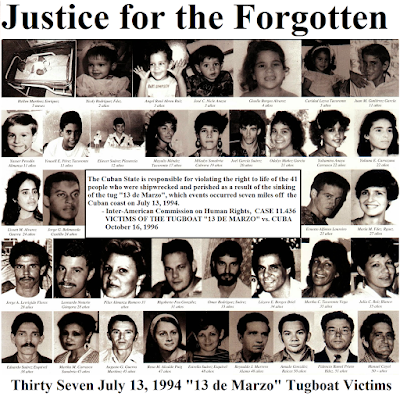
Whether consciously or not, to film in Cuba, and not have regime censors shut down their production, he gutted the film of what would have been powerful elements that would have provided context, not to mention drama and pathos to his film . It would've provided a dramatic explanation of the July 13, 1995 overflight of Havana by Brothers to the Rescue but this would have necessitated putting on film the July 13, 1994 "13 de marzo" tugboat incident when agents of the Castro regime sank a tugboat six miles off the coast of Havana and attacked and killed 37 men, women, and children trying to flee the island. Next month will mark 26  years without justice for the victims. A detailed report on this crime against humanity was published by the Inter-American Commission on Human Rights in 1996 and is available online.

One year later on the anniversary of the killings, and with the bodies never recovered, a flotilla of boats organized by Cuban pro-democracy groups tried to reach the spot where the tugboat rested with the remains of the tugboat victims to hold a service for the dead. The lead boat Democracia had its hull crushed by Cuban government gunboats, and turned back, as had been agreed upon by organizers, if the dictatorship's forces turned violent. At that moment Brothers to the Rescue that had been flying overhead changed course and flew over Havana dropping leaflets that read "Comrades No. Brothers."  This outraged the Castro brothers and I believe this is when they began plotting their revenge which they carried out seven months later.

Other and more dramatic activities carried out by the Wasp Network were left out of the film.

The spies had received instructions from Havana to burn down an airport hangar, sabotage planes, first terrorize then send a mail bomb to kill a CIA agent living in Bal Harbour identified as Jesus Cruza Flor. The network provided material intelligence that assisted in the shoot down of two civilian planes on February 24, 1996 killing four Americans that they do not even show or name in the film. They are treated as non-persons.


The Wasp Network engaged in espionage: targeted U.S. military facilities, planned to smuggle arms and explosives into the United States, provided information that led to the extrajudicial killings of Armando Alejandre, Carlos Costa, Mario de la Peña and Pablo Morales, infiltrated two non-violent exile groups, and carried out numerous other activities to sow division, shape public opinion, and meddle in U.S. elections.

The Cuban spy network gathered personal information of American military personnel "compiling the names, home addresses, and medical files of the U.S. Southern Command’s top officers and that of hundreds of officers stationed at Boca Chica Naval Station in Key West."  What did the Castro regime plan to do with this information?

The WASP spy network was disbanded in 1998 by the FBI, but another high ranking Castro spy burrowed deep in the Pentagon's Defense Intelligence Agency, Ana Belen Montes, was not arrested until days after the Twin Towers and the Pentagon were attacked on September 11, 2001.

All of this came out during their trial. Gerardo Hernandez, the head of the network was convicted of murder conspiracy and espionage and condemned to a double life sentence.

Hernandez had his double life sentence commuted by President Obama on December 17, 2014 as part of the concessions made in the drive to normalize relations between the two countries.

In April 2020, Gerardo Hernández, convicted of murder conspiracy for the Brothers to the Rescue shootdown and espionage for heading up the WASP spy network, was promoted to Deputy National Coordinator of the Committees for the Defense of the Revolution (CDR), an Orwellian agency, and is now tasked with spying on all Cubans in the island.

There is a long history of espionage by the Castro regime targeting the United States that stretches back to the early years of the Cuban dictatorship, and policy makers should not forget or underestimate it. These were not the last soldiers of the "Cold War", because Cuban spies continue to carry out the orders of the dictatorship in Havana even when that means carrying out acts of terrorism, torture, and murder.

In the meantime we can challenge the Castro regime's narrative and remember the victims and continue to demand justice. The case of the Brothers to the Rescue shootdown on February 24, 1996 has been studied in detail and a report prepared in 1999 by the Inter-American Commission for Human Rights with references to other sources. The Wasp Network film never identified the four men killed on that Saturday afternoon 24 years ago. Lets challenge their narrative with facts and documentary evidence. Let us also remember and say the names of Armando Alejandre, Carlos Costa, Mario de la Peña and Pablo Morales.

Sunday, June 21, 2020

Wasp Network film: What was left out watered down and muddled what would have been an interesting film

Say their names:  Armando Alejandre, Carlos Costa, Mario de la Peña and Pablo Morales. Killed on February 24, 1996 with the active assistance of the Wasp Network.


Olivier Assayas is a talented filmmaker who with Edgar Ramirez once made a powerful film about international terrorism that is worth seeing, unfortunately that film is not the 2019 film Wasp Network that has been correctly described as a "disappointingly muddled spy saga," and something to skip.

This is one case where reality is much more dramatic and engaging then what appeared on the screen, because the film was based on misinformation provided by the Castro regime to portray the WASP network in a positive light, and to do this non-violent movements Brothers to the Rescue, and the Democracy Movement had to libeled, their significance downplayed, and linked to violent groups with sketchy actors.

Meaning that at a time when a popular and broad based non-violent movement was gaining strength in the Cuban diaspora the film engages in an act of schizophrenia. The main spies featured in the film Juan Pablo Roque and Rene Gonzalez infiltrate Brothers to the Rescue and the Democracy Movement and attempted to get close to their respective leaders Jose Basulto and Ramon Saul Sanchez.

We do not see Ramon Saul Sanchez in the film, although he is mentioned, but we do encounter a version of Jose Basulto that bears no resemblance to the man I've been acquainted with for over 25 years, and had the privilege to briefly interview and take part in a panel discussion on nonviolence with both men.


The film repeats Castro regime falsehoods about both groups trying to link them to violent movements, but the reality is that they were collaborating with The King Center in the early 1990s and organized a non-violence teach in at Florida International University. The film includes footage of  former Foreign Minister Roberto Robaina (now defenestrated) defending the shoot down of the two civilian planes in February 24, 1996 and towards the end Fidel Castro making the case for his regime engaging in espionage on American soil.

The Wasp Network repeats the Castro regime's line that they were just spying on Cuban exile groups, and implies that there were only ten of them in the network. The reality is that there were over 40 operatives, and they were also targeting American military bases, Congressional offices, and were engaging in active measures to manipulate elections.

Ten captured spies
 The film lightly mentions the Ochoa Affair, and touches on its political aspect of liquidating General Arnaldo Ochoa, a popular general among the ranks, who was executed in 1989, but fails to mention the Castro regime's extensive involvement in drug trafficking.

However it guts the film of what would have been powerful elements that would have provided clarity not to mention drama and pathos to the film and explained the overflight of Havana by Brothers to the Rescue but this would have necessitated putting on film the July 13, 1994 ""13 de marzo" tugboat massacre when agents of the Castro regime sank a tugboat six miles off the coast of Havana and actively caused 37 men, women, and children to drown.

One year later on the anniversary of the killings, and with the bodies never recovered, a flotilla of exile boats tried to reach the spot where the tugboat rested with their remains to hold a service for the dead. The lead boat Democracia had its hull crushed by Cuban government gunboats, and turned back. At that moment Brothers to the Rescue that had been flying overhead changed course and flew over Havana dropping the leaflets that read "Comrades No. Brothers."  This outraged the Castro brothers and they began plotting their revenge which they carried out seven months later.

It would have been much more interesting to learn about the other activities carried out by the Wasp Network and what they were planning when captured by the FBI.

The Wasp Network had planned to burn down a airport hangar, first terrorize then send a mail bomb to kill a CIA agent living in Bal Harbour identified as Jesus Cruza Flor, and provided material intelligence that assisted in the shoot down of two civilian planes on February 24, 1996 killing four. This came out during their trial. Gerardo Hernandez, the head of the network was convicted of murder conspiracy and espionage and condemned to a double life sentence.

This would have been a much more interesting and powerful film and not the muddled and confused propaganda film that is now playing on Netflix and is slow moving and unwatchable. Worse yet, the film does not identify the four men killed in the shoot down or the persons who flew with Jose Basulto that day and made it back. It also downplays and cleans up the communications of the Castro regime's pilots as they shot down the two planes, and attempts to portray Basulto in a negative light. A more accurate breakdown of what happened is available here.  


The three planes did not over fly Havana and the two planes shot down did not enter Cuban airspace. The one plane that allegedly entered a mile into Cuba's airspace briefly while flying a search and rescue pattern with the other two planes that were farther out was Jose Basulto's. The film shows the MiGs flying by the Brothers to the Rescue planes which did not happen in real life. There was no warning.

International organizations recognized that Armando Alejandre, Carlos Costa, Mario de la Peña and Pablo Morales were murdered by agents of the Cuban government on February 24, 1996 when they were blown out of the sky by air-to-air missiles fired by a Cuban MiG.  This was a criminal conspiracy organized by an outlaw regime. 


Remember and say their names:  Armando Alejandre, Carlos Costa, Mario de la Peña and Pablo Morales. Killed on February 24, 1996 with the active assistance of the Wasp Network.

In the meantime go see Assayas's 2010 film Carlos, that explores the life of a terrorist trained by the Castro regime,  but give Wasp Network a pass.

Below is a transcription that was translated that gives you a more accurate idea of what this spy network was really up to.


Transcribed and translated excerpts from seized diskettes:
DAV-118 (E) RTF (AIRPORT.DIR)
WORK DIRECTIVES FOR OPERATION “AEROPUERTO”
1-. THE IDEA OF THE OPERATION:
SINCE THE VERY BEGINNING THE ESSENTIAL IDEA OF THE OPERATION WAS FOR A-32 TO JOIN WITH THE ILLEGAL CENTER THAT WAS BEING DIRECTED BY A-4 AND WAS FUNCTIONING IN THE STATE OF FLORIDA.
2-. OPERATIONAL OBJECTIVES:
THE FUNDAMENTAL OBJECTIVE OF THE OPERATION IS TO ESTABLISH S/A A-32 IN KEY WEST FOR THE PURPOSE OF PENETRATING AND OBTAINING INFORMATION ON THE NAVAL AIR STATION LOCATED IN THAT CITY.
ALSO, TO MAKE CONTACTS WHICH CAN PROVIDE US WITH MILITARY, POLITICAL , BIOGRAPHICAL AND OPERATIONAL INFORMATION AS AS TO STUDY COUNTERREVOLUTIONARY ORGANIZATIONS EXISTING IN THE AREA AND CARRY OUT STUDIES ON THE OPERATIONAL SITUATION OF ROADS, MAINLY IN KEY WEST.
3-. PARTICIPANTS
A-32 WILL BE THE MAIN PARTICIPANT AND HE WILL BE DIRECTLY UNDER I.O. A-4.
WORK DIRECTIVES FOR OPERATION “GIRÓN.”
1-. IDEA OF THE OPERATION
Reviewed by: LS Salomon
Declassified by: KMDJr / RJG
Cred. #10517
11/27/00 1

[…]

DHo-101 (E) CMA (Disk 17).wpd
OPERATION “PICADA’
OBJECTIVES:
1.-) TRY TO IMPEDE THE CONSUMPTION OF INTENTIONS OF THE OPERATION P.A.L. (PAN, AMOR Y LIBERTAD) OF THE COUNTERREVOLUTIONARY ORGANIZATION BROTHER’S TO THE RESCUE.
2.-) AFFECT AND DISCREDIT THE IMAGE OF SAID ORGANIZATION.
ACTIONS TO BE DEVELOPED:
1.-) PERFORM THE OPERATIONAL SITUATION STUDY OF THE HANGAR AT THE OPA LOCKA BASE WHERE THE ORGANIZATION KEEPS AND OPERATES THEIR PLANES.
2.-) THE POSSIBILITY OF BURNING DOWN THE WAREHOUSE OF THE COUNTERREVOLUTIONARY ORGANIZATION, AND AFFECT THEIR PLANES, MAKING IT SEEM LIKE AN ACCIDENT, NEGLIGENCE OR SELF DAMAGE.
KEEPING IN MIND THAT THIS PLACE MAY BE SECURED AND THAT IN CASES LIKE THESE, INVESTIGATIONS ARE PERFORMED, RUMORS WILL LEAK THAT BASULTO AND HIS PEOPLE CAUSED THE DAMAGE THEMSELVES TO COLLECT THE INSURANCE AND GET MORE MONEY FROM THEIR CONTRIBUTORS.
3.-) ATTEMPT TO DISABLE THEIR EQUIPMENT AND TRANSMISSION ANTENNAE ON LAND, THE ONES THEY USE TO COMMUNICATE WITH DURING THEIR MISSIONS, MAKING IT SEEM LIKE NEGLIGENCE.
NOTE: THESE THREE POINTS WERE REQUESTED OF CASTOR VIA RADIO MESSAGE. IT HAS TO BE DETERMINED WHAT HE HAS BEEN ABLE TO OBTAIN.
4.-) ANALYZE WITH CASTOR IF HE COULD INFORM US AHEAD OF TIME (DETERMINE PRECISE TIME) WHEN THE BROTHER’S TO THE RESCUE PLANES WILL BE TAKING OFF, WHO IS IN THEM AND IF THEY ARE GOING TO LAND AT A SPECIFIC PLACE. WHAT PERSONNEL KNOWS THIS INFORMATION BEFOREHAND. AT SOME POINT, CAN IT BE DETERMINED WHO PROVIDED THIS INFORMATION.
5.-) ACCORDING TO THE FEATURES OF THE PLANES, THEIR SECURITY SYSTEM, AS WELL AS THE HANGAR WHERE THEY ARE LOCATED, IF AT ANY SPECIFIC MOMENT HE COULD HIDE SOME TYPE OF MATERIAL AND KEEP IT THERE WITHOUT BEING DETECTED. WHAT SIZE WOULD THAT MATERIAL HAVE TO BE
OPERATION PARALLELO:
THE OBJECTIVE OF THIS OPERATION IS TO DEVELOP A SERIES OF ACTIONS AGAINST CIA AGENT JESUS CRUZA FLOR.
THESE ACTIONS WOULD BE:
1.-) PHOTOGRAPH OR VIDEO TAPE HIS HOUSE, LOCATED AT:
1440 S. BAYSHORE DR.
MIAMI, FLORIDA 33131
TELEPHONE (305)358-0762
2.-) ONCE THE HOUSE IS PHOTOGRAPHED, MAKE VARIOUS THREATENING TELEPHONE CALLS (TWO OR THREE) CONCERNING HIS NEARING EXECUTION.
THESE CALLS WOULD BE AT DIFFERENT HOURS AND DIFFERENT DAYS. TRY TO USE THE EQUIPMENT (CALLED SCRAMBLER OR SOMETHING SIMILAR) TO CHANGE THE VOICE. PHONE BOOTHS SHOULD BE SELECTED THAT ALLOW A QUICK EXIT OUT OF THE AREA. KEEP IN MIND THAT THE MEASURES IS AGAINST A CIA AGENT AND HE COULD HAVE CALLER ID TO FIND OUT THE TELEPHONE NUMBER THAT IS CALLING AND THE ADDRESS WHERE IT IS LOCATED. ON THE OTHER HAND, KEEP IN MIND THE REST OF THE SECURITY MEASURES THAT SHOULD BE TAKEN IN THE BOOTH, SUCH AS FINGERPRINTS, HAIR, ODORS, SALIVA, DRESS, THAT THERE BE NO PERMANENT PERSONNEL IN THE AREA TO RECOGNIZE THE CALLER. DO NOT LEAVE THE CAR WHERE IT CAN BE OBSERVED, THE DURATION OF THE CALL. DO NOT RESPOND TO ANY QUESTIONS ASKED.
3.-) PREPARE AN ALLEGED BOOK-BOMB (BOOK, CABLE, BATTERIES, PLASTIQUE, ETC., AND SEND IT VIA EXPRESS MAIL. KEEP IN MIND TO WRAP THE BOOK IN A PROTECTIVE PAPER, WHICH IF THE ENVELOPE IS PASSED THROUGH THE X-RAY MACHINES, IMPEDES THE DETECTION OF WHAT IS INSIDE, AND THEREFORE IT WILL NOT BE ROUTED THROUGH THE MAIL.
KEEP IN MIND TO OBTAIN THE ENVELOPE, AS WELL AS THE POSTAGE, MANY DAYS IN ADVANCE AND SELECT A BUSY PLACE. USE A SPECIFIC CAMOUFLAGE.
STUDY THE MAILBOX WHERE THE PACKAGE WILL BE DEPOSITED, AS WELL AS THE TIME IT WILL BE DEPOSITED. ANALYZE HOW YOU WILL GET OUT OF THE AREA.
DURING THE ENTIRE PROCESS KEEP THE SECURITY MEASURES IN MIND, SUCH AS THE ONES MENTIONED BEFORE, GIVING SPECIAL ATTENTION TO FINGER PRINTS DURING THE ENTIRE PROCESS.
EVALUATE THE POSSIBILITY OF USING MANOLO TO MAKE THE CALL, THE TOPOS TO DEPOSIT THE ENVELOPE AND A-4 TO PREPARE THE BOOK-BOMB.
--------------
FEBRUARY 1, 1994
CONTACT AGENDA WITH 0-4 “ESELIN”
Reviewed by: LS Salomon
Declassified by: KMDJr
MM-#10517
9/24/00 2-6