Showing posts with label Ramon Saul Sanchez. Show all posts

Monday, July 13, 2020

Twenty five years after the flotilla to pay tribute to the 37 victims of the "13 de Marzo" Tugboat Massacre: A reflection from back then

Twenty  five years ago, one year after the massacre, Cuban exiles gathered together and set out in a flotilla that peacefully invaded Cuban national territory to travel to the spot where the "13 de Marzo" tugboat sank and where the human remains of the 37 victims still reside never returned to their families to this day to hold religious services for them.


 Hard to believe that its been 25 years.  Found an old essay written  just returned from the flotilla on July 14, 1995 and reproduce excerpts below:

On the Straits

The purpose of the trip is peaceful. The mastermind behind this project is Ramon Saul Sanchez, of the Cuban National Commission. I leave Miami convinced that the possibility of death or imprisonment in Cuba is the likely outcome of this flotilla. As best as one can prepare for such terrible possibilities I am at peace with these grim prospects. Why are we doing this? We do it for the liberation of the Cuban nation. Because we feel a pain in our soul every time we see another raft intercepted in the straits, and we think of all those who have perished. We do it because of the senseless murder of [37] women and children and of the thousands more who have been murdered by Castro''s tyranny. We do it because we must.
[...]

It is still dark when we leave. We pray together for the fulfillment of our non-violent ceremony. We jump aboard a forty foot lobster boat. Ramon Saul Sanchez comes to our boat embraces and shakes hands with some of us. He apologizes that they don't have more room on the lead boat so that we can all travel together. A WSVN reporter and cameraman join us on departure and begin to do interviews. "This is a bad sign," someone says. "How do you figure?" replies another. "This is channel 7 covering us," he continues,"don't you know their motto: if it bleeds it leads." Gentle laughter among those who hear the exchange. 
Later they leave on a speed boat to interview someone else. We sleep and talk. As the hours pass and the sun climbs higher. Anticipation mounts, the smell of diesel and the choppy seas take their toll on the passengers. All of a sudden dozens of dolphins start jumping in the wake of the boat. God's creatures living free on the open sea. A sense of emotional uplift spreads through the boat. Temporarily we forget our worries and enjoy these creatures entertaining themselves and us.

[...]

As we near the12 mile limit we begin to see Cuban aircraft circling. We wave our flags and sing the Cuban national anthem. Joy fills our hearts our mission has been partially accomplished. We can see Democracia in the distance leading us further into Cuban waters. One of my compatriots asks if we have entered Cuban waters. Yes, we tell him. He throws a bucket over the side and draws the Cuban water out and pours it into a bottle shaped like the Virgin. This was his holy water: Cuban water.
At this point we begin to see a military helicopter circling the flotilla. We wave our flags and shout our greetings. The Brothers to the Rescue fly formation with some of the Cuban planes. We see a MiG high overhead, and I feel proud of these pilots in small propellar driven aircraft facing off with military helicopters and MiGs.
As we continue in, we can see the Havana skyline. Someone says they see someone signaling with a mirror from one of the buildings. We begin to make out four dots leaving the island and growing larger. We continue in further. La Democracia speeds ahead. As the ships grow larger; we can see that they are gunboats. 
Our captain stops. His brother tells him to go further, "know when to say when," he responds. As he ponders whether to go further or not. We stare out across the water as La Democracia tries to evade the gunboats and make it to the 6 mile limit. We can see the two gunboats pass on both sides of the ship. 
La Democracia turns around and speeds towards us. They're radio has been knocked out. We need to call the Coast guard. They've been rammed. They have wounded on board, among them Dade County Commisioner Pedro Reboredo, who is going into shock. Our captain radioed in and heads out as fast as the engines will take him.

I learn later that two of the Brothers to the Rescue planes flew over Havana and dropped bumper stickers over the capitol. This was done as a diversionary tactic when the Democracia was attacked by the Cuban gunboats. The bumper stickers read: "Comrades no. Brothers."

Today, as we've done since 1995 we held a silent vigil for justice for the 37 Cuban men, women, and children extra-judicially executed on July 13, 1994. Today, it was at the Embassy of Cuba in Washington DC. Wherever you are in the world I hope you'll join us in continuing this demand for truth and justice using nonviolent means.
 
''There are those who think that we should be full of rancor and a thirst for vengeance but I don't want revenge. I feel sorry for the people who assassinated my family. I can never be compensated for my loss. I will never be happy again with my family surrounding me. There will always be a tinge of sadness but I do want there to be a trial so that this situation can serve as a lesson and that these people or others like them in other parts of the world, don't do this kind of thing again. Not in Cuba. Not anywhere.''

Jorge García, July 13, 2004 (A decade after July 13, 1994 tugboat massacre


In 2006, in the year that we marked  10 years since the Brothers to the Rescue Shootdown the Free Cuba Foundation at Florida International University had both Jose Basulto, of Brothers to the  Rescue and Ramon Saul Sanchez, of the Democracy Movement had a conversation about the realities of US-Cuba relations. A portion of the conversation was recorded and is available on Youtube.

Thursday, June 25, 2020

The Wasp Network, that killed Americans and plotted a terror attack on US soil, were not the Castro regime's last soldiers of the Cold War

Some of what they left out.


Wasp Network is a 2019 film now playing on Netflix that is based on the book The Last Soldiers of the Cold War by the Brazilian author, journalist, and politician Fernando Morais that paints a sympathetic and whitewashed picture of the Castro regime's spy network that was rounded up by the FBI in 1998. To have a better idea about who the author is and his ideological motivations consider the following factoid. Morais's first book published in 1976 titled A Ilha about his three month visit to Cuba, at a time when Brazil's military dictatorship had severed relations with the Castro's communist dictatorship since 1964, and Brazilian passports carried a warning: "Not valid for Cuba."

This visit and the book upon which it was based made Morais an icon of the Brazilian left.

Olivier Assayas, who wrote the screenplay, based on the book by Morais, and directed the film, initially encountered resistance from the Castro regime, but found all doors opened to him and he spent half a year in Havana, Cuba  to complete the film.

Therefore it should be a surprise that the book that the film is based on and the film portrays the Castro dictatorship, and its spy network in a favorable and non-threatening light. The film is a masterclass and misinformation, but also a demonstration that to satisfy Havana what should have been a powerful and impacting film ended up a mediocrity, panned by critics and with even a lower score among the audience according to Rotten Tomatoes.

The WASP Network (La Red Avispa) was made up of over forty officers and agents, four escaped to Cuba when the FBI began rounding them up. Ten were captured, and five of them pleaded guilty and cooperated with the prosecution. They are unpersons in Cuba, and the remaining five became the focus of an international propaganda campaign organized by the Castro regime that did not end until December 2014.

The film briefly mentions the Ochoa Affair, and touches on its political aspect of liquidating General Arnaldo Ochoa, a popular general among the ranks, who was executed by firing squad in 1989, but fails to mention the Castro regime's extensive involvement in drug trafficking.


Whether consciously or not, to film in Cuba, and not have regime censors shut down their production, he gutted the film of what would have been powerful elements that would have provided context, not to mention drama and pathos to his film . It would've provided a dramatic explanation of the July 13, 1995 overflight of Havana by Brothers to the Rescue but this would have necessitated putting on film the July 13, 1994 "13 de marzo" tugboat incident when agents of the Castro regime sank a tugboat six miles off the coast of Havana and attacked and killed 37 men, women, and children trying to flee the island. Next month will mark 26  years without justice for the victims. A detailed report on this crime against humanity was published by the Inter-American Commission on Human Rights in 1996 and is available online.

One year later on the anniversary of the killings, and with the bodies never recovered, a flotilla of boats organized by Cuban pro-democracy groups tried to reach the spot where the tugboat rested with the remains of the tugboat victims to hold a service for the dead. The lead boat Democracia had its hull crushed by Cuban government gunboats, and turned back, as had been agreed upon by organizers, if the dictatorship's forces turned violent. At that moment Brothers to the Rescue that had been flying overhead changed course and flew over Havana dropping leaflets that read "Comrades No. Brothers."  This outraged the Castro brothers and I believe this is when they began plotting their revenge which they carried out seven months later.

Other and more dramatic activities carried out by the Wasp Network were left out of the film.

The spies had received instructions from Havana to burn down an airport hangar, sabotage planes, first terrorize then send a mail bomb to kill a CIA agent living in Bal Harbour identified as Jesus Cruza Flor. The network provided material intelligence that assisted in the shoot down of two civilian planes on February 24, 1996 killing four Americans that they do not even show or name in the film. They are treated as non-persons.


The Wasp Network engaged in espionage: targeted U.S. military facilities, planned to smuggle arms and explosives into the United States, provided information that led to the extrajudicial killings of Armando Alejandre, Carlos Costa, Mario de la Peña and Pablo Morales, infiltrated two non-violent exile groups, and carried out numerous other activities to sow division, shape public opinion, and meddle in U.S. elections.

The Cuban spy network gathered personal information of American military personnel "compiling the names, home addresses, and medical files of the U.S. Southern Command’s top officers and that of hundreds of officers stationed at Boca Chica Naval Station in Key West."  What did the Castro regime plan to do with this information?

The WASP spy network was disbanded in 1998 by the FBI, but another high ranking Castro spy burrowed deep in the Pentagon's Defense Intelligence Agency, Ana Belen Montes, was not arrested until days after the Twin Towers and the Pentagon were attacked on September 11, 2001.

All of this came out during their trial. Gerardo Hernandez, the head of the network was convicted of murder conspiracy and espionage and condemned to a double life sentence.

Hernandez had his double life sentence commuted by President Obama on December 17, 2014 as part of the concessions made in the drive to normalize relations between the two countries.

In April 2020, Gerardo Hernández, convicted of murder conspiracy for the Brothers to the Rescue shootdown and espionage for heading up the WASP spy network, was promoted to Deputy National Coordinator of the Committees for the Defense of the Revolution (CDR), an Orwellian agency, and is now tasked with spying on all Cubans in the island.

There is a long history of espionage by the Castro regime targeting the United States that stretches back to the early years of the Cuban dictatorship, and policy makers should not forget or underestimate it. These were not the last soldiers of the "Cold War", because Cuban spies continue to carry out the orders of the dictatorship in Havana even when that means carrying out acts of terrorism, torture, and murder.

In the meantime we can challenge the Castro regime's narrative and remember the victims and continue to demand justice. The case of the Brothers to the Rescue shootdown on February 24, 1996 has been studied in detail and a report prepared in 1999 by the Inter-American Commission for Human Rights with references to other sources. The Wasp Network film never identified the four men killed on that Saturday afternoon 24 years ago. Lets challenge their narrative with facts and documentary evidence. Let us also remember and say the names of Armando Alejandre, Carlos Costa, Mario de la Peña and Pablo Morales.

Monday, May 2, 2016

Reflections on the Free Cuba Protest Flotilla

 "Nonviolence is a powerful and just weapon which cuts without wounding and ennobles the man who wields it. It is a sword that heals." - Martin Luther King Jr., Nobel Lecture, December 11, 1964 


Freedom Flotilla protests discriminatory visa policies of the Castro regime
Active non-violence is not easy but it beats violent resistance in two areas: 1) There is a higher cost in responding to nonviolent resistance with violence and repression. 2) Committing violence exerts a greater psychological toll that makes it more difficult to mobilize large numbers of persons compared to nonviolent action.

However, despite these two advantages nonviolence is not a magic bullet. Active non-violence needs the development of tactics and strategy to be successful. You can't beat a plan without a plan. The first step is to have a vision of where you want to go.

In the campaign generated over the Carnival Cruise to Cuba, that initially accepted discriminating against Cuban-borns, refusing to sell them tickets to satisfy the demands of the Castro regime. Ramon Saul Sanchez of the Democracy Movement has a vision of where he wants to go: "I'm sure that someday all the walls will come down and new bridges will be built, and Cubans will be able return to their homeland," said Ramón Saul Sánchez.

Mass protests, law suits and negative press led to Carnival first backing down and selling tickets to Cuban-borns stating that if the Cuban government did not allow this group of travelers to enter Cuba because of their national origin then the cruise would be called off on May 1st.  A short while later the Castro regime announced that it would permit Cuban-borns to travel to Cuba on the cruise ship ending this discriminatory practice.

Prior to all this the Democracy Movement had announced a "protest flotilla" against Carnival for discriminating against travelers of Cuban origin. However when Carnival changed its stance the tone and mobilization of the protest was lessened.

Nevertheless the protest continued, although no longer directed at Carnival, but to highlight the continued discrimination by the Castro regime. Ramón Saul Sánchez called on the Cuban dictatorship that in the same way that they ended "the discriminatory regulation that impeded a Cuban to enter or exit by sea that they now take a second step" and end the obligation of Cubans to obtain a visa explaining that "they are instruments to get money and to discriminate."

The challenge was then made that if the discriminatory practice were not repealed, Miami exiles would organize a larger protest flotilla with the objective to reach the coasts of Cuba.

Shift in tone after Carnival's change

Friday, April 22, 2016

No longer separate but still unequal: Cubans can now travel to Cuba on a cruise ship

The power of nonviolent resistance and the challenges that remain

Carnival Cruise Line ship and Cuban-born protester
 Ramon Saul Sanchez, the Democracy Movement and the Cuban American community have achieved a victory in demanding first that Carnival Cruise Linea U.S. corporation not be complicit in systematic discrimination against Cubans. The Castro regime has had a long standing policy of  not allowing Cuban born travelers to enter or exit Cuba by boat and Carnival was cooperating with this policy. This sparked protests, boycotts, and lawsuits that led the company to end this practice on April 18, 2016. Advocates of engagement, such as Tim Padgett, were doubtful that the cruise would take place any time soon.

Plane over American Airlines Arena with "Boycott Bigoted Carnival Cruise Line" banner
 In the midst of all this on April 15, 2016 Ramon Saul Sanchez received notice that the United States wanted him to leave the country and that his 2002 application for residency had been denied. Ramon Saul suspects the hand of the Castro dictatorship in his current immigration plight.

Today the Castro regime announced that Cuban-born people would be allowed to travel on the May 1, 2016 cruise and was loosening the overall policy. This is a good thing and an example of the power of active nonviolence to effect positive change.

It is important to remember that the Obama Treasury Department on July 7, 2015 signed off on the Carnival Cruise Line - Castro regime deal that discriminated against an entire class of Americans based on their national origin.

It is also important to remember that although Cuban-born people are now allowed on the boat they are still being discriminated against when compared to their non-Cuban counterparts. The Sun Sentinel Editorial board on April 20, 2016 outlined these discriminatory practices by the Castro regime with some key facts.
  • Americans visiting Cuba must present a valid passport and a special tourist card that costs $75.
  • Cuban-born Americans who immigrated after January 1971 must purchase a Cuban passport — even though they have renounced their Cuban citizenship and are now U.S. citizens. These passports are valid for six years and cost $375. To keep these passports active, holders must pay $230 every two years.
  • Cuban-born Americans who left Cuba before January 1971 may use their U.S. passport, but must apply for an HE-11 visa, which costs $250, lasts only 90 days and can take months to obtain. 
Cuban-born Americans can now get on the boat but they are not treated as equals by the Castro regime because of where they were born.  It matters not if they have a United States passport and the irony is that a regime founded on the claim that it is challenging U.S. imperialism treats those born in Cuba as second class when compared to their American born counterparts.

No longer separate but still unequal.

However this separate and unequal treatment of Cuban-born citizens of the United States by the Castro regime should give rise to a question:  How are Cubans living in the island treated by the dictatorship?

Cubans have been shot and killed by Cuban state security agents as recently as 2015 for trying to leave Cuba. The body count of the Castro dictatorship is still rising. The Florida Straits under the Castro regime has been the equivalent of the Berlin Wall, but with estimates of 100,000 killed by academic scholars.

As Cuban-born citizens of the United States now enjoy their May 1, 2016 cruise across the Florida Straits to Cuba, hopefully they will pause for a moment and say a prayer for all those who perished there seeking freedom.

Saturday, April 16, 2016

Why is the United States denying Cuba Democracy activist's residency application after 14 years?

"To us it is suspicious, that in the midst of this and after so many years, we suddenly get this letter and we're concerned whether they're doing this to try to prevent us from exercising free speech with the flotillas in Cuba." - Ramon Saul Sanchez, reaction to NBC6 upon receiving letter denying his application for residency in the United States and asking him to leave the country.

Screen capture from NBC6 interview
Ramon Saul Sanchez applied for permanent residency status in 2002. On the eve of a flotilla in solidarity for 88 Cuban political prisoners with the objective of setting off fireworks, one for each of them, and visible from Havana, Cuba he received a letter from the Miami office of the Department of Homeland Security denying his residency and telling him to leave the United States immediately. He is right to be suspicious of the timing of this letter.

Last night on Roberto R. Tejera's program Prohibido Callarse (Forbidden to be Silent) Ramon Saul Sanchez was interviewed along with his attorneys. A copy of the envelope in which the letter arrived was handwritten and his name misspelled was shown on air. In addition it was revealed by Roberto Tejera that the Miami office of Homeland Security just last week met with functionaries of the Castro regime's Ministry of the Interior in negotiations of which the content are unknown.

Screen grab from program Prohibido Callarse of envelope denying residency
Ramon Saul Sanchez is a Cuban exile who fled Cuba in the Freedom Flights of 1967 with his family when he was just 12 years old. He has carried out a life long struggle against the Cuban dictatorship, and the entire time that I've known him he has been a practitioner of nonviolence collaborating with the Florida Martin Luther King Institute of Nonviolence.

I've known Ramon Saul Sanchez for over twenty years and consider him a friend. We take different positions in the US - Cuba policy debate, but we do agree on a fundamental level that change in Cuba can best be achieved through nonviolent means. This past week in the radio program Valores Humanos (Human Values) we discussed, in Spanish, the principles and applicability of nonviolence within the Cuba context.

Ramon Saul's reaction to President Obama's December 17, 2014 Cuban policy announcement was that it was an opportunity and that he would keep an open mind. My own view on that day was and remains that: "Regime hardliners have won, thanks to the Obama Administration's actions today. Kidnapping an American and holding him for ransom for five years has paid off.  Moderate elements within the dictatorship, seeking to transition Cuba into a responsible member of the family of nations, will have to continue to remain silent and wait."  

Never thought that moderate elements in the diaspora would also be targeted under this new Cuba policy in an effort to silence them, leaving only administration apologists and corporate interests to repeat talking points.

If this is the beginning of a trend to intimidate and silence dissenting voices, even those that defend much of Obama's Cuba policy but are independent, then the hollowness and mendacity of the claim that this policy is about empowering Cubans will be made more evident.

This also underscores the need for keeping the Cuban Adjustment Act

In the mean time friends of freedom should be watching closely what happens later today in Marathon Key, Florida when the Democracy Movement attempts to exercise it's first amendment rights to free speech and assembly with their flotilla.


Saturday, September 19, 2015

Pope Francis in Cuba Day One: Papal Call for Dialogue Rejected by Castro Regime

Castro regime dialogues with the United States but rejects dialogue with dissidents


Pope Francis arrived in Havana, Cuba this afternoon and was received by Raul Castro in a military ceremony at the airport. The speech by His Holiness touched on a number of key elements from Cuban history while praising the normalization of relations between the United States and Cuba:
For some months now, we have witnessed an event which fills us with hope: the process of normalizing relations between two peoples following years of estrangement.  It is a sign of the victory of the culture of encounter and dialogue, “the system of universal growth” over “the forever-dead system of groups and dynasties” (José Martí, loc. cit.).  I urge political leaders to persevere on this path and to develop all its potentialities as a proof of the high service which they are called to carry out on behalf of the peace and well-being of their peoples, of all America, and as an example of reconciliation for the entire world. I place these days under the protection of our Lady of Charity of El Cobre, Blessed Olallo Valdés and Blessed José López Pieteira, and Venerable Félix Varela, the great promoter of love between Cubans and all peoples, so that our bonds of peace, solidarity and mutual respect may ever increase.
During the day the news of mass arrests of democratic opposition activists begin to appear in the social media. Former Amnesty International prisoner of conscience Librado Linares was detained and handcuffed following a provocation by a National Revolutionary Police (PNR) official impeding his attendance at the Papal Mass in Havana. Cuban dissident, Antonio Rodiles, reported this morning that more than 20 Ladies in White had been arrested.


Later this evening over social media it was reported that various dissident leaders were invited to meet with Pope Francis in a low profile gathering at the Apostolic Nunciature but were arrested as they left their homes to meet with the Pontiff. Independent journalist Ivan Hernandez Carrillo reported that Angel Moya and Berta Soler, were invited by Apostolic Nuncio in Havana to meet the Pope, leaving home they were arrested. Marta Beatriz Roque was also detained and returned to her home to prevent her meeting with His Holiness.

Yenisleydis Millo and her husband, activist Carlos Olivera, were arrested in Colón, Matanzas at 11:09pm. At 12 minutes to midnight Berta Soler over twitter reported that Rapid Response Brigades besieged the Ladies in White headquarters in Lawton. 

These actions by the Castro regime are a rejection "of the culture of encounter and dialogue" praised by Pope Francis during his speech at the welcome ceremony organized by the dictatorship. The international community needs to keep a close eye on events in Cuba that goes beyond the scripted performance of the Castro regime. People of faith need to keep Pope Francis and the people of Cuba in their prayers.

Thursday, September 17, 2015

Pope Francis in Cuba: Fasts For Freedom

"I ask the children of the Church in Cuba to please pray for me, because I need it." - Pope Francis, Message to the president of the Cuban Episcopal Conference, September 8, 2014

#FastForFreedom: #PopeInCuba

Cubans and people of good will inside and outside of Cuba are praying for Pope Francis and for the long national nightmare that has gripped the island for 56 years to finally come to an end.

Cuban democrats are deeply concerned with the Pope's upcoming visit to Cuba where it is rumored that His Holiness will not have time to meet with them but will make time to meet with Fidel Castro. This has led to members of the Cuban resistance to initiate a hunger strike titled “Holy Father, “We too are Cuba” on September 16th when Jorge Luis Garcia Perez Antúnez announced it from Placetas:
"We human rights defenders, former political prisoners, in short opponents of the totalitarian dictatorship of the Castro brothers announce to the world that we are starting a hunger strike in order to draw attention to the recent escalation of arrests, harassment, bullying and persecution that the hordes of the Havana regime unleash against members of the internal resistance to avoid their involvement in the activities that will be officiated by the Holy Father Francis during his upcoming visit to Cuba."  
In Miami, on the same day the Democracy Movement leader Ramon Saul Sanchez announced that he was starting a fast:
 “I will begin a fast of conscience without any food, just water, to appeal directly to the pope on two issues recognizing Cuba’s civil society and stopping human rights abuses against the Ladies in White, an opposition group on the island."
The Free Cuba Foundation (FCF), a student movement, in a blog entry that begins citing Psalm 146:3
 "
Do not trust in princes, In mortal man, in whom there is no salvation." is calling on people of good will to engage in a fast for freedom during the Pope Francis's visit to Cuba:
The Free Cuba Foundation calling on people of good will to join us in fasting and prayer during the visit of Pope Francis to Cuba beginning with his arrival on September 19, 2015 at 4:00pm and ending on September 22, 2015 at 12:30pm.
FCF is calling on fasters to also engage in at least four prayers during the fast for freedom. The first is a prayer for fasting, the second is the prayer of St. Francis, the third is a prayer for prisoners of conscience, and the fourth a prayer for victims of violence. The student organization explained the reasoning behind this course of action:
This fast is being done to pray for the nonviolent democratic resistance in Cuba, that their demand for a general amnesty for all political prisoners be granted, that the systematic violation of human rights be ended, that a democratic transition and an authentic national reconciliation take place.
The past few years have marked a worsening human rights situation on the island with increasing repression and violence against activists. Prominent opposition leaders such as Oswaldo Payá Sardiñas have been assassinated by state security. Presently there are at least 71 political prisoners in Cuba.

The hierarchy of the Catholic Church in Cuba has generated some controversies over the years and the Pope's visit may be another occasion in which lay people might be disappointed but this should not disillusion believers. It is important to remember the words of defender of the faith, Hilaire Belloc, who remarked to William Temple:
"The Catholic Church is an institution I am bound to hold divine - but for unbelievers a proof of its divinity might be found in the fact that no merely human institution conducted with such knavish imbecility would have lasted a fortnight."
It is also important to recall that Pope Francis did meet with Cuban opposition leaders and activists in Rome. During Pope Francis's visit to Cuba I will join the fast for freedom and use the above hashtags.

Thursday, October 9, 2014

Teach-in on Nonviolence at St. Brendan Catholic Church

Thank you to the Christian Liberation Movement for hosting and organizing this teach-in on nonviolence.
Gathering here on Church property it seems appropriate to take a moment and pray an Our Father.
"Our Father, Who art in Heaven, hallowed be Thy name; Thy Kingdom come, Thy will be done on earth as it is in Heaven. Give us this day our daily bread; and forgive us our trespasses as we forgive those who trespass against us; and lead us not into temptation, but deliver us from evil. Amen." 

Mohandas Gandhi, a Hindu, regularly read the Sermon on the Mount and said: "The message of Jesus as I understand it, is contained in the Sermon on the Mount unadulterated and taken as a whole. If then I had to face only the Sermon on the Mount and my own interpretation of it, I should not hesitate to say, ‘Oh, yes, I am a Christian.’"
Reading an excerpt the Sermon on the Mount found in Matthew 5:38 underlines the nonviolent nature of Jesus's teachings:
38 “You have heard that it was said, ‘Eye for eye, and tooth for tooth.’ 39 But I tell you, do not resist an evil person. If anyone slaps you on the right cheek, turn to them the other cheek also.
Further on it explicitly calls on one to proactively care and pray for our enemies:
43 “You have heard that it was said, ‘Love your neighbor and hate your enemy.’ 44 But I tell you, love your enemies and pray for those who persecute you, 45 that you may be children of your Father in heaven. He causes his sun to rise on the evil and the good, and sends rain on the righteous and the unrighteous. 46 If you love those who love you, what reward will you get? Are not even the tax collectors doing that? 47 And if you greet only your own people, what are you doing more than others? Do not even pagans do that? 48 Be perfect, therefore, as your heavenly Father is perfect. 
Nevertheless, the behavior of many who call themselves Christians led to the following observation by the leader of Indian independence: "It is a first class human tragedy that people of the earth who claim to believe in the message of Jesus, whom they describe as the Prince of Peace, show little of that belief in actual practice."  
How many of us follow the Christ's instruction to love our enemies and to pray for those who persecute us? When we say the Our Father do we understand and internalize Matthew 6:14-15: 
14 For if you forgive other people when they sin against you, your heavenly Father will also forgive you. 15 But if you do not forgive others their sins, your Father will not forgive your sins.  
In a speech he gave in St. Augustine in 1964 Rev. Martin Luther King Jr. described both the kind of love referred to in the Sermon on the Mount and the impracticability of violence:
"Its difficult advice and in some quarters it isn't too popular to say it...Let us recognize that violence is not the answer. I must say to you tonight that violence is impractical...We have another method that is much more powerful and much more effective than the weapon of violence...Hate isn't our weapon either...I am not talking now about a weak love it would be nonsense for an oppressed people to love their oppressor in an affectionate sense I'm not talking about that too many people confuse the meaning of love when they go to criticizing the love ethic. ...I am talking about a love that is so strong that it becomes a demanding love. A love that is so strong that it organizes itself into a mass movement and says somehow I am my brothers keeper and he is so wrong that I am willing to suffer and die to get him right and to see that he is on the wrong road."
There are two fundamental elements for nonviolence to function laid out by nonviolence scholar Michael Nagler:
1. We approach our situation with right intention. We are not and do not need to be against the well-being of any person.
2. We employ right means. Wrong means such as violence can never, in the long run, bring about right ends.

Mohandas Gandhi observed that "To answer brutality with brutality is to admit to one’s moral and intellectual bankruptcy and it can only start a vicious cycle." It is not only the history of Cuba in the 20th century that demonstrates the truth of that statement but of the world in general. 

It was said that the First World War, that started a hundred years ago on July 28, 1914 and ended in 1918 with more than 16 million dead, was to make the world safe for democracy and that it would be the war to end all wars. Instead it ended up with the creation of the first communist state in Russia and with the humiliation of Germany gave rise to Nazism. Twenty one years later the Second World War started with more than 50 million dead. It ended with the United States using two nuclear arms over civilian population centers in Japan. In the long run violence can lead to the end of human life on the planet. It does not work.   

Oswaldo Payá Sardiñas understood this.
 Teach-in on Nonviolence at St. Brendan's Catholic Church
Oswaldo Payá Sardiñas was one of the founders of the Christian Liberation Movement that came into existence on September 8, 1988, and had it become a national movement despite all the obstacles presented by the dictatorship. Oswaldo Payá explained the methods of this movement in December of 2002 while receiving the European Union's Sakharov Prize:
We have not chosen the path of peace as a tactic, but because it is inseparable from the goal for which our people are striving. Experience teaches us that violence begets more violence and that when political change is brought about by such means, new forms of oppression and injustice arise. It is our wish that violence and force should never be used as ways of overcoming crises or toppling unjust governments. This time we shall bring about change by means of this civic movement which is already opening a new chapter in Cuba’s history, in which dialogue, democratic involvement, and solidarity will prevail. In such a way we shall foster genuine peace.
In the struggle against dictatorship in Cuba it was the internal opposition that first took up nonviolence as a method to resist injustice without becoming unjust. It was the nonviolent opposition that confronted a regime rooted in hatred without hating but were followed by other organizations in exile such as:
  • Brothers to the Rescue was a grassroots movement founded in May 1991 in response to the death of a fifteen year old named Gregorio Pérez Ricardo who had died fleeing Cuba on a raft only to die of exposure and dehydration. The movement was funded by the community through donations in order to carry out a nonviolent constructive program saving the lives of Cuban rafters before they died of dehydration or starvation on the high seas in small rafts. Brothers to the Rescue actively collaborated with both The King Center in Atlanta, Georgia and Gene Sharp of the Albert Einstein Institution. Brothers to the Rescue conducted more than  2,400 aerial search missions.  These resulted in the rescue of more than 4,200 men, women and children ranging in age from a five day old infant to a man 79 years of age.
  • The Democracy Movement was founded in 1995 following the July 13, 1995 13-boat flotilla that paid tribute to 37 men, women and children massacred on the "13 de Marzo" tugboat by Cuban government agents a year earlier on July 13, 1994. Over the past 20 years it has carried flotillas, hunger strikes, and demonstrations in a obstructive program of civil disobedience challenging injustices not only in Cuba but in the Bahamas and the United States as well.
Jose Basulto played a crucial role in the formation of Brothers to the Rescue in 1991 and Ramon Saul Sanchez played an equally crucial role in founding the Democracy Movement in 1995. Unlike Oswaldo Payá both Jose Basulto and Ramon Saul Sanchez did not begin as nonviolent activists but came to it later. 

I want to conclude quoting Oswaldo Payá Sardiñas from the same speech of 2002 in Strasbourg mentioned earlier:
"The first victory we can claim is that our hearts are free of hatred. Hence we say to those who persecute us and who try to dominate us: ‘You are my brother. I do not hate you, but you are not going to dominate me by fear. I do not wish to impose my truth, nor do I wish you to impose yours on me. We are going to seek the truth together’. This is the liberation which we are proclaiming."

One should not underestimate the importance of not having one's heart filled with hatred.   

Friday, August 9, 2013

Hunger Strike for Human Rights in the Bahamas: An Update

Jesus Alexis Gomez 22 days and Ramon Saul Sanchez 15 days on hunger strike protesting mistreatment of migrants in the Bahamas. 

Jesús Aléxis Gómez (Day 22 on hunger strike)

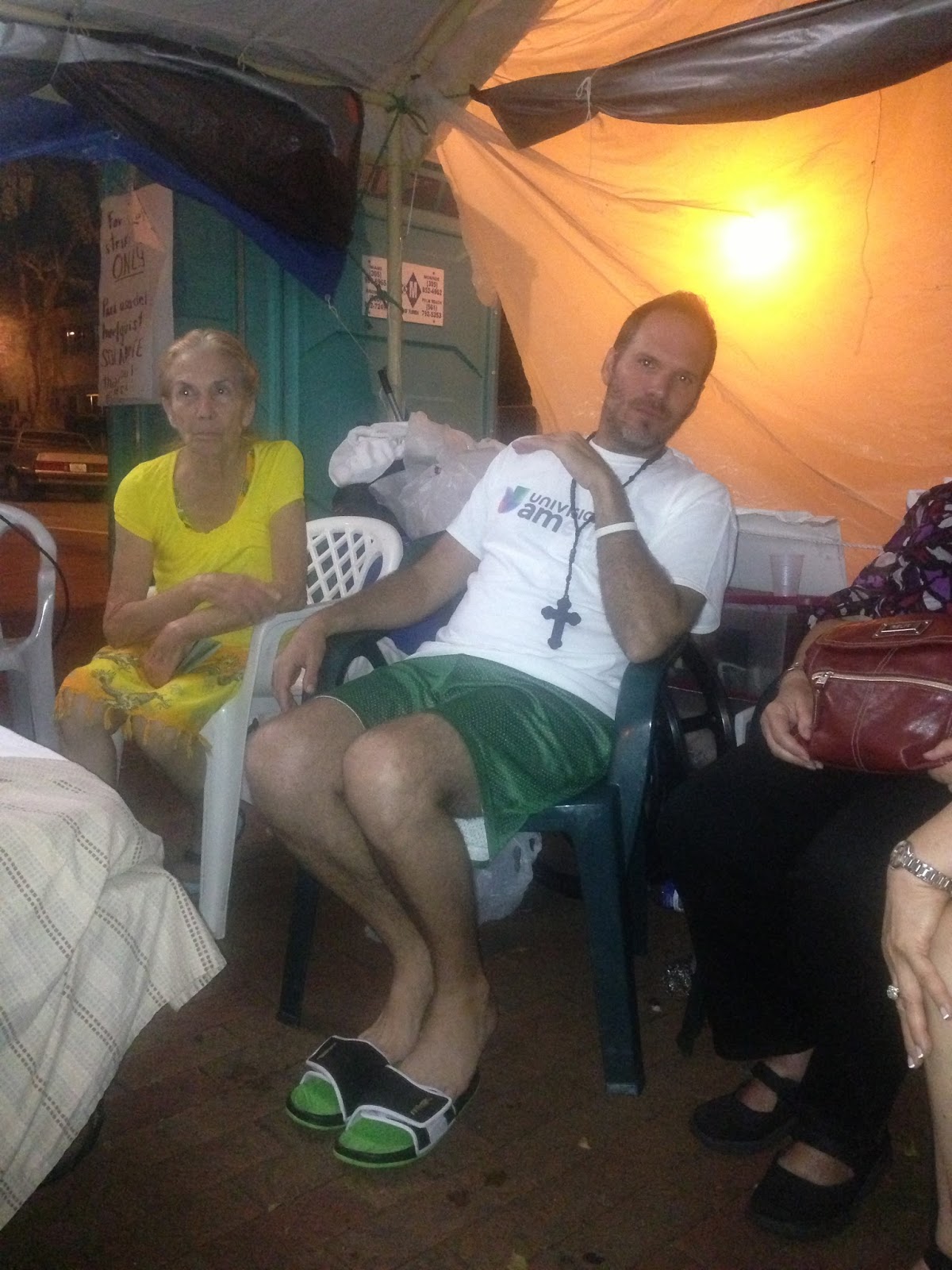
 The demands have not been met and the hunger strike continues. After 22 days Jesús Aléxis looks gaunt and his face emaciated but he remains determined to carry on his protest. Ramon Saul seems in better shape but as a diabetic undergoing a hunger strike is a precarious exercise.

Ramon Saul Sanchez (Day


Meanwhile this week the hunger strike garnered greater attention in the international media and at the same time Bahamian officials went to Cuba to meet with their Cuban counterparts.


All eyes on a small tent in Little Havana on South West 8th Street and 13th Avenue where two men are putting all on the line for the rights of undocumented migrants in the Bahamas, and if you're the praying type - please say a prayer for them.


 Listen to their demands here below.

Friday, August 2, 2013

Hunger Strike for Human Rights in the Bahamas: Placing it in context

 The Bahamas and Cuba: 39 years of abnormal relations has led to the present crisis

Jesús Aléxis Gómez (15 days ) and Ramon Saul Sanchez (8 days) on hunger strike

The Bahamas and Cuba officially established diplomatic relations on November 30, 1974 and despite having normalized relations over the past 39 years come this November, relations are anything but normal. This is because the government in Cuba is not a normal government but a totalitarian regime and this has real consequences in the relations between states on matters such as immigration. For example, Mexico is a democracy - with problems and challenges -but the government is answerable to Mexican citizens and there are competitive elections.

Mexicans who have fled to the United States illegally are provided with assistance and counseling by the Mexican government.  The Mexican government says plainly that it is committed to seeing that Mexicans living abroad have improved quality of life. This includes offering assistance and aide to undocumented Mexicans in the United States.

Contrast the Mexican example with what the dictatorship in Cuba does to those Cubans who leave "illegally". The regime has engaged in massacres of Cuban migrants seeking a better life abroad sinking the tugboat "13 de Marzo", using sand bags, and snipers on defenseless swimmers. The Cuban government lobbies to end advantageous laws for Cuban migrants such as the Cuban Adjustment Act.

Poster at the hunger strike in Little Havana
This leads us to the situation in the Bahamas where there are credible allegations of abuse against undocumented Cuban migrants. Since the Cuban government does not represent the interests of its citizens, as Mexico and many other countries do, at has fallen on the Cuban diaspora to stand up for undocumented Cubans suffering abuse in Bahamian detention.

The mistreatment of  undocumented migrants in the prisons of the Bahamas is not only limited to Cubans and Amnesty International has ample documentation on what goes on there. Fifteen days ago Jesús Aléxis Gómez, outraged at the ill treatment of these Cuban refugees, initiated a hunger strike and eight days ago following a failure in negotiations with the Bahamian consulate Ramon Saul Sanchez joined the hunger strike.


Initially the hunger strike was held in downtown Miami at the Torch of Friendship, but this past week it was moved to Little Havana to Calle Ocho and 13th Avenue at the monument to Bay of Pigs Veterans.

The failure of the Cuban government to protect its citizens who are being mistreated in the Bahamas is just another example how normalizing relations with a totalitarian dictatorship leads to all sorts of abnormalities.

Meanwhile on a side street from Calle Ocho in Little Havana two courageous men put their lives on the line in defense of their fellow country men. They are mobilizing public opinion in Miami and the press is increasing its coverage of their plight, as the days go by and the risk to their health increases. Let us pray that a just agreement can be reached before it is too late.

Sunday, July 28, 2013

Hunger strike and boycott demanding Cubans held in the Bahamas be treated decently

Jesus Alexis Gomez has been on hunger strike since July 19, 2013 and was joined on Friday July 26, 2013 by Ramon Saul Sanchez after Bahamian officials failed to follow through on a verbal agreement by placing it in writing. There is an online petition directed at the United Nations and also a campaign underway to boycott the Bahamas. Below is an essay by Rosa María Payá Acevedo that outlines what is being done to Cubans under custody of the Bahamian authorities. 

Ramon Saul Sanchez (Left) and Jesus Alexis Gomez (Right)

Categories of Human Beings
By Rosa María Payá

Where are the documentaries about the Bahamian concentration camps where there are school-age children and women with their lips sewn shut?

It has been a few weeks since South Florida’s media and social networks have been denouncing the systematic abuses to which refugees from Cuba and other nations are subjected in the Bahamas. The trigger was a series of clandestinely made cellphone videos that showed officers kicking people and subjecting them to different tortures. Those who made the videos public assure these were taken in the refugee detention camps in Nassau, and even when people have recognized their friends and relatives in the videos, the Bahamian Chancellery has denied that these are authentic.

These detention centers seem to be the scene of systematic human rights violations, but they are not a new phenomenon. The oldest data I know of refers to the New York Times of August, 1963, which discusses the intervention of Cuban air and naval forces in the former British island during which 19 refugees were kidnapped and taken back to Cuba. But even more astonishing is the reaction of the international community before a situation that has been taking place for years, and for which there are not many echoes beyond the modest ones from the voices of Cubans and Cuban Americans.

In the past 20 years, there is no trace of these events in two of the most important American newspapers, even when the Interamerican Human Rights Commission (IACHR) has issued reports thereon from allegations dating from 1998. For its part, the Spanish newspaper El País lists the names of the two Caribbean islands when it comes to hurricanes while other Iberian newspapers only mention them to highlight the progress of the oil drilling carried out in collaboration with Cuba.

The reaction is different when it comes to the equally unjust humiliations suffered by the prisoners at the U.S. Naval Base in Guantánamo. The acts of condemnation in this case reach high political dimensions including the Human Rights Commission of the Russian Chancellery, the Swiss President of the International Committee of the Red Cross, the United Nations, the American Catholic Church, some leftist French party and thousands, perhaps millions of people from around the word who are in favor of the closing of this prison in the easternmost end of Cuba.

However, curiously enough, in that very end of my country the Provincial Prison of Guantánamo, run by Cuban authorities, is known for its inhumane treatment, the lack of hygiene, a poor diet and occasional beatings to which the people who are surviving there are subjected to. Most of the country’s prisons are run in similar conditions.

It would seem as if the men in orange uniforms held at the naval base belonged to a different category from that of the non-uniformed emigrants of the Caribbean. One hypothesis could be that the people of the Middle East evoke greater sympathy or compassion than the Caribbean people, but since it is precisely in that region where countless human rights violations have been committed in the past and continue to be committed to this day by the authorities of those countries, and the international condemnation has historically suffered its ups and downs, this argument doesn’t hold water. It would be scandalous if the level of the scandal was related to the category of the oppressors.

It is not the US Marines who are torturing Cubans and Haitians in the Bahamas; it is not “the Yankee empire” against “the oppressed people of the world.” Therefore, the perception is that the abuses committed by the authorities of the Commonwealth of the Bahamas are less attractive to the international community.

I cannot help questioning the motivations of the forces behind these reactions. If it is not compassion for those who are suffering, a sense of justice and respect for international treaties, could it be that the level of solidarity is determined by the unpopularity of the oppressor? Doesn’t the Universal Declaration of Human Rights proclaim that all human beings are born free and equal in dignity and rights? A world in which lobbies have the last say and pressure groups have more interests than convictions is scary.

Who is lobbying for our brothers whose rights are violated with the same impunity in Havana and Nassau? Where are the documentaries about the Bahamian concentration camps where there are school-age children and women with their lips sewn shut? Where is the absolute condemnation for the humiliations that these people who emigrate suffer from, which are not subjected to any accusations? Why throughout the 20 years this situation has been taking place has it not become popular among youth to favor the closure of the prison camps in the Bahamas?

Apparently, the sense of impunity is contagious, and the Bahamian officials feel they can beat Cubans in the same way in which the repressive bodies of the State Security in the Largest of the Antilles have no mercy toward opposition members. Each of them should know that impunity is not sustainable over time, and that time is running out.

6 July 2013