Showing posts with label Washington DC. Show all posts

Thursday, May 12, 2022

Address to the Transatlantic Parliamentary Forum held in Washington DC on May 12, 2022

Truth and memory

Protesters march across Cuba in July 2021 [REUTERS/Alexandre Meneghini]

The July 11, 2021, national nonviolent protests in Cuba marked a before and after in Cuban history. Tens of thousands of Cubans across the island demanded an end to the dictatorship, rejected the official slogan Patria o Muerte (Homeland or Death) and chanted Patria y Vida (Homeland and Life).

The reaction of the totalitarian regime was swift and brutal. The Boinas Negras (black berets), formally known as the National Special Brigade of the Ministry of the Interior, were captured on video firing on unarmed protesters.

The dictatorship handed out clubs to regime agents to attack demonstrators. Thousands of nonviolent protesters were detained. Hundreds remain jailed, facing summary trials with prison sentences in excess of 25 years.

The lack of transparency in Cuba has taken on a new urgency in the current context. The International Committee of the Red Cross has not been allowed in Cuban prisons since 1989, and that was a brief period between 1988 and 1989. In comparison, the prison for Al Qaeda prisoners at the U.S. Guantanamo Naval Base had over 100 visits between 2002 and 2014, and continues to the present date.

Cuba is the only country in the Americas where Amnesty International, Human Rights Watch, and other international and regional human rights organizations are unable to visit

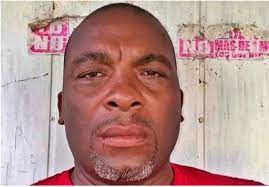
Prisoner of conscience Virgilio Mantilla Arango

We remain deeply concerned with the plight of political prisoners such as Virgilio Mantilla Arango, Luis Manuel Otero Alcántara, and Maykel Castillo Pérez (Osorbo), and their health status. It is also no coincidence that all are black Cubans.
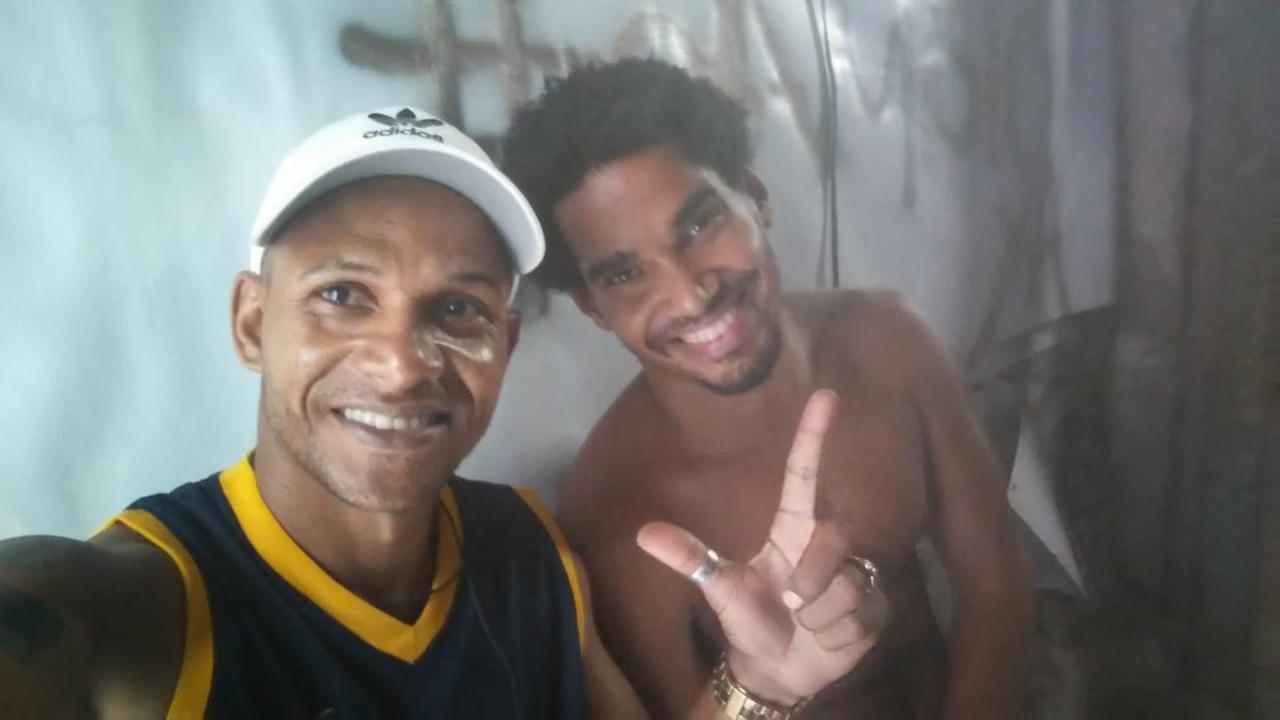
Maykel Castillo Pérez (Osorbo) and Luis Manuel Otero Alcántara

The one Cuban that the Cuban government recognized was killed during the protests on July 12, 2021, was Diubis Laurencio Tejeda, an unarmed 36-year old Black man, who was shot in the back by a Castro regime official.

The largest numbers of Cubans arrested and processed following the July protests are from predominantly black neighborhoods such as La Güinera, which government officials call “marginal.”
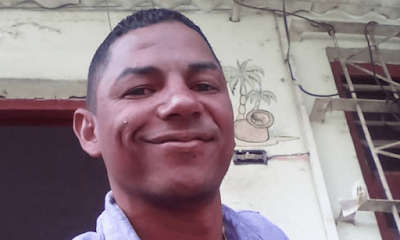
Diubis Laurencio Tejeda, (age 36) shot in the back by regime officials on July 12, 2021.

These and other cases raise questions about the racist nature of the Castro regime.

According to the January 13, 2020 article by EuropaPress, based on the Institute for Crime and Justice Policy Research, Cuba today has the largest per capita prison population in the world. Although official data is unavailable, it is known that a disproportionate number are black Cubans.

On March 22, 1959, Fidel Castro declared that racism no longer existed in Cuba. To contradict the maximum leader was to be a counter-revolutionary and subject to punishment.

Castro regime's publication Verde Olivo 1, no. 29 (October 1, 1960)

Over the next six decades, the communist dictatorship repeatedly claimed that there was no racism in Cuba, despite the fact that poverty disproportionately affects black Cubans, with 95% having the lowest incomes compared to 58% of white Cubans, and black voices continue to be silenced

This is another reason why we are calling on UN General Assembly members to expel Cuba from the UN Human Rights Council.

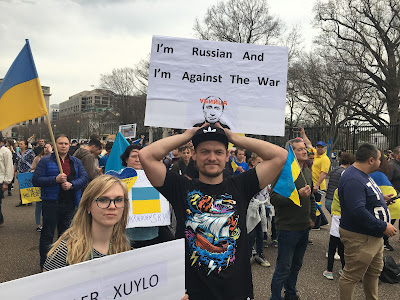
Sunday, March 6, 2022

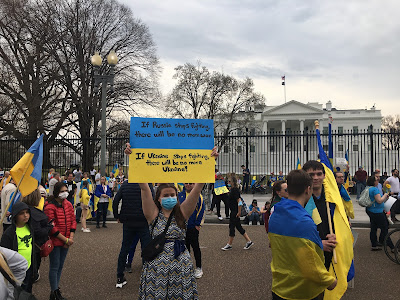
Reflections on Ukraine from a peace rally in front of the White House: Civilian based defense and strategic nonviolence

"The era of dictatorships and totalitarian systems has not ended at all. It may have ended in a traditional form as we know it from the 20th century, but new, far more sophisticated ways of controlling society are being born. It requires alertness, carefulness, caution, study and a detached view." - Václav Havel, "Freedom and Its Enemies" November 14, 2009.


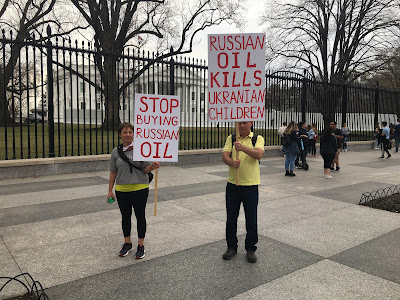
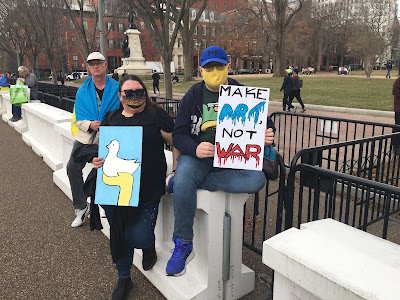
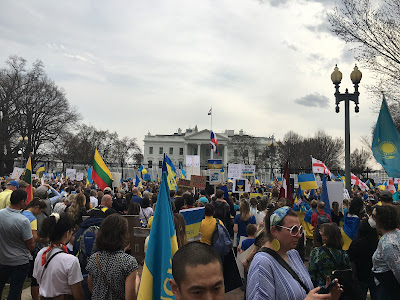
Today, at the White House in Washington DC thousands of Ukrainians, and friends of Ukraine gathered to call on President Biden to do more. Politicians, diplomats, and members of the clergy spoke out for an end to the Russian invasion of Ukraine.

Václav Havel's words from November 14, 2009, speak to the present moment in Europe. Vladimir Putin's total invasion of Ukraine reveals that the era of dictatorship, and empire continues, and repeated efforts by various U.S. Presidents to legitimize Putin pursuing normal relations have failed. 


When negotiations between Ukraine and Russia broke down on removing nuclear weapons from Ukraine in September 1993, the United States government engaged in a trilateral process with Ukraine and Russia. This resulted in the January 1994 Trilateral Statement. Ukraine agreed to transfer its nuclear warheads to Russia. Ukraine received security assurances from the United States, Russia, and the United Kingdom.

The breaking of that agreement sends a dangerous message: if you give up your nuclear weapons then your neighbor can invade you with impunity, and in the case of Russia, a nuclear power, threaten nuclear annihilation


Putin's attacks against Georgia in 2008, Crimea in 2014 and the eight years long low intensity war in the Donbas region in Eastern Ukraine, and the February 24, 2022, multipronged Russian invasion of Ukraine were all acts of aggression in violation of international law.

The Russian dictator's repeated aggressions were backed by Cuba in 20082014 and now in 2022. They represent an alternative international order based on brute force. The Castro regime's foreign minister on Putin's invasion of Ukraine said that Russia “has the right to defend itself.”

This latest act of aggression has been met with a brave response of the Ukrainian military, and the citizenry who have violently resisted the latest Russian invasion, but the costs in deaths and destruction meted out by the Russian invaders continues to be high. Over a million Ukrainians have fled the country, and it appears there will be many more. 

In light of this what can be done to repel and/or frustrate the aggressors while minimizing the loss of life? 


How effective is it to arm grandmothers and children with AK-47s to take on battle hardened Russian troops? Or Germany sending the government of Ukraine 35-year-old anti-aircraft missiles that were deemed unusable in 2012

Vladimir Putin is a war criminal, and he is also guilty of poisoning and murdering Russian dissidents and journalists throughout his rule. He is a brutal dictator experienced in violent conflict.

Too many discard nonviolence as an option claiming that Putin is as bad as Hitler, but the reality is that nonviolent actions against the Nazis in Denmark and Germany were successful. Secondly, Putin is not Hitler, but a brutal dictator and former KGB officer.


University academics and nonviolent theoreticians Maria J. Stephan and Erica Chenoweth in their 2008 study "Why Civil Resistance Works: The Strategic Logic of Nonviolent Conflict" compared the outcomes of 323 nonviolent and violent resistance campaigns from 1900 to 2006. 

They found that major nonviolent campaigns achieved success 53 percent of the time, compared with just under half that at 26 percent for violent resistance campaigns.

Even the 26% figure needs to be looked at in the Cuban context. The above-mentioned Stephan, Chenoweth study also suggests “that nonviolent campaigns are more likely than violent campaigns to succeed in the face of brutal repression.” 

There is an alternative to a violent insurgency or abject surrender.

This isn't the first time Russia has invaded a neighbor who was not a threat to them, and unlike Afghanistan, the example of Czechoslovakia offers some useful insights for today. 
On August 20, 1968, Warsaw Pact military forces initiated a massive invasion of Czechoslovakia. On the morning of the 21st Czechs and Slovaks found their streets filled with tanks and troops from East Germany, Poland, Hungary, Bulgaria and Russia. However, it would take these occupation forces eight months to complete their invasion. This was due to a nonviolent civilian defense that was mounted and sustained for months, and laid the groundwork for the Velvet Revolution.
Although not focused on in most media accounts there are examples that civic resistance is having an impact in Ukraine.
The nonviolent theoretician Gene Sharp published a book that is available online titled Civilian Based Defense: A Post-Military Weapons System that explores how these methods can be applied at the national level as a method of national defense.
Waging Nonviolent makes the case how nonviolent resistance can demoralize an army and lead to mutinies, and references Sharp's book.
In his highly-relevant text “Civilian-Based Defense,” Gene Sharp explained the power of mutinies — and civilians’ ability to cause them. 
“Mutinies and the unreliability of troops in repressing the predominantly nonviolent Russian revolutions of 1905 and February 1917 were highly significant factors in the weakening and final downfall of the tsar’s regime.”  
Mutinies increase as the resistance targets them, attempting to undermine their sense of legitimacy, appealing to their humanity, digging in with prolonged, committed resistance, and creating a compelling narrative that the invading force simply does not belong here.

Friends of a free Ukraine, and against Russian imperialism owe it to themselves, and the people of Ukraine to share this information on nonviolent resistance that has been shown in other circumstances to be more effective in resisting brutal despots like Vladimir Putin.


Tuesday, August 13, 2019

Independent Cuban journalist sentenced to a year in prison for committing journalism.

"There may be times when we are powerless to prevent injustice, but there must never be a time when we fail to protest." - Elie Wiesel, Nobel Lecture 1986
Independent journalist Roberto Quiñones faces year in prison.
Today at the Cuban Embassy in Washington DC a son demanded his father’s freedom. Roberto de Jesús Quiñones faces a one year prison sentence for exercising his fundamental rights. He is an independent journalist, attorney, Catholic lay person, and family man. His son, Roberto José Quiñones Castro, is a university student in Virginia who is working his way through school.

Last week on August 7th Roberto de Jesus Quiñones was sentenced to a year in prison in a rigged trial. Today his son brought a letter to the Cuban Embassy in Washington DC calling for his dad’s freedom.

Roberto José Quiñones with letter in hand protests dad's sentence
His father was unjustly imprisoned for five years for being an independent attorney in Cuba in 1998. No longer able to practice as a lawyer upon his release, he became an independent journalist.
On April 22, 2019 Roberto de Jesús Quiñones was beaten up for covering the trial of a religious couple sentenced to prison for homeschooling their kids. The Committee to Protect Journalists reported on April 24th what had happened:
On April 22, at around 2:00 p.m., Cuban police agents detained Quiñones, a contributor to the news website CubaNet, as he was standing outside of the Guantánamo Municipal Tribunal, according to CubaNet and the Association for Press Freedom (APLP), a Cuban press freedom organization. At the time of his detention, Quiñones was covering the trial of two Cuban evangelical pastors facing charges for homeschooling their children, CubaNet reported. While being transported in the police car, agents beat Quiñones, injuring his mouth, tongue, and right thumb and causing an inflammation in his right ear, his wife told APLP.
According to the Committee to Protect Journalists in the same report "Cuba is one of the most hostile environments for the press in the world, and ranks among CPJ's 10 Most Censored Countries."
Roberto Quiñones was physically assaulted on April 22, 2019.
Today the Cuban embassy did not respond to the petitions of this Cuban citizen. Since they would not accept the letter Roberto José read it aloud and in it he outlined the real reason for his father's political persecution:
"The rigged trial held against my father for his work as a journalist, independent lawyer, and Catholic activist in the Family and Penitentiary Ministry of the Guantánamo-Baracoa Diocese, was actually a reprimand for his dignified work in general, and especially for his accompaniment to the evangelical pastors Adya Expósito and Ramón Rigal, also tried and convicted in a rigged manner on April 22 in that same Court; and also when my father was beaten and arbitrarily detained."
When he concluded reading the letter, all present chanted: Free Roberto Jesús Quiñones! Following the protest Roberto José Quiñones gave a short interview in English outlining the circumstances of his father's case and how his dad is doing presently.

Picket today outside the Cuban embassy in Washington DC.
Earlier today 30 non-governmental organizations called on the Cuban state to respect and guarantee the rights of journalist Roberto Jesús Quiñones.