Showing posts with label Obama. Show all posts

Thursday, April 21, 2022

US and Cuban officials hold talks amid tensions over migration. Will Havana again be rewarded for weaponizing migration?

"Those who cannot remember the past are condemned to repeat it." - George Santayana

Cuban migrants forced back to Mexico by U.S. - Los Angeles Times

Original: CubaBrief

During President Obama's detente with General Raul Castro between 2014 and 2016 over 120,000 Cubans entered the United States in another migration surge comparable to Mariel. This was at a time of loosened sanctions, and under an Administration seeking normalized relations that provided an influx of international credits to the Castro regime. 

Secondly, tougher sanctions began to be put in place in 2017, but migration from Cuba during the Trump Administration returned to the lower pre-normalization levels of 2011

President Biden, during his 2020 campaign, promised a return to the Obama Cuba policy, and engagement by an Administration that, unlike his predecessor, would act rationally.

Cuban migration began to rise during the early days of the Biden Administration and was drawing press scrutiny in April 2021. In mid July 2021, Senator Marco Rubio warned of a Mariel-style crisis after the 11J protests in Cuba.

The Afghanistan pullout completed on August 30, 2021, and signaling Putin that he could make a minor incursion into Ukraine without serious repercussions, in early 2022 may have all sent a green light to Havana that they could further intensify the migration crisis with the belief that they could leverage additional concessions from the Biden Administration

The influx dramatically increased with Cubans traveling through Nicaragua in the last month of 2021.  In late November 2021, days after the United States condemned Cuban-ally Daniel Ortega for stealing the Nicaraguan presidential election on November 7, 2021, Managua lifted visa requirements on Cubans entering the country, creating a new and larger channel for an exodus. 

Havana's tactic against Washington is explained in Professor Kelly M. Greenhill's 2002 paper, "Engineered Migration and the Use of Refugees as Political Weapons: A Case Study of the 1994 Cuban Balseros Crisis." (Please let us know if you need a copy.)

Castro regime actions over the past 63 years demonstrate that Havana uses migration as a weapon and has the capability to open migration up or shut it down depending on foreign policy goals and the perceived risk that a hawkish administration may call their bluff or pursue some sort of action that would endanger the regime's future, or negatively impact the dictatorship internationally. Economic conditions and sanctions are not the determining factors in generating a migration crisis. It is the ability to obtain unilateral concessions from the United States without incurring a negative response.

Will Havana again be rewarded for weaponizing migration? They claim that the talk was focused on migration and not part of any broader thaw. Time will tell. Message to policy makers: Loosening sanctions is not the answer. Its been tried and failed three times. The fourth time won't be the charm.

Saturday, June 22, 2019

Setting the record straight on human trafficking in Cuba and Saudi Arabia

Cuba downgraded status in this year’s #TIPReport because Cuban regime fails to provide trafficking victims the justice and protection they deserve.- Kimberly Breier, Assistant Secretary of State for Western Hemisphere Affairs


On July 27, 2015 the Obama administration continued its drive to normalize diplomatic relations with the Castro regime by whitewashing the dictatorship's record on human trafficking. The State Department upgraded Cuba's status after 12 years from Tier 3 to Tier 2 in its Trafficking in Persons Report, but there had been no improvement. Melysa Sperber, director of the Alliance to End Slavery and Trafficking (ATEST) back in 2015 expressed both her surprise and concern that these were "blatantly political decisions" by the Kerry State Department that would "have a really detrimental impact on both the integrity of the report and progress in the global fight to end modern slavery."

Four years later on June 20, 2019, the State Department's 2019 Trafficking in Persons report is finally setting the record straight. Both Cuba and Saudi Arabia have been placed on Tier 3, the blacklist for human trafficking. They should have both been on this list for some time, and Cuba had been for many years because of its dismal record. The Pompeo State Department has restored the integrity of the report, demonstrating their commitment to end modern slavery.


2019 Trafficking in Persons Report: Cuba

CUBA: Tier 3

The Government of Cuba does not fully meet the minimum standards for the elimination of trafficking and is not making significant efforts to do so; therefore Cuba was downgraded to Tier 3. Despite the lack of significant efforts, the government took some steps to address trafficking, including prosecuting sex traffickers and one labor trafficker and imprisoning sex tourists engaged in child sex trafficking. However, the government did not take action to address forced labor in the foreign medical mission program, despite persistent allegations Cuban officials threatened and coerced some participants to remain in the program. The government did not criminalize all forms of forced labor or sex trafficking of children ages 16 and 17. The government lacked procedures to proactively identify forced labor victims, lacked a comprehensive package of services to include housing and physical protection, and detained or charged potential sex trafficking victims for unlawful acts their traffickers coerced them to commit.

PRIORITIZED RECOMMENDATIONS

Implement policies to prohibit force, fraud, or coercion by foreign labor recruiters and state-owned or controlled enterprises, including foreign medical missions in recruiting and retaining employees. • Draft and enact a comprehensive anti-trafficking law that prohibits and prescribes significant prison terms for all forms of human trafficking, including forced labor, sex trafficking of children ages 16 and 17, and the full range of trafficking “acts” (recruiting, transporting, transferring, harboring, or receiving persons).
• Vigorously investigate and prosecute both sex trafficking and forced labor offenses.
• Implement formal policies and procedures on the identification of all trafficking victims and their referral to appropriate services, and train officials, including first responders, in their use.
• Proactively identify trafficking victims, including among vulnerable populations.
• Adopt policies and programs that provide trafficking-specific, specialized assistance for male and female trafficking victims.
• Ensure participants in the foreign medical missions program retain control of their passports.
• Screen individuals charged or detained for prostitution-related offenses for sex trafficking and refer victims to care providers.
• Educate all Cuban workers about trafficking indicators and where to report trafficking-related violations.
• Establish a permanent inter-ministerial anti-trafficking committee and implement the 2017-2020 national anti-trafficking action plan in partnership with international organizations. • Provide specialized training on trafficking indicators for hotline staff and interpretation for non-Spanish speakers.

Saturday, June 8, 2019

Reviewing the historical record: The case for undoing Obama's Cuba policy and how it will help Venezuelans.

Reviewing some "highlights" of the Obama record on Cuba and why it must be reversed.

Dictator Raul Castro and President Barack Obama
Detente with the Castro regime had and continues to have negative and unintended consequences. The consensus with Europe established in 1996 in the EU Common Position, linking improved relations to improvement in human rights, was ended. The influx of cash and international legitimacy during the Obama Administration emboldened the dictatorship to behave more aggressively in the region, and against the democratic opposition in Cuba. 

It was a policy born of secrecy, great injustices, skirting Congressional oversight, and U.S. law. A former U.S. Ambassador to the Organization of American States warned that the policy would "represent a billion-dollar windfall to Cuba’s hospitality sector - all of which is co-owned by the regime, with most of the industry operated by the military, and much of  it located on property confiscated from US nationals."

On April 17, 2009 President Barack Obama said that his Administration sought "a new beginning with Cuba" and stated further that he was “prepared to have my administration engage with the Cuban government on a wide range of issues — from human rights, free speech, and democratic reform to drugs, migration, and economic issues.” The White House also marginalized Cuban dissidents and downplayed their importance early on in 2009 refusing to meet with them.  

Strong man Daniel Ortega and President Obama in 2009
Despite normal relations and high level outreach early in the Obama Administration both the Ortega regime and the Chavez regime pursued closer relations with Russia and China. Cuban intelligence services have played a large role in both Venezuela and Nicaragua.

Embracing Hugo Chavez in 2009 did not help democracy in Venezuela
Less than eight months later Alan Gross was taken hostage in Cuba. Alan Gross was arrested on December 3, 2009. This American citizen spent 25 days in a Havana jail before being visited by a U.S. diplomat. By that time Alan Gross had been approached by a Cuban “attorney” who just happened to be representing five Cuban spies imprisoned in the United States for espionage and conspiracy to commit murder. This Cuban attorney represented Alan Gross before his show trial and later appeals.  Alan Gross’s supposed crime was attempting to provide Internet access to the local Jewish community in Cuba.

Orlando Zapata Tamayo
Orlando Zapata Tamayo, Cuban dissident and Amnesty International prisoner of conscience, died in Havana, Cuba on February 23, 2010 at the age of 42 after more than eighty days on a water only hunger strike. During the hunger strike prison officials denied him water for more than two weeks in an effort to force him to end the strike contributing to his death.   

In February 2010  Ramiro Valdes, then age 77, was hired "as a consultant for that country's energy crisis" but his expertise is not in energy.  Valdes was the Vice President of the Council of State and Minister of Communications in the Cuban government. His role in Communications was figuring out in 2007 a way to muzzle the internet, what he called a "wild colt of new technologies."

Nicolas Maduro and Ramiro Valdes
Commander Ramiro Valdes, founder of the Castro regime's feared Ministry of the Interior, head of the organization between 1961 and 1968 and was viewed by some as "the No. 3 man in the Cuban hierarchy." He is the architect of Cuban totalitarianism's repressive apparatus and assisted Chavez and Maduro in building the Venezuelan version.  


Laura Inés Pollán Toledo
Laura Inés Pollán Toledo died on October 14, 2011 from heart failure at the age of 63. One week after she had fallen suddenly ill from a respiratory infection compounded with dengue fever and already existing condition as a diabetic. Secret police limited access in the hours prior to her death. Furthermore a Cuban medical doctor described her death as caused by purposeful medical neglect.

Report of Cholera outbreak in Manzanillo, in eastern Cuba, broke in El Nuevo Herald on June 29, 2012 thanks to the reporting of the outlawed independent press in the island. State controlled media did not confirm the outbreak until days later on July 3, 2012. The BBC reported on July 7, 2012 that a patient had been diagnosed with Cholera in Havana. The dictatorship stated that it has it under control.


Oswaldo Payá Sardiñas, and Harold Cepero Escalante were last seen alive at 1:50pm Eastern Standard Time on July 22, 2012, on a Sunday afternoon, and were later extrajudicially executed by agents of the political police, who staged a car crash. The location of their killings in Cuba remains to be determined. Oswaldo Payá Sardiñas had both the international stature and political savvy to oversee a non-violent transition in Cuba. He was critical of the policy pursued and called it fraudulent change. This may have contributed to his untimely death.

Some of the weapons bound from Cuba to North Korea in 2013

The Cuban government was caught on July 15, 2013 trying to smuggle tons of weapons hidden under bags of sugar to North Korea through the Panama Canal on a North Korean-flagged ship from Cuba with undeclared military cargo.” Among the weapons sent by Cuba to North Korea were found: "A total of 25 standard shipping containers (16 forty-foot and 9 twenty-foot) and 6 trailers were found, for a total of about 240 tons of arms and related materiel." Cubans provided North Koreans with surface to air missile systems, two MiG 21 jet fighters, 15 MiG-21 engines, eight 73 mm rocket propelled projectiles (PG-9/PG-15 anti-tank and OG-9/OG-15 fragmentation projectiles) to be fired with recoil-less rifles, as well as a single PG-7VR round, a high explosive antitank tandem charge to penetrate explosive reactive armor, were also in the shipment. 

Nevertheless, the Administration continued outreach to the Castro regime through secret negotiations, its policy of unilateral concessions, that included loosening sanctions, and skirting laws prohibiting travel to Cuba by re-designating it "people to people contact." This policy was a reboot of a legal tactic carried out by the Clinton Administration in the 1990s. 

Barack Obama and Raul Castro on December 17, 2014
President Obama announced his new Cuba policy on December 17, 2014 to great fanfare but downplayed commuting the sentences of three Cuban spies and freed them the same day. These spies had planned terrorist acts on U.S. soil on orders from Havana. The ring leader, Gerardo Hernandez, was serving a life sentence for his role in a murder conspiracy that claimed four innocent lives in the February 24, 1996 Brothers to the Rescue shoot down

Cuban spies plotted terrorist attacks on U.S. soil.
The Kerry State Department threatened the daughter of a martyred dissident in order to protect the sensibilities of the Castro regime's foreign minister in 2015. Not to mention claiming that there was no room for dissidents at the opening of the U.S. Embassy in Havana later that same year.

On March 2, 2015 the government of Colombia seized a shipment of ammunition bound for Cuba on a China-flagged ship due to a lack of proper documentation. The BBC reported that "officials said about 100 tons of gunpowder, almost three million detonators and some 3,000 cannon shells were found on board. The ship's records said it was carrying grain products." 

China-flagged ship smuggling ammunition bound for Cuba in 2015

Hxagon, a consulting and technology company that provides risk assessments and predictive analysis in emerging markets, concluded: "Two big shipments of weapons seized in 20 months means that this is probably a regular occurrence."  


On May 29, 2015, despite a long history of international terrorism, the Obama State Department removed Cuba from the list of state sponsors of terrorism. This did not end the Castro dictatorship's promotion of terrorism to advance its policy aims.

Leticia Ramos and Augusto Monge attacked in Panama by Cuban secret police
On April 8 - 9, 2015 parallel to the Summit of the Americas in Panama agents of the Castro regime engaged in acts of repudiation to shutdown down dialogue and parallel and official events. At Porra park in Panama City  a group of Cuban dissidents were physically assaulted when they sought to lay flowers before a bust of Jose Marti by Cuban secret police. Carlos Alberto Montaner reported on twitter that the ringleader of the attacks in Panama. was Colonel Alexis Frutos Weeden, head of Cuban intelligence in Venezuela.

Secretary Kerry on August 20, 2015 reported that "the United States and Cuba are talking about ways to solve the Venezuelan crisis."  Four years later and Canadian Foreign Minister Chrystia Freeland is repeating the same mantra as the situation in Venezuela has spiraled out of control and become a humanitarian catastrophe.

On January 7, 2016 The Wall Street Journal broke the story that in June 2014 an inert US Hellfire missile sent to Europe for a training exercise was "wrongly" shipped on to Cuba when it was supposed to be on its way back to the United States. Since 2014 the United States had been privately asking the Cuban dictatorship to return the missile but refused to do so when first discovered.  It was returned shortly after the story broke in the above mentioned paper.

President Obama does the wave with Raul Castro at a baseball game in Cuba
 In March 2016, the month that President Obama visited Cuba in the midst of a human rights crackdown, the Cuban government signed a confidential military cooperation and intelligence-sharing agreement with North Korea reported the Paris based publication Intelligence Online. The Cuban dictatorship, under Raul Castro, has had extensive relations with the Hermit Kingdom.

In April 2016 Nicaragua purchased 50 Russian battle tanks at a cost of $80 million. Vladimir Putin signed a new security agreement with Nicaragua's Daniel Ortega that same year. 

On May 15, 2016 Henry Ramos Allup, the head of the National Assembly of Venezuela was complaining over social media of the leadership role played by a Cuban general and 60 Cuban officers over the Venezuelan military to maintain Maduro in power and continue exploiting Venezuela's natural resources.

On September 2, 2016 warned about the dangerous spin in Associated Press reporting, done to maintain their Havana bureau, repeats Castro regime propaganda as news because the claims made in "Cuba reports remarkable success in containing Zika virus" would lead travelers to go to Cuba believing the Zika virus threat in Cuba is over. 

On September 9, 2016 The Washington Times in the article “Cuban military expands its economic empire under détente” reported: 
“The military’s long-standing business wing, GAESA (Armed Forces Business Enterprises Group), assumed a higher profile after Gen. Raul Castro became president in 2008, positioning the armed forces as perhaps the prime beneficiary of a post-detente boom in tourism. Gaviota, the military’s tourism arm, (a subsidiary of GAESA) is in the midst of a hotel building spree that outpaces projects under control of nominally civilian agencies like the Ministry of Tourism.” The same article also reported that “Gaviota has 62 hotels with 26,752 rooms across Cuba, pulling in some $700 million a year from more than 40 percent of the tourists who visit Cuba.”
The military general in charge of GAESA is Luis Alberto Rodriguez, General Raul Castro’s son in law.  

American diplomats started being harmed in attacks in November of 2016. On December 7, 2016 the United States and Cuba held their fifth Bilateral Commission meeting where they celebrated progress on U.S.-Cuba relations, and signed 11 non-binding agreements on health, the environment, counter-narcotics, and other areas of cooperation. No word on these attacks.

Source: Comisión Cubana de Derechos Humanos y Reconciliación Nacional (CCDHRN)
On January 2, 2017 Raúl Castro presided over a military parade in Havana where marching troops chanted about shooting the American President in the head: "Obama! Obama! with what fervor we’d like to confront your clumsiness, to give you a cleansing with rebels and mortar, and send you a hat of lead to the head.”
 
On January 12, 2017 the Obama Administration provided further concessions to Cuba gutting the Cuban Adjustment Act and ending the Cuban Medical Professional Parole Program that had bothered General Castro for years.  

On January 16, 2017 the Obama State Department issued a statement that "the United States and Cuba [had] signed a bilateral Law Enforcement Memorandum of Understanding to deepen law enforcement cooperation and information sharing." American diplomats were suffering serious harm, including mild traumatic brain injury, permanent hearing loss that included loss of balance, headaches, and brain swelling. Yet, according to The Wall Street Journal no complaint was made until February of 2017.  

Cuban troops in military parade chant they'll shoot President Obama in the head
 On January 17, 2017 President Obama granted clemency to Oscar López Rivera, a founder of the Armed Forces of National Liberation Fuerzas Armadas de Liberación Nacional (FALN), a movement responsible for more than 130 bombings in American cities - including one in New York City on January 24, 1975 that went off in the Fraunces Tavern during lunch hour killing four people. Unrepentant, López had 10 years added to his sentence when he and another FALN member were caught plotting a prison break that included killing their prison guards. On November 17, 2017 Mr. 
López Rivera received the Order of Solidarity from the Cuban government.

In March 2017 Lonely Planet pitches Cuba as "old school cool" and an "escape from the hustle and bustle" but at the bottom of the web page has one line of caution: "The US Center for Disease Control has issued a travel alert suggesting that pregnant women postpone travel to Cuba due to the presence of the zika virus." The Castro regime has a poor history of timely reporting of epidemics on the island, placing tourists at risk. Travel agencies are being sued by disgruntled tourists.

In November 2017 former Cuban diplomat, Jose Antonio "Tony" Lopez was also linked to terrorists responsible for the June 17, 2017 bombing in Bogota, Colombia that killed three and injured nine according to prosecutors in the South American country. 

U.S. Embassy in Havana
The Journal of the American Medical Association (JAMA) published a preliminary report on February 15, 2018 and an accompanying editorial studying health impacts on 21 U.S. government employees in Havana between December 2016 and August 2017. These individuals had severe injuries and the bottom line on medical findings are that: "Concussion-like symptoms were observed in U.S. government personnel in Cuba after they reported hearing intensely loud sounds in their homes and hotel rooms and feeling changes in air pressure caused by an unknown source. The symptoms were consistent with brain injury although there was no history of head trauma."

OAS General Secretary Luis Almagro, former Foreign Minster for José Mujica, Uruguay's leftist president, stated In a December 2018 conference on human rights in Cuba: “It is estimated that there are some 46,000 Cubans in Venezuela, an occupation force that teaches how to torture and repress, that performs intelligence, civil identification, and migration services.”  


The publication New Scientist reported on January 8, 2019 that "thousands of Zika virus cases went unreported in Cuba in 2017, according to an analysis of data on travelers to the Caribbean island. Veiling them may have led to many other cases that year." Founded in 1956, New Scientist is the world’s most popular weekly science and technology magazine.  The article should raise concerns for travelers to the island. However they did forget to mention that the Castro regime in the recent past failed to report Dengue (1997) and Cholera (2012) outbreaks in Cuba. Jailing those who warned the world of the threat.

In February 2019 reports emerged that lawsuits were filed by both American and Canadian diplomats impacted by health attacks in Cuba. Twenty six (26) American diplomats and their family members were harmed in Havana, but Cuban officials claimed that the diplomats had preexisting conditions.  In the Canadian case it has been reported that "nine (9) adults and five (5) children from diplomatic families have developed unusual illnesses in Havana, with symptoms including nausea, dizziness, headaches and trouble concentrating." These are the same symptoms reported by the Americans.

Timeline of health attacks in Cuba targeting U.S. and Canadian diplomats.

Venezuela’s interim president, Juan Guaidó in an interview on May 29, 2019 in El Nuevo Herald reported that "[t]he intelligence network has been somewhat diminished by cutting off the supply of oil to Cuba [with sanctions]. The support of our allies leaves these networks without funding. Through these actions that network is weaker than a year ago."

Treasury Secretary’s Mnuchin’s statement that the new policy is “a strategic decision to reverse the loosening of sanctions and other restrictions on the Cuban regime,” and the objective “to keep U.S. dollars out of the hands of Cuban military, intelligence, and security services,” within the context outlined above is a reasonable policy that should have been instituted a while ago.

Why should the US allow the flow of tourist dollars to Havana while thousands of Cuban soldiers repress Venezuelans? The ‘people to people’ travel was designed to circumvent the law which bans tourism to the island, and during President Obama’s détente this led to an expansion of military control over the Cuban economy. It was a failure (as was President’s Carter similar détente in 1977-1980 and Clinton's 1994-2000) and needs to be completely reversed to restore a policy of containment.


Monday, November 12, 2018

Boatload of Cubans intercepted and sent back to Cuba

The exodus from Cuba continues. 

Cuban refugees continue to flee the Castro regime.
 

A small boat overloaded with Cuban migrants was stopped on November 10, 2018 by the Coast Guard Cutter Charles Sexton, and the cutter William Trump took 36 refugees back to Cabanas, Cuba.

In May of 2017, Admiral Paul F. Zukunft, Commandant of the U.S. Coast Guard claimed that due to a drastic measure taken by the Obama administration in negotiation with the Cuban government on January 12, 2018: the elimination of an immigration policy for Cubans known as “wet foot, dry foot” that Cubans were no longer fleeing to the United States.

The Admiral was wrong.

According to Elena Toledo writing in the PanAm Post 15,135 Cubans were declared “inadmissible” in the United States in 2017 and 14,037 Cubans were rejected from entering through Laredo, Texas alone. Cubans continue to be deported but they also continue to flee to the United States.

They weren't leaving because of the Cuban Adjustment Act but because of the communist dictatorship in Cuba.

Tuesday, February 13, 2018

Year one of the Trump Administration and a new Cuba policy: Trade is up and detentions are down

A look at some numbers for 2017 and U.S. - Cuba relations.
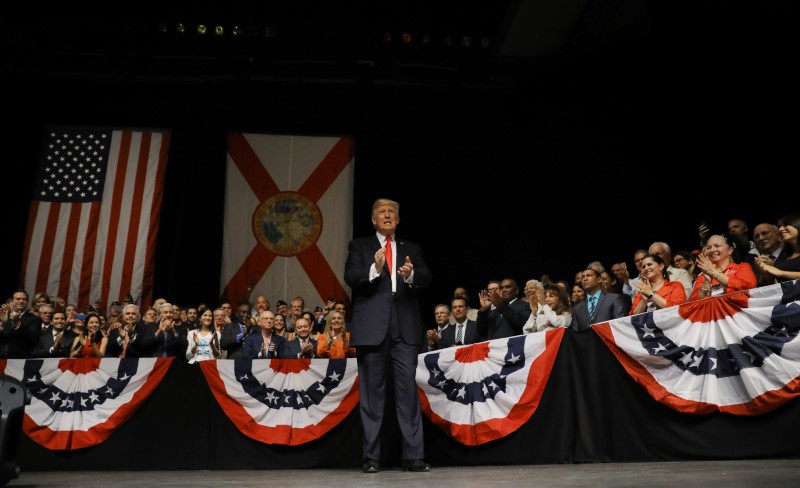
President Trump at the Manuel Artime Theater with Cuban Americans in 2017
Cuba in 2017 remained a repressive totalitarian regime with prisoners of conscience, and a one-party communist dictatorship that has used its military and intelligence apparatus to control Venezuela, turning that nation into a colony that it is plundering.Things had gotten worse for Cubans, especially following the Obama Administration's engagement with the Castro dictatorship, including a state visit in March of 2016. The current Administration has rolled back a number of Obama era Cuba policies, spoken out on the human rights situation in Cuba, and Ambassador Nikki Haley defended the morality of U.S. sanctions on the Castro regime.

Despite the claim by the architect of the previous Administration's Cuba policy, that President Trump's turn around on the Obama Administration's Cuba policy would fail, trade between the United States and Cuba was at its highest level in 2017 following its collapse between 2014 and 2016 when the previous Administration was pushing its new Cuba policy.

President Barack Obama announced his new Cuba policy on December 17, 2014 and the following year U.S. trade in goods with Cuba dropped $118.9 million from $299.1 million in 2014 to $180.2 million in 2015. This economic relationship has improved under the Trump Administration despite news that the Cuban economy is worsening and the regime's creditors are nervous.

Trade peaked under Bush in 2008 and began a steady decline under Obama
Obama Cuba policy flawed
President Obama downplayed commuting the sentences of three Cuban spies, including Gerardo Hernandez who was serving a life sentence for his role in a murder conspiracy that claimed four innocent lives in 1996 and freed them the same day.  This was part of the price paid to free an American hostage, Alan Gross, that had been an impediment to normalized relations.

President Obama does the wave with Raul Castro at a baseball game in Cuba
The Obama Administration apparently ignored the mysterious attacks that began in November of 2016 at the U.S. Embassy in Havana when 24 American diplomats and their dependents suffered severe injuries, including brain trauma.

On the human rights front the Obama Administration's new Cuba policy was also a disaster. The suspicious deaths of human rights defenders such as Orlando Zapata Tamayo (2010), Juan Wilfredo Soto Garcia (2011), Laura Inés Pollán Toledo (2011), Wilman Villar Mendoza (2012), Oswaldo Payá Sardiñas (2012), and Harold Cepero Escalante (2012) is a terrifying alternative to the long prison sentences that the Castro regime would use to take opposition leaders out of circulation, as was the case in 2003, during the Bush administration.

Some of the Cubans killed by the Castro regime during the Obama years
Over the eight years of the previous Administration (January 2009 through January 2017) high profile activists met untimely deaths that appear to have been carried by Castro's state security service. The same spy agency that President Obama's October 2016 Presidential Directive on Cuba orders the CIA to share intelligence with.

The number of politically motivated arbitrary detentions documented by the Havana based, Cuban Commission for Human Rights and National Reconciliation since 2008 demonstrates a dramatic rise in repression between 2008 and 2016, that spiked dramatically in the year of the Obama Administration's new Cuba policy announcement in 2014 from 6,424 arbitrary detentions in 2013 to 8,899 in 2014. This also occurred with troubling incidents of violence by regime agents.


 During President Obama's last year in office the number of arbitrary detentions reached their highest number since 2010 with 9,940 arbitrary detentions. Despite this, on his way out of office in January 2017, President Obama closed the door on Cuban refugees.


Under Trump's first year a dramatic reduction in arbitrary detentions in Cuba
During 2017 there were 5,155 Cubans arbitrarily detained, and although still far too high, it is a dramatic improvement over 2016. There are still prisoners of conscience enduring horrid and dangerous conditions in Cuban prisons and dissenters sent to psychiatric institutions for punishment.

However in the area of religious freedom. Things have gotten worse in Cuba. "From January to December 2017 Christian Solidarity Worldwide (CSW) recorded 325 separate violations of freedom of religion or belief (FoRB) in Cuba. Christians across a wide range of denominations were affected. Many of these cases involved large numbers of victims. By comparison, CSW reported 220 FoRB violations in Cuba in 2014, 180 in 2013, 120 in 2012 and 40 in 2011."

Overall the changes in tone and substance by the current Administration, so far, have been an improvement over the previous failed policy of the prior Administration that scrapped an old policy that was containing the regime, replacing it with one that legitimized the dictatorship, marginalized democrats, and negatively impacted U.S. interests.

The Trump Administration has taken positive steps, with its policy changes on Cuba, but more needs to be done.

Saturday, January 20, 2018

U.S. foreign policy in China for the past generation is a dangerous failure that threatens world peace.

"The cause of human rights is a single cause, just as the people of the world are a single people. The talk today is of globalization, but we must state that unless there is global solidarity, not only human rights but also the right to remain human will be jeopardized." - Oswaldo Paya, December 17, 2002

 Presidents Richard Nixon, Jimmy Carter meet with Deng Xiaoping in 1979
Yesterday at the Dorothea Green Lecture Series event, State of the World 2018 at Florida International University yesterday on the first panel, Challenges to U.S. Foreign Policy, Anne-Marie Slaughter, president of New America made the claim that "globalization isn't a choice but a reality." Others have made that claim, but it downplays that choices were made and are being made that define this global order.

 One of those decisions was for the United States to engage and legitimize Communist China's leadership, and assist in its economic modernization and growth, despite a horrid human rights record, over the past forty six years. The rest of Western countries followed the lead of the super power. Was that a good idea?

State of the World 2018 panel at Florida International University
Anne-Marie Slaughter, president of New America responded that US assisting the economic rise of China, lifting 400 million out of poverty, was a good thing on the whole.

Realpolitik could justify engaging China in 1971, in the midst of the bloody Cultural Revolution, to exploit divisions with the Soviet Union, but once the USSR imploded in 1991 that engagement, especially economic should have ended but instead it intensified.

Richard Nixon shaking hands with China's mass murderer Mao Ze Dong
Consider that 10 years after President Jimmy Carter normalized relations with China in 1979 at least 10,000 Chinese demonstrators, who demanded democratic reforms, were butchered in Beijing's 1989 Tiananmen Square massacre. Western nations, including the United States during the Bush Administration, continued and intensified their economic engagement with this murderous regime. 
 
The Clinton Administration continued and intensified this relationship with China and completely de-linked it from human rights considerations. This decision had consequences for the American middle class. Corruption appears to have also played a role. Clinton confidante Webster Hubbell was forced to resign to face a criminal investigation in 1994, the former associate attorney general received more than $400,000 from about a dozen enterprises, including the organizers of a multibillion-dollar development in mainland China that received the endorsement of the Clinton administration. Jane White, the author of America, welcome to the poorhouse, have called Bill Clinton, the outsourcer in chief. What did this translate into in concrete economic terms? According to Jane White quite a lot:
"Manufacturers never emerged from the 2001 recession, which coincided with China's entry into the World Trade Organization. Between 2001 and 2009 the U.S. lost 42,400 factories and manufacturing employment dropped to 11.7 million, a loss of 32 percent of all manufacturing jobs. The last time fewer than 12 million people worked in the manufacturing sector was in 1941."
Chinese nationals have been subjected to new totalitarian controls over there lives with the help of American companies such as Google and Yahoo. Google,to be able to operate in China, censored its search engines and Yahoo went further and actively tracked down dissidents who had been sending out e-mails critical of the government, leading to their imprisonment and torture. American corporations today are complicit with a murderous totalitarian regime.

Chinese Dictator Jiang Zemin and U.S. President Bill Clinton in 1997
Economically empowering Communist China also means that the regime has modernized and grown its military, projecting power regionally and flexing its economic muscle in Africa and Latin America. It also means that it could buy influence in Washington, and academia to the detriment of U.S. national interests.

The Peoples Republic of China during the 1990s was having set backs getting its rockets to launch successfully but American corporations came to the rescue with the assistance of presidential waivers signed by President Bill Clinton in exchange for substantial campaign donations.

China goes ballistic, tests nuclear-capable missiles able to reach U.S.
John Mintz in The Washington Post on January 1, 2003 reported that The State Department had charged that two of the country's largest aerospace companies, Hughes Electronics Corp. and Boeing Satellite Systems (Loral), illegally transferred sensitive U.S. space technology to China in the 1990s that could have helped Beijing's military develop intercontinental missiles. In the end the Loral Space and Communications Corporation paid out $20 million in fines to settle the Federal investigation which is relatively small potatoes when compared to $250 million telecommunications deal for Loral to launch satellites on Chinese rockets.

DF-31A mobile missile
Bill Gertz in The Washington Times reported on October 2, 2014 that "China’s military has conducted the first flight test of a new variant of one of its road-mobile intercontinental ballistic missiles in a sign that Beijing is increasing its strategic strike capability against the United States. The test of a new DF-31B missile was conducted Sept. 25 from a missile test range in central China."

Disagree with Anne-Marie Slaughter because the disengagement from human rights in China while pushing economic engagement with the same regime that killed 45 million of its own people was and is a terrible idea. It is part of the reason for freedom's decline globally over the past 12 years and the rising threat to peace in the world.

History has demonstrated that appeasing tyrants, rather than confront them early on, has terrible and bloody consequences. This isn't a choice but a historical reality. Paying lip service to human rights, while abandoning them in practice, shaped the process of globalization that is leading to an emerging world order that is the stuff of dystopian nightmares.