Year of crisis
These are the top 15 blog entries of the year arranged in chronological
order. George Santayana understood the importance of remembering the
past in order to avoid repeating the same mistakes.
On January 12, 2017 the Obama Administration shut the door on fleeing Cubans by gutting the
Cuban Adjustment Act and ending a special parole program for Cuba doctors being exploited by the Castro regime in third countries. Six days later the Obama White House
commuted the sentence of a terrorist backed by the Castro regime who had organized bombing campaigns in the United States that claimed American lives. In November of 2017 the Puerto Rican terrorist
received the Order of Solidarity from the Castro regime and toured Cuba invited by the communist dictatorship.
On January 31, 2017
Amnesty International declared the national coordinator of the Christian Liberation Movement, Eduardo Cardet, a prisoner of conscience.
In March of 2017 a report prepared by the outgoing Obama Administration
white washed the Castro regime's drug trafficking record. Cuba's communist dictatorship has a long established record of deceit and should not be underestimated. Drugs in 2017 were flooding into the United States at unprecedented levels fueling overdoses and an epidemic endangering American lives. Sharing drug intelligence with the Castro regime, considering its history was madness. Whitewashing Cuba's drug trafficking record to do it was a disservice to the American people.
In early March spent several days
visiting colleges in
Louisiana with Rosa Maria Payá Acevedo and talking about
the situation in Cuba and
challenges faced by the human rights and pro-democracy movement there.
The issue of misrepresentation by travel agencies of the conditions for tourists in Cuba
sparked lawsuits in March of 2017 and were reported in this blog. The Free Cuba Foundation
would revisit this issue following Hurricane Irma
in October 2017 and the failure of travel agencies to warn their
clients of the imminent force five hurricane that would not only ruin
their vacation but endanger their lives.
On March 29, 2017
marked 20 years since the extrajudicial killing of Danish student
Joachim
Løvschall by an AK-47 wielding soldier of the Castro regime on March 29, 1997.
On March 31, 2017 Amnesty International recognized a family of four human rights
defenders jailed in November 2016 for refusing to mourn the death of Fidel Castro.
On May 7, 2017 analyzed the Castro regime's continuing involvement in Venezuela and the repression visited on the democratic opposition.
On October 9, 2017 marked the death of Che Guevara fifty years ago analyzing his murderous impact on urban guerilla warfare in the United States in the mid 1960s and in Latin America. On that same day on a Turkish television network debated the head British apologist for the Castro regime in the United Kingdom and wrote about it two days later in a blog entry.
Beginning in July of 2017 it was learned that the Institute of Cuban and Cuban American Studies was going to be shut down and the staff given notice for August of the same year. On October 19, 2017 this blog reported on how the UM administration apparently back tracked while at the same time pursuing engagement with the Castro regime.
On December 4, 2017 revisited Glenn Garvin's December 2016 essay titled "Red Ink: The high human cost of the Cuban Revolution" and addressed the question of how many extrajudicial executions have taken place in Cuba while raising new questions.
Reviewed Obama's Cuba policy legacy three years after the December 17, 2014 announcement looking at the worsening human rights situation, brain damaged U.S. diplomats, and Venezuela in a tailspin.
There is a new Administration that has changed the tone towards the Castro regime, but much of the Obama era bureaucracy remains in the State Department and as everyone knows personnel is policy.
Response to President Obama's Statement on Cuban Immigration Policy
Obama's shameful legacy in Cuba
On December 17, 2014 when President Obama announced his new Cuba policy I wrote that Obama's legacy would be one of
normalizing relations with an abnormal regime.
Over the course of eight years the marginalization of dissidents would
result in the extrajudicial deaths of high profile dissidents such as
Oswaldo Payá Sardiñas and
escalating violence against Cubans unhappy with the dictatorship. The end result,
not surprisingly, is another Cuban exodus. We'd
seen this before with President Carter and President Clinton, but the Obama Administration has gone further ironically
going along with discrimination against Cuban Americans until it became an embarrassment in the media this past year.
 |
| They come not seeking the American dream but fleeing the Cuban nightmare |
The Office of the Press Secretary at The White House on January 12, 2017 released a "
Statement by the President on Cuban Immigration Policy"
that does two concrete things further restricts the Cuban Adjustment
Act and ends the Cuban Medical Professional Parole Program. [
Full entry]
President Obama's commuting Oscar López Rivera: Freeing another terrorist backed by the Castro regime
 |
|
NY Daily News Photo By Harry Hamburg
|
Yesterday President Barack Obama granted clemency to Oscar López Rivera, a founder of the Armed Forces of National Liberation Fuerzas Armadas de Liberación Nacional (FALN), who has been portrayed by leftists as a political prisoner while downplaying his violent past, but the facts demonstrate otherwise. The New York Daily News on January 17, 2017 offered the following summary:
FALN
placed more than 130 bombs in American cities — including one in New
York on Jan. 24, 1975. The explosive went off in busy Fraunces Tavern
during lunch hour. Four people died, including Frank Connor, a
33-year-old father. “I
faced Lopez six years ago at his parole hearing ... If he had expressed
any atonement, any sympathy or empathy ... we’d have recommended he be
released. But he didn’t,” said Joe Connor, who was a 9-year-old when his
father was killed. López got 10 years tacked onto his sentence when he
and a fellow FALN member were caught plotting a prison break that
included killing their guards.
According to the
Federal Bureau of Investigation's
Counterterrorism Division: "Terrorism
is defined in the Code of Federal Regulations as “the unlawful use of
force and violence against persons or property to intimidate or coerce a
government, the civilian population, or any segment thereof, in
furtherance of political or social objectives” By this definition Mr. López Rivera is a terrorist.
[
Full entry]
Amnesty International issues urgent action for Cuban prisoner of conscience Eduardo Cardet
Today, January 31, 2017 Amnesty International issued an urgent action for Eduardo Cardet. This blog has been following his plight since last November
and welcome the news that Eduardo's case is receiving greater
international attention and scrutiny by a well respected international
human rights organization.
URGENT ACTION
demand release of human rights defender
Five days after Fidel Castro’s
death, human rights defender Eduardo Cardet was detained and has since
been held in provisional detention in Holguín, south-east Cuba. He is a
prisoner of conscience who must be released immediately and
unconditionally.
Dr. Eduardo Cardet Concepción, leader of the Christian Liberation Movement (Movimiento Cristiano Liberación,
MCL) since 2014 was arrested in Holguín on 30 November 2016, five days
after the death of the former leader of Cuba, Fidel Castro. Eduardo
Cardet has spent two months in the provisional prison (prisión provisional) of Holguín. He has been refused bail on three occasions, according to his wife.
According
to five witnesses who spoke to Amnesty International by telephone on
the condition of anonymity, Eduardo Cardet was pushed off his bicycle
and violently detained in the early evening of 30 November by at least four plain clothed and one uniformed police officer as he returned home after visiting his mother. It is not clear on what grounds Eduardo Cardet was initially detained.
According to his wife, who witnessed her husband’s detention with their
two children, Eduardo Cardet is charged with attacking an official of
the state (atentado). This offence is covered under Article 142.1 of the Criminal Code. [Full entry]
President Obama's goodbye gift to General Raul Castro: Whitewashing Cuba's drug trafficking record
Reality check on the Castro regime's continuing links to drug trafficking
 |
| Diosdado Cabello target of the DEA with General Raul Castro and his Foreign Minister |
Only ignorance of history and hemispheric realities could lead one to
believe the newest and last claims by the Obama Administration with
regards to Cuba and it is not the first time. For example, the Obama
State Department played politics
with human trafficking to portray the Cuban government in
a more positive light that
drew criticism from human trafficking experts that it had been
politicized. They are now doing the same with drug trafficking in the just released 2017
International Narcotics Control Strategy Report (INCSR) where on page 142 made the following extraordinary claim:
"Cuba
Despite its proximity to the largest exporters of illegal
drugs in the hemisphere and the U.S.
market, Cuba is not a major consumer, producer, or transit point of illicit narcotics. Cuba’s
domestic production and consumption remain low due to active policing, strict sentencing, and
nationwide prevention and public information programs."
No mention made in the report or in The Miami Herald of the Panamanian police
seizing more than 400 kilograms of cocaine in a Cuban ship on its way to Belgium
in April of 2016. [
Full entry]
Castro's Legacy and the Future of Cuba: What's past is prologue
"What's past is prologue" - William Shakespeare,
The Tempest.
 |
| Murray Bessette of VOC, Rosa María Payá of Cuba Decide, John Suarez of CFC |
The Dividing Line
It is an honor that this event today is hosted by The Eric Voegelin
Institute and if you'll indulge me I'd like to begin by citing Russell
Kirk who wrote the following in which he cited the great political
scientist from Louisiana State University in
Ten Conservative Principles:
"The great line of demarcation in modern politics, Eric Voegelin used to
point out, is not a division between liberals on one side and
totalitarians on the other. No, on one side of that line are all those
men and women who fancy that the temporal order is the only order, and
that material needs are their only needs, and that they may do as they
like with the human patrimony. On the other side of that line are all
those people who recognize an enduring moral order in the universe, a
constant human nature, and high duties toward the order spiritual and
the order temporal."
This division can be seen in Cuba between those who
view human beings as a means to be used for material ends and those
who in recognizing the intrinsic dignity of the person and the spiritual
dimension to human existence understand that human beings are an end in
and of themselves. Cuba endured three centuries of slavery
under colonialism and has now been subjected to 58 years of communism
and this is a tragic history, because on both counts a large number of
Cubans were and are treated as something to be used and not as persons
but the struggle for that to be changed continues. [
Full entry]
Travel agencies getting sued for misrepresenting conditions in Cuba to tourists
Travel agencies rosy picture of Cuba has a legal downside
 |
| Paradisus Rio de Oro in Holguin: what travel agencies show (left) what tourists see (right) |
Lonely Planet pitches
Cuba as "old school cool" and an "escape from the hustle and bustle" but
at the bottom of the web page has one line of caution: "The US Center
for Disease Control has issued a travel alert suggesting that pregnant
women postpone travel to Cuba due to the presence of the zika virus."
The Castro regime has a
poor history of timely reporting of epidemics on the island, placing tourists at risk. Canada's
Sunwing travel agency
pitches Cuba as "Paradise…with a history." However it fails to mention
that the resort they were sending tourists to in Cuba had "water
problems" which meant
little or no water for at least 12 days according to a March 22, 2017
Global News article. In a follow up article on March 24th
Global news reported on
the Starfish Cayo Santa Maria resort in Cuba:
Travellers
told Global News they had little or no fresh water for their entire
trip to the resort, making it impossible to flush toilets, take showers
or wash their hands.
Some, like Donna Carvalho of Georgetown,
Ont., returned to Canada and went almost immediately to hospital with
severe diarrhea, vomiting and an excruciating headache. Carvalho was
placed in isolation for five hours and released after she said doctors
concluded she had likely become ill from unsanitary conditions at the
resort.
Carvalho said she witnessed the hotel restaurant using a
“dirty rag” to clean dishes, cutlery and glassware in lieu of a
dishwasher. Other travellers described similar nauseating experiences.
The Canadian government has said that the ill served tourists, many of whom returned home very sick
can sue the travel agency. It is not only Sunwing that needs to worry about a lawsuit but also the British based
Thomas Cook travel agency. [
Full entry ]
20 years without justice for Danish student gunned down in Havana by a soldier
"There may be times when we are powerless to prevent injustice, but
there must never be a time when we fail to protest." - Elie Wiesel, Nobel Lecture 1986
 |
| Joachim
Løvschall: December 7, 1970 - March 29, 1997 |
Joachim
Løvschall was studying Spanish in Havana in the spring of 1997. He was
gunned down by a soldier of the Castro regime in Havana, Cuba twenty
years ago today on March 29, 1997. The identity of the soldier has never
been revealed to Joachim''s family. No one has been brought to justice.
Joachim's family is not satisfied with the official explanation.
The last time they saw Joachim
On March 28, 1997 Joachim Løvschall ate his last dinner with white wine
in a
little restaurant called Aladin, located on 21st street in Havana. He
went
to the Revolutionary Plaza and bought a ticket to the Cuban National
Theater. Following the performance he went to the theater's bar, Cafe Cantate, and
met
up with two Swedish friends. They each drank a couple of beers, but soon left
because
Joachim did not like the music. At 23:30, they said good bye to each other on the sidewalk in front of
Cafe
Cantate.
Joachim was never seen alive again. [ Full entry ]
Family jailed for not mourning Castro's death declared prisoners of conscience by Amnesty
Twin sisters, their mom and their brother jailed for leaving their
home during the period of mourning for Fidel Castro have been recognized
as prisoners of conscience by Amnesty International
 |
| Anairis,Adairis Miranda Leyva, Maydolis Leyva Portelles, Fidel
Manuel Batista Leyva |
UA: 76/17 Index: AMR 25/6001/2017 Cuba Date: 31 March 2017
URGENT ACTION
PRISONERS OF CONSCIENCE ON HUNGER STRIKE
Two days after Fidel Castro’s death, a family of four human rights
defenders were arrested in Holguín, south-east Cuba. They received a
one-year sentence, and the three siblings are currently on hunger
strike. They are prisoners of conscience and must be released
immediately and unconditionally.
Twin sisters Anairis and Adairis Miranda Leyva, their brother, Fidel
Manuel Batista Leyva, and their mother, Maydolis Leyva Portelles, all
human rights defenders, were arrested on 27 November 2016, two days
after the death of Fidel Castro for allegedly leaving their house during
the period of state mourning. The initial arrests took place in Holguín
and coincided with an “act of repudiation” (acto de repudio), a
government-led demonstration that is common in Cuba, carried out at the
family’s home. The family are government critics, known for their
activism and associated with a number of political and human rights
movements including Movimiento Cubano de Reflexión (Cuban Reflection
Movement). According to Maydolis Leyva Portelles, currently under house
arrest, there were many non-uniformed state security officials,
including political police and military officials, present during the
arrest. [
Full entry]
Cuba's role in the crisis in Venezuela and how it can also hurt Americans
Venezuela in crisis
 |
| Venezuelan women march on May 6, 2017 against repression in Cuba |
Protests across Venezuela continue
Thousands of Venezuelan women, dressed in white,
marched through the streets of Venezuela on Saturday denouncing
repression by security forces. Some of the women flashed their breasts
waving posters that read: "We have no firearms, just breasts." Young
Venezuelans continue to be shot in the head by paramilitary groups
working together with the police and national guard. Opposition leader
Maria Corina Machado pleaded: "We beg the armed forces: don't open fire on unarmed people."
Young Venezuelans peacefully demonstrating the Maduro regime continue to
be shot in the head and killed some victims from over the past month
are:
Hecder Lugo (age 20),
Miguel Medina (age 20),
Jairo Otriz (age 19)
Carlos Moreno (age 17) and although not shot in the head, but in the throat, was 18 year old violinist,
Armando Cañizales. This
last death led the Venezuelan director of the Los Angeles Philharmonic, Gustavo Dudamel,
to say "It is time to listen to the people: Enough is enough.” There is a long
list of Venezuelan youth murdered by the Maduro regime. [
Full entry]
#LetWomenSing: Castros wouldn't let Celia Cruz sing in Cuba but the Queen of Salsa sang to the world
Let Celia Cruz be heard on radio in Cuba.
 |
| Let Celia Cruz's music be heard in Cuba |
Freemuse in 2017 is
focusing on women’s and musicians’ rights
and access to cultural equality under the banner #LetWomenSing. The
image they are using in their media campaign bears a striking
resemblance to Celia Cruz and it is appropriate because Freemuse wants
to create awareness and start a conversation about the inequality female
musicians are experiencing.
Celia Cruz was and remains a nonperson in Cuba.
Celia Cobo of Billboard Magazine once said "Cruz is indisputably the
best known and most influential female figure in the history of Cuban
music." The impact of the Castro regime on music in Cuba goes beyond jailing
musicians and includes systematic censorship that threatens the island's
musical legacy as has been the case with the Queen of Salsa.
According to the 2004 book
Shoot the singer!: music censorship today
edited by Marie Korpe there is increasing concern that post-revolution generations in Cuba are
growing up without knowing or hearing
censored
musicians such as Celia Cruz and
Olga Guillot and that this could lead to a loss of Cuban identity in
future generations. This process has been described as a
Cuban cultural genocide that is
depriving generations of Cubans of their heritage. [
Full entry]
Che Guevara, communist networks, and a terrible legacy in America
Observing the death of a war criminal and the disastrous legacy he inspired.
 |
| Che Guevara executed for trying to overthrow government of Bolivia on this day in 1967 |
Ireland has issued a Che Guevara stamp
on the 50th anniversary of his execution in Bolivia. In too many places
he is an admired figure. The facts say otherwise. Ernesto "Che"
Guevara, as Fidel Castro's right hand man, killed a lot of people and
did a lot of harm in Cuba. Armando Valladares, the Cuban dissident, writer, poet and
former prisoner of conscience who served 22 years in Cuban prisons
starting in 1960 described him as follows:
"He
was a man full of hatred … Che Guevara executed dozens and dozens of
people who never once stood trial and were never declared guilty … In
his own words, he said the following: 'At the smallest of doubt we must
execute.' And that's what he did at the Sierra Maestra and the prison of
Las Cabañas."
If
one doubts the above observation by Valladares characterizing Guevara
as a hateful mass murderer then one need only look to the Argentine
guerrilla's own words embracing violence, armed struggle and
"annihilating" capitalists in letters to his Aunt and parents. He was a
communist who in 1953 in a letter written from Guatemala to his Aunt
Beatriz reported on an oath he made,
"I have sworn before a picture of the old and mourned comrade Stalin
that I won't rest until I see these capitalist octopuses annihilated."
In 1965, two years prior to his death in Bolivia, he wrote his last letter to his parents explaining that his "Marxism has taken root and become purified. I believe in armed
struggle as the only solution for those peoples who fight to free
themselves, and I am consistent with my beliefs." [Full entry]
Debating the director of the Castro Dictatorship Support Campaign
Taking a closer look at a totalitarian network
 |
| Debating a supporter of the Castro regime on TRT World on October 9, 2017 |
On October 9, 2017 on the TRT World program "
The News Makers"
I participated in a contentious conversation on US-Cuba relations that
ended up turning into a debate that hopefully generated more light than
heat on the important subject of the diplomatic crisis taking place
between the United States and Cuba.
My adversary on this program was Robert Miller, director of the Cuba
Solidarity Campaign (CSC). The organization's name is a misnomer in
reality it should be called the Castro Dictatorship Support Campaign.
Douglas Dowell,
a self described
"liberal-minded social democrat" describes CSC as "apologists for a
repressive dictatorship." CSC claims that Cuba is a democracy are even
more
troubling when one takes into account that
Jeremy
Corbyn, the Leader of the Labour Party and Leader of the Opposition
since 2015 in the United Kingdom, is a long time supporter. [
Full entry]
Following controversy UM postpones event but the drive for engagement with the Castro regime continues.
UM's drive to engage with the Castro dictatorship continues.
The University of Miami has been under a cloud of controversy following
the announcement that the Institute for Cuban and Cuban American Studies
(ICCAS)
would be closed, then
back tracked that it would remain open, with a new director. Furthermore that the founding director Professor Jaime Suchlicki had not retired
but resigned in protest over the direction Cuba Studies was taking under the new UM President Julio Frenk.
As the weeks went by the claims made by Professor Suchlicki's about the
University of Miami going in a different direction that requires
placating the dictatorship in Cuba became more evident. The University
of Miami has now produced a
special report
titled "Cuba and the Caribbean" that has a clear editorial line,
including a slanted poll that makes little or no mention of human rights
or dissidents. [
Full entry]
Red Killings in Cuba: The cost in Cuban lives
Death counts, statistics, and anecdotal evidence
 |
| Firing squad |
Over the past month victims of extrajudicial killings in Cuba
have been profiled
with an aim of getting away from dry statistics and focusing on the
human cost at an individual level, but a few days ago a came across a
discussion on numbers killed in Cuba. This blog entry seeks to join the
discussion on death tolls, statistics, and the pursuit of accurate
estimates, or in other word discuss numbers.
The body count
Glenn Garvin wrote an important essay one year ago on December 1, 2016 titled "
Red Ink: The high human cost of the Cuban Revolution" and in it addresses the question of how many extrajudicial executions have taken place in Cuba. This blog
addressed this issue before in 2012, but Garvin adds some new and critical insights to understanding the real nature of the Castro regime.
"University of Hawaii historian R. J. Rummel,
who made a career out of studying what he termed “democide,” the
killing of people by their own government, reported in 1987 that
credible estimates of the Castro regime’s death toll ran from 35,000 to 141,000, with a median of 73,000." [ Full entry]
Obama's Cuba policy legacy three years later: brain damaged diplomats, microwaves and the sounds of crickets
2014 Change in policy worsened relations with Cuba.
 |
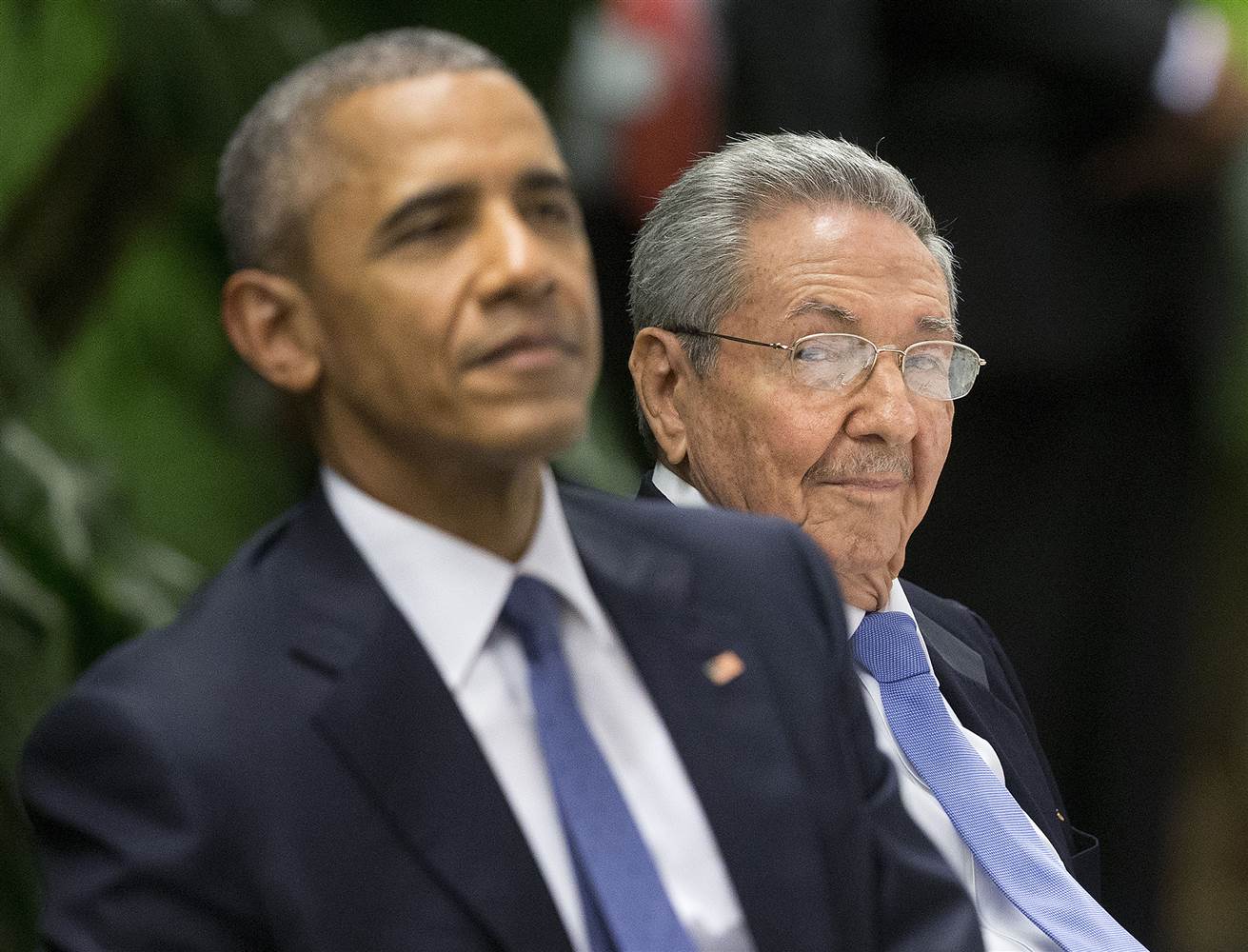
| President Barack Obama with General Raul Castro in 2016 |
President Obama announced his new Cuba policy on December 17, 2014 to great fanfare but downplayed commuting the sentences of three Cuban spies, including Gerardo Hernandez who was serving a life sentence for his role in a murder conspiracy that claimed four innocent lives in 1996 and freed them the same day.
The
argument at the time was that this opening would lead to normalized and
improved relations between Cuba and the United States.
On May 29, 2015, despite a long history of sponsoring terrorism, the Obama State Department removed Cuba from the list of state sponsors of terrorism. In November of 2017 former Cuban diplomat, Jose Antonio "Tony" Lopez was linked to terrorists responsible for the June 17, 2017 bombing in Bogota, Colombia that killed three and injured nine
according to prosecutors in the South American country. A mother of one
of the accused denied her son's involvement in the attack but confirms the link with the former Cuban diplomat. [ Full entry ]






 Posts
Posts

