Wednesday, April 6, 2022

#GS22: Turning on the lights for the millions suffering in darkness (Live stream today and video from yesterday)

Today begins the 14th edition of the Geneva Summit for Human Rights and Democracy. Yesterday there was a non streamed opening session, but today begins the live streamed portion. 

This gathering presents an opportunity for pro-democracy activists from around the world to gather and exchange best practices, and compare notes on what authoritarians are doing to continue their 16 year track record of undermining international human rights standards, and reducing the number of democracies in the world.

Video of the April 5th opening session is available here.

 Here is a also a Twitter thread from yesterday's opening session.

Not in Geneva Switzerland? Follow the live stream of the summit here, and use the hashtags #GS22 and #GenevaSummit2022 to comment, and also to follow the conversation online.

Free Cuba activists will have a lot to check out throughout the day. Below is the program taken from the official website.


Morning Session ( Central European Time )

10:00 Welcome

  • Hillel Neuer, Executive Director of United Nations Watch, on behalf of the 25 NGO co-sponsors of the Geneva Summit.

10:10 The Future of Russia: Resisting Putin From Moscow to Kyiv

Interviewer: Hillel Neuer, Executive Director of United Nations Watch

  • Leonid Volkov, Russian opposition activist and Chief of Staff to Alexei Navalny

10:30 The Struggle for Human Rights in China

Moderator: Luke de Pulford, Founder & CEO of Arise

  • Rushan Abbas, Founder of Campaign for Uyghurs, sister of political prisoner in China
  • Joey Siu, Policy Advisor at Hong Kong Watch, Advisor to Inter-Parliamentary Alliance on China
  • Tenzin Tsundue, Tibetan refugee and writer, arrested 16 times for his activism

11:20 The War in Ukraine: An Eyewitness Account

  • Olga Aivazovska, Forcibly displaced civil society leader & advocate for war crimes tribunal against Putin

11:30 Price of Dissent: The Plight of Political Prisoners

Moderator: Yonah Diamond, International human rights lawyer

  • Areej Al-Sadhan, Activist & sister of Saudi political prisoner Abdulrahman al-Sadhan
  • Sophie Luo, Activist, wife of Chinese political prisoner Ding Jiaxi
  • Tatsiana Khomich, Activist fighting to free Belarus political prisoners, including her sister Maria Kalesnikava
  • Mariam Claren, Daughter of Nahid Taghavi, jailed political prisoner in Iran

12:15 Exiled From Vietnam: The Fight for Freedom of Speech

12:25 The 2022 International Women’s Rights Award

Presented by: Nazanin Boniadi, Award-nominated actress and Amnesty International Ambassador

  • Zarifa Ghafari, Youngest elected mayor in Afghanistan, survivor of three assassination attempts
    Interviewer: Melissa Mahtani, CNN journalist, senior producer

Afternoon Session

14:30 Uncovering Corruption

  • Hopewell Chin’ono, Zimbabwean journalist and filmmaker arrested 3 times for exposing corruption

14:40 Scarred by North Korea

  • Timothy Cho, North Korean human rights activist who escaped from prison

14:50 Resisting Dictatorship in Latin America

Moderator: Melissa Mahtani, CNN journalist, senior producer
  • Hamlet Lavastida, Cuban artist, former political prisoner, founder of artist-led campaign groups 27N and San Isidro Movement
  • Berta Valle, Nicaraguan journalist & activist, wife of political prisoner Félix Maradiaga
  • Miguel Henrique Otero, Journalist, CEO of Venezuela’s El Nacional newspaper that was recently seized by the regime

15:40 How To Topple A Dictator

  • Bobi Wine, Ugandan opposition leader & 2021 presidential candidate

15:50 The 2022 Courage Award

Presented by: Zumretay Arkin, World Uyghur Congress Women’s Committee Chair

16:30 End of Summit


Tuesday, April 5, 2022

Fourteen years of the Geneva Summit for Human Rights and Democracy: A look back

"The world is in greater peril from those who tolerate or encourage evil than from those who actually commit it." - Albert Einstein

The 14th Geneva Summit for Human Rights and Democracy convenes in Switzerland on April 6, 2022. Over the past fourteen years this summit has been and continues to be a vital space for dissenting voices to gather and engage in an important conversation: to diagnose the problems challenging human rights and dignity and to do better and be better in order to turn around the 16 year global decline in human rights.  


The first edition was held on April 19, 2009, "one day before the international community gather[ed] in Geneva to address racism, intolerance and persecution in the High-Level Segment of the UN Durban Review Conference (DRC)" and it had a longer title, "Geneva Summit for Human Rights, Tolerance and Democracy" and the tag line, "Stop Discrimination, Go for Human Rights." UN Watch, a Geneva based NGO whose mission is "to monitor the performance of the United Nations by the yardstick of its own Charter", brought together an international coalition of nineteen organizations to co-sponsor the summit. 


Founding members of the Coalition are: The Assistance Association for Political Prisoners (Burma), AVEGA (Rwanda), CADAL (Argentina), Directorio (Cuba), Darfur Peace and Development Center (Sudan), Fondation Généreuse Développement (Cameroon), Freedom House (USA), Freedom Now (USA ), Groupe des Anciens Etudiants Réscapés du Genocide (Rwanda), Global Zimbabwe Forum (Zimbabwe), Human Rights Without Frontiers (Belgium),  International Federation of Liberal Youth, (United Kingdom), Ingenieurs du Monde (Switzerland) LICRA (France), SOS Racisme (France), Stop Child Executions (Canada), Becket Fund for Religious Liberty (USA), East and Horn of Africa Human Rights Defenders Project (Uganda), UN Watch (Switzerland). Fourteen years later the partners coalition has grown to 27.

Arielle Herzog, Leon Saltiel, Hillel C. Neuer and other UN Watch staff were the chief organizers of the first six editions and responsible for their great success and establishing this space for dialogue. UN Watch today continues to lead this coalition and build on this great legacy, but it is important to return to the beginning to see how we arrived were we are today.

The UN Durban Review Conference (DRC) of 2009 was one more example of the ongoing moral bankruptcy of the United Nations. The star speaker, and apparently the only head of state invited to speak, was Iran's notorious president, Mahmoud Ahmadinejad who engages in holocaust denial and has called for the destruction of Israel. This conference, ostensibly to confront the problem of racism, began a gathering point of the worse dictatorships on the planet to legitimize themselves and demonize Israel.

Meanwhile, in marked contrast, the Geneva Summit for Human Rights, Tolerance and Democracy was held at the Centre International de Conférences Genève, just down the street from the Palais des Nations UN compound where the DRC was being held. Human rights defenders, victims of repression and political dissidents gathered to share their experiences, bear witness, and attempt to wield real political force from the power of human conscience. This is what the martyred Czech dissident and philosopher Jan Patočka called the "solidarity of the shaken". This coalition called for an end to discrimination and for human rights promotion.

The first summit's inaugural speech was given by by Iranian Activist and President of Stop Child Executions, Nazanin Afshin Jam, who outlined the human rights situation in Iran. She addressed that under Iranian laws the life of a woman is worth half of a man's and other sexist practices, the execution of homosexuals, and the executions of minors. The Iranian activist also gave an overview of the summit that began at 9:00am and ended at 6:30pm.

The inaugural summit was divided into four sessions that were tied into the Universal Declaration of Human Rights.

Session I was titled "Racism, Genocide, and Crimes Against Humanity: Assessing the Genocide Convention After 60 Years" and the panel was made up by Irwin Cotler, Counsel for genocide victims and dissidents, Canadian MP, Gregory Stanton, President of Genocide Watch and International Association of Genocide Scholars, Ester Murawajo, Tutsi survivor, founder of AVEGA and Dominique Sopo, President of SOS Racisme.  

Session II was titled "Resisting Authoritarianism: Human Rights, Democracy, and the Dissident Movement" with speakers Bo Kyi, Burmese dissident and winner of the Human Rights Prize from Human Rights Watch, Saad Eddin Ibrahim, Egyptian dissident, José Gabriel Ramón Castillo, Cuban dissident and prisoner of conscience, and Esra'a Al Shafei, dissident blogger, Mideast Youth - Thinking Ahead.

Session III was titled "Torture and Cruel and Inhuman Treatment" with speakers Nazanin Afshin-Jam, president of Stop Child Execution,  Parvez Sharma, Producer of the documentary Jihad for Love, and Ahmad Batebi, Iranian dissident.

Session IV was titled "Freedom of Expression and 'Defamation of Religion'" with panelists  Mohamed Sifaoui, Journalist, Algeria, Floyd Abrams, U.S. advocate for First Amendment press freedom,  Patrick Gaubert, President of LICRA and Member of the European Parliament.

The 2nd Geneva Summit was held on March 8-9, 2010, strategically timed to coincide with the main annual session of the U.N. Human Rights Council. The objective of the 2010 Geneva Summit was to give voice to victims of the world’s worst abusers, empowering those who suffer repression under closed systems of government.

The program featured plenary sessions, workshops and training sessions over two days. A large portion of the program was dedicated to presentations—personal and compelling testimony—from victims of the world’s worst abusers.

On March 8, 2010 gave the opening address on behalf of the Geneva Summit Coalition for the second edition of the Geneva Summit. Sadly, these words remain relevant today, but now the global decline in political freedoms and civil liberties has expanded from four to thirteen years in a row.

Regrettably, the chief international body charged with protecting human rights is failing to live up to its mission to stop these and other abuses. The Geneva-based UN Human Rights Council—as acknowledged in a recent report by 17 of its 47 member states, supported by Amnesty International, Human Rights Watch, and the International Commission of Jurists—falls short in its handling of country situations, in the efficiency of the process involved in highlighting violations, and in its reactivity to crisis situations. Strong politicization of the Council, driven by bloc-based voting patterns, has led to inaction in face of atrocity and abuse. We saw this sad spectacle last week within the Council, first with the secretary general of Iran’s High Council for Human Rights denying the documented and rampant instances of torture, executions, and mass detentions of Iranians followed by the Cuban Foreign Minister’s speech who echoing his Iranian colleague also denied Cuba’s horrible human rights record and to add insult to injury went on to blame the United States for the death of Orlando Zapata Tamayo as well as slander the deceased Cuban prisoner of conscience as a criminal.

Little wonder that the March 1st magazine issue of Newsweek contains an article titled “The Downfall of Human Rights.” The article highlights Freedom House's report "Freedom in the World," released in January, and reveals a global decline in political freedoms and civil liberties for the fourth year in a row, the longest drop in the almost 40 years that the survey has been produced.

According to Summit organizers, "[m]ore then 800 people registered to attend the summit and over 1600 watched the live webcast. 35 dissidents and human rights activists took the floor to condemn and testify about some of the worst human rights situations around the world and issued a joint call for Internet Freedom around the world."
Cuban dissident Nestor Rodriguez Lobaina was denied an exit visa by the Castro regime despite being invited to attend the Geneva Summit, but the coalition did not stop there and started a campaign for him to attend.

30 NGOs from this Summit called on the UN High Commissioner for Human Rights to intervene on behalf of Cuban human rights defender Nestor Rodriguez Lobaina barred by the Cuban dictatorship from attending this meeting. The Cuban ambassador protested loudly when Hillel Neuer of UN Watch raised the matter in an interactive dialogue with the High Commissioner, but Nestor on the other hand was grateful that the UN Watch representative spoke up for his human rights.
In the end Nestor addressed the summit by phone, and would attend and address the 2012 Summit in person. Still remember the powerful and haunting testimony of Caspian Makan, human rights activist, and fiancé of Neda Agha-Soltan, who was murdered in Iran by pro-regime agents months earlier on June 20, 2009. Another speaker who made a powerful impression was Yang Jianli, activist in the 1989 Tiananmen Square protest, a former political prisoner, and founder of Initiatives for China and today a friend. The Geneva Summit created network of activists that remain in contact and continue to collaborate.

Cuban human rights defenders and victims of repression have had a voice at this gathering over the past fourteen years to denounce their plight and call for human rights and freedom for Cuba. Former Cuban prisoners of conscience and human rights defenders Jose Gabriel Ramon Castillo (2009, 2010), Luis Enrique Ferrer Garcia (2011), Nestor Rodriguez Lobaina (2012), Regis Iglesias (2013), and Juan Francisco Sigler Amaya (2015), human rights defender and daughter of martyred actvist Rosa Maria Paya (2013, 2016), human rights defender Damarys Moya Portieles (2014), human rights defender and social democrat Manuel Cuesta Morua (2015), former prisoner of conscience, human rights defender and artist Danilo Maldonado El Sexto (2017), Sakharov laureate Guillermo Fariñas Hernández (2018), human rights lawyer Juan Carlos Gutiérrez representing Cuban prisoner of conscience Dr. Eduardo Cardet (2019), Cuban lawyer, journalist, and human rights defender who serves as Executive Director of the nonprofit Cubalex Laritza Diversent (2020), Cuban political performance artist Tania Bruguera (2021), and Cuban visual artist and political activist Hamlet Lavastida (2022).

2013 was the last time I addressed the Geneva Summit for Human Rights and Democracy during the fifth edition of the gathering and less than seven months after Oswaldo Payá Sardiñas and Harold Cepero Escalante had been murdered by State Security on July 22, 2012. Present in the room were Rosa María Payá Acevedo, and Regis Iglesias Ramírez of the Christian Liberation Movement. Both had addressed the meeting.
The 5th Annual Geneva Summit for Human Rights and Democracy today is an opportunity for reflection. Unfortunately, the human rights situation around the world has not improved over the past five years and in many instances worsened. The question is why? Cuban democratic opposition activist, Oswaldo Payá Sardiñas, when awarded the Sakharov prize for Freedom of Thought on December 17, 2002 observed that “The cause of human rights is a single cause, just as the people of the world are a single people. The talk today is of globalization, but we must state that unless there is global solidarity, not only human rights but also the right to remain human will be jeopardized.” The past decade has demonstrated that he was right.

Cuban state security has worked for decades trying to discredit and silence authentic dissident voices and continues to today with their spies and agents of influence.  It is a constant struggle to frustrate their efforts. They are willing to lie, slander, assault and even murder those who have the courage to dissent. The 2012 killings of Oswaldo Payá and Harold Cepero and the firing on unarmed protesters during the 11J protests in Cuba demonstrate this.

For decades Cuban victims of repression said that nobody listened, and in 1987 an award winning documentary titled "Nobody Listened" interviewed Cuban political prisoners and human rights defenders describing the lack of international solidarity.  

Over the past fourteen years thanks to the Geneva Summit for Human Rights and Democracy their voices have been and continue to be heard.  

The next summit begins on Wednesday, April 6, 2022 at 9:00am Central European Time. For more information visit the Geneva Summit website here. Use hashtags #GenevaSummit2022 and #GS22


Monday, April 4, 2022

#GenevaSummit2022: Turning on the lights for the millions suffering in darkness

  The 14th Annual Geneva Summit for Human Rights and Democracy – April 5- 6, 2022

The Geneva Summit for Human Rights and Democracy will begin tomorrow now for the 14th time, and needs your help. Never heard of the Summit? Here is what this gathering is about:

The Geneva Summit for Human Rights and Democracy is a major conference that shines a spotlight on urgent human rights situations that require global attention. It provides human rights heroes, activists and former political prisoners with a unique platform to testify about their personal struggles for democracy and freedom, while building an international community to take on dictatorships.

The Summit is held around the main annual session of the United Nations Human Rights Council, when foreign ministers gather in Geneva, to force critical issues onto the international agenda. The 14th Geneva Summit will be held on Wednesday, April 6, 2022, on the heels of the main session.

The event is attended by hundreds of dissidents, victims, diplomats, journalists, student leaders and other concerned citizens. Thousands more watch online.

The Geneva Summit is sponsored by a coalition of 25 human rights NGOs from around the world. It has been featured in media around the glove, including CNN, AFP, AP, DW, the Wall Street Journal and The Australian.

Over the past 14 years the Geneva Summit has provided a space for victims of repression from around the world. One of the countries constantly represented for its terrible human rights record over this time has been Cuba.  This year for the first time Geneva Summit speak Hamlet Lavastida will address the gathering. 

Below is a brief biography of the Cuban artist and dissident.

Hamlet Lavastida is a Cuban visual artist and political activist. He was a founder at both of Cuba’s most prominent artist-led campaign groups, 27N and the San Isidro Movement (MSI).

Lavastida was imprisoned on June 26th, 2021, as he returned from an artistic residency in Berlin. He was arrested for an unrealised idea he had shared with members of the 27N activist group, to stamp Cuban currency with subversive anti-Communist symbols.

Lavastida spent three months incarcerated in Villa Marista, the high security prison famous for holding political prisoners, and was named a prisoner of conscience by Amnesty International in August 2021.

He was released in September on condition of exile for him and his partner, the poet and activist Katherine Bisquet. He resides in Germany.

Source: Geneva Summit for Human Rights and Democracy

Rosa Maria Payá Acevedo will also be attending the gathering.  She has spoken in the past at the Geneva Summit in 2013 and 2016. This year also marks 10 years since her father Oswaldo Payá Sardiñas, and friends Harold Cepero Escalante were killed by Castro's secret police on July 22, 2012.


On April 6, 2022 the live streamed session of the Geneva Summit will begin at 10:00am Central European Time with presentations on Russia and China.  In the afternoon at 14:50pm there will be a panel on resisting dictatorship in Latin America that will feature speakers from Cuba, Nicaragua, and Venezuela. Representing Cuba will be Hamlet Lavastida of the San Isidro Movement.

Register for the Summit, participate virtually in this gathering, add your views, and share them over your social media platforms with the hashtag #GenevaSummit2022 and #GS22.

On January 5, 1967, then California Governor Ronald Reagan warned that we should not take freedom and democracy for granted.   

"Freedom is a fragile thing and it's never more than one generation away from extinction. It is not ours by way of inheritance; it must be fought for and defended constantly by each generation, for it comes only once to a people."


The future American President was right and #GenevaSummit2022 is correctly calling attention to complacency in democracies, and the fragility of both freedom and democratic institutions as the world faces an expanded conflagration in Ukraine, and an ascendant China backing autocracies worldwide.

Tuesday, March 29, 2022

25 years without justice for Danish student gunned down in Havana by a soldier

 "There may be times when we are powerless to prevent injustice, but there must never be a time when we fail to protest." - Elie Wiesel, Nobel Lecture 1986

Joachim Løvschall: December 7, 1970 - March 29, 1997
 

Joachim Løvschall was studying Spanish in Havana in the spring of 1997. He was gunned down by a soldier of the Castro regime in Havana, Cuba twenty five years ago today on March 29, 1997. The identity of the soldier was never revealed to Joachim''s family. No one was brought to justice. Joachim's family is not satisfied with the official explanation.

The last time they saw Joachim
On March 28, 1997 Joachim Løvschall ate his last dinner with white wine in a little restaurant called Aladin, located on 21st street in Havana. He went to the Revolutionary Plaza and bought a ticket to the Cuban National Theater. Following the performance he went to the theater's bar, Cafe Cantante, and met up with two Swedish friends. They each drank a couple of beers, but soon left because Joachim did not like the music. At 23:30, they said good bye to each other on the sidewalk in front of Cafe Cantante. 


Joachim was never seen alive again. 

Last seen in the front of Cafe Cantante

The Castro regime's version of what happened
On September 28, 1997 the Danish newspaper Jyllands-Posten published an article by Kim Hundevadt titled "Dangerous Vacation" that outlined what happened to Joachim Løvschall and presented the Castro dictatorship's version of the events leading to this young man's death:

Around 23:30, a person matching Joachim Løvschall's description was in a bar named Segundo Dragon d'Oro. The bar lies in the hopeless part of town, around the Revolutionary Plaza which is dominated by ministry and other official buildings of harsh concrete architecture, and lies empty in at night.
At 2:45am he left the bar, after becoming intoxicated. Around 20 minutes later, he was walking down the Avenue Territorial, behind the Defense Ministry.

Joachim Løvschall walked, according to the Cuban authorities, first on the sidewalk that lies opposite the Ministry. Midway he crossed over to the other sidewalk, considered to be a military area, though it is not blocked off.

The Cubans have explained that Joachim Løvschall was shouted at by two armed guards, who in addition fired warning shots, which he did not react to. Therefore, one guard shot from the hip with an AK-47 rifle. The first shot hit Joachim in the stomach and got him to crumble down. The second shot hit slanting down the left side of the neck.

Joachim Løvschall gunned down in Cuba in 1997

Fifteen years ago

On June 12, 2007 Christian Løvschall, Joachim's father, at a parallel forum at the United Nations Human Rights Council spoke about his son's disappearance and the struggle to find out if Joachim was dead or alive:

"Although the killing took place on the 29th of March, we only came to know about it on the 6th of April - i.e. after 8 days were we had the feeling that the Cuban authorities were unwilling to inform anything about the incident. Only because of good relations with Spanish speaking friends in other Latin American countries did we succeed in getting into contact with the family with whom Joachim stayed and the repeated message from their side was that they could reveal nothing, but that the situation had turned out very bad and that we had to come to Cuba as soon as possible. At the same time all contacts to the responsible authorities turned out negatively... Only after continued pressure from our side on the Cuban embassy in Copenhagen, things suddenly changed and the sad information was given to us by our local police on the evening of the 6th of April. We are, however, 100% convinced that had we not made use of our own contact and had we not continued our pressure on the embassy in Copenhagen, we might have faced a situation where Joachim would have been declared a missing person, a way out the Cuban authorities have been accused of applying in similar cases."
 Ten years later Christian Løvschall outlined what he knew concerning his son's untimely death:
We do feel we were (and still are) left with no answers except to maybe one of the following questions: Where, When, Who, Why Starting out with the where we were told that Joachim was killed by the soldiers outside the Ministry of Interior.
Where
What we do not understand is why no fence or signs did inform that this is a restricted area? I have been on the spot myself, and the place appears exactly like a normal residential area. So you may question whether this in fact was the place of the killing? Contrary to this the authorities keep maintaining that the area was properly sealed off, and the relevant sign posts were in place.
When
As to when Joachim was killed we only have the information received from the police because of the delay informing one might believe that this is another forgery made up to cover the truth.
Who
The who was in our opinion has never been answered by the Cuban authorities. We understand that a private soldier on duty was made responsible for the killing, and also it has been rumored that his officer in charge has been kept responsible. This is of course the easy way out, but why can't we get to know the whole and true story?   
Why 
Why did the soldiers have to fire two shots, one to his body and one to his head, to murder him? Was Joachim violent and did he, an unarmed individual, attack the armed soldiers? Or is it simply that the instruction to Cuban soldiers are: first you shoot and then you ask? But again: Who can explain why two shots were needed?
Despite the claims made by the travel industry there have been other travelers to Cuba who have been killed or gone missing under suspicious circumstances. Others have been falsely imprisoned in legal proceedings that fall far short of international standards. Like North Korea, but with a tropical twist, Cuba suffers a dictatorship where both nationals and foreigners have no legal protections locally if they run into trouble with the regime. The ongoing plight of Benjamin Tomlin, who has spent three years in a Cuban prison, should lead others considering a holiday in Cuba to think twice. So should what happened to Joachim Løvschall on March 29, 1997 when he was gunned down by an AK-47 wielding Cuban soldier for allegedly walking on the wrong sidewalk.

Friday, March 18, 2022

Remembering the 2003 Black Cuban Spring, the failure of the UN Human Rights Council, and the terror in Cuba today

Remembering the 2003 Black Cuban Spring, the long winter, and the new Black Spring
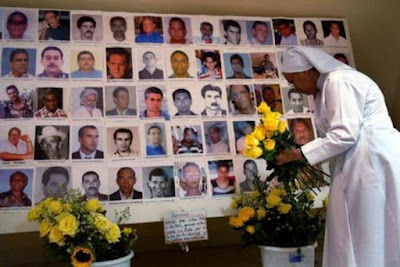
Nun places sun flowers to images of 75 Cubans jailed in 2003

Nineteen years ago on March 18, 2003 a crackdown began in Cuba on the eve of the United States going to war in Iraq. Scores of nonviolent Cuban dissidents were rounded up and subjected to political show trials. 75 were condemned to lengthy prison terms of up to 28 years in prison. This became known as the Black Cuban Spring

This past year the Castro regime carried out a crackdown not seen since 2003, and that may exceed it. On March 16, 2022 the draconian sentences were justified in an official communication that marked a new Black Spring for hundreds of imprisoned Cubans and their families. Many of the jailed are young Cubans.
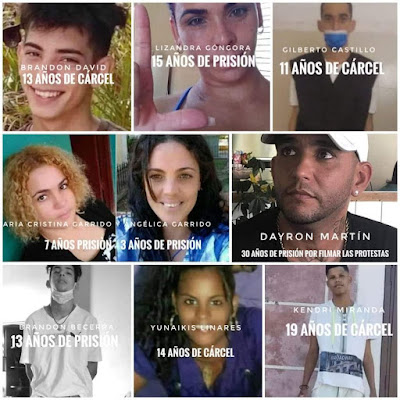
Some of the young Cubans sentenced to long prison terms (Photo: Claudia Peiro)


The Cuban dictatorship released a statement on March 16, 2022 that "it had sentenced upwards of 100 protesters in Havana to between 4 and 30 years in prison for violence committed during island-wide demonstrations last year, the largest since Fidel Castro's 1959 revolution," reported Reuters and other news outlets.

Diubis Laurencio Tejeda, age 36, shot in the back on July 12, 2021

Regime officials failed to mention that it was they who had initiated and carried out the deadly violence that day, not anti-government demonstrators who were non-violent. On July 12, 2021, during the 11J protests, Diubis Laurencio Tejeda, age 36, was shot in the back by regime officials on day two of nationwide protests in Cuba. He was not the only one shot by them.

Worse yet, the longest sentences handed out were for video recording the protests. Cubans that recorded or live streamed the protests were accused of sedition. Here are four high profile cases.
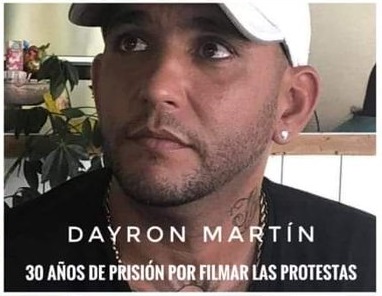
Dayron Martín sentenced to 30 years of prison for filming protests (Photo: Claudia Peiro)

France24 reported on the plight of Dayron Martín Rodríguez (age 36) who was sentenced to 30 years in prison. He was "detained in La Güinera. He was out "to buy food for his pigeons when he ran into the rally," said his mother, Esmeralda Rodríguez (age 63), who added that "he started recording to send his father the video." He felt the stones hitting him, he fell and lost his phone. Video emerged during the 11J protests of police throwing rocks and firing on unarmed protesters. Esmeralda Rodríguez, "suffered a pre-infarction when she found out in Ecuador, where she emigrated. eight years ago" that her son had been sentenced to 30 years in prison. 
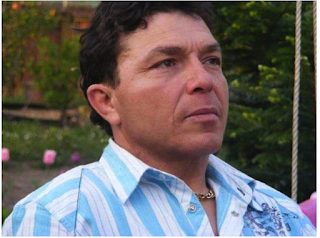
German tourist and dual citizen, Luis Frómeta Compte, was sentenced to 25 years in prison on December 23, 2021 for spontaneously filming a demonstration in Havana for private purposes with his smartphone while visiting relatives and was subsequently arrested. According to the Frankfurt arm of the International Society for Human Rights (ISHR), "the Dresden family man is one of about two thousand demonstrators arrested on July 11 during protests against the dictatorship." ISHR strongly criticized the long prison sentence and pointed out that, in the meantime, the 59-year-old’s brother-in-law is also in pre-trial detention.
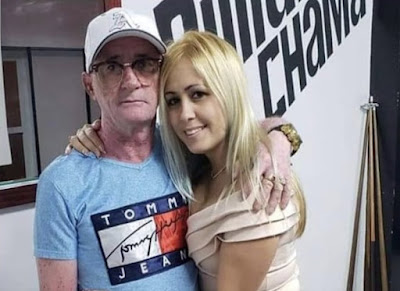
Fredy Beirut (age 64) and Katia Beirut (age 36) each sentenced to 20 years in prison

Agence France Presse reported on the plight of a father and daughter punished for filming the protests.  Fredy Beirut (age 64) and Katia Beirut (age 36) who filmed the July 2022 protests were each sentenced to 20 years in prison. The father will emerge from prison at 84 years of age, and the daughter will be 56 years old.

Filming, and bearing witness can end your life as a free person in Cuba. 19 years ago it was organizing a petition drive, or being an independent journalist or human rights activist that could cost you a 28 year prison sentence.

The majority of the activists imprisoned in 2003 had participated in the Varela Project, a petition drive that called for a referendum under the terms of the Cuban Constitution on whether there should be more freedom of expression, an amnesty for political prisoners and a chance for ordinary citizens to own small businesses. 11,020 signatures had been turned in 10 months earlier on May 10, 2002. 
 
The regime responded with its own mandatory petition drive to make the Cuban Constitution unchangeable. 
 
The Economist in its December 14, 2005 issue published a conversation with Oswaldo Payá Sardiñas titled "An unsilenced voice for change" that outlined what had taken place:
Between 2001 and 2004, Mr Payá's movement gathered 25,000 signatures in a vain attempt to persuade Cuba's National Assembly to change the constitution to allow multi-party democracy. Activists of his Christian Liberation Movement made up more than two-thirds of the 75 dissidents and journalists rounded up and jailed for long terms in April 2003. [...] Spain is “complaisant” with Mr Castro's regime, Mr Payá says. “We need a campaign of support and solidarity with peaceful change in Cuba” of the kind that brought an end to apartheid in South Africa and to the Pinochet dictatorship in Chile.

It took over eight years, but the last of the group of the 75 were eventually released. This was in large part due to the Ladies in White and international solidarity campaigns carried out by NGOs, but the international community failed to call out Havana's impunity.

Castro expected the March 2003 crackdown, dubbed the “Black Cuban Spring,” to be the end of the opposition. Instead, it sparked the emergence of a new movement, the Ladies in White, led by the wives, mothers, sisters and daughters of the men jailed. For eight years, these women lobbied, protested and marched for their loved ones’ freedom. They were successful, and the last of the men were released from prison in 2011, a nonviolent victory over the dictatorship. The Ladies in White continue to the present day, demanding human rights be respected in Cuba.

On April 2, 2003 three young black men were arrested, tried and executed by firing squad nine days later on April 11, 2003 for trying to flee the island in a hijacked ferry, in which no one had been physically harmed. This drew worldwide condemnation at the time, and became known as Cuba's Black Spring, but it did not prevent the end of the mandate for monitoring human rights violations in Cuba in a backroom deal for the establishment of the UN Human Rights Council on March 15, 2006.
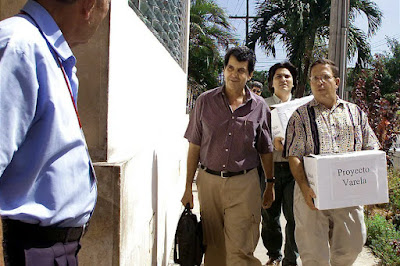
11,020 Varela Project signatures turned in on May 20, 2002

Oswaldo was murdered along with the Christian Liberation Movement's youth leader Harold Cepero on July 22, 2012. His successor Eduardo Cardet was a prisoner of conscience from November 30, 2016 through September 3, 2019. He was jailed for giving a frank assessment of Fidel Castro's legacy following his death on November 25, 2016.

Sixteen years ago the United Nations Human Rights Council was founded on a small moral compromise that sacrificed human rights oversight in Belarus and Cuba in what U.N. officials called the dawn of a new era. Special rapporteurs with mandates to specifically monitor the human rights situation in those two countries were formally gotten rid of in 2007 and a code of conduct established that undermined the independence of all special rapporteurs.

Ending oversight of Belarus and Cuba not only left the victims of these dictatorships exposed to more repression, with impunity by their oppressors, but emboldened these dictatorships not only to worsen their practices at home but to undermine human rights abroad. Worse yet, both would be elected to serve on the UN Human Rights Council with other outlaw regimes. 

Throughout this entire period, despite repeated requests, the Castro regime has not allowed the International Committee of the Red Cross to visit prisons in Cuba. 

Prison conditions are so poor that of the 75 imprisoned in 2003, fourteen have died, many due to conditions arising from their time in prison. There names are: Orlando Zapata, Miguel Tamayo, Antonio Villarreal, Arturo Pérez, Jorge Luis González, José G. Ramón, Julio César Gálvez, Omar Pernet, Raúl Rivero, Julio A. Valdés, Arnaldo Ramos, Carmelo Díaz, Orlando Fundora, and Oscar M. Espinosa.
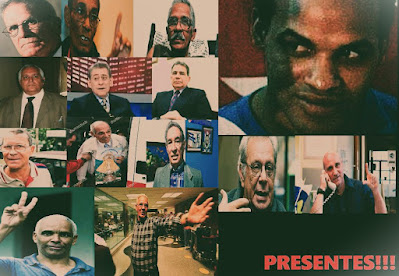
Cubans jailed during the 2003 Black Spring that died before their time. (Photo: Regis Iglesias )

This failure of accountability led to greater levels of violence and repression by the Cuban dictatorship that continues to sit on the UN Human Rights Council. The regime in Havana is an outlaw regime, and cannot be trusted.

This can be seen in their legal system and how it treats poor Cubans.

Havana Times reported on La Guinera, a Havana neighborhood, "where 96 of the 790 people in Cuba for taking part in the protests on July 11th and 12th, that is to say, 12 out of every 100 people arrested for protesting are La Guinera locals." Regime claims do not hold up when their own documents are examined, demonstrates Havana Times citing official documents.

"The Public Prosecutor’s Office says that sedition charges against La Guinera residents are due to the 'level of violence in vandalic acts that in a riot-like situation led to injuries and put the lives of civilians, public officials and law enforcement officers at risk, by attacking them with sharp, blunt and incendiary objects, seriously disturbing public order with the deliberate purpose of subverting rule of law.' However, these same records state that in La Guinera police patrol cars weren’t attacked —unlike other parts of the country—, and the highly-criticized dollar stores weren’t vandalized, there was no looting or serious damage to property. Furthermore, those charged with sedition include people who were only recording and live streaming events on Facebook, without taking part in any conflict with the police, as well as detainees who the Public Prosecutor’s Office is charging with sedition for the simple fact they were present in the crowd that prevented public order."

The pattern repeats itself, the longest prison sentences are meted out to those accused of sedition for "recording and live streaming events on Facebook, without taking part in any conflict with the police" or "for the simple fact they were present in the crowd." Press bureaus in Havana, perhaps in order not to be expelled, failed to report that deadly violence came not from the protesters, but from regime agents, and counter protesters that they head armed with clubs and bussed in to violently shut down what had been peaceful protests. Havana Times offers the following in evidence that conflicts with the official version.

The Public Prosecutor’s Office also justifies sedition charges by saying detainees attacked and injured police officers and counter-protestors without reason, but this statement also falters. Stones and objects were thrown during the protests, but the Public Prosecutor’s Office was unable to find police officers and counter-protestors who sustained severe injuries. The records state that only three counter-protestors were injured and none of them required medical attention. In the case of police officers, 14 were injured, and only one needed medical attention. On the contrary, during the police’s response —involving the use of firearms—, Diubis Laurencio lost his life, the only fatality recognized by the Government, and many protestors were hit by bullets, including minors. “I was told my wife went to look for my stepson at the protest. She didn’t find him, and she soon found out that he had been hit by a bullet in his knee, just before they killed the other young man,” Janoi Ceballos wrote in a text message, the step-father of 16-year-old Cuban teenager Misael Yoel Fuentes Garcia, who was injured in La Guinera.

Dictatorship's need to be held accountable, at least ostracized, and removed from international human rights bodies. Western democracies, such as the Spanish government, should not be selling weapons to the Cuban dictatorship to use them against the Cuban people. 

These failings on the international stage have real world consequences as we are seeing today in Ukraine.

This is why we are circulating a petition to leaders in the Western democracies and the international community to finally hold the dictatorship in Havana accountable.