Independence and Emancipation
The Grito de Yara on October 10, 1868 has a double significance for Cubans, and Black Cubans specifically. It was the initial cry for independence that marked the start of the "Ten Years War" that seriously challenged Spanish colonial rule, and the institution of slavery.
This day marked an immediate and concrete start of liberation.
Plantation and slave owner Carlos
Manuel de Céspedes del
Castillo,
sounded a bell that gathered enslaved black Cubans together to begin the
work day, but on October 10, 1868 he freed them instead.
This slave owner then invited them, if they chose, to take up arms and
join him in a new struggle for independence. The nearest town to his plantation was
called Yara and this cry for freedom became known as the "Grito de
Yara."
Carlos Manuel not only promised independence from Spain, but the abolition of slavery in Cuba.
This
was a day of choosing for black Cuban slaves and over the next decade
they fought for freedom, together with free blacks, and white Cubans.
On October 10, 1878 in the Pact of Zanjón
slaves that had taken part on either side of the fight were freed, but
those who remained on the sidelines would not be freed until October 7,
1886.
 |
| General Martínez Campos and General Antonio Maceo meet |
Not everyone agreed with the pact. General Antonio Maceo was summoned by Martínez Campos to Los Mangos de Baraguá on March 15, 1879. General Maceo refused to accept the conditions established in the agreement. He demanded full independence and the complete abolition of slavery. This became known as "La Protesta de Baraguá"
where General Antonio Maceo told his
Spanish counterpart: "We do not understand each
other".
Juan
Gualberto Gómez Ferrer, a free Cuban black, and leader of the independence struggle defended the rights of Black Cubans for his
entire career. In 1892 he founded the “Directory of Colored Societies” - the same year that slavery ended in Cuba.
The
Central Directory of Societies of Color would spend the next seventy six
years pushing for Black advancement in Cuba.
It
would be a fair assessment to define October 10, 1868 as not only the
beginning of Cuban independence, but a day to celebrate black liberation
from 373 years of bondage beginning with the arrival of the first African slaves to Cuba in 1513. Over 900,000 Africans would be taken from
West Africa and brought
to Cuba over
350 years.
Juan Gualberto transmitted the order that
began the 2nd war of independence on February 24,
1895. Gómez
Ferrer was captured on February 28, 1895 and imprisoned by the Spanish for
three years. Upon his release he went to New York and continued the struggle
for Cuban independence from exile.
"In December 1898, he
accompanied Major General Calixto García to Washington, D.C. as a member of the
commission sent to negotiate for funds necessary for the Cuban Liberation
Army and recognition of the rebels" by the United States.
In 1900 Juan Gualberto Gómez
Ferrer
was elected to represent Oriente
in the Constituent Assembly.
Following
independence he was deeply critical of the Platt Amendment. The United
States military had occupied Cuba from 1898 to 1902, and the
bitter price of independence was accepting the Platt Amendment in the
1901 Cuban Constitution, which permitted U.S. interference in Cuban
internal affairs to preserve order
and protect American interests, put into question the status of Cuba's
Isle of Pines as a possible U.S. possession.
Gómez
Ferrer held seats in the
Cuban House of Representatives (1914–1917) and Senate (1917–1925),
representing Havana.
 |
| Juan Gualberto Gómez
Ferrer |
Between
1886 and 1962 in Cuba, free black people were able to organize in a network of
societies founded by Juan Gualberto Gómez Ferrer to press for black social, economic and political advancement in
Cuba.
Cuba
during the later colonial period, and during the Republic wrestled with the
legacy of slavery, and racism, but it was part of the public discussion – with
its high and low points.
Ugly periods,
such as the 1912 race war, and private discrimination persisted, but so did
black agency to advocate for each other.
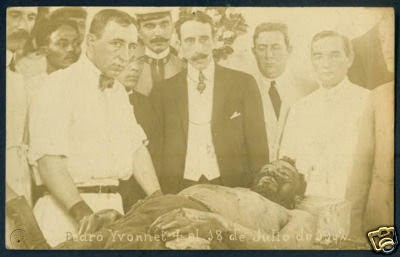 |
| General Pedro Ivonnet Dufort was a Mambi officer killed in 1912 |
Political
leaders had to answer to these black societies, and provide patronage to them,
and in a vibrant free press, and in publishing houses debates on race, and
racism, and the need for redress took place.The
Central Directory of Societies of Color, founded by Gómez
Ferrer in 1892 succeeded in lobbying for the 1940 Constitution to address racism
in Articles 10, 20, 74, and 102.
And
although incomplete and too slow, progress had been made in the 1940 Constitution, and in labor legislation to provide greater inclusion for black
Cubans over the next 20 years.
All
of this came crashing down with Castro’s communist revolution. “Of
the 256 Negro societies in Cuba, many
have had to close their doors and others are in death agony. One
can
truthfully say, and this is without the slightest exaggeration, that the
Negro
movement in Cuba died at the hands of Sr. Fidel Castro.” … “Yet this is
the man
who had the cynical impudence to visit the United States in 1960 for the
purpose of censuring American racial discrimination. Although this evil
obviously exists in the United States, Castro is not precisely the man
to offer
America solutions, nor even to pass judgement,” reported Cuban
nationalist Juan René Betancourt in his essay in the NAACP's publication
The Crisis in 1961.
Some
of the more prominent clubs that are still remembered are the Sociedad Buena
Vista ( Buena Vista Social Club), Amantes del Progreso, Unión
Fraternal, Progreso, Nueva Era, and El Club Atenas.
 |
| Juan René Betancourt |
Between
1898 and 1959 the relationship between Black-Americans and Black-Cubans
was based on their race and being black minorities. The relationship
between the two diasporas ended when the Castro regime ended autonomous
black civil society in 1962.
It was replaced by Castro and his white
revolutionary elite allying with Black elites in the United States, and Africa. The Castro regime would selectively target black elites in the NAACP, the Nation of Islam, and representatives of newly liberated nations in Africa. This was exemplified by Fidel Castro meeting with Malcolm X on September 19, 1960.
The elimination of
Afro-Cubans from this dynamic demonstrated how the new communist revolutionary elite transformed what race meant within the island while at the same time turning it into a political tool outside of Cuba to advance the Castro regime's communist agenda.
This ended black agency in Cuba for decades, and replaced it with a policy based in obedience, submission, and gratitude to the white revolutionary elite, and this was reflected in official propaganda with racist tropes.
 |
| From the Castro regime's publication Verde Olivo 1, no. 29 (October 1, 1960) |
Cuban blacks today that would have been
political leaders in the 1940s and 1950s are dissidents persecuted, hunted and killed by the secret police.The
regime claims there is no racism in Cuba while poverty disproportionately
impacts black people, and black voices are silenced.
Tonight Cuba's Cry for Freedom is once again being heard across the island. 154 years after the Grito de Yara there is a new Grito de Libertad.




 Posts
Posts

