Tuesday, December 5, 2017

The Conservative counter-revolution and chocolate pastry.

The Austrian Foreign Minister, the chef, the apprentice and the creation of a new dessert


Prince Metternich, Sacher Torte, and Franz Sacher

A few days ago discussed the role of  Prince Klemens von Metternich in securing a conservative order that provided Europe with a century of relative peace and stability. Returning to Austria yesterday came across the story of the origin of the Sacher Torte, a popular chocolate cake, and that Metternich played an important role.

In addition to playing an important role in establishing the Concert of Europe that prevented a major war on the European landmass for 99 years and blocking the revolutionary ambitions of communists and others Prince Metternich was also involved in the development of the Sacher Torte in Vienna in 1832. He had high-ranking guests attending a dinner and wanted the court's kitchen to create a special dessert demanding: Dass er mir aber keine Schand' macht, heut' Abend! ("Let there be no shame on me tonight!"),but his chef was ill and the task of creating the dessert fell to 16-year old Franz Sacher, a second year apprentice at the palace. The new desert, a magnificent chocolate cake, was a success and the Sacher Torte would become famous.

Sacher Torte
It is said in the Bible that by their fruits you shall know them. A century of peace and a delicious desert still enjoyed today across the world speaks volumes about the conservative order established by Metternich in 1815 and the success of the Sacher family, of how an apprentice under the Austrian Prince created great opportunities.

On December 4, 2017 enjoyed a Sacher Torte at one of the restaurants opened by the Sacher family located in Innsbruk, but if you can, visit the original location in Vienna.


"If your heart is weary, you need more sweets." - Anna Sacher

Monday, December 4, 2017

Red Killings in Cuba: The cost in Cuban lives

Death counts, statistics, and anecdotal evidence

Firing squad
Over the past month victims of extrajudicial killings in Cuba have been profiled with an aim of getting away from dry statistics and focusing on the human cost at an individual level, but a few days ago a came across a discussion on numbers killed in Cuba. This blog entry seeks to join the discussion on death tolls, statistics, and the pursuit of accurate estimates, or in other word discuss numbers.

The body count
Glenn Garvin wrote an important essay one year ago on December 1, 2016 titled "Red Ink: The high human cost of the Cuban Revolution" and in it addresses the question of how many extrajudicial executions have taken place in Cuba. This blog addressed this issue before in 2012, but Garvin adds some new and critical insights to understanding the real nature of the Castro regime.
"University of Hawaii historian R. J. Rummel, who made a career out of studying what he termed “democide,” the killing of people by their own government, reported in 1987 that credible estimates of the Castro regime’s death toll ran from 35,000 to 141,000, with a median of 73,000."
Matthew White in the introduction to his 2011 book, The Great Big Book of Horrible Things: The Definitive Chronicle of History's 100 Worst Atrocities explains that:
An exact body count is hard to come by for Castro’s regime in Cuba, but no one has ever suggested that he killed the hundreds of thousands necessary to be considered for a slot on my list. Many infamous brutes such as Francois “Papa Doc” Duvalier, Vlad the Impaler, Caligula, and Augusto Pinochet easily fall short, as do many well known conflicts such as the Arab-Israeli wars and the Anglo-Boer War.
Garvin's 2016 article also cites Cuba Archive's death toll number of 7,193 but in 2006 Frances Robles reported that the same organization had a total of 31,173 cases documented. In the article 8,151 were broken down as follows: 5,728 killed by Castro firing squads, 1,207 extrajudicial killings after Castro took power and 1,216 deaths in prison. It'd be curious to learn how after 10 years of additional research (and new extrajudicial killings reported since then) that the number has gone down by 958 deaths. This does not include the debate over numbers who have been killed or died in the ocean fleeing the Castro regime. Nevertheless it is a low outlier among sources on regime killings in Cuba and raises questions on reporting criteria and how to arrive at a number that reflects historical reality.

The cover-up
Marion Smith, executive director of the Victims of Communism Memorial Foundation, that studies the damage of communist regimes on persons and their communities places the difficulty in pinning down the number killed by the Castro regime in a methodology that began with the leadership of the Soviet Union of covering up their crimes and copied by their Cuban counterparts. 
“Even after the Soviet Union fell, when some of its archives opened up for a time, all we really learned was the extent of the cover-up, all the measures the Soviets took to cover up their crimes. But we never got a precise number of victims, or their names. The Soviets didn’t want to keep precise records — they had learned their lesson from the Nazis, who did keep precise records, which were used to indict Nazi war criminals at Nuremberg.”
Nevertheless Marion Smith agrees with the Rummel estimate, telling Garvin, “I think that’s a good range. It’s compatible with what we’re comfortable using, which is ‘tens of thousands.’”  It is important to look into regime strategies for covering up crimes against humanity. This is a reasonable analysis with the current information at hand.

 Extrajudicial killings
The Cuban Democratic Directorate in 2013 submitted a report to the United Nations Human Rights Council's  second universal periodic review of Cuba that studies eight specific cases of suspicious deaths and extrajudicial executions during a four year period. It reveals a sinister pattern of death threats, beatings, engineered car accidents, and the misuse of medicine to eliminate political enemies. Irving Louis Horowitz in The Long Night of Dark Intent: A Half Century of Cuban Communism summarized what was known in patterns of killing by the Castro regime in 2008:
The state led by Fidel and Raul Castro is responsible for thousands of firing squad executions and extrajudicial killings. Even conservative reports indicate over one thousand deaths in prisons, police stations, or State Security offices, as well as dozens of civilians murdered while trying to escape by sea or seeking asylum in foreign embassies and at the U.S. Naval Base at Guantanamo. Pregnant women have been assassinated in political prisons, and religious leaders and minors have been executed by firing squads. Nine extrajudicial killings and five deaths of prisoners for lack of medical attention were recorded for 2007
Firing Squads
In The Black Book of Communism in chapter 25 "Communism in Latin America" by Pascal Fontaine states that in Cuba between 1959 through the late 1990s "between 15,000 and 17,000 people were shot." International human rights bodies such as The Inter-American Commission on Human Rights (IACHR) documented some of what was taking place during this period of time. The IACHR in their April 7, 1967 special report on Cuba documented that on May 25, 1963 the Castro regime issued orders to the armed forces that any peasant seen out of their home after 8:00pm and before 5:00am be executed without a trial by an official of the army or the militia. They also provided numerous examples of young Cubans who were detained and summarily executed. The same human rights body also documented the October 24, 1964 armed invasion of the Uruguayan embassy in Cuba by forces of the Cuban government in order to machine gun to death four Cubans that had sought asylum there.


On the dawn of May 27, 1966, around six in the morning until sunset, about six in the afternoon they were, executing, by firing squad and with single shots (coup de grâce) in the fortress of La Cabaña in Havana, political prisoners, civilians and military. The firing squad was composed of three members of the militia and one officer. The severity of these events is even greater, when one adds that the executed were previously subjected to the procedure of blood extraction to replenish the Blood Bank. On the above mentioned May 27th Cuban civilians and military were executed and subjected to the medical procedures for drawing blood at a rate of an average of 7 pints per person. This blood was being sold to Communist Vietnam at a rate of $ 50 per pint. Relatives to see their imprisoned loved ones also had to "donate" blood.

Killing peasants who resisted
While Fidel Castro talked democracy in 1959 the firing squads were filmed and broadcast and the terror began to consolidate control. Those who had fought by his side in good faith believing the Revolution was a struggle to restore democracy became uneasy with the course of the new regime. Some, like Huber Matos, Julio Ruiz Pitaluga, and Mario Chanes de Armas who spoke out spent decades in prison. Many returned to the hills of the Escambray to carry on the struggle for the democratic restoration. This resistance was crushed in 1966 after five years of assistance from 400 Soviet counterinsurgency advisors. 

Frank Calzon writing in National Review on November 10, 1978 about the six year peasant uprising in the Escambray and numbers killed citing official and non-official sources. "Raul Castro estimated that five hundred government soldiers died in order to kill or capture 3,591 " bandits." Writing in 1971, the British historian Hugh Thomas put the total slightly higher: "Minor guerrilla skirmishing has gone on most of the time in Oriente and other mountainous districts in an unsung war; rumors abound but probably at least four thousand guerilleros have been killed since 1962." 

Mary O'Grady in The Wall Street Journal on November 12, 2017 reported on the beginning of "how the Soviets crushed the Escambray rebellion, which at one point numbered 8,000 insurgents. Castro had sent 12,000 soldiers and 80,000 militia to the region in late 1960, but they’d made no headway. So in January 1961 the Kremlin stepped in. It sent a contingent of Soviet coaches to a military compound near the city of Trinidad. That compound became a “KGB redoubt. ..."From there, the Soviets secretly directed a major offensive to quash the insurgency.” ..."The operation mobilized 70,000 Cuban soldiers and 110,000 militia. They 'uprooted most of the peasant families living in the area, and dragged them into concentration camps' in the far western part of the country. ...'The obsessive goal was total extermination,' so the government forces 'destroyed crops, burned huts and contaminated springs as they systematically combed the region for rebels or suspects.'” The Castro regime would carry out these practices in other countries after learning these methods from their Soviet handlers.
 
 
15 year old Cuban rafter died of dehydration in 1991
Rafter deaths
The IACHR also reported that on October 23, 1966 a group of young Cubans tried to flee Cuba swimming from the populated coast of Caimanera to the Guantanamo naval base. The "Frontier Batallion" of the Cuban government pursued them and shot them with automatic weapons killing three of the four, of which two were identified:Pedro Baraña age 35 and Francisco Arcano Galano age 21. Their bodies were found floating in Guantánamo Bay. The same type of action was denounced in 1993 when regime officials used snipers and grenades against defenseless swimmers. 

In February of 1991 news accounts of the death by dehydration of 15-year-old Gregorio Perez Ricardo, a rafter fleeing Cuba, as U.S. Coast Guard officials tried to save his life made the news, but the question that arises is how many rafters since 1959 have perished in the straits fleeing Castroism or been murdered by Castro's border patrol? 

In the 1995 monograph, The Cuban Balseros: Voyage of Uncertainty authored by human rights expert Holly Ackerman, and sociologist Juan M. Clark and published by the Policy Center of the Cuban American National Council placed the number of balseros, Cuban boat people, to have died trying to leave Cuba in a range with an upper limit of 100,000 over the first 36 years of the Castro regime. Professor Clark, who passed away in 2013, is the author of Castro's Revolution: Myths and Reality that was published posthumously in 2016 and covered with great detail the sociological impact of Castroism on Cuba and its human cost.

Estimates range widely on the number of Cubans who have died in the Florida Straits fleeing the Castro dictatorship. On February 17, 1994 Mimi Whitefield authored the article "U.N. Report: About 6 Cubans die every day fleeing island" in The Miami Herald. The article referred to a report prepared by Carl-Johan Groth. "Groth was appointed by the Geneva-based U.N. Human Rights Commission in 1992 as a special reporter on the human rights situation in Cuba." According to this report presented at the UNHRC in Geneva, "[a]bout 25 people try to flee Cuba every day and a quarter of those die in the attempt" and the special rapporteur broke it down as follows: 
Groth said he estimated that about 25 people try to escape the island in illegal ways each day, and quoted "some sources" as saying that out of every four people who try to flee, one makes it, two are turned back by authorities or adverse conditions, and one dies.
Whitefield quoted a Clinton State Department official who monitored Cuba at the time claiming that Groth's statistics were "all anecdotal, but certainly it's a very dangerous passage and many people perish."  Professor Juan Clark in the fourth edition of his monograph CUBA: EXODUS, LIVING CONDITIONS AND HUMAN RIGHTS  An Informative Summary" reported:
From 1959 through 1993, some 25,000 Cubans managed to escape from the island, mostly by sea in small boats and fragile rafts. Others fled by way of the U.S. Naval Base at Guantánamo, which is encircled ‹on the Cuban side‹ by barbed-wired fences and heavily mined fields, much like those between the former East and West Germany. (See diagram below) It is estimated that only one of every three or four Cubans who have attempted to escape has been successful. Thousands have died in the attempt or have been captured and imprisoned.

Much like former East Germany, Guantanamo Naval Base contains a system of fences
and minefields that surround the Cuban side in order to impede escape through this route.
There are pages and pages of such documented events in IACHR special reports on Cuba from 1962, 1963, 1967, 1970, 1976 , 1979 and 1983.

Reading the debate over the numbers of victims of the Castro regime is reminiscent of the reception Cold War historian and Sovietologist Robert Conquest received for the estimates he provided in his 1968 book, The Great Terror where he said that Stalin's purges had claimed 20 million lives. Reaction from "respectable" academics was to ridicule his estimates. Following the end of the Cold War and the possibility to get into archives and document numbers it appeared that Conquest's estimates "were on the low end of the spectrum."

Nevertheless Conquest was in the ballpark, while many others were giving the Soviets a pass in mass murder, and his published works got the truth out and played a role in the end of the Soviet Union. Professor Juan Clark published several works, that like Robert Conquest's, provide well informed estimates on the crimes of the Castro regime and should be revisited and made known to a wider audience.


Saturday, December 2, 2017

Rosa Parks, President Donald Trump and the power of nonviolence.

Rosa Parks and the power of a nonviolent moment


Before the 1960 lunch counter sit-ins in Greensboro, North Carolina and the Reverend Martin Luther King Jr. there was Rosa Parks.  On December 1, 1955 in Montgomery, Alabama sitting in the back of the bus [the area reserved for African Americans during Segregation] the "white" section having been filled to capacity with a white man standing the bus driver told Rosa Parks to stand up and give her seat to him.

She said "no."

Rosa Parks refused and a nonviolent moment that would generate a movement that would tear down legal segregation was mobilized. She was arrested, finger printed, photographed, jailed and fined $14 dollars for refusing to give up her seat.

Rosa Parks and Rev. Martin Luther King Jr.
Her nonviolent action created a nonviolent moment that brought Reverend Martin Luther King Jr. into the movement and mobilized young men such as John Lewis.

Both Rosa Parks and John Lewis would live out full lives dedicated to civil rights and public service. John Lewis is currently a U.S. Congressman. Sadly, Martin Luther King Jr. was assassinated in 1968.

 
Coretta Scott King watches as President Reagan signs MLK Day into law

But his death, in defense of civil rights, decades later in 1983 led Ronald Reagan to declare a public holiday in King's name.  Today, President Trump on the 62nd anniversary of Rosa Parks refusing to give up her seat, honored her memory and the good that she has done for the United States.

This is the power of nonviolence and its capacity for good, decades after the initial action.

Learn the lessons from those who brought prosperity and peace. Study the case of Konrad Adeneur

"We all live under the same sky, but we don't all have the same horizon. In an instant age, perhaps we must relearn the ancient truth that patience, too, has its victories."  - Konrad Adeneur

Konrad Adenuer, statesman

Today visited Cologne, Germany the birthplace of Konrad Adeneur, Germany's greatest statesman who presided over the German economic miracle following the destruction of the country in World War 2.  He was Time's Man of the Year in 1954. The roots of Western civilization have a long history in Cologne, Germany and no doubt shaped his formative years along with his Catholic faith.

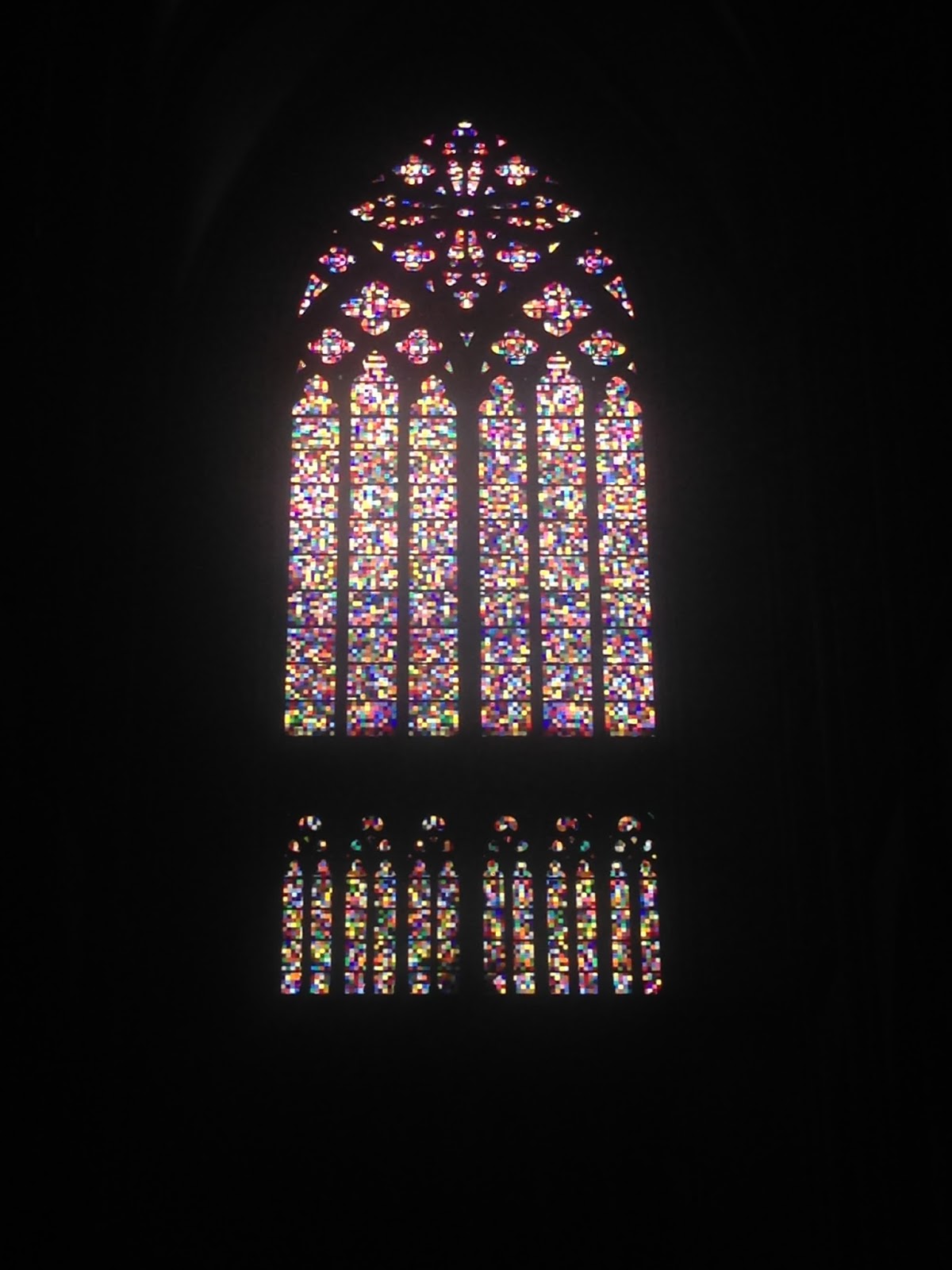
Stain glass from the Cologne Cathedral
 Cologne was a fortress outpost of the Roman Empire beginning in 38 B.C with the first urban settlement of Oppidum Ubiorum in what is today modern day Germany, the dividing line between civilization and barbarism. This first urban settlement was established on the Rine by Roman General Marcus Vipsanius Agrippa. The website of the Romano Germanic Museum in Cologne described its evolution. "The military outpost continued to grow and was eventually elevated to a colony status under Emperor Claudius in A.D. 50. He re-named the area, Colonia Claudia Ara Agrippinensium (“Colony of Claudius and the Altar of Agrippina”) after his wife Agrippina the Younger who was born there. From the colony’s shortened name Colonia Agrippina, thus came the modern name Cologne. Due to its strategic location on the Rhine, the colony grew both militaristically and economically, and was eventually made the capital of the Roman province Germania Inferior."

According to the Cologne Cathedral website, says that "the first mention of a bishop of Cologne, St Maternus, was in the year 313 AD. Although there is no architectural evidence to prove it, it is possible that in Maternus's lifetime, the cathedral (the seat of the bishop) in Cologne, which was a Roman city at the time, stood in the same area as the cathedral we see today. The site of the Early Christian cathedral was in the north-eastern corner of the city, directly alongside the city wall and close to the northern gate. The area was predominantly residential. It is possible that the first church was situated inside a Roman house, which has been proven to have been the case in other Roman cities." The Western Roman Empire collapsed in in the west, when the last Roman emperor, Romulus Augustulus, was deposed by the Germanic King Odoacer in 476 AD. In the east, it continued until 1453 AD.

Roman ruins excavated in Cologne, Germany


Eighty five years after construction began on the Cathedral of Notre Dame in Paris, the construction of the Cologne Cathedral began on 1248 A.D.  1,210 years after Christianity arrived in Cologne this magnificent Cathedral was built.

European civilization would reach a breaking point in the 20th Century with World War One and World War Two. Adeneur's political career as a Christian Democrat was paused in 1933 by the Nazis, who understood that he was a threat to their designs. He would suffer political repression during the Nazi dictatorship and be arrested several times. In the aftermath of WWII he emerged as a leader, and the first chancellor of post-Hitler Germany. He presided over the economic recovery in Germany and that countries integration into what would become known as the European Union. He was a fierce and brilliant anti-communist. In large part it is thanks to him that Germany where it is today. His legacy of intelligent democracy promotion is carried out today by the foundation that bears his name.

Popular culture focuses on the destroyers: Hitler, Stalin, Lenin, Mao, Castro, Pol Pot and their defenders and critics debate their merits, despite the societies they led being destroyed on every level: moral, material, spiritual and the rest. This is a stupidity of the first order. Soviet Foreign Minister Anatoliĭ Andreevich Gromyko in his book Through Russian Eyes : President Kennedy's 1036 Days (1973) quotes Adenuer, "In view of the fact that God limited the intelligence of man, it seems unfair that he did not also limit his stupidity." 

This is a mistake one should focus on those who preserved the peace and made things better such as Adeneur, De Gasperi, Churchill and others who founded a Europeaan order that prevented the outbreak of a major war for over seventy years as Metterneich and another generation did from 1815 to 1914. Listen to the words of one of the men who helped give Europe seven decades and counting without a major war.

Friday, December 1, 2017

International Support for Cuban prisoner of conscience Eduardo Cardet: United States and Spain

On the one year mark of his unjust imprisonment, U.S. Congressman, Spanish political and civic leaders call for release of Eduardo Cardet, national coordinator of the Christian Liberation Movement.


Eduardo Cardet
Diaz-Balart: One Year of Dr. Cardet’s Imprisonment Highlights Continued Repression by Castro Regime

Nov 30, 2017

WASHINGTON – Congressman Mario Diaz-Balart (FL-25) issued the following statement marking the one year anniversary that Cuban activist Dr. Eduardo Cardet was brutally and arbitrarily arrested. Cardet remains imprisoned by the Castro regime.

“Today marks one year since the latest disgraceful arrest of Cuban activist Dr. Eduardo Cardet.  Dr. Cardet is a leader within Cuba’s Christian Liberation Movement (MCL) and a physician who worked in a health center in Velasco until he was expelled due to his pro-democracy activities.  According to accounts provided by MCL members, Dr. Cardet suffered severe beatings at the time of his arrest and during his subsequent detention.  Human rights organizations such as Amnesty International, Freedom House, and Directorio Democratico Cubano have condemned his imprisonment.

“Dr. Cardet’s imprisonment highlights the continued repression suffered by those who dare to express opposition to the Castro regime.  Prior to an important JusticeCuba event in Washington, D.C. earlier this month, which I attended, the Castro regime prohibited Jorge Luis Garcia Perez Antunez from leaving Cuba to personally attest to lawmakers the brutal repression that he has faced.  Just this month, dozens of the renowned Ladies in White, who march in support of political prisoners and their families, were detained on Sundays while on their way to Mass.

“The repression must end, and innocent activists such as Dr. Cardet, Antunez, and the Ladies in White must no longer endure these egregious human rights abuses simply for expressing opposition to tyranny.”

In Spanish


Manifesto for the freedom of Eduardo Cardet

FOR THE LIBERATION OF THE PRISONER OF CONSCIENCE IN CUBA EDUARDO CARDET

Eduardo Cardet, "the village doctor", imprisoned on November 30, 2016 for political reasons and declared a prisoner of conscience by Amnesty International, remains in crowded conditions with ordinary prisoners and sentenced to three years in a fraudulent trial for assault against an authority.His notoriety in Cuba is due to being the successor of Oswaldo Payá at the head of the MCL, the Christian Liberation Movement, which carries out the peaceful demand "One Cuban, One Vote", which is being handed out to the deputies of the National Assembly of the Popular Power of Cuba and that in retaliation has ended with its leader in prison.


They are applying against Dr. Cardet treatment reserved for a prisoner in maximum security in open violation of the same penitentiary laws in force on the Caribbean island.

His detention a year ago was very dangerous, as he was arrested and beaten in front of his children. In all this long period of arbitrary detention he has been under the supervision and control at all times by State Security. His family is also threatened and coerced and all of this when, according to the Cuban regime, he is only charged with a common crime of brawling with one of the police officers who arrested him. 

Cuba has always been a fraternal people with which we are united by great ties of blood and shared history. The release of Eduardo Cardet, who was honored last July with the Prize for Freedom of Conscience of the Peace and Cooperation Foundation, is a just cause that deserves the support of all democratic citizens.

For this reason, the undersigned formulated to the Cuban authorities this petition for the release of those imprisoned for reasons of conscience in Cuba. Likewise, we ask the Spanish authorities, in coherence with the principles of defense of human rights and democracy, to do everything possible to ensure the immediate release of Eduardo Cardet and other prisoners of conscience in Cuba. 

November 30, 2017

1. José María Álvarez del Manzano, former Mayor of Madrid
2. Joaquín Antuña, Presidente de la Fundación Paz y Cooperación
3. Enrique Barón Crespo, ex Presidente del Parlamento Europeo y Ex Ministro de Transportes del Gobierno de España
4. Josep Borrell, Ex Presidente del Parlamento Europeo y Ex Ministro de transporte del Gobierno de España
5. Benita Ferrero-Waldner, Presidente de la Fundación Eurolat, ex Comisaria de la Unión Europea y ex Ministra de Asuntos Exteriores de Austria
6. Fernando Gerbasi, Embajador de Venezuela y ex Viceministro de Asuntos Exteriores de Venezuela
7. José María Gil-Robles, ex Presidente del Parlamento Europeo
8. Fernando González Urbaneja, Periodista y Presidente de la Revista Consejeros
9. David Hatchwell, Presidente de la Comunidad Judía de Madrid y Presidente del Grupo Excem
10. Como Hubar, Embajador de los Países Bajos
11. Javier Morillas, Catedrático Economía Aplicada Universidad San Pablo CEU
12. Eugenio Nasarre, Presidente del Consejo Federal Español del Movimiento Europeo y ex Diputado a Cortes
13. Alfonso Ramonet, Empresario y Jefe de Protocolo Arzobispado de Madrid
14. Rafael Rubio Núñez, Profesor Derecho Constitucional Universidad Complutense de Madrid
15. Javier Rupérez, Embajador de España y ex Diputado a Cortes
16. Juan Solaeche, Rector Sociedad Estudios Internacionales
17. Carlos Uriarte, Miembro del Consejo de Presidencia de la Unión Paneuropea Internacional

 In Spanish