
"We all live under the same sky, but we don't all have the same horizon. In an instant age, perhaps we must relearn the ancient truth that patience, too, has its victories." - Konrad Adeneur
Today visited Cologne, Germany the birthplace of Konrad Adeneur, Germany's greatest statesman who presided over the German economic miracle following the destruction of the country in World War 2. He was Time's Man of the Year in 1954. The roots of Western civilization have a long history in Cologne, Germany and no doubt shaped his formative years along with his Catholic faith.
Cologne was a fortress outpost of the Roman Empire beginning in 38 B.C with the first urban settlement
of Oppidum Ubiorum in what is today modern day Germany, the dividing line between civilization and barbarism. This first urban settlement was established on the Rine by Roman General
Marcus Vipsanius Agrippa. The website of the Romano Germanic Museum in Cologne described its evolution. "The military outpost continued to grow and was
eventually elevated to a colony status under Emperor Claudius in A.D.
50. He re-named the area, Colonia Claudia Ara Agrippinensium (“Colony of
Claudius and the Altar of Agrippina”) after his wife Agrippina the
Younger who was born there. From the colony’s shortened name Colonia
Agrippina, thus came the modern name Cologne. Due to its strategic
location on the Rhine, the colony grew both militaristically and
economically, and was eventually made the capital of the Roman province
Germania Inferior."
According to the Cologne Cathedral website, says that "the first mention of a bishop of Cologne, St Maternus, was in the year 313 AD. Although there is no architectural evidence to prove it, it is possible that in Maternus's lifetime, the cathedral (the seat of the bishop) in Cologne, which was a Roman city at the time, stood in the same area as the cathedral we see today. The site of the Early Christian cathedral was in the north-eastern corner of the city, directly alongside the city wall and close to the northern gate. The area was predominantly residential. It is possible that the first church was situated inside a Roman house, which has been proven to have been the case in other Roman cities." The Western Roman Empire collapsed in in the west, when the last Roman emperor, Romulus Augustulus, was deposed by the Germanic King Odoacer in 476 AD. In the east, it continued until 1453 AD.
Eighty five years after construction began on the Cathedral of Notre Dame in Paris, the construction of the Cologne Cathedral began on 1248 A.D. 1,210 years after Christianity arrived in Cologne this magnificent Cathedral was built.
European civilization would reach a breaking point in the 20th Century with World War One and World War Two. Adeneur's political career as a Christian Democrat was paused in 1933 by the Nazis, who understood that he was a threat to their designs. He would suffer political repression during the Nazi dictatorship and be arrested several times. In the aftermath of WWII he emerged as a leader, and the first chancellor of post-Hitler Germany. He presided over the economic recovery in Germany and that countries integration into what would become known as the European Union. He was a fierce and brilliant anti-communist. In large part it is thanks to him that Germany where it is today. His legacy of intelligent democracy promotion is carried out today by the foundation that bears his name.
Popular culture focuses on the destroyers: Hitler, Stalin, Lenin, Mao, Castro, Pol Pot and their defenders and critics debate their merits, despite the societies they led being destroyed on every level: moral, material, spiritual and the rest. This is a stupidity of the first order. Soviet Foreign Minister Anatoliĭ Andreevich Gromyko in his book Through Russian Eyes : President Kennedy's 1036 Days (1973) quotes Adenuer, "In view of the fact that God limited the intelligence of man, it seems unfair that he did not also limit his stupidity."
This is a mistake one should focus on those who preserved the peace and made things better such as Adeneur, De Gasperi, Churchill and others who founded a Europeaan order that prevented the outbreak of a major war for over seventy years as Metterneich and another generation did from 1815 to 1914. Listen to the words of one of the men who helped give Europe seven decades and counting without a major war.
 |
| Konrad Adenuer, statesman |
Today visited Cologne, Germany the birthplace of Konrad Adeneur, Germany's greatest statesman who presided over the German economic miracle following the destruction of the country in World War 2. He was Time's Man of the Year in 1954. The roots of Western civilization have a long history in Cologne, Germany and no doubt shaped his formative years along with his Catholic faith.
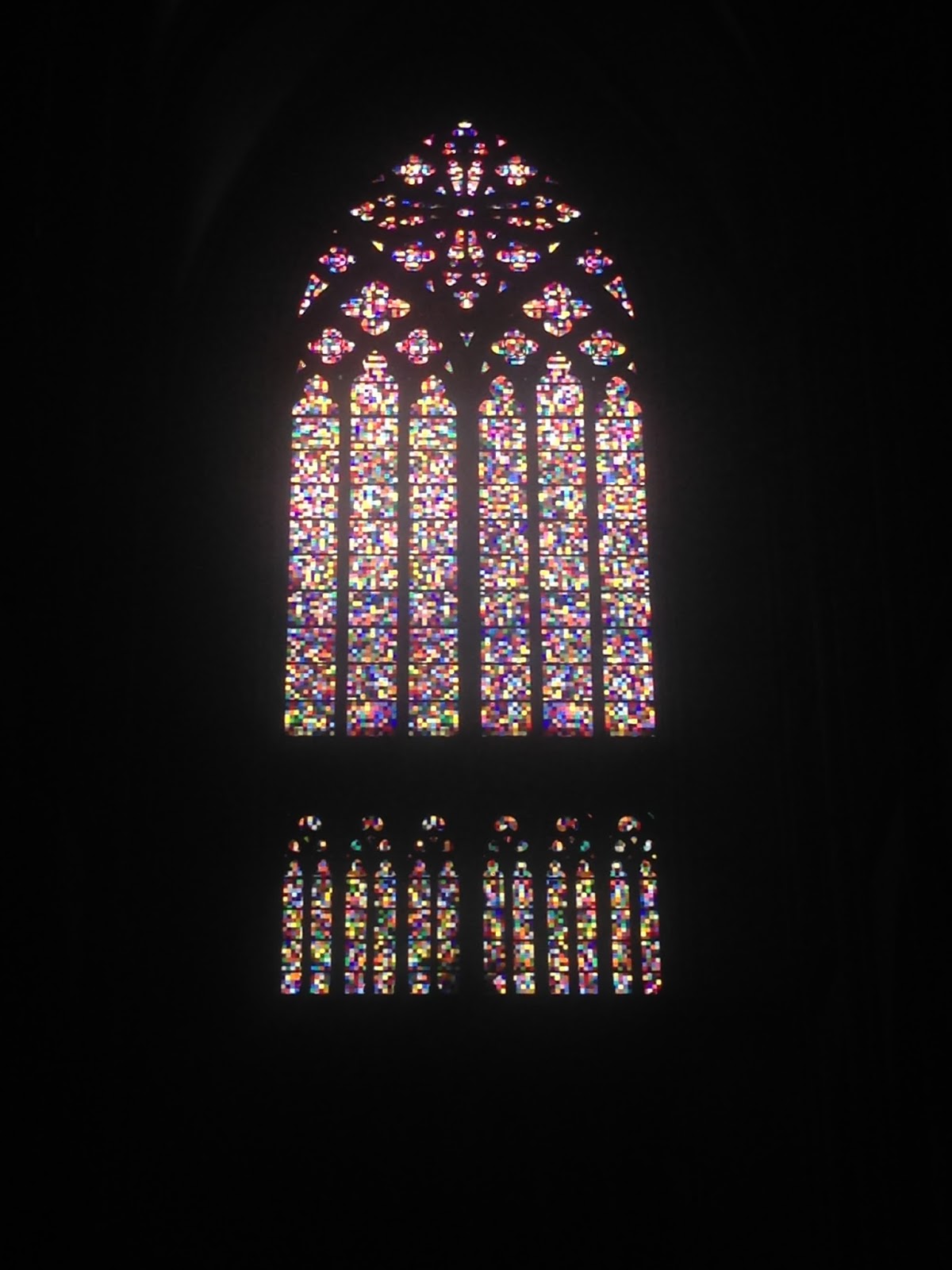 |
| Stain glass from the Cologne Cathedral |
According to the Cologne Cathedral website, says that "the first mention of a bishop of Cologne, St Maternus, was in the year 313 AD. Although there is no architectural evidence to prove it, it is possible that in Maternus's lifetime, the cathedral (the seat of the bishop) in Cologne, which was a Roman city at the time, stood in the same area as the cathedral we see today. The site of the Early Christian cathedral was in the north-eastern corner of the city, directly alongside the city wall and close to the northern gate. The area was predominantly residential. It is possible that the first church was situated inside a Roman house, which has been proven to have been the case in other Roman cities." The Western Roman Empire collapsed in in the west, when the last Roman emperor, Romulus Augustulus, was deposed by the Germanic King Odoacer in 476 AD. In the east, it continued until 1453 AD.
 |
| Roman ruins excavated in Cologne, Germany |
Eighty five years after construction began on the Cathedral of Notre Dame in Paris, the construction of the Cologne Cathedral began on 1248 A.D. 1,210 years after Christianity arrived in Cologne this magnificent Cathedral was built.
European civilization would reach a breaking point in the 20th Century with World War One and World War Two. Adeneur's political career as a Christian Democrat was paused in 1933 by the Nazis, who understood that he was a threat to their designs. He would suffer political repression during the Nazi dictatorship and be arrested several times. In the aftermath of WWII he emerged as a leader, and the first chancellor of post-Hitler Germany. He presided over the economic recovery in Germany and that countries integration into what would become known as the European Union. He was a fierce and brilliant anti-communist. In large part it is thanks to him that Germany where it is today. His legacy of intelligent democracy promotion is carried out today by the foundation that bears his name.
Popular culture focuses on the destroyers: Hitler, Stalin, Lenin, Mao, Castro, Pol Pot and their defenders and critics debate their merits, despite the societies they led being destroyed on every level: moral, material, spiritual and the rest. This is a stupidity of the first order. Soviet Foreign Minister Anatoliĭ Andreevich Gromyko in his book Through Russian Eyes : President Kennedy's 1036 Days (1973) quotes Adenuer, "In view of the fact that God limited the intelligence of man, it seems unfair that he did not also limit his stupidity."
This is a mistake one should focus on those who preserved the peace and made things better such as Adeneur, De Gasperi, Churchill and others who founded a Europeaan order that prevented the outbreak of a major war for over seventy years as Metterneich and another generation did from 1815 to 1914. Listen to the words of one of the men who helped give Europe seven decades and counting without a major war.





 Posts
Posts

