Sunday, September 13, 2020

Gaslighting Cuban Americans on Obama's Cuba policy hurting Vice President Biden with Cuban American voters

“We are going to have diplomatic relations with the United States without having ceded one iota.”- Gerardo Hernandez, Cuban spy sentenced to life in prison for murder conspiracy freed by Obama as part of his deal with Raul Castro.

Raul Castro, First Lady Michelle Obama, President Barack Obama in March 2016

On September 3, 2020 Vice President Joe Biden  in an interview with Jackie Nespral of NBC6 said he'd "try to reverse the failed Trump policies, it inflicted harm on Cubans and their families. It’s done nothing to advance democracy and human rights, on the contrary, the crackdown on Cubans by the regime has gotten worse under Trump, not better.” What the Vice President is stating is that he would return to the Obama Cuba policy.  However human rights worsened under the Obama Cuba policy.

Consider the following during and after negotiations:

Machete attacks

The United States and Cuba held secret negotiations for 18 months beginning in 2013. Coinciding with the start of these negotiations were a series of machete attacks against opposition activists. On June 8, 2013 in Holguin, Cuba Werlando Leiva Batista of the Christian Liberation Movement was attacked with a machete on a public street. Later that same month on June 21, 2013 in Camaguey, Orlando Lazaro Gomez Hernandez, a member of the Pro Human Rights Party of Cuba stepped out of his home with a sign supporting hunger striker Luis Enrique Santos Caballero. Seeing this protest the president of the Committee for the Defense of the Revolution (CDR),  ran out of his home with a machete and attacked Orlando Lazaro with it, cutting part of his right hand and also striking him on the back. Others came out as the activist fell to the ground and began to kick him.

Freeing spy convicted of murder conspiracy of three Cuban Americans and a Cuban resident

The December 17, 2014 announcement by the President broke new ground in only one area releasing Gerardo Hernandez, a Cuban spy and terrorist, convicted of murder conspiracy of three U.S. citizens and a resident. Not only did President Obama commute the sentence but tried to rewrite history calling an act of international terrorism, the Brothers to the Rescue shoot down, a tragedy.  Freeing unrepentant killers is not a good policy for promoting human rights.

Brothers to the Rescue shoot down victims.

Small number of political prisoners released
Obama administration attempt to claim that the release of 53 political prisoners in early January 2014 was a human rights improvement. But once the names were released it was revealed that 17 of the 53 had been released prior to the agreement and had nothing to do with it. This meant that a total of 38 political prisoners were freed at the time.  Some context is needed to understand how small this number is. The Swedish NGO, Civil Rights Defenders, on January 13, 2020 reported that " approximately 8,400 Cubans currently serve time for ”pre-criminal social dangerousness”.

According to a report in The New York Times on January 13, 2020 documents were examined that "showed that approximately 92 percent of those accused in the more than 32,000 cases that go to trial in Cuba every year are found guilty. Nearly 4,000 people every year are accused of being “antisocial” or “dangerous,” terms the Cuban government uses to jail people who pose a risk to the status quo, without having committed a crime." Furthermore, the article says that "records show that Cuba’s prison system holds more than 90,000 prisoners. The Cuban government has only publicly released the figure once, in 2012, when it claimed that 57,000 people were jailed."

Regime behavior worsened in the immediate aftermath of the normalization announcement.


Skyrocketing arbitrary detentions

The number of politically motivated arbitrary detentions documented by the Havana based, Cuban Commission for Human Rights and National Reconciliation since 2008 demonstrates a dramatic rise in repression between 2008 and 2016, that spiked dramatically in the year of the Obama Administration's new Cuba policy announcement in 2014 from 6,424 arbitrary detentions in 2013 to 8,899 in 2014. This also occurred with troubling incidents of violence by regime agents.

During President Obama's last year in office the number of arbitrary detentions reached their highest number since 2010 with 9,940 arbitrary detentions. Despite this, on his way out of office in January 2017, President Obama closed the door on Cuban refugees. 

During 2017 there were 5,155 Cubans arbitrarily detained, and although still far too high, it is a dramatic improvement over 2016. There are still prisoners of conscience enduring horrid and dangerous conditions in Cuban prisons and dissenters sent to psychiatric institutions for punishment.

Sirley Avila Leon: Before and after May 2015 machete attack

More extreme machete attack in 2015

Six months after the announcement of normalizing relations on May 24, 2015, Sirley Ávila León was the victim of a brutal machete attack that cost her her left hand and also left her right upper arm nearly severed and knees slashed, leaving her crippled. She was denied adequate medical care and was told quietly by medical doctors that if she wanted to get better she would need to leave Cuba. The regime had been embarrassed by a campaign she organized to keep a school open. She arrived in Miami on March 8, 2016 unable to bend her legs, or use her remaining had.Thanks to a team of medical doctors treating her, by September 2016 Sirley had regained the use of her hand, and was able to walk short distances.

Negative international trends for human rights in Cuba under Obama Cuba policy.

Human rights worsened in Cuba as the dictatorship was legitimized internationally by the Obama Administration's Cuba policy, and March 2016 state visit that led to Cuban dissidents and human rights defenders becoming more isolated. 

EU's High Representative Federica Mogherini with Raul Castro


The Obama Administration's Cuba policy had a negative impact internationally on human rights in Cuba internally. The decision of the European Union to "open a new chapter" on relations with Cuba that dropped human rights as a condition for normalization and ended a European Common Position adopted in 1996. This arrangement was formalized in a signing ceremony on December 12, 2016. Twenty  years of linking improved relations between the EU and Cuba to improvements in human rights ended.

Gaslighting the Cuban American community with the claim that the Obama Cuba policy was good on human rights in Cuba is leading to Biden's poll numbers tanking among that demographic. 

Former Secretary of State John Kerry recognizing this reality began to change the campaign's triumphalist message in order to bring it closer in line with the facts on the ground outlined above when told journalist Andres Oppenheimer earlier this month: “It’s fair to say that everybody shares a little bit of disappointment about the direction that the government in Cuba chose to go” after the normalization of U.S.-Cuba ties. Cuba seemed to harden down after the initial steps were taken.”

No kidding.


Read more here: https://www.miamiherald.com/news/local/news-columns-blogs/andres-oppenheimer/article245597340.html#storylink=cpy


Friday, September 11, 2020

Guevara's and Castro's drive to overthrow existing governments in Latin America led to the rise of Augusto Pinochet

 "Hatred as an element of the struggle; a relentless hatred of the enemy, impelling us over and beyond the natural limitations that man is heir to and transforming him into an effective, violent, selective and cold killing machine. Our soldiers must be thus; a people without hatred cannot vanquish a brutal enemy." - Ernesto "Che" Guevara, Message to the Tricontinental (1967)

Fidel Castro and Augusto Pinochet meet in Chile

Ernesto "Che" Guevara's drive to overthrow existing governments in Latin America, combined with Fidel Castro's support for terrorist groups in Chile led to unease in Chile that resulted in Augusto Pinochet's successful coup against Salvador Allende on September 11, 1973.

Che Guevara was an admirer of Mao Zedong and his formulation of guerilla warfare is adapted from the Chinese leader. Che published influential manuals Guerrilla Warfare (1961) and Guerrilla Warfare: A Method (1963), which were based on his own experiences and partly chairman Mao Zedong's writings. Guevara stated that revolution in Latin America must come through insurgent forces developed in rural areas with peasant support. His international legacy of glorifying violence through an erroneous analysis of guerilla warfare, based on his experiences with the Batista army, which was too incompetent and corrupt to fight, and applying Zedong’s writings on the subject led to bloodbaths in Argentina, Chile, El Salvador, Nicaragua, Chiapas, Congo, Angola and decades of military dictatorship and political violence. 

Ernesto "Che" Guevara meets Mao Zedong in China in 1960

Guevara in his 1967 Message to the Tricontinental, an international gathering of guerilla and terrorist groups from Asia, Europe, and Latin America, described the kind of struggle  to be expanded and carried out in Latin America to overthrow the existing governments:

"We must carry the war into every corner the enemy happens to carry it: to his home, to his centers of entertainment; a total war. It is necessary to prevent him from having a moment of peace, a quiet moment outside his barracks or even inside; we must attack him wherever he may be; make him feel like a cornered beast wherever he may move." 

Guevara’s call to total war led to the rise of new military juntas in countries that had not known them before in their history: Brazil, Ecuador, Panama, and Uruguay all had their first military juntas after the Castro regime began to export guerillas and Guevara's ideology. Other countries such as Chile, who had known a military junta between 1924 and 1931, in reaction to communist threats in 1973 embraced Augusto Pinochet who remained in power for seventeen years thanks to the continued terrorism carried out by agents and groups funded and backed by Fidel Castro. 

With the exception of Nicaragua Che Guevara’s prescription for revolution in Latin America led to a generation of right wing military dictatorships and harsh repression. In Nicaragua it led to a Marxist dictatorship, civil war and harsh repression. 

In Ireland the Irish Republican Army holds up Guevara as a hero and exemplar. No one should be surprised when some of his admirers in Ireland planted a 600 pound bomb to advance their revolutionary agenda. They were just following the Argentine revolutionary's instructions.

Guevara and Chairman Mao dining together in 1960


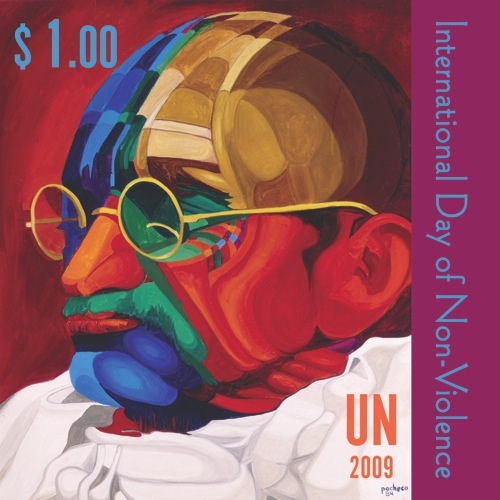
Gandhi and the importance of September 11th for nonviolence

"Terrorism and deception are weapons not of the strong but of the weak." - Mohandas K. Gandhi

Gandhi in South Africa

114 years ago today on September 11, in South Africa Mohandas Gandhi coined the term Satyagraha which brought together truth and firmness into one word defining the essence of nonviolent resistance.

Nineteen years ago today, the United States was attacked and 2,977 men, women, and children were murdered and over 6,000 wounded in terrorist attacks planned by Osama Bin Laden and his Al Qaeda network.

September 11, 2001 victims

The date September 11 was picked by the terrorists because it marks the September 11, 1683 defeat of the Ottoman Empire at the Battle of Vienna. It turned the tide of Islamic conquest in Europe. 318 years later the Islamist began their offensive in revenge for the defeat of their armies in the heart of Europe.

Michael Nagler, a long time peace scholar, presents the theorem as follows: Nonviolence sometimes “works” and always works, while by contrast, Violence sometimes “works” and never works.  Nagler offers a more detailed explanation.

The exercise of violence always has a destructive effect on human relationships even when, as sometimes happens, it accomplishes some short-term goal. The exercise of nonviolence, or Satyagraha, always brings people closer. This explains why Gandhi, after fifty years of experimentation in every walk of life, could declare that he “knew of no single case in which it had failed.” Where it seemed to fail he concluded that he or the other satyagrahis had in some way failed to live up to its steep challenge.  Taking the long view, he was able to declare that “There is no such thing as defeat in non-violence. The end of violence is surest defeat.”

The young Mohandas Gandhi

Humanity faces a stark choice defined and marked by the chasm between the strong and courageous Satyagraha of Mohandas Gandhi and weak and frustrated terrorists. Will hope or terror triumph? In the article linked to below Gandhi describes the meeting where the word Satyagraha came into existence and with the life he lived gave the answer to the question.

Gandhi, M.K., Satyagraha in South Africa (Ahmedabad, 1928, revised 2nd edition, 1950) pp. 95-102)

Mohandas Gandhi was a critic of terrorism, as the quote on the top of the page indicates, but below are two more epigrams by the Indian independence leader.

"I do not regard killing or assassination or terrorism as good in any circumstances whatsoever."

"The spirit of democracy cannot be established in the midst of terrorism, whether governmental or popular."  

Tuesday, September 8, 2020

Christian Liberation Movement statement on 32nd anniversary since its founding

1988-2020 XXXII Anniversary of the Christian Liberation Movement.


Today marks 32 years since the founding of the Christian Liberation Movement, our thanks and admiration to its founding fathers, and many congratulations to all the brothers who during these years have remained firm and consistent with the principles and values ​​of Liberation.

These years have been hard: persecution, repression, jail, exile, isolation, murder of our leaders; but also fruitful, there are the Varela Project, The Peoples Path (El Camino del Pueblo), the Heredia Project, Once Cuban one Vote (Un Cubano un Voto), among others; formidable expressions of citizen mobilization in order to demand the rights that the regime denies to the Cuban people.

We use nonviolence as a method of struggle to subvert oppression, and as a rational and civilized response to intolerance and hatred.

For the people a message of faith and hope, with the certainty that change is possible if all Cubans of good will work for that purpose.

Freedom for Cuba, enough of injustices and oppression!
 
Freedom for all political prisoners and prisoners of conscience!

Long live Oswaldo and Harold!

Long live the MCL!

 
Original text in Spanish below:

1988-2020 XXXII Aniversario del Movimiento Cristiano Liberación.

Hoy cumple 32 años de fundado el Movimiento Cristiano Liberación, nuestro agradecimiento y admiración a sus padres fundadores, y muchas felicidades a todos los hermanos que durante estos años se han mantenido firmes y coherentes a los principios y valores de Liberación.

Estos años han sido duros: persecución, represión, cárcel, destierro, aislamiento, asesinato de nuestros lideres; pero también fecundos, ahí están el Proyecto Varela , El Camino del Pueblo, el Proyecto Heredia, Un Cubano un Voto entre otros; formidables expresiones de movilización ciudadana en aras de exigir los derechos que el régimen niega al pueblo cubano.

Empleamos la no violencia como método de lucha para subvertir la opresión, y como respuesta racional y civilizada a la intolerancia y el odio.

Para el pueblo  un mensaje de fe y esperanza, con la certeza que el cambio es posible si todos los cubanos de buena voluntad trabajamos por dicho propósito.

¡Libertad para Cuba, basta ya de injusticias y opresión!
Libertad para todos los presos políticos y de ¡conciencia!
¡Vivan Oswaldo y Harold!
¡Viva  el MCL!

 Eduardo Cardet.
Coordinador  Nacional  del MCL

Sunflower Uprising?: Cuban dissidents announce call for nonviolent protests on Lady of Charity feast day

"Nonviolence is a powerful and just weapon. Indeed, it is a weapon unique in history, which cuts without wounding and ennobles the man who wields it." - Rev. Martin Luther King Jr., Nobel Prize acceptance speech, Stockholm, Sweden, 1964

 September 8th is the feast day for Our Lady of Charity, known affectionately as "Cachita", and she unites Cubans together both inside and outside of the island. This year it falls on a Tuesday. She is also a touch stone of Cuban identity. Catholics take sunflowers to the shrine to Our Lady of Charity which is located in Santiago de Cuba. 

September 8th is also the 32nd anniversary of the founding of the Christian Liberation Movement, whose leader Oswaldo Payá Sardiñas, and youth leader Harold Cepero Escalante, were extrajudicially executed by Castro's secret police on July 22, 2012.

 Like Oswaldo and Harold, the founding leader of this movement, Laura Inés Pollán Toledo , died under suspicious circumstances in 2011.

Cuban dissident Yosvany Arostegui Armenteros died on August 7, 2020 in Cuba while in police custody following a 40 day hunger strike. He had been jailed on false charges in the Kilo 8 prison of Camagüey. His body was quickly cremated by the dictatorship without his families consent.  

Yosvany Arostegui Armenteros

Prisoner of conscience Silverio Portal Contreras, former activist with the Ladies in White, is serving a 4-year sentence for "contempt" and "public disorder." He was arrested on the June 20, 2016 in Havana after shouting “Down Fidel Castro, down Raúl...” Regime agents were upset because according to them, "the behavior of the accused is particularly offensive because it took place in a touristic area."  

Prisoner of conscience Silverio Portal Contreras

According to Silverio’s wife, before his arrest he had campaigned against the collapse of dilapidated buildings in Havana. Silverio was recognized as a prisoner of conscience by Amnesty International on August 26, 2019. He was beaten by prison officials in mid-May 2020 and lost sight in one eye. Since then his health has worsened and he has lost sight in the second eye. Activists are circulating a petition for his freedom.

The initiative solidarity between brothers continues to demand that the shipment of humanitarian assistance detained by the dictatorship be released, and call for participants in the sunflower uprising to join in this demand.

These are some of the reasons why on September 8th brave souls will be protesting in Cuba to reject repression and to demonstrate their solidarity with the Ladies in White, who are regularly assaulted for nonviolently gathering on Sundays.

 It is also why the secret police are working over time to shutdown the protests before they start with preemptive arrests and sunflowers have disappeared in Havana.

It is all the more reason why people of good will should denounce the oldest and most ruthless dictatorship in the Western hemisphere and go to the street on September 8th with a sunflower in hand and love for liberty in their hearts. 

In Washington DC activists will be gathering in front of the Cuban Embassy at 11:00am.