Thursday, June 25, 2020

The Wasp Network, that killed Americans and plotted a terror attack on US soil, were not the Castro regime's last soldiers of the Cold War

Some of what they left out.


Wasp Network is a 2019 film now playing on Netflix that is based on the book The Last Soldiers of the Cold War by the Brazilian author, journalist, and politician Fernando Morais that paints a sympathetic and whitewashed picture of the Castro regime's spy network that was rounded up by the FBI in 1998. To have a better idea about who the author is and his ideological motivations consider the following factoid. Morais's first book published in 1976 titled A Ilha about his three month visit to Cuba, at a time when Brazil's military dictatorship had severed relations with the Castro's communist dictatorship since 1964, and Brazilian passports carried a warning: "Not valid for Cuba."

This visit and the book upon which it was based made Morais an icon of the Brazilian left.

Olivier Assayas, who wrote the screenplay, based on the book by Morais, and directed the film, initially encountered resistance from the Castro regime, but found all doors opened to him and he spent half a year in Havana, Cuba  to complete the film.

Therefore it should be a surprise that the book that the film is based on and the film portrays the Castro dictatorship, and its spy network in a favorable and non-threatening light. The film is a masterclass and misinformation, but also a demonstration that to satisfy Havana what should have been a powerful and impacting film ended up a mediocrity, panned by critics and with even a lower score among the audience according to Rotten Tomatoes.

The WASP Network (La Red Avispa) was made up of over forty officers and agents, four escaped to Cuba when the FBI began rounding them up. Ten were captured, and five of them pleaded guilty and cooperated with the prosecution. They are unpersons in Cuba, and the remaining five became the focus of an international propaganda campaign organized by the Castro regime that did not end until December 2014.

The film briefly mentions the Ochoa Affair, and touches on its political aspect of liquidating General Arnaldo Ochoa, a popular general among the ranks, who was executed by firing squad in 1989, but fails to mention the Castro regime's extensive involvement in drug trafficking.


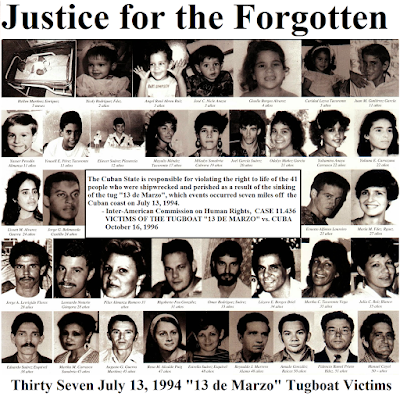
Whether consciously or not, to film in Cuba, and not have regime censors shut down their production, he gutted the film of what would have been powerful elements that would have provided context, not to mention drama and pathos to his film . It would've provided a dramatic explanation of the July 13, 1995 overflight of Havana by Brothers to the Rescue but this would have necessitated putting on film the July 13, 1994 "13 de marzo" tugboat incident when agents of the Castro regime sank a tugboat six miles off the coast of Havana and attacked and killed 37 men, women, and children trying to flee the island. Next month will mark 26  years without justice for the victims. A detailed report on this crime against humanity was published by the Inter-American Commission on Human Rights in 1996 and is available online.

One year later on the anniversary of the killings, and with the bodies never recovered, a flotilla of boats organized by Cuban pro-democracy groups tried to reach the spot where the tugboat rested with the remains of the tugboat victims to hold a service for the dead. The lead boat Democracia had its hull crushed by Cuban government gunboats, and turned back, as had been agreed upon by organizers, if the dictatorship's forces turned violent. At that moment Brothers to the Rescue that had been flying overhead changed course and flew over Havana dropping leaflets that read "Comrades No. Brothers."  This outraged the Castro brothers and I believe this is when they began plotting their revenge which they carried out seven months later.

Other and more dramatic activities carried out by the Wasp Network were left out of the film.

The spies had received instructions from Havana to burn down an airport hangar, sabotage planes, first terrorize then send a mail bomb to kill a CIA agent living in Bal Harbour identified as Jesus Cruza Flor. The network provided material intelligence that assisted in the shoot down of two civilian planes on February 24, 1996 killing four Americans that they do not even show or name in the film. They are treated as non-persons.


The Wasp Network engaged in espionage: targeted U.S. military facilities, planned to smuggle arms and explosives into the United States, provided information that led to the extrajudicial killings of Armando Alejandre, Carlos Costa, Mario de la Peña and Pablo Morales, infiltrated two non-violent exile groups, and carried out numerous other activities to sow division, shape public opinion, and meddle in U.S. elections.

The Cuban spy network gathered personal information of American military personnel "compiling the names, home addresses, and medical files of the U.S. Southern Command’s top officers and that of hundreds of officers stationed at Boca Chica Naval Station in Key West."  What did the Castro regime plan to do with this information?

The WASP spy network was disbanded in 1998 by the FBI, but another high ranking Castro spy burrowed deep in the Pentagon's Defense Intelligence Agency, Ana Belen Montes, was not arrested until days after the Twin Towers and the Pentagon were attacked on September 11, 2001.

All of this came out during their trial. Gerardo Hernandez, the head of the network was convicted of murder conspiracy and espionage and condemned to a double life sentence.

Hernandez had his double life sentence commuted by President Obama on December 17, 2014 as part of the concessions made in the drive to normalize relations between the two countries.

In April 2020, Gerardo Hernández, convicted of murder conspiracy for the Brothers to the Rescue shootdown and espionage for heading up the WASP spy network, was promoted to Deputy National Coordinator of the Committees for the Defense of the Revolution (CDR), an Orwellian agency, and is now tasked with spying on all Cubans in the island.

There is a long history of espionage by the Castro regime targeting the United States that stretches back to the early years of the Cuban dictatorship, and policy makers should not forget or underestimate it. These were not the last soldiers of the "Cold War", because Cuban spies continue to carry out the orders of the dictatorship in Havana even when that means carrying out acts of terrorism, torture, and murder.

In the meantime we can challenge the Castro regime's narrative and remember the victims and continue to demand justice. The case of the Brothers to the Rescue shootdown on February 24, 1996 has been studied in detail and a report prepared in 1999 by the Inter-American Commission for Human Rights with references to other sources. The Wasp Network film never identified the four men killed on that Saturday afternoon 24 years ago. Lets challenge their narrative with facts and documentary evidence. Let us also remember and say the names of Armando Alejandre, Carlos Costa, Mario de la Peña and Pablo Morales.

Wednesday, June 24, 2020

Is Cuba coming to Seattle at the the Capitol Hill Occupied Protest (CHOP)? Press freedoms violated by revolutionaries in control

Have constitutional rights been suspended at the Capitol Hill Occupied Protest (CHOP)

Capitol Hill Occupied Protest (CHOP) in Seattle Washington
Capitol Hill Autonomous Zone "CHAZ" renamed now the Capitol Hill Occupied Protest (CHOP), consists of six city blocks that protesters have taken over, is apparently following aspects of the the Cuban model of policing when dealing with journalists who record them without their permission. The video below starting at 3 hours and 44 minutes starts calm, but then the sound of gun fire erupts, followed by CHOP security coming in and trying to censor the citizen journalist at 3 hours and 50 minutes.
Citizen journalist Shawn Gui was recording with a live feed from his phone when shooting erupted, and shortly afterwards the CHOP's security forces grabbed his camera and tried to delete it.

On Sunday night, a second shooting occurred in Seattle’s so-called “Capitol Hill Autonomous Zone,” dubbed “CHAZ” or “CHOP,” that was captured via livestream by Twitch user Shawn Whiting.
In footage of the aftermath of the shooting, a member of CHAZ “security” is seen stealing Whiting’s phone and demanding he “delete” the damning footage.

“Whiting was livestreaming on Twitch for just under four hours,” reported NOQ Report posted Monday morning. “Near the end, gunshots can be heard. At the time, it was unclear if the noise was actual gunshots or fireworks, but his phone continued to livestream after it was taken by a member of CHOP ‘security.’ The man who carried the phone away confirmed at least one person had been shot.”
Following the ring of gunfire, folks in CHAZ who’ve reached safety call the area a “war zone.”
“Another n***** just got shot,” one man says. “This is a war zone.”
Whiting suggests the shooting, the second in just two days (the Saturday shooting included at least one fatality), will be the “end of CHOP.”
“This is kind of a nightmare,” the Twitch user says aloud.
Earlier this month, far-left protesters including Antifa and Black Lives Matter supporters commandeered six blocks of property, including the Seattle Police Department’s East Precinct, which has since been abandoned.

At one point during the stream, Whiting is questioned by a “security” member of CHAZ and told to delete the footage. Whiting suggests he has permission to live-stream, directing the man to a person named “James Madison.”
“Give me that f***ing phone, man,” the man tells Whiting. “What the f*** are you doing? … Hey, hey! Delete that s***! Delete that f***ing s***!”
“That’s my phone!” Whiting says after his phone is stolen.
“I do not give a f***,” CHAZ “security” replies. “I do not care.”
Last week The Progressive, a publication founded in 1909 in Madison, Wisconsin published an article titled "Foreign Correspondent: Police Lessons From Cuba" by Reese Erlich that claimed "Contrary to the image of brutal and repressive communists, police in Cuba offer an instructive example for activists in the United States." 
At the time I outlined that in Cuba individuals uploading images of the police on a digital platform with out their permission would be guilty of violating Cuban law  and it would be compounded if the images portrayed the police in a negative light. 


At the time I naively pointed out that a law, patterned after Cuba's, would require those who record police on or off the job to get the approval of the police officer recorded before sharing the video with any digital platforms, and that it would run afoul of First Amendment  guarantees.

Evan Gerstmann writing in Forbes said, "The situation inside CHOP represents an egregious deprivation of its residents’ constitutional rights. The residents of the area have not consented to being ruled over by the leaders of CHOP. They have not consented to the withdrawal of police protection of their persons and property or to violations of freedom of the press."  

Americans in 2020 in six city blocks of Seattle, Washington are getting a little taste of Cuba. Reading the manifesto of some of the protesters, if they have their way many more Americans will be experiencing what being derived of your Constitutional rights feels like, but hey for the folks tearing down statues of Washington, and Jefferson all that is so 1787.

Sunday, June 21, 2020

Wasp Network film: What was left out watered down and muddled what would have been an interesting film

Say their names:  Armando Alejandre, Carlos Costa, Mario de la Peña and Pablo Morales. Killed on February 24, 1996 with the active assistance of the Wasp Network.


Olivier Assayas is a talented filmmaker who with Edgar Ramirez once made a powerful film about international terrorism that is worth seeing, unfortunately that film is not the 2019 film Wasp Network that has been correctly described as a "disappointingly muddled spy saga," and something to skip.

This is one case where reality is much more dramatic and engaging then what appeared on the screen, because the film was based on misinformation provided by the Castro regime to portray the WASP network in a positive light, and to do this non-violent movements Brothers to the Rescue, and the Democracy Movement had to libeled, their significance downplayed, and linked to violent groups with sketchy actors.

Meaning that at a time when a popular and broad based non-violent movement was gaining strength in the Cuban diaspora the film engages in an act of schizophrenia. The main spies featured in the film Juan Pablo Roque and Rene Gonzalez infiltrate Brothers to the Rescue and the Democracy Movement and attempted to get close to their respective leaders Jose Basulto and Ramon Saul Sanchez.

We do not see Ramon Saul Sanchez in the film, although he is mentioned, but we do encounter a version of Jose Basulto that bears no resemblance to the man I've been acquainted with for over 25 years, and had the privilege to briefly interview and take part in a panel discussion on nonviolence with both men.


The film repeats Castro regime falsehoods about both groups trying to link them to violent movements, but the reality is that they were collaborating with The King Center in the early 1990s and organized a non-violence teach in at Florida International University. The film includes footage of  former Foreign Minister Roberto Robaina (now defenestrated) defending the shoot down of the two civilian planes in February 24, 1996 and towards the end Fidel Castro making the case for his regime engaging in espionage on American soil.

The Wasp Network repeats the Castro regime's line that they were just spying on Cuban exile groups, and implies that there were only ten of them in the network. The reality is that there were over 40 operatives, and they were also targeting American military bases, Congressional offices, and were engaging in active measures to manipulate elections.

Ten captured spies
 The film lightly mentions the Ochoa Affair, and touches on its political aspect of liquidating General Arnaldo Ochoa, a popular general among the ranks, who was executed in 1989, but fails to mention the Castro regime's extensive involvement in drug trafficking.

However it guts the film of what would have been powerful elements that would have provided clarity not to mention drama and pathos to the film and explained the overflight of Havana by Brothers to the Rescue but this would have necessitated putting on film the July 13, 1994 ""13 de marzo" tugboat massacre when agents of the Castro regime sank a tugboat six miles off the coast of Havana and actively caused 37 men, women, and children to drown.

One year later on the anniversary of the killings, and with the bodies never recovered, a flotilla of exile boats tried to reach the spot where the tugboat rested with their remains to hold a service for the dead. The lead boat Democracia had its hull crushed by Cuban government gunboats, and turned back. At that moment Brothers to the Rescue that had been flying overhead changed course and flew over Havana dropping the leaflets that read "Comrades No. Brothers."  This outraged the Castro brothers and they began plotting their revenge which they carried out seven months later.

It would have been much more interesting to learn about the other activities carried out by the Wasp Network and what they were planning when captured by the FBI.

The Wasp Network had planned to burn down a airport hangar, first terrorize then send a mail bomb to kill a CIA agent living in Bal Harbour identified as Jesus Cruza Flor, and provided material intelligence that assisted in the shoot down of two civilian planes on February 24, 1996 killing four. This came out during their trial. Gerardo Hernandez, the head of the network was convicted of murder conspiracy and espionage and condemned to a double life sentence.

This would have been a much more interesting and powerful film and not the muddled and confused propaganda film that is now playing on Netflix and is slow moving and unwatchable. Worse yet, the film does not identify the four men killed in the shoot down or the persons who flew with Jose Basulto that day and made it back. It also downplays and cleans up the communications of the Castro regime's pilots as they shot down the two planes, and attempts to portray Basulto in a negative light. A more accurate breakdown of what happened is available here.  


The three planes did not over fly Havana and the two planes shot down did not enter Cuban airspace. The one plane that allegedly entered a mile into Cuba's airspace briefly while flying a search and rescue pattern with the other two planes that were farther out was Jose Basulto's. The film shows the MiGs flying by the Brothers to the Rescue planes which did not happen in real life. There was no warning.

International organizations recognized that Armando Alejandre, Carlos Costa, Mario de la Peña and Pablo Morales were murdered by agents of the Cuban government on February 24, 1996 when they were blown out of the sky by air-to-air missiles fired by a Cuban MiG.  This was a criminal conspiracy organized by an outlaw regime. 


Remember and say their names:  Armando Alejandre, Carlos Costa, Mario de la Peña and Pablo Morales. Killed on February 24, 1996 with the active assistance of the Wasp Network.

In the meantime go see Assayas's 2010 film Carlos, that explores the life of a terrorist trained by the Castro regime,  but give Wasp Network a pass.

Below is a transcription that was translated that gives you a more accurate idea of what this spy network was really up to.


Transcribed and translated excerpts from seized diskettes:
DAV-118 (E) RTF (AIRPORT.DIR)
WORK DIRECTIVES FOR OPERATION “AEROPUERTO”
1-. THE IDEA OF THE OPERATION:
SINCE THE VERY BEGINNING THE ESSENTIAL IDEA OF THE OPERATION WAS FOR A-32 TO JOIN WITH THE ILLEGAL CENTER THAT WAS BEING DIRECTED BY A-4 AND WAS FUNCTIONING IN THE STATE OF FLORIDA.
2-. OPERATIONAL OBJECTIVES:
THE FUNDAMENTAL OBJECTIVE OF THE OPERATION IS TO ESTABLISH S/A A-32 IN KEY WEST FOR THE PURPOSE OF PENETRATING AND OBTAINING INFORMATION ON THE NAVAL AIR STATION LOCATED IN THAT CITY.
ALSO, TO MAKE CONTACTS WHICH CAN PROVIDE US WITH MILITARY, POLITICAL , BIOGRAPHICAL AND OPERATIONAL INFORMATION AS AS TO STUDY COUNTERREVOLUTIONARY ORGANIZATIONS EXISTING IN THE AREA AND CARRY OUT STUDIES ON THE OPERATIONAL SITUATION OF ROADS, MAINLY IN KEY WEST.
3-. PARTICIPANTS
A-32 WILL BE THE MAIN PARTICIPANT AND HE WILL BE DIRECTLY UNDER I.O. A-4.
WORK DIRECTIVES FOR OPERATION “GIRÓN.”
1-. IDEA OF THE OPERATION
Reviewed by: LS Salomon
Declassified by: KMDJr / RJG
Cred. #10517
11/27/00 1

[…]

DHo-101 (E) CMA (Disk 17).wpd
OPERATION “PICADA’
OBJECTIVES:
1.-) TRY TO IMPEDE THE CONSUMPTION OF INTENTIONS OF THE OPERATION P.A.L. (PAN, AMOR Y LIBERTAD) OF THE COUNTERREVOLUTIONARY ORGANIZATION BROTHER’S TO THE RESCUE.
2.-) AFFECT AND DISCREDIT THE IMAGE OF SAID ORGANIZATION.
ACTIONS TO BE DEVELOPED:
1.-) PERFORM THE OPERATIONAL SITUATION STUDY OF THE HANGAR AT THE OPA LOCKA BASE WHERE THE ORGANIZATION KEEPS AND OPERATES THEIR PLANES.
2.-) THE POSSIBILITY OF BURNING DOWN THE WAREHOUSE OF THE COUNTERREVOLUTIONARY ORGANIZATION, AND AFFECT THEIR PLANES, MAKING IT SEEM LIKE AN ACCIDENT, NEGLIGENCE OR SELF DAMAGE.
KEEPING IN MIND THAT THIS PLACE MAY BE SECURED AND THAT IN CASES LIKE THESE, INVESTIGATIONS ARE PERFORMED, RUMORS WILL LEAK THAT BASULTO AND HIS PEOPLE CAUSED THE DAMAGE THEMSELVES TO COLLECT THE INSURANCE AND GET MORE MONEY FROM THEIR CONTRIBUTORS.
3.-) ATTEMPT TO DISABLE THEIR EQUIPMENT AND TRANSMISSION ANTENNAE ON LAND, THE ONES THEY USE TO COMMUNICATE WITH DURING THEIR MISSIONS, MAKING IT SEEM LIKE NEGLIGENCE.
NOTE: THESE THREE POINTS WERE REQUESTED OF CASTOR VIA RADIO MESSAGE. IT HAS TO BE DETERMINED WHAT HE HAS BEEN ABLE TO OBTAIN.
4.-) ANALYZE WITH CASTOR IF HE COULD INFORM US AHEAD OF TIME (DETERMINE PRECISE TIME) WHEN THE BROTHER’S TO THE RESCUE PLANES WILL BE TAKING OFF, WHO IS IN THEM AND IF THEY ARE GOING TO LAND AT A SPECIFIC PLACE. WHAT PERSONNEL KNOWS THIS INFORMATION BEFOREHAND. AT SOME POINT, CAN IT BE DETERMINED WHO PROVIDED THIS INFORMATION.
5.-) ACCORDING TO THE FEATURES OF THE PLANES, THEIR SECURITY SYSTEM, AS WELL AS THE HANGAR WHERE THEY ARE LOCATED, IF AT ANY SPECIFIC MOMENT HE COULD HIDE SOME TYPE OF MATERIAL AND KEEP IT THERE WITHOUT BEING DETECTED. WHAT SIZE WOULD THAT MATERIAL HAVE TO BE
OPERATION PARALLELO:
THE OBJECTIVE OF THIS OPERATION IS TO DEVELOP A SERIES OF ACTIONS AGAINST CIA AGENT JESUS CRUZA FLOR.
THESE ACTIONS WOULD BE:
1.-) PHOTOGRAPH OR VIDEO TAPE HIS HOUSE, LOCATED AT:
1440 S. BAYSHORE DR.
MIAMI, FLORIDA 33131
TELEPHONE (305)358-0762
2.-) ONCE THE HOUSE IS PHOTOGRAPHED, MAKE VARIOUS THREATENING TELEPHONE CALLS (TWO OR THREE) CONCERNING HIS NEARING EXECUTION.
THESE CALLS WOULD BE AT DIFFERENT HOURS AND DIFFERENT DAYS. TRY TO USE THE EQUIPMENT (CALLED SCRAMBLER OR SOMETHING SIMILAR) TO CHANGE THE VOICE. PHONE BOOTHS SHOULD BE SELECTED THAT ALLOW A QUICK EXIT OUT OF THE AREA. KEEP IN MIND THAT THE MEASURES IS AGAINST A CIA AGENT AND HE COULD HAVE CALLER ID TO FIND OUT THE TELEPHONE NUMBER THAT IS CALLING AND THE ADDRESS WHERE IT IS LOCATED. ON THE OTHER HAND, KEEP IN MIND THE REST OF THE SECURITY MEASURES THAT SHOULD BE TAKEN IN THE BOOTH, SUCH AS FINGERPRINTS, HAIR, ODORS, SALIVA, DRESS, THAT THERE BE NO PERMANENT PERSONNEL IN THE AREA TO RECOGNIZE THE CALLER. DO NOT LEAVE THE CAR WHERE IT CAN BE OBSERVED, THE DURATION OF THE CALL. DO NOT RESPOND TO ANY QUESTIONS ASKED.
3.-) PREPARE AN ALLEGED BOOK-BOMB (BOOK, CABLE, BATTERIES, PLASTIQUE, ETC., AND SEND IT VIA EXPRESS MAIL. KEEP IN MIND TO WRAP THE BOOK IN A PROTECTIVE PAPER, WHICH IF THE ENVELOPE IS PASSED THROUGH THE X-RAY MACHINES, IMPEDES THE DETECTION OF WHAT IS INSIDE, AND THEREFORE IT WILL NOT BE ROUTED THROUGH THE MAIL.
KEEP IN MIND TO OBTAIN THE ENVELOPE, AS WELL AS THE POSTAGE, MANY DAYS IN ADVANCE AND SELECT A BUSY PLACE. USE A SPECIFIC CAMOUFLAGE.
STUDY THE MAILBOX WHERE THE PACKAGE WILL BE DEPOSITED, AS WELL AS THE TIME IT WILL BE DEPOSITED. ANALYZE HOW YOU WILL GET OUT OF THE AREA.
DURING THE ENTIRE PROCESS KEEP THE SECURITY MEASURES IN MIND, SUCH AS THE ONES MENTIONED BEFORE, GIVING SPECIAL ATTENTION TO FINGER PRINTS DURING THE ENTIRE PROCESS.
EVALUATE THE POSSIBILITY OF USING MANOLO TO MAKE THE CALL, THE TOPOS TO DEPOSIT THE ENVELOPE AND A-4 TO PREPARE THE BOOK-BOMB.
--------------
FEBRUARY 1, 1994
CONTACT AGENDA WITH 0-4 “ESELIN”
Reviewed by: LS Salomon
Declassified by: KMDJr
MM-#10517
9/24/00 2-6


Thursday, June 18, 2020

Progressive Claims There Are Lessons for American Police in Cuba? Do Black Lives Matter in a Communist Police State?

Do Black Lives Matter in Cuba?
Silverio Portal Contreras, prisoner of conscience
The Progressive, a publication founded in 1909 in Madison, Wisconsin claims to question anything, but when it comes to Cuba it has swallowed hook, line, and sinker the misinformation of the Castro regime on policing. On June 18, 2020 they published an article titled "Foreign Correspondent: Police Lessons From Cuba" by Reese Erlich that claims "Contrary to the image of brutal and repressive communists, police in Cuba offer an instructive example for activists in the United States."

On the same day Havana Times published an article by IPS-Cuba titled "Is it legal to Take Photos or Videos of Police in Cuba?" The case of George Floyd became known because his death was recorded by a civilian who witnessed the events as they transpired, and then uploaded the video and shared it with others. Now the question is would it be legal to do that in Cuba? 
According to Cuban lawyer Humberto Lopez asked last Wednesday June 10th, on an episode of his “Hacemos Cuba” TV show "recording the police officer isn't illegal or constitute a crime" but “if this image is uploaded onto a digital platform without this person’s consent, then you are using it without their authorization,”would violate the right to privacy of the police officer under Article 48 of the Cuban Constitution. The Cuban attorney added "that if the intent of the publication is to defame police actions (he didn’t say if it mattered if these actions were right or wrong), it is an administrative violation, which is subject to a fine, because it violates Decree-Law 370 passed in 2018, by the Ministry of Information Technologies and Communications." 
Therefore, if the United States adopted this Cuban approach any person recording a police officer, then sharing that image on a digital platform would be violating their right to privacy, and if what they record the police officer doing, whether his or her actions were right or wrong, they would be fined and if they did not pay the fine would be subject to prison.

A law, patterned after Cuba's, would require those who record police on or off the job to get the approval of the police officer recorded before sharing the video with any digital platforms. Thankfully, the First Amendment prohibits such restrictions in the United States, and also runs afoul of international human rights instruments such as the Universal Declaration of Human Rights, of which Cuba is a signatory, even though the document is censored in the island.

According to a January 13, 2020 report in The New York Times a former high-ranking judge in Cuba provided documents which "showed that approximately 92 percent of those accused in the more than 32,000 cases that go to trial in Cuba every year are found guilty. Nearly 4,000 people every year are accused of being “antisocial” or “dangerous,” terms the Cuban government uses to jail people who pose a risk to the status quo, without having committed a crime." Furthermore, the article says that "records show that Cuba’s prison system holds more than 90,000 prisoners. The Cuban government has only publicly released the figure once, in 2012, when it claimed that 57,000 people were jailed."

Based on the Institute for Crime and Justice Policy Research, according to the January 13, 2020 article by EuropaPress, Cuba today has the largest per capita prison population in the world.

The United States, in contrast to Cuba, offers regular reports on its prison system, and allows the International Committee of the Red Cross access to its prison, including high security areas such as the prison at the Guantanamo Naval Base. The reason that so much is known and documented about the abuses with regards to the prisoners there is because the International Committee of the Red Cross has visited the U.S. Guantanamo detention facility over 100 times since 2001.

Meanwhile over the past 20 years the Cuban government permitted no visits by the International Committee of the Red Cross to Cuba's prisons. The Castro regime considered allowing a visit in 2013, but decided against it.

The Castro regime has demonstrated by not allowing international observers into its prisons that it is out of sight out of mind from most international indices, and gets the benefit of the doubt from "progressive publications."

Nevertheless there are moments that highlight the brutality of the regime.

Three black men executed by firing squad for trying to leave Cuba.
Lorenzo Enrique Copello Castillo, Bárbaro Leodán Sevilla García, and Jorge Luis Martínez Isaac, were shot by firing squad following a speedy "trial" in 2003 for trying to leave Cuba. On April 2, 2003 eleven Cubans hijacked a ferry traveling to Regla from Havana with 40 people on board with the intention of traveling to the United States of America but ran out of fuel 28 miles off the Cuban coast and were towed back to the island.  Despite verbal threats made against the safety of the passengers to maintain control of the vessel, the situation, according to the authorities, ended without violence and that “all of those who had been on board were rescued and saved without so much as a shot or a scratch.”
The hijackers were tried by the "Court for Crimes against State Security of the People’s Court of Havana. The Court had applied the specially expedited summary proceeding contemplated in Articles 479 and 480 of the Criminal Procedure Act, and found guilty. They appealed their sentence, and it was quickly denied.  Unlike in the United States the Judiciary in Cuba is not independent of the Executive.

In the early morning of April 11, 2003, following the decision handed down by the Council of State, the sentences were carried out and Lorenzo Enrique Copello Castillo, Bárbaro Leodán Sevilla García, and Jorge Luis Martínez Isaac were executed by firing squad. Nine days after the hijacking and three days after the trial.

The Cuban government also knew how to handle the aftermath and avoid negative publicity.

Family members were informed of their loved ones' summary executions after they had already been buried.

​ Ramona Copello mourns execution of her son Lorenzo Enrique in 2003
Ramona Copello, Mother of Lorenzo Enrique Copello interviewed by the Associated Press described how: "They came to my home at 6 in the morning and knocked on the door and told me to go to the cemetery at 10:00. He was already dead and buried. Go to the cemetery at 10 (am) so we can tell you where your relative is buried. That was it. He was already buried, he was covered. I asked and implored and even kneeled so they would let me see his face. Since they are liars, I couldn't believe it was him. I uncovered the crypt. I uncovered it because I wanted to see if it was really him, but I couldn't see his face because the security and police arrived and so I didn't get to see his face. I'm not sure if it's my son or a dog buried there."

Lorenzo Enrique was 31 years old and left behind a widow and an 11 year old daughter, who last saw her dad on April 10, 2003. He worked as a caretaker in a health center.

Bárbaro Leodán Sevilla executed in 2003
On April 12, 2003 the Spanish newspaper El Pais on how another family reacted. "According to eyewitnesses, in the neighborhood of Central Havana, where Bárbaro Leodán Sevilla lived, who was 21 years old, some incidents were recorded when the execution was reported to his family. Sevilla's mother suffered a nervous breakdown upon hearing the news and went out of the house shouting against the government and crying, to which dozens of neighbors joined. The police arrived to control the situation and kept the area cordoned off all day long."

On April 25, 2003 Fidel Castro appeared on television to defend the three executions, and show trials against nonviolent dissidents that had taken place in parallel. The official transcript left out unscripted comments by the old dictator who referred to the three executed men as the "tres negritos" which translates into English as the "three pickaninnies."

Unlike in the United States, all mass media in Cuba is controlled by the Cuban Communist Party, and any embarrassing or inconvenient statements can be disappeared and erased from public view.

Orlando Zapata Tamayo, a black Cuban prisoner of conscience was subjected to systematic physical and psychological torture between 2003 and 2010, and following his death on February 23, 2010 was subjected to a campaign of vilification by Cuba's Communist authorities. Orlando's mother, Reina Luisa Tamayo, denounced her son's mistreatment and held up a blood stained shirt that belonged to her son, who had been beaten up by prison guards, for rejecting communist re-education and continuing to denounce human rights violations in the prisons.
 
​ Reina Luisa Tamayo, with her son's bloody shirt
Ten years have passed since his untimely death, but many inside and outside of Cuba continue to demand justice for him and his family. The poster below reads "Tenth Anniversary of his Martyrdom: His Murderers Continue Without Being Tried" and underneath it reads "Orlando Zapata Tamayo: Martyr  for the Liberation of the Cuban people" followed by his birth date and the day he died.


Black lives matter, without question but the question that necessarily arises is do they matter everywhere, regardless of ideology? 
It necessarily arises because the leadership of the Black Lives Matter organization, despite the above examples (which are the tip of the iceberg) never raised these cases, but instead mourned the death of Fidel Castro in November 2016 and more shockingly defended what today is a old, male and white minority dictatorship in Cuba. 
Will progressives speak up about continuing injustices against black Cubans such as Silverio Portal Contreras, an Amnesty International prisoner of conscience, who is now serving a four-year prison sentence for "contempt" and "public disorder"? He was beaten by prison officials in mid-May 2020 and lost sight in one eye.

Do black lives matter in Cuba? Is the monstrous Cuban police state what progressives want to turn the United States into? 

Tuesday, June 9, 2020

Martin Luther King Jr.'s World House 53 Years Later: Seen from Cuba

"Racism is no mere American phenomenon. Its vicious grasp knows no geographical boundaries. In fact, racism and its perennial ally—economic exploitation—provide the key to understanding most of the international complications of this generation."  - Reverend Martin Luther King Jr., Where Do We Go From Here? Chaos or Community? (1967)


Reverend Martin Luther King Jr. in Where Do We Go From Here? Chaos or Community?  written in 1967 meditated on the World House and the threat that racism posed around the world to civilization.

Fifty three years later his prophetic vision does not only continue to apply to the United States and other Western nations, but also to the regime's of some of the "revolutionary leaders of Africa, Asia, and Latin America" that he mentioned back in 1967.

They grew rich and became a new class while the majority grew poorer living in greater misery.  The inner circle of power in Cuba today is all white, and those who possess the wealth of the nation are the children of this white elite.


Meanwhile, collapsing balcony kills three poor children, while the children of the Castro elite fly around in private jets and go on cruises aboard their private yachts, and those who criticize them go to prison, and if they are black they are punished doubly for not being grateful to their white saviors.

Antonio Castro, Cuban dictatorship's point man for baseball business
"Former generations could not conceive of such luxury, but their children now take this vision and demand that it become a reality. And when they look around and see that the only people who do not share in the abundance of Western technology are colored people, it is an almost inescapable conclusion that their condition and their exploitation are somehow related to their color and the racism of the white Western world," said the civil rights leader in 1967.

Fidel Castro's son Antonio Castro visited Greece in this 160 foot yacht in 2015
The words of Reverend King should land hard among Cubans who consider the situation today in their own country and that the foundation upon which the Revolution is built, in practice, upon white supremacy and privilege to a Spanish familial dynasty named Castro. The regime in Cuba built on a treacherous foundation of white supremacy, in which the poor do not event have the right to complain, cannot endure over the long term.

Silverio Portal lost sight in one eye after May 2020 beating in prison
 Silverio Portal Contreras is an Amnesty International prisoner of conscience, a former activist with the Ladies in White, who is serving a 4-year sentence for "contempt" and "public disorder." Amnesty provided the following description of his plight. "According to a court document, Silverio was arrested on June 20, 2016 in Old Havana after shouting “Down Fidel Castro, down Raúl...” The document states that the behavior of the accused is particularly offensive because it took place in a tourist area. The document further describes the accused as having “bad social and moral behavior” and mentions that he fails to participate in pro-government activities. According to Silverio’s wife, before his arrest he had campaigned against the collapse of  dilapidated buildings in Havana."  

Silverio was the victim of a severe beating in mid-May 2020 while in custody that has cost him his sight in one eye, according to a report from his wife.

Cuban author Reinaldo Arenas observed in 1980  that “the difference between the communist and capitalist systems is that, although both give you a kick in the ass, in the communist system you have to applaud, while in the capitalist system you can scream.”

Lorenzo Enrique Copello, Bárbaro Leodán Sevilla and Jorge Luis Martínez
The last public executions recognized by the Castro regime were in 2003 and were Lorenzo Enrique Copello, Bárbaro Leodán Sevilla and Jorge Luis Martínez, three young black men ,who tried to flee Cuba and in the space of nine days were caught, tried, condemned, their sentences appealed, and were executed by firing squad on Fidel Castro's orders. This despite the laws that they had broken not carrying the death penalty.

At least for them it was quick. Black Cubans who sought to change things in Cuba by promoting human rights and non-violence fared much worse. Ten years ago at 3:00pm on February 23, 2010 it was announced that Orlando Zapata Tamayo had died. This humble bricklayer who became a human rights defender, spent nearly seven years being mistreated and tortured by prison officials. He was an Amnesty International prisoner of conscience who was regularly beaten, subjected to racist taunts and assaults on his human dignity.

Orlando Zapata Tamayo: Before and After Cuba's prisons
The New York Times on January 25, 2020 published an opinion piece by French journalist and essayist Jean François Fogel that reports that Cuba under the Castro dictatorship is "a segregated society: 70 percent of black and mixed-race Cubans said they didn’t have access to the internet, compared with 25 percent of white Cubans. The racial wealth gap was also vast: While 50 percent of white Cubans had a banking account, only 11 percent of black Cubans said they had one. Moreover, white Cubans received 78 percent of remittances to Cuba, and they controlled 98 percent of private companies.

Cuba's regime expanded to other corners such as Nicaragua and Venezuela. There must also be an accounting for what has taken place there.

Nicaraguan mothers have been killed by Daniel Ortega's repressive forces, backed by Cuba, for demanding justice for their murdered children. How can people of good will associate and promote such a regime? Two years ago on Mother's Day in Nicaragua, that was celebrated on May 30, 2018, a peaceful protest march was carried out in solidarity and mourning with mothers whose children had been killed in previous weeks by the Sandinistas. The mothers carried photos of their murdered children. During the march Ortega's henchman killed 16 more Nicaraguans and nearly another 200 were injured

Parents mourn their murdered children killed by Sandinistas in Nicaragua
Venezuela today, under Nicolas Maduro, has the highest per capita killings by law enforcement officers in the world.  Cuba plays the role of occupier in Venezuela that began under the presidency of Hugo Chavez and whose Ambassador today runs the show in the South American country.

Young Venezuelans murdered by Maduro's security forces.
"This is a treacherous foundation for a world house. Racism can well be that corrosive evil that will bring down the curtain on Western civilization. Arnold Toynbee has said that some twenty-six civilizations have risen upon the face of the earth. Almost all of them have descended into the junk heaps of destruction. The decline and fall of these civilizations, according to Toynbee, was not caused by external invasions but by internal decay. They failed to respond creatively to the challenges impinging upon them. If Western civilization does not now respond constructively to the challenge to banish racism, some future historian will have to say that a great civilization died because it lacked the soul and commitment to make justice a reality for all men."

The same will hold true for these so-called revolutionary outposts, and already has through Central Europe with the liberation of Poland, Slovakia, Hungary, East Germany, Romania, the Czech Republic, Lithuania, Latvia and Estonia.