Showing posts with label prison. Show all posts

Sunday, March 14, 2021

Cost of holding up a poster in Cuba: 100 days in prison and counting

100 days and counting for carrying a poster calling for Denis Solis's freedom, and an end to dictatorship.  


Earlier today the Acting Assistant Secretary for U.S. Department of State's Bureau of Western Hemisphere Affairs Julie Chung tweeted that it has been a hundred days since a young Cuban was jailed for holding up a poster in central Havana.

One hundred days in prison and counting since Luis Robles Elizastigui walked along the San Rafael Boulevard in central Havana on December 4, 2020 with a piece of cardboard converted into a poster calling for the freedom of Denis Solis, an end to repression, and freedom. Videos were taken by passersby and uploaded to the internet. 

He was arrested without resistance by the police, and charged "with 'acts against state security.' According to Diario de Cuba the charge was filed by First-Lieutenant Roberto Batista, who issued an order for 'temporary detention.'"

14ymedio identified the "young man as 28-year-old Luis Robles Elizastigui, originally from Guantanamo, who is the father of one son. Bystanders rushed to his defense when police tried to arrest him for holding up a cardboard sign that read, “Freedom, no more repression.” The sign also included the hashtag '#FreeDenis,' a reference to the rapper Denis Solis, who was sentenced to eight months in jail for alleged contempt."
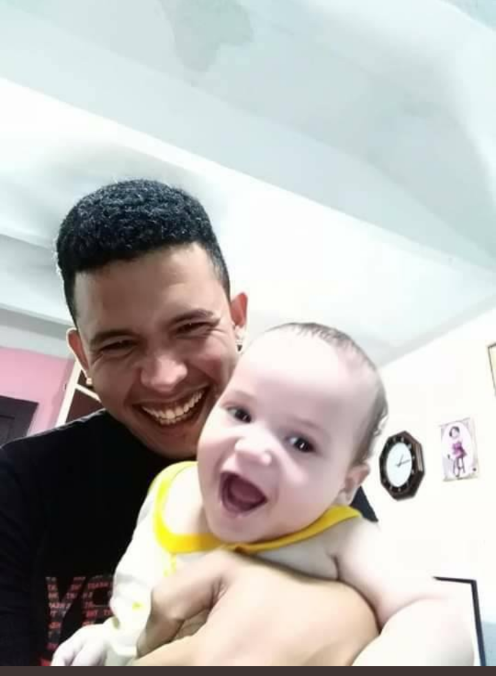
Luis Robles with his son

A Habeus Corpus motion filed on December 14, 2020 was rejected by Popular Provincial Tribunal of Havana and he remained held at the headquarters of the secret police in Villa Marista. He was transferred to the maximum security prison of Combinado del Este in Havana. Activists reported that a prison official has instructed other prisoners to repeatedly physically assault him, and expressed their concerns for his safety.

The Castro regime declared war against human rights in 1959, and freedom of expression was one of its first victims, and continues to the present day. It got worse in 1996 with Law 88, also known as the gag law, when restrictions on freedom of expression and association were expanded increasing prison sentences to 20-years.

There are currently 180 identified political prisoners in Cuba. According to a January 13, 2020 article in The New York Times a former high-ranking judge in Cuba provided documents showing that there are nearly 4,000 Cubans every year accused of being “antisocial” or “dangerous,” terms the Castro regime uses to jail people who pose a risk to the status quo, without having committed a crime." Furthermore, the article says that "records show that Cuba’s prison system holds more than 90,000 prisoners. The Cuban government only publicly released the figure once, in 2012, when it claimed that 57,000 people were jailed."

EuropaPress, reported on January 13, 2020 that Cuba today has the largest per capita prison population in the world according to the ranking method of the Institute for Crime and Justice Policy Research. 

Before getting lost in the statistics it is important to remember that among the thousands jailed for challenging the status quo are Luis Robles Elizastigui and Denis Solís Gonzalez. They are jailed for simple defending human rights, and there are many others like them behind bars in Cuba.

Denis Solís Gonzalez: "People of Cuba decide your future."


Thursday, June 18, 2020

Progressive Claims There Are Lessons for American Police in Cuba? Do Black Lives Matter in a Communist Police State?

Do Black Lives Matter in Cuba?
Silverio Portal Contreras, prisoner of conscience
The Progressive, a publication founded in 1909 in Madison, Wisconsin claims to question anything, but when it comes to Cuba it has swallowed hook, line, and sinker the misinformation of the Castro regime on policing. On June 18, 2020 they published an article titled "Foreign Correspondent: Police Lessons From Cuba" by Reese Erlich that claims "Contrary to the image of brutal and repressive communists, police in Cuba offer an instructive example for activists in the United States."

On the same day Havana Times published an article by IPS-Cuba titled "Is it legal to Take Photos or Videos of Police in Cuba?" The case of George Floyd became known because his death was recorded by a civilian who witnessed the events as they transpired, and then uploaded the video and shared it with others. Now the question is would it be legal to do that in Cuba? 
According to Cuban lawyer Humberto Lopez asked last Wednesday June 10th, on an episode of his “Hacemos Cuba” TV show "recording the police officer isn't illegal or constitute a crime" but “if this image is uploaded onto a digital platform without this person’s consent, then you are using it without their authorization,”would violate the right to privacy of the police officer under Article 48 of the Cuban Constitution. The Cuban attorney added "that if the intent of the publication is to defame police actions (he didn’t say if it mattered if these actions were right or wrong), it is an administrative violation, which is subject to a fine, because it violates Decree-Law 370 passed in 2018, by the Ministry of Information Technologies and Communications." 
Therefore, if the United States adopted this Cuban approach any person recording a police officer, then sharing that image on a digital platform would be violating their right to privacy, and if what they record the police officer doing, whether his or her actions were right or wrong, they would be fined and if they did not pay the fine would be subject to prison.

A law, patterned after Cuba's, would require those who record police on or off the job to get the approval of the police officer recorded before sharing the video with any digital platforms. Thankfully, the First Amendment prohibits such restrictions in the United States, and also runs afoul of international human rights instruments such as the Universal Declaration of Human Rights, of which Cuba is a signatory, even though the document is censored in the island.

According to a January 13, 2020 report in The New York Times a former high-ranking judge in Cuba provided documents which "showed that approximately 92 percent of those accused in the more than 32,000 cases that go to trial in Cuba every year are found guilty. Nearly 4,000 people every year are accused of being “antisocial” or “dangerous,” terms the Cuban government uses to jail people who pose a risk to the status quo, without having committed a crime." Furthermore, the article says that "records show that Cuba’s prison system holds more than 90,000 prisoners. The Cuban government has only publicly released the figure once, in 2012, when it claimed that 57,000 people were jailed."

Based on the Institute for Crime and Justice Policy Research, according to the January 13, 2020 article by EuropaPress, Cuba today has the largest per capita prison population in the world.

The United States, in contrast to Cuba, offers regular reports on its prison system, and allows the International Committee of the Red Cross access to its prison, including high security areas such as the prison at the Guantanamo Naval Base. The reason that so much is known and documented about the abuses with regards to the prisoners there is because the International Committee of the Red Cross has visited the U.S. Guantanamo detention facility over 100 times since 2001.

Meanwhile over the past 20 years the Cuban government permitted no visits by the International Committee of the Red Cross to Cuba's prisons. The Castro regime considered allowing a visit in 2013, but decided against it.

The Castro regime has demonstrated by not allowing international observers into its prisons that it is out of sight out of mind from most international indices, and gets the benefit of the doubt from "progressive publications."

Nevertheless there are moments that highlight the brutality of the regime.

Three black men executed by firing squad for trying to leave Cuba.
Lorenzo Enrique Copello Castillo, Bárbaro Leodán Sevilla García, and Jorge Luis Martínez Isaac, were shot by firing squad following a speedy "trial" in 2003 for trying to leave Cuba. On April 2, 2003 eleven Cubans hijacked a ferry traveling to Regla from Havana with 40 people on board with the intention of traveling to the United States of America but ran out of fuel 28 miles off the Cuban coast and were towed back to the island.  Despite verbal threats made against the safety of the passengers to maintain control of the vessel, the situation, according to the authorities, ended without violence and that “all of those who had been on board were rescued and saved without so much as a shot or a scratch.”
The hijackers were tried by the "Court for Crimes against State Security of the People’s Court of Havana. The Court had applied the specially expedited summary proceeding contemplated in Articles 479 and 480 of the Criminal Procedure Act, and found guilty. They appealed their sentence, and it was quickly denied.  Unlike in the United States the Judiciary in Cuba is not independent of the Executive.

In the early morning of April 11, 2003, following the decision handed down by the Council of State, the sentences were carried out and Lorenzo Enrique Copello Castillo, Bárbaro Leodán Sevilla García, and Jorge Luis Martínez Isaac were executed by firing squad. Nine days after the hijacking and three days after the trial.

The Cuban government also knew how to handle the aftermath and avoid negative publicity.

Family members were informed of their loved ones' summary executions after they had already been buried.

​ Ramona Copello mourns execution of her son Lorenzo Enrique in 2003
Ramona Copello, Mother of Lorenzo Enrique Copello interviewed by the Associated Press described how: "They came to my home at 6 in the morning and knocked on the door and told me to go to the cemetery at 10:00. He was already dead and buried. Go to the cemetery at 10 (am) so we can tell you where your relative is buried. That was it. He was already buried, he was covered. I asked and implored and even kneeled so they would let me see his face. Since they are liars, I couldn't believe it was him. I uncovered the crypt. I uncovered it because I wanted to see if it was really him, but I couldn't see his face because the security and police arrived and so I didn't get to see his face. I'm not sure if it's my son or a dog buried there."

Lorenzo Enrique was 31 years old and left behind a widow and an 11 year old daughter, who last saw her dad on April 10, 2003. He worked as a caretaker in a health center.

Bárbaro Leodán Sevilla executed in 2003
On April 12, 2003 the Spanish newspaper El Pais on how another family reacted. "According to eyewitnesses, in the neighborhood of Central Havana, where Bárbaro Leodán Sevilla lived, who was 21 years old, some incidents were recorded when the execution was reported to his family. Sevilla's mother suffered a nervous breakdown upon hearing the news and went out of the house shouting against the government and crying, to which dozens of neighbors joined. The police arrived to control the situation and kept the area cordoned off all day long."

On April 25, 2003 Fidel Castro appeared on television to defend the three executions, and show trials against nonviolent dissidents that had taken place in parallel. The official transcript left out unscripted comments by the old dictator who referred to the three executed men as the "tres negritos" which translates into English as the "three pickaninnies."

Unlike in the United States, all mass media in Cuba is controlled by the Cuban Communist Party, and any embarrassing or inconvenient statements can be disappeared and erased from public view.

Orlando Zapata Tamayo, a black Cuban prisoner of conscience was subjected to systematic physical and psychological torture between 2003 and 2010, and following his death on February 23, 2010 was subjected to a campaign of vilification by Cuba's Communist authorities. Orlando's mother, Reina Luisa Tamayo, denounced her son's mistreatment and held up a blood stained shirt that belonged to her son, who had been beaten up by prison guards, for rejecting communist re-education and continuing to denounce human rights violations in the prisons.
 
​ Reina Luisa Tamayo, with her son's bloody shirt
Ten years have passed since his untimely death, but many inside and outside of Cuba continue to demand justice for him and his family. The poster below reads "Tenth Anniversary of his Martyrdom: His Murderers Continue Without Being Tried" and underneath it reads "Orlando Zapata Tamayo: Martyr  for the Liberation of the Cuban people" followed by his birth date and the day he died.


Black lives matter, without question but the question that necessarily arises is do they matter everywhere, regardless of ideology? 
It necessarily arises because the leadership of the Black Lives Matter organization, despite the above examples (which are the tip of the iceberg) never raised these cases, but instead mourned the death of Fidel Castro in November 2016 and more shockingly defended what today is a old, male and white minority dictatorship in Cuba. 
Will progressives speak up about continuing injustices against black Cubans such as Silverio Portal Contreras, an Amnesty International prisoner of conscience, who is now serving a four-year prison sentence for "contempt" and "public disorder"? He was beaten by prison officials in mid-May 2020 and lost sight in one eye.

Do black lives matter in Cuba? Is the monstrous Cuban police state what progressives want to turn the United States into? 

Tuesday, April 23, 2019

Campaign by American NGO to free Cuban parents jailed for home schooling their kids


Old patterns of repression continue to ensnare new generations in Cuba. 


Pastors Ramón Rigal and Ayda Expósito jailed for homeschooling their children
Pastor Ramón Rigal and his wife Pastor Ayda Expósito were found guilty in a Cuban court on April 22, 2019 for homeschooling their children Ruth and Joel.

Pastor Ramón Rigal has been sentenced to be deprived of his freedom for to two years. Pastor Ayda Expósito has been sentenced to one and a half years in prison. This news was provided by Ruth, their eldest daughter, to DIARIO DE CUBA.

Pastor Rigal already served a year in prison in 2017 for homeschooling his kids.

Pastor Ramon Rigal (on the right) served a year in prison in 2017 for homeschooling.
In Cuba not only are parents jailed for trying to home school their kids. Pastor Ramon Rigal was sentenced on April 25, 2017 to one year in prison for the "crime" of homeschooling his two children.

Cuban students have also been expelled from school for refusing to tow the official line.

Consider that for a moment. You can be kicked out of school for thinking independently, and then your parents can be jailed for trying to provide you with an education at home.

The Home School Legal Defense Association is campaigning for their release and has launched an online campaign to encourage the White House to intercede on their behalf.

Saturday, December 31, 2016

This New Year they remain imprisoned for acts of conscience

Honoring the courageous


Seven years ago on Christmas day in Beijing Municipal No. 1 Intermediate People's Court sentenced Liu Xiaobo, a prominent intellectual and long time activist, to eleven years in prison for "inciting subversion of state power." His "crime"? Organizing a petition drive in China calling for democratic reforms in 2008. 2016 marks the seventh anniversary of his unjust sentencing and the sixth anniversary of receiving the Nobel Peace Prize "for his long and non-violent struggle for fundamental human rights in China."

PEN America's case history on this courageous Chinese dissident reveals that he could have stayed in the United States where he was a visiting scholar in the United States in 1989 but returned to China after the start of the Tiananmen uprising:
"Liu Xiaobo is a renowned literary critic, writer, and political activist based in Beijing. He served as president of the Independent Chinese PEN Center from 2003 to 2007 and now serves as an honorary president. He was a professor at Beijing Normal University and was a visiting scholar at several universities outside of China, including the University of Oslo, the University of Hawaii, and Columbia University in New York City.  In the spring of 1989, Liu Xiaobo left his post at Columbia University and returned to Beijing to play a crucial role in the spreading pro-democracy movement..."
Unfortunately, the situation in China has not improved and international solidarity has receded over an economically and militarily ascendent China. Nevertheless in China activists took to the streets and risked their freedom to demand the release of Liu Xiaobo.

Cuba is a long way geographically from China but the trends in the island nation have also been in the wrong direction in terms of regime behavior and the international environment. However Cubans like the Chinese understand this and while many flee the country, some remain and risk everything for their homeland.

Last year was at the King Mango Strut with Cuban dissidents lampooning the Castro regime and the Obama administration. Among the revelers was Danilo Maldonado, also known as "El Sexto" an artist who desires to live in freedom, in Cuba. Under the Castro brothers that is not an easy feat and Danilo has already been declared an Amnesty International prisoner of conscience after a prolonged detention in December of 2014 for trying to carry out a performance art piece mocking the Castro brothers.

This Christmas finds him behind bars for tagging a wall with the phrase "Se fue" [he left] referring to the death of Fidel Castro on November 26, 2016. Beaten up and arrested Danilo has spent Christmas and New Years behind bars.

El Sexto is not alone, also arrested in the aftermath of Fidel Castro's death was Eduardo Cardet, the spokesperson of the Christian Liberation Movement. Cardet who is also a beloved medical doctor and family man respected in his community. While traveling abroad his wife was detained and warned that upon his return they would lock him up for 15 years in prison for having met the wrong people during his travels. Despite the threat Eduardo Cardet returned home to a brutal beating, incarceration and trumped up charges. He has also spent Christmas and New Years imprisoned and separated from his family.

Liu, Danilo and Eduardo could have easily stayed in the United States as political refugees, but made the courageous decision to return to their homeland and continue the struggle for freedom.

Today as we are about to celebrate the New Year and celebrated Christmas let us take a moment to reflect upon these three courageous men and their profound sacrifices for liberty


Saturday, December 10, 2016

Human Rights Day in Cuba 2016: From Bad to Worse

International Human Rights Day in Cuba 2016 finds a worsening human rights situation on the island.


Secret police wait outside home of activists in Havana, Cuba early this morning
Human rights have been in decline around the world for over a decade and the situation in Cuba, that was already bad, has also worsened. International Human Rights Day presents an opportunity to reflect on what is going on today.

The headquarters of one of Cuba's most important civic nonviolent movements, the Ladies in White is at this hour under surveillance in anticipation that this organization may want to commemorate international human rights day.

In Miami at Our Lady of Charity known by Cuban Americans as La Ermita de la Caridad friends of Father Miguel Angel Loredo, who passed away in 2011, gathered at 10:00am to remember the life and legacy of this former prisoner of conscience and human rights defender concluding with a midday mass. Nearby the Democracy Movement called for the community to gather and join hands in a Human Chain in Memory of the Victims of Castroism today Saturday December 10th at 12 noon on SW 8 St and 15th Avenue.

Unfortunately, the Obama Administration's Cuba policy is having an impact internationally that will negatively impact on human rights in Cuba internally. The latest being the decision of the European Union to "open a new chapter" on relations with Cuba that drops human rights as a condition for normalization and will be the end of a European Common Position adopted in 1996. This arrangement is to be formalized on December 12th.

Meanwhile many remain unjustly imprisoned in Cuba today, but will highlight the following three cases from the past few months:

Eduardo Cardet, medical doctor and opposition leader

Before Eduardo Cardet Concepción returned to Cuba, the secret police detained his wife and told her that the Christian Liberation Movement spokesman had met the wrong people while traveling abroad and would be arrested and sentenced to 15 years in prison. 

Two days after Fidel Castro's death was announced Eduardo Cardet described events as follows“There are few people in the streets, and lots of police presence. Lots of controls and restrictions. Castro was a man hated and rejected by the Cuban people.”


On November 30, 2016 Eduardo Cardet returned home to Cuba and was brutally beaten and arrested then beaten some more and held incomunicado until December 5th. A criminal case is being fabricated against him in a clumsy attempt by state security to prevent this medical doctor, husband and father of two from being declared a prisoner of conscience. He remains imprisoned today.


Julio Ferrer Tamayo, human rights attorney

Julio Alfredo Ferrer Tamayo is a human rights activist, attorney and member of the Legal Information Center known as Cubalex. He has been arbitrarily detained since September 23, 2016 for demanding that the authorities respect national legislation and the right to associate of nongovernmental organizations of independent civil society.

This is not his first arbitrary detention. On February 20, 2015 he was jailed and denied his freedom for six months accused of contempt against three judges in a tribunal that dealt with Crimes against State Security. He was released on September 21, 2015 and joined Cubalex becoming an active member.

On September 23, 2016 the secret police (Ministry of the Interior) along with other regime agencies raided the offices of Cubalex seizing internal documents and equipment. Amnesty International pronounced itself on this raid.

Danilo Maldonado, graffitti artist
On December 5, 2016 Amnesty International issued the following update on Danilo Maldonado, also known as "El Sexto" which in part details:
On 4 December Danilo Maldonado Machado (also known as ‘El Sexto’) was transferred to El Vivac prison in the outskirts of Havana, the capital of Cuba. His mother was able to visit him on 5 December and told Amnesty International that he now refuses to eat the food provided by the prison for fear of poisoning, but he ate the food brought to him by his mother. Danilo Maldonado was arrested at his home in Havana the morning of 26 November, hours after the announcement of Fidel Castro’s death. That same day, Cuba-based newspaper 14 y medio reported that he had graffitied the words “He’s gone” (Se fue) on a wall in Havana. Nine days after Danilo Maldonado’s arrest, Cuban authorities have still failed to present official charges under an internationally recognized offence against him. The authorities have not informed his mother or his lawyer of the reasons for this detention, nor a date for his release. His family presented a Habeas Corpus request for the preservation of Danilo Machado’s individual rights before the Provincial Court of Havana (Tribunal Provincial de la Habana) on 5 December seeking his immediate release.

Summary on human rights in Cuba
2016 is proving to be a terrible year for human rights in Cuba with 9,484 politically motivated arbitrary detentions in 2016 as of November 30th and levels of religious freedom violations not seen in over a decade. The death of Fidel Castro coincided with an ongoing rise in repression and intimidation of not only dissidents, but the populace in general.

Cubans are still being brutally assaulted in Cuba, many are imprisoned for their beliefs, and some are dying under suspicious circumstances that point to extrajudicial executions carried out by the Castro regime's secret police. Other Cubans have been shot and killed, had their boats and rafts attacked in order to prevent them leaving Cuba. Even human rights lawyers are under threat. The death and funeral of Fidel Castro highlighted the Stalinist nature of Castroism, but many in the mainstream media did not provide this context in their coverage. Although the island remains a police state under Raul Castro and independent media remains outlawed the bits and pieces of real news that escape the censors reveals a regime that systematically violates human rights. Sadly it is also known that visitors to the island are not exempt from these horrors. Unfortunately, too many in the international community continue to give the Castro regime a pass while ignoring those who deserve to be honored. Meanwhile people of goodwill gather together to remember the victims of Castroism in Cuba and appeal for justice.

International Human Rights Day 2016

Friday, March 15, 2013

Amnesty International Statement on Black Cuban Spring 10th Anniversary


AI Index: AMR 25/003/2013
15 March 2013

10 years on from crackdown on dissidence, fundamental freedoms still lacking in Cuba

On 18 March 2003, a group of 75 political dissidents were detained across Cuba in an unprecedented crackdown on spurious charges related to state security and, following summary trials, they were sentenced to long prison terms of up to 28 years.

They were subsequently declared prisoners of conscience by Amnesty International as they had been imprisoned solely for the peaceful exercise of fundamental freedoms.
In July 2010, following the intervention of the Cuban Catholic Church, the Cuban authorities agreed to release those of the 75 who remained in prison. However, the majority of them were forced into exile in Spain.

Those who refused to leave Cuba were kept in prison until early 2011. Although they were allowed to remain on the island their release was conditional - their prison sentences hang over them even though they are no longer confined.

Their release has not heralded a change in human rights policy in Cuba. The authorities remain determined to contain government critics with new tactics, including intimidation, harassment, multiple short-term detentions and restrictions on movement to stop them from carrying out their activities or as retaliation.

In spite of recent changes to the migration law which makes travel abroad easier for Cubans, the Cuban government continues to maintain a swathe of laws aimed at preventing political dissidents and human rights defenders from exercising their freedom of expression, association and assembly Amnesty International has been monitoring the human rights situation in Cuba for decades.

Experts from the organization are available to comment on the 10th anniversary of the crackdown and the current human rights situation on the island. We can also facilitate contact with former Cuban prisoners of conscience who were detained in March 2003’s crackdown on political dissidence.

For further information or to arrange interviews, please contact:

Juan I. Cortes - Press Officer for the Americas
Email: JuanIgnacio.Cortes@amnesty.org
Tel: + 44 (0) 20 3036 5801
Mobile: +44 (0) 7956 612 329

http://www.amnesty.org/en/library/info/AMR25/003/2013/en

Wednesday, November 28, 2012

Cuban sentenced to 2 years in prison for being a labor activist


Ulises González Moreno (photo: Ivan Hernandez Carrillo)

Iván Hernández Carrillo is reporting over his twitter account that Cuban labor union activist Ulises González Moreno was sentenced on November 28, 2012 to two years in prison for his labor organizing activities in a trial whose outcome had already been decided before it even started. The imprisoned activist's wife, Jacqueline Daly, is devastated by the news.

According to Cuba Sindical, González Moreno is 45 years old and was detained on November 15, 2012 at his home located in Concordia # 414 apartment 2 in Central Havana by two plain clothes state security agents who identified themselves as members of the Ministry of the Interior (MININT).

The following day when his wife went to where her husband was being detained she was told that he would be tried for "Peligrosidad Social" (Social Dangerousness), which indicates that the activist has a predilection to in a possible future commit a crime against the regime. This law has been used to persecute nonviolent activists.

Human Rights Watch in their 2009 report  New Castro, Same Cuba stated that the "Criminal Code offense of 'dangerousness,' which allows authorities to imprison individuals before they have committed any crime, on the suspicion that they are likely to commit an offense in the future. This 'dangerousness' provision is overtly political, defining as 'dangerous' any behavior that contradicts Cuba's socialist norms." This is a thought crime and is profoundly Orwellian.

Ulises is a prisoner of conscience arrested, convicted and sentenced for what he thought and for what he might have done in the future as a labor organizer.

The following is a translation and compilation of some of the tweets sent out by Iván last night:

As customary, the tyranny rigged an arbitrary trial condemning Ulises González Moreno for being an independent unionist 

telephone of Jacqueline Daly, wife of Ulises González, condemned to 2 years in prison, is +0115358061724

Once again it is proven that in justice does not exist, here justice is blind.  

  Ulises González Moreno's wife very tense, disgusted, sad for her husband's unjust penalty of 2 years in prison


Ulises González Moreno and his wife Jacqueline Daly (photo: Ivan Hernandez Carrillo)
 One day after independent journalist and human rights defender Antonio Rodiles was released after 19 days in prison another activist, Ulises González Moreno, is unjustly sentenced to two years in prison for being an independent labor union activist and human rights defender. The repression in Cuba by a half-century old totalitarian dictatorship continues as does the need to resist it.
