Showing posts with label Emilio Bacardi Lay. Show all posts

Saturday, April 12, 2025

Bacardi’s long fight for a free and independent Cuba continues

 NBC’s The Today Show featured a segment looking back at the spirited history of BACARDI on April 3, 2025, from the company’s founding in Santiago de Cuba in 1862, expropriation by Castro’s communist dictatorship, to their ongoing success, but much was left out.

Bacardi’s history is intrinsically related to the fight for Cuban independence from Spain, the defense of democracy during the Republic, and the ongoing struggle for the restoration of democracy and the rule of law under the current communist dictatorship. The Bacardi family arrived in Colonial Cuba from Spain in the early 1800s. In 1828, Don Facundo Bacardi Massó joined his older brothers in Santiago, Cuba, where Bacardi Limited was founded by him on February 4, 1862. Don Facundo had three sons who went into the family business: Emilio Bacardi Moreau, Juan Bacardi Moreau, and Facundo Bacardi Moreau.

Emilio Bacardi Moreau was born in Santiago de Cuba on June 5, 1844, the son of Facundo Bacardí Massó,who together with his father was arrested by Spanish loyalist forces for their support of Cuban independence. Don Facundo was released shortly afterwards, but his son Emilio spent four years imprisoned, and then forced into exile. Don Facundo passed away at age 71 on May 9, 1886.

Emilio Bacardi Moreau’s son, Emilio Bacardi Lay, actively took part in Cuba’s war of independence. In 1895, he was a field officer for Gen. Antonio Maceo during the invasion of Cuba by independence forces. He reached the rank of colonel by the age of 22. After a life of entrepreneurship and patriotic service, Emilio Bacardi Moreau died on August 28, 1922, of a heart ailment. He was 78 years old. The city of Santiago suspended all public events for two days to mourn and celebrate his life. He had been nicknamed “Cuba’s foremost son.”

Emilio Bacardi Lay, who had fought for Cuban independence and been opposed to the dictatorships of Gerardo Machado and Fulgencio Batista but remained in Cuba and repeatedly resisted authoritarianism, was forced to flee when Castroism consolidated control in 1961. Emilio Bacardi Lay, who was born in Santiago de Cuba on June 12, 1877, died in exile in Miami on October 14, 1972 at the age of 95. He was the last surviving ranking officer from Cuba’s war of independence with Spain.

Emilio Bacardi Lay ( Source: Cuba en la memoria )

A history of the Bacardi family written by Tom Gjelten, a reporter for National Public Radio, titled “Bacardi and The Long Fight for Cuba :The Biography of a Cause,” led to renewed interest in their role in Cuba’s independence.  A 2008 review of the book in The New York Times by Randy Kennedy touches on the figure of Emilio Bacardi Moreau.

Emilio Bacardi, especially, comes to life as the book’s most powerful character, though one so strange that Gabriel García Márquez might have invented him. Emilio was imprisoned twice by Spain off the coast of Morocco for his revolutionary activities. But he still managed to hold the company together, to serve as Santiago’s mayor during the unsettled years of the American occupation, to help found a salon called the Victor Hugo Freethinker Group, to practice theosophy in a predominantly Catholic country and to track down a genuine mummy on a trip to Egypt, which he bought as the centerpiece for a museum he had founded in San­tiago. (Modest he was not; he signed his revolutionary correspondence with the name Phocion, after the Athenian statesman known as “the good.”)

Bacardi Imports, Inc., re-established its headquarters in Miami in 1963 after having been based for a century in Santiago de Cuba.

This is the history that the Castros would like to erase but have been unable to. Meanwhile, to all who read this, please consider that if you wish to make a toast to freedom with alcoholic spirits, do it with Bacardi or the real Havana Club.

However, it is important to point out that Bacardi, in addition to having a great history, also retain an enlightened vision for the future that is human centered.  Today, an article appeared that revealed how Bacardi is putting money behind people to make sure artificial intelligence doesn’t replace human bartenders.

Bacardi also has a positive track record on environmental stewardship that has been repeatedly recognized. Bacardi USA was awarded the SmartWay® Excellence Award from the U.S. Environmental Protection Agency for the fourth time in 2020.

In contrast, the Cuban dictatorship continues to sell their stolen version of Havana Club, that today “pumps 1,288 cubic meters of waste liquids into the Chipriona inlet in Cuba every day, mostly vinasse (a residual liquid remaining from the fermentation and distillation of alcoholic liquors). It has been doing that since the 1990s, although the problems became more acute starting in 2007,” according to Julio Batista in his 2017 report described the impact of this pollution as follows:

“The Chipriona inlet is a place where no one goes, where no one fishes, that doesn’t need a fence because no one wants to swim in the boiling filth that flows into its waters every day. The waters of what used to be a beach are now soupy and have the sour smell of decomposition. No studies about the marine life in the inlet are publicly available, but fishermen say there’s no fish there.” …”In the last decade, Chipriona has become the drainage point for the Ronera Sana Cruz, the biggest distillery in the country and one of the four owned by Cuba Ron S.A. It’s the end point of the sewage of the only place where the white and 3-year-old brands are distilled by Havana Club International (HCI). And the dumping ground for a company that earned $118.5 million in profits in 2016 from the sale of 4.2 million boxes each with nine liters of rum.”

 Bacardi has recognized the work of Oswaldo Payá Sardiñas, and in 2017 that of his daughter, Rosa María Payá and they are supporting the Cuba Decide initiative to push for a democratic transition in Cuba.

Bacardi is synonymous with the best of Republican Cuba. Generations of the Bacardi family fought for Cuban independence with one family member fighting alongside General Antonio Maceo, and during the Republic the family not only had enlightened business practices but also engaged in civic activities that promoted a democratic culture based in the rule of law. Through their marketing, Bacardi put Cuba on the map. They continue in the long fight for a free and independent Cuba.


Wednesday, November 11, 2020

Bacardi, the Castro regime, and the Havana Club Trademark: An injustice that needs to be remedied

Bacardi environmental stewardship recognized while Castro regime's rum maker harm's Cuba's, yet a travesty continues

CubaBrief by Center for a Free Cuba

Bacardi is in the news again. The rum maker founded in 1862 in Santiago de Cuba has a positive track record on environmental stewardship that has again been recognized. Bacardi USA was awarded the SmartWay® Excellence Award from the U.S. Environmental Protection Agency for the fourth time.

Meanwhile, the Castro regime continues to sell their stolen version of Havana Club, that today "pumps 1,288 cubic meters of waste liquids into the Chipriona inlet in Cuba every day, mostly vinasse (a residual liquid remaining from the fermentation and distillation of alcoholic liquors). It has been doing that since the 1990s, although the problems became more acute starting in 2007," according to Julio Batista in his 2017 report described the impact of this pollution as follows:

"The Chipriona inlet is a place where no one goes, where no one fishes, that doesn't need a fence because no one wants to swim in the boiling filth that flows into its waters every day. The waters of what used to be a beach are now soupy and have the sour smell of decomposition. No studies about the marine life in the inlet are publicly available, but fishermen say there's no fish there." ..."In the last decade, Chipriona has become the drainage point for the Ronera Sana Cruz, the biggest distillery in the country and one of the four owned by Cuba Ron S.A. It's the end point of the sewage of the only place where the white and 3-year-old brands are distilled by Havana Club International (HCI). And the dumping ground for a company that earned $118.5 million in profits in 2016 from the sale of 4.2 million boxes each with nine liters of rum."

Despite the Castro regime's poor record on environmental stewardship and overall terrible record on human rights the United States in 2016 stripped Bacardi of its right to the Havana Club brand and turned it over to a company of the Castro dictatorship. According to Reuters, "in January, the U.S. Patent and Trademark Office decided to allow Cuban state firm Cubaexport to register the Havana Club name once again in the United States." Bacardi "acquired the rights to the Havana Club trademark from its pre-revolutionary owner whose distillery was nationalized" by the communist regime.

Ambassador Otto J. Reich, president of the Center for a Free Cuba, on January 31, 2020 in The Miami Herald called on the United States to undo this wrong that continues to favor the Castro dictatorship and gutted the rights of a Cuban family business. "The Obama administration allowed Cuba to renew an expired trademark registration for the confiscated Havana Club rum. The Trump administration should reverse that action and demonstrate to unscrupulous foreign companies that there are grave risks to economic deals with a regime that has stolen billions of dollars in properties from Americans and Cubans, and thus stop dishonestly enriching the Cuban government."

This action by the United States in 2016 against Bacardi, and in favor of the Castro dictatorship was a deeply unpopular move for Cubans with a sense of history. Business Insider on October 28, 2020 broadcast a podcast on "Bacardi and the Long Fight for Cuba" that explored the company's history back to Cuba's colonial period under Spain in beginning in 1862. 


Emilio Bacardi, son of one of the two founders of Bacardi, Don Emilio Bacardi, "was a field officer for Gen. Antonio Maceo in 1895 during the invasion of Cuba by independence forces, and reached the rank of colonel by the age of 22," according to his obituary in The New York Times on October 16, 1972 when he died at the age of 95 in exile in Miami. 

Emilio Bacardi Lay

He was "the last surviving ranking officer of Cuba's war of independence with Spain," according to the paper of record. The Bacardi family throughout the struggle for independence, and during the years of the Republic defended democracy and Cuban national identity, and remain a historic example. They also resisted all of Cuba's dictators: Machado, Batista and Castro. 

This is in stark contrast to the history of the Castro family. Fidel Castro's father, Angel Castro, enlisted in the Spanish army and arrived in Cuba to defend Spain's colonial possession from forces battling for independence. He returned with the Spanish armed forces to the Iberian Peninsula following their defeat in 1898, but shortly after emigrated to Cuba and established himself there. This allegiance to Spain would continue through his sons Fidel and Raul Castro.

In 2016 TV3 produced a documentary "Franco and Fidel: A Strange Friendship" that explored this relationship between the two dictators and is available online.

The documentary revealed how pro-Castro Cuban exiles were able to celebrate Fidel Castro's triumph in 1959 with a mass protest in Retiro Park in Spain. This was at a time when Spaniards could not do that. Latin American Herald Tribune reported on this and more regarding the TV3 production.

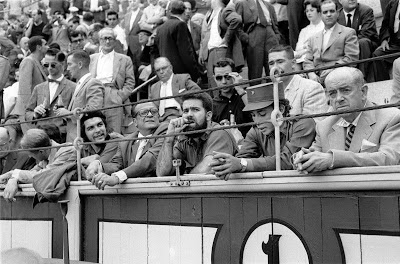
Also revealing are accounts by Castro revolutionaries who said that during their struggle against dictator Fulgencio Batista their lives were saved thanks to the help of the Spanish Embassy, as well as images of Ernesto "Che" Guevara walking in Madrid and attending a bullfight with members of Franco's secret police. 

Ernesto "Che" Guevara in Franco Spain at a Bullfight

Following the 1962 Cuban Missile Crisis, when the US pushed for tight economic sanctions on the Castro regime, the rest of Latin America, France and the United Kingdom all went along with Washington, but Franco's Spain continued trading with Havana.

On Franco's death in 1975, Fidel Castro decreed three days of mourning in Cuba, although he made sure that it went unnoticed by the press, it was an official decree signed by Cuban president Oswaldo Dorticós. This relationship with the Spanish dictator should not be a surprise when one considers that the Castro regime had a close working relationship with former high ranking Nazis.

This is why the United States siding with the Castro dictatorship in an issue of private property rights against Bacardi is so deeply offensive, and needs to be remedied. Cuban Americans and Cubans on the island would remember this gesture.