Showing posts with label Vladimir Lenin. Show all posts

Sunday, January 21, 2024

Vladimir Lenin died 100 years ago today and Communist Cuba's hand picked president is celebrating his legacy

 #Lenin100
 
Today, 100 years ago, Vladimir Lenin died. His bloody revolutionary career claimed millions of lives through politically orchestrated famines or outright murders, and he sentenced the peoples of the Soviet Union to seven decades of despotism. 

Communist Cuba's president pays homage to Lenin.

Raul Castro's handpicked president, Miguel Díaz-Canel Bermúdez, today over Twitter observed the death of Vladimir Ilyich Ulyanov, better known as Vladimir Lenin and honored the late mass murderer, and despot. Below is the text translated to English, and a screen grab of what the Cuban president posted.

"#Lenin100 is trending on this platform today, a century after the physical disappearance of the leader of the October Socialist Revolution and the world proletariat. #Cuba honors his memory."

Responded to his X post pointing out that it was the dictatorship in Cuba honoring Lenin's memory, not the Cuban people, and added that "Lenin was truly one of the bloodiest mass murderers in history as well as a dictator and psychopath. You should be ashamed honoring this monster."
 
Soviet leader: Lenin worse than Stalin

Who was this man, whom the Castro regime honored today on the 100th anniversary of his death?

The Russian communist revolutionary had several hundred aliases, but Lenin was the one he was best known for, and that he used politically. All the Bolshevik leaders used aliases.  

Molotov, a contemporary who held a leadership position in the Soviet Union, was quoted in David Remnick's 2014 book, Lenin's Tomb: The Last Days of the Soviet Empire. 

"'You know its a pity that Lenin died so early. If he had lived longer, everything would have been normal.' But Molotov said, 'Why do you say that?' My friend said, 'Because Stalin was a bloodsucker and Lenin was a noble person.' Molotov smiled, and then he said, ' Compared to Lenin, Stalin was a mere lamb."

Molotov was born Vyacheslav Mikhailovich Skryabin and took the revolutionary name Vyacheslav Molotov. Molotov was one of the few Bolsheviks in Moscow, and he was part of the group that successfully carried out a coup against the social democrats in October 2017, and he was in the leadership group with both Lenin and Stalin throughout. He held leadership positions in the Soviet Union from the 1920s until 1961, when he was expelled from the Communist Party for opposing Khrushchev's de-Stalinization policy. Molotov could assess both Lenin and Stalin's ruthlessness. 

The Library of Congress has communications between Lenin and Molotov. For example in a letter dated March 19, 1922, from Lenin via Molotov to members of the Politburo, he outlined "a brutal plan of action against the 'Black Hundreds' clergy and their followers, who were defying the government decree to remove church valuables (purported by the government to be used to fund famine relief). Lenin proposed the arrest and quick trial of the insurrectionists in Shuia, followed by a ruthless campaign to shoot a large number of the reactionary clergy and bourgeoisie and urged that removal of valuables from the richest churches and monasteries be finished quickly."

Lenin and the Bolsheviks did not depose the Czar.  They overthrew the social democrats who had forced the Czar to abdicate and placed him under house arrest, and were navigating power through democratic processes that were unprepared for the terror and conspiracies of the Bolsheviks.

Lenin's body count

From November 1917 until his death in January 1924, the publication Counting Stars provided a summary of the victims of Leninism which is reproduced below.

The figures of victims of Leninism, from November 1917 to January 1924

  • More than a million people murdered for political or religious reasons.
  • Between 300,000 and 500,000 Cossacks killed.
  • Hundreds of thousands of workers and peasants killed for striking.
  • 240,000 killed in the suppression of the Tambov rebellion.
  • More than 50,000 white prisoners of war executed.
  • Between 3.9 million and 7.75 million deaths from famines among Russians, Kazakhs and Tatars." 

 A communist coup d'etat that aborted democracy in Russia

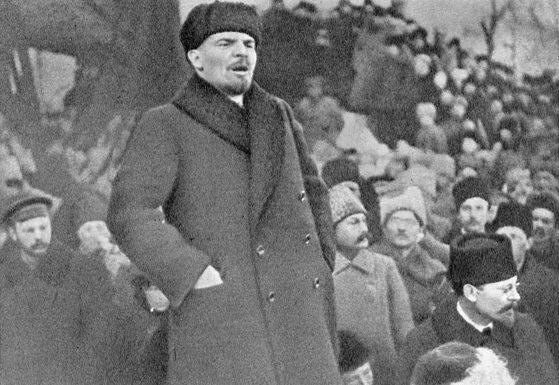
Lenin at a rally on March 18, 1918.

To demystify Lenin one must first break other myths. The most basic is that when the Bolshevik coup d'etat broke out on November 7, 1917, the communists did not overthrow the Tsar - which no longer reigned - but aborted the incipient democracy in Russia, taking advantage of the crisis that arose between conservatives and socialists. After the violent assault on power by the communists, a civil war broke out that lasted five years, and in which - already in power - the Bolsheviks - who were victorious - faced all their rivals. It was the beginning of a bloody dictatorship that would last more than 70 years, until the disappearance of the USSR in 1991."
Ideas have consequences 

The body count amassed by Vladimir Lenin and his fellow Bolsheviks was not an accident, but the result of the ideas that animated them, and continue to animate the Cuban communists today.

On October 2, 1920, the first leader of the Soviet Union, Vladimir Lenin, stated in a speech to Russian communist youth: 

 "The class struggle is continuing and it is our task to subordinate all interests to that struggle. Our communist morality is also subordinated to that task. We say: morality is what serves to destroy the old exploiting society and to unite all the working people around the proletariat, which is building up a new, communist society." 

This is at the heart of communist morality, the ends justify the means, a profound immorality and a pillar of international communism. It also leads to the doctrine of the "big lie." According to Lenin, "To speak the truth is a petit-bourgeois habit. To lie, on the contrary, is often justified by the lie's aim." 

The Third International was founded by Lenin in 1915 and held its first of seven world congresses on March 2, 1919 and was also known as the Communist International, and was known by its abbreviated form the Comintern. It was an international communist organization that advocated world communism. The International intended to fight "by all available means, including armed force, for the overthrow of the international bourgeoisie and for the creation of an international Soviet republic as a transition stage to the complete abolition of the State".  

The Soviet State was never abolished, but a new class created, "the nomenklatura" that spent decades ruling over the proletariat with a ruthlessness that led workers in communist regimes, to prefer a return to market systems and democracy. It is a historical irony that Communism in Eastern Europe and the Soviet Union was brought to an end by the rise of an independent trade union movement in Poland. 

Castroism's Leninist continuity 

The Castro regime took a country with one of the largest middle classes in Latin America, in part due to a strong labor movement that had existed and grown more powerful for over 50 years. The Batista dictatorship was unable to crush it, but Castro's communist dictatorship over a couple of years crushed this workers movement, and 64 years later the nomenklatura lives with great wealth and privileges while the rest of the Cuban populace is immiserated. 

Fidel Castro, and the rest of the Cuban communists embraced Lenin's "communist morality" and "the big lie." Consider the late dictator's own words on the subject.

Fidel Castro on December 2, 1961 in a moment of frankness confessed: "If we had paused to tell the people that we were Marxist-Leninists while we were on Pico Turquino and not yet strong, it is possible that we would never have been able to descend to the plains."  He was able to "confess" that he had always been a communist because he had consolidated power and killed or imprisoned all his enemies, and shut down all independent media. He had imposed a totalitarian dictatorship on Cubans.

Years later on March 26, 1964, Fidel Castro explained: "I conceive the truth in terms of a just and noble end, and that is when the truth is truly true. If it does not serve a just, noble and positive end, truth, as an abstract entity, philosophical category, in my opinion, does not exist."  

Mr. Castro's philosophy is not original, but Leninism with tropical flair, and the speaking style of Benito Mussolini.

Cuban scholar and Christian Democrat Jose Ignacio Rasco, who knew Fidel Castro from primary school and onward, concluded that the Cuban revolutionary had been a committed communist by 1950.

Terrorism and Communism

Author and Journalist Claire Sterling in her March 1, 1981 article in The New York Times,  TERRORISM  TRACING THE INTERNATIONAL NETWORK touched on terrorism's links to international communism beginning with Lenin, but moved on to the pivotal role played by the Castro regime in Cuba.

"Lenin's definition -- 'the purpose of terror is to terrorize' -- is a useful beginning. The terrorist uses violence not to punish the victim but to intimidate the audience, to impose his political will by force when he cannot achieve it by democratic means".

The Castro regime fully embraced terrorism as a global strategy and built an international terrorist network.

..."Fidel Castro had been operating his own schools for guerrillas since 1961, starting with recruits from Latin America and Africa. By 1964, Palestinians and Europeans had joined the ranks." ..."The roots of the terrorist network can be traced directly to the Tricontinental Congress held in Havana in January 1966. More than 500 delegates passed resolutions emphasizing the need for close collaboration between 'Socialist countries' --i.e., the Soviet Union and its satellites -- and national liberation movements." ...  "It was, unmistakably, a call for a Guerrilla International. And the call was heeded. Ten months later, a new cluster of more than a dozen training camps for guerilla fighters from all over the world was opened in Cuba." 

Bombing campaigns were carried out in the United States, and innocents were murdered.  Some of these terrorists were captured, placed on trial, but then broke out of prison and ended up being harbored by the Castro regime. They continue to advocate terrorism, and justify their violence. Worse yet, communist networks claim these killers are "political prisoners."

Lenin died 100 years ago today. The tragedy is that he was able to cause so much harm in his 53 years of life. He is the intellectual author of the Soviet Union,  a system correctly described as anti-human by British conservative Peter Hitchens.

Diaz- Canel is part of a regime that is a continuity of the system created by Lenin.

The Cuban communist channeled Lenin on July 11, 2021 when tens of thousands of Cubans took to the streets nonviolently across Cuba demanding freedom: 

"The order to fight has been given — into the street, revolutionaries! ...They will have to walk right over our corpses. We are ready to do anything if they want to confront the revolution."

Díaz-Canel's call to violence had deadly consequences for Cubans. Regime agents went out into residential neighborhoods firing on protesters. Cuban protester Diubis Laurencio Tejeda, (age 36) was shot in the back and killed on July 12, 2021 by police.

The Cuban president's honoring of Lenin, a mass murdering psychopath, conforms to the actions he has taken since being handpicked for the post by Raul Castro in 2018. Dr. Maya Angelou once said, “When people show you who they are, believe them the first time,” and Cuba watchers should believe Diaz-Canel is a Leninist.

Saturday, January 21, 2023

Vladimir Lenin died 99 years ago today and the Castro regime celebrated his legacy

Vladimir Lenin died 99 years ago today, bringing to an end a blood filled revolutionary career that killed millions in outright murders or politically engineered famines, and condemned the Soviet peoples to seven decades of tyranny.

Castro regime pays homage to Lenin.

Raul Castro's handpicked president, Miguel Díaz-Canel Bermúdez, today over Twitter observed the death of Vladimir Ilyich Ulyanov, better known as Vladimir Lenin. 

Two days after a high-level delegation of American officials visited Havana to meet with the Castro regime's state security officials, the Cuban president praised Vladimir Ilyich Lenin.

"Vladimir Ilyich #Lenin, eternal leader of those who fight for socialism and social justice, died this day in 1924, at only 53 years of age. His social and political work has not ceased to inspire millions of people around the world. #Cuba pays tribute."

The Russian communist revolutionary had several hundred aliases, but Lenin was the one he was best known for, and that he used politically. All the Bolshevik leaders used aliases.  

Soviet leader: Lenin worse than Stalin

Who was this man, whom the Castro regime remembered today on the 99th anniversary of his death?
Molotov, a contemporary who held a leadership position in the Soviet Union, was quoted in David Remnick's 2014 book, Lenin's Tomb: The Last Days of the Soviet Empire. 

"'You know its a pity that Lenin died so early. If he had lived longer, everything would have been normal.' But Molotov said, 'Why do you say that?' My friend said, 'Because Stalin was a bloodsucker and Lenin was a noble person.' Molotov smiled, and then he said, ' Compared to Lenin, Stalin was a mere lamb."

Molotov was born Vyacheslav Mikhailovich Skryabin and took the revolutionary name Vyacheslav Molotov. Molotov was one of the few Bolsheviks in Moscow, and he was part of the group that successfully carried out a coup against the social democrats in October 2017, and he was in the leadership group with both Lenin and Stalin throughout. He held leadership positions in the Soviet Union from the 1920s until 1961, when he was expelled from the Communist Party for opposing Khrushchev's de-Stalinization policy. Molotov could assess both Lenin and Stalin's ruthlessness. 

The Library of Congress has communications between Lenin and Molotov. For example in a letter dated March 19, 1922, from Lenin via Molotov to members of the Politburo, he outlined "a brutal plan of action against the 'Black Hundreds' clergy and their followers, who were defying the government decree to remove church valuables (purported by the government to be used to fund famine relief). Lenin proposed the arrest and quick trial of the insurrectionists in Shuia, followed by a ruthless campaign to shoot a large number of the reactionary clergy and bourgeoisie and urged that removal of valuables from the richest churches and monasteries be finished quickly."

Lenin and the Bolsheviks did not depose the Czar.  They overthrew the social democrats who had forced the Czar to abdicate and placed him under house arrest, and were navigating power through democratic processes that were unprepared for the terror and conspiracies of the Bolsheviks.

Lenin's body count

From November 1917 until his death in January 1924, the publication Counting Stars provided a summary of the victims of Leninism.

"The figures of victims of Leninism, from November 1917 to January 1924

  • More than a million people murdered for political or religious reasons.
  • Between 300,000 and 500,000 Cossacks killed.
  • Hundreds of thousands of workers and peasants killed for striking.
  • 240,000 killed in the suppression of the Tambov rebellion.
  • More than 50,000 white prisoners of war executed.
  • Between 3.9 million and 7.75 million deaths from famines among Russians, Kazakhs and Tatars."
Lenin at a rally on March 18, 1918.

"A communist coup d'etat that aborted democracy in Russia

To demystify Lenin one must first break other myths. The most basic is that when the Bolshevik coup d'etat broke out on November 7, 1917, the communists did not overthrow the Tsar - which no longer reigned - but aborted the incipient democracy in Russia, taking advantage of the crisis that arose between conservatives and socialists. After the violent assault on power by the communists, a civil war broke out that lasted five years, and in which - already in power - the Bolsheviks - who were victorious - faced all their rivals. It was the beginning of a bloody dictatorship that would last more than 70 years, until the disappearance of the USSR in 1991."

Ideas have consequences 

The body count amassed by Vladimir Lenin and his fellow Bolsheviks was not an accident, but the result of the ideas that animated them, and continue to animate the Cuban communists today.

On October 2, 1920, the first leader of the Soviet Union, Vladimir Lenin, stated in a speech to Russian communist youth: 

 "The class struggle is continuing and it is our task to subordinate all interests to that struggle. Our communist morality is also subordinated to that task. We say: morality is what serves to destroy the old exploiting society and to unite all the working people around the proletariat, which is building up a new, communist society." 

This is at the heart of communist morality, the ends justify the means, a profound immorality and a pillar of international communism. It also leads to the doctrine of the "big lie." According to Lenin, "To speak the truth is a petit-bourgeois habit. To lie, on the contrary, is often justified by the lie's aim." 

The Third International was founded by Lenin in 1915 and held its first of seven world congresses on March 2, 1919 and was also known as the Communist International, and was known by its abbreviated form the Comintern. It was an international communist organization that advocated world communism. The International intended to fight "by all available means, including armed force, for the overthrow of the international bourgeoisie and for the creation of an international Soviet republic as a transition stage to the complete abolition of the State".  

The Soviet State was never abolished, but a new class created, "the nomenklatura" that spent decades ruling over the proletariat with a ruthlessness that led workers in communist regimes, to prefer a return to market systems and democracy. It is a historical irony that Communism in Eastern Europe and the Soviet Union was brought to an end by the rise of an independent trade union movement in Poland. 

Castroism's Leninist continuity 

The Castro regime took a country with one of the largest middle classes in Latin America, in part due to a strong labor movement that had existed and grown more powerful for over 50 years. The Batista dictatorship was unable to crush it, but Castro's communist dictatorship over a couple of years crushed this workers movement, and 64 years later the nomenklatura lives with great wealth and privileges while the rest of the Cuban populace is immiserated. 

Fidel Castro, and the rest of the Cuban communists embraced Lenin's "communist morality" and "the big lie." Consider the late dictator's own words on the subject.

Fidel Castro on December 2, 1961 in a moment of frankness confessed: "If we had paused to tell the people that we were Marxist-Leninists while we were on Pico Turquino and not yet strong, it is possible that we would never have been able to descend to the plains."  He was able to "confess" that he had always been a communist because he had consolidated power and killed or imprisoned all his enemies, and shut down all independent media. He had imposed a totalitarian dictatorship on Cubans.

Years later on March 26, 1964, Fidel Castro explained: "I conceive the truth in terms of a just and noble end, and that is when the truth is truly true. If it does not serve a just, noble and positive end, truth, as an abstract entity, philosophical category, in my opinion, does not exist."  

Mr. Castro's philosophy is not original, but Leninism with tropical flair, and the speaking style of Benito Mussolini.

Cuban scholar and Christian Democrat Jose Ignacio Rasco, who knew Fidel Castro from primary school and onward, concluded that the Cuban revolutionary had been a committed communist by 1950.

Terrorism and Communism

Author and Journalist Claire Sterling in her March 1, 1981 article in The New York Times,  TERRORISM  TRACING THE INTERNATIONAL NETWORK touched on terrorism's links to international communism beginning with Lenin, but moved on to the pivotal role played by the Castro regime in Cuba.

"Lenin's definition -- 'the purpose of terror is to terrorize' -- is a useful beginning. The terrorist uses violence not to punish the victim but to intimidate the audience, to impose his political will by force when he cannot achieve it by democratic means".

The Castro regime fully embraced terrorism as a global strategy and built an international terrorist network.

..."Fidel Castro had been operating his own schools for guerrillas since 1961, starting with recruits from Latin America and Africa. By 1964, Palestinians and Europeans had joined the ranks." ..."The roots of the terrorist network can be traced directly to the Tricontinental Congress held in Havana in January 1966. More than 500 delegates passed resolutions emphasizing the need for close collaboration between 'Socialist countries' --i.e., the Soviet Union and its satellites -- and national liberation movements." ...  "It was, unmistakably, a call for a Guerrilla International. And the call was heeded. Ten months later, a new cluster of more than a dozen training camps for guerilla fighters from all over the world was opened in Cuba." 

Bombing campaigns were carried out in the United States, and innocents were murdered.  Some of these terrorists were captured, placed on trial, but then broke out of prison and ended up being harbored by the Castro regime. They continue to advocate terrorism, and justify their violence. Worse yet, communist networks claim these killers are "political prisoners."

Lenin died 99 years ago today. The tragedy is that he was able to cause so much harm in his 53 years of life. He is the intellectual author of the Soviet Union,  a system correctly described as anti-human by British conservative Peter Hitchens.

Diaz- Canel is part of a regime that is a continuity of the system created by Lenin.

The Cuban communist channeled Lenin on July 11, 2021 when tens of thousands of Cubans took to the streets nonviolently across Cuba demanding freedom: 

"The order to fight has been given — into the street, revolutionaries! ...They will have to walk right over our corpses. We are ready to do anything if they want to confront the revolution."

Díaz-Canel's call to violence had deadly consequences for Cubans. Regime agents went out into residential neighborhoods firing on protesters. Cuban protester Diubis Laurencio Tejeda, (age 36) was shot in the back and killed on July 12, 2021 by police.

Tuesday, August 25, 2020

Communist Morality: Why Fidel Castro denied he was a communist as he planned to turn Cuba into a communist dictatorship

"'To speak the truth is a petit-bourgeois habit. To lie, on the contrary, is often justified by the lie's aim." - Vladimir Ilyich Ulyanov (Lenin)

"If we had paused to tell the people that we were Marxist-Leninists while we were on Pico Turquino and not yet strong, it is possible that we would never have been able to descend to the plains."  - Fidel Castro, December 2, 1961 


Fidel Castro and his revolutionaries wore medallions of the Virgin Mary
Fidel Castro was a shrewd rascal, as his classmate and future political adversary Jose Ignacio Rasco described him in his writings, but there was more to the wholesale lying and denial of his political ideology and the regime he and others imposed by stealth on Cubans in 1959 and together with his brother remained in total control for six decades. 

Before they consolidated total control in early 1959 they spoke publicly of democracy, human rights and respect for press freedom while privately threatening Cuban journalists of dire consequences if they published anything negative. In the February 14, 1959 letter to journalist Jules Dubois, Fidel Castro claimed that "every person in the society of free nations -- and even those who are oppressed under the heels of dictators -- has a right to express his or her opinion," and in the letter he also recognized the freedom of the press.


Once the Castro brothers had consolidated power and declared their regime openly Marxist Leninist, freedom of expression was subordinated to the goal of a building a communist state, and freedom of the press declared a "bourgeois liberty" that no longer applied to Cuba. Fidel Castro in a 1986 interview spoke on freedom:

"There is revolutionary liberty and there are other liberties which are bourgeois. It's difficult for me to talk about them to Europeans because bourgeois liberties were born there. In England, France, those countries. You talk of equality, liberty, fraternity. I think only our society can truly speak of equality. There's no equality between millionaires and beggars."
Mr. Castro had a point, that with wide disparities of wealth, the poor are at a disadvantage in exercising their rights. However in Cuba the disparity between those in the inner circle of power and the rest of the population is far more extreme and an even worse assault on human dignity. Cuban author Reinaldo Arenas in his book Before Night Falls described it as follows: “The difference between the communist and capitalist systems is that, although both give you a kick in the ass, in the communist system you have to applaud, while in the capitalist system you can scream."


What Castro failed to mention, and Arenas described in the quote above, is that in a society where the rule of law exists a beggar has greater protections that is to say "more equality" than a poor person in Cuba who is entirely subject to the whims of Mr. Castro who also happens to be worth $900 million dollars while the vast majority of Cubans live in squalor.  In the same interview the Cuban dictator expanded on his argument:
"Bourgeois liberties, no. We have two different concepts of freedom. Europeans have one, we have another.  Capitalism and socialism are not at all alike. Your political concepts of liberty, equality, justice are very different from ours. You try to measure a country like Cuba with European ideas. And we do not resign ourselves to or accept being measured by those standards."
For a Marxist Leninist there is no morality beyond whatever serves you to take power. Vladimir Lenin stated it clearly in a speech to Russian communist youth on October 2, 1920:
"The class struggle is continuing and it is our task to subordinate all interests to that struggle. Our communist morality is also subordinated to that task. We say: morality is what serves to destroy the old exploiting society and to unite all the working people around the proletariat, which is building up a new, communist society."
Years later on March 26, 1964, after announcing that he had always been a Marxist Leninist in 1961, Fidel Castro explained: "I conceive the truth in terms of a just and noble end, and that is when the truth is truly true. If it does not serve a just, noble and positive end, truth, as an abstract entity, philosophical category, in my opinion, does not exist." Jose Ignacio Rasco, who knew Fidel Castro from school and afterwards concluded that the Cuban revolutionary had been a committed communist by 1950.

This is why Fidel Castro denied being a communist and along with his fellow guerillas wore medallions of the Virgin Mary when they emerged from the Sierra Maestra in 1959, why Hugo Chavez called Fidel Castro a dictator during his first presidential campaign in 1998, and why Senator Sanders claimed to be critical of Cuba and Nicaragua, in 2020 when he has been a long time apologist. Because to tell the truth would deny them power, and their revolutionary objective is to seize absolute power, transform society into a totalitarian dictatorship that cannot be removed at the polling booth.

Morality and truth are means to an end, and if they do not serve the end of achieving absolute power then they are not recognized as either moral or truthful.
Nazi Foreign minister von Ribbentrop (L), Josef Stalin, Soviet Foreign minister Ribbentrop (R)
This also means that in the service of seeking power everything is moral. Communists in Weimar Germany allied with Nazis to destroy German democracy in the mistaken belief that the National Socialists would quickly implode and they would take over.  

On the international stage Josef Stalin allied with Adolf Hitler on August 23, 1939 and their foreign ministers, Vyacheslav Molotov and Joachim von Ribbentrop, signed a Non-Aggression Pact that was in reality an Aggression Pact to divide up Eastern Europe and led to Soviet and Nazi armies meeting and marching together in the middle of Poland to celebrate their victory. 

Nearly two years later, Hitler double crossed Stalin and invaded the Soviet Union ending the totalitarian dictatorships honeymoon, but after the end of WW2 Stalin and the East German Stasi were funding Neo-Nazi parties to undermine and embarrass West Germany's democracy.
Fidel Castro in 1962 bought weapons from Otto-Ernst Remer
In the early 1960s Otto-Ernst Remer, the Nazi who saved Hitler's Third Reich from being overthrown internally in early 1944, had contacts with and assisted Fidel Castro in Cuba with the purchase of weapons. Ernst-Remer along with Ernst Wilhelm Springer sold the Cuban dictator 4,000 pistols. German foreign intelligence agency Bundesnachrichtendienst (BND) reported: "Evidently, the Cuban revolutionary army did not fear contagion from personal links to Nazism, so long as it served its objectives." 


This is not saying that the Soviet and Castro Communists are Nazis, but that their moral vision does not preclude allying with Nazis to advance their class struggle agenda to achieve power. It is saying that Communists will say and do anything to achieve power. Communists will ally with the worse of the worse and lie about their beliefs and intentions to deceive their way into power. Venezuelans and Nicaraguans have learned this lesson the hard way.


If a political leader honestly told  the citizens of his or her nation: "I am going to take absolute power, strip you of your rights, erect a police state, and rule the country for life, and if you disagree then you have three options: death, prison, or exile" how many votes would they get?


This is why they lie.


Postscript: Fidel Castro and his communist revolutionaries wore medallions of the Virgin Mary, but on September 17, 1961 the communists at gun point collected 131 priests, brothers and a bishop, placing them on board the Spanish ship Covadonga and deported them from Cuba. 

The US State Department 2003 International Religious Freedom Report reported that "from 1965-67 the Government forced many priests, pastors, and others 'who made religion a way of life' into forced labor camps called Military Units to Aid Production (UMAPS), alongside homosexuals, vagrants, and others considered by the regime to be 'social scum.'" 

Fidel Castro canceled Christmas in 1969 under the pretext to prevent work shortages for the 1970 ten million ton sugar harvest but continued the ban until 1997, and sent mobs to intimidate Cubans who attended religious services. Three Kings Day and Easter were also abolished.  In 1976 the Castro dictatorship adopted a constitution which turned Cuba into an atheist state.  

Things improved in the 1990s, but  still today, the Office of Religious Affairs (ORA), an arm of the Central Committee of the Cuban Communist Party, oversees religious affairs in Cuba, and exists to monitor, hinder and restrict religious activities.  


Priests were taken at gun point and forced out of Cuba in 1961
 

Tuesday, November 7, 2017

100 years ago today a great evil came to power in Russia.

"How do you tell a Communist? Well, it's someone who reads Marx and Lenin. And how do you tell an anti-Communist? It's someone who understands Marx and Lenin."  - Ronald Reagan, September 25, 1987 


One hundred years ago this week Vladimir Lenin led the Bolsheviks to power in Russia and established the first communist regime, among what would come to be many, that would began a hundred year killing spree that would claim more than 100 million lives. To understand communism in power it is important to revisit Lenin, the head of government of Soviet Russia from 1917 to 1924 and of the Soviet Union from 1922 to 1924 consolidating a one party communist regime that would remain in power for the next 74 years. 

Morally bankrupt

Communists consider morality of lesser importance than violence in the service of taking power. Vladimir Lenin on October 2, 1920 in a speech to Russian communist youth explained:  "The class struggle is continuing and it is our task to subordinate all interests to that struggle. Our communist morality is also subordinated to that task. We say: morality is what serves to destroy the old exploiting society and to unite all the working people around the proletariat, which is building up a new, communist society."  Truth has no value if it does not serve the communist agenda. Fidel Castro on March 26, 1964 rejected objective truth stating: "I conceive the truth in terms of a just and noble end, and that is when the truth is truly true. If it does not serve a just, noble and positive end, truth, as an abstract entity, philosophical category, in my opinion, does not exist."


Terrorism for Lenin is a legitimate within class struggle
In January of 1918 at a meeting of the Presidium of the Petrograd Soviet Lenin explained the necessity of terrorism for communist revolutionaries: "We can't expect to get anywhere unless we resort to terrorism: speculators must be shot on the spot.  Vladimir Lenin viewed terrorism in a positive light when integrated into the proletarian class struggle and in the fifth volume of his collected works explained that only a true believer could understand. "Terrorists bow to the spontaneity of the passionate indignation of intellectuals, who lack the ability or opportunity to connect the revolutionary struggle and the working-class movement into an integral whole. It is difficult indeed for those who have lost their belief, or who have never believed, that this is possible, to find some outlet for their indignation and revolutionary energy other than terror."

Karl Marx also embraced the use of terror within a communist context. On May 18, 1849 he wrote "We are ruthless and ask no quarter from you. When our turn comes we shall not disguise our terrorism." In Marx's 1850 address to the Communist league he explained that "[the working class] must act in such a manner that the revolutionary excitement does not collapse immediately after the victory.  On the contrary, they must maintain it as long as possible.  Far from opposing so-called excesses, such as sacrificing to popular revenge of hated individuals or public buildings to which hateful memories are attached, such deeds must not only be tolerated, but their direction must be taken in hand, for examples' sake." This is heavily embedded in communism's ideological DNA.


Lenin's regime prioritized power over morality and viewed terrorism as an instrument for achieving power.  This is also reflected in one of his innovations of governance under his regime: the gulag.  In January of 1918 just three months in power to pursue policies to "cleanse" Russia of harmful human parasites.
"There must be worked out and tested thousands  of  forms  and means of practical reckoning by the  communes  themselves, small cells  i n the village  and  the  city.  Variety  is  here a guarantee of  vitality, a guarantee of success and the achievement of   the one common  goal: the cleansing of the Russian and of  all harmful insects, of fleas -- swindlers, of bugs -- the rich, and so on and so forth."
Richard Pipes has written an important paper titled "Lenin's Gulags" that is required reading. Vladimir Lenin started the Gulag system in Russia in 1918 and by the 1920s the number of detainees was over 100,000. The full number is in the tens of millions and may never be known because their was an effort to destroy all evidence of this network of prisons, work camps, and slave labor. The Gulag system is not a mistake but a consequence of the communist system that denies human rights to anyone who is not viewed positively by the regime.

Map of Gulag prison-camps, between 1923 and 1961, based on data from Memorial
This afternoon I watched the world premiere of "Women of the Gulag" directed by Marianna Yarovskaya at the Landmark E Street Cinema Corner of E and 11th Streets NW in Washington, DC hosted by the Victims of Communism Memorial Foundation and based on the 2013 book Women of the Gulag: Portraits of Five Remarkable Lives by Dr. Paul Gregory. It is a powerful and moving documentary and opens up a little seen chapter of a great historical wrong. Earlier versions of "Women of the Gulag" are available online and are embedded below.
