Tuesday, August 10, 2021

Remembering Cuban political prisoner Yosvany Arostegui Armenteros one year after his untimely death

"All prisoners shall be treated with the respect due to their inherent dignity and value as human beings." - Basic Principles for the Treatment of Prisoners, United Nations 1990

Yosvany Arostegui died on hunger strike on August 7, 2020

Fyodor Dostoevsky wrote in his 1861 book, The House of the Dead  that "the degree of civilization in a society can be judged by entering its prisons." What does this say about the Cuban government that has barred the International Committee of the Red Cross from visiting Cuba's prisons for decades?

Cuban dissident Yosvany Arostegui Armenteros died last year on August 7, 2020 in Cuba while in police custody following a 40 day hunger strike. He had been jailed on false charges in the Kilo 8 prison of Camagüey. His body was quickly cremated by the dictatorship.
Yale professor and author Carlos Eire writing in Babalu Blog highlighted Yosvany's untimely passing and placed it in context:
It’s happened again. Another Cuban dissident has died in prison. Strangely, unlike previous hunger-striking political prisoners who received international attention, Yosvany Arostegui was barely noticed in social media and totally ignored by the world’s news outlets. He joins a long list of hunger-strikers who have been pushed to their deaths by the Castro regime. May his self-immolation in prison be the last, and may he rest in peace and eternal freedom.
Exiled Cuban lawyer and human rights defender Laritza Diversent over Facebook wrote:
I feel deep sadness and pain. I imagine how lonely he felt and how convinced he was that he preferred to exhaust his body until it was turned off. His death reminds me of the thousands of people who, in Cuban prisons, use their body to protest against unjust criminal proceedings. It makes me more aware of all the activists who, like Silverio Portal, are locked up as punishment for exercising their rights to free expression, criticize, protest, meet and associate.
On Friday, August 7, 2020 State Security contacted the family of prisoner Yosvany Aróstegui Armenteros to inform them that he had died during a hunger strike that he had carried out for 40 days. 

Yosvany Arostegui Armenteros

Aróstegui Armenteros had been arrested a year earlier and prosecuted for two common crimes for which he pleaded not guilty from the beginning. Before this last strike he had carried out others with the same objective: to demand his freedom.

As in the case of Orlando Zapata Tamayo (February 2010), Aróstegui Armenteros was transferred to Kilo 8 prison from another prison and then transferred to the Prison ward of the Amalia Simoni Hospital in the city of Camagüey. Authorities at the Kilo 8 Prison have a torture system to subject prisoners who go on strike: they isolate them, and take away their water, the only sustenance of any striker.

In the case of Zapata and thanks to pressure from opposition groups outside the Amalia Simoni hospital, his mother was able to see him and learn from his lips about the torture and denial of water to which he had been subjected. 
Yosvany Aróstegui did not have the same luck. His brother, Yaudel Aróstegui Armenteros was not allowed to see him.
“Ten days before he died, they called my brother Yaudel Arostegui Armenteros, at the hospital to appear there, when he arrived at Amalia Simoni they told him that my brother was very ill. My brother couldn't see him. A doctor who was there told my brother that the next call they were going to make would not be good, it was because he was going to die. And so it was,” Raidel Aróstegui Armenteros, who lives in exile in the state of Washington, United States, told the Center for a Free Cuba.

According to Raidel, his brother always said he was innocent of the common crimes he was accused of. The family hired an attorney who conducted investigations into the case, but a week before the trial, the attorney mysteriously died in a traffic accident.

Friday, August 6, 2021

For Solidarity with Freedom of Cubans Campaign | Christian Liberation Movement

Eleven concrete actions to isolate the regime.


The Liberation Christian Movement has begun a campaign to condemn and isolate the Cuban dictatorship. We believe the international community should have a strong answer to the Cuban regime’s repression. It is imperative to condemn the dictatorship in the strongest terms. But we also believe that these much needed condemnation statements are not enough to let the ruling military junta know that the international community would not tolerate the dictatorship’s impunity. That is why concrete international isolation measures, like those imposed upon the South African apartheid regime, are needed.

We propose that until the dictatorship unconditionally releases all those arrested for the peaceful demonstrations and all political prisoners and prisoners of conscience, and holds free and plural elections:

– The Cuban regime should be excluded from participating in any international forum, Summit and event.

– Cuba should be investigated and condemned for its human rights violations by the U.N. Human Rights Council.

– All economic and military cooperation agreements with the Cuban dictatorship, like the EU-Cuba cooperation agreement, should be suspended.

– Lines of credit should not be granted to the Cuban regime.

– Foreign investments and tourism to Cuba should be discouraged.

– All products exported from Cuba, either directly by the regime or through foreign companies associated with Cuban tyranny, should be boycotted.

– An international arms and repression equipment embargo on Cuba should be imposed

– Cuba should be banned from all international sporting, cultural and academic events.

– Visas to military junta officials and relatives, and to members of the Cuba’s Communist Party and all organizations and institutions who take part in repressive actions or support the repression, should not be granted or should be revoked.

– Channels to send humanitarian aid should be facilitated as part of this campaign to isolate the regime and in solidarity with the Cuban people.

– An international commission to support democracy in Cuba should be created. It should promote that these and other measures are executed, and should watch over its implementation.

The Liberation Christian Movement invites governments and parliaments of all freedom loving countries, all international institutions and all people of goodwill, to join this campaign for solidarity with the freedom of Cubans.

All Cubans, all brothers, and now, freedom!

July 27th, 2021

On behalf of the Liberation Christian Movement,

Eduardo Cardet, National Coordinator

Antonio Diaz, General Secretary

Regis Iglesias, Spokesman

https://mcliberacion.org/2021/07/por-la-solidaridad-con-la-libertad-de-los-cubanos/

Thursday, August 5, 2021

Maleconazo at 27: When Castro's secret police shot into crowds of non-violent protesters with live ammunition and the world looked the other way

 "Without memory, there is no culture. Without memory, there would be no civilization, no society, no future." - Elie Wiesel  


Secret police in plain clothes firing live ammunition at protesters

27 years ago on August 5, 1994, a thousand Cubans marched through the streets of Havana chanting "Freedom!"and "Down With Castro!" They were met with brutal repression, including regime agents dressed in plain clothes shooting live rounds at unarmed demonstrators.

Cubans chant "Freedom" and "Down with Castro" on 8/5/94 in Havana

On July 11, 2021 it happened again, but this time it was not just in Havana, but across the island with hundreds of thousands of Cubans participating from over 50 cities and towns. The response of the dictatorship was the same as 1994, but this time the images reached the world almost immediately.

Cubans chant "Freedom" and "Down with Communism" on 7/11/21 across Cuba 
 
In 2013 photographs taken during the 1994 protests by Karel Poort, a Dutch visitor, were made public and confirmed the anecdotal accounts of that day. Cuban dissident Regis Iglesias described how the dictatorship militarized the streets in an effort to terrorize the populace: 
A convoy of trucks crammed with repressive special troops and a vehicle with a 50 caliber machine gun on top patrolled up and down the long street.
Little has been reported on this, but some of the images and sounds remain. This combined with testimony of those who were there provide a better idea of what took place.

What happened?
Five hundred of the Cubans had arrived at the Havana sea wall (El Malecon) to board a launch that was rumored was going to be taken to Miami.  These people were not seeking to overthrow the dictatorship but did want to live in freedom.

They were met by the Castro dictatorship's secret police who told the crowd to disperse.

Instead of diffusing the situation another 500 Cubans joined in and  they began to march along the Malecon chanting "Freedom!"and "Down With Castro! After marching for a kilometer, a hundred Special Brigade members and plain clothes police confronted the protesters firing live rounds into the crowd.
 
Secret police aiming handgun at protesters on August 5, 1994
 

27 years later and the full details of what transpired remains mostly silenced despite the pictures of regime officials pointing their handguns at the demonstrators combined with reports of the sounds of gun shots and wounded protesters echoing down through the years in anecdotal stories about that day. 

Eyewitness account  
 
Ignacio Martínez Montero
 
Ignacio Martínez Montero posted on la Voz del Morro a first hand account of what happened that day that is translated to English below:
Then came the year 94 One hot August of that year's day, I'd arrived at my mother in laws home in Cuba and Chacón in the heart of Old Havana, near the Malecón, for that reason alone, after visiting my mother in law, I sat , like many, on the wall of the bay, very close to where still today the famous Casablanca launch travels in and out. That year was turbulent, constantly talking about boats diverted to Miami, and the tugboat. Maybe that's why the special brigade trucks arrived and attacked all of us who were sitting. 
Our response to this aggression was only to clamor for freedom. It has been said that we threw stones; but all that is a lie, the truth was that we were tired of so much aggression and without agreeing to we began to walk together screaming, Enough, Down with the revolution ... And before reaching Hotel Deauville, a battalion waited for us that attacked us with sticks and iron rods. It was they who made the big mess. They broke my left eyebrow and left me semi-lame. Yes, there were assaults and the aggressors had guns, but not among the civilians. One of the boys who went with us, who was called the Moor, even while handcuffed, they shot him in the torso and it was a miracle that he did not die. Who do you think paid for that? No one. 
They put us in a truck where they received us with beatings only to convince us to scream "Viva Fidel." They took us to the police station located at L and Malecon. Hours later I was taken to Calixto García hospital. There they attended to my foot and I treated the eyebrow wound; the medical certificate, never appeared. From there we boarded another bus and were taken to the prison 15/80, I could say "kidnapped" because nobody knew where we were. Some kids and nephews of my dad, who were with us, were released immediately. A boy could not take it and ended up hanged. No one learned of this; but we are many the witnesses who know what really happened that August 5th 1994, the day of Maleconazo.
Twenty seven years later and the Castro regime continues in power terrorizing, beating, torturing and murdering nonviolent dissidents, and shooting young black men in the back, but some Progressive Americans want to apply Cuban style policing in the United States, and claim that there is a lot we can learn from them. Hopefully, the events of July 11, 2021 will wake up many more to the true nature of the Castro dictatorship, and the need to be in solidarity with the Cuban people, not their oppressors. 
 

Saturday, July 31, 2021

The case for the opposition to continue nonviolent resistance in Cuba: Switching to violence will help the dictatorship

It may seem counter intuitive. 

The Castro regime is a brutal communist dictatorship that has killed thousands of Cubans, and created a police state terrorizing millions of Cubans. Fidel and Raul Castro along with thousands of their soldiers went to Ethiopia to assist  a war criminal consolidate power and commit genocide. The Castro brothers have undermined and compromised democracies in Latin America, turned Venezuela into a colony where thousands of soldiers, and spies torture, rape, and kill Venezuelan dissidents. Havana for over six decades has sponsored international terrorism on several continents and created new terrorist groups that still operate today. It is not an overstatement to say that they are experts in violence and terror.
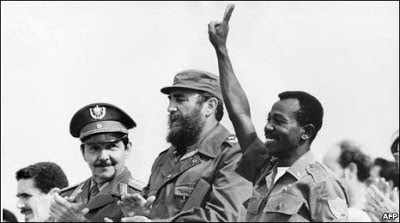
L to R: Ramiro Valdes, Raul Castro, Fidel Castro and Mengistu Haile Mariam

It may seem counter intuitive, but due to the extreme violent and criminal nature of the Castro regime it is nonviolence not violence that has a better chance in ending the Castro dictatorship.

Maciej Bartkowski, an adjunct faculty at Johns Hopkins University,  where he teaches strategic nonviolent resistance, in the essay "Nonviolent strategies to defeat totalitarians such as ISIS" makes an unexpected argument for stopping the Middle East terrorist group. 

"No single action by itself can dislodge totalitarians and pave the way for more stable societies, but collective actions, like the multipronged, civilian-based, and nonviolent strategies offered in the cited cases, can prove successful against extremely violent groups" ... "These strategies consist of:    

- Containment that lets the henchmen rule and erode their own legitimacy in the eyes of locals;  

- Grassroots noncooperation against totalitarians, including acts of subtle and overt disobedience, deliberate inefficiencies, and underground solidarity networks; 

[...]

- Transnational assistance to nonviolent activists and their civil resistance actions in a violence-torn environment."

The moral rightness of the economic embargo on the Castro regime: containment

Containment is a state strategy of non-cooperation with a hostile power that also avoids complicity with bad actors.  In the context of U.S. - Cuba relations the economic embargo when tightened and enforced has constrained the bad actions of the regime. This is why when Cubans took to the streets calling for the end of the dictatorship they did not wave Canadian, Spanish or European Union flags, but the flag of the United States. 

These other countries who have maintained "normal" relations with a criminal regime that includes providing subsidies and selling weapons to the dictatorship make them complicit in the crimes of the dictatorship.

The United States has economic sanctions that exempt food and medicine. American companies, due to the Castro dictatorship's monopoly over the economy, can only sell to the regime. The dictatorship is the one exploiting Cubans. For example, American companies sell chicken to Cuba for $1 per kilo and the Castro regime turns around and sales it to Cubans in government stores at $7 per kilo pocketing the difference for the Castros.

The United States also permits millions of Cubans in the United States to send remittances back to their families in Cuba, but out of every $100 sent today, at least $40 dollars are taken by the regime, and their business allies. However, one must weigh the harm done, versus the good in maintaining links between families. 

These are not considerations made by Havana. 

When the Castro regime was receiving Soviet subsidies and riding high in the world economically they forced Cubans to cut off relations with family living abroad. It was only when the dictatorship needed hard currency from the diaspora that they stopped punishing Cubans on the island having contacts with family abroad.

The power of nonviolent resistance

Oswaldo Payá, Antonio Diaz, Regis Iglesias turn in petitions to National Assembly 5/10/02

Courageous Cubans fought with arms against the dictatorship from the earliest days of the regime well into the 1960s with untold numbers killed, and the regime consolidated. 

Beginning in the 1970s a nonviolent human rights movement emerged in the prisons and would win some battles against the dictatorship using grassroots civic resistance tactics and endure to the present day inspiring millions of Cubans on the island and around the world.

Transnational assistance to Cuban nonviolent activists have been measures of concrete solidarity with the Cuban people that draws howls from the dictatorship and their allies, but gratitude from most Cubans.

This may not seem like much, but these methods of containment, nonviolent resistance, and transnational assistance have a better track record in defeating brutal terrorist regimes than armed conflict.

This is why I have been and continue to be vocal in my opposition to calls for violent resistance in Cuba. It is also why I have been and continue to be vocal in my support for the U.S. embargo on the Castro regime and targeted sanctions against regime bad actors, and advocate for transnational assistance to nonviolent dissidents in Cuba.

The U.S. military spent much in blood and treasure waging war against ISIS, and beat them back for a while, but they have not gone away. When it comes to violence, genocidal mass murderers have the advantage. Why fight on their terrain? Force them onto the terrain of nonviolent resistance where millions can challenge the dictatorship in a civic nonviolent manner. The Cuban opposition has been doing that and on July 11th the Castro regime was placed on the defensive when Cubans across the country nonviolently called for freedom and an end to the dictatorship.

Paradoxically, the best way to save the dictatorship and perpetuate its rule would be to abandon nonviolent resistance, in the belief that it would speed up change on the island, but by switching to violence the opposition would be helping the Castro regime by switching to a terrain that they have extensive experience in: violence, terror, and war.


Thursday, July 22, 2021

Remembering Cuban dissident leaders, Oswaldo Payá and Harold Cepero, both murdered by Castro regime on July 22, 2012

Remembering two Cubans who paid the ultimate price for Cuba's freedom.

July 22, 2021 outside the Embassy of Cuba in Washington DC

Today paid homage to Oswaldo Payá Sardiñas, and Harold Cepero Escalante, two martyrs for democracy in the Americas killed on July 22, 2012 by Castro's secret police. Had a meeting nearby the Cuban Embassy at 4:00pm, brought a large poster honoring both, and when I emerged from the gathering walked over and for nine minutes picketed in front. Gentleman passed by, and was willing to take a few photographs of this small action. He asked me if I spoke Spanish, and I said yes than asked him where he was from, and he told me "Costa Rica." We smiled and he took several pictures, and handed me back the camera and continued on his way.


Oswaldo was sixty years old at the time that he was murdered by agents of the Castro regime. He was a family man and lay Catholic from Havana, an engineer, who in September 1988 founded the Christian Liberation Movement with fellow Catholics in the neighborhood of El Cerro, and over the next 23 years would carry out important campaigns to support human rights and a transition to democracy in Cuba.

Harold Cepero was 32 years old at the time he was killed together with Oswaldo. He was from the town of Chambas in Ciego de Ávila. At age 18 he began to study at the University of Camaguey, and in 2002 together with other students Harold signed the Varela Project. It was an initiative that was legal within the existing Cuban constitution that had been authored by the Christian Liberation Movement.

On May 10, 2002 Oswaldo, along with Regis Iglesias and Tony Diaz Sanchez of the Christian Liberation Movement turned in 11,020 Varela Project petitions, and the news of the petition drive was reported worldwide.


Despite this, Harold and other students were expelled from the university for signing it and sharing it with others. The secret police would organize a mob to “judge”, scream at, insult, threaten and expel the students who had signed the Varela Project. Following his expulsion on November 13, 2002, Harold wrote a letter in which he cautioned that “those who steal the rights of others steal from themselves. Those who remove and crush freedom are the true slaves."

Regis Iglesias and Tony Diaz Sanchez were sentenced to long prison sentences in March 2003 following show trials, along with 73 other Cuban dissidents, many of them had taken part in the Varela Project and nearly eight years later were forced into exile as an alternative to completing their prison sentences.


In spite the crackdown, Oswaldo would turn in another 14,384 petition signatures on October 5, 2003. He would spend the next eight years campaigning for the release of his imprisoned compatriots, and continuing campaigns to achieve a democratic transition in Cuba.

Ten years, two months and twelve days after turning in the first Varela Project petitions while traveling in Eastern Cuba on a Sunday afternoon on July 22, 2012 with two international visitors Oswaldo and Harold were killed. Cuban state security bumped into the car they were driving, and when the vehicles stopped, with everyone still alive in the car, approached the driver striking him in the temple with the butt of a pistol. Within hours the lifeless and brutalized bodies of both men would appear.

These are somber times with a pandemic raging across the world killing millions, in part, due to the lack of transparency of the Chinese Communist Party.

Oswaldo Payá when awarded the Sakharov prize for Freedom of Thought on December 17, 2002 spoke prophetically when he said: “The cause of human rights is a single cause, just as the people of the world are a single people. The talk today is of globalization, but we must state that unless there is global solidarity, not only human rights but also the right to remain human will be jeopardized.”


The failure of the international community to advance human rights along with globalization that is made manifest by the West’s embrace of Communist China, ignoring its continuing dismal human rights record has created a crisis of values that has become a global economic and health crisis.

How did they not see that embracing a regime that killed over 45 million of its own people and building it up economically would not be a disaster? Have the lessons of Nazi Germany so faded from popular imagination that the world needed a reminder?

Oswaldo understood that the means are also the ends and in the same talk explained: “We now know that any method or model which purportedly aims to achieve justice, development, and efficiency but takes precedence over the individual or cancels out any of the fundamental rights leads to a form of oppression and to exclusion and is calamitous for the people.”

Oswaldo was a consistent human rights defender.

On January 12, 2002 the Cuban Communist Party's daily newspaper Granma offered the official position of the dictatorship on the United States opening a prison camp in Guantanamo: "We will not create any obstacles to the development of the [U.S. military] operation, though the transfer of foreign prisoners of war by the U.S. government to the base—located on a space in our territory upon which we have been deprived of any jurisdiction—was not part of the agreement that the base was founded upon."

The first Cuban on the island to criticize and denounce the United States for housing Afghan prisoners in Cuba and demanding they be treated with dignity was Cuban opposition leader Oswaldo Payá Sardiñas on December 17, 2002:  
"It's obviously a matter of shame that our land is being used for that purpose, having foreign prisoners brought to Cuba. Even if they are terrorists they deserve respect. Their human rights should be respected."
In the midst of darkness, it is important to remember these points of light that give us hope and a path to freedom and improved human rights around the world.

Six years ago on July 22, 2015 Javier El-Hage, and Roberto González of the Human Rights Foundation released a 147 page report titled The Case of Oswaldo Payá that concluded.
"Information that emerged in the months that followed and that was not at all considered by the Cuban court that convicted Carromero – consisting of witness statements, physical evidence and expert reports – suggest direct government responsibility in the deaths of Payá and Cepero. Specifically, the evidence deliberately ignored by the Cuban State strongly suggests that the events of July 22, 2012 were not an accident – as was quickly claimed by authorities in the state-owned media monopoly and later rubber – stamped by Cuba’s totalitarian court system – but instead the result of a car crash directly caused by agents of the State, acting (1) with the intent to kill Oswaldo Payá and the passengers in the vehicle he was riding, (2) with the intent to inflict grievous bodily harm to them, or (3) with reckless or depraved indifference to an unjustifiably high risk to the life of the most prominent Cuban activist in the last twenty-five years and the passengers riding with him in the car."
Let there be truth and justice for Oswaldo Payá, Harold Cepero and the many victims of Communism around the world, and let us continue their work in defense of human dignity and in pursuit of the global solidarity that they advocated and lived for.

Oswaldo Payá, Harold Cepero and others living and dead have laid the groundwork that made possible the nonviolent character of the mass nationwide protests that marked a new before and after in Cuban history. However Oswaldo and Harold marked two such historic moments in Cuban history: turning in the Varela Project signatures on May 10, 2002 and their martyrdom on July 22, 2012.
