Monday, February 20, 2023

Abraham Lincoln's Definition of Democracy

Frederick Douglass and Abraham Lincoln met several times.

Today is President's day, it falls between the birthdays' of the two most important U.S. Presidents: Abraham Lincoln born on February 12, 1809 and George Washington on February 22, 1732. Both, in today's ahistorical climate, are considered controversial, but reading their statements, and their example one obtains a deeper understanding of why they are, and should be honored and remembered as exemplars.

Historians believe that Abraham Lincoln wrote his definition of democracy on August 1, 1858.

"As I would not be a slave, so I would not be a master. This expresses my idea of democracy. Whatever differs from this, to the extent of the difference, is no democracy."

Slavery was routed after a long and bloody war that begin in 1861 and ended with the Union consolidated in 1865, and President Abraham Lincoln assassinated  by Southern partisans on the evening of April 14, 1865. 

Abolitionist Frederick Douglass passed away on this day in 1895 at his Cedar Hill home in Anacostia.The DC City Council commemorated this anniversary earlier today.

Abraham Lincoln and Frederick Douglass met together three times in the White House. Historians report that Douglass was initially harshly critical, but he ultimately came to view Lincoln as "emphatically the Black man's president: the first to show any respect for their rights as men." 

Over the next 12 years we saw the  U.S. Constitution amended, slavery outlawed in the United States, and African Americans living in the United States made full citizens, but then a corrupt bargain ended this spring of freedom and the Dream was deferred 80 years.

Progress is not inevitable, and the legacy of Lincoln, and his clear eyed view of democracy impacted the direction of the United States positively to the present day.

His definition of democracy remains relevant today for too many around the world still denied it.

These are additional reasons for my defense in June 2020 of the Emancipation Memorial at Lincoln Park, and for it remaining in its current location.

Sunday, February 19, 2023

Fidel Castro was Cuba's first communist oligarch, but not the last. The new ones continue to defend the old tyrant's legacy.

“The difference between the communist and capitalist systems is that, although both give you a kick in the ass, in the communist system you have to applaud, while in the capitalist system you can scream.” - Reinaldo Arenas, 1980 

This video has gone viral over social media highlighting members of the Castro clan that live a life of luxury in Cuba amidst the great poverty of the vast majority of Cubans.  The dictatorship has passed a new penal code that lengthens prison sentences for Cubans who complain about it.  A Tweet sharing the video states in Spanish: "The life of millionaires from the Castro Canel leadership while they ask for resistance from the people of Cuba."

This is not a new phenomenon, but one that was well hidden for decades. 

According to Forbes magazine and other publications, Castro enjoyed absolute privacy on his island.

The first oligarch in Communist Cuba was Fidel Castro. The late Cuban dictator owned a private island, 20 mansions, yachts, and according to Forbes Magazine was worth $900 million.  In 2014 upon the release of La Vie Cachée de Fidel Castro (Fidel Castro's Hidden Life) by the Cuban dictator's former bodyguard Juan Reinaldo Sánchez, The Guardian published an article on May 20th that dispelled myths about the communist leader.

Fidel Castro lived like a king with his own private yacht, a luxury Caribbean island getaway complete with dolphins and a turtle farm, and travelled with two personal blood donors, a new book claims. In La Vie Cachée de Fidel Castro (Fidel Castro's Hidden Life), former bodyguard Juan Reinaldo Sánchez, a member of Castro's elite inner circle, says the Cuban leader ran the country as his personal fiefdom like a cross between a medieval overlord and Louis XV. Sánchez, who was part of Castro's praetorian guard for 17 years, describes a charismatic and intelligent but manipulative, cold-blooded, egocentric Castro prone to foot-stamping temper tantrums. He claims the vast majority of Cubans were unaware their leader enjoyed a lifestyle beyond the dreams of many Cubans and at odds with the sacrifices he demanded of them. "Contrary to what he has always said, Fidel has never renounced capitalist comforts or chosen to live in austerity. Au contraire, his mode de vie is that of a capitalist without any kind of limit," he writes. "He has never considered that he is obliged by his speech to follow the austere lifestyle of a good revolutionary."

Videos and photos would emerge over the years revealing the Castro family's life of luxury while most Cubans lived in misery and extreme poverty, but the hypocrisy began with Fidel Castro.

This is one of the 20 mansions attributed to the late Cuban dictator.

This life of luxury was paid for initially out of what was looted from Cuban capitalists, farmers, and the middle class, then through Soviet subsidies, drug trafficking, and loans provided by Western countries and businesses. The Castro regime defaulted on the loans, and today is considered a poor credit risk, and a deadbeat. This leads to a question that will be decided in a UK court in the next few months: "Can the Cuban government be sued for unpaid debts from the early 1980s?"

"The trial ended last week, but it could be months before the judge, Sara Cockerill, renders judgement in the case of CRF vs Banco Nacional de Cuba & Cuba. Her decision is central to whether Cuba may finally be forced to pay back billions of dollars in unpaid debts. The trial is seen as a test case. CRF1, formerly known as the Cuba Recovery Fund, owns more than $1 billion in face value of European bank loans extended to Cuba in the late 1970s and early 1980s, when Fidel Castro still ruled the island. Cuba defaulted on the debt in 1986."

Middle class Europeans and Canadian taxpayers are subsidizing the life-styles of the elite of the Castro military dictatorship.

Daniel I Pedreira, an Adjunct Professor of Political Science at the University of Miami, in a 2013 paper presented at the Association for the Study of the Cuban Economy (ASCE) made the case in 2013 that the Cuban government was already engaged in the establishment of an oligarchy. The formal and institutionalized military-economic oligarchy began to be planned out by Raul Castro prior to the Special Period.

"For decades, the Cuban government has developed the framework for an oligarchy comprised of military leaders. Dr. Terry L. Maris (2009:64) asserts: Even prior to the “special period,” Cuba had begun to explore new ways to improve its economy. Raúl Castro, in his role as the minister of the Revolutionary Armed Forces (F.A.R.), designed and implemented a novel education and training program. Under the direction of Raúl’s close friend, General Julio Casas Regueiro, high-ranking officers were carefully selected to attend some of the most prominent business schools in Western Europe to acquire the skills deemed necessary for the salvation of the Cuban economy. In apparent contradiction of the tenets of socialism, the Cuban military quietly embraced the teachings of capitalism."

The establishment of the so-called "Centre for Economic Transformation" by the Castro regime with Russian oligarchs confirms that there will be no transition to a free market, but rather a formalization of the informal and previously existing kleptocracy run by the Cuban military through its conglomerate GAESA, with a greater role for Moscow in the evolution of this model. At the same time one cannot ignore the presence of Beijing in Cuba, and its links to the Cuban dictatorship, and its oligarchs. In November 2022, Beijing announced that it would restructure its debts with Havana, provide new credits, and donate $100 million to the Castro regime.

Oligarchies exist the world over, but the Cuban case, like the Russian, are extreme examples that also entrench political power into a permanent dictatorship. They are also infiltrated into the United States, and Europe where they can corrupt and undermine Western Democracies.

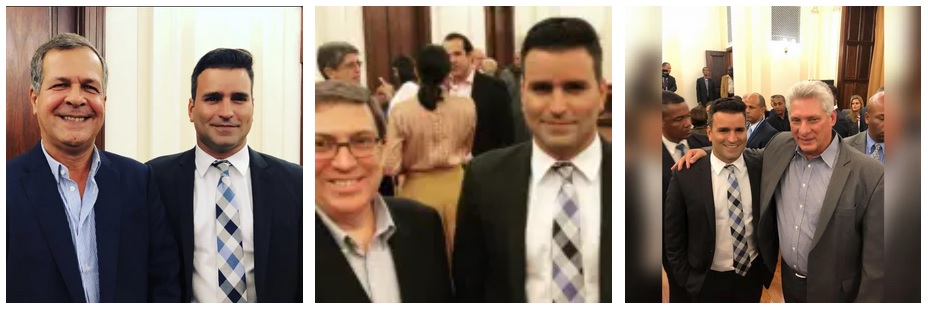
Rodolfo Dávalos León w/ Lopez Callejas,  Bruno Rodriguez, and Diaz-Canel

Rodolfo Dávalos León is a Cuban national living in the United States who founded Caribbean Ventures Management LLC, a company incorporated in the state of Delaware in 2016, but headquartered in Coral Gables, Miami.  When protests erupted across Cuba on July 11, 2021, and the dictatorship's future was in doubt, Mr. Dávalos León tweeted out "If the revolution falls you will find me in Cuba, with my father, knee on ground, rifle in hand, defending the work of Fidel. Long live Cuba, long live Raul, and long live Fidel!" 

Naturally, a few questions will arise. Has the FBI investigated what he is doing? In addition, who is his father? Has he registered as an agent of a foreign principal?

According to publicly available photos, he met with Ben Rhodes in Coral Gables and U.S. Senator Patrick Leahy in the U.S. Capitol.

His father is a highly placed confidant of Fidel and Raul Castro. According to official records, Dr. Rodolfo Dávalos Fernández is a professor of International Law at the University of Havana and president of the Cuban Court of International Commercial Arbitration.

Dr. Rodolfo Dávalos Fernández with Fidel Castro. His daughter pictured on the right.

Cuban independent journalist Ulises Fernández in a July 2021 piece for Cubanet filled in some of the gaps in the professor's official record. Dr. Dávalos Fernández was present in  "every international litigation that involved the Cuban government as defendant, plaintiff, summoned party, or even referenced entity, in matters unpleasant in nature, since they always have to do with breach of contracts, frozen bank accounts, confiscations, accumulated debts, fraudulent practices against businessmen, blackmail, espionage and psychological manipulation..."

It is not mentioned that Professor Dávalos Fernández is one of the patriarchs of the Cuban oligarchy, with his children enjoying lucrative lifestyles in private companies in the United States and Spain.  

Dr. Rodolfo Dávalos Fernández, Cuban oligarch

Rodolfo Dávalos León, who is based in Coral Gables, has already been mentioned. Let us now turn our attention to his sister, Lourdes Dávalos León, an attorney based in Spain and a social influencer with a penchant for Louis Vuitton handbags and the finer things in life. Video emerged highlighting their visit to the United Kingdom in 2023. She now wants to open a shop in Cuba, and is described as an entrepreneur.

If the Biden Administration believes that these "entrepreneurs" will be agents of a democratic transition in Cuba, it is delusory. More likely, they will be agents of corruption in the United States, Europe, and elsewhere, seeking to undermine the rule of law and democracy, as their Russian counterparts are doing.   

Saturday, February 18, 2023

Fact Sheet on February 24, 1996 Brothers to the Rescue Shoot down

 “Facts are stubborn things; and whatever may be our wishes, our inclinations, or the dictates of our passion, they cannot alter the state of facts and evidence.”― John Adams, Boston Massacre trial (1770)


February 24, 1996 shoot down was an act of state terrorism that blew two civilian aircraft out of the sky with air to air missiles while in international airspace after regime planned the act months beforehand with its espionage network in the United States.
 
 FACT 1: By definition: Terrorism is the calculated use of violence (or the threat of violence) against civilians in order to attain goals that are political or religious or ideological in nature; this is done through intimidation or coercion or instilling fear)
http://wordnetweb.princeton.edu/perl/webwn?s=terrorism  


FACT 2: Cuba is responsible for violating the right to life (Article I of the American Declaration of the Rights and Duties of Man) to the detriment of Carlos Costa, Pablo Morales, Mario De La Peña, and Armando Alejandre, who died as a result of the direct actions of its agents on the afternoon of 24 February 1996 while flying through international airspace.

Inter-American Commission on Human Rights September 29, 1999 Report on the Merits http://www.cidh.org/annualrep/99eng/Merits/Cuba11.589.htm

FACT 3: Cuba is responsible for violating the right to a fair trial (Article XVIII of the American Declaration of the Rights and Duties of Man) to the detriment of the relatives of Carlos Costa, Pablo Morales, Mario De La Peña, and Armando Alejandre, in that to date the Cuban authorities have not conducted an exhaustive investigation with a view toward prosecuting and punishing the perpetrators and have not indemnified those same relatives for the damage they suffered as a result of those illicit acts.

Inter-American Commission on Human Rights September 29, 1999 Report on the Merits http://www.cidh.org/annualrep/99eng/Merits/Cuba11.589.htm

FACT 4: In Alejandre v. Republic of Cuba, 996 F.Supp. 1239 (S.D.Fla. 1997), a federal district court awarded the families of three of the four occupants of the “ Brothers to the Rescue” planes shot down by Cuba in 1996 a total of $187.7 million in damages against Cuba.

Lawsuits Against State Supporters of Terrorism: An Overview by Jennifer K. Elsea  
https://fas.org/sgp/crs/terror/RS22094.pdf

FACT 5: WASP spy network was involved. One of the “illegal officers” (Gerardo Hernandez) was convicted of conspiracy to commit first-degree murder based on his role in the February 24, 1996, shoot-down of two unarmed civilian aircraft in international airspace by Cuban Air Force jet fighters, which resulted in the deaths of four people, three of them U.S. citizens.

Department of Justice on Obama Commutations
http://www.justice.gov/pardon/obama-commutations#dec152014

FACT 6: Brothers to the Rescue had spotted and saved thousands of rafters in the Florida Straits and was engaged in such a mission on that day. The one plane that skirted the boundary briefly was the only one to return. The other two were shotdown miles away from Cuba’s boundary having never entered or touched it on that day and the planes had been in contact with the Cuban tower throughout the flight.

ICAO Resolution on February 24 shootdown 
http://www.icao.int/icao/en/nr/1996/pio199606_e.pdf

FACT 7: On July 26, 1996 the United Nations Security Council: "Noting that the unlawful downing of two civil aircraft on 24 February by the Cuban Air Force violated the principle that States must refrain from using weapons against airborne civil aircraft, the Security Council this afternoon condemned such use as being incompatible with the rules of customary international law "

ICAO Resolution on February 24 shootdown 
http://www.icao.int/icao/en/nr/1996/pio199606_e.pdf

FACT 8: Ana Belen Montes, the US intelligence community's top analyst on Cuban affairs had throughout a sixteen-year career at the Defense Intelligence Agency sent the Cuba intelligence service sensitive and secret information and helped to shape US opinion on Cuba. Investigation against her was triggered by her odd behavior before and after the Brothers to the Rescue shoot down. On September 21 2001 Ana Belen Montes was arrested and subsequently charged with Conspiracy to Commit Espionage for the government of Cuba. Montes eventually pleaded guilty to spying, and in October, 2002, she was sentenced to a 25-year prison term followed by 5 years of probation.

True Believer: Inside the Investigation and Capture of Ana Montes, Cuba's Master Spy http://www.amazon.com/True-Believer-Inside-Investigation-Capture/dp/1591141001

FACT 9: On December 27, 2010 and again in a January 19, 2011 clarification the defense of Cuban spy-master Gerardo Hernandez acknowledged that "there was overwhelming evidence that the 1996 shoot-down of two Brothers to the Rescue planes occurred in international airspace, not Cuban territory."

The Miami Herald: Cuban spymaster now claims Brothers to the Rescue shooting was outside Cuban airspace by Jay Weaver December 27, 2010  https://www.sun-sentinel.com/news/fl-xpm-2010-12-27-fl-cuba-spy-20101227-story.html

FACT 10: On December 17, 2014 President Barack Obama commuted Gerardo Hernandez’s two life sentences and returned him along with two other spies jailed for crimes in the United States to Cuba where they were received with a hero’s welcome in what is an immense propaganda victory for the Castro regime.

Department of Justice on Obama Commutations
http://www.justice.gov/pardon/obama-commutations#dec152014 

Thursday, February 16, 2023

Fact Sheet on Orlando Zapata Tamayo

"Long live human rights, with my blood I wrote to you so that this be saved as evidence of the savagery we are subjected to that are victims of the Pedro Luis Boitel political prisoners [movement]" - Orlando Zapata Tamayo, letter smuggled out April of 2004*

 Orlando Zapata Tamayo tortured and killed by prison officials on February 23, 2010

Fact #1 Orlando Zapata Tamayo was murdered by Cuban government officials 

Both Abel Lopez Perez and Reina Luisa Tamayo charge that Cuban prison officials denied Orlando Zapata Tamayo water in an effort to break his spirit. Reina Luisa Tamayo in an interview with Yoani Sanchez, hours after her son’s death denounced that officials had denied him water.[1] Abel Lopez corroborates the charge stating: “Before Zapata was checked into the hospital, he was regularly taking some vitamins. He was in a weak state of health. A military chief known as ‘Gordo’, who was the one responsible for ordering all of Zapata’s things to be taken out of the cell and to stop giving him water, also took his bottle of vitamins and poured all the pills down a drain. He told him, ‘Those who are in protest here don’t drink vitamins. I think those are pills sent to you by the Yankees so you can continue your hunger strike.’ Those were the exact words said to him, I verified them. His vitamins were taken away, as were any other medications. And they stopped giving him water for a while.”[2] This type of practice was also documented in the 1966 death of another Cuban hunger striker, Roberto López Chávez.[3], [4] Denying water to a man on water only hunger strike is cruel and inhuman treatment that contributed to his death.


Fact #2 Orlando Zapata Tamayo was an Amnesty International prisoner of conscience

Orlando Zapata Tamayo #6 with other prominent dissidents in regime publication.

 
Orlando Zapata Tamayo was recognized as an Amnesty International (AI) prisoner of conscience on January 29, 2004 a designation given only to nonviolent activists after careful examination.[5] On January 29, 2004 Amnesty International outlined Orlando Zapata Tamayo’s past arrests:

“He has been arrested several times in the past. For example he was temporarily detained on 3 July 2002 and 28 October 2002. In November 2002 after taking part in a workshop on human rights in the central Havana park, José Martí, he and eight other government opponents were reportedly arrested and later released. He was also arrested on 6 December 2002 along with Oscar Elías Biscet[6], but was released on 8 March 2003. Most recently, he was arrested on the morning of 20 March 2003 whilst taking part in a hunger strike at the Fundación Jesús Yánez Pelletier, Jesús Yánez Pelletier Foundation, in Havana, to demand the release of Oscar Biscet and other political prisoners.”[7]

Orlando Zapata Tamayo appeared photographed in the Cuban government’s own publication Los Disidentes, in photos prior to his 2003 arrest and was then recognized by Cuban officials as a dissident. The Spanish newspaper El Mundo carried a photo the day after the Cuban regime announced the death of Orlando Zapata Tamayo with prominent Cuban dissidents.[8]

Orlando Zapata Tamayo with other dissidents in El Mundo.


Fact #3 Orlando Zapata Tamayo’s hunger strike was an act of non-violent self-defense

Orlando Zapata Tamayo had been beaten and tortured on more than one occasion by prison guards, state security officials, along with other prisoners. His body was scarred and his health in decline. For example, Amnesty International reported that, on "October 20, 2003 [Orlando Zapata] was dragged along the floor of Combinado del Este Prison by prison officials after requesting medical attention, leaving his back full of lacerations."[9] Cuban political prisoner Abel Lopez Perez transferred to the same prison in Camaguey as Orlando Zapata Tamayo on December 3, 2009 briefly saw him and heard from other prisoners “that a few days before being taken away, Zapata stood up and shouted, ‘People, don’t let yourselves be lied to. Don’t believe anything that they tell you. I’m not demanding a kitchen or any of the things they took away from me. I’m demanding an improvement of treatment for all prisoners, and so you all know, I am going to die for it.’”[10] The case of Ariel Sigler Amaya, another Cuban prisoner of conscience, is instructive. He had to threaten a hunger strike, although already emaciated and crippled, to obtain medical treatment to save his life.[11] The hunger strike was not an act of suicide but rather a tactic of self defense within the arsenal of nonviolent options.

Fact #4 Between 1966 and 2010 at least six Cuban political prisoners died while on hunger strike: Roberto López Chávez , Carmelo Cuadra Hernández , Pedro Luis Boitel, Olegario Charlot Pileta, Enrique García Cuevas and Orlando Zapata Tamayo.

Roberto López Chávez, 25 years old, died on December 11, 1966 in Isla de Pinos prison on hunger strike without medical assistance.[12] Armando Valladares, in his prison memoir, Against All Hope described the circumstances surrounding his death: “When Roberto López Chávez, went on a hunger strike to protest the abuses in the prison, the guards withheld water from him until he became delirious, twisting on the floor and begging for something to drink. The guards then urinated in his mouth. He died the next day.”[13], [14]

Carmelo Cuadra Hernández, died in La Cabaña prison in April of 1969 on hunger strike, after suffering mistreatment and torture over eight and a half months, without receiving medical care and was the third political prisoner that has died on a hunger strike.[15], [16]

Pedro Luis Boitel died on hunger strike on May 25, 1972.[17],[18]

Olegario Charlot Pileta, died in the famous "Escaleras" (staircase) of the Boniato prison, in of January 1973 during a hunger strike, without medical assistance and is described in documents as a “black youth.” [19],[20]

Enrique García Cuevas died on a hunger strike, without receiving medical care, in cell No. 4 of the new Provincial Jail of Santa Clara, on June 24, 1973.[21]

Two of the four outlined above died on hunger strikes after Pedro Luis Boitel and there are partial estimates that place the number identified to have died while on hunger strike at twelve including both Boitel and Zapata. Since the death of Pedro Luis Boitel there are partial lists identifying six political prisoners dead on hunger strikes between May 25, 1972 and February 23, 2010.[22]


Sources:

1. Sanchez, Yoani “Orlando Zapata Tamayo's Mother Speaks After Her Son's Death” The Huffington Post February 24, 2010 http://www.huffingtonpost.com/yoani-sanchez/orlando-zapata-tamayos-mo_b_475006.html

2. Felipe Rojas, Luis “Abel Remembers the Last Days of Zapata in a Prison of Camaguey” Crossing the Barbed Wire November 24, 2010 http://cruzarlasalambradaseng.wordpress.com/2010/11/24/abel-remembers-the-last-days-of-zapata-in-a-prison-of-camaguey/

3. Valladares, Armando Against All Hope: The Prison Memoirs of Armando Valladares (1st edition Knopf April 12, 1986) quote taken from (1st Edition Encounter Books April 1, 2001) pg. 379

4. Glazov, Jamie United in Hate: The Left's Romance with Tyranny and Terror WND Books, 2009 Pg 48

5. Amnesty International “CUBA Newly declared prisoners of conscience” January 29, 2004  
    https://www.amnesty.org/en/documents/AMR25/002/2004/en/

6. Quintero, Tania “CUBA | Llorando a un amigo ¡Así te voy a recordar, Orlando!” El Mundo February 24, 2010 http://www.elmundo.es/america/2010/02/24/cuba/1267020583.html

7. Amnesty International “CUBA Newly declared prisoners of conscience” January 29, 2004 https://www.amnesty.org/en/documents/AMR25/002/2004/en/

8. Felipe Rojas, Luis “Abel Remembers the Last Days of Zapata in a Prison of Camaguey” Crossing the Barbed Wire November 24, 2010 http://cruzarlasalambradaseng.wordpress.com/2010/11/24/abel-remembers-the-last-days-of-zapata-in-a-prison-of-camaguey/

9. Rodriguez, Eliott “Paralyzed Former Cuban Prisoner Arrives In Miami” CBS4 July 28, 2010

10. Inter-American Commission on Human Rights “Annual Report 1975: 1805 Cuba” http://www.cidh.org/annualrep/75eng/Cuba1805.htm

11. Valladares, Armando Against All Hope: The Prison Memoirs of Armando Valladares (1st edition Knopf April 12, 1986) quote taken from (1st Edition Encounter Books April 1, 2001) pg. 379

12. Glazov, Jamie United in Hate: The Left's Romance with Tyranny and Terror WND Books, 2009 Pg 48

13. Inter-American Commission on Human Rights SITUATION OF POLITICAL PRISONERS IN CUBA (1976) http://www.cidh.org/countryrep/cuba76eng/chap.1.htm

14. Inter-American Commission on Human Rights SEGUNDO INFORME SOBRE LA SITUACIÓN DE LOS PRESOS POLÍTICOS Y SUS FAMILIAS EN CUBA May 7, 1970 http://www.cidh.org/countryrep/Cuba70sp/cap.1b.htm

15. Amnesty International “CUBA Newly declared prisoners of conscience” January 29, 2004 https://www.amnesty.org/en/documents/AMR25/002/2004/en/

16. Inter-American Commission on Human Rights “Annual Report 1975: 1805 Cuba” http://www.cidh.org/annualrep/75eng/Cuba1805.htm

17. Tamayo, Juan O. “Jailed Cuban activist Orlando Zapata Tamayo dies on hunger strike” The Miami Herald February 23, 2010 https://newcentrist.wordpress.com/2010/02/23/jailed-cuban-activist-orlando-zapata-tamayo-dies-on-hunger-strike/

18. Inter-American Commission on Human Rights 6TH REPORT ON THE SITUATION OF POLITICAL PRISONERS IN CUBA: CHAPTER III: AN ANALYSIS OF CERTAIN INDIVIDUAL CASES SUBMITTED TO THE IACHR 14 December 1979 http://www.cidh.org/countryrep/cuba79eng/chap.3.htm

19. Inter-American Commission on Human Rights CHAPTER I SITUATION OF POLITICAL PRISONERS IN CUBA (1976) https://www.cidh.oas.org/countryrep/Cuba76eng/toc.htm

20. Inter-American Commission on Human Rights “Annual Report 1975: 1805 Cuba” http://www.cidh.org/annualrep/75eng/Cuba1805.htm

21. Inter-American Commission on Human Rights CHAPTER I SITUATION OF POLITICAL PRISONERS IN CUBA (1976) https://www.cidh.oas.org/countryrep/Cuba76eng/toc.htm

22. Corzo, Pedro “El calvario de las prisiones cubanas” El Nuevo Herald March 13, 2010 https://democraciaparticipativa.net/foro/iberoamerica-y-espana-latin-america-spain/3038-el-calvario-de-las-prisiones-cubanas

Wednesday, February 15, 2023

Laura Pollán at 75 - Remembering the Cuban dissident leader's legacy. Global rise in number of political prisoners with Belarus and Cuba in the lead. Cuba and Iran undermining Peru

They can either kill us, put us in jail or release them. We will never stop marching no matter what happens." - Laura Inés Pollán Toledo (2010)

Laura Inés Pollán Toledo, February 13, 1948 - October 14, 2011

Earlier version published as a CubaBrief 

Laura Inés Pollán Toledo, was born 75 years ago on February 13, 1948. She had been a school teacher, before her husband,  Héctor Fernando Maseda Gutiérrez, was jailed for his independent journalism in 2003 along with more than 75 other civil society members. Amnesty International recognized them as prisoners of conscience.

Claudia Márquez (izq) , Blanca Reyes (centro) y Miriam Leiva (der), al salir el 7 de abril de 2003 del Tribunal Provincial de La Habana tras conocer las sentencias dictadas contra sus respectivos esposos (Foto: Radio Televisión Martí)

This drove her break with the regime, and the formation of a dissident movement that marked a before and after in Cuban history. Claudia Márquez (izq) , Blanca Reyes (centro) y Miriam Leiva, who had been long time activists, and also had their husbands jailed were founding leaders in the new movement.

Laura reached out to the wives, mothers, sisters, and daughters of the 75 prisoners of conscience jailed in March 2003, which included her husband and they carried out a sustained nonviolent campaign that after eight years obtained the freedom of their loved ones. The first group was released in November 2010, and the last of the group of 75 were freed in March 2011.

Laura was greatly admired both inside and outside of Cuba for founding the Ladies in White movement after the Black Cuban Spring of 2003. She, and the group of women she led, nonviolently challenged the Castro regime in the streets of Havana initially, and eventually across the island.

She did not disband the Ladies in White when her husband returned home in February 2011. Laura recognized that the laws had not changed, that prisoners of conscience remained behind bars.

Laura Pollán and Héctor Maseda reunited in February 2011

Mary O'Grady in The Wall Street Journal on October 24, 2011 reported that Pollán instead of disbanding sought to expand "the movement across the country and promised to convert it to a human rights organization open to all women. Speaking from the Guanajay prison as her condition was deteriorating, jailed former Cuban counterintelligence officer Ernesto Borges Pérez told the Hablemos Press that making public those objectives likely sealed her fate." Laura Pollán died on October 14, 2011 and was cremated shortly afterwards.

Following her death, her husband Héctor Fernando Maseda mourned and through tears observed that "the toll on our private lives has been that after eight years of forced separation, we didn't even get eight months together. So I had one month of happiness for every year of separation."


Héctor Fernando Maseda marches with the Ladies in White following Laura's death in October 2011

Dr. Oscar Elías Biscet MD, who was a first degree medical specialist in internal medicine, before being fired from his post by the government for his dissident views, examined the circumstances surrounding the death of  Laura Pollán and wrote an analysis in November 2011 titled "A MEDICAL ANALYSIS OF LAURA POLLAN'S PAINFUL, TRAGIC AND UNNECESSARY DEATH." He concluded that " There is concrete evidence that the closest relatives, friends and dissidents expressed suspicions about a possible assassination by the communist regime's political police. Now, what has been proven over and over again is the stubborn nature of the regime at this sad, tragic and unnecessary death."

U.S. journalist Tracey Eaton interviewed Laura's widower Héctor Maseda on Dec. 15, 2011, about three months after her death, and he held the Castro regime responsible for her death, but admitted that he did not have the evidence to back up his allegation.

Twelve years later, and the wisdom of her analysis is reflected in over a thousand prisoners of conscience, and a dictatorship that changed the penal code to increase punishments for exercising freedom of expression.

Belarus, Cuba, and Vietnam have jailed thousands of prisoners of conscience in recent years.

The Ladies in White continue to be subjected to brutal repression, and four women of this movement are today jailed in Cuba for calling for the release of political prisoners, and nonviolently defending human rights.

Ladies in White Tania Echevarría, Saylí Navarro, Sissi Abascal and Aymara Nieto jailed.

 On April 14, 2022, Ms.Tania Echevarría Menéndez was sentenced to six years in prison for crimes of public disorder and contempt.

On April 18, 2022, Ms. Sayli Navarro Alvares began serving an eight-year sentence for crimes of public disorder, contempt, and assault related to her participation in the July 11 protests.
 
Ms. Sissi Abascal Zamora was sentenced to six years in prison for participating in the 11J protests in the town of Carlos Rojas, in the municipality of Jovellanos, in the province of Matanzas. The 23-year-old activist and member of the Party for Democracy Pedro Luis Boitel has ten business days to appeal. Reports are that a bus full of women dressed as civilians arrived where Sissi was peacefully demonstrating with others on July 11, 2021, and proceeded to beat her and others up, and a bottle was broken over Ms. Abascal Zamora's head requiring that she receive stitches.

Mrs. Aymara Nieto Muñoz served four years in prison for her activism in the Ladies in White and when released officials created a new case against her and sentenced her to five years and four months in prison. This was in retaliation for not having agreed with State Security to leave the country with her family.

Laura is not forgotten, and her memory and example continue to animate the Ladies in White, and their current leader Berta Soler.

Berta Soler Fernandez is the current leader of the Ladies in White in Cuba.

Sadly, too many in the international community are funding the dictatorship, and ignoring what Havana does with the resources provided. On February  12, 2023 in her column "Cuba Dares Biden to Look Away" exposed the nexus between Iran, Cuba, Venezuela and terrorist groups in subverting democracy in Peru.

"In March 2015, political and security analyst Dardo López-Dolz, a former Peruvian vice minister of the interior, laid out the threat before a U.S. House subcommittee. He said Iran and Hezbollah came to his attention in 2011, when “a connection was forming between the Islamic Republic and other activist movements in Peru controlled by Havana, Caracas and La Paz.” The Cuban and Venezuelan “political/social organizations aimed at subverting and weakening our democratic institutions and spreading socialist ideology,” he said, had been operating in Peru “since at least 2005.”

The Islamic regime in Iran, a close ally of Havana, has embarked on a six month long crackdown against protesters killing over 528 protesters, and jailing approximately 20,000 protesters.