Monday, February 18, 2019

#Feb24SilentProtest: Time to say NO to illegitimate votes, NO to continued impunity, NO to dictatorship, and NO to Castro regime meddling in other countries

"There may be times when we are powerless to prevent injustice, but there must never be a time when we fail to protest." - Elie Wiesel, Nobel Lecture 1986

#YoVotoNo =  #YoNoVoto = #N1Mas = #NoMoreImpunity = #NoMoreCastros

February is a difficult month for friends of freedom in Cuba and Venezuela. 

Five years ago in February of 2014 on Venezuela's national youth day the Maduro regime gunned down students peacefully protesting in the streets of Venezuela. The killings have continued to the present day.

Robert Redman with other youths carrying Bassil Dacosta on February 12, 2014.
Nine years ago on February 23, 2010 human rights defender, and Amnesty International prisoner of conscience, Orlando Zapata Tamayo died on hunger strike after years of torture and mistreatment by Castro regime agents. Political prisoners continue to suffer in Cuban prisons today.

Orlando Zapata Tamayo 1967 - 2010
Twenty three years ago on February 24, 1996 at 3:21 pm and 3:27 pm in international airspace two civilian aircraft belonging to the humanitarian group Brothers to the Rescue were destroyed by air-to-air missiles fired by a Cuban MiG-29 killing Armando Alejandre Jr. (age 45), Carlos Alberto Costa (29), Mario Manuel de la Peña (24), and Pablo Morales (29).

Extrajudicially executed by the Castro regime on 2/24/1996
Author Matt Lawrence translated and subtitled the audio of the Cuban MiG pilots who hunted and destroyed the two planes. The planes had been engaged in a search and rescue mission for Cuban rafters in the Florida Straits. Three planes set out only one returned.

On Sunday, February 24th the Castro regime will be engaged in a sham constitutional referendum in an attempt to gain international legitimacy to perpetuate the rule of the Castro dictatorship in Cuba for another generation. The democratic resistance in Cuba has campaigned proclaiming "No" to the illegitimate process calling on Cubans not to vote and stay home or if they are going to vote to vote "No."

Let us also take this upcoming Sunday, February 24th not only to say "No" to the illegitimate referendum in Cuba, but to say "No" to dictatorship, and "No" to the continued impunity in Cuba and Venezuela. Friends of freedom around the world please join us in calling on the Castro regime to stop meddling and get out of Venezuela, Nicaragua and bring those responsible for gross and systematic human rights abuses in Cuba to justice.

#Feb24SilentProtest at 3:00pm in front of the Cuban Embassy. We will not chant or yell, but bring posters with the word "No" writ large and images of victims of the Castro regime. Between 3:21pm and 3:27pm form a human chain, and at 3:30pm go our separate ways.


Thursday, February 14, 2019

Five years after 12F: The Youth Day when Maduro's Snipers Executed Nonviolent Youth and Kept Doing It

"Gentlemen, he who is here will go out tomorrow to find a better future." - Bassil Alejandro Dacosta, age 24 , over Facebook on February 11, 2014. He was murdered the next day by the Maduro regime.

Robert Redman with other youths carrying Bassil Dacosta on February 12, 2014.
Five years ago nonviolent student protesters Bassil Da Costa and Robert Redman were gunned down on February 12, 2014 in Venezuela, while engaged in nonviolent street protests against the government of Nicolas Maduro. Robert Redman was shot and killed hours after he had carried Bassil, who had also been shot and died earlier that same day, and tweeted about it.

"Today I was hit with a rock in the back, a helmet in my nose. I swallowed tear-gas, carried the kid who died, and what did you do?" - Robert Redman, age 28 over twitter on February 12, 2014 
On February 12, 2014 Venezuela's National Youth Day millions of young students took to the streets to nonviolently protest "the social and economic crisis caused by the illegitimate government that Venezuela has today."  

Young Venezuelans inside and outside of the country mobilized in a coherent and sustained effort to expose the anti-democratic nature of the Maduro regime. A full and brief explanation was offered by Andreina Nash at the time in the video titled: What's going on in Venezuela in a nutshell.

The regime violence had escalated in the days prior to February 12th. On February 11, 2014 in an update via twitter from Roderick Navarro and Guido Mercado they reported, "wounded by bullets today: Jorge Monsalve 20 years old, Franco Perez 15 years old (Thorax), Pedro Alison 24 years old (Left arm), Anny Paredes 36 years old (Abdomen)."  On the days following February 12th the regime orchestrated violence and killings continued.


Robert Redman and Bassil Alejandro Dacosta murdered five years ago.
On May 18, 2017 The Miami Herald reported that it had a secret recording of a Venezuelan general advocating for the use of snipers against street demonstrators "in the future." The sad news is that this has been a practice long adopted by the Maduro regime in Venezuela.

Genesis Carmona is evacuated on a motorcycle after being shot.

Génesis Carmona, a local beauty queen, was just 22 years old and nonviolently expressing her desire for a better Venezuela when she was shot in the head on February 18, 2014 and died a day later. 

Génesis was marching at approximately 4:00 pm on Tuesday February 18, 2014, near Cedeño Avenue and the intersection of Carabobo, when  a group of masked gunmen on motorcycles opened fire on the demonstrators. She was shot in the head in the left occipital region. Génesis was with her sister Alejandra Carmona at the moment it happened. Alejandra in a radio interview said "I was with her, when the motorized units (of the Government) arrived, we fled running. We were stopped on a street corner, we were looking up and then suddenly she fell."   

According to VOXXI the "22-year-old was rushed in a motorcycle to the Medical Center Guerra Mendez in Valencia, where she was operated and kept in intensive care. Less than 24 hours later on 12:14 p.m., the doctors announced that she had died from her injury. 

Five years will have passed in five days and those responsible for her murder have yet to be brought to justice, and the extrajudicial killings continue in Venezuela.

Génesis Carmona: Shot in the head by a sniper on February 18, 2014
Geraldine Moreno was shot in the head with buckshot on February 19, 2014 in Tazajal, located in Naguanagua, in the state of Carabobo while taking part in a protest and in one of her last tweets on February 17th explained what motivated her to take part in the demonstrations: "No one sends me I go because I want to defend my Venezuela." She died from her injuries on Saturday, February 22, 2014. She was 23 years old.

Geraldine Moreno (age 23) shot in the head with buckshot and died

 In the evening hours of March 18, 2014 Anthony Rojas died of a gunshot wound to the face. He was a second semester student of mechanical engineering at the University of Tachira (UNET). He died in a presumed shootout near a shop in the Diamante sector of Táriba. It was learned that Rojas was in the commercial establishment buying drinks with other youth when motorized units passed by fired and into the place. He was eighteen years old. 

Anthony Rojas shot in the face and killed 3/18/14
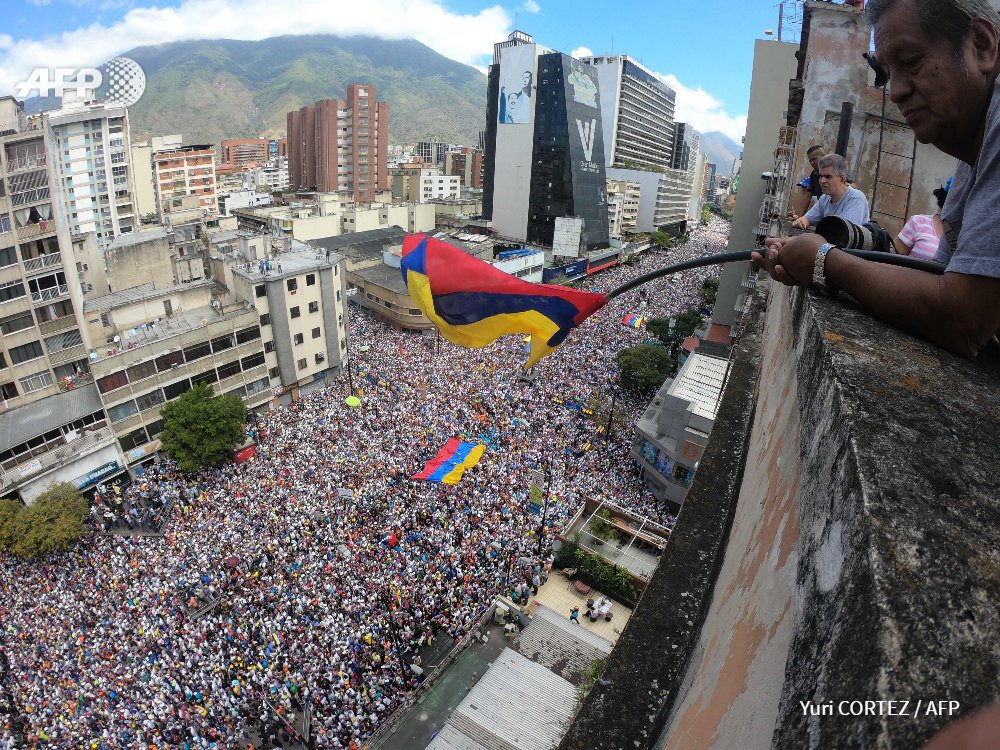
On February 12, 2019 hundreds of thousands of Venezuelans took to the streets to protest against the Maduro regime, to demand a democratic restoration, and remember those killed by the dictatorship. The theme for the mobilization of the student movement on February 12th was "The Youth Do Not Forget" and the mass nonviolent movement took to the streets.

Regime tactics have grown more deadly over the past five years.  In 2017 Nicolas Maduro ordered the formation of the FAES - "the Spanish acronym for the Bolivarian National Police’s Special Action Forces," according to Caracas Chronicles " are police Death Squads in all but name."

Maikel Jesús Cumare Ávila (age 21) murdered by Maduro's death squad on 1/8/19
Maikel Jesús Cumare Ávila was 21 years old when he was murdered by FAES officers in front of his mother, Desiré Cúmare, on January 8, 2019. At 9:00 a.m., his mom heard a knock on the door. In a flash, masked men had a gun to her face. They threatened to shoot her if she didn’t open the metal door. According to his mom, "Maikel took the keys and opened himself. They burst in, pushed him to the ground and started kicking his head against the floor. That’s how they killed him. They cracked his skull.”


The Chavez-Maduro regime was in its 20th year, before the arrival of the new and legitimate government of President Juan Guaido. Although now illegitimate and a tyranny, Maduro's regime, still continues to carry out extrajudicial killings and attempt to block humanitarian aide for Venezuelans.  

According to Amnesty International there have been more than 8,200 extrajudicial executions between 2015 and June 2017 in Venezuela.

Two question arise in the midst of the continuing repression: How many Venezuelans have been murdered by the Chavez-Maduro regime between 1999 and 2019?  and "When will this regime that sends out death squads to murders students and artists finally stop?"


Tuesday, February 12, 2019

Simple math: #YoVotoNo = #YoNoVoto = #N1Mas = #NoMoreCastroRegime

"Nonviolent action is just what it says: action which is nonviolent, not inaction. This technique consists, not simply of words, but of active protest, noncooperation, and intervention. Overwhelmingly, it is a group or mass action." - Gene Sharp  

#YoVotoNo =  #YoNoVoto = #N1Mas = #NoMoreCastroRegime
The Cuban opposition today is preparing for the February 24, 2019 sham the Castro regime calls a "constitutional referendum."  Part of the Cuban democratic opposition is calling on Cubans to stay home and not vote. While another part of the opposition is calling on Cubans to go to the polls and vote no.

The current Cuban Constitution, a Stalinist invention adopted in 1976 was modified twice: first in 1992 and a second time in 2002, but for the purposes of this essay will not focus on the changes, but on Article 137 that deals with constitutional changes.
"If the modification has to do with the integration and authority of the National Assembly of the People’s Power or its Council of State or involves any rights and duties contained in the Constitution, it shall also require the approval of the majority of citizens with the right to vote by means of a referendum called upon for this purpose by the Assembly itself."
This means that a majority of the total population of eligible voters would have to vote "Yes" for the new draft of the constitution to pass. Both opposition campaigns are valid and compliment each other.  Whether one refuses to vote or votes no they are not part of the "Yes," and are rejecting the Castro dictatorship.

Despite this, there is still a debate that presents two positions. On the one hand encouraging Cubans to abstain from voting is an act of non-cooperation and powerful. It also is relatively low risk.  On the other hand voting no is also relatively low risk, but presents a possibility to mobilize around polling places, and also present challenges to vote count methodologies in an act of nonviolent intervention that can also generate change.

A democratic movement has room for debate and conversation, but one should also remember the old Roman dictum for conquering enemies: divide et impera (divide and rule).

These are tactical debates within a shared nonviolent strategic network and the Cuban democratic opposition should be able to navigate these differences and engage in conversations and understandings in order to present a united and democratic front against the dictatorship. It also presents an excellent opportunity to expose the anti-democratic nature of the Castro regime.

21 years ago, under very different circumstances, on the other side of the world a democratic opposition was able to work together to send a message rejecting a long term dictatorship.
 
In 1988 Chile held a plebiscite on the rule of General Augusto Pinochet who had taken power on September 11, 1973 and ruled over the country for 15 years.  This plebiscite would mark the beginning of the end of the Pinochet dictatorship.  To vote "Yes" was to vote for continued military rule and to vote "No" was to vote for a democratic restoration.

On February 24, 2019. Cubans will have an opportunity to reject the murderous dictatorship in Havana. This sham vote will take place twenty three years to the day that two Brothers to the Rescue planes were shot down over international airspace while engaged in a search and rescue for Cuban rafters killing the four pilots on board.

Let Cuban democrats unite in rejection of the Castro regime, and in support of justice and a democratic transition. Let us also remember Armando Alejandre Jr. (age 45), Carlos Alberto Costa (29), Mario Manuel de la Peña (24), and Pablo Morales (29), the four men murdered in an act of state terrorism by the Castro regime on February 24, 1996 while they sought to save Cuban lives.

Monday, February 11, 2019

Cuban prisoner of conscience marks 803 days in prison.

"I regret that the EU does not require Cuba to stop being a totalitarian regime." - Eduardo Cardet, over twitter on September 19, 2016

Prisoner of conscience Eduardo Cardet has spent 803 days unjustly imprisoned

Dr. Eduardo Cardet has spent 803 days unjustly imprisoned and separated from his family. Eduardo is a medical doctor, a husband, a father of two small children, and the national coordinator of the Christian Liberation Movement (MCL). MCL is a nonviolent movement that has sought civic means to achieve democratic change in Cuba.

Fidel Castro died on November 25, 2016 while Cardet was outside of Cuba. He was interviewed by international media and gave a frank assessment of Fidel Castro's political legacy and said that there was nothing positive.

Two days after Fidel Castro's death was announced Eduardo Cardet described events as follows: “There are few people in the streets, and lots of police presence. Lots of controls and restrictions. Castro was a man hated and rejected by the Cuban people.”

He returned to Cuba and was beaten up and arrested in front of his wife and children on November 30, 2016. Since that day he has been arbitrarily and unjustly detained by the Castro dictatorship.


Refusing to mourn Fidel Castro's death is punishable by prison in Cuba, and offering a nonviolent political alternative to the existing system is grounds for a prolonged prison sentence.

In March of 2017 he was sentenced to three years in prison, and Amnesty International recognized him as a prisoner of conscience.

The Spanish Senate, members of Congress, international human rights gatherings, civil society and the Christian Liberation Movement have called for his immediate release.

Today, his plight is not forgotten and in the United Kingdom calls for his freedom continue.

Sunday, February 10, 2019

Emperor Haile Selasie I: Historic figure of African unity honored in Addis Ababa today

“History teaches us that unity is strength and cautions us to submerge and overcome our differences in the quest for common goals; to strive, with all our combined strength, for the path to true African brotherhood and unity.” Emperor Haile Sellasie I 

PM Abiy Ahmed with Presidents of Rwanda, Ghana & the Chairperson of the AUC

Haile Selassie is being honored today with a statue of his likeness unveiled at the African Union's headquarters in Addis Ababa, Ethiopia.  He is being honored for his role in establishing the African Union's predecessor, the Organization of African Unity (OAU). The first meeting of the OAU was in Addis Ababa in May of 1963.

Haile Selassie of Ethiopia

Emperor of Ethiopia Haile Selassie I was believed to be the reincarnation of Jesus Christ. Selassie had served first as regent of Ethiopia from 1916 to 1930 and was emperor from 1930 to 1974. He was the heir to a dynasty that traced its origins to the 13th century, and from there by tradition back to King Solomon and the Queen of Sheba.

At the League of Nations in 1936, Emperor Selassie condemned the use of chemical weapons by Fascist Italy against the people of Ethiopia. Ethiopia was the one independent African state during a time when the rest of the continent was under colonial rule. H.I.M. Haile Selassie , the lion of Judah, resisted the Fascist invasion of his homeland Ethiopia and warned the world of its threat when he addressed the League of Nations. He would go into exile in Great Britain but returned home after the defeat of the fascists.

Emperor of Ethiopia Haile Selassie I

Emperor Haile Selassie's internationalist views led to Ethiopia becoming a charter member of the United Nations, and his political thought and experience in promoting multilateralism and collective security are still viewed as part of his enduring legacy. Despite inspiring the founding of a religion that today has up to 800,000 followers he remained an Ethiopian Orthodox Christian until his death.


Emperor Haile Selassie was deposed in a communist  military coup and it is believed that the officers smothered him and that Mengistu Haile Mariam: "ordered the emperor's body to be buried head down in the palace and had a lavatory erected over the grave so that he could express daily his contempt for the monarch."
Raul Castro & Fidel Castro with close ally Mengistu Haile Mariam
Winston Churchill had described Emperor of Ethiopia Haile Selassie I as "the only enlightened Abyssinian prince." In December 1994 The New York Times reported that an Ethiopian court described "how Emperor Haile Selassie was 'strangled in his bed most cruelly' in 1975 by order of the leaders of a Marxist military coup."

Fidel and Raul Castro were both deeply involved in sending 17,000 Cuban troops to East Africa in assisting Lt. Col. Mengistu Haile Mariam in consolidating his rule and eliminating actual and potential opposition in Ethiopia.

Human Rights Watch in their 2008 report on Ethiopia titled outlined "Collective Punishment War Crimes and Crimes against Humanity in the Ogaden area of Ethiopia’s Somali Region" some of the practices carried out by Cuban troops sent there by Fidel and Raul Castro excerpted below:
In December 1979, a new Ethiopian military offensive, this time including Soviet advisors and Cuban troops, “was more specifically directed against the population’s means of survival, including poisoning and bombing waterholes and machine gunning herds of cattle.”
Charles Lane of The Washington Post in the December 1, 2016 article "Castro was no liberator" raises the following question that touches heavily on Ethiopia:
Mengistu participated in a successful military coup against the U.S.-backed Emperor Haile Selassie in 1974, eventually seizing power on Feb. 3, 1977,by massacring his rivals in the officer corps. Castro admired this bloody deed as a preemptive strike against “rightists” that showed “wisdom” and cleared the way for Cuba to support Mengistu “without any constraints,” as he explained to East German dictator Erich Honecker in an April 1977 meeting whose minutes became public after the fall of European communism. [...] With the Cuban forces watching his back, Mengistu wrapped up his bloody campaign of domestic repression, known as “the Red Terror,” and sent his own Soviet-equipped, Cuban-trained troops to crush a rebellion in Eritrea. The last Cuban troops did not leave Ethiopia until September 1989; they were still on hand as hundreds of thousands died during the 1983-1985 famine exacerbated by Mengistu’s collectivization of agriculture. 
Mengistu fled into exile on May 21, 1991. Less than a decade later on November 5, 2000, Haile Selassie was given an Imperial funeral by the Ethiopian Orthodox church. Bob Marley's widow, Rita Marley, participated in the funeral.